The 7 Steps to
Effective
Communication
Developed by Nathan L. Vanderford, PhD, MBA. University of Kentucky 2013
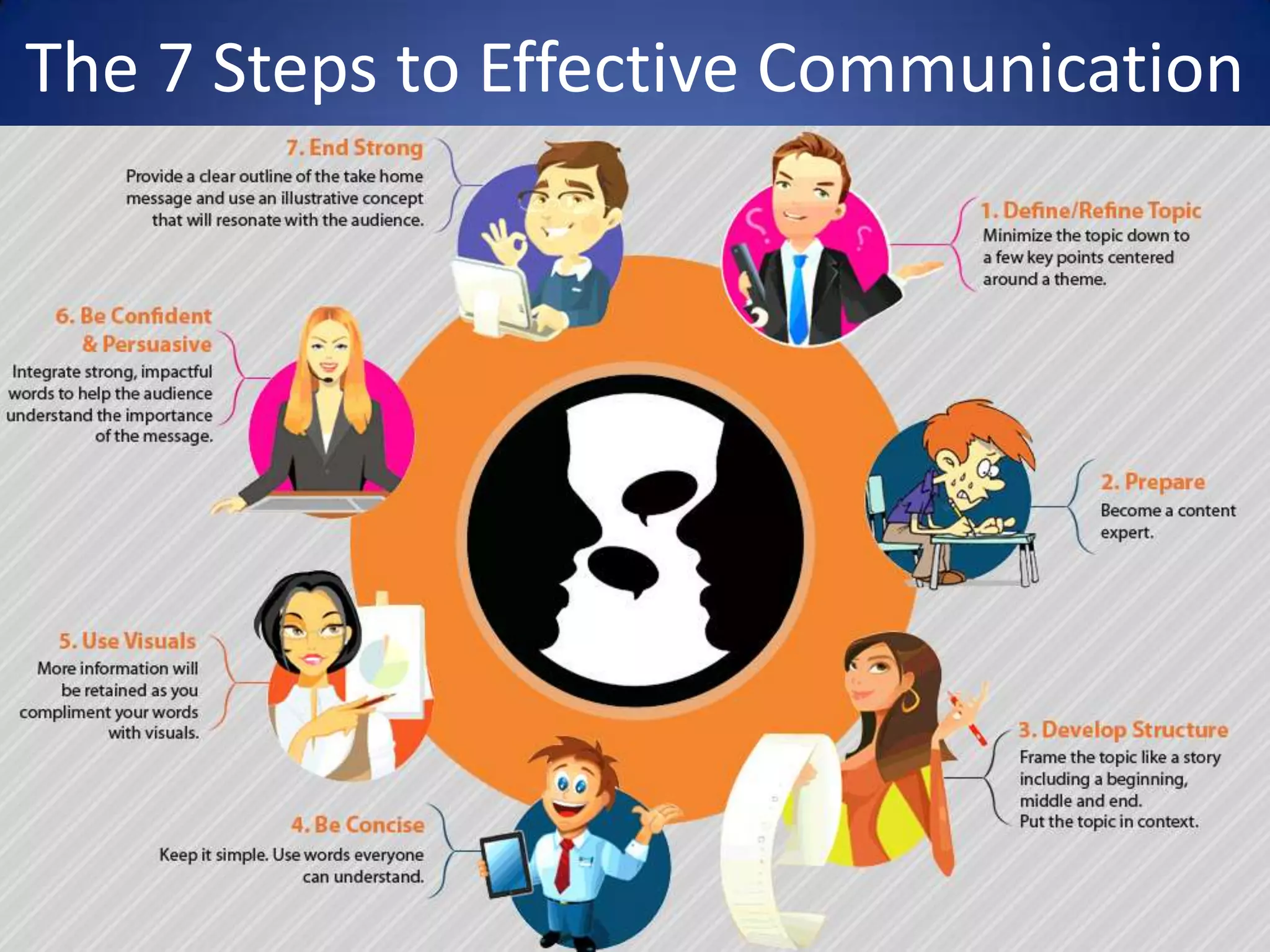
The 7 Steps to Effective Communication
Step 1: Define/Refine The Topic
• Resist making your topic too broad.
– Focus your content on the minimum information
required for your audience to understand the
topic.
• Constantly work to refine your information
down to the minimum needed. Repeat this
step over and over.
Step 2: Prepare
• Become an “expert” in your topic area.
• Preparation will allow you to:
– Better hone the content that you need to deliver
to your audience.
– Be more comfortable/relaxed during your
presentation.
• As the “expert” in the room, you should not be
intimidated by your audience.
Step 3: Develop Structure
• Think of your topic like it’s a story.
– Good stories have a beginning
(introduction), middle (primary “new”
content), and end (conclusion).
• Good storytellers always capture the attention
of their audience.
– Your audience will retain more information if you
convey a great, engaging story.
Step 4: Be Concise
• Use simple, standard language.
• Avoid:
– Overusing topic-specific language
– Jargon
– Repeated content
Step 5: Use Visuals
• Information retention increase as much as
6-fold when visuals are combined with words.
• Focus your visuals on the key points related to
your “take-home message.”
Step 6: Be Confident and Persuasive
• You must believe you are the expect and you
must display such confidence.
• You must incorporate persuasive language to
convince your audience of the importance of
the topic and the take-home message.
• Your confidence and persuasiveness are
directly proportional to the reaction of and
information retained by your audience.
Step 7: End Strong
• You should clearly articulate the take-home
message.
– Do not make your audience guess as to the point
of your presentation.
• Incorporate a strong, meaningful, and perhaps
dramatic concept to illustrate the take-home
message.
– This will help your audience better retain the
message.

The 7 Steps to Effective Communication

  • 1.
    The 7 Stepsto Effective Communication Developed by Nathan L. Vanderford, PhD, MBA. University of Kentucky 2013
  • 2.
    The 7 Stepsto Effective Communication
  • 3.
    Step 1: Define/RefineThe Topic • Resist making your topic too broad. – Focus your content on the minimum information required for your audience to understand the topic. • Constantly work to refine your information down to the minimum needed. Repeat this step over and over.
  • 4.
    Step 2: Prepare •Become an “expert” in your topic area. • Preparation will allow you to: – Better hone the content that you need to deliver to your audience. – Be more comfortable/relaxed during your presentation. • As the “expert” in the room, you should not be intimidated by your audience.
  • 5.
    Step 3: DevelopStructure • Think of your topic like it’s a story. – Good stories have a beginning (introduction), middle (primary “new” content), and end (conclusion). • Good storytellers always capture the attention of their audience. – Your audience will retain more information if you convey a great, engaging story.
  • 6.
    Step 4: BeConcise • Use simple, standard language. • Avoid: – Overusing topic-specific language – Jargon – Repeated content
  • 7.
    Step 5: UseVisuals • Information retention increase as much as 6-fold when visuals are combined with words. • Focus your visuals on the key points related to your “take-home message.”
  • 8.
    Step 6: BeConfident and Persuasive • You must believe you are the expect and you must display such confidence. • You must incorporate persuasive language to convince your audience of the importance of the topic and the take-home message. • Your confidence and persuasiveness are directly proportional to the reaction of and information retained by your audience.
  • 9.
    Step 7: EndStrong • You should clearly articulate the take-home message. – Do not make your audience guess as to the point of your presentation. • Incorporate a strong, meaningful, and perhaps dramatic concept to illustrate the take-home message. – This will help your audience better retain the message.