Storm
Distributed and fault-tolerant realtime computation


                                          Nathan Marz
                                            Twitter
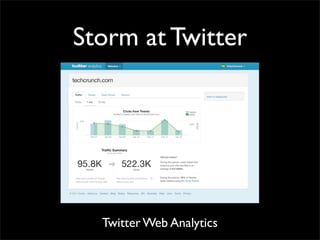
Storm at Twitter


  Twitter Web Analytics
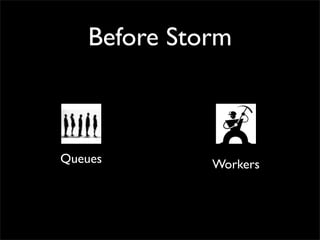
Before Storm


Queues        Workers
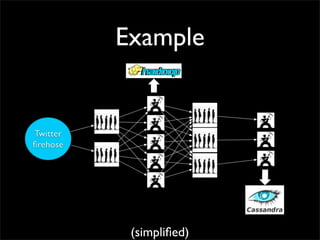
Example


 (simplified)
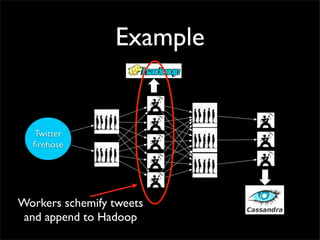
Example


Workers schemify tweets
 and append to Hadoop
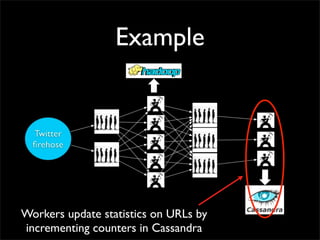
Example


Workers update statistics on URLs by
incrementing counters in Cassandra
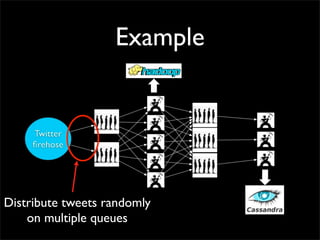
Example


Distribute tweets randomly
    on multiple queues
Example


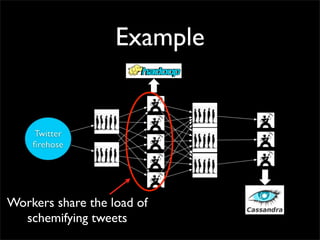
Workers share the load of
  schemifying tweets
Example


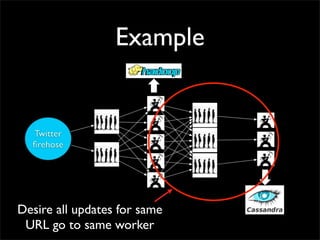
Desire all updates for same
 URL go to same worker
Message locality

• Because:
 • No transactions in Cassandra (and no
    atomic increments at the time)
 • More effective batching of updates
Implementing message
        locality


• Have a queue for each consuming worker
• Choose queue for a URL using consistent hashing
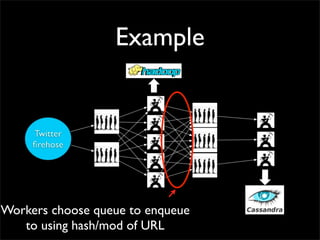
Example


Workers choose queue to enqueue
   to using hash/mod of URL
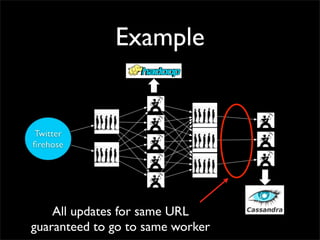
Example


    All updates for same URL
guaranteed to go to same worker
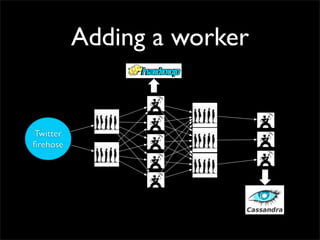
Adding a worker
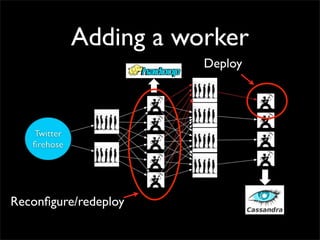
Adding a worker
                      Deploy


Reconfigure/redeploy
Problems

• Scaling is painful
• Poor fault-tolerance
• Coding is tedious
What we want
• Guaranteed data processing
• Horizontal scalability
• Fault-tolerance
• No intermediate message brokers!
• Higher level abstraction than message passing
• “Just works”
Storm
Guaranteed data processing
Horizontal scalability
Fault-tolerance
No intermediate message brokers!
Higher level abstraction than message passing
“Just works”
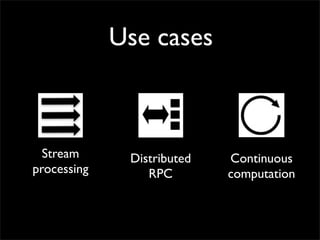
Use cases


  Stream      Distributed   Continuous
processing       RPC        computation
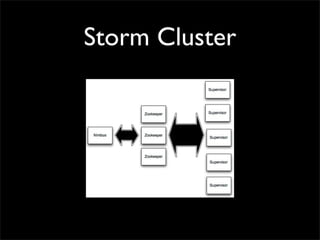
Storm Cluster
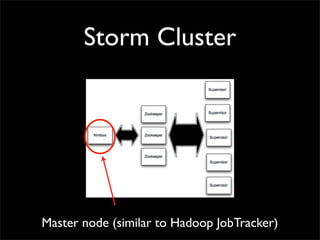
Storm Cluster


Master node (similar to Hadoop JobTracker)
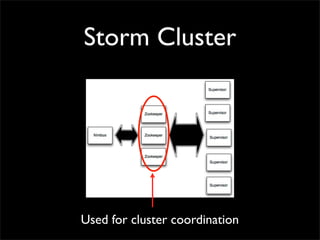
Storm Cluster


Used for cluster coordination
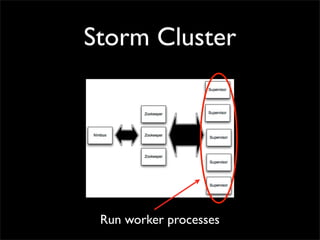
Storm Cluster


 Run worker processes
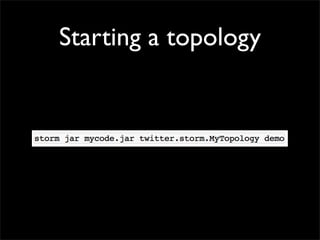
Starting a topology
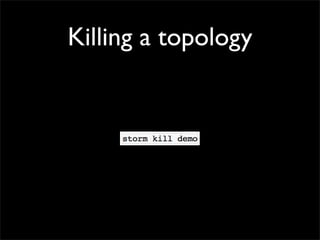
Killing a topology
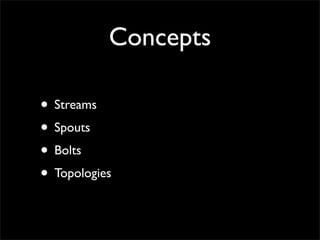
Concepts

• Streams
• Spouts
• Bolts
• Topologies
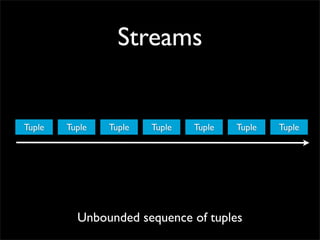
Streams


Tuple   Tuple   Tuple   Tuple   Tuple   Tuple   Tuple


          Unbounded sequence of tuples
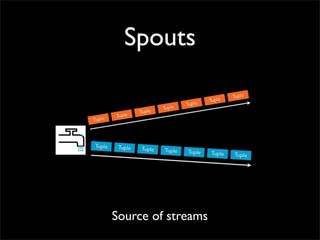
Spouts


Source of streams
Spout examples


• Read from Kestrel queue
• Read from Twitter streaming API
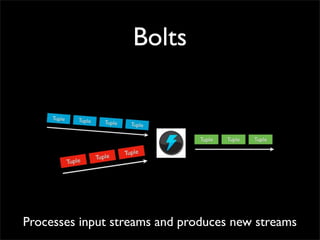
Bolts


Processes input streams and produces new streams
Bolts
• Functions
• Filters
• Aggregation
• Joins
• Talk to databases
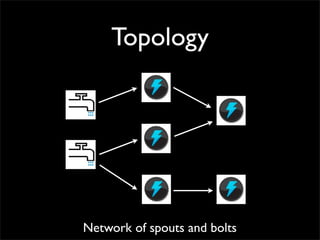
Topology


Network of spouts and bolts
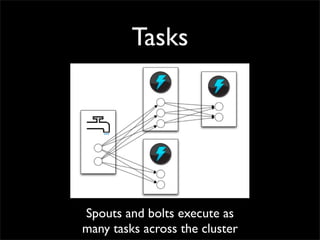
Tasks


Spouts and bolts execute as
many tasks across the cluster
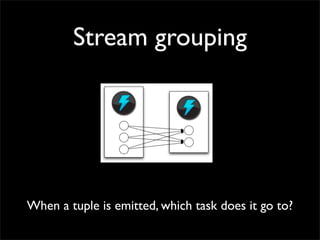
Stream grouping


When a tuple is emitted, which task does it go to?
Stream grouping

• Shuffle grouping: pick a random task
• Fields grouping: consistent hashing on a
  subset of tuple fields
• All grouping: send to all tasks
• Global grouping: pick task with lowest id
Topology
shuffle      [“id1”, “id2”]


           shuffle
[“url”]


  shuffle

              all
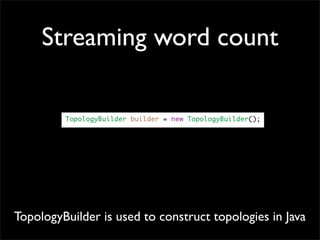
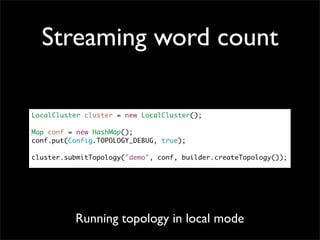
Streaming word count


TopologyBuilder is used to construct topologies in Java
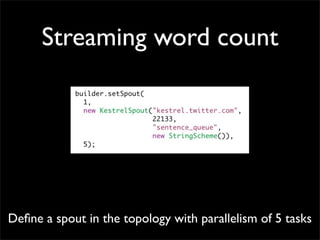
Streaming word count


Define a spout in the topology with parallelism of 5 tasks
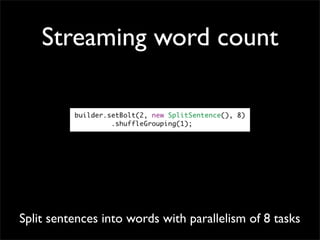
Streaming word count


Split sentences into words with parallelism of 8 tasks
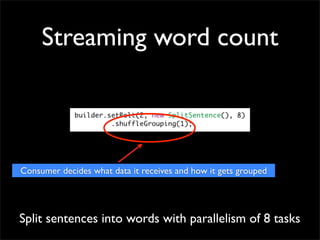
Streaming word count


Consumer decides what data it receives and how it gets grouped


Split sentences into words with parallelism of 8 tasks
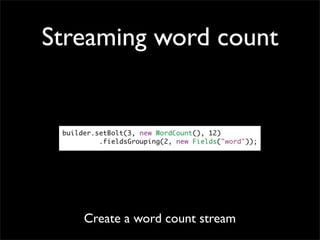
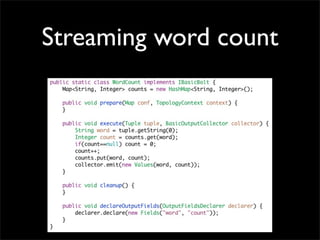
Streaming word count


   Create a word count stream
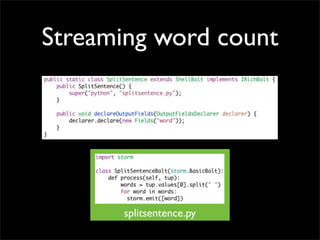
Streaming word count


      splitsentence.py
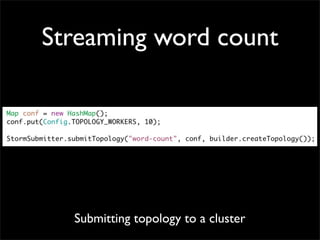
Streaming word count


  Submitting topology to a cluster
Streaming word count


  Running topology in local mode
Demo
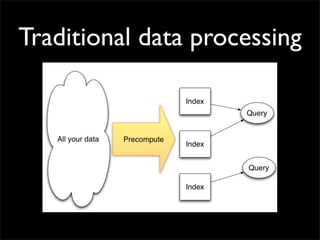
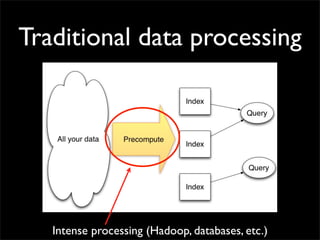
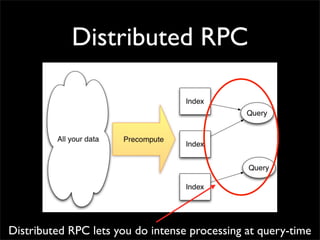
Traditional data processing


   Intense processing (Hadoop, databases, etc.)
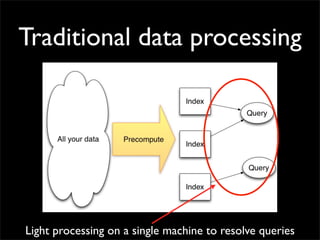
Traditional data processing


Light processing on a single machine to resolve queries
Distributed RPC


Distributed RPC lets you do intense processing at query-time
Game changer
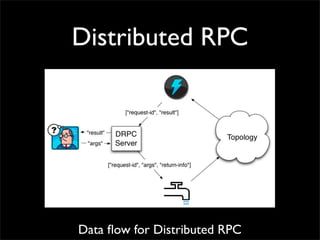
Distributed RPC


Data flow for Distributed RPC
DRPC Example


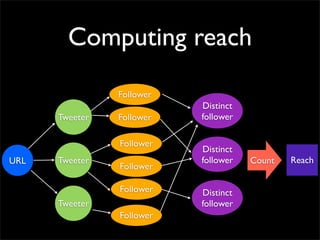
Computing “reach” of a URL on the fly
Reach


Reach is the number of unique people
    exposed to a URL on Twitter
Computing reach
                Follower
                           Distinct
      Tweeter   Follower   follower

                Follower
                           Distinct
URL   Tweeter              follower   Count   Reach
                Follower

                Follower   Distinct
      Tweeter              follower
                Follower
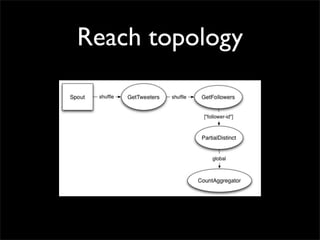
Reach topology
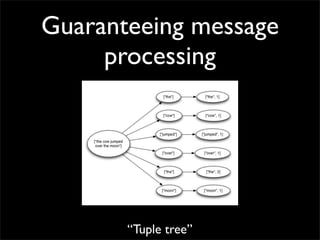
Guaranteeing message
     processing


       “Tuple tree”
Guaranteeing message
     processing

• A spout tuple is not fully processed until all
  tuples in the tree have been completed
Guaranteeing message
     processing

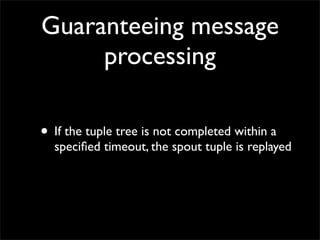
• If the tuple tree is not completed within a
  specified timeout, the spout tuple is replayed
Guaranteeing message
     processing


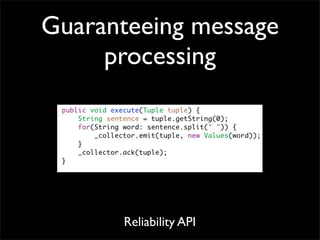
      Reliability API
Guaranteeing message
     processing


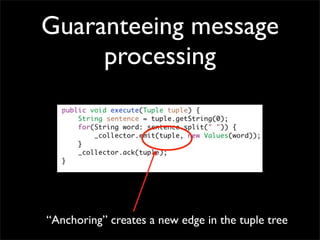
“Anchoring” creates a new edge in the tuple tree
Guaranteeing message
     processing


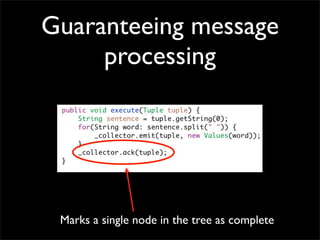
 Marks a single node in the tree as complete
Guaranteeing message
     processing

• Storm tracks tuple trees for you in an
  extremely efficient way
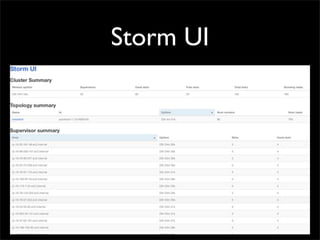
Storm UI
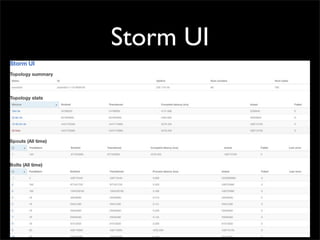
Storm UI
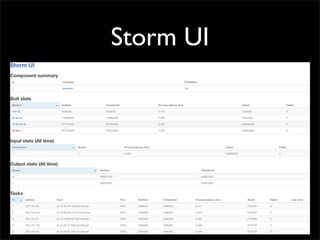
Storm UI
Storm on EC2


https://github.com/nathanmarz/storm-deploy


          One-click deploy tool
Documentation
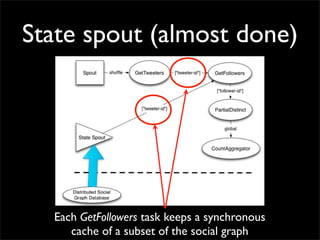
State spout (almost done)


       Synchronize a large amount of
  frequently changing state into a topology
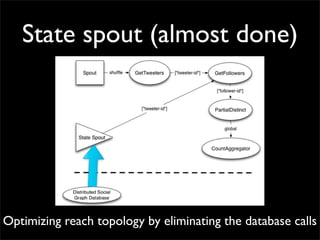
State spout (almost done)


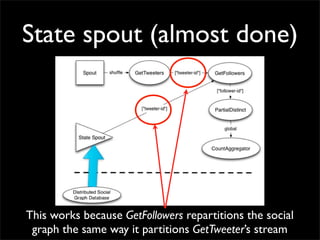
Optimizing reach topology by eliminating the database calls
State spout (almost done)


  Each GetFollowers task keeps a synchronous
     cache of a subset of the social graph
State spout (almost done)


This works because GetFollowers repartitions the social
 graph the same way it partitions GetTweeter’s stream
Future work

• Storm on Mesos
• “Swapping”
• Auto-scaling
• Higher level abstractions
Questions?


http://github.com/nathanmarz/storm
What Storm does
•   Distributes code and configurations

•   Robust process management

•   Monitors topologies and reassigns failed tasks

•   Provides reliability by tracking tuple trees

•   Routing and partitioning of streams

•   Serialization

•   Fine-grained performance stats of topologies

Storm: distributed and fault-tolerant realtime computation