Kristie L. Ebi, Ph.D., MPH
Understanding and managing risks
Evolution of conceptualization of vulnerability
• IPCC AR4
– Vulnerability is the degree to which a system is susceptible to, and
unable to cope with, adverse effects of climate change, including
climate variability and extremes. Vulnerability is a function of the
character, magnitude, and rate of climate change and variation to
which a system is exposed, its sensitivity, and its adaptive capacity
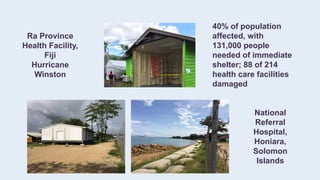
Ra Province
Health Facility,
Fiji
Hurricane
Winston
40% of population
affected, with
131,000 people
needed of immediate
shelter; 88 of 214
health care facilities
damaged
National
Referral
Hospital,
Honiara,
Solomon
Islands
Evolution of conceptualization of vulnerability
• IPCC AR4
– Vulnerability is the degree to which a system is susceptible to, and
unable to cope with, adverse effects of climate change, including
climate variability and extremes. Vulnerability is a function of the
character, magnitude, and rate of climate change and variation to
which a system is exposed, its sensitivity, and its adaptive capacity
• IPCC SREX
– The propensity or predisposition to be adversely affected
IPCC 2012
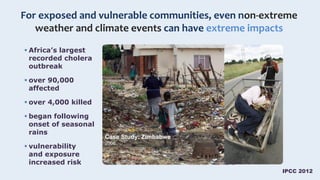
For exposed and vulnerable communities, even non-extreme
weather and climate events can have extreme impacts
Looking for a good example here.
▪ Africa’s largest
recorded cholera
outbreak
▪ over 90,000
affected
▪ over 4,000 killed
▪ began following
onset of seasonal
rains
▪ vulnerability
and exposure
increased risk
Case Study: Zimbabwe
2008
IPCC 2012
Context matters
• Multiple political, social, economic, technological, and
human factors determine whether adaptation strategies,
policies, and measures are effective
– Therefore, differences in culture, education, knowledge, availability and
affordability of technology, and other factors means that a “one size fits all”
approached is likely to fail
• Public health challenges presented by climate change
need to be addressed within the context of issues such as
access to clean water and sanitation, inadequate
nutrition, and diseases such as HIV/AIDS
• Poverty a major factor
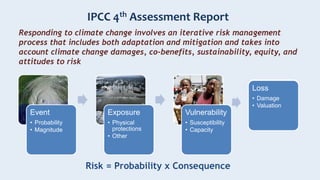
Event
• Probability
• Magnitude
Exposure
• Physical
protections
• Other
Vulnerability
• Susceptibility
• Capacity
Loss
• Damage
• Valuation
IPCC 4th Assessment Report
Risk = Probability x Consequence
Responding to climate change involves an iterative risk management
process that includes both adaptation and mitigation and takes into
account climate change damages, co-benefits, sustainability, equity, and
attitudes to risk
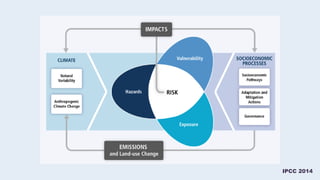
IPCC 2014
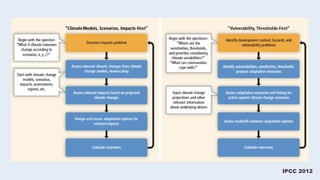
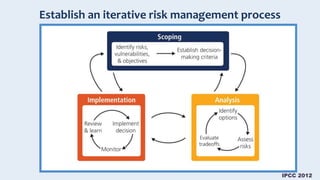
Establish an iterative risk management process
IPCC 2012
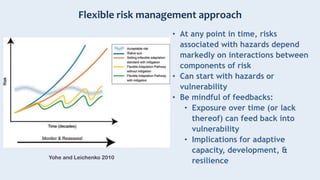
Flexible risk management approach
Yohe and Leichenko 2010
• At any point in time, risks
associated with hazards depend
markedly on interactions between
components of risk
• Can start with hazards or
vulnerability
• Be mindful of feedbacks:
• Exposure over time (or lack
thereof) can feed back into
vulnerability
• Implications for adaptive
capacity, development, &
resilience
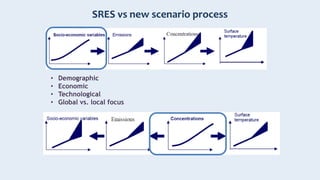
SRES vs new scenario process
• Demographic
• Economic
• Technological
• Global vs. local focus
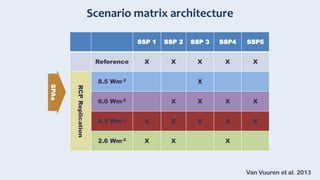
SSP 1 SSP 2 SSP 3 SSP4 SSP5
Reference X X X X X
RCPReplication
8.5 Wm-2 X
6.0 Wm-2 X X X X
4.5 Wm-2 X X X X X
2.6 Wm-2 X X X
SPAs
Scenario matrix architecture
Van Vuuren et al. 2013
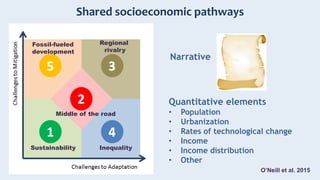
Shared socioeconomic pathways
O’Neill et al. 2015
Fossil-fueled
development
Regional
rivalry
Middle of the road
Sustainability Inequality
Narrative
Quantitative elements
• Population
• Urbanization
• Rates of technological change
• Income
• Income distribution
• Other
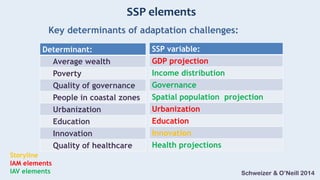
SSP elements
Key determinants of adaptation challenges:
Determinant:
Average wealth
Poverty
Quality of governance
People in coastal zones
Urbanization
Education
Innovation
Quality of healthcare
Storyline
IAM elements
IAV elements
SSP variable:
GDP projection
Income distribution
Governance
Spatial population projection
Urbanization
Education
Innovation
Health projections
Schweizer & O’Neill 2014
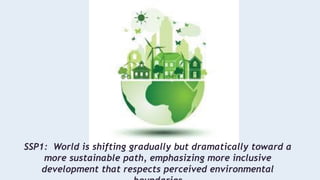
SSP1: World is shifting gradually but dramatically toward a
more sustainable path, emphasizing more inclusive
development that respects perceived environmental
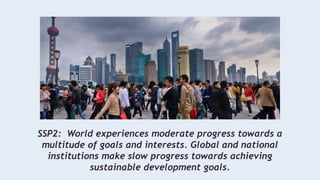
SSP2: World experiences moderate progress towards a
multitude of goals and interests. Global and national
institutions make slow progress towards achieving
sustainable development goals.
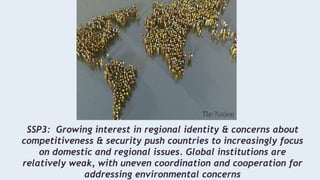
SSP3: Growing interest in regional identity & concerns about
competitiveness & security push countries to increasingly focus
on domestic and regional issues. Global institutions are
relatively weak, with uneven coordination and cooperation for
addressing environmental concerns
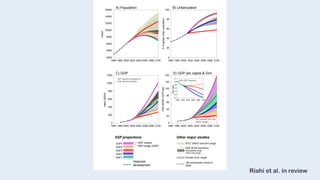
1960 1980 2000 2020 2040 2060 2080 2100
trillion$2005
0
200
400
600
800
1000
1200
1960 1980 2000 2020 2040 2060 2080 2100
million
2000
4000
6000
8000
10000
12000
14000
16000
A) Population
1960 1980 2000 2020 2040 2060 2080 2100
%ofglobalurbanpopulation
0
20
40
60
80
100
B) Urbanization
C) GDP D) GDP per capita & Gini
SSP projections
SSP5
SSP4
SSP3
SSP2
SSP1
SSP marker
SSP range (GDP)
Other major studies
Historical
development
UN urbanization trend to
2050
IPCC SRES scenario range
AR5 WGIII scenarios
Interquartile range
100% (full) range
Grubler et al. range
1960 1980 2000 2020 2040 2060 2080 2100
0
20
40
60
80
100
120
140
1000$2005(GDP/cap)
0.7
2000 2020 2040 2060 2080 2100
0.1
0.2
0.3
0.4
0.5
0.6
GINI (SSP markers)
SSP markers compared to
other literature studies
SSP markers and non-
marker ranges
Giniindex Riahi et al. in review
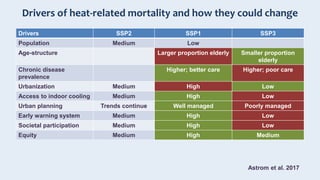
Drivers of heat-related mortality and how they could change
Drivers SSP2 SSP1 SSP3
Population Medium Low
Age-structure Larger proportion elderly Smaller proportion
elderly
Chronic disease
prevalence
Higher; better care Higher; poor care
Urbanization Medium High Low
Access to indoor cooling Medium High Low
Urban planning Trends continue Well managed Poorly managed
Early warning system Medium High Low
Societal participation Medium High Low
Equity Medium High Medium
Astrom et al. 2017
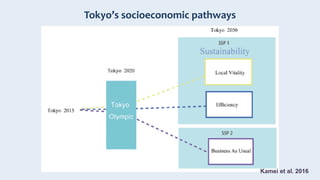
Tokyo’s socioeconomic pathways
Kamei et al. 2016
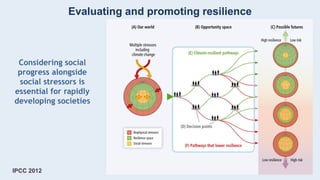
Evaluating and promoting resilience
Considering social
progress alongside
social stressors is
essential for rapidly
developing societies
IPCC 2012
https://depts.washington.edu/iconics/
IPCC Risk Framework_Ebi

IPCC Risk Framework_Ebi

  • 1.
    Kristie L. Ebi,Ph.D., MPH Understanding and managing risks
  • 2.
    Evolution of conceptualizationof vulnerability • IPCC AR4 – Vulnerability is the degree to which a system is susceptible to, and unable to cope with, adverse effects of climate change, including climate variability and extremes. Vulnerability is a function of the character, magnitude, and rate of climate change and variation to which a system is exposed, its sensitivity, and its adaptive capacity
  • 3.
    Ra Province Health Facility, Fiji Hurricane Winston 40%of population affected, with 131,000 people needed of immediate shelter; 88 of 214 health care facilities damaged National Referral Hospital, Honiara, Solomon Islands
  • 4.
    Evolution of conceptualizationof vulnerability • IPCC AR4 – Vulnerability is the degree to which a system is susceptible to, and unable to cope with, adverse effects of climate change, including climate variability and extremes. Vulnerability is a function of the character, magnitude, and rate of climate change and variation to which a system is exposed, its sensitivity, and its adaptive capacity • IPCC SREX – The propensity or predisposition to be adversely affected
  • 5.
  • 6.
    For exposed andvulnerable communities, even non-extreme weather and climate events can have extreme impacts Looking for a good example here. ▪ Africa’s largest recorded cholera outbreak ▪ over 90,000 affected ▪ over 4,000 killed ▪ began following onset of seasonal rains ▪ vulnerability and exposure increased risk Case Study: Zimbabwe 2008 IPCC 2012
  • 8.
    Context matters • Multiplepolitical, social, economic, technological, and human factors determine whether adaptation strategies, policies, and measures are effective – Therefore, differences in culture, education, knowledge, availability and affordability of technology, and other factors means that a “one size fits all” approached is likely to fail • Public health challenges presented by climate change need to be addressed within the context of issues such as access to clean water and sanitation, inadequate nutrition, and diseases such as HIV/AIDS • Poverty a major factor
  • 9.
    Event • Probability • Magnitude Exposure •Physical protections • Other Vulnerability • Susceptibility • Capacity Loss • Damage • Valuation IPCC 4th Assessment Report Risk = Probability x Consequence Responding to climate change involves an iterative risk management process that includes both adaptation and mitigation and takes into account climate change damages, co-benefits, sustainability, equity, and attitudes to risk
  • 10.
  • 11.
    Establish an iterativerisk management process IPCC 2012
  • 13.
    Flexible risk managementapproach Yohe and Leichenko 2010 • At any point in time, risks associated with hazards depend markedly on interactions between components of risk • Can start with hazards or vulnerability • Be mindful of feedbacks: • Exposure over time (or lack thereof) can feed back into vulnerability • Implications for adaptive capacity, development, & resilience
  • 15.
    SRES vs newscenario process • Demographic • Economic • Technological • Global vs. local focus
  • 16.
    SSP 1 SSP2 SSP 3 SSP4 SSP5 Reference X X X X X RCPReplication 8.5 Wm-2 X 6.0 Wm-2 X X X X 4.5 Wm-2 X X X X X 2.6 Wm-2 X X X SPAs Scenario matrix architecture Van Vuuren et al. 2013
  • 17.
    Shared socioeconomic pathways O’Neillet al. 2015 Fossil-fueled development Regional rivalry Middle of the road Sustainability Inequality Narrative Quantitative elements • Population • Urbanization • Rates of technological change • Income • Income distribution • Other
  • 18.
    SSP elements Key determinantsof adaptation challenges: Determinant: Average wealth Poverty Quality of governance People in coastal zones Urbanization Education Innovation Quality of healthcare Storyline IAM elements IAV elements SSP variable: GDP projection Income distribution Governance Spatial population projection Urbanization Education Innovation Health projections Schweizer & O’Neill 2014
  • 19.
    SSP1: World isshifting gradually but dramatically toward a more sustainable path, emphasizing more inclusive development that respects perceived environmental
  • 20.
    SSP2: World experiencesmoderate progress towards a multitude of goals and interests. Global and national institutions make slow progress towards achieving sustainable development goals.
  • 21.
    SSP3: Growing interestin regional identity & concerns about competitiveness & security push countries to increasingly focus on domestic and regional issues. Global institutions are relatively weak, with uneven coordination and cooperation for addressing environmental concerns
  • 22.
    1960 1980 20002020 2040 2060 2080 2100 trillion$2005 0 200 400 600 800 1000 1200 1960 1980 2000 2020 2040 2060 2080 2100 million 2000 4000 6000 8000 10000 12000 14000 16000 A) Population 1960 1980 2000 2020 2040 2060 2080 2100 %ofglobalurbanpopulation 0 20 40 60 80 100 B) Urbanization C) GDP D) GDP per capita & Gini SSP projections SSP5 SSP4 SSP3 SSP2 SSP1 SSP marker SSP range (GDP) Other major studies Historical development UN urbanization trend to 2050 IPCC SRES scenario range AR5 WGIII scenarios Interquartile range 100% (full) range Grubler et al. range 1960 1980 2000 2020 2040 2060 2080 2100 0 20 40 60 80 100 120 140 1000$2005(GDP/cap) 0.7 2000 2020 2040 2060 2080 2100 0.1 0.2 0.3 0.4 0.5 0.6 GINI (SSP markers) SSP markers compared to other literature studies SSP markers and non- marker ranges Giniindex Riahi et al. in review
  • 23.
    Drivers of heat-relatedmortality and how they could change Drivers SSP2 SSP1 SSP3 Population Medium Low Age-structure Larger proportion elderly Smaller proportion elderly Chronic disease prevalence Higher; better care Higher; poor care Urbanization Medium High Low Access to indoor cooling Medium High Low Urban planning Trends continue Well managed Poorly managed Early warning system Medium High Low Societal participation Medium High Low Equity Medium High Medium Astrom et al. 2017
  • 24.
  • 25.
    Evaluating and promotingresilience Considering social progress alongside social stressors is essential for rapidly developing societies IPCC 2012
  • 26.