Questionnaire Design
Questionnaire design Questionnaire is a technique for collecting data Open ended questions provide important and detail feedback Close ended questions provide ease in analysis There is no guaranteed technique that will give good questionnaire It is a skill that can be mastered by experience.
Preliminary considerations for designing questionnaire Data needs: Refer Investigative questions Respondent’s profile Method of administering questionnaire: Personal interview Mail questionnaire Telephone interview Internet
Personal interview Advantages: Spontaneous response can be obtained Higher response rate Information at greater depth Flexibility of restructuring the Questionnaire  Interviewer by his skill can come over resistance  Non Response generally low Samples can controlled more effectively Personal information can be obtained  Interviewer can collect supplementary information about respondent’s personal characteristics and environment which has value in interpreting results
Personal interview Disadvantages: Expensive & time consuming Not suitable if respondent wants to be anonymous Respondent may give bias information Some Executive people are not approachable so data collected may be inadequate Takes more time when samples are more Supervisors has to do complex work of selecting ,training and supervising the field staff.
Mail questionnaire Advantages: Efficiency in cost and time if sample is geographically spread Useful if respondent wants to be anonymous (sensitive subjects of research) Disadvantages: Non-response can be high Answers can be incomplete  Not suitable for spontaneous response
Telephone questionnaire Advantages: Efficiency in cost and time if sample is geographically spread Useful if respondent wants to be anonymous Spontaneous response can be obtained Disadvantages: Visual aid can not be used
Preliminary considerations for designing questionnaire Research design used: Open ended questions are suitable for exploratory research  Close ended for conclusive research
Steps in questionnaire design Prepare flowchart to decide flow of questions. Prepare first draft of the questionnaire Test questionnaire for finding any mistakes Finalize questionnaire
Do’s of questionnaire Interviewer should first reveal his identity and purpose of study Assure respondent that responses given by him will be kept confidential Convince him about benefit that will be derived from his co-operation Place neutral or filter questions at the beginning Use conversational language State meaning of technical words Use categories for sensitive data. E.g. age, income
Do’s of questionnaire Include all relevant answers to a close ended question Options given to a question should be mutually exclusive Use balanced scale in attitude measurement Sequence questions from general information to specific information Place demographic questions at the end unless required for screening respondent or for quota sample Ask respondent to give spontaneous response to know his top of mind awareness Give examples to respondents for understanding scale
Do’s of questionnaire Write instructions to interviewer at the beginning of questionnaire Use capital letters for instructions Do not provide lines for answers to open ended questions Use checkboxes [  ] for recording answers Send covering letter for mail questionnaire Thank the respondent at the end of questionnaire Layout should be such that it avoids flipping pages
Do’s of questionnaire Physical appearance of the questionnaire should be pleasant Leave sufficient white space Use booklet form Provide visual aid to respondent, if necessary Each questionnaire should have unique serial number and interviewer’s code no.
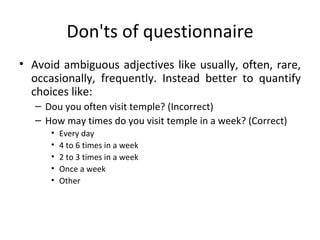
Don'ts of questionnaire Avoid ambiguous adjectives like usually, often, rare, occasionally, frequently. Instead better to quantify choices like: Dou you often visit temple? (Incorrect) How may times do you visit temple in a week? (Correct) Every day 4 to 6 times in a week 2 to 3 times in a week  Once a week Other
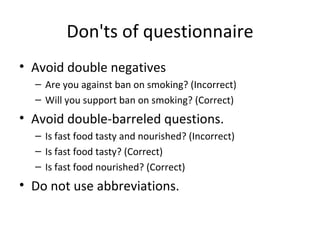
Don'ts of questionnaire Avoid double negatives Are you against ban on smoking? (Incorrect) Will you support ban on smoking? (Correct) Avoid double-barreled questions.  Is fast food tasty and nourished? (Incorrect) Is fast food tasty? (Correct) Is fast food nourished? (Correct) Do not use abbreviations.
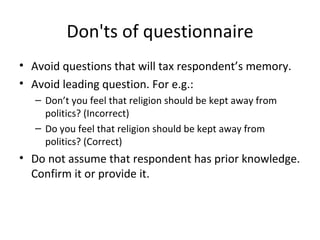
Don'ts of questionnaire Avoid questions that will tax respondent’s memory. Avoid leading question. For e.g.: Don’t you feel that religion should be kept away from politics? (Incorrect) Do you feel that religion should be kept away from politics? (Correct) Do not assume that respondent has prior knowledge. Confirm it or provide it.
Don'ts of questionnaire Do not substitute respondent. For e.g. do not interview husband if wife is not available.
Pre-testing questionnaire Check the questionnaire for any flaw in the questionnaire. Some of the areas are: Required data is obtained fully  Scales used are valid  Meaning of questions are properly understood by everybody Respondent does not get irritated About 75 respondents are found sufficient for testing Perform analysis on the data obtained during pre-testing and show it to the decision maker
Qualities of interviewer Understands respondents Listens well Maintains attitude of genuine interest Accepts rejection Does not let mood affect performance Is sincere, committed and of high integrity
Field Survey Inform respondents in advance, if possible Have proper checks while survey is on Do courtesy call or send thanks giving letters to those who responded to survey Send reminders to those who have not sent responses to mail survey

Data collection methods for descriptive research

  • 1.
  • 2.
    Questionnaire design Questionnaireis a technique for collecting data Open ended questions provide important and detail feedback Close ended questions provide ease in analysis There is no guaranteed technique that will give good questionnaire It is a skill that can be mastered by experience.
  • 3.
    Preliminary considerations fordesigning questionnaire Data needs: Refer Investigative questions Respondent’s profile Method of administering questionnaire: Personal interview Mail questionnaire Telephone interview Internet
  • 4.
    Personal interview Advantages:Spontaneous response can be obtained Higher response rate Information at greater depth Flexibility of restructuring the Questionnaire Interviewer by his skill can come over resistance Non Response generally low Samples can controlled more effectively Personal information can be obtained Interviewer can collect supplementary information about respondent’s personal characteristics and environment which has value in interpreting results
  • 5.
    Personal interview Disadvantages:Expensive & time consuming Not suitable if respondent wants to be anonymous Respondent may give bias information Some Executive people are not approachable so data collected may be inadequate Takes more time when samples are more Supervisors has to do complex work of selecting ,training and supervising the field staff.
  • 6.
    Mail questionnaire Advantages:Efficiency in cost and time if sample is geographically spread Useful if respondent wants to be anonymous (sensitive subjects of research) Disadvantages: Non-response can be high Answers can be incomplete Not suitable for spontaneous response
  • 7.
    Telephone questionnaire Advantages:Efficiency in cost and time if sample is geographically spread Useful if respondent wants to be anonymous Spontaneous response can be obtained Disadvantages: Visual aid can not be used
  • 8.
    Preliminary considerations fordesigning questionnaire Research design used: Open ended questions are suitable for exploratory research Close ended for conclusive research
  • 9.
    Steps in questionnairedesign Prepare flowchart to decide flow of questions. Prepare first draft of the questionnaire Test questionnaire for finding any mistakes Finalize questionnaire
  • 10.
    Do’s of questionnaireInterviewer should first reveal his identity and purpose of study Assure respondent that responses given by him will be kept confidential Convince him about benefit that will be derived from his co-operation Place neutral or filter questions at the beginning Use conversational language State meaning of technical words Use categories for sensitive data. E.g. age, income
  • 11.
    Do’s of questionnaireInclude all relevant answers to a close ended question Options given to a question should be mutually exclusive Use balanced scale in attitude measurement Sequence questions from general information to specific information Place demographic questions at the end unless required for screening respondent or for quota sample Ask respondent to give spontaneous response to know his top of mind awareness Give examples to respondents for understanding scale
  • 12.
    Do’s of questionnaireWrite instructions to interviewer at the beginning of questionnaire Use capital letters for instructions Do not provide lines for answers to open ended questions Use checkboxes [ ] for recording answers Send covering letter for mail questionnaire Thank the respondent at the end of questionnaire Layout should be such that it avoids flipping pages
  • 13.
    Do’s of questionnairePhysical appearance of the questionnaire should be pleasant Leave sufficient white space Use booklet form Provide visual aid to respondent, if necessary Each questionnaire should have unique serial number and interviewer’s code no.
  • 14.
    Don'ts of questionnaireAvoid ambiguous adjectives like usually, often, rare, occasionally, frequently. Instead better to quantify choices like: Dou you often visit temple? (Incorrect) How may times do you visit temple in a week? (Correct) Every day 4 to 6 times in a week 2 to 3 times in a week Once a week Other
  • 15.
    Don'ts of questionnaireAvoid double negatives Are you against ban on smoking? (Incorrect) Will you support ban on smoking? (Correct) Avoid double-barreled questions. Is fast food tasty and nourished? (Incorrect) Is fast food tasty? (Correct) Is fast food nourished? (Correct) Do not use abbreviations.
  • 16.
    Don'ts of questionnaireAvoid questions that will tax respondent’s memory. Avoid leading question. For e.g.: Don’t you feel that religion should be kept away from politics? (Incorrect) Do you feel that religion should be kept away from politics? (Correct) Do not assume that respondent has prior knowledge. Confirm it or provide it.
  • 17.
    Don'ts of questionnaireDo not substitute respondent. For e.g. do not interview husband if wife is not available.
  • 18.
    Pre-testing questionnaire Checkthe questionnaire for any flaw in the questionnaire. Some of the areas are: Required data is obtained fully Scales used are valid Meaning of questions are properly understood by everybody Respondent does not get irritated About 75 respondents are found sufficient for testing Perform analysis on the data obtained during pre-testing and show it to the decision maker
  • 19.
    Qualities of interviewerUnderstands respondents Listens well Maintains attitude of genuine interest Accepts rejection Does not let mood affect performance Is sincere, committed and of high integrity
  • 20.
    Field Survey Informrespondents in advance, if possible Have proper checks while survey is on Do courtesy call or send thanks giving letters to those who responded to survey Send reminders to those who have not sent responses to mail survey