© 2022 Juniper Networks 1
Chief Architect Juniper Networks
Exploring Quantum Technology
for Networking
Melchior Aelmans
© 2022 Juniper Networks 2
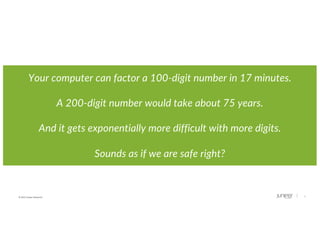
Your computer can factor a 100-digit number in 17 minutes.
A 200-digit number would take about 75 years.
And it gets exponentially more difficult with more digits.
Sounds as if we are safe right?
© 2022 Juniper Networks 3
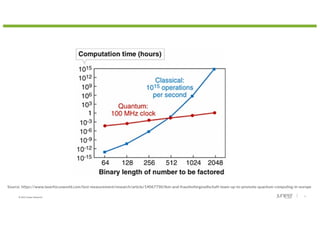
Source: https://www.laserfocusworld.com/test-measurement/research/article/14067750/ibm-and-fraunhofergesellschaft-team-up-to-promote-quantum-computing-in-europe
© 2022 Juniper Networks 4
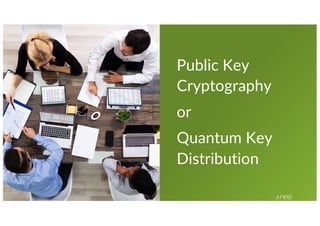
Public Key
Cryptography
or
Quantum Key
Distribution
© 2022 Juniper Networks 5
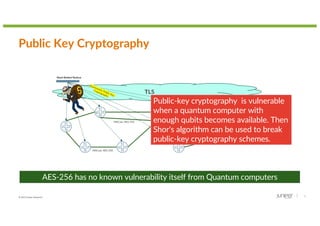
Public Key Cryptography
Steel-Belted Radius
TLS
Asymmetric Public Key
Cryptography
MACsec AES-256
AES-256 has no known vulnerability itself from Quantum computers
MACsec AES-256
Public-key cryptography is vulnerable
when a quantum computer with
enough qubits becomes available. Then
Shor's algorithm can be used to break
public-key cryptography schemes.
© 2022 Juniper Networks 6
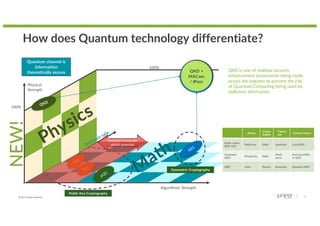
How does Quantum technology differentiate?
6
Algorithmic Strength
RSA
DH
AES
pQC
sharing
Crypto
Engine
Typical
use
Entropy Source
Public crypto
(RSA, DH)
Public key Math bootstrap Local RNG
Symmetric
(AES)
Private key Math
Work
horse
from local RNG
or QKD
QKD none Physics bootstrap Quantum-RNG
Public Key Cryptography
Symmetric Cryptography
QKD is one of multiple security
enhancement investments being made
across the industry to prevent the risk
of Quantum Computing being used by
malicious adversaries
Quantum Computer
attack potential
Physical
Strength
100%
QKD
100%
Quantum channel is
information
theoretically secure
NEW!
QKD +
MACsec
/ IPsec
M
ath
Physics
Quantum
safe
© 2022 Juniper Networks 7
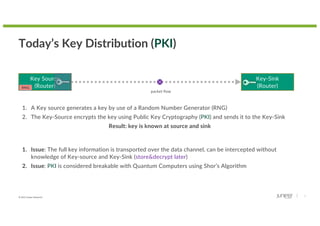
Today’s Key Distribution (PKI)
Key Source
(Router)
Key-Sink
(Router)
1. A Key source generates a key by use of a Random Number Generator (RNG)
2. The Key-Source encrypts the key using Public Key Cryptography (PKI) and sends it to the Key-Sink
Result: key is known at source and sink
RNG
1. Issue: The full key information is transported over the data channel, can be intercepted without
knowledge of Key-source and Key-Sink (store&decrypt later)
2. Issue: PKI is considered breakable with Quantum Computers using Shor’s Algorithm
packet flow
© 2022 Juniper Networks 8
Post Quantum Cryptography (pQC) Key Distribution
1. Issue: [same as today] The full key information is transported over the data channel, can be intercepted without
knowledge of Key-source and Key-Sink (store & much harder to decrypt later)
2. Issue: pQC-PKI is considered resistant against attacks with Quantum Computers using Shor’s algorithm. But there
is no proof that another Algorithm exists that could break the encryption
Key Source
(Router)
Key-Sink
(Router)
packet flow
RNG
1. A Key source generates a key by use of a Random Number Generator (RNG)
2. The Key-Source encrypts the key using pQC-based Public Key Cryptography (PKI) and sends it to the
Key-Sink
Result: key is known at source and sink
© 2022 Juniper Networks 9
Quantum Key Distribution (QKD)
QKD-A QKD-B
Quantum Channel
Dark fiber or Satellite
1. Quantum Key Distribution enables two distant devices connected with a Quantum Channel to “distill”
the same information on both devices
Result: key is known at source and sink
1. Advantage: cannot be broken even if the adversary has unlimited computing power. The distribution
mechanism is proven to be information theoretic secure [Wikipedia]
• Quantum state cannot be intercepted without changing it’s state and is detectable
• Quantum state decays fast. It cannot be stored for a long time to decrypt it later
Router Router
© 2022 Juniper Networks 10
Quick Intro: Quantum Communication by dummies
• Quantum state of individual photons is any
fraction between 0 and 1
• Photons can be split into two photons jointly
maintaining the properties of the original
photon. P0 = 1 à (p1 + p2) = 1
• The state of photons is unknown until
measured: p1 =?, p2 =?
• Measurement of one photon ‘collapses’ the
state of both: Measuring p1 = 0.3 causes p2 =
0.7 [Remember: (p1 + p2) = 1 ]
• If we measure the state of a photon and know
that it was entangled, the state of the other
photon is known.
© 2022 Juniper Networks 11
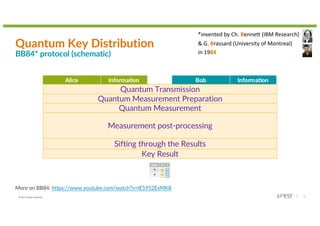
Quantum Key Distribution
BB84* protocol (schematic)
11
*invented by Ch. Bennett (IBM Research)
& G. Brassard (University of Montreal)
in 1984
Quantum Transmission
Quantum Measurement Preparation
Quantum Measurement
Measurement post-processing
Sifting through the Results
Key Result
More on BB84: https://www.youtube.com/watch?v=IE5952ExMK8
© 2022 Juniper Networks 12
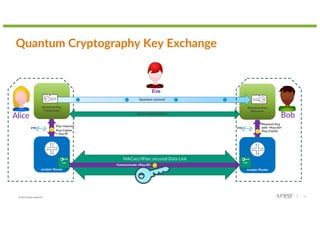
Quantum Cryptography Key Exchange
Quantum Key
Receiver
Quantum Key
Transmitter
Key request
1
2 Key-Cipher
+ key-ID
Request Key
with <Key-ID>
4
5 Key-Cipher
Juniper Router
crypt
Juniper Router
crypt
Data communication
MACsec/IPsec secured Data Link
Quantum channel
3
Communicate <Key-ID>
Eve
Alice Bob
© 2022 Juniper Networks 13
Random Number
Generators
© 2022 Juniper Networks 14
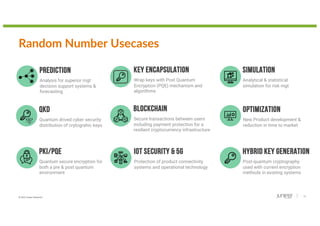
Random Number Usecases
BLOCKCHAIN
Secure transactions between users
including payment protection for a
resilient cryptocurrency infrastructure
IOT SECURITY & 5G
Protection of product connectivity
systems and operational technology
PKI/PQE
Quantum secure encryption for
both a pre & post quantum
environment
OPTIMIZATION
New Product development &
reduction in time to market
HYBRID KEY GENERATION
Post-quantum cryptography
used with current encryption
methods in existing systems
SIMULATION
Analytical & statistical
simulation for risk mgt
PREDICTION
Analysis for superior mgt
decision support systems &
forecasting
QKD
Quantum drived cyber security
distribution of crytograhic keys
KEY ENCAPSULATION
Wrap keys with Post Quantum
Encryption (PQE) mechanism and
algorithms
© 2022 Juniper Networks 15
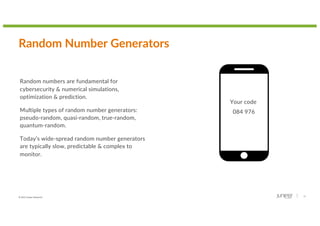
Random Number Generators
Random numbers are fundamental for
cybersecurity & numerical simulations,
optimization & prediction.
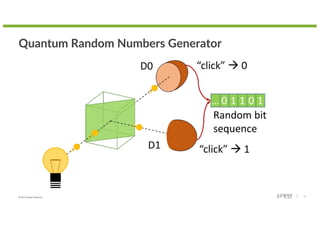
Multiple types of random number generators:
pseudo-random, quasi-random, true-random,
quantum-random.
Today’s wide-spread random number generators
are typically slow, predictable & complex to
monitor.
Your code
084 976
© 2022 Juniper Networks 16
Quantum Random Numbers Generator
© 2022 Juniper Networks 17
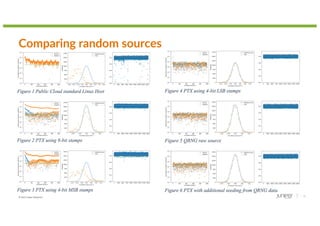
Comparing random sources
© 2022 Juniper Networks 18
Summary: Potential fields of interest to networking
Currently there are three quantum technology of interest for a Quantum Safe Strategy:
1. Quantum Random Number Generators (QRNG)
QRNG has become a key enabling technology for quantum-level security in mobile devices, data centers and
even medical implants, to name just a few current-day applications.
2. Quantum Key Distribution (QKD)
QKD is only used to produce and distribute a key, not to transmit any message data. This key is used by any
chosen encryption algorithm to encrypt (and decrypt) a message, which can then be transmitted over a
standard communication channel.
3. Post Quantum Cryptography (PQC)
Post-quantum cryptography refers to mathematical cryptographic algorithms (usually public-key algorithms)
that are thought to be more secure against a cryptanalytic attack by a quantum computer than current-day
public-key algorithms.
© 2022 Juniper Networks 19
But what about a
Quantum Internet?
© 2022 Juniper Networks 20
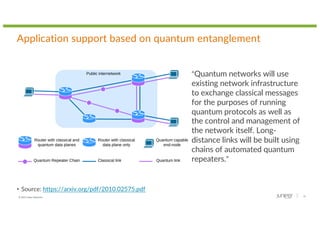
how will the quantum internet look like?
Application support based on quantum entanglement
• Source: https://arxiv.org/pdf/2010.02575.pdf
“Quantum networks will use
existing network infrastructure
to exchange classical messages
for the purposes of running
quantum protocols as well as
the control and management of
the network itself. Long-
distance links will be built using
chains of automated quantum
repeaters.”
© 2022 Juniper Networks 21
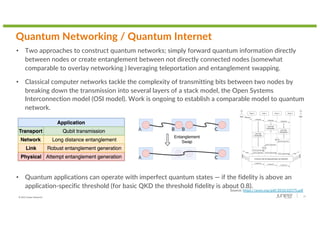
Quantum Networking / Quantum Internet
• Two approaches to construct quantum networks; simply forward quantum information directly
between nodes or create entanglement between not directly connected nodes (somewhat
comparable to overlay networking ) leveraging teleportation and entanglement swapping.
• Classical computer networks tackle the complexity of transmitting bits between two nodes by
breaking down the transmission into several layers of a stack model, the Open Systems
Interconnection model (OSI model). Work is ongoing to establish a comparable model to quantum
network.
• Quantum applications can operate with imperfect quantum states — if the fidelity is above an
application-specific threshold (for basic QKD the threshold fidelity is about 0.8).
A
A
B C
C
B
Source: https://arxiv.org/pdf/2010.02575.pdf
© 2022 Juniper Networks 22
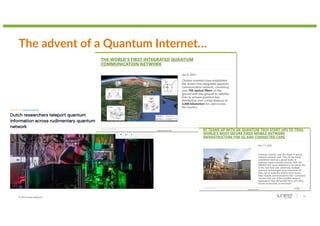
The advent of a Quantum Internet…
22
© 2022 Juniper Networks 23
© 2022 Juniper Networks 24
Questions? Reach out!
Melchior Aelmans
melchior@juniper.net
© 2022 Juniper Networks 25
Thank you

Exploring Quantum Engineering for Networking by Melchior Aelmans, Juniper Networks

  • 1.
    © 2022 JuniperNetworks 1 Chief Architect Juniper Networks Exploring Quantum Technology for Networking Melchior Aelmans
  • 2.
    © 2022 JuniperNetworks 2 Your computer can factor a 100-digit number in 17 minutes. A 200-digit number would take about 75 years. And it gets exponentially more difficult with more digits. Sounds as if we are safe right?
  • 3.
    © 2022 JuniperNetworks 3 Source: https://www.laserfocusworld.com/test-measurement/research/article/14067750/ibm-and-fraunhofergesellschaft-team-up-to-promote-quantum-computing-in-europe
  • 4.
    © 2022 JuniperNetworks 4 Public Key Cryptography or Quantum Key Distribution
  • 5.
    © 2022 JuniperNetworks 5 Public Key Cryptography Steel-Belted Radius TLS Asymmetric Public Key Cryptography MACsec AES-256 AES-256 has no known vulnerability itself from Quantum computers MACsec AES-256 Public-key cryptography is vulnerable when a quantum computer with enough qubits becomes available. Then Shor's algorithm can be used to break public-key cryptography schemes.
  • 6.
    © 2022 JuniperNetworks 6 How does Quantum technology differentiate? 6 Algorithmic Strength RSA DH AES pQC sharing Crypto Engine Typical use Entropy Source Public crypto (RSA, DH) Public key Math bootstrap Local RNG Symmetric (AES) Private key Math Work horse from local RNG or QKD QKD none Physics bootstrap Quantum-RNG Public Key Cryptography Symmetric Cryptography QKD is one of multiple security enhancement investments being made across the industry to prevent the risk of Quantum Computing being used by malicious adversaries Quantum Computer attack potential Physical Strength 100% QKD 100% Quantum channel is information theoretically secure NEW! QKD + MACsec / IPsec M ath Physics Quantum safe
  • 7.
    © 2022 JuniperNetworks 7 Today’s Key Distribution (PKI) Key Source (Router) Key-Sink (Router) 1. A Key source generates a key by use of a Random Number Generator (RNG) 2. The Key-Source encrypts the key using Public Key Cryptography (PKI) and sends it to the Key-Sink Result: key is known at source and sink RNG 1. Issue: The full key information is transported over the data channel, can be intercepted without knowledge of Key-source and Key-Sink (store&decrypt later) 2. Issue: PKI is considered breakable with Quantum Computers using Shor’s Algorithm packet flow
  • 8.
    © 2022 JuniperNetworks 8 Post Quantum Cryptography (pQC) Key Distribution 1. Issue: [same as today] The full key information is transported over the data channel, can be intercepted without knowledge of Key-source and Key-Sink (store & much harder to decrypt later) 2. Issue: pQC-PKI is considered resistant against attacks with Quantum Computers using Shor’s algorithm. But there is no proof that another Algorithm exists that could break the encryption Key Source (Router) Key-Sink (Router) packet flow RNG 1. A Key source generates a key by use of a Random Number Generator (RNG) 2. The Key-Source encrypts the key using pQC-based Public Key Cryptography (PKI) and sends it to the Key-Sink Result: key is known at source and sink
  • 9.
    © 2022 JuniperNetworks 9 Quantum Key Distribution (QKD) QKD-A QKD-B Quantum Channel Dark fiber or Satellite 1. Quantum Key Distribution enables two distant devices connected with a Quantum Channel to “distill” the same information on both devices Result: key is known at source and sink 1. Advantage: cannot be broken even if the adversary has unlimited computing power. The distribution mechanism is proven to be information theoretic secure [Wikipedia] • Quantum state cannot be intercepted without changing it’s state and is detectable • Quantum state decays fast. It cannot be stored for a long time to decrypt it later Router Router
  • 10.
    © 2022 JuniperNetworks 10 Quick Intro: Quantum Communication by dummies • Quantum state of individual photons is any fraction between 0 and 1 • Photons can be split into two photons jointly maintaining the properties of the original photon. P0 = 1 à (p1 + p2) = 1 • The state of photons is unknown until measured: p1 =?, p2 =? • Measurement of one photon ‘collapses’ the state of both: Measuring p1 = 0.3 causes p2 = 0.7 [Remember: (p1 + p2) = 1 ] • If we measure the state of a photon and know that it was entangled, the state of the other photon is known.
  • 11.
    © 2022 JuniperNetworks 11 Quantum Key Distribution BB84* protocol (schematic) 11 *invented by Ch. Bennett (IBM Research) & G. Brassard (University of Montreal) in 1984 Quantum Transmission Quantum Measurement Preparation Quantum Measurement Measurement post-processing Sifting through the Results Key Result More on BB84: https://www.youtube.com/watch?v=IE5952ExMK8
  • 12.
    © 2022 JuniperNetworks 12 Quantum Cryptography Key Exchange Quantum Key Receiver Quantum Key Transmitter Key request 1 2 Key-Cipher + key-ID Request Key with <Key-ID> 4 5 Key-Cipher Juniper Router crypt Juniper Router crypt Data communication MACsec/IPsec secured Data Link Quantum channel 3 Communicate <Key-ID> Eve Alice Bob
  • 13.
    © 2022 JuniperNetworks 13 Random Number Generators
  • 14.
    © 2022 JuniperNetworks 14 Random Number Usecases BLOCKCHAIN Secure transactions between users including payment protection for a resilient cryptocurrency infrastructure IOT SECURITY & 5G Protection of product connectivity systems and operational technology PKI/PQE Quantum secure encryption for both a pre & post quantum environment OPTIMIZATION New Product development & reduction in time to market HYBRID KEY GENERATION Post-quantum cryptography used with current encryption methods in existing systems SIMULATION Analytical & statistical simulation for risk mgt PREDICTION Analysis for superior mgt decision support systems & forecasting QKD Quantum drived cyber security distribution of crytograhic keys KEY ENCAPSULATION Wrap keys with Post Quantum Encryption (PQE) mechanism and algorithms
  • 15.
    © 2022 JuniperNetworks 15 Random Number Generators Random numbers are fundamental for cybersecurity & numerical simulations, optimization & prediction. Multiple types of random number generators: pseudo-random, quasi-random, true-random, quantum-random. Today’s wide-spread random number generators are typically slow, predictable & complex to monitor. Your code 084 976
  • 16.
    © 2022 JuniperNetworks 16 Quantum Random Numbers Generator
  • 17.
    © 2022 JuniperNetworks 17 Comparing random sources
  • 18.
    © 2022 JuniperNetworks 18 Summary: Potential fields of interest to networking Currently there are three quantum technology of interest for a Quantum Safe Strategy: 1. Quantum Random Number Generators (QRNG) QRNG has become a key enabling technology for quantum-level security in mobile devices, data centers and even medical implants, to name just a few current-day applications. 2. Quantum Key Distribution (QKD) QKD is only used to produce and distribute a key, not to transmit any message data. This key is used by any chosen encryption algorithm to encrypt (and decrypt) a message, which can then be transmitted over a standard communication channel. 3. Post Quantum Cryptography (PQC) Post-quantum cryptography refers to mathematical cryptographic algorithms (usually public-key algorithms) that are thought to be more secure against a cryptanalytic attack by a quantum computer than current-day public-key algorithms.
  • 19.
    © 2022 JuniperNetworks 19 But what about a Quantum Internet?
  • 20.
    © 2022 JuniperNetworks 20 how will the quantum internet look like? Application support based on quantum entanglement • Source: https://arxiv.org/pdf/2010.02575.pdf “Quantum networks will use existing network infrastructure to exchange classical messages for the purposes of running quantum protocols as well as the control and management of the network itself. Long- distance links will be built using chains of automated quantum repeaters.”
  • 21.
    © 2022 JuniperNetworks 21 Quantum Networking / Quantum Internet • Two approaches to construct quantum networks; simply forward quantum information directly between nodes or create entanglement between not directly connected nodes (somewhat comparable to overlay networking ) leveraging teleportation and entanglement swapping. • Classical computer networks tackle the complexity of transmitting bits between two nodes by breaking down the transmission into several layers of a stack model, the Open Systems Interconnection model (OSI model). Work is ongoing to establish a comparable model to quantum network. • Quantum applications can operate with imperfect quantum states — if the fidelity is above an application-specific threshold (for basic QKD the threshold fidelity is about 0.8). A A B C C B Source: https://arxiv.org/pdf/2010.02575.pdf
  • 22.
    © 2022 JuniperNetworks 22 The advent of a Quantum Internet… 22
  • 23.
    © 2022 JuniperNetworks 23
  • 24.
    © 2022 JuniperNetworks 24 Questions? Reach out! Melchior Aelmans melchior@juniper.net
  • 25.
    © 2022 JuniperNetworks 25 Thank you