Learning  Curve      
How  College  Graduates    
Solve  Information  Problems    
in  the  Workplace	
Michele Van Hoeck
CSU Maritime and Project Information Literacy
California Conference on Library Instruction
San Jose State University, April 5, 2013
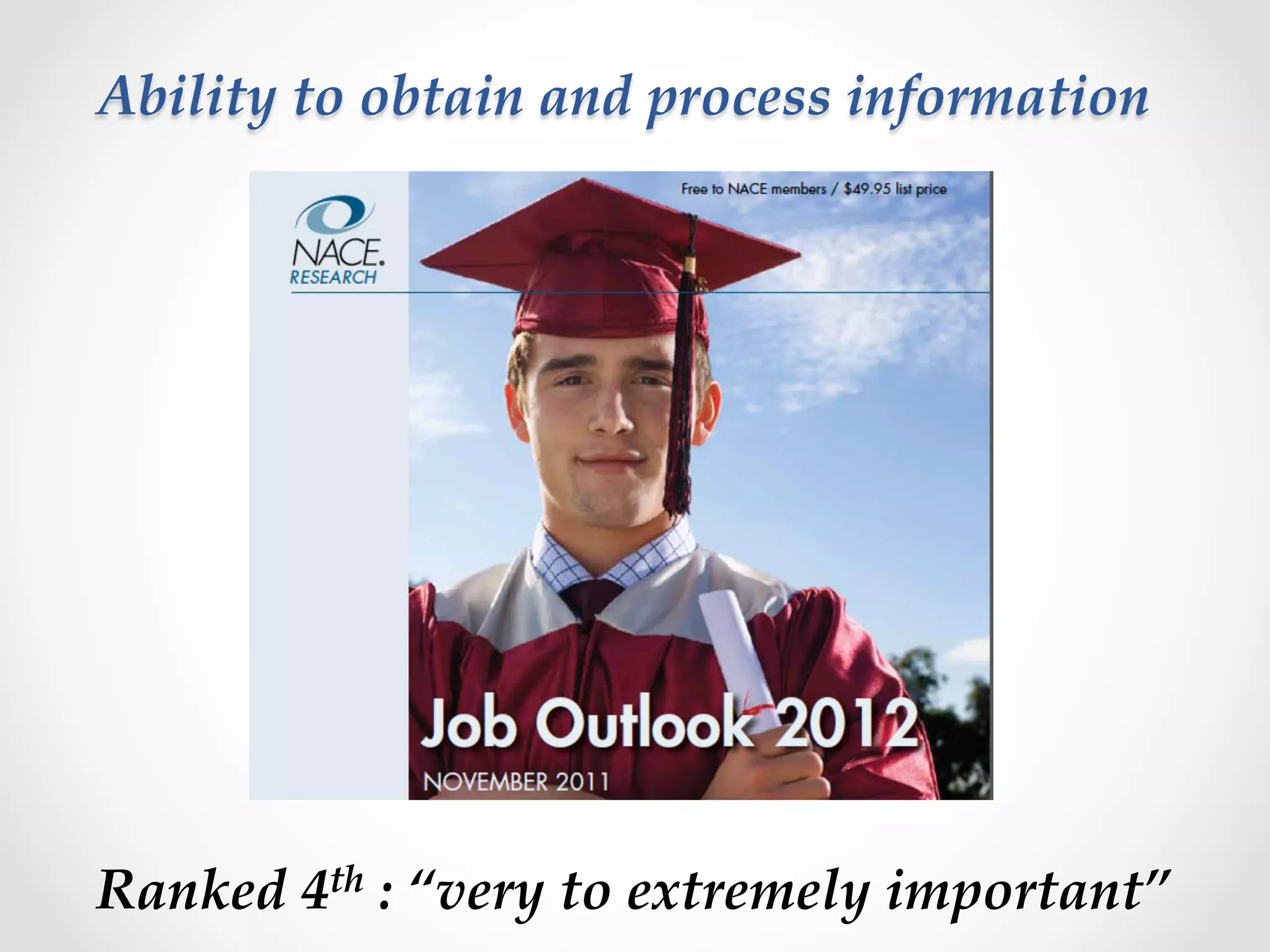
Ability  to  obtain  and  process  information	
Ranked  4th  :  “very  to  extremely  important”
Project Information Literacy
A large-scale study about early adults and their research habits
Who?	


Director:
Dr. Alison Head
Research Team:
Beth Black
Ohio State University Libraries
Sue Gilroy
Harvard University Libraries
Michele Van Hoeck
CSU Maritime Library
Jordan Eschler
University of Washington
Sean Fullerton
University of Washington
What?	
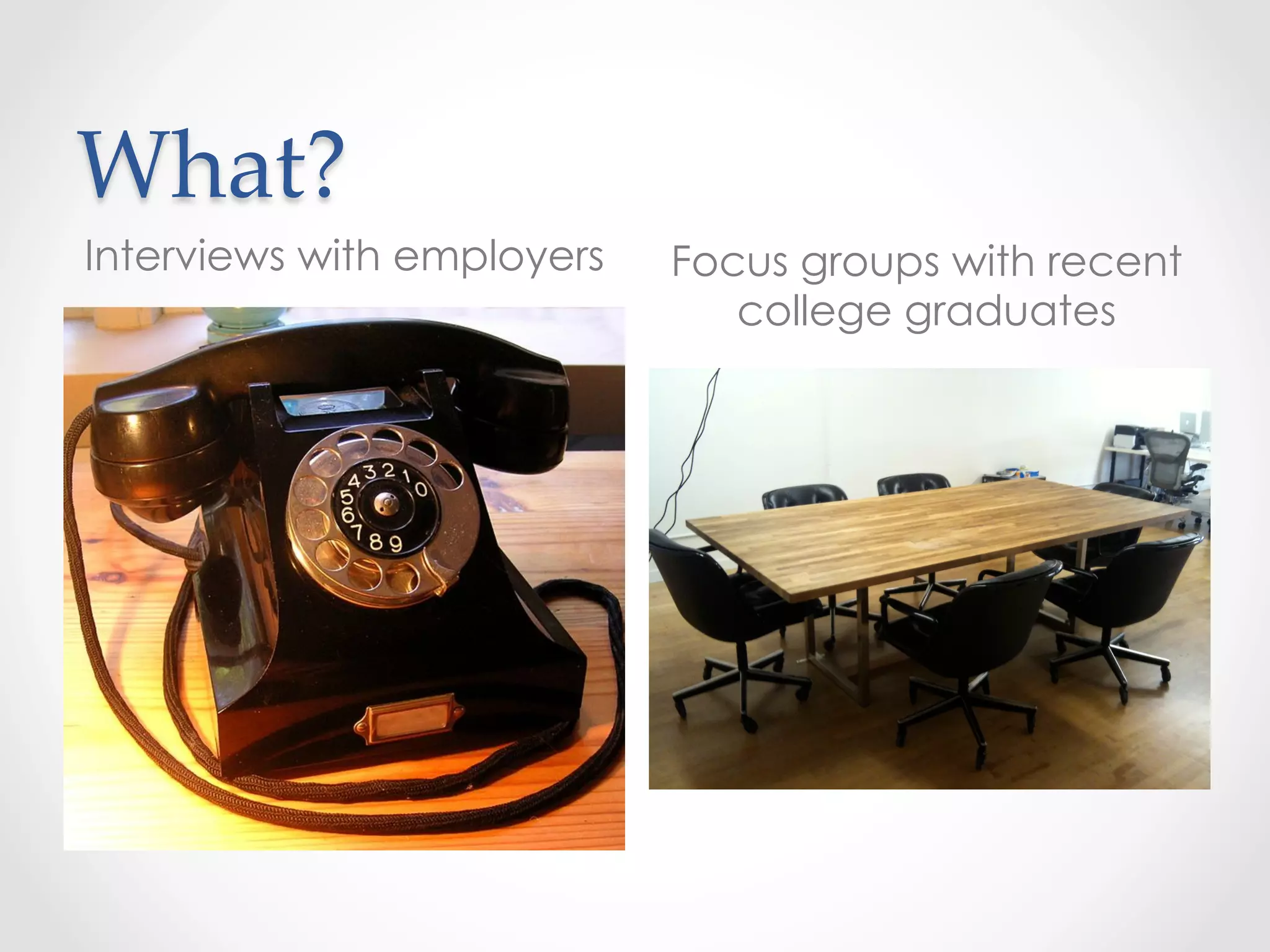
Interviews with employers Focus groups with recent
college graduates
23  Employers	
•  Fortune  500  +  small  +  mid-­‐‑sized  
companies	
•  Media,  Tech,  Engineering,  
Government,  Manufacturing,  
Financial,  Research
33  Recent  Graduates	
•  Santa  Rosa  Junior  College	
•  University  of  Puget  Sound	
•  University  of  Texas  Austin	
•  Harvard  College
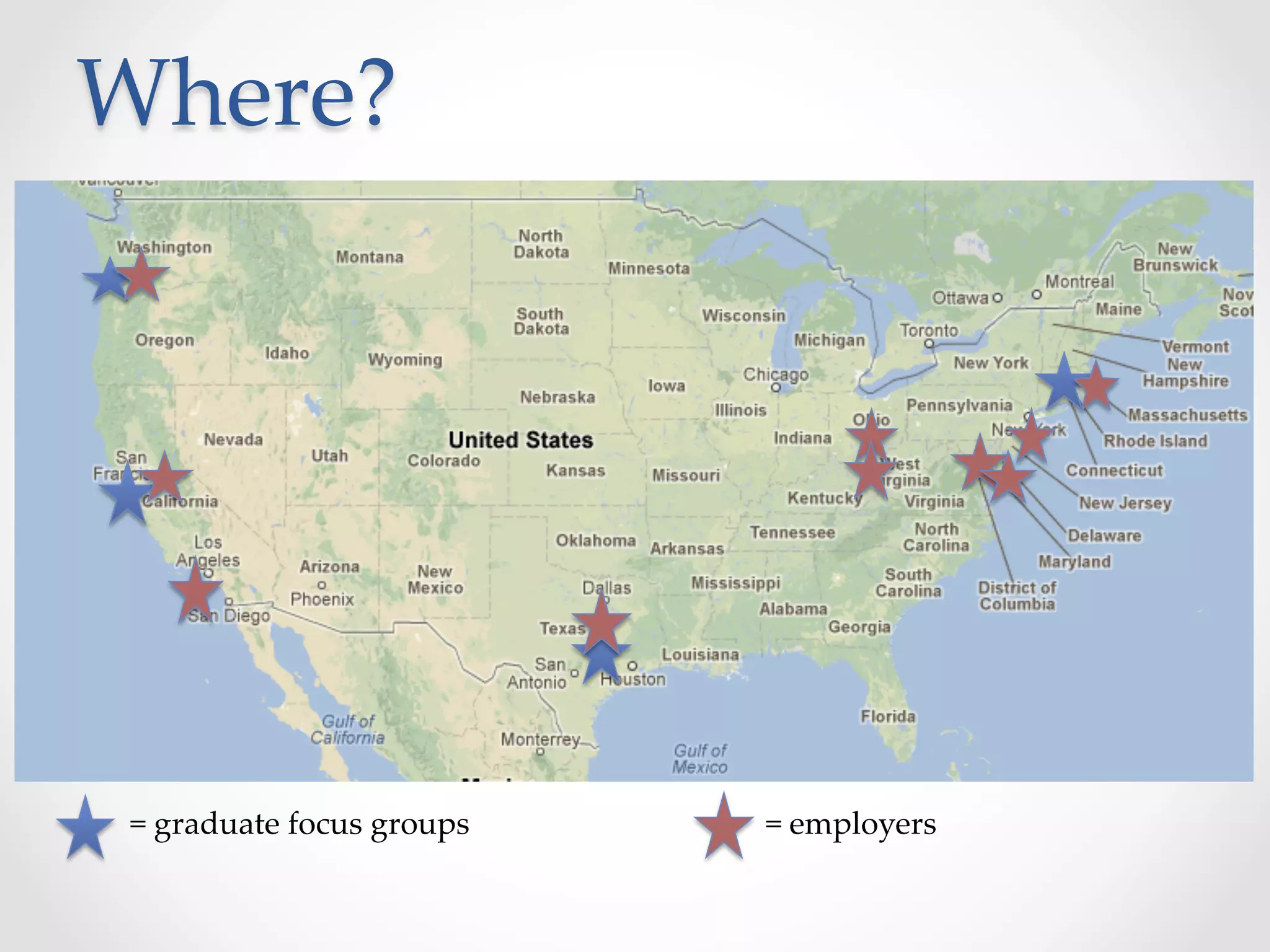
Where?	
                      =  graduate  focus  groups	
 	
	
 =  employers
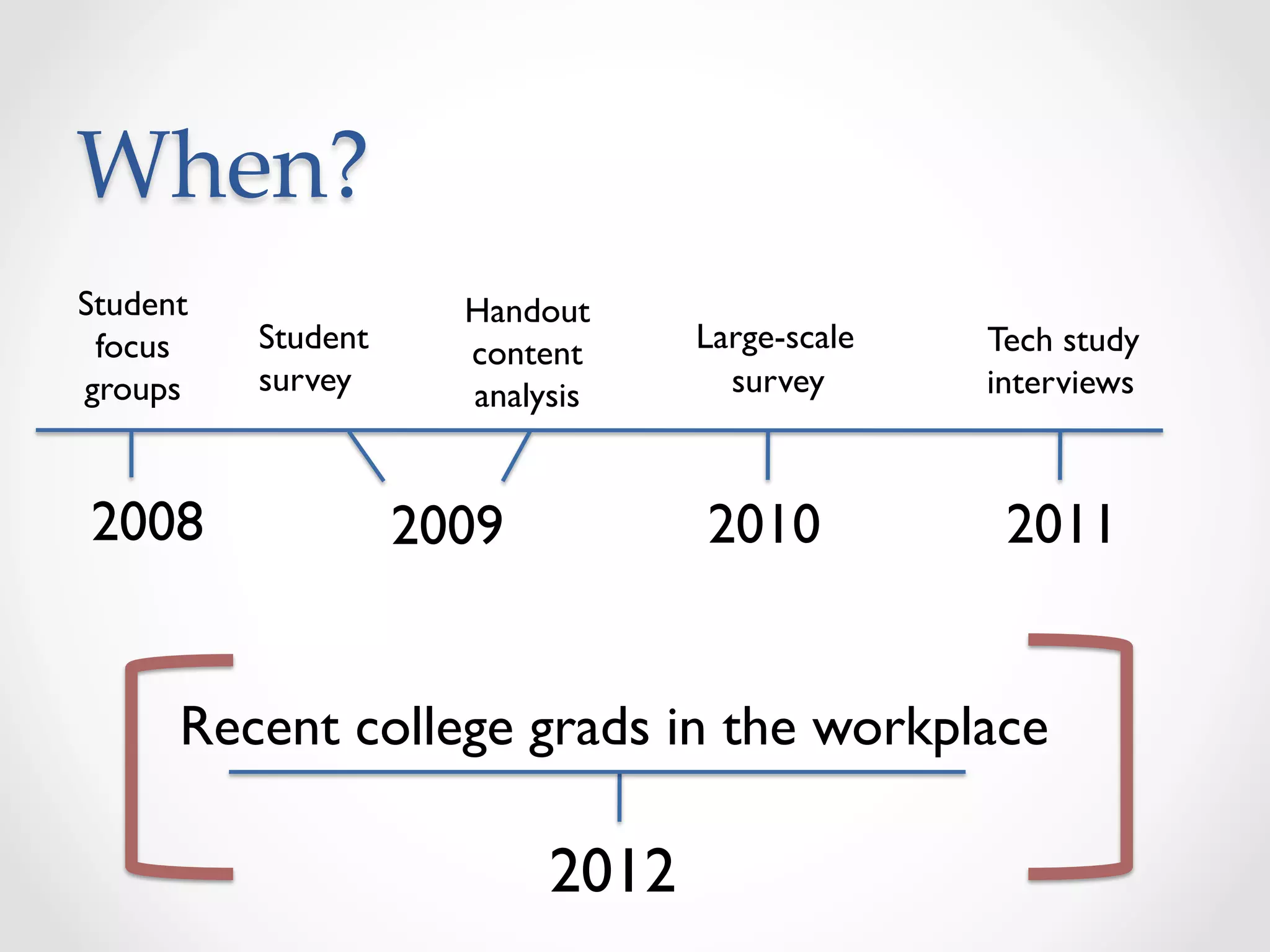
When?	
	

2008	

 2009	

 2010	

Student
focus 	

groups	

	
Handout
content	

analysis 	


Large-scale	

survey 	

Tech study	

interviews	

2011	

Recent college grads in the workplace	

2012	

Student	

survey
How  $
Why?	
A Confession
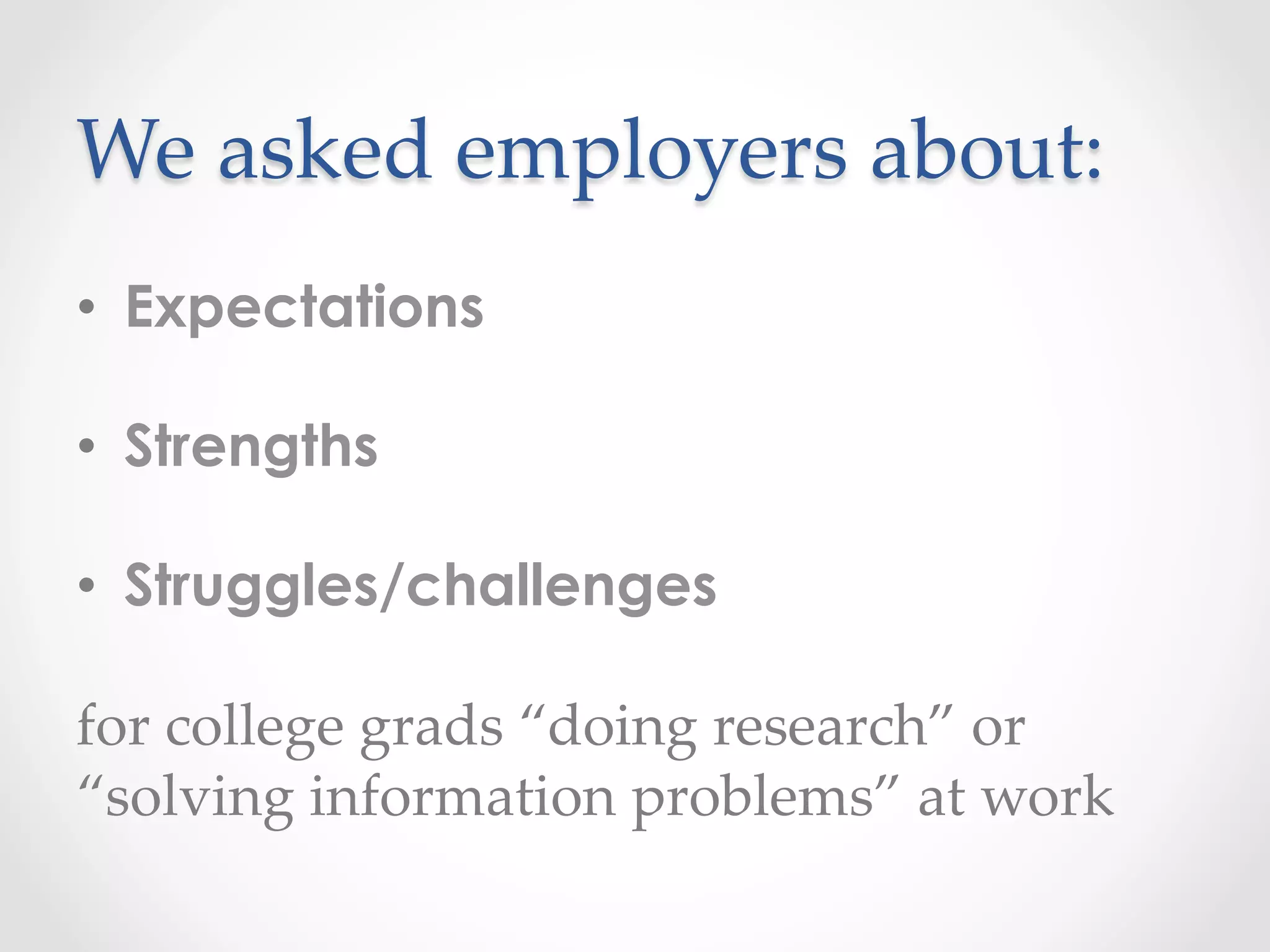
We  asked  employers  about:	
•  Expectations
•  Strengths
•  Struggles/challenges
for  college  grads  “doing  research”  or  	
“solving  information  problems”  at  work
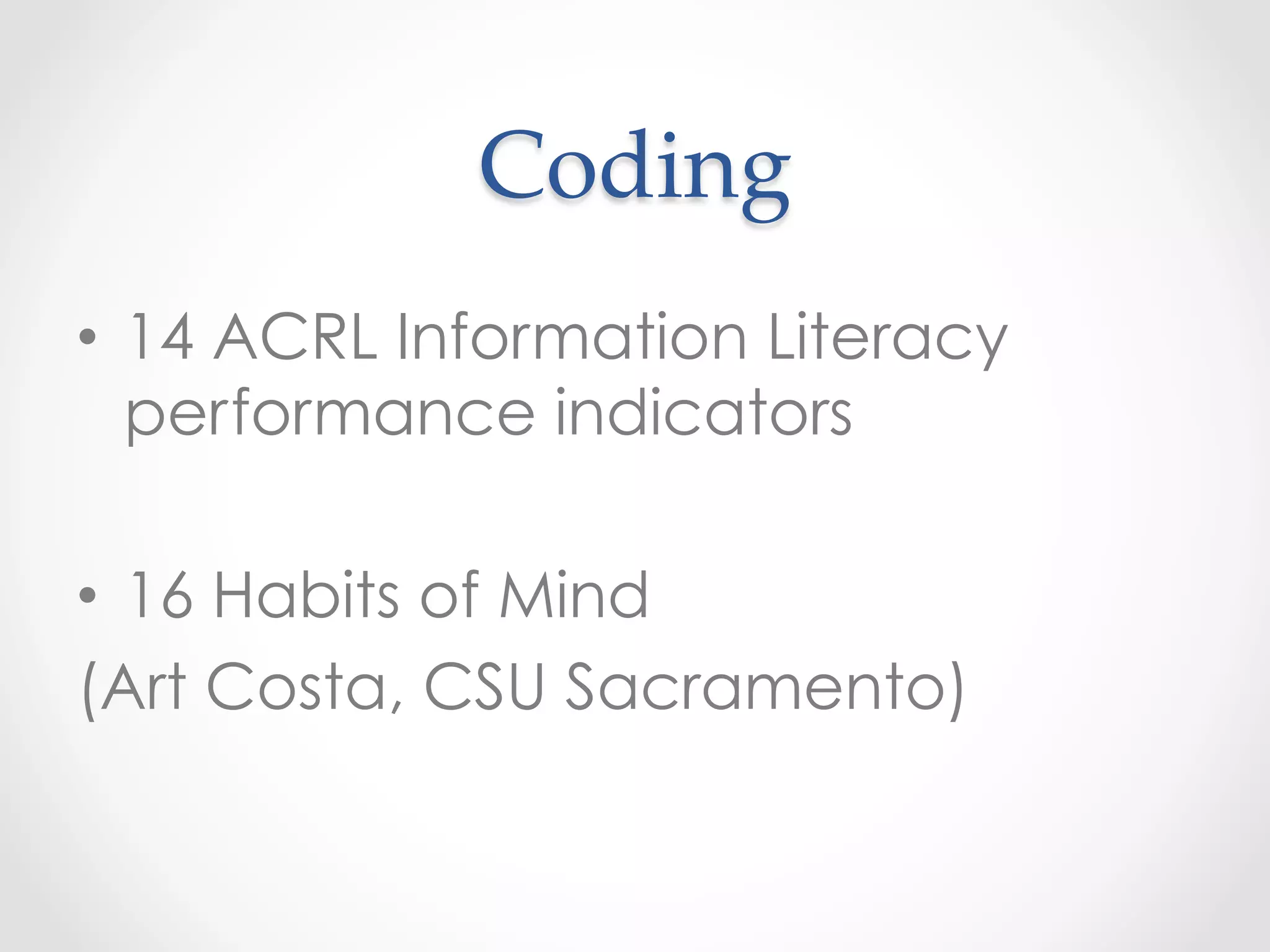
Coding	
•  14 ACRL Information Literacy
performance indicators
•  16 Habits of Mind
(Art Costa, CSU Sacramento)
Findings
Baseline  Expectations	
•  How  and  where  to  find  information  online,  
without  much  guidance  	
•  Use  a  search  strategy  that  goes  beyond  first  
page  of  Google  results	
•  Articulate  a  “best  solution”  and  conclusion  
from  all  that  was  found
Strengths	
Ease with technology: A+
“The  contrast  is  so  evident  
between  us  on  one  side  and  
them  on  the  other  side.  They  
are  connected  in  a  way  that  
my  generation  wasn’t.”  
“Information?  They  find  
it,  they  take  it,  and  they  
blend  it,  they  mash  it  up,  
they  re-­‐‑purpose  it.”  
What  do  employers  need  
(but  rarely  see)  
  in  recent  grads?
1.  Engage  team  during  
research  process	
“We  need  someone  who  will  go  
out  and  explore  on  their  own  and  
then  come  back  to  the  team  and  
say,  ‘Here'ʹs  my  best  take,  what  
do  you  think?’  They  need  that  
ability  to  invite  discussion  and  
be  able  to  redirect  on  the  fly.”
“They  believe  the  computer  is  their  
workspace,  so  basic  interactions  
between  people  are  lost.  They  won’t  get  
up  and  walk  over  and  ask  someone  a  
question.  They  are  less  comfortable  and  
have  some  lack  of  willingness  to  use  
people  as  sources  and  also  have  a  lack  
of  awareness  that  people  are  a  valid  
source  of  information.”
2.  Use  variety  of  formats	
“There  were  many  graduates  
who  just  looked  in  one  place—
the  Internet—and  that  was  the  
problem.  It’s  a  whole  bag  of  
tricks  you  need  for  doing  
research  today.”
3.  Find  Pa]erns	
“difficulty  distinguishing	
        the  noise  from  the  	
                solid  material”  	


get  stuck  in  the  mud	


                                        trying  to  figure  out  	


        what  it  all  means”
4.  Being  thorough	
“I  don'ʹt  think  there'ʹs  a  lot  of  	
that  desire  to  go  deep.  They  expect  
information  to  be  so  easy  to  get,  	
that  when  it'ʹs  not,  	
it'ʹs  frustrating  to  them.”
Habits  of  Mind	
• Openness to learning
• Persistence
Surprise!	
The  workplace  needs  	
sophisticated  	
information  literacy  skills.
Workplace  research:	
•  Is  social  (and  socially  iterative)	
•  Uses  a  variety  of  sources  and  source  types	
•  Seeks  pa>erns	
•  Requires  persistence	
•  Means  being  open  to  continuous  learning
What  information  problems  
do  you  solve  at  work?
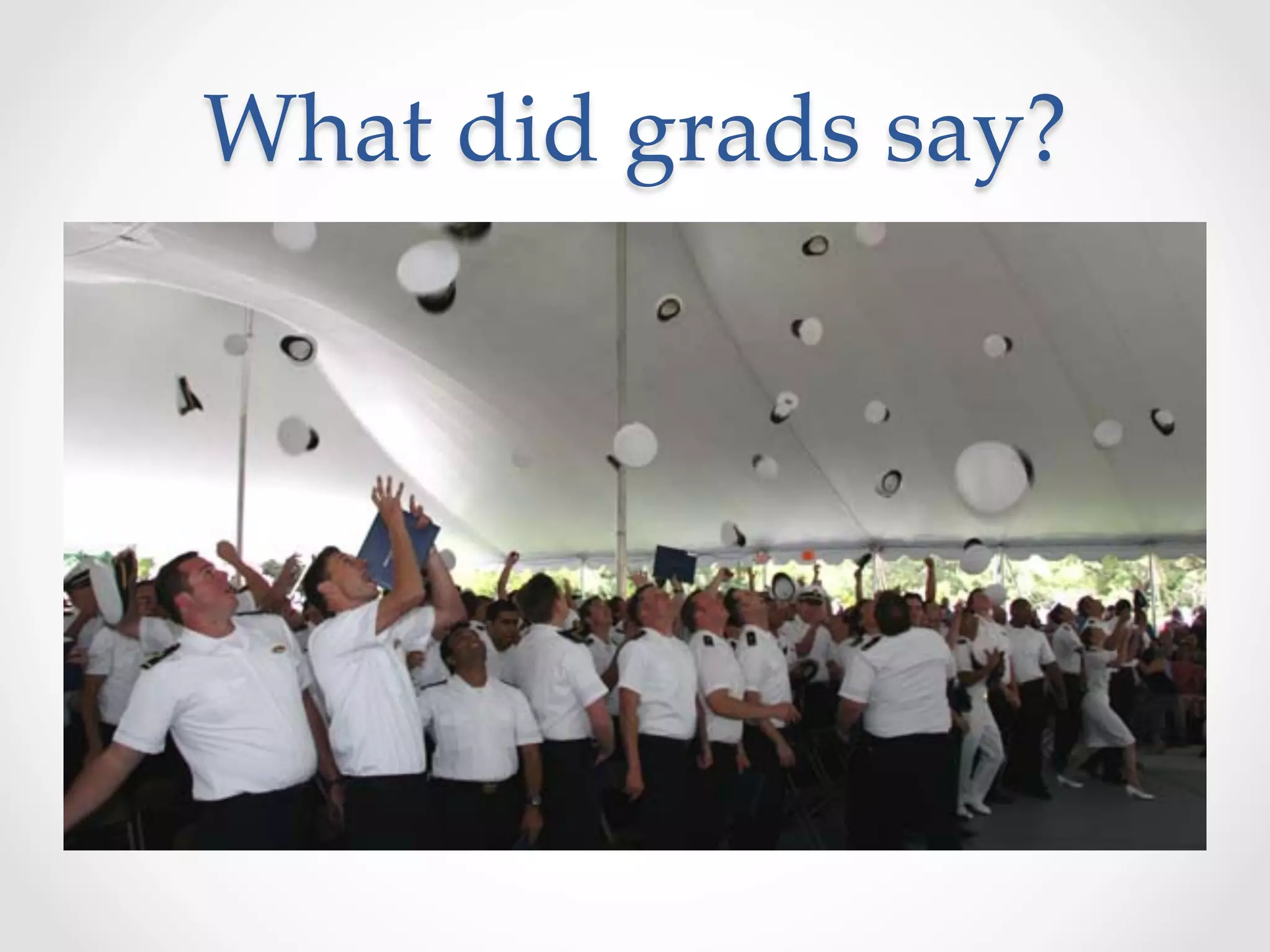
What  did  grads  say?
Focus  group  questions	
•  What  is  challenging  about  solving  
information  problems  in  the  workplace?    	
•  Which  college  learning  experiences  have  
been  most  applicable?  	
•  What  strategies  do  you  use  to  solve  
information  problems?  
“My  job  feels  like  there’s  a  
perpetual  thesis  due,  but  my  job  
is  literally  about  finding  
information  that  does  not  exist.  
My  information  needs  have  
changed  and  intensified  since  
when  I  was  an  undergraduate.”
Workplace  research  challenges	
1.  Increased  sense  of  urgency  	
  	
2.  Li]le  structure  or  direction	
  	
3.  Highly  contextual  and  	
        fundamentally  social
What  transferred  well?	
Ability  to:	
•  Systematically  evaluate  sources	
•  Critically  read  and  analyze  published  sources	
•  Synthesize  large  volumes  of  content  and  
extract  quality  information
Overlap:  Workplace  research  is  social	
The  biggest  hurdle  
for  me  was  ge]ing  
used  to  talking  to  
strangers.	
They  need  to  look  
beyond  their  
computer  screens.	
Recent  graduate	
Employer
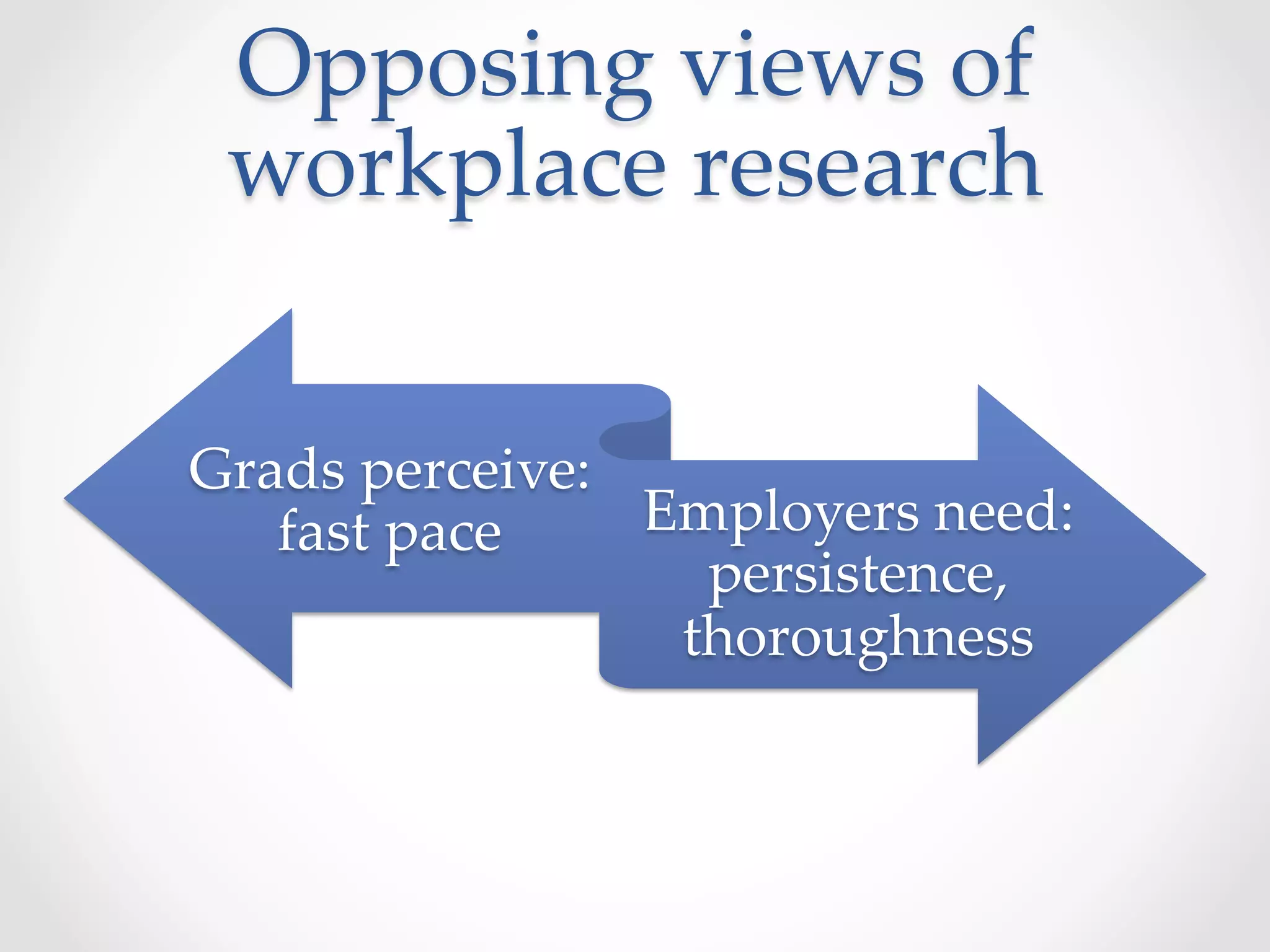
Opposing  views  of  
workplace  research	
Grads  perceive:  
fast  pace	
 Employers  need:  
persistence,  
thoroughness
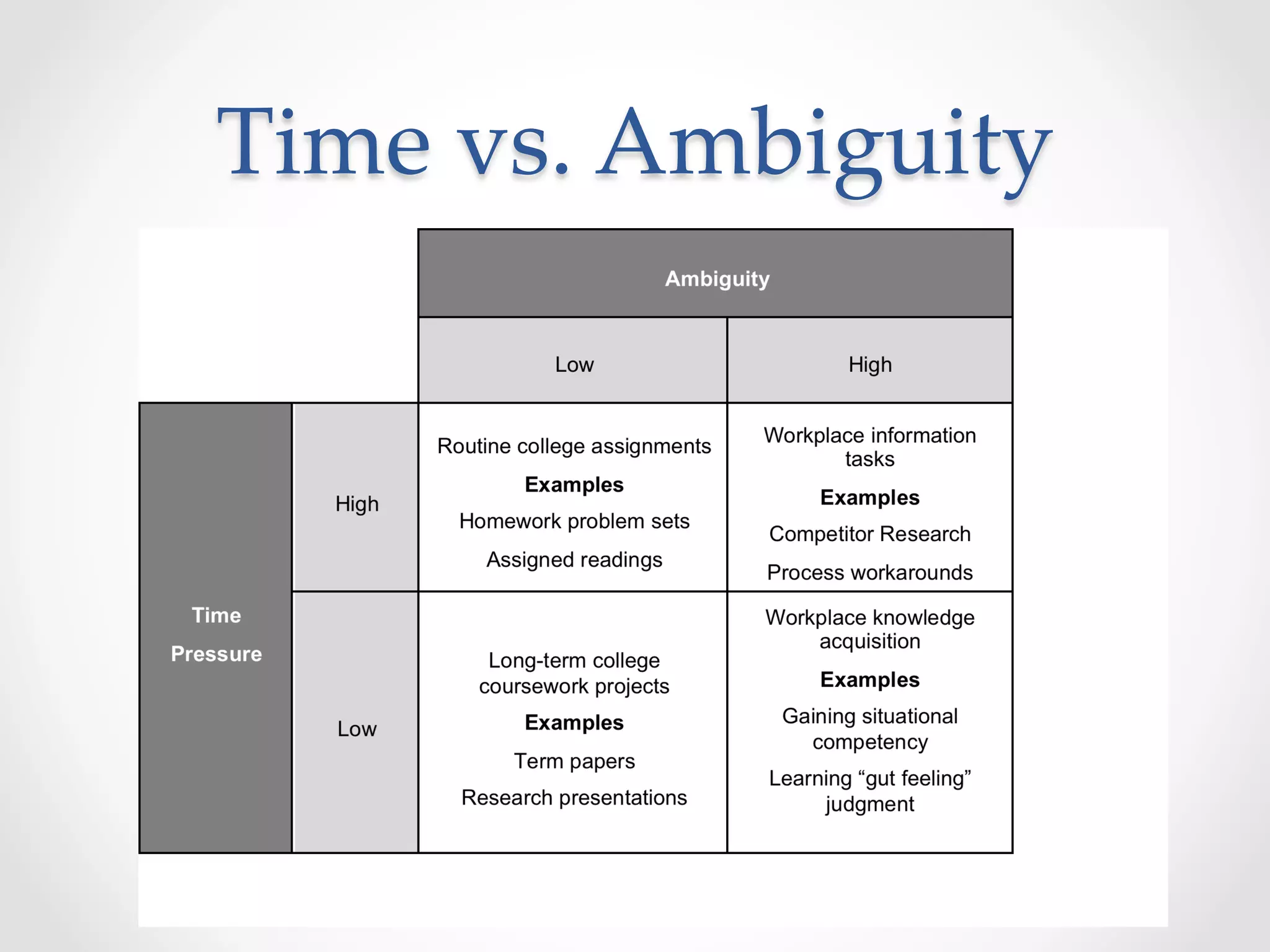
Time  vs.  Ambiguity
What  is  our  learning  curve?
If  team  projects  are  so  
prevalent  in  college,  why  
aren’t  grads  be]er  at  doing  
research  in  teams?	
Text  your  hypothesis!
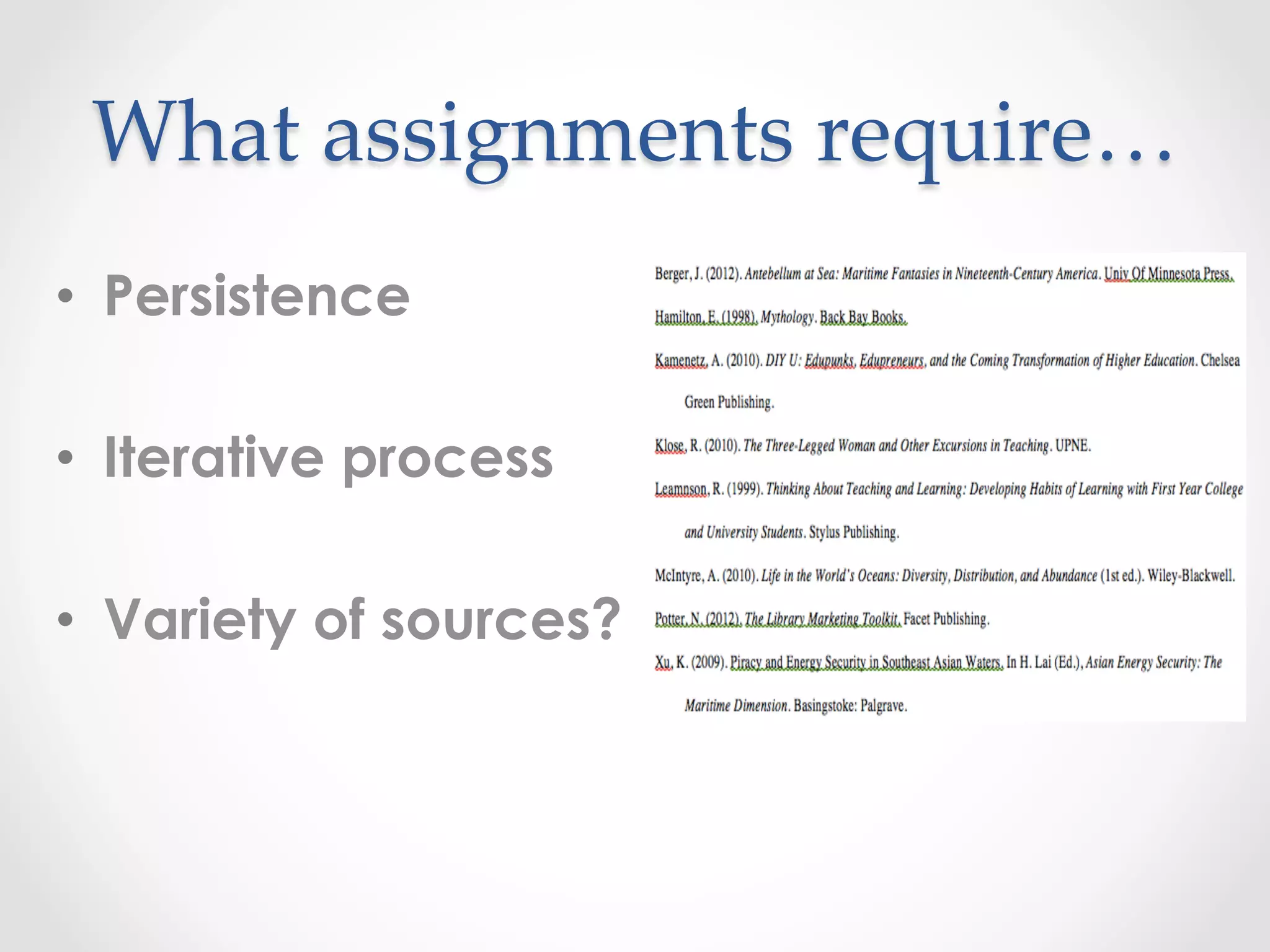
What  assignments  require…	
•  Persistence
•  Iterative process
•  Variety of sources?
Are  research  papers  the  
best  way  to  develop  
persistent,  iterative  
researchers?
Opportunities  
for  Instruction  Librarians
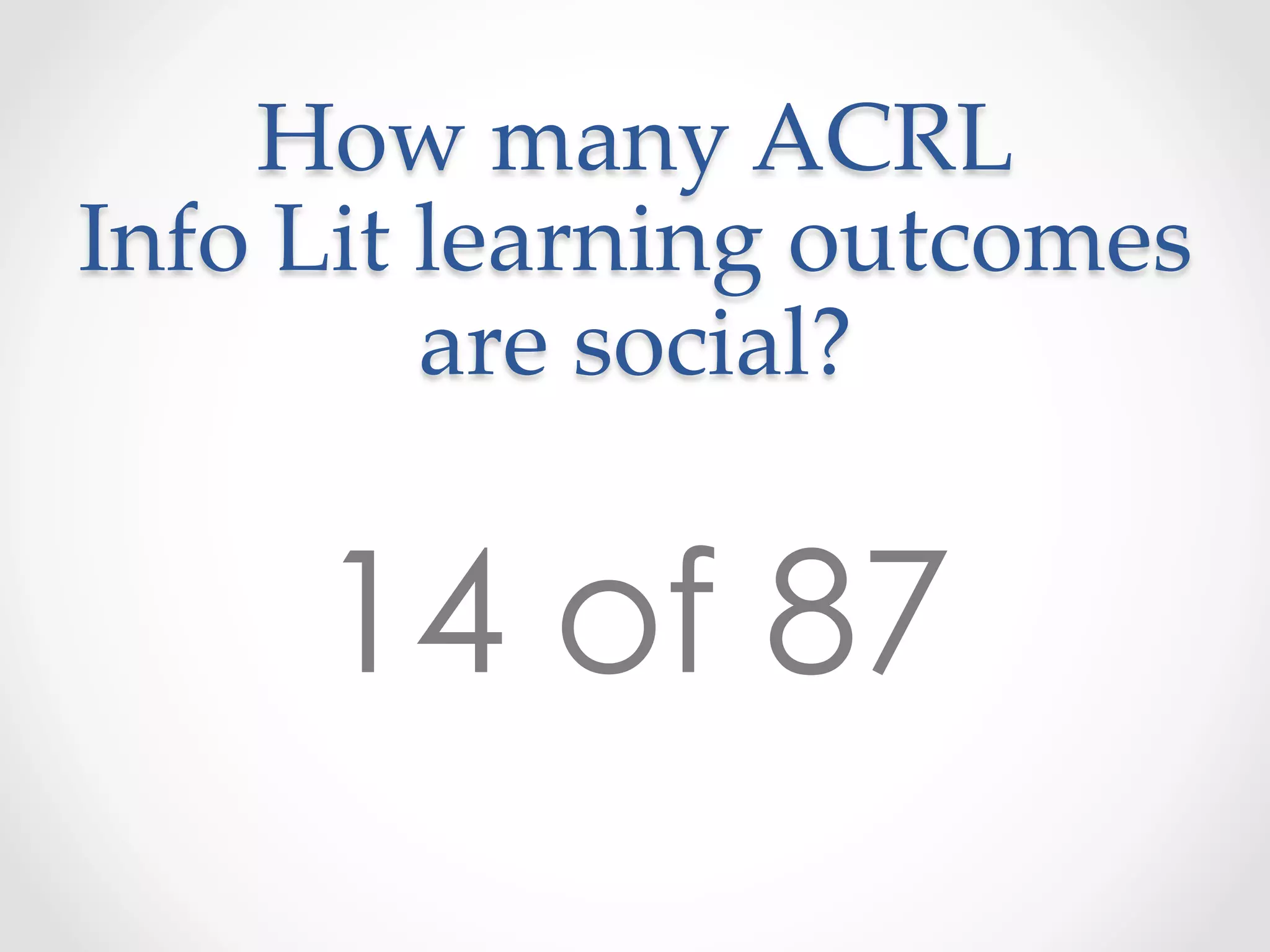
How  many  ACRL    
Info  Lit  learning  outcomes  
are  social?	
14 of 87
Social  side  of  research	
•  Encourage  team  consultations  with  
librarians	
•  Teach  identification  of  experts  as  sources	
•  Discuss  tools/sources  that  make  iterative,  
team-­‐‑based  research  more  transparent:	
Google Docs, Zotero, Wikipedia
Motivation  and  authentic  tasks	
•  Use  data  from  NACE  or  PIL  to  talk  about  the  
workplace  value  of  information  literacy	
•  Partner  with  faculty  to  design  research  
assignments  that  reflect  workplace  realities	
•  Reach  out  to  extracurricular  groups  on  campus
New  assessment  possibilities	
•  How  can  we  measure  source  
variety?	
•  How  can  we  measure  
persistence?
Resources	
Alison Head, Project Information Literacy (2012). Learning Curve.
http://projectinfolit.org/pdfs/PIL_fall2012_workplaceStudy_FullReport.pdf
National Association of Colleges and Employers (press releases)
http://www.naceweb.org
Art Costa, Habits of Mind
http://www.instituteforhabitsofmind.com/
Bill Coplin. (2012). 10 things employers want you to learn in
college. Berkeley, CA: Ten Speed Press.
Head, Van Hoeck, Eschler, Fullerton. What information
competencies matter in today’s workplace? (May 2013), Library
and Information Research, http://www.lirgjournal.org.uk

Learning Curve: How College Graduates Solve Information Problems in the Workplace

  • 1.
    Learning  Curve      How  College  Graduates     Solve  Information  Problems     in  the  Workplace Michele Van Hoeck CSU Maritime and Project Information Literacy California Conference on Library Instruction San Jose State University, April 5, 2013
  • 2.
    Ability  to  obtain and  process  information Ranked  4th  :  “very  to  extremely  important”
  • 3.
    Project Information Literacy Alarge-scale study about early adults and their research habits
  • 4.
    Who? Director: Dr. Alison Head Research Team: Beth Black Ohio State University Libraries Sue Gilroy Harvard University Libraries Michele Van Hoeck CSU Maritime Library Jordan Eschler University of Washington Sean Fullerton University of Washington
  • 5.
    What? Interviews with employersFocus groups with recent college graduates
  • 6.
    23  Employers •  Fortune 500  +  small  +  mid-­‐‑sized   companies •  Media,  Tech,  Engineering,   Government,  Manufacturing,   Financial,  Research
  • 7.
    33  Recent  Graduates • Santa  Rosa  Junior  College •  University  of  Puget  Sound •  University  of  Texas  Austin •  Harvard  College
  • 8.
    Where?                     =  graduate  focus  groups =  employers
  • 9.
    When? 2008 2009 2010 Student focus groups Handout content analysis Large-scale survey Tech study interviews 2011 Recent college grads in the workplace 2012 Student survey
  • 10.
  • 11.
  • 12.
    We  asked  employers about: •  Expectations •  Strengths •  Struggles/challenges for  college  grads  “doing  research”  or   “solving  information  problems”  at  work
  • 13.
    Coding •  14 ACRLInformation Literacy performance indicators •  16 Habits of Mind (Art Costa, CSU Sacramento)
  • 14.
  • 15.
    Baseline  Expectations •  How and  where  to  find  information  online,   without  much  guidance   •  Use  a  search  strategy  that  goes  beyond  first   page  of  Google  results •  Articulate  a  “best  solution”  and  conclusion   from  all  that  was  found
  • 16.
  • 17.
    “The  contrast  is so  evident   between  us  on  one  side  and   them  on  the  other  side.  They   are  connected  in  a  way  that   my  generation  wasn’t.”  
  • 18.
    “Information?  They  find  it,  they  take  it,  and  they   blend  it,  they  mash  it  up,   they  re-­‐‑purpose  it.”  
  • 19.
    What  do  employers need   (but  rarely  see)    in  recent  grads?
  • 20.
    1.  Engage  team during   research  process “We  need  someone  who  will  go   out  and  explore  on  their  own  and   then  come  back  to  the  team  and   say,  ‘Here'ʹs  my  best  take,  what   do  you  think?’  They  need  that   ability  to  invite  discussion  and   be  able  to  redirect  on  the  fly.”
  • 21.
    “They  believe  the computer  is  their   workspace,  so  basic  interactions   between  people  are  lost.  They  won’t  get   up  and  walk  over  and  ask  someone  a   question.  They  are  less  comfortable  and   have  some  lack  of  willingness  to  use   people  as  sources  and  also  have  a  lack   of  awareness  that  people  are  a  valid   source  of  information.”
  • 22.
    2.  Use  variety of  formats “There  were  many  graduates   who  just  looked  in  one  place— the  Internet—and  that  was  the   problem.  It’s  a  whole  bag  of   tricks  you  need  for  doing   research  today.”
  • 23.
    3.  Find  Pa]erns “difficulty distinguishing        the  noise  from  the                  solid  material”             get  stuck  in  the  mud                                        trying  to  figure  out                                                what  it  all  means”
  • 24.
    4.  Being  thorough “I don'ʹt  think  there'ʹs  a  lot  of   that  desire  to  go  deep.  They  expect   information  to  be  so  easy  to  get,   that  when  it'ʹs  not,   it'ʹs  frustrating  to  them.”
  • 25.
    Habits  of  Mind • Opennessto learning • Persistence
  • 26.
    Surprise! The  workplace  needs  sophisticated   information  literacy  skills.
  • 27.
    Workplace  research: •  Is social  (and  socially  iterative) •  Uses  a  variety  of  sources  and  source  types •  Seeks  pa>erns •  Requires  persistence •  Means  being  open  to  continuous  learning
  • 28.
    What  information  problems  do  you  solve  at  work?
  • 29.
  • 30.
    Focus  group  questions • What  is  challenging  about  solving   information  problems  in  the  workplace?     •  Which  college  learning  experiences  have   been  most  applicable?   •  What  strategies  do  you  use  to  solve   information  problems?  
  • 31.
    “My  job  feels like  there’s  a   perpetual  thesis  due,  but  my  job   is  literally  about  finding   information  that  does  not  exist.   My  information  needs  have   changed  and  intensified  since   when  I  was  an  undergraduate.”
  • 32.
    Workplace  research  challenges 1. Increased  sense  of  urgency     2.  Li]le  structure  or  direction   3.  Highly  contextual  and          fundamentally  social
  • 33.
    What  transferred  well? Ability to: •  Systematically  evaluate  sources •  Critically  read  and  analyze  published  sources •  Synthesize  large  volumes  of  content  and   extract  quality  information
  • 34.
    Overlap:  Workplace  research is  social The  biggest  hurdle   for  me  was  ge]ing   used  to  talking  to   strangers. They  need  to  look   beyond  their   computer  screens. Recent  graduate Employer
  • 35.
    Opposing  views  of  workplace  research Grads  perceive:   fast  pace Employers  need:   persistence,   thoroughness
  • 36.
  • 37.
    What  is  our learning  curve?
  • 38.
    If  team  projects are  so   prevalent  in  college,  why   aren’t  grads  be]er  at  doing   research  in  teams? Text  your  hypothesis!
  • 39.
    What  assignments  require… • Persistence •  Iterative process •  Variety of sources?
  • 40.
    Are  research  papers the   best  way  to  develop   persistent,  iterative   researchers?
  • 41.
  • 42.
    How  many  ACRL    Info  Lit  learning  outcomes   are  social? 14 of 87
  • 43.
    Social  side  of research •  Encourage  team  consultations  with   librarians •  Teach  identification  of  experts  as  sources •  Discuss  tools/sources  that  make  iterative,   team-­‐‑based  research  more  transparent: Google Docs, Zotero, Wikipedia
  • 44.
    Motivation  and  authentic tasks •  Use  data  from  NACE  or  PIL  to  talk  about  the   workplace  value  of  information  literacy •  Partner  with  faculty  to  design  research   assignments  that  reflect  workplace  realities •  Reach  out  to  extracurricular  groups  on  campus
  • 45.
    New  assessment  possibilities • How  can  we  measure  source   variety? •  How  can  we  measure   persistence?
  • 46.
    Resources Alison Head, ProjectInformation Literacy (2012). Learning Curve. http://projectinfolit.org/pdfs/PIL_fall2012_workplaceStudy_FullReport.pdf National Association of Colleges and Employers (press releases) http://www.naceweb.org Art Costa, Habits of Mind http://www.instituteforhabitsofmind.com/ Bill Coplin. (2012). 10 things employers want you to learn in college. Berkeley, CA: Ten Speed Press. Head, Van Hoeck, Eschler, Fullerton. What information competencies matter in today’s workplace? (May 2013), Library and Information Research, http://www.lirgjournal.org.uk