Bell, Steven J.,& Shank, John. (2004). The blended
librarian: A blueprint for redefining the teaching and
learning role of academic librarians. College & Research
Libraries News, 65(7), 372-375.
8.
Campus innovatorsand change agents
Developers of campus-wide information
literacy initiatives
Designing instructional and educational
programs
Collaborating and engaging in dialogue with
Implementing adaptive, creative, proactive,
and innovative change in library instruction.
Transforming our relationship with faculty
11.
Barbara Dewey (2004):
-Integral part of the whole
- Experiencing, observing daily life of another
group
- Value-added services
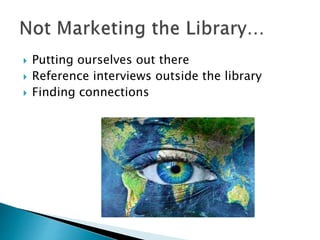
Putting ourselvesout there
Reference interviews outside the library
Finding connections
25.
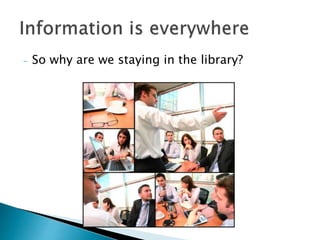
Get outof the library
Find new ways to relate to your users
Build relationships
Collaborate
Learn about parent organization
26.
Assess yourlibrary and organizational
readiness
Get included in teams
Take ownership
Be the knowledge expert
Lead drive for cost effectiveness
Watch workload, staff cohesion, funding
28.
Information literacymore meaningful when
in-context learning takes place
Evidence-based surgery meetings
PICO plus search strategies to resolve
problem
Team teaching relationships built with
teacher-librarian and teacher-clinician
Team teaching
Interdisciplinary collaborations
Shared vision
Sequential learning
Teachers model collaborative relationships
Shared learning process
Social learning from different perspectives
31.
Where is itstrategically important to embed the
librarian?
Education
Research
Patient care
Build a presence physically, virtually, culturally
32.
Benefits of clinicallibrarianship:
1. Save the time of the clinician
2. Decrease costs
3. Support decision making
4. Improve patient care
5. Librarian is detached from emotional part of
patient care
Research informationistNLM funding requests
for existing NIH-funded teams in 2011
7 awarded for:
Open access compliance
Research data management
Aggregate metadata
Metadata standards
Data preservation best practices
Literature research
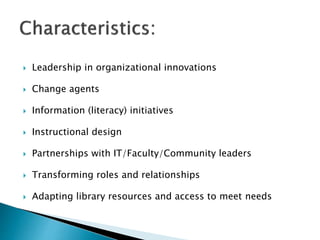
Leadership inorganizational innovations
Change agents
Information (literacy) initiatives
Instructional design
Partnerships with IT/Faculty/Community leaders
Transforming roles and relationships
Adapting library resources and access to meet needs
56.
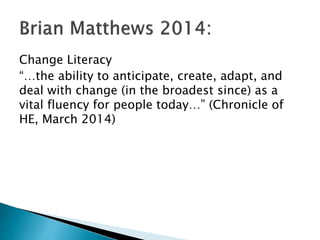
Change Literacy
“…the abilityto anticipate, create, adapt, and
deal with change (in the broadest since) as a
vital fluency for people today…” (Chronicle of
HE, March 2014)
57.
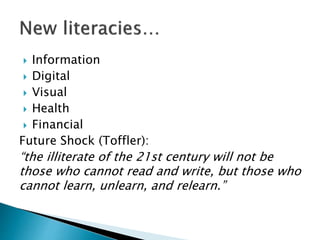
Information
Digital
Visual
Health
Financial
Future Shock (Toffler):
“the illiterate of the 21st century will not be
those who cannot read and write, but those who
cannot learn, unlearn, and relearn.”
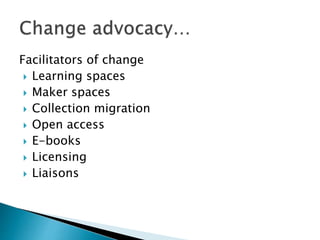
Facilitators of change
Learning spaces
Maker spaces
Collection migration
Open access
E-books
Licensing
Liaisons
60.
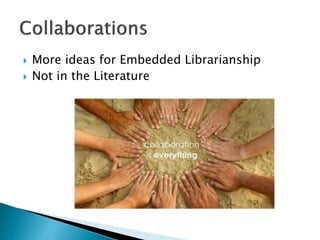
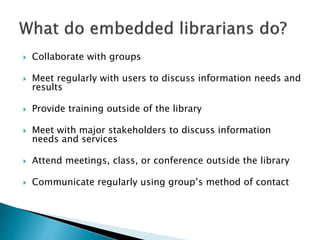
Collaborate withgroups
Meet regularly with users to discuss information needs and
results
Provide training outside of the library
Meet with major stakeholders to discuss information
needs and services
Attend meetings, class, or conference outside the library
Communicate regularly using group’s method of contact
Access http://www.ncbi.nlm.nih.gov/pubmed/clinical
Literacy http://www.ncbi.nlm.nih.gov/pubmed/clinical
Learning
http://net.educause.edu/ir/library/pdf/eli7081.pdf
Critical assessment of information
http://backpack.openbadges.org/backpack/login
Threshold concepts
http://www.comminfolit.org/index.php?journal=cil&page=art
icle&op=viewFile&path[]=v7i2p108&path[]=168
Systematic reviews for fundraising or
benchmarks
http://guides.library.tamu.edu/systematicreviews
64.
Dewey, Barbara I.(2004). The Embedded
Librarian: Strategic Campus Collaborations.
Resource Sharing & Information Networks, 17
(1/2), 5-17. doi: 10.1300/J121v17n0102
65.
Journalists in Iraqwar comparison
Direct interaction within partnerships
Librarian observes, shares experiences with
external group
Comprehensive collaboration
66.
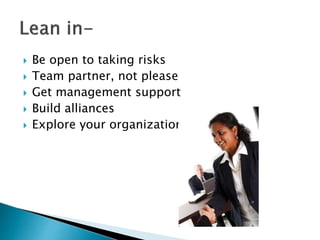
Be opento taking risks
Team partner, not please
Get management support
Build alliances
Explore your organization
67.
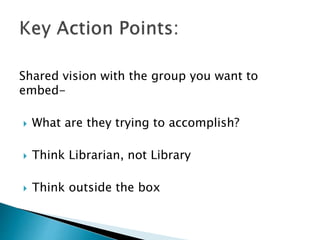
Shared vision withthe group you want to
embed-
What are they trying to accomplish?
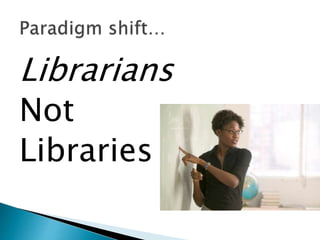
Think Librarian, not Library
Think outside the box
68.
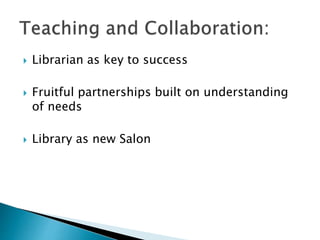
Librarian askey to success
Fruitful partnerships built on understanding
of needs
Library as new Salon
69.
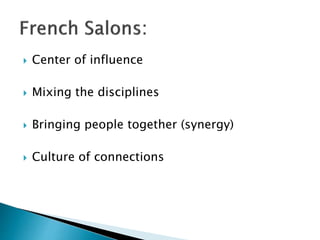
Center ofinfluence
Mixing the disciplines
Bringing people together (synergy)
Culture of connections
70.
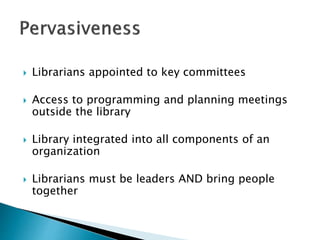
Librarians appointedto key committees
Access to programming and planning meetings
outside the library
Library integrated into all components of an
organization
Librarians must be leaders AND bring people
together
71.
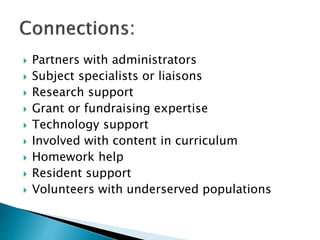
Partners withadministrators
Subject specialists or liaisons
Research support
Grant or fundraising expertise
Technology support
Involved with content in curriculum
Homework help
Resident support
Volunteers with underserved populations
72.
Bowler, Meagan, &Street, Kori. (2008).
Investigating the efficacy of embedment:
experiments in information literacy integration.
Reference Services Review 36, 438-449.
73.
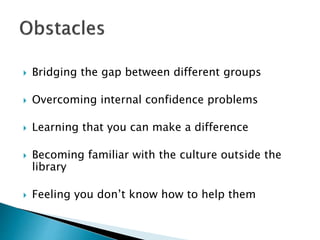
Bridging thegap between different groups
Overcoming internal confidence problems
Learning that you can make a difference
Becoming familiar with the culture outside the
library
Feeling you don’t know how to help them
74.
Blake, Lindsay,and Darra Ballance. 2013. "Teaching Evidence-
Based Practice in the Hospital and the Library: Two Different
Groups, One Course." Medical Reference Services Quarterly no.
32 (1):100-110. doi: 10.1080/02763869.2013.749143.
Boruff, Jill T., and Dale Storie. 2014. "Mobile devices in medicine:
a survey of how medical students, residents, and faculty use
smartphones and other mobile devices to find information."
Journal of the Medical Library Association no. 102 (1):22-30. doi:
10.3163/1536-5050.102.1.006.
Bowler, Meagan, and Kori Street. 2008. Investigating the efficacy
of embedment: experiments in information literacy integration.
Reference & User Services Quarterly 36 (4): 438-449.
Brandes, Susan, Karen Wells, and Margaret Bandy. 2013. "Invite
Yourself to the Table: Librarian Contributions to the Electronic
Medical Record." Medical Reference Services Quarterly no. 32
(3):358-364. doi: 10.1080/02763869.2013.807087.
75.
Camlek, Victor.2011. "Healthcare mobile
information flow." Information Services & Use no.
31 (1/2):23-30. doi: 10.3233/ISU-2011-0626.
Cooper, Diane, and Janet A. Crum. 2013. "New
activities and changing roles of health sciences
librarians: a systematic review, 1990-2012."
Journal of the Medical Library Association no.
101 (4):268-277. doi: 10.3163/1536 -
5050.101.4.008.
Cordell, Diane. 2012. "Skype and the Embedded
Librarian." Library Technology Reports no. 48
(2):8-11.
Dewey, Barbara I. 2004. "The Embedded
Librarian: Strategic Campus Collaborations."
Resource Sharing & Information Networks no. 17
(1/2):5-17. doi: 10.1300/J121v17n01̱02.
76.
Donahue, AmyE., and Robin M. Featherstone. 2013. "New roles
for hospital librarians: a benchmarking survey of disaster
management activities." Journal of the Medical Library
Association no. 101 (4):315-318. doi: 10.3163/1536 -
5050.101.4.014.
Federer, L. 2013. "The librarian as research informationist: a case
study." J Med Libr Assoc no. 101 (4):298-302. doi:
10.3163/1536-5050.101.4.011.
Godin, Seth. 2010. Linchpin: are you indispensible? New York,
NY: Penguin.
Greyson, Devon, Soleil Surette, Liz Dennett, and Trish Chatterley.
2013. ""You're just one of the group when you're embedded":
report from a mixed-method investigation of the research-
embedded health librarian experience." Journal of the Medical
Library Association no. 101 (4):287-297. doi: 10.3163/1536 -
5050.101.4.010.
Hurst, Emily J. 2014. "Educational Technologies in Health
Sciences Libraries: Teaching Technology Skills." Medical
Reference Services Quarterly no. 33 (1):102-108. doi:
10.1080/02763869.2013.866494.
77.
Kenefick, ColleenM., Rachel Boykan, and Maribeth Chitkara. 2013.
"Partnering With Residents for Evidence-Based Practice." Medical
Reference Services Quarterly no. 32 (4):385-395. doi:
10.1080/02763869.2013.837669.
Kho, Nancy Davis. 2011. "Embedded Librarianship: Building Relational
Roles. (cover story)." Information Today no. 28 (3):1-36.
King, David N. 2012. "The Contribution of Hospital Library Information
Services to Clinical Care: A Study in Eight Hospitals." Journal of the
Medical Library Association no. 100:291-301.
Kumar, Sajeesh, Lin Wu, and Rebecca Reynolds. 2014. "Embedded
Librarian Within an Online Health Informatics Graduate Research Course:
A Case Study." Medical Reference Services Quarterly no. 33 (1):51-59.
doi: 10.1080/02763869.2014.866485.
Marshall, Joanne Gard, Julia Sollenbergers, Sharon Easterby-Gannett,
Lynn Morgan, Mary Lou Klem, Susan K. Cavanaugh, Kathleen Burr Oliver,
Cheryl A. Thompson, Neil Ramonosky, and Sue Hunter. 2013. "The value
of library and information services in patient care: results of a multisite
study." Journal of the Medical Library Association no. 101 (1):38-46. doi:
10.3163/1536-5050.101.1.007.
78.
Owusu-Ansah, E.K. 2004. Information literacy and higher education:
Placing the academic library in the center of a comprehensive solution.
Raimondo, Paula G., Ryan L. Harris, Michele Nance, and Everly D. Brown.
2014. "Health literacy and consent forms: librarians support research on
human subjects." Journal of the Medical Library Association no. 102
(1):5-8. doi: 10.3163/1536-5050.102.1.003.
Shannon, Amy W. 2012. "Co-Teaching Relationships among Librarians
and Other Information Professionals." Collaborative Librarianship no. 4
(4):132-148.
Shumaker, David. 2009a. "Let's Circulate Librarians." Library Journal no.
134:8-8.
Shumaker, David. 2009b. "Who Let the Librarians Out?" Reference & User
Services Quarterly no. 48 (3):239-242.
Shumaker, David. 2012a. The Embedded Librarians.
Shumaker, David. 2012b. Embedded Librarians in Special Libraries.
Simons, M. R., M. K. Morgan, and A. S. Davidson. 2012. "Time to rethink
the role of the library in educating doctors: driving information literacy
in the clinical environment." J Med Libr Assoc no. 100 (4):291-6. doi:
10.3163/1536-5050.100.4.011.
79.
Tan, M.C., and L. A. Maggio. 2013. "Expert searcher,
teacher, content manager, and patient advocate: an
exploratory study of clinical librarian roles." J Med Libr
Assoc no. 101 (1):63-72. doi: 10.3163/1536-
5050.101.1.010.
Tarver, Talicia, Dixie A. Jones, Mararia Adams, and
Alejandro Garcia. 2013. "The Librarian's Role in Linking
Patients to Their Personal Health Data and Contextual
Information." Medical Reference Services Quarterly no. 32
(4):459-467. doi: 10.1080/02763869.2013.837730.
Wu, Lin, and Misa Mi. 2013. "Sustaining Librarian Vitality:
Embedded Librarianship Model for Health Sciences
Libraries." Medical Reference Services Quarterly no. 32
(3):257-265. doi: 10.1080/02763869.2013.806860.
Zabel, Diane, John D. Shank, and Steven Bell. 2011.
"Blended Librarianship: [Re]Envisioning the Role of
Librarian as Educator in the Digital Information Age."
Reference & User Services Quarterly no. 51 (2):105-110.
80.
Have youever helped a group outside the
library in a group setting with your library
skills?
What are your strengths?
What are you afraid of?







![ Access http://www.ncbi.nlm.nih.gov/pubmed/clinical
Literacy http://www.ncbi.nlm.nih.gov/pubmed/clinical
Learning
http://net.educause.edu/ir/library/pdf/eli7081.pdf
Critical assessment of information
http://backpack.openbadges.org/backpack/login
Threshold concepts
http://www.comminfolit.org/index.php?journal=cil&page=art
icle&op=viewFile&path[]=v7i2p108&path[]=168
Systematic reviews for fundraising or
benchmarks
http://guides.library.tamu.edu/systematicreviews](https://image.slidesharecdn.com/embeddedlibrarianshiptrends2-150401105756-conversion-gate01/85/Embedded-librarianship-What-Trends-and-Transformations-Have-We-Seen-63-320.jpg)
![ Tan, M. C., and L. A. Maggio. 2013. "Expert searcher,
teacher, content manager, and patient advocate: an
exploratory study of clinical librarian roles." J Med Libr
Assoc no. 101 (1):63-72. doi: 10.3163/1536-
5050.101.1.010.
Tarver, Talicia, Dixie A. Jones, Mararia Adams, and
Alejandro Garcia. 2013. "The Librarian's Role in Linking
Patients to Their Personal Health Data and Contextual
Information." Medical Reference Services Quarterly no. 32
(4):459-467. doi: 10.1080/02763869.2013.837730.
Wu, Lin, and Misa Mi. 2013. "Sustaining Librarian Vitality:
Embedded Librarianship Model for Health Sciences
Libraries." Medical Reference Services Quarterly no. 32
(3):257-265. doi: 10.1080/02763869.2013.806860.
Zabel, Diane, John D. Shank, and Steven Bell. 2011.
"Blended Librarianship: [Re]Envisioning the Role of
Librarian as Educator in the Digital Information Age."
Reference & User Services Quarterly no. 51 (2):105-110.](https://image.slidesharecdn.com/embeddedlibrarianshiptrends2-150401105756-conversion-gate01/85/Embedded-librarianship-What-Trends-and-Transformations-Have-We-Seen-79-320.jpg)