SNAKE VENOM POISONING
OPHITOXAEMIA
SNAKES
Snakes belong to the Class Reptilia. All snakes are placed in the
Suborder Serpentes. All snakes share the common characteristics
separating them from the lizards namely: Lack of eyelids & Lack
of visible external ears.
CLASSIFICATION OF SNAKES
There are approximately 3,000 species of snakes globally, but only
about 600 species are venomous and all of these are found in just 5
snake Families:
Type Of Fangs
Indian krait - Bungarus caeruleus
Banded krait - Bungarus fasciatus
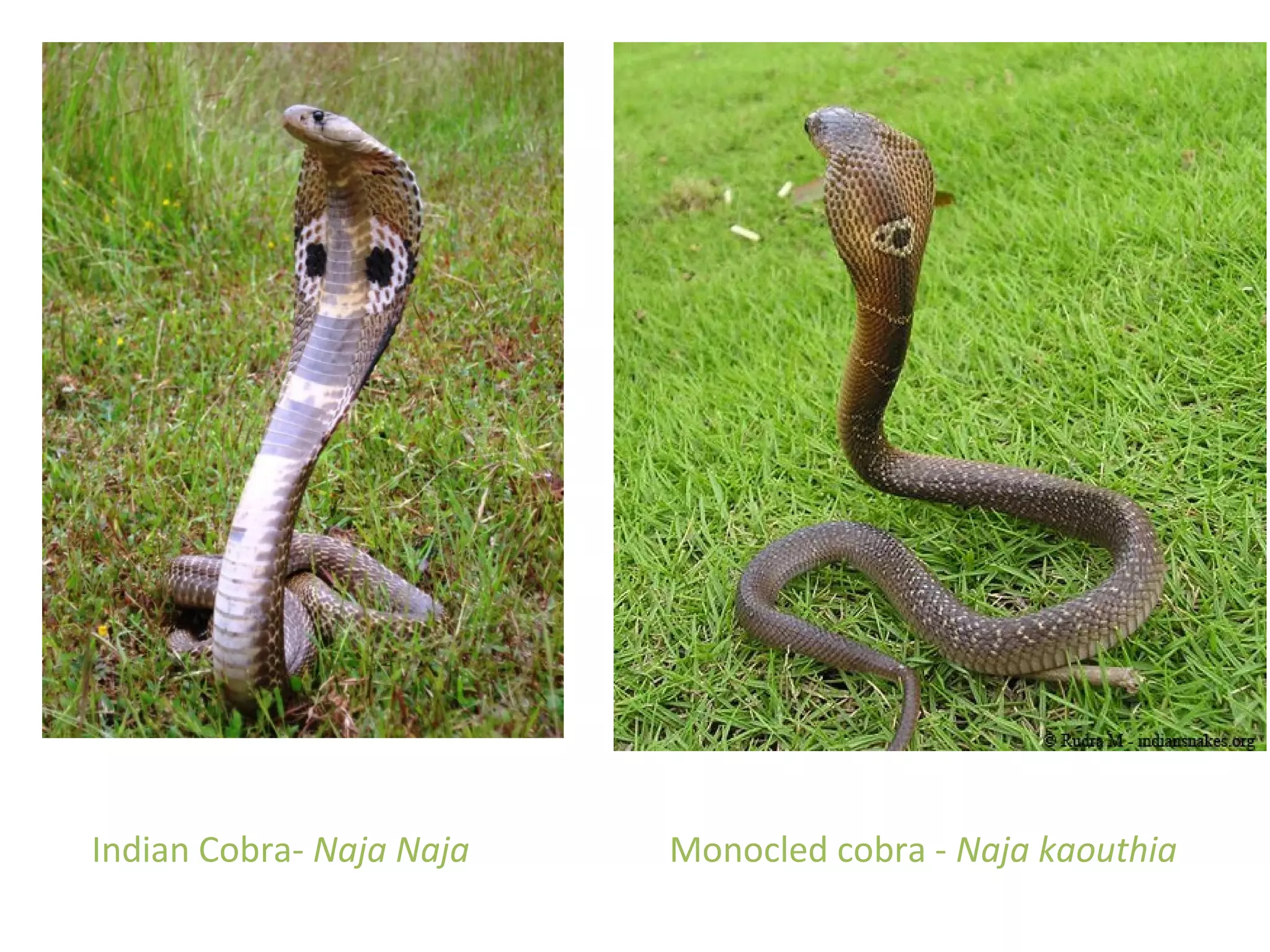
Indian Cobra- Naja Naja Monocled cobra - Naja kaouthia
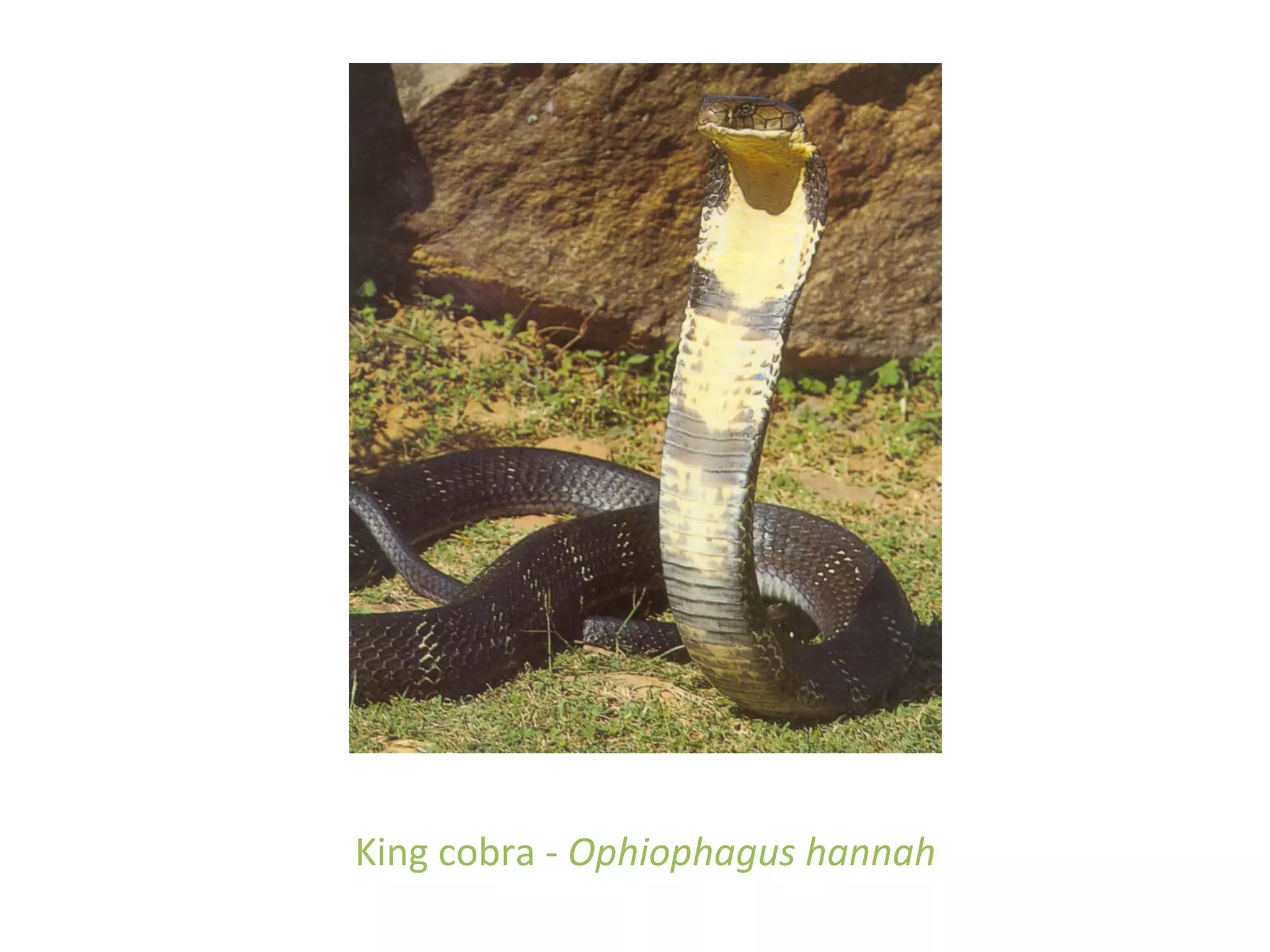
King cobra - Ophiophagus hannah
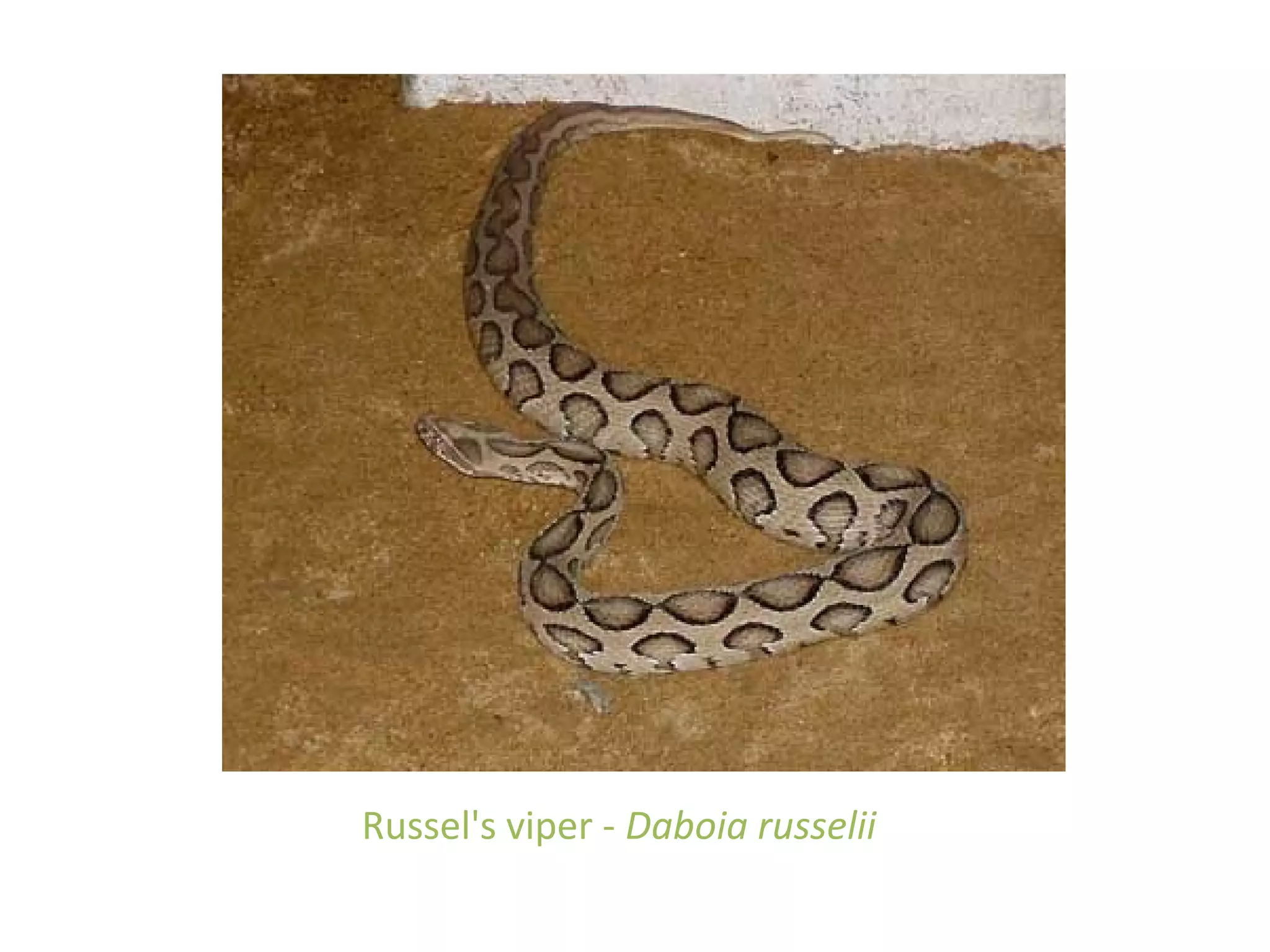
Russel's viper - Daboia russelii
Saw-scale d viper Echis carinatus
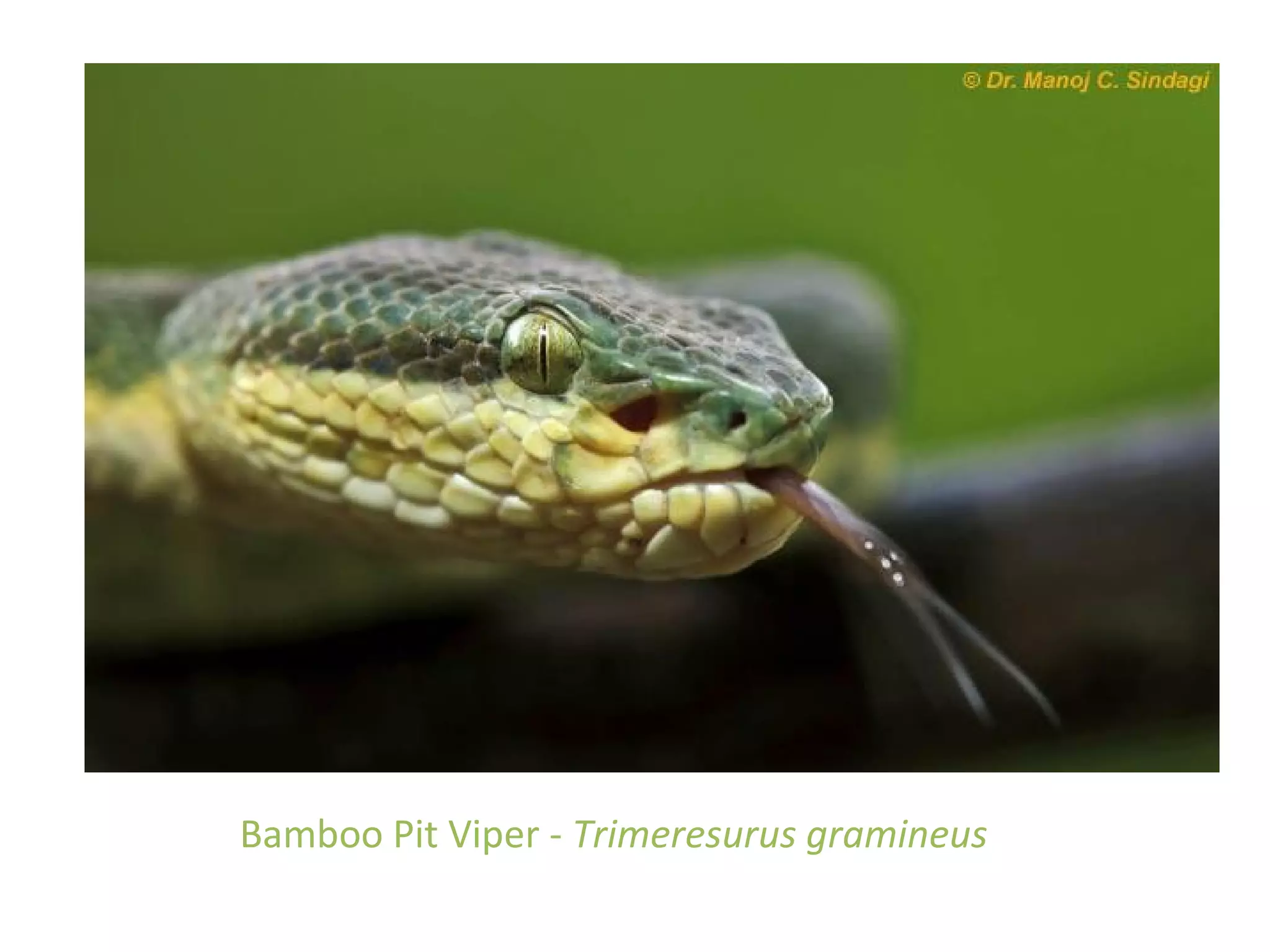
Bamboo Pit Viper - Trimeresurus gramineus
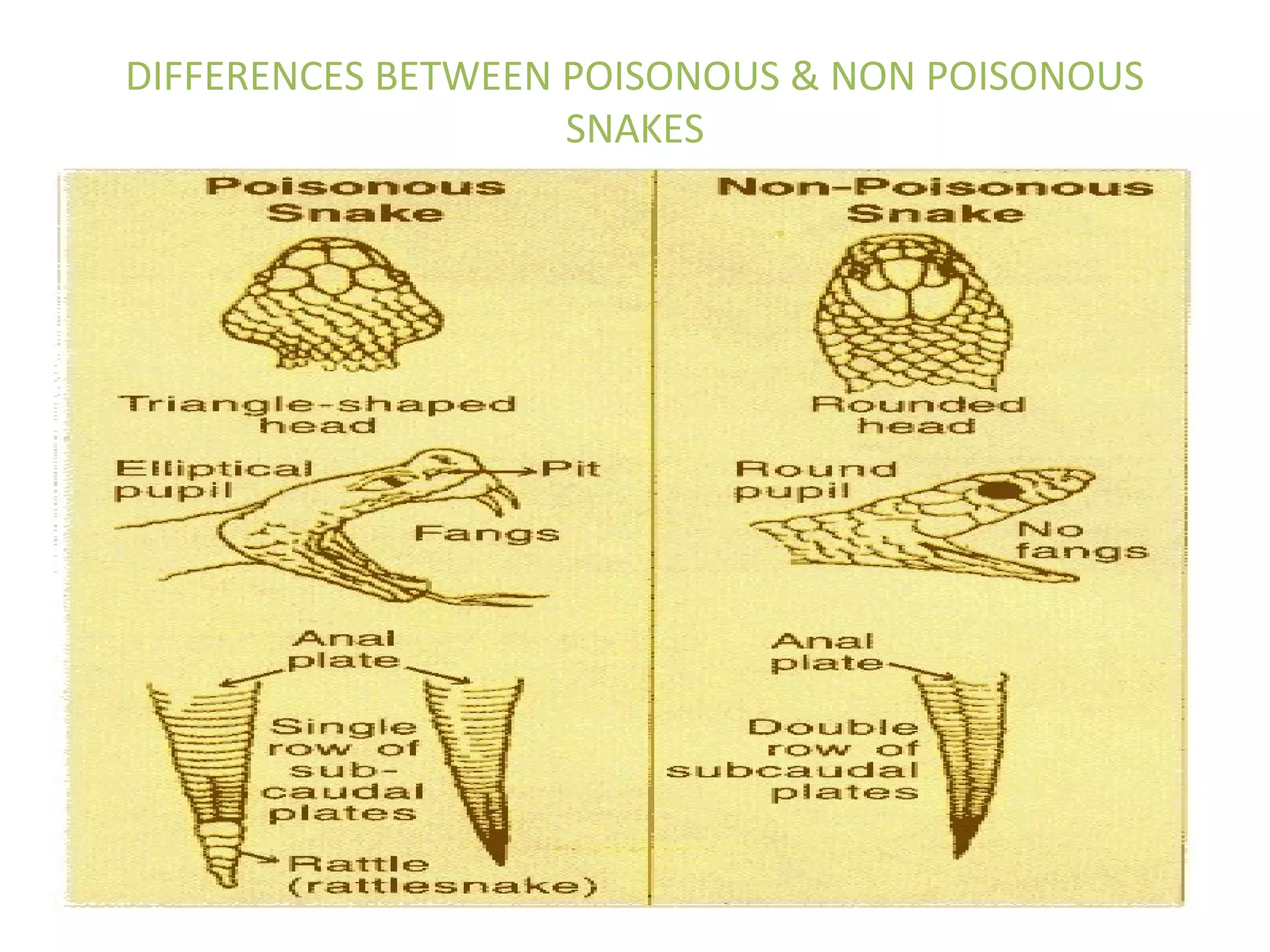
POISONOUS & NON POISONOUS SNAKES
DIFFERENCES BETWEEN POISONOUS & NON POISONOUS
SNAKES
SNAKE VENOM
• Snake venoms are generally produced in specific venom glands,
derived from salivary glands.
• The venom, once produced, is delivered by a duct to the fang
base, where it is transported into the victim either by a groove in
the fang, or through a fang duct.
Contnd.
Medical classification of snake venom activities.
Toxin activity type Clinical effects
Neurotoxin Flaccid paralysis
Presynaptic - Resistant to late antivenom
therapy
Postsynaptic - Often reversal with
antivenom therapy
Anticholinesterase - Fasciculation
Myotoxin Systemic skeletal muscle
damage
Haemostatic system toxins Interfere with normal haemostasis,
causing either bleeding or
thrombosis
Contnd.
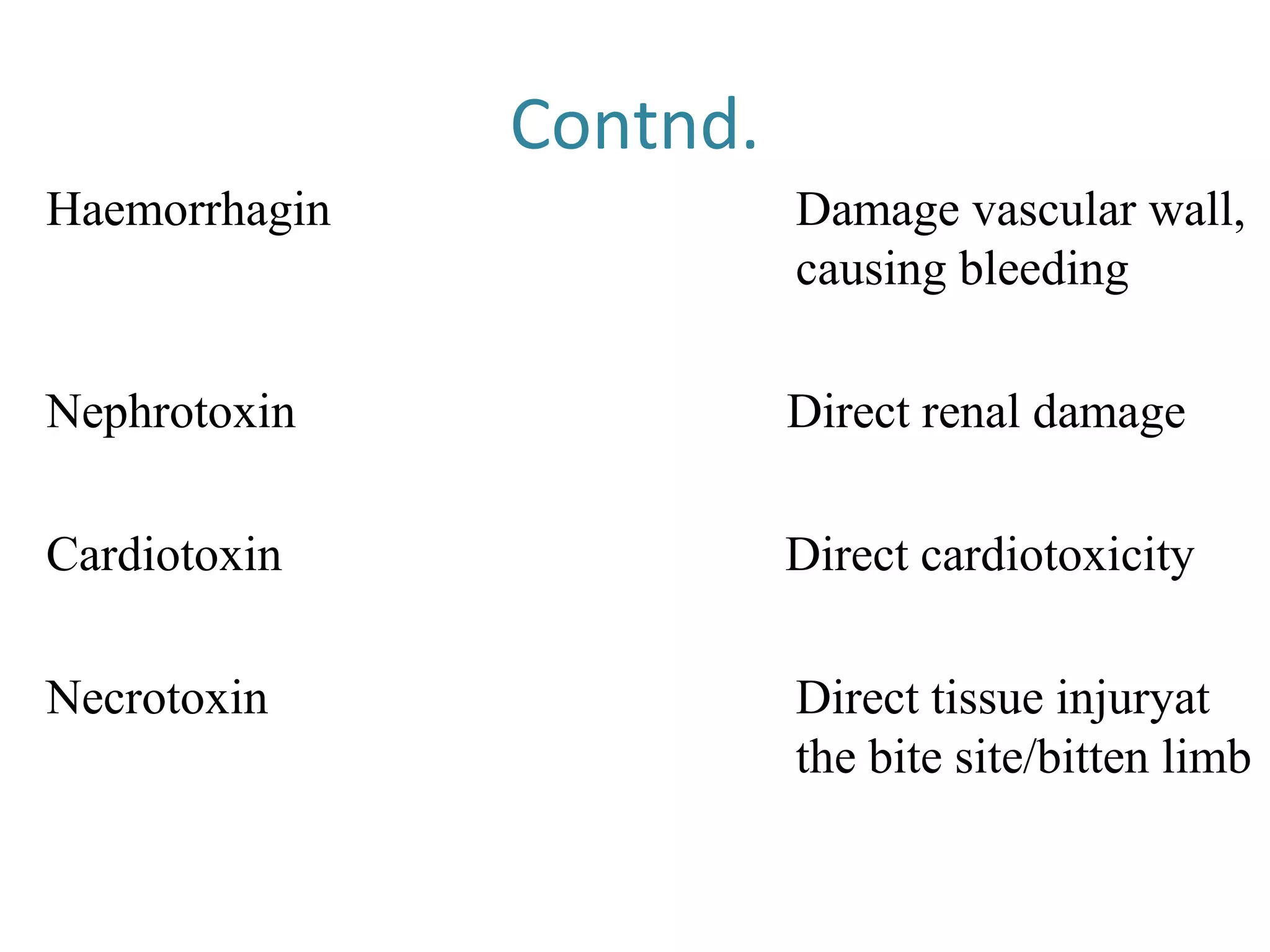
Haemorrhagin Damage vascular wall,
causing bleeding
Nephrotoxin Direct renal damage
Cardiotoxin Direct cardiotoxicity
Necrotoxin Direct tissue injuryat
the bite site/bitten limb
Snake venom• Procoagulant enzymes
– DIC-“consumption coagulopathy”
–non clotting blood
– Viperidae
• Zinc metalloproteinase
haemorrhagins
– Damage vascular endothelium –
bleeding
• Hyaluaronidase
– Promotes the spread of
venom through tissues.
• Proteolytic enzymes
(metalloproteinases, endopeptidases
or hydrolases) & polypetide
cytotoxins (“cardiotoxins”)
– ↑ vascular permeability causing
oedema, blistering, bruising and
necrosis at the site of the bite
• Phospholipase A2
(lecithinase )
– damages mitochondria, red
blood cells, leucocytes,
platelets, peripheral nerve
endings
– damages skeletal muscle,
vascular endothelium
– produces presynaptic
neurotoxic activity
• Venom polypeptide
toxins (“neurotoxins”)
– Postsynaptic (α) neurotoxins
such as α-bungarotoxin and
cobrotoxin,
– Presynaptic (β) neurotoxins
such as β-bungarotoxin,
crotoxin and taipoxin,
Contnd.
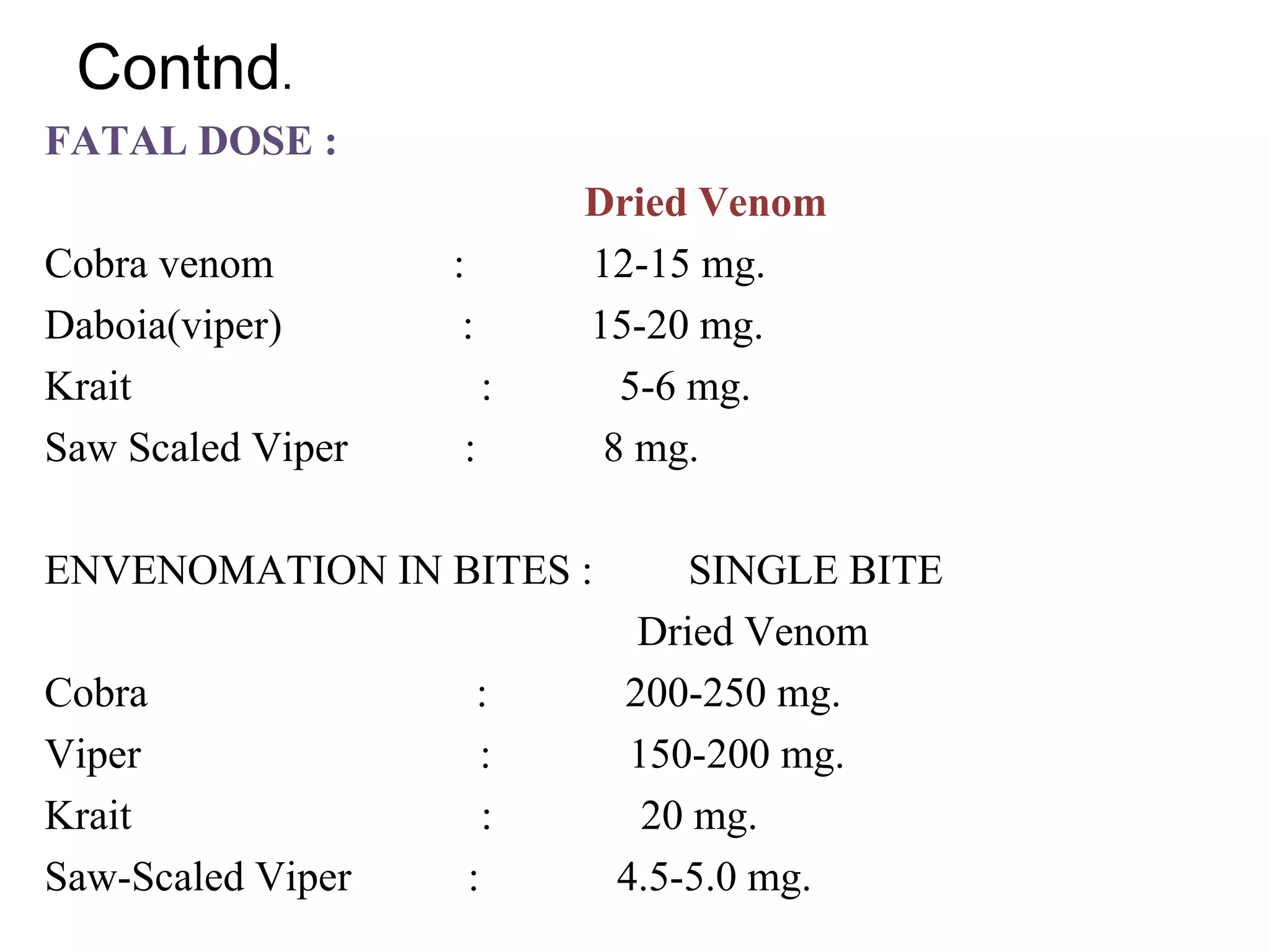
FATAL DOSE :
Dried Venom
Cobra venom : 12-15 mg.
Daboia(viper) : 15-20 mg.
Krait : 5-6 mg.
Saw Scaled Viper : 8 mg.
ENVENOMATION IN BITES : SINGLE BITE
Dried Venom
Cobra : 200-250 mg.
Viper : 150-200 mg.
Krait : 20 mg.
Saw-Scaled Viper : 4.5-5.0 mg.
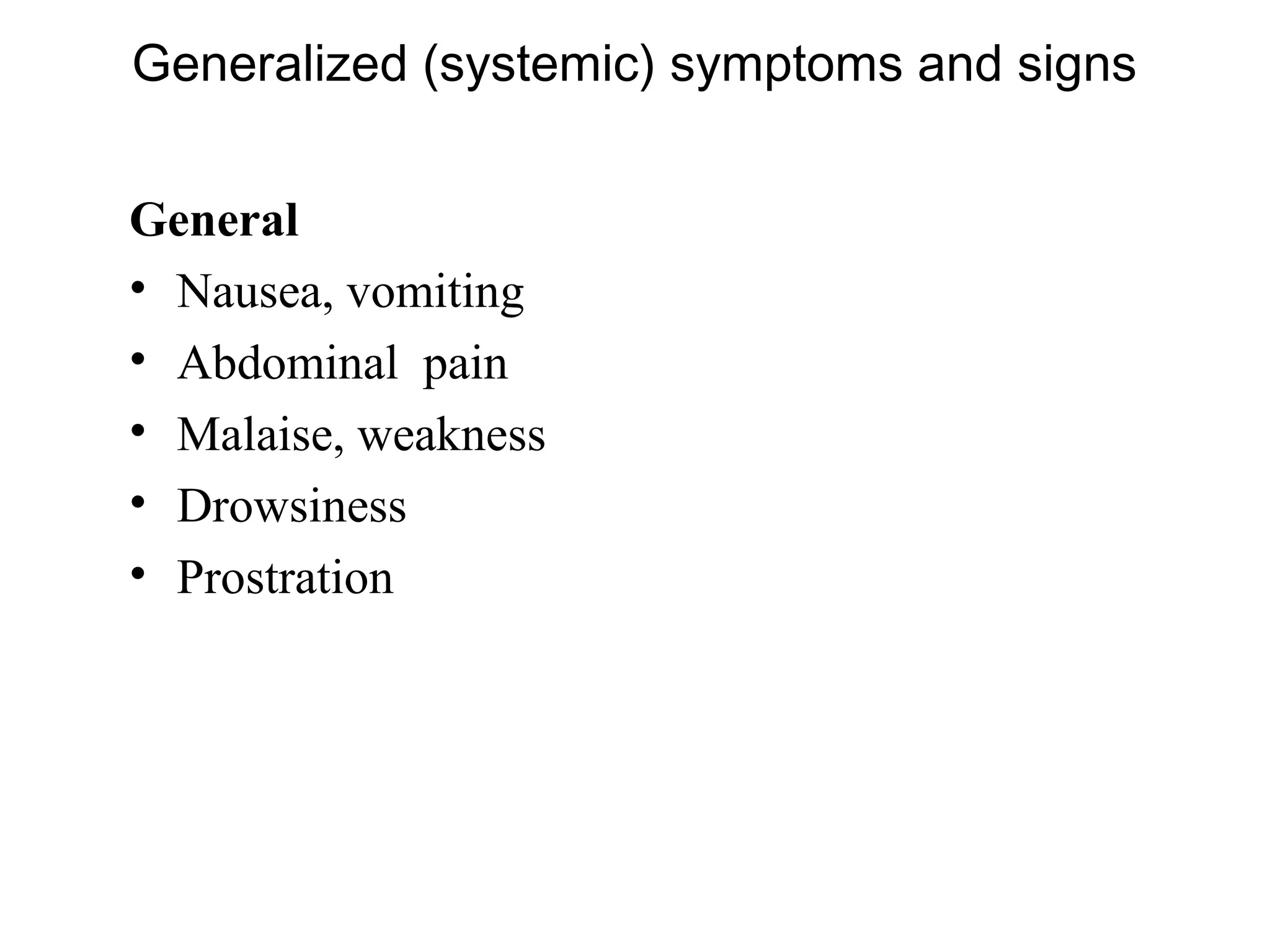
Generalized (systemic) symptoms and signs
General
• Nausea, vomiting
• Abdominal pain
• Malaise, weakness
• Drowsiness
• Prostration
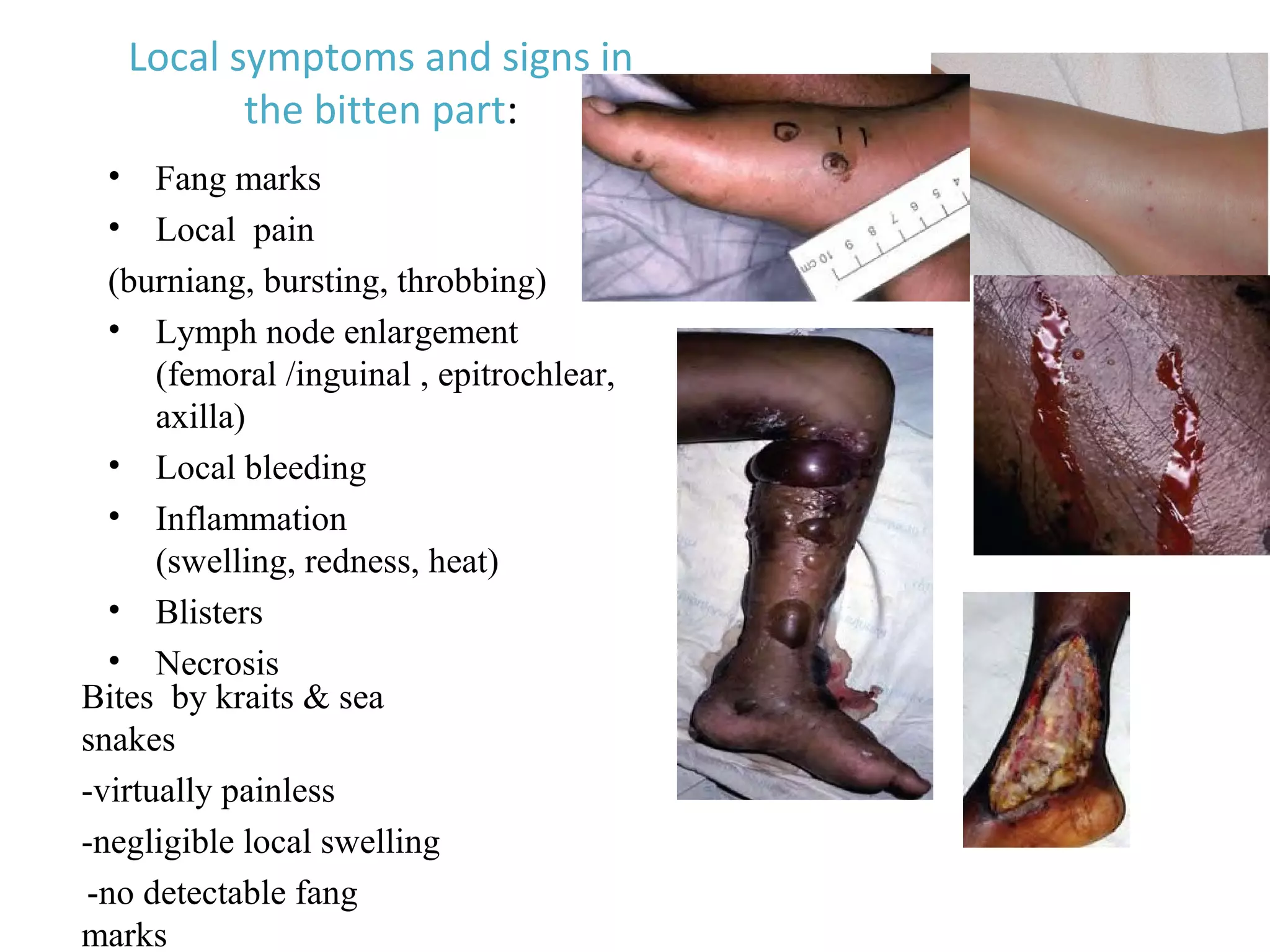
Local symptoms and signs in
the bitten part:
• Fang marks
• Local pain
(burniang, bursting, throbbing)
• Lymph node enlargement
(femoral /inguinal , epitrochlear,
axilla)
• Local bleeding
• Inflammation
(swelling, redness, heat)
• Blisters
• Necrosis
Bites by kraits & sea
snakes
-virtually painless
-negligible local swelling
-no detectable fang
marks
Neurological (Elapidae,
Russell’s viper)
• Drowsiness, paraesthesiae
• Abnormalities of taste and smell
• “Heavy” eyelids, ptosis
• External ophthalmoplegia
Diplopia
• Descending paralysis of facial
muscles and other muscles
innervated by the cranial nerves
• Nasal regurgitation
• Difficulty in swallowing
secretions
• Respiratory and generalised
flaccid paralysis.
Bleeding
(Viperidae)
• Traumatic bleeding
– fang marks /venipunctures
Spontaneous systemic bleeding
– gums
– epistaxis
– haemoptysis , haematemesis,
haematuria
– bleeding into the mucosae (e.g.
conjunctivae )
– bleeding into the skin (petechiae,
purpura, discoid haemorrhages and
ecchymoses)
– bleeding into the retina
– intracranial haemorrhage
– rectal bleeding or melaena
– vaginal bleeding
– ante-partum haemorrhage in pregnant
women
Cerebral arterial thrombosis
(Russell’s viper)
• Thrombotic strokes,
confirmed by angiography
or imaging, are reported
rarely after envenoming by
D. russelii
Skeletal muscle breakdown
(Rhabdomyolysis)
• Generalized pain
• Stiffness and tenderness of
muscles
• Trismus
• Myoglobinuria (Coca-
Cola-coloured)
• Acute renal failure
• Hyperkalaemia
• Cardiac arrest
• Sea snakes
• Russell’s viper ( Daboia russelii )
• Krait species –Bungarus niger
and B. candidus
Renal
• Loin (lower back) pain
• Haematuria
• Haemoglobinuria
• Myoglobinuria
• Oliguria /anuria
• Symptoms and signs of
uraemia (acidotic
breathing)
• Hiccups, nausea
• Viperidae
• Sea snakes
Cardiovascular
Viperidae
• Dizziness, faintness
• Collapse, shock
• Hypotension
• Cardiac arrhythmias,
pulmonary oedema
ManageMent
First aid treatment
"First, do no
harm."
Aims of first-aid
• Attempt to retard systemic absorption of venom.
• Preserve life and prevent complications before the patient can
receive medical care
• Arrange the transport of the patient to a place where they can
receive medical care.
First aid“Do Nots”
Do not panic
• Reassure
– 70% of all snakebites-
non-venomous
– only 50% of bites from
venomous snakes
envenomate the patient
( So only 15% of all
snake bites
envenomate the
patient)
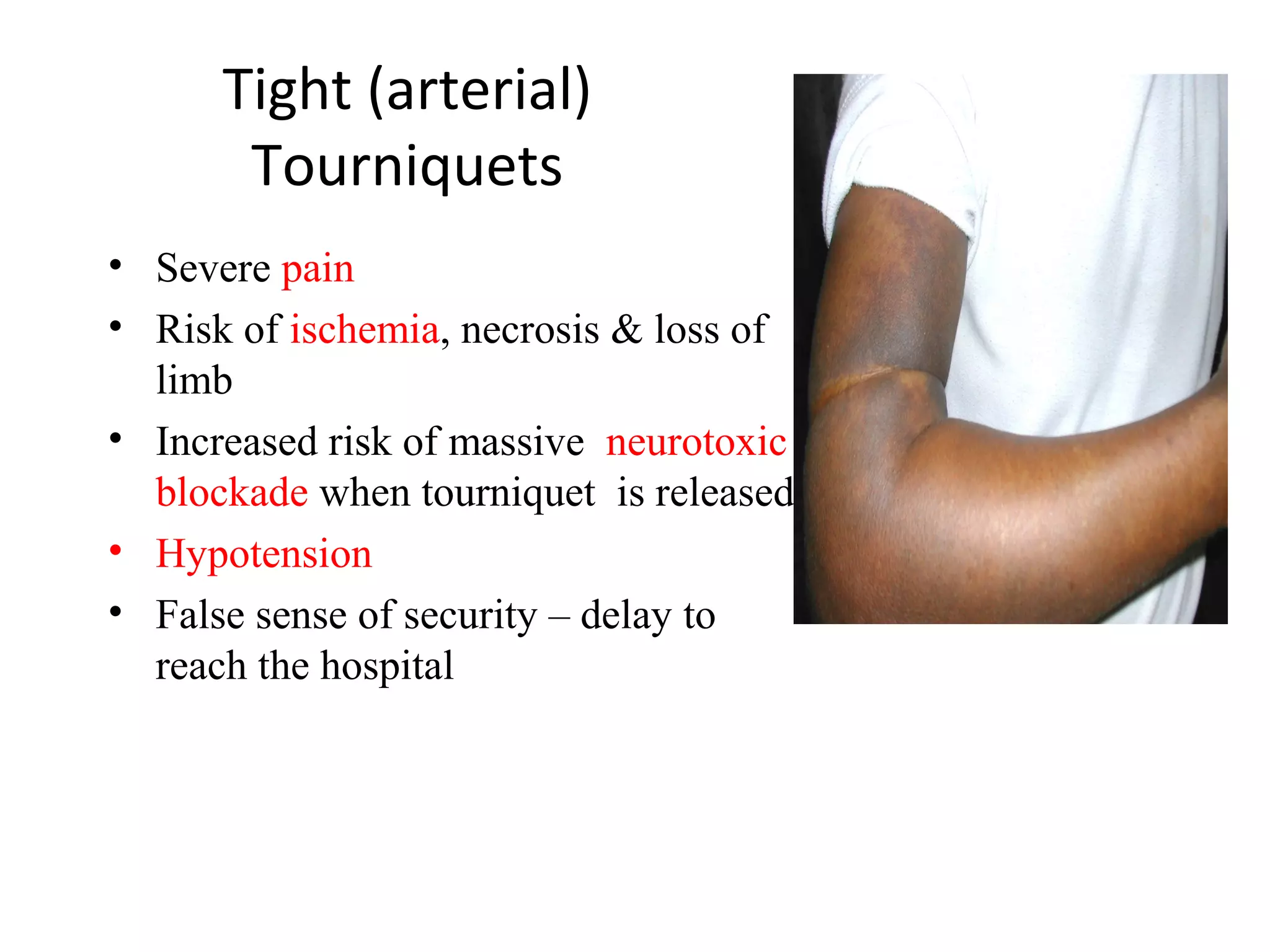
Tight (arterial)
Tourniquets
• Severe pain
• Risk of ischemia, necrosis & loss of
limb
• Increased risk of massive neurotoxic
blockade when tourniquet is released
• Hypotension
• False sense of security – delay to
reach the hospital
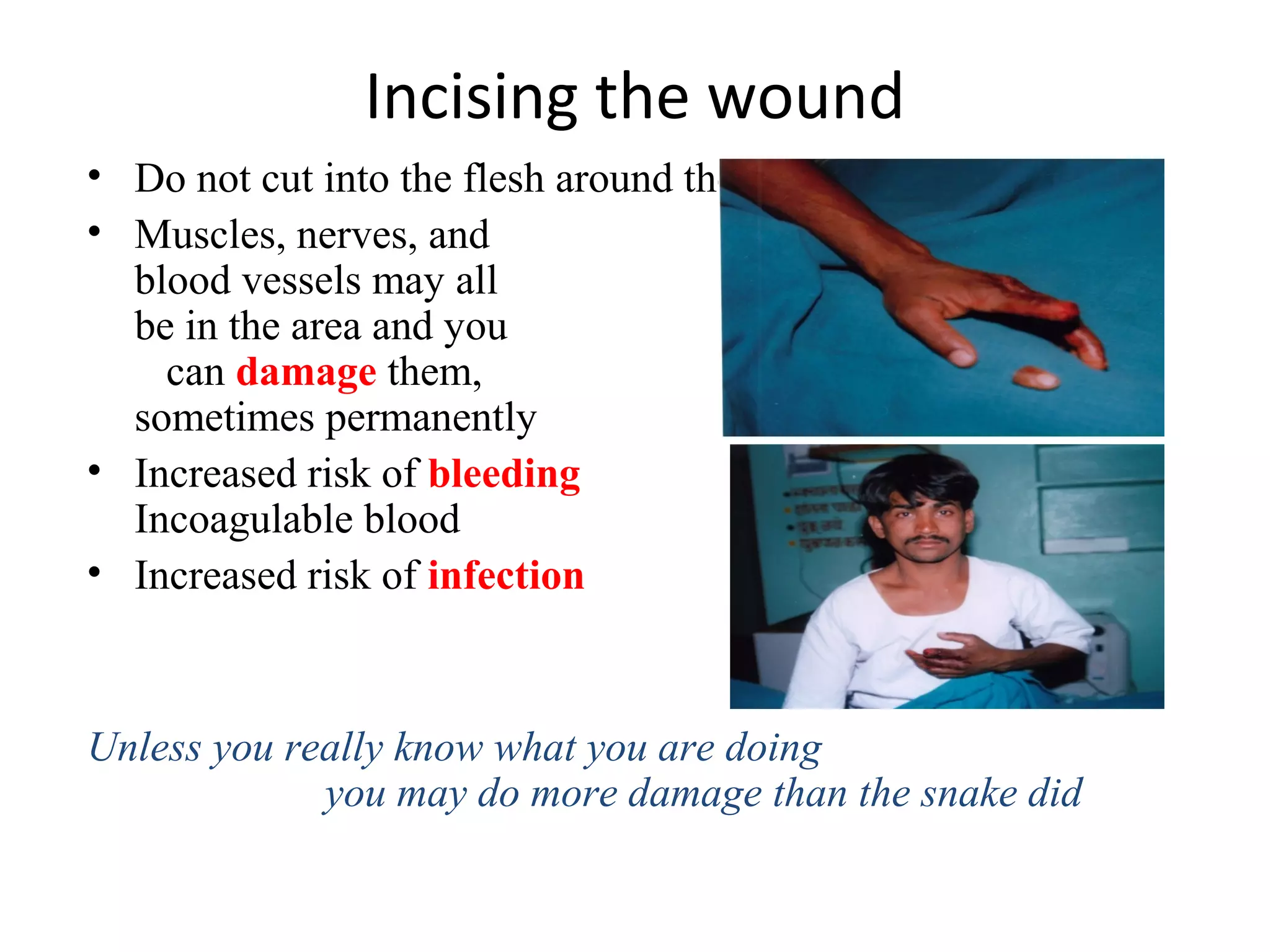
Incising the wound
• Do not cut into the flesh around the fang marks.
• Muscles, nerves, and
blood vessels may all
be in the area and you
can damage them,
sometimes permanently
• Increased risk of bleeding –
Incoagulable blood
• Increased risk of infection
Unless you really know what you are doing
you may do more damage than the snake did
Oral Suction
• Sucking venom by mouth is unlikely to be of any benefit, risks
venom getting into your bloodstream via an open sore
• More likely to be a source of infection for the wound
Washing
• The bite site should not be washed so that the area can be
swabbed for venom detection.
• Act of washing accelerates lymphatic flow
First aid “Do’s”• Reassure
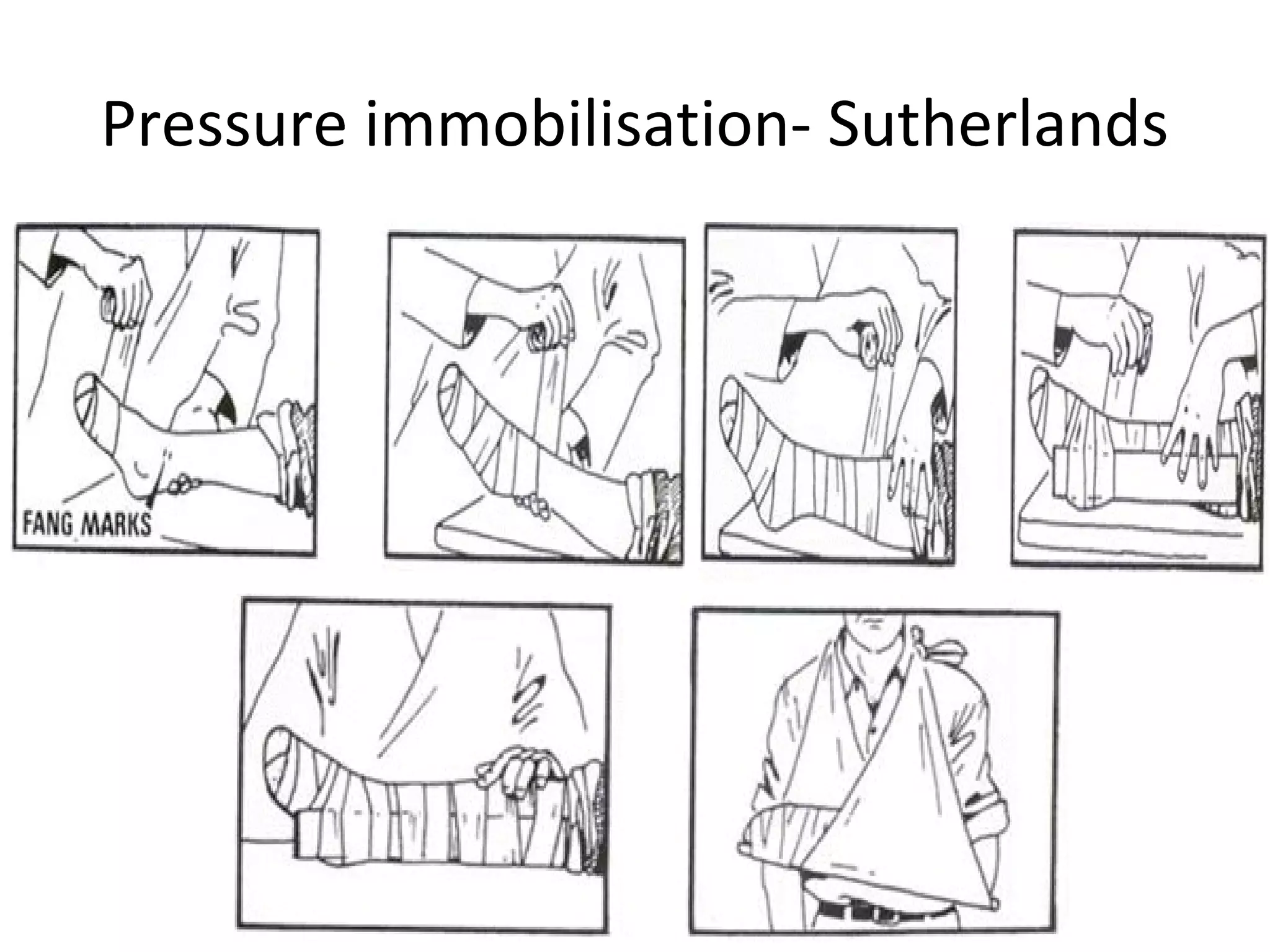
• Lay flat on the ground
• Immobilize the bitten
limb with splint or
sling
• Get to Hospital fast
• Tell the doctor about
signs such as bleeding,
shock or drooping
eyelids that develop
on way to hospital
• Do it R. I. G. H. T
• Remove shoes, rings,
watches, jewelry & tight
clothing's from the
bitten part of the body
Pressure immobilisation- Sutherlands
Rush the patient to hospital...
….
Diagnosis
• Diagnosis is crucial in effective
management of snake bites
• “Is this a snake bite or some other
condition?”
• If it’s a snake bite;
– What type of snake was responsible
– Is there significant envenoming
present?
– To what extent?
Species diagnosis
• Dead snake
• Circumstances
• ‘Syndrome approach’ – clinical symptoms
• Antigen detection by ELISA technique
Diagnosis cont….
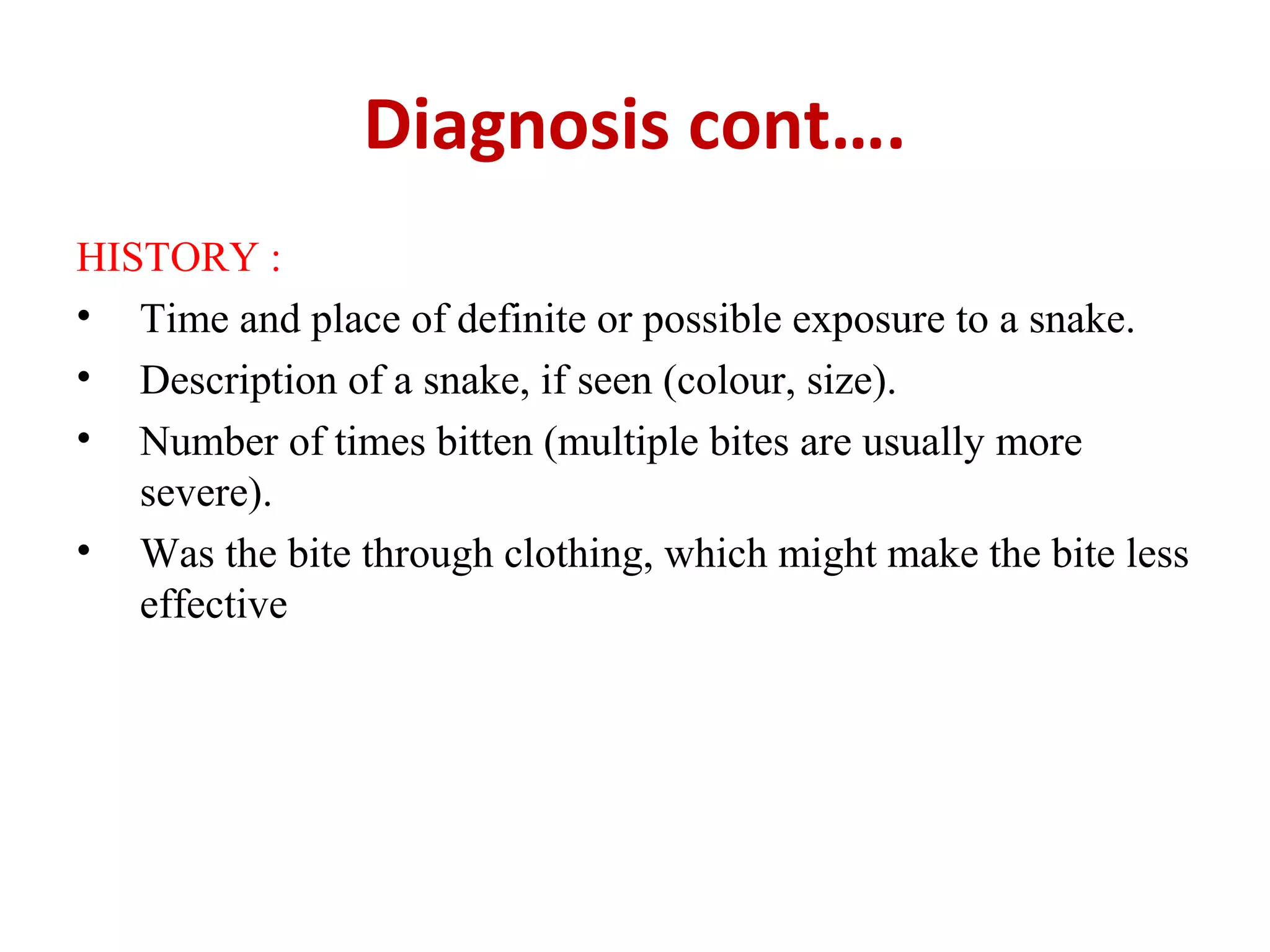
HISTORY :
• Time and place of definite or possible exposure to a snake.
• Description of a snake, if seen (colour, size).
• Number of times bitten (multiple bites are usually more
severe).
• Was the bite through clothing, which might make the bite less
effective
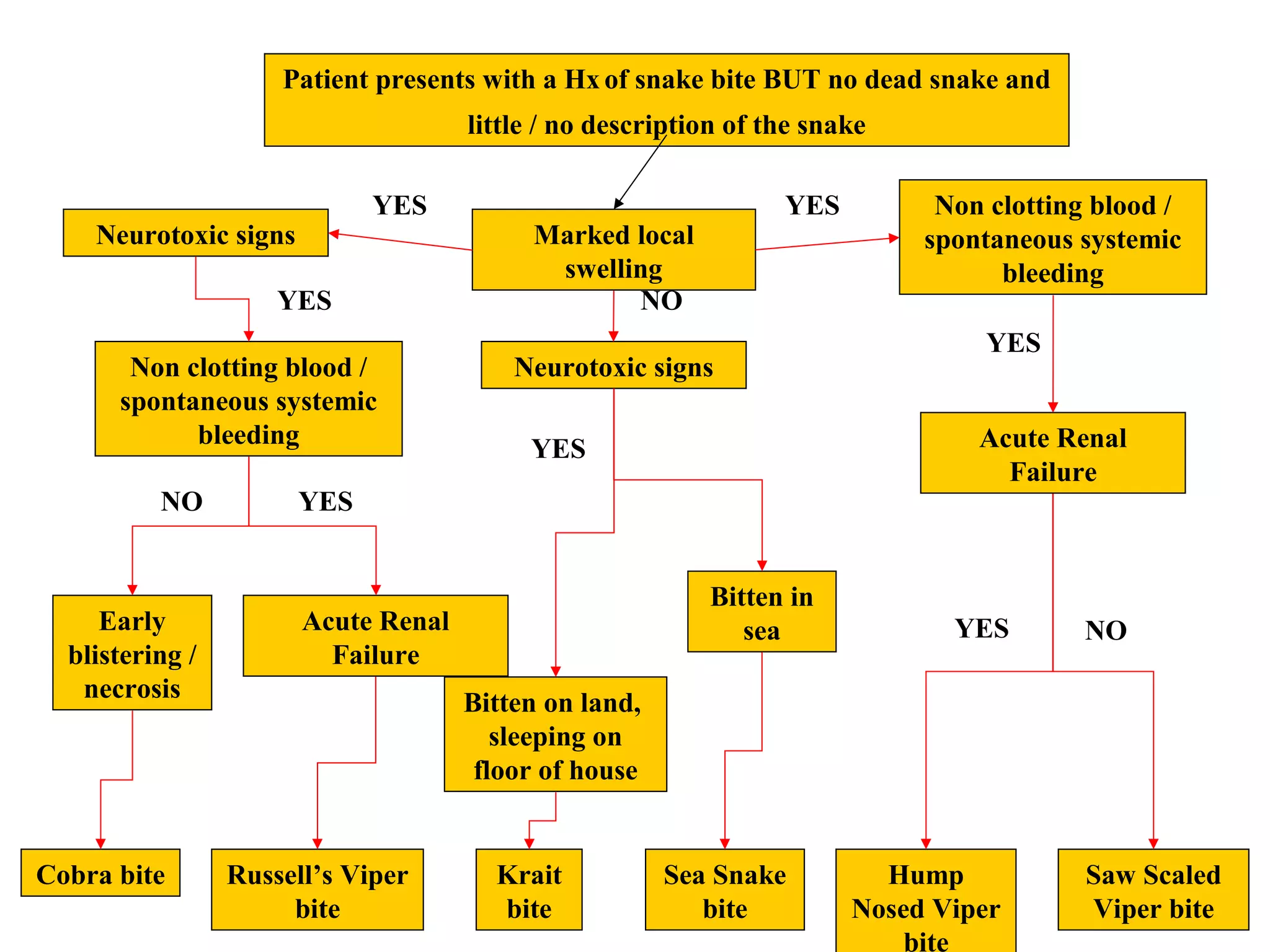
Patient presents with a Hx of snake bite BUT no dead snake and
little / no description of the snake
Acute Renal
Failure
YES
Early
blistering /
necrosis
NO
Cobra bite Russell’s Viper
bite
Marked local
swelling
Neurotoxic signs
YES Non clotting blood /
spontaneous systemic
bleeding
YES
Neurotoxic signs
NO
Bitten in
sea
Krait
bite
Sea Snake
bite
Bitten on land,
sleeping on
floor of house
YES
Hump
Nosed Viper
bite
YES
Saw Scaled
Viper bite
NO
Acute Renal
Failure
YES
Non clotting blood /
spontaneous systemic
bleeding
YES
Diagnosis cont….
LABORATORY TESTS
• Twenty-minute whole blood clotting test (20WBCT) is
considered as reliable test of coagulation which can be carried out
by bedside and is considered to be superior to ‘capillary tube’
method for establishing clotting capability in snake bite.
• Extended coagulation studies; prothrombin time/international
normalised ratio (PT/INR), activated partial thromboplastin time
(apt), fibrinogen level, cross linked or d-dimer degradation
products of fibrin/ fibrinogen degradation products (XDP/FDP).
ii) Complete blood picture; especially platelet and absolute
lymphocyte counts.
iii) Electrolytes, urea, creatinine.
iv) Creatinine phosphokinase
v) Where appropriate, arterial blood gas estimation.
vi) Examination of peripheral blood smear
Specific TreaTmenT
Indian Protocol
Cont…..
• Anti-snake venom (ASV) is the mainstay of treatment. In
India, polyvalent ASV, i.e. effective against all the four
common species; Russell’s viper, common cobra, common
Krait and saw-scaled viper and no monovalent ASVs are
available
Cont…..
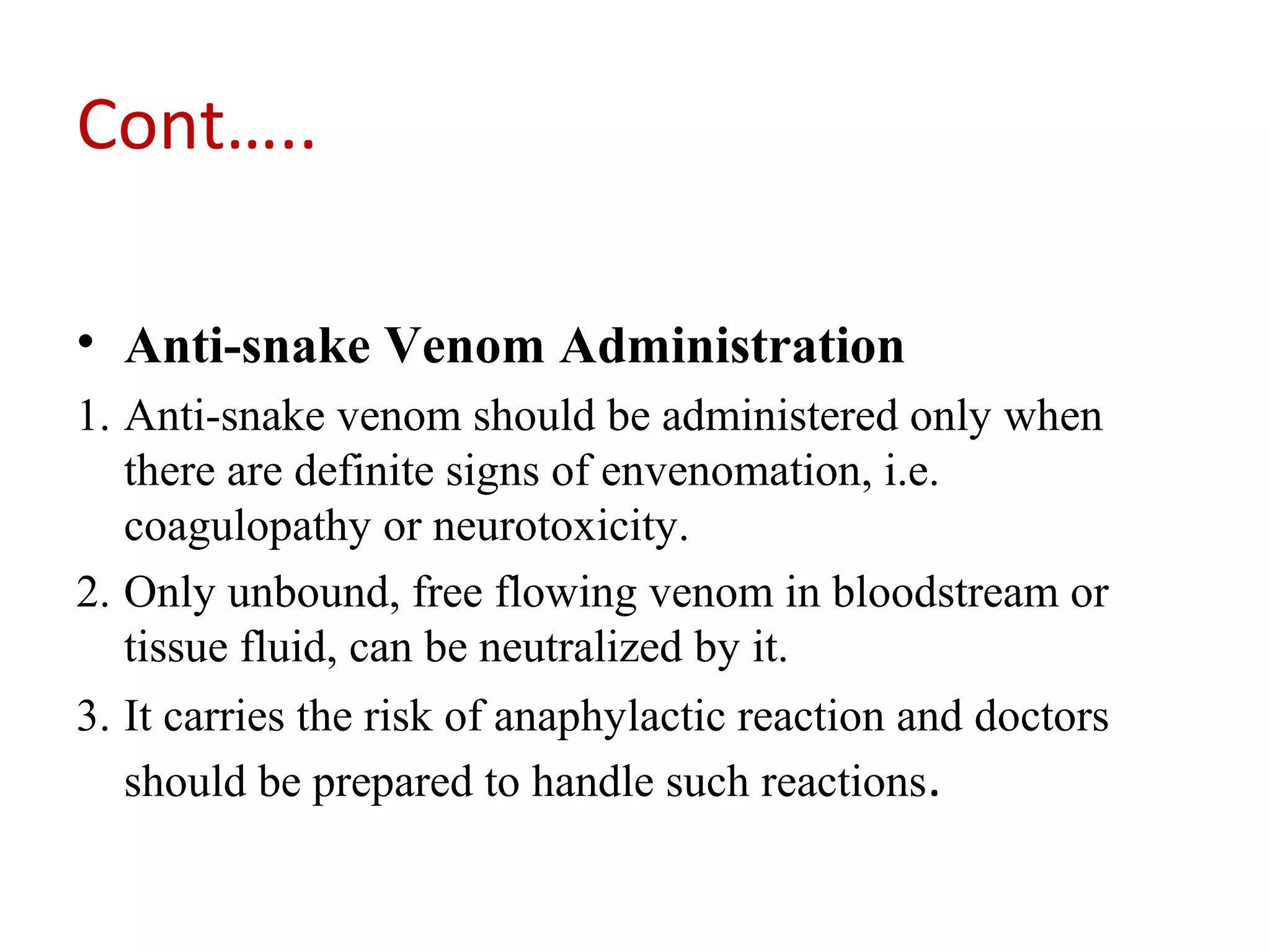
• Anti-snake Venom Administration
1. Anti-snake venom should be administered only when
there are definite signs of envenomation, i.e.
coagulopathy or neurotoxicity.
2. Only unbound, free flowing venom in bloodstream or
tissue fluid, can be neutralized by it.
3. It carries the risk of anaphylactic reaction and doctors
should be prepared to handle such reactions.
Cont…..
• Prophylaxis for Anti-snake Venom Reactions
 There are no systematic trials of sufficient power to show that
prophylactic regimes are effective in preventing ASV
reactions.
 Two regimens are normally recommended, i.e. hydrocortisone
(100 mg) + antihistamine or 0.25–0.3 mg adrenaline
subcutaneously
Cont…..
Mild envenomation (systemic
symptoms manifest > 3 hours after
bite) neurotoxic/hemotoxic 8–10
Vials
Severe envenomation (systemic
symptoms manifest < 3 hours after
bite) neurotoxic or hemotoxic 8
Vials
Each vial is 10 ml of reconstituted
ASV. Children should receive the
same ASV dosage as adults.
Initial Dose
Cont…..
• Further Doses
 It will depend on the response to the initial dose. ASV
should be administered either as intravenous infusion (5–
10 mL/kg body weight) or as slow intravenous (IV)
injection i.e. 2 mL/min).
 ASV should be administered over 1 hour at constant
speed and patient should be closely monitored for 2
hours.
Cont…..
Repeat Doses of Anti-snake Venom
After initial ASV dose, no
additional ASV should be given
until the next clotting test at 6
hours
After initial ASV dose, no
additional ASV should be given
until the next clotting test at 6
hours
repeat dose of 5–10 vials of ASV,
i.e. 1/2 1 full dose, should continue‒
6 hourly till coagulation is restored
or species is identified against
which polyvalent ASV is
ineffective.
repeat dose of 5–10 vials of ASV,
i.e. 1/2 1 full dose, should continue‒
6 hourly till coagulation is restored
or species is identified against
which polyvalent ASV is
ineffective.
If WBCT more than 20 minutesHemotoxic bite
Cont…..
Repeat Doses of Anti-snake Venom
After 1–2 hours of initial
dose, patient should be
reassessed and if symptoms
have worsened or have not
improved, a second dose of
ASV should be given.. and
should have if required.
After 1–2 hours of initial
dose, patient should be
reassessed and if symptoms
have worsened or have not
improved, a second dose of
ASV should be given.. and
should have if required.
This dose should be the same
as the initial dose, i.e. 10
vials and then discontinued
This dose should be the same
as the initial dose, i.e. 10
vials and then discontinued
Once the patient develops
respiratory failure, has
received 20 vials, ASV
therapy should be
discontinued assuming that all
the circulating venom is
neutralized
Once the patient develops
respiratory failure, has
received 20 vials, ASV
therapy should be
discontinued assuming that all
the circulating venom is
neutralized
assisted ventilationassisted ventilation
Neurotoxic
Cont…..
Neostigmine is an
anticholinesterase,
which is particularly
effective in
postsynaptic
neurotoxins such as
those of cobra and is
not useful against
presynaptic neurotoxin
i.e. common Krait and
the Russell’s viper.
Neostigmine is an
anticholinesterase,
which is particularly
effective in
postsynaptic
neurotoxins such as
those of cobra and is
not useful against
presynaptic neurotoxin
i.e. common Krait and
the Russell’s viper.
Neostigmine test should be
performed by administering 0.5–2
mg IV and if neurological
improvement occurs, it should be
continued 1/2 hourly over next 8
hours with atropin.
Neostigmine test should be
performed by administering 0.5–2
mg IV and if neurological
improvement occurs, it should be
continued 1/2 hourly over next 8
hours with atropin.
Neostigmine
Snake bite

Snake bite

  • 1.
  • 2.
    SNAKES Snakes belong tothe Class Reptilia. All snakes are placed in the Suborder Serpentes. All snakes share the common characteristics separating them from the lizards namely: Lack of eyelids & Lack of visible external ears.
  • 3.
    CLASSIFICATION OF SNAKES Thereare approximately 3,000 species of snakes globally, but only about 600 species are venomous and all of these are found in just 5 snake Families:
  • 4.
  • 5.
    Indian krait -Bungarus caeruleus
  • 6.
    Banded krait -Bungarus fasciatus
  • 7.
    Indian Cobra- NajaNaja Monocled cobra - Naja kaouthia
  • 8.
    King cobra -Ophiophagus hannah
  • 9.
    Russel's viper -Daboia russelii
  • 10.
    Saw-scale d viperEchis carinatus
  • 11.
    Bamboo Pit Viper- Trimeresurus gramineus
  • 12.
    POISONOUS & NONPOISONOUS SNAKES
  • 13.
    DIFFERENCES BETWEEN POISONOUS& NON POISONOUS SNAKES
  • 15.
    SNAKE VENOM • Snakevenoms are generally produced in specific venom glands, derived from salivary glands. • The venom, once produced, is delivered by a duct to the fang base, where it is transported into the victim either by a groove in the fang, or through a fang duct.
  • 16.
    Contnd. Medical classification ofsnake venom activities. Toxin activity type Clinical effects Neurotoxin Flaccid paralysis Presynaptic - Resistant to late antivenom therapy Postsynaptic - Often reversal with antivenom therapy Anticholinesterase - Fasciculation Myotoxin Systemic skeletal muscle damage Haemostatic system toxins Interfere with normal haemostasis, causing either bleeding or thrombosis
  • 17.
    Contnd. Haemorrhagin Damage vascularwall, causing bleeding Nephrotoxin Direct renal damage Cardiotoxin Direct cardiotoxicity Necrotoxin Direct tissue injuryat the bite site/bitten limb
  • 18.
    Snake venom• Procoagulantenzymes – DIC-“consumption coagulopathy” –non clotting blood – Viperidae • Zinc metalloproteinase haemorrhagins – Damage vascular endothelium – bleeding • Hyaluaronidase – Promotes the spread of venom through tissues. • Proteolytic enzymes (metalloproteinases, endopeptidases or hydrolases) & polypetide cytotoxins (“cardiotoxins”) – ↑ vascular permeability causing oedema, blistering, bruising and necrosis at the site of the bite • Phospholipase A2 (lecithinase ) – damages mitochondria, red blood cells, leucocytes, platelets, peripheral nerve endings – damages skeletal muscle, vascular endothelium – produces presynaptic neurotoxic activity • Venom polypeptide toxins (“neurotoxins”) – Postsynaptic (α) neurotoxins such as α-bungarotoxin and cobrotoxin, – Presynaptic (β) neurotoxins such as β-bungarotoxin, crotoxin and taipoxin,
  • 19.
    Contnd. FATAL DOSE : DriedVenom Cobra venom : 12-15 mg. Daboia(viper) : 15-20 mg. Krait : 5-6 mg. Saw Scaled Viper : 8 mg. ENVENOMATION IN BITES : SINGLE BITE Dried Venom Cobra : 200-250 mg. Viper : 150-200 mg. Krait : 20 mg. Saw-Scaled Viper : 4.5-5.0 mg.
  • 20.
    Generalized (systemic) symptomsand signs General • Nausea, vomiting • Abdominal pain • Malaise, weakness • Drowsiness • Prostration
  • 21.
    Local symptoms andsigns in the bitten part: • Fang marks • Local pain (burniang, bursting, throbbing) • Lymph node enlargement (femoral /inguinal , epitrochlear, axilla) • Local bleeding • Inflammation (swelling, redness, heat) • Blisters • Necrosis Bites by kraits & sea snakes -virtually painless -negligible local swelling -no detectable fang marks
  • 22.
    Neurological (Elapidae, Russell’s viper) •Drowsiness, paraesthesiae • Abnormalities of taste and smell • “Heavy” eyelids, ptosis • External ophthalmoplegia Diplopia • Descending paralysis of facial muscles and other muscles innervated by the cranial nerves • Nasal regurgitation • Difficulty in swallowing secretions • Respiratory and generalised flaccid paralysis.
  • 23.
    Bleeding (Viperidae) • Traumatic bleeding –fang marks /venipunctures Spontaneous systemic bleeding – gums – epistaxis – haemoptysis , haematemesis, haematuria – bleeding into the mucosae (e.g. conjunctivae ) – bleeding into the skin (petechiae, purpura, discoid haemorrhages and ecchymoses) – bleeding into the retina – intracranial haemorrhage – rectal bleeding or melaena – vaginal bleeding – ante-partum haemorrhage in pregnant women
  • 24.
    Cerebral arterial thrombosis (Russell’sviper) • Thrombotic strokes, confirmed by angiography or imaging, are reported rarely after envenoming by D. russelii
  • 25.
    Skeletal muscle breakdown (Rhabdomyolysis) •Generalized pain • Stiffness and tenderness of muscles • Trismus • Myoglobinuria (Coca- Cola-coloured) • Acute renal failure • Hyperkalaemia • Cardiac arrest • Sea snakes • Russell’s viper ( Daboia russelii ) • Krait species –Bungarus niger and B. candidus
  • 26.
    Renal • Loin (lowerback) pain • Haematuria • Haemoglobinuria • Myoglobinuria • Oliguria /anuria • Symptoms and signs of uraemia (acidotic breathing) • Hiccups, nausea • Viperidae • Sea snakes
  • 27.
    Cardiovascular Viperidae • Dizziness, faintness •Collapse, shock • Hypotension • Cardiac arrhythmias, pulmonary oedema
  • 28.
  • 29.
  • 30.
    Aims of first-aid •Attempt to retard systemic absorption of venom. • Preserve life and prevent complications before the patient can receive medical care • Arrange the transport of the patient to a place where they can receive medical care.
  • 31.
  • 32.
    Do not panic •Reassure – 70% of all snakebites- non-venomous – only 50% of bites from venomous snakes envenomate the patient ( So only 15% of all snake bites envenomate the patient)
  • 33.
    Tight (arterial) Tourniquets • Severepain • Risk of ischemia, necrosis & loss of limb • Increased risk of massive neurotoxic blockade when tourniquet is released • Hypotension • False sense of security – delay to reach the hospital
  • 34.
    Incising the wound •Do not cut into the flesh around the fang marks. • Muscles, nerves, and blood vessels may all be in the area and you can damage them, sometimes permanently • Increased risk of bleeding – Incoagulable blood • Increased risk of infection Unless you really know what you are doing you may do more damage than the snake did
  • 35.
    Oral Suction • Suckingvenom by mouth is unlikely to be of any benefit, risks venom getting into your bloodstream via an open sore • More likely to be a source of infection for the wound
  • 36.
    Washing • The bitesite should not be washed so that the area can be swabbed for venom detection. • Act of washing accelerates lymphatic flow
  • 37.
    First aid “Do’s”•Reassure • Lay flat on the ground • Immobilize the bitten limb with splint or sling • Get to Hospital fast • Tell the doctor about signs such as bleeding, shock or drooping eyelids that develop on way to hospital • Do it R. I. G. H. T • Remove shoes, rings, watches, jewelry & tight clothing's from the bitten part of the body
  • 38.
  • 39.
    Rush the patientto hospital... ….
  • 40.
    Diagnosis • Diagnosis iscrucial in effective management of snake bites • “Is this a snake bite or some other condition?” • If it’s a snake bite; – What type of snake was responsible – Is there significant envenoming present? – To what extent?
  • 41.
    Species diagnosis • Deadsnake • Circumstances • ‘Syndrome approach’ – clinical symptoms • Antigen detection by ELISA technique
  • 42.
    Diagnosis cont…. HISTORY : •Time and place of definite or possible exposure to a snake. • Description of a snake, if seen (colour, size). • Number of times bitten (multiple bites are usually more severe). • Was the bite through clothing, which might make the bite less effective
  • 43.
    Patient presents witha Hx of snake bite BUT no dead snake and little / no description of the snake Acute Renal Failure YES Early blistering / necrosis NO Cobra bite Russell’s Viper bite Marked local swelling Neurotoxic signs YES Non clotting blood / spontaneous systemic bleeding YES Neurotoxic signs NO Bitten in sea Krait bite Sea Snake bite Bitten on land, sleeping on floor of house YES Hump Nosed Viper bite YES Saw Scaled Viper bite NO Acute Renal Failure YES Non clotting blood / spontaneous systemic bleeding YES
  • 44.
    Diagnosis cont…. LABORATORY TESTS •Twenty-minute whole blood clotting test (20WBCT) is considered as reliable test of coagulation which can be carried out by bedside and is considered to be superior to ‘capillary tube’ method for establishing clotting capability in snake bite. • Extended coagulation studies; prothrombin time/international normalised ratio (PT/INR), activated partial thromboplastin time (apt), fibrinogen level, cross linked or d-dimer degradation products of fibrin/ fibrinogen degradation products (XDP/FDP). ii) Complete blood picture; especially platelet and absolute lymphocyte counts. iii) Electrolytes, urea, creatinine. iv) Creatinine phosphokinase v) Where appropriate, arterial blood gas estimation. vi) Examination of peripheral blood smear
  • 45.
  • 46.
    Cont….. • Anti-snake venom(ASV) is the mainstay of treatment. In India, polyvalent ASV, i.e. effective against all the four common species; Russell’s viper, common cobra, common Krait and saw-scaled viper and no monovalent ASVs are available
  • 47.
    Cont….. • Anti-snake VenomAdministration 1. Anti-snake venom should be administered only when there are definite signs of envenomation, i.e. coagulopathy or neurotoxicity. 2. Only unbound, free flowing venom in bloodstream or tissue fluid, can be neutralized by it. 3. It carries the risk of anaphylactic reaction and doctors should be prepared to handle such reactions.
  • 48.
    Cont….. • Prophylaxis forAnti-snake Venom Reactions  There are no systematic trials of sufficient power to show that prophylactic regimes are effective in preventing ASV reactions.  Two regimens are normally recommended, i.e. hydrocortisone (100 mg) + antihistamine or 0.25–0.3 mg adrenaline subcutaneously
  • 49.
    Cont….. Mild envenomation (systemic symptomsmanifest > 3 hours after bite) neurotoxic/hemotoxic 8–10 Vials Severe envenomation (systemic symptoms manifest < 3 hours after bite) neurotoxic or hemotoxic 8 Vials Each vial is 10 ml of reconstituted ASV. Children should receive the same ASV dosage as adults. Initial Dose
  • 50.
    Cont….. • Further Doses It will depend on the response to the initial dose. ASV should be administered either as intravenous infusion (5– 10 mL/kg body weight) or as slow intravenous (IV) injection i.e. 2 mL/min).  ASV should be administered over 1 hour at constant speed and patient should be closely monitored for 2 hours.
  • 51.
    Cont….. Repeat Doses ofAnti-snake Venom After initial ASV dose, no additional ASV should be given until the next clotting test at 6 hours After initial ASV dose, no additional ASV should be given until the next clotting test at 6 hours repeat dose of 5–10 vials of ASV, i.e. 1/2 1 full dose, should continue‒ 6 hourly till coagulation is restored or species is identified against which polyvalent ASV is ineffective. repeat dose of 5–10 vials of ASV, i.e. 1/2 1 full dose, should continue‒ 6 hourly till coagulation is restored or species is identified against which polyvalent ASV is ineffective. If WBCT more than 20 minutesHemotoxic bite
  • 52.
    Cont….. Repeat Doses ofAnti-snake Venom After 1–2 hours of initial dose, patient should be reassessed and if symptoms have worsened or have not improved, a second dose of ASV should be given.. and should have if required. After 1–2 hours of initial dose, patient should be reassessed and if symptoms have worsened or have not improved, a second dose of ASV should be given.. and should have if required. This dose should be the same as the initial dose, i.e. 10 vials and then discontinued This dose should be the same as the initial dose, i.e. 10 vials and then discontinued Once the patient develops respiratory failure, has received 20 vials, ASV therapy should be discontinued assuming that all the circulating venom is neutralized Once the patient develops respiratory failure, has received 20 vials, ASV therapy should be discontinued assuming that all the circulating venom is neutralized assisted ventilationassisted ventilation Neurotoxic
  • 53.
    Cont….. Neostigmine is an anticholinesterase, whichis particularly effective in postsynaptic neurotoxins such as those of cobra and is not useful against presynaptic neurotoxin i.e. common Krait and the Russell’s viper. Neostigmine is an anticholinesterase, which is particularly effective in postsynaptic neurotoxins such as those of cobra and is not useful against presynaptic neurotoxin i.e. common Krait and the Russell’s viper. Neostigmine test should be performed by administering 0.5–2 mg IV and if neurological improvement occurs, it should be continued 1/2 hourly over next 8 hours with atropin. Neostigmine test should be performed by administering 0.5–2 mg IV and if neurological improvement occurs, it should be continued 1/2 hourly over next 8 hours with atropin. Neostigmine

Editor's Notes

  • #48 Indian Protocol
  • #52 Mild envenomation (systemic symptoms manifest &amp;gt; 3 hours after bite) neurotoxic/hemotoxic 8–10 Vials
  • #54 Hemotoxic bite
  • #55 Neurotoxic
  • #56 Neostigmine