Downloaded 241 times




![4. Machine Learning Platforms
Providing algorithms, APIs, development and training toolkits, data, as
well as computing power to design, train, and deploy models into
applications, processes, and other machines. Currently used in a wide
range of enterprise applications, mostly involving prediction or
classification. Sample vendors: Amazon, Fractal Analytics, Google,
H2O.ai, Microsoft, SAS, Skytree, 24[7].
Imagine in Education: A concrete example of machine learning in use
is McGraw-Hill Education’s ALEKS, a web-based, intelligent assessment
and learning system, which uses graph theory to break up a domain
into concepts. The edges of the network might then be used as a
bridge to another domain. For instance, if algebra has 500 concepts, a
student might be tested when he or she begins learning, pinpointing
exactly what a student knows and doesn’t know, and then creating an
appropriate path through the learning domain that is selected based
upon the start point and then continuously revising the learning map
for that individual student.](https://image.slidesharecdn.com/aispecialbriefing-181019190917/85/Ai-in-Higher-Education-9-320.jpg)

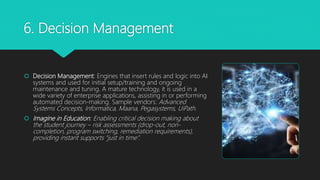
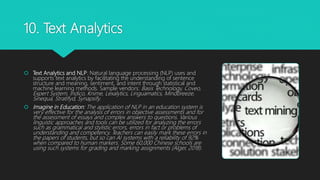




This document outlines how AI could impact higher education in 10 ways: (1) natural language generation, (2) speech recognition, (3) virtual agents, (4) machine learning platforms, (5) AI optimized hardware, (6) decision management, (7) deep learning platforms, (8) biometrics, (9) robotic process automation, and (10) text analytics. It then provides examples of current AI activities in higher education, including automated feedback/grading, intelligent tutoring, learning analytics, student support services, adaptive group formation, virtual agents, virtual reality, and personalized adaptive learning. The document concludes by noting some key concerns with AI in education, such as explainability, bias, filter bubbles,


