Region Pakistan
Muhammad Sumair Arain
An area of countryside, protected by
the state for the enjoyment of the
general public or the preservation of
wildlife
National park is relatively large
area where:
 Ecosystems can not be altered by human activity.
 Govt. has taken step to prevent exploitation.
 Visitors are allowed under special conditions.
Purpose:
 For Research purpose.
 Recreation
 To preserve and protect the natural resources for future
generations.
Prohibited acts:
Hunting, shooting, trapping, is prohibited.
Firing of guns.
Burning, destroying, removal of plants.
Clearing of land for cultivation.
Construction of roads, railway line etc.
Polluting water flowing through national park.
Pakistan has 29 protected areas known as National Parks. As of 2012, 22 of these are under
supervision of respective provincial governments and remaining are in private care. Only some of
these are under the conservation scope of International Union for Conservation of Nature and
Natural Resources (IUCN). Protection and conservation of the environment of Pakistan was
included in the concurrent constitution of 1973. As a result, Environment Protection Ordinance was
enacted in 1983, which was mainly regulated by the Environment and Urban Affairs Division. Later,
a new system of 'Modern Protected Areas' legislation began at the provincial level which assigned
the protected areas with designations such as national parks, wildlife sanctuaries and game
reserves. Further recommendations of the national parks of the Indomalaya ecozone were
highlighted in the IUCN review of 1986. Nevertheless, the development of national parks was
mainly carried out by National Conservation Strategy of 1992. Due to more awareness about their
importance in conservation of biodiversity, 10 national parks have been established during the time
period from 1993 to 2005.
According to the 'Modern Protected Areas' legislation, a national park is a protected area set aside
by the government for the protection and conservation of its outstanding scenery and wildlife in a
natural state. It is accessible to public for research, education and recreation. In order to promote
public use, construction of roads and rest houses is permitted. Use of firearms, polluting water,
cleaning of land for cultivation, destruction of wildlife is banned in these areas. The oldest national
park is Lal Suhanra in Bahawalpur District , established in 1972. It is also the only biosphere
reserve of Pakistan. Lal Suhanra is the only national park established before the independence of
the nation in August 1947. The main purpose of this area was to protect the wildlife of Cholistan
Desert. Central Karakoram in Gilgit Baltistan is currently the largest national park in the country,
spanning over a total approximate area of 1,390,100 hectares (3,435,011.9 acres). The smallest
national park is the Ayub, covering a total approximate area of 931 hectares (2,300.6 acres).
Protected areas of Pakistan
National parks = 29
Wildlife sanctuaries =100
Game reserves = 90
Total protected areas = 219
National parks
National park Established Area District(s) Province
Ayub National
Park
--- 931 ha
(2,301 acres)
Rawalpindi Punjab
Shandure-
Phander National
Park
2012
3,312 ha
(8,184 acres)
Ghizer Gilgit Baltistan
Broghil Valley
National Park
2010 134,744 ha
(332,960 acres)
Chitral
Khyber
Pakhtunkhwa
Central
Karakoram
National Park
1993
1,390,100 ha
(3,435,012 acres)
Gilgit and Skard
u
Gilgit Baltistan
Chinji National
Park
1987 6,095 ha
(15,061 acres)
Chakwal Punjab
Chitral Gol
National Park
1984 7,750 ha
(19,151 acres)
Chitral
Khyber
Pakhtunkhwa
Deosai National
Park
1993 358,400 ha
(885,626 acres)
Skardu Gilgit Baltistan
Deva Vatala
National Park
2009 2,993 ha
(7,396 acres)
Bhimber Azad Kashmir
Ghamot National Park 2004 27,271 ha
(67,388 acres)
Neelum Azad Kashmir
Gurez 'musk deer'
National Park
2009 52,815 ha
(130,509 acres)
Neelum Azad Kashmir
Hazarganji-Chiltan
National Park
1980 15,555 ha
(38,437 acres)
Quetta Balochistan
Hingol National Park 1988 165,004 ha
(407,734 acres)
Awaran, Gwadar
and Lasbela
Balochistan
K2 National Park --- 233,468 ha
(576,912 acres)
Gilgit, Skardu Gilgit Baltistan
Kala Chitta National
Park
2009 36,965 ha
(91,343 acres)
Attock Punjab
Khunjerab National
Park
1975 226,913 ha
(560,714 acres)
Gilgit Gilgit Baltistan
Kirthar National Park 1974 308,733 ha
(762,896 acres)
Dadu Sindh
Lal Suhanra National
Park
1972 87,426 ha
(216,034 acres)
Bahawalpur Punjab
Lulusar-Dudipatsar 2003 30,375 ha Khyber
Machiara National Park 1996 13,532 ha
(33,438 acres)
Muzaffarabad Azad Kashmir
Margalla Hills National
Park
1980 17,386 ha
(42,962 acres)
Islamabad,
Rawalpindi
Punjab
Murree-Kotli Sattian-
Kahuta National Park
2009 57,581 ha
(142,286 acres)
Rawalpindi Punjab
Pir Lasura National Park 2005 5,625 ha
(13,900 acres)
Kotli Azad Kashmir
Poonch River Mahaseer
National Park
2010
4,500 ha
(11,120 acres)
Kotli, Mirpur
and
Poonch
Azad Kashmir
Qurumber National
Park
2011 74,000 ha
(182,858 acres)
Ghizer Gilgit-Baltistan
Saiful Muluk National
Park
2003 4,867 ha
(12,027 acres)
Mansehra
Khyber
Pakhtunkhwa
Sheikh Buddin National
Park
1993 15,540 ha
(38,400 acres)
Dera Ismail
Khan
Khyber
Pakhtunkhwa
Toli Pir National Park 2005 5,045 ha
(12,466 acres)
Poonch Azad Kashmir
Panjal Mastan 2005 5,045 ha
(12,466 acres)
Bagh District Azad Kashmir
List.
 Central Karakoram National Park
 Deosai National Park
 Kirthar National Park
 K2 National Park
 Khunjerab National Park
 Hingol National Park
 Broghil Valley National Park
 Laal Suhanra National Park
 Qurumber National Park
 Murree-Kotli Sattian-Kahuta National Park
 Ayub National Park
Central Karakoram National Park
(1,390,100 Hectares)
Larger mammals found in this region include the Marco Polo sheep ,
the markhor , the ibex and the urial . The snow leopard preys on
these, and also on the pikas, hares and gamebirds found here.
Other predators include the mountain weasel , the beech marten ,
the brown bear , the Asian black bear , the lynx , the red fox and
the grey wolf .The number of bird species present is low. The robin
accentor and black-throated thrush overwinter here, and vultures,
birds of prey, rosefinches, Himalayanmonals and Güldenstädt's
redstarts remain throughout the year, though they may move to
somewhat lower elevations in winter. There are three species
of lizard in the park but no amphibians.
Deosai National Park
(358,400 Hectares)
 Deosai means the land of Giants.
 Also known as central
karakuram national park.
 Established in 1993.
 This park protect the survival of
the ”Himalayan Brown Bear” and
its habitat.
The Deosai Plains are
also home to the
Himalayan Ibex, Red
Fox, Golden Marmot,
Gray Wolf, SnowLeopard.
 Birds in the park include
the Golden
Eagle, Griffon Vulture,
LaggarFalcon,Peregrine
Falcon
Species:
Himalayan Brown bear
Kirthar National Park
(308,733 Hectares)
 3rd largest park of Pakistan.
 Established in 1970.
 Located in Sindh.
 Established to protect wild Goat and sheep of
sindh.
Species:
26 Species of mammals present
including Sindh ibex, chinkara,
jackal, hyaena, jungle cats,
leopard, Pangolin, Porcupine and
mongoose.
Bird includes at least 58 hoopoe,
wabbler, kingfisher, eagles,
vultures .
 Reptiles are lizard,
geckos, chameleons,
turtles, tortoises and
snakes
Goat
K2 National Park
(233,468 Hectares)
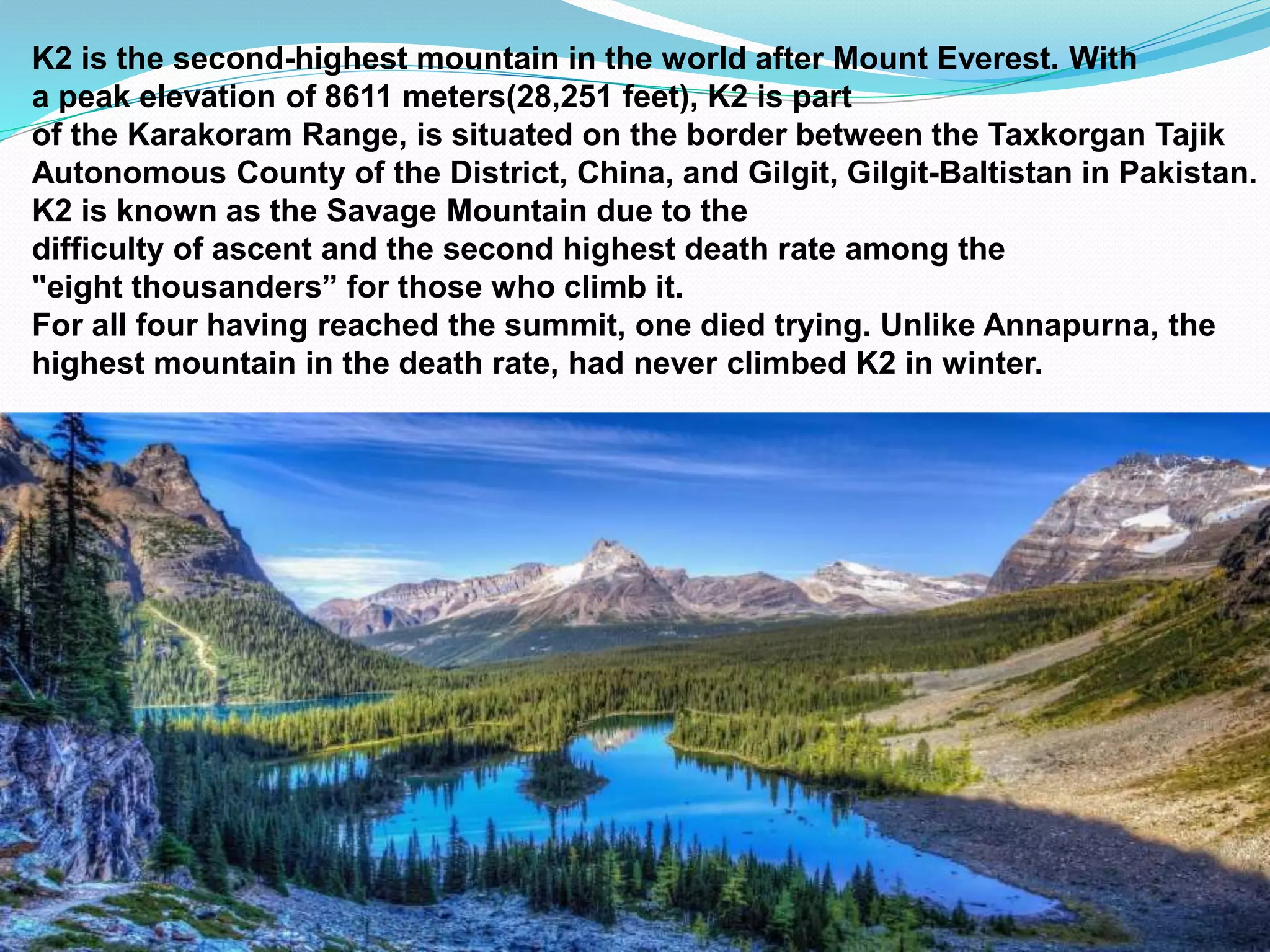
K2 is the second-highest mountain in the world after Mount Everest. With
a peak elevation of 8611 meters(28,251 feet), K2 is part
of the Karakoram Range, is situated on the border between the Taxkorgan Tajik
Autonomous County of the District, China, and Gilgit, Gilgit-Baltistan in Pakistan.
K2 is known as the Savage Mountain due to the
difficulty of ascent and the second highest death rate among the
"eight thousanders” for those who climb it.
For all four having reached the summit, one died trying. Unlike Annapurna, the
highest mountain in the death rate, had never climbed K2 in winter.
Khunjerab National Park
(226,913 Hectares)
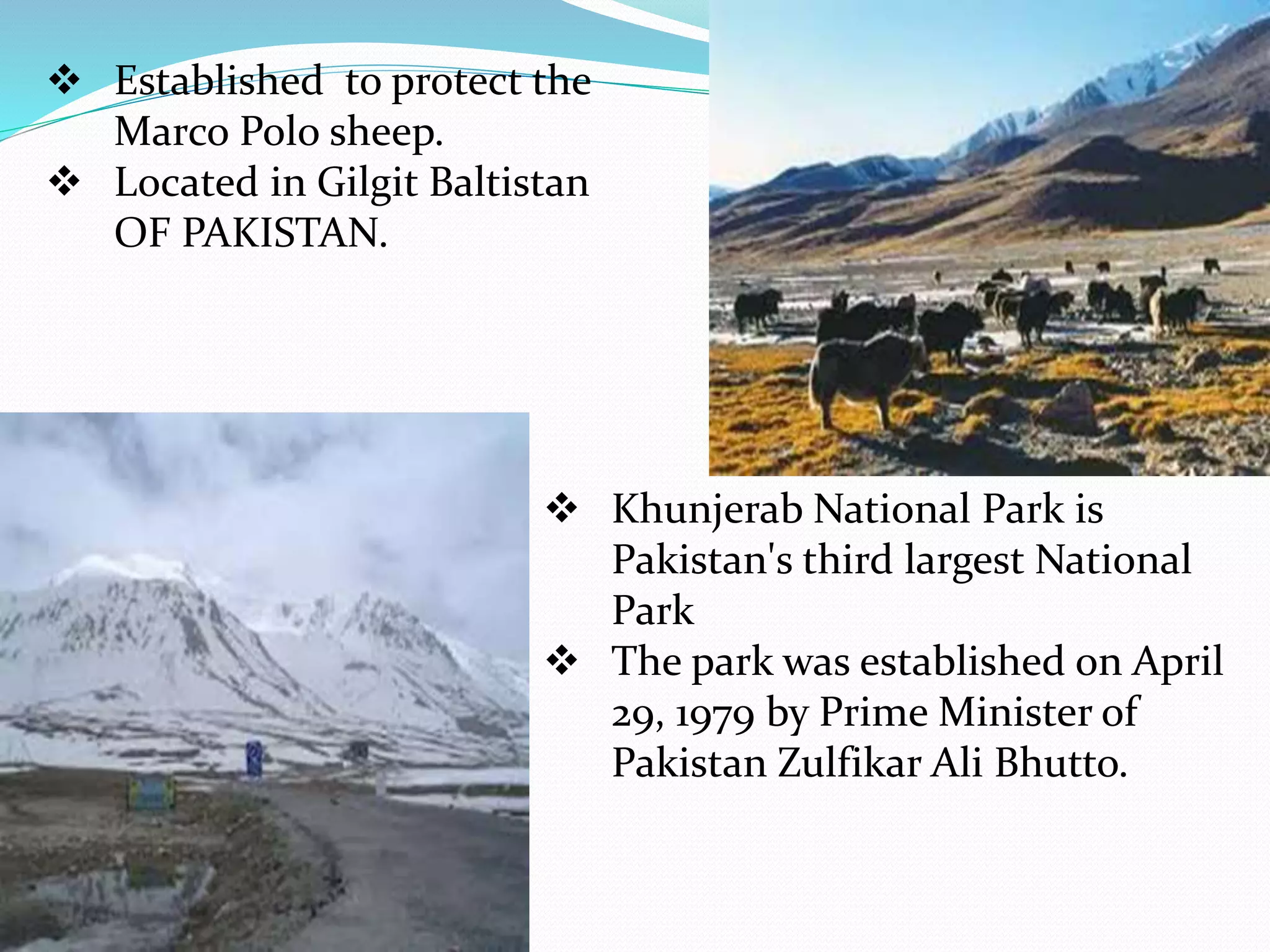
 Established to protect the
Marco Polo sheep.
 Located in Gilgit Baltistan
OF PAKISTAN.
 Khunjerab National Park is
Pakistan's third largest National
Park
 The park was established on April
29, 1979 by Prime Minister of
Pakistan Zulfikar Ali Bhutto.
Species:
Include Bharal, snow -leopard, and
Himalayan ibex,wild ass, Brown
bear..
 Bird: Golden eagle,
vulture, Marsh
harrier, Eurasian
sparrow, hawk etc.
Morcopolo sheep
Snow leopord
Hingol National Park
(165,004 Hectares)
It is located in Baluchistan.
Hingol National Park or Hungol
National Park protects 1,650 km²,
Largest National Park of Pakistan.
It was established in 1988.
Hingol National Park is known to
support at least
35 species of mammals,
65 species of amphibians and
reptiles 185 species of birds.
It covers the area of about 619043
hectares.
The park forms an excellent
habitat to wild Sindh Ibex, Afghan
Urial and Chinkara Gazelle
Total population is estimated over
3000
Broghil Valley National Park
(134,744 Hectares)
Broghil valley is one of the beautiful
valleys located in Khyber Pakhton
Khawa near Afghanistan border
Broghil valley enhances many lakes and
mountain attraction which are unique
from all over the world although it is yet
not explored by the international and
local
tourists.
It is established on 25th August 2010
It is located in Khyber Pakhtun Khwa.
It covers the area of approximately
134744 hectares.
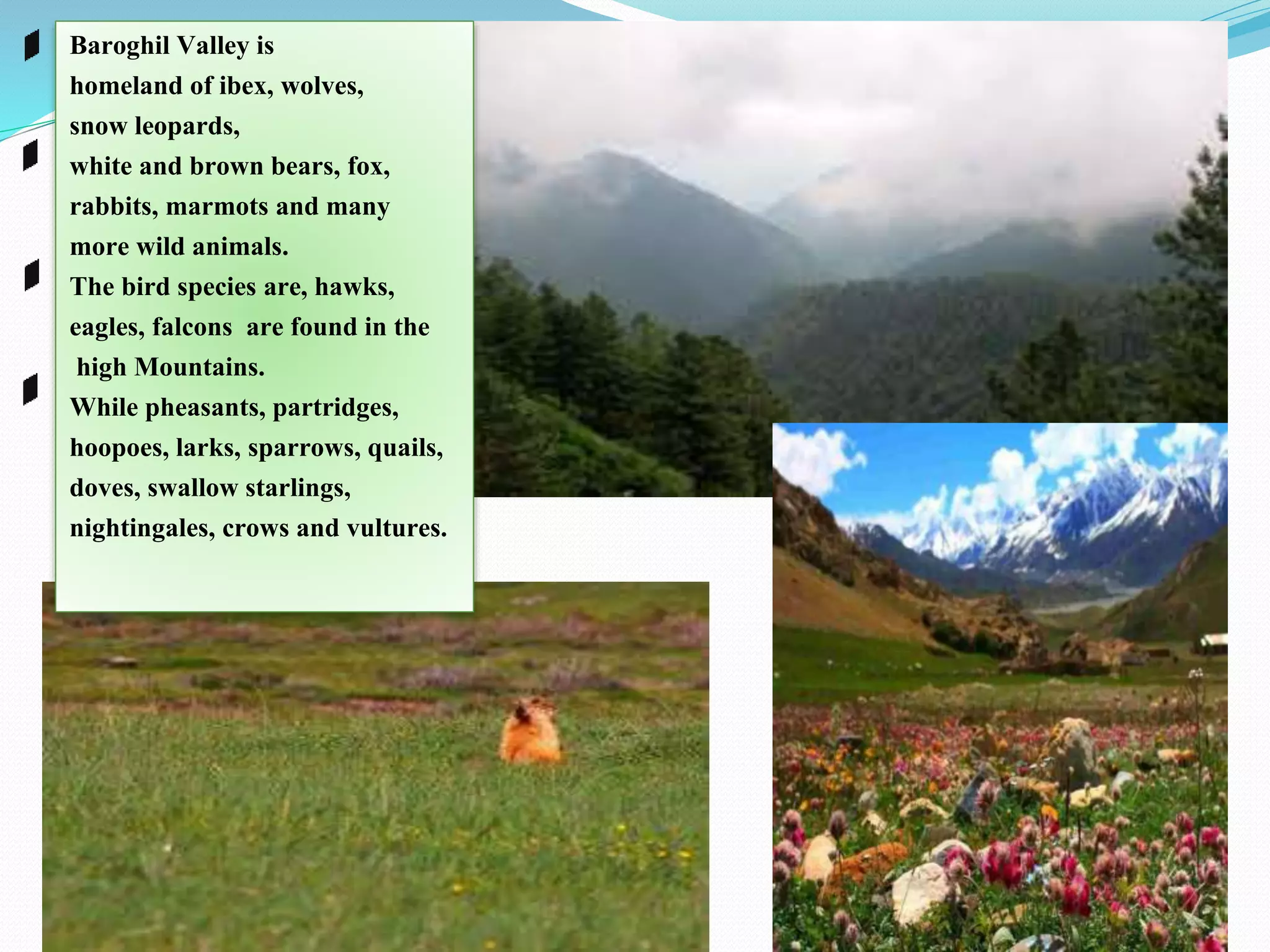
Baroghil Valley is
homeland of ibex, wolves,
snow leopards,
white and brown bears, fox,
rabbits, marmots and many
more wild animals.
The bird species are, hawks,
eagles, falcons are found in the
high Mountains.
While pheasants, partridges,
hoopoes, larks, sparrows, quails,
doves, swallow starlings,
nightingales, crows and vultures.
Laal Suhanra National Park
(87,426 Hectares)
The Punjab government has
plans to convert the
Lal Sohanra National Park into
a
wildlife safari park of
international standard.
Oldest National park of
Pakistan
Established in 1972.
Located in Bahawalpur
District.
situated
in Bahawalpur district
of Punjab province
Lal Sohanra is spread over
153000 acre,
notable for the diversity of
its landscape, which includes
areas of desert, forest and
water.
It is one of the largest nationals
parks in South Asia
Main Purpose of the
establishment of this park is to
protect the Wildlife of
Cholistan Desert,
Many species of
animals can
be found
throughout
the park.
 302 species of plants.
 119 species of birds.
 27 species of reptiles.
 3 of amphibians.
 23 species of fresh
water fish.
 Mammals: black
buck, chinkara,
nilgai, caracal,
jackal, wild boar.
Species:
Black buck
Chinkara
Qurumber National Park
(74,000 Hectares)
Murree-Kotli Sattian-Kahuta
National Park
(57,581 Hectares)
Ayub National Park
(931 Hectares)
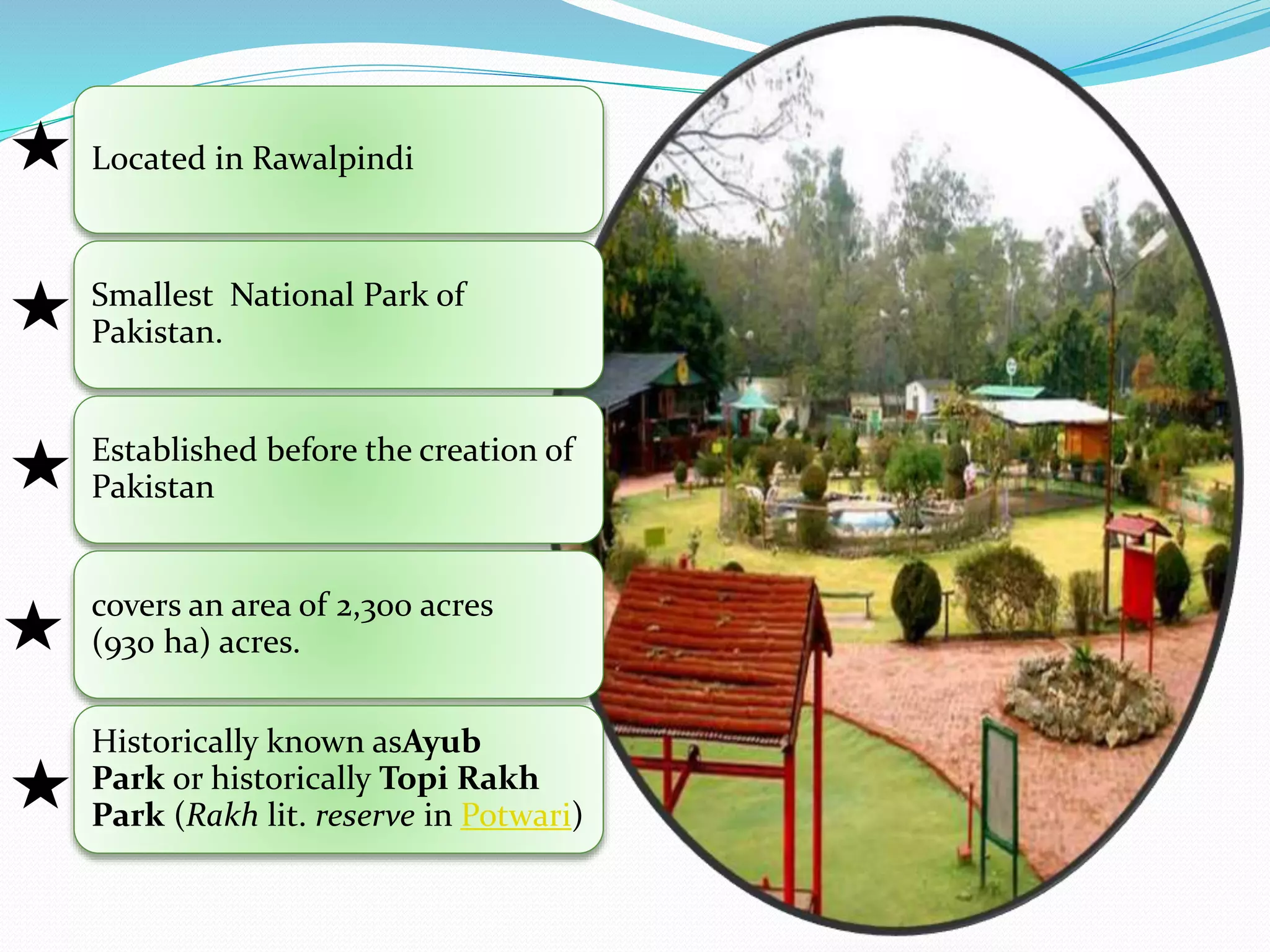
Located in Rawalpindi
Smallest National Park of
Pakistan.
Established before the creation of
Pakistan
covers an area of 2,300 acres
(930 ha) acres.
Historically known asAyub
Park or historically Topi Rakh
Park (Rakh lit. reserve in Potwari)
It has
A play area
Lake with boating
facility,
An aquarium,
A garden restaurant
An open air theater

National Parks in Pakistan

  • 1.
  • 2.
    An area ofcountryside, protected by the state for the enjoyment of the general public or the preservation of wildlife
  • 3.
    National park isrelatively large area where:  Ecosystems can not be altered by human activity.  Govt. has taken step to prevent exploitation.  Visitors are allowed under special conditions. Purpose:  For Research purpose.  Recreation  To preserve and protect the natural resources for future generations.
  • 4.
    Prohibited acts: Hunting, shooting,trapping, is prohibited. Firing of guns. Burning, destroying, removal of plants. Clearing of land for cultivation. Construction of roads, railway line etc. Polluting water flowing through national park.
  • 5.
    Pakistan has 29protected areas known as National Parks. As of 2012, 22 of these are under supervision of respective provincial governments and remaining are in private care. Only some of these are under the conservation scope of International Union for Conservation of Nature and Natural Resources (IUCN). Protection and conservation of the environment of Pakistan was included in the concurrent constitution of 1973. As a result, Environment Protection Ordinance was enacted in 1983, which was mainly regulated by the Environment and Urban Affairs Division. Later, a new system of 'Modern Protected Areas' legislation began at the provincial level which assigned the protected areas with designations such as national parks, wildlife sanctuaries and game reserves. Further recommendations of the national parks of the Indomalaya ecozone were highlighted in the IUCN review of 1986. Nevertheless, the development of national parks was mainly carried out by National Conservation Strategy of 1992. Due to more awareness about their importance in conservation of biodiversity, 10 national parks have been established during the time period from 1993 to 2005. According to the 'Modern Protected Areas' legislation, a national park is a protected area set aside by the government for the protection and conservation of its outstanding scenery and wildlife in a natural state. It is accessible to public for research, education and recreation. In order to promote public use, construction of roads and rest houses is permitted. Use of firearms, polluting water, cleaning of land for cultivation, destruction of wildlife is banned in these areas. The oldest national park is Lal Suhanra in Bahawalpur District , established in 1972. It is also the only biosphere reserve of Pakistan. Lal Suhanra is the only national park established before the independence of the nation in August 1947. The main purpose of this area was to protect the wildlife of Cholistan Desert. Central Karakoram in Gilgit Baltistan is currently the largest national park in the country, spanning over a total approximate area of 1,390,100 hectares (3,435,011.9 acres). The smallest national park is the Ayub, covering a total approximate area of 931 hectares (2,300.6 acres).
  • 6.
    Protected areas ofPakistan National parks = 29 Wildlife sanctuaries =100 Game reserves = 90 Total protected areas = 219
  • 8.
    National parks National parkEstablished Area District(s) Province Ayub National Park --- 931 ha (2,301 acres) Rawalpindi Punjab Shandure- Phander National Park 2012 3,312 ha (8,184 acres) Ghizer Gilgit Baltistan Broghil Valley National Park 2010 134,744 ha (332,960 acres) Chitral Khyber Pakhtunkhwa Central Karakoram National Park 1993 1,390,100 ha (3,435,012 acres) Gilgit and Skard u Gilgit Baltistan Chinji National Park 1987 6,095 ha (15,061 acres) Chakwal Punjab Chitral Gol National Park 1984 7,750 ha (19,151 acres) Chitral Khyber Pakhtunkhwa Deosai National Park 1993 358,400 ha (885,626 acres) Skardu Gilgit Baltistan Deva Vatala National Park 2009 2,993 ha (7,396 acres) Bhimber Azad Kashmir
  • 9.
    Ghamot National Park2004 27,271 ha (67,388 acres) Neelum Azad Kashmir Gurez 'musk deer' National Park 2009 52,815 ha (130,509 acres) Neelum Azad Kashmir Hazarganji-Chiltan National Park 1980 15,555 ha (38,437 acres) Quetta Balochistan Hingol National Park 1988 165,004 ha (407,734 acres) Awaran, Gwadar and Lasbela Balochistan K2 National Park --- 233,468 ha (576,912 acres) Gilgit, Skardu Gilgit Baltistan Kala Chitta National Park 2009 36,965 ha (91,343 acres) Attock Punjab Khunjerab National Park 1975 226,913 ha (560,714 acres) Gilgit Gilgit Baltistan Kirthar National Park 1974 308,733 ha (762,896 acres) Dadu Sindh Lal Suhanra National Park 1972 87,426 ha (216,034 acres) Bahawalpur Punjab Lulusar-Dudipatsar 2003 30,375 ha Khyber
  • 10.
    Machiara National Park1996 13,532 ha (33,438 acres) Muzaffarabad Azad Kashmir Margalla Hills National Park 1980 17,386 ha (42,962 acres) Islamabad, Rawalpindi Punjab Murree-Kotli Sattian- Kahuta National Park 2009 57,581 ha (142,286 acres) Rawalpindi Punjab Pir Lasura National Park 2005 5,625 ha (13,900 acres) Kotli Azad Kashmir Poonch River Mahaseer National Park 2010 4,500 ha (11,120 acres) Kotli, Mirpur and Poonch Azad Kashmir Qurumber National Park 2011 74,000 ha (182,858 acres) Ghizer Gilgit-Baltistan Saiful Muluk National Park 2003 4,867 ha (12,027 acres) Mansehra Khyber Pakhtunkhwa Sheikh Buddin National Park 1993 15,540 ha (38,400 acres) Dera Ismail Khan Khyber Pakhtunkhwa Toli Pir National Park 2005 5,045 ha (12,466 acres) Poonch Azad Kashmir Panjal Mastan 2005 5,045 ha (12,466 acres) Bagh District Azad Kashmir
  • 11.
    List.  Central KarakoramNational Park  Deosai National Park  Kirthar National Park  K2 National Park  Khunjerab National Park  Hingol National Park  Broghil Valley National Park  Laal Suhanra National Park  Qurumber National Park  Murree-Kotli Sattian-Kahuta National Park  Ayub National Park
  • 12.
    Central Karakoram NationalPark (1,390,100 Hectares)
  • 13.
    Larger mammals foundin this region include the Marco Polo sheep , the markhor , the ibex and the urial . The snow leopard preys on these, and also on the pikas, hares and gamebirds found here. Other predators include the mountain weasel , the beech marten , the brown bear , the Asian black bear , the lynx , the red fox and the grey wolf .The number of bird species present is low. The robin accentor and black-throated thrush overwinter here, and vultures, birds of prey, rosefinches, Himalayanmonals and Güldenstädt's redstarts remain throughout the year, though they may move to somewhat lower elevations in winter. There are three species of lizard in the park but no amphibians.
  • 14.
  • 15.
     Deosai meansthe land of Giants.  Also known as central karakuram national park.  Established in 1993.  This park protect the survival of the ”Himalayan Brown Bear” and its habitat.
  • 16.
    The Deosai Plainsare also home to the Himalayan Ibex, Red Fox, Golden Marmot, Gray Wolf, SnowLeopard.  Birds in the park include the Golden Eagle, Griffon Vulture, LaggarFalcon,Peregrine Falcon Species: Himalayan Brown bear
  • 17.
  • 18.
     3rd largestpark of Pakistan.  Established in 1970.  Located in Sindh.  Established to protect wild Goat and sheep of sindh.
  • 19.
    Species: 26 Species ofmammals present including Sindh ibex, chinkara, jackal, hyaena, jungle cats, leopard, Pangolin, Porcupine and mongoose. Bird includes at least 58 hoopoe, wabbler, kingfisher, eagles, vultures .  Reptiles are lizard, geckos, chameleons, turtles, tortoises and snakes Goat
  • 20.
  • 21.
    K2 is thesecond-highest mountain in the world after Mount Everest. With a peak elevation of 8611 meters(28,251 feet), K2 is part of the Karakoram Range, is situated on the border between the Taxkorgan Tajik Autonomous County of the District, China, and Gilgit, Gilgit-Baltistan in Pakistan. K2 is known as the Savage Mountain due to the difficulty of ascent and the second highest death rate among the "eight thousanders” for those who climb it. For all four having reached the summit, one died trying. Unlike Annapurna, the highest mountain in the death rate, had never climbed K2 in winter.
  • 22.
  • 23.
     Established toprotect the Marco Polo sheep.  Located in Gilgit Baltistan OF PAKISTAN.  Khunjerab National Park is Pakistan's third largest National Park  The park was established on April 29, 1979 by Prime Minister of Pakistan Zulfikar Ali Bhutto.
  • 24.
    Species: Include Bharal, snow-leopard, and Himalayan ibex,wild ass, Brown bear..  Bird: Golden eagle, vulture, Marsh harrier, Eurasian sparrow, hawk etc. Morcopolo sheep Snow leopord
  • 25.
  • 26.
    It is locatedin Baluchistan. Hingol National Park or Hungol National Park protects 1,650 km², Largest National Park of Pakistan. It was established in 1988. Hingol National Park is known to support at least 35 species of mammals, 65 species of amphibians and reptiles 185 species of birds. It covers the area of about 619043 hectares. The park forms an excellent habitat to wild Sindh Ibex, Afghan Urial and Chinkara Gazelle Total population is estimated over 3000
  • 27.
    Broghil Valley NationalPark (134,744 Hectares)
  • 28.
    Broghil valley isone of the beautiful valleys located in Khyber Pakhton Khawa near Afghanistan border Broghil valley enhances many lakes and mountain attraction which are unique from all over the world although it is yet not explored by the international and local tourists. It is established on 25th August 2010 It is located in Khyber Pakhtun Khwa. It covers the area of approximately 134744 hectares.
  • 29.
    Baroghil Valley is homelandof ibex, wolves, snow leopards, white and brown bears, fox, rabbits, marmots and many more wild animals. The bird species are, hawks, eagles, falcons are found in the high Mountains. While pheasants, partridges, hoopoes, larks, sparrows, quails, doves, swallow starlings, nightingales, crows and vultures.
  • 30.
    Laal Suhanra NationalPark (87,426 Hectares)
  • 31.
    The Punjab governmenthas plans to convert the Lal Sohanra National Park into a wildlife safari park of international standard.
  • 32.
    Oldest National parkof Pakistan Established in 1972. Located in Bahawalpur District. situated in Bahawalpur district of Punjab province Lal Sohanra is spread over 153000 acre, notable for the diversity of its landscape, which includes areas of desert, forest and water. It is one of the largest nationals parks in South Asia Main Purpose of the establishment of this park is to protect the Wildlife of Cholistan Desert,
  • 33.
    Many species of animalscan be found throughout the park.
  • 34.
     302 speciesof plants.  119 species of birds.  27 species of reptiles.  3 of amphibians.  23 species of fresh water fish.  Mammals: black buck, chinkara, nilgai, caracal, jackal, wild boar. Species: Black buck Chinkara
  • 35.
  • 36.
  • 37.
  • 38.
    Located in Rawalpindi SmallestNational Park of Pakistan. Established before the creation of Pakistan covers an area of 2,300 acres (930 ha) acres. Historically known asAyub Park or historically Topi Rakh Park (Rakh lit. reserve in Potwari)
  • 40.
    It has A playarea Lake with boating facility, An aquarium, A garden restaurant An open air theater