Dr. Muath Asmar
Investment & Portfolio
Management
AN-NAJAH
NATIONAL UNIVERSITY
Faculty of Graduate Studies
INVESTMENTS | BODIE, KANE, MARCUS
©2021 McGraw-Hill Education. All rights reserved. Authorized only for instructor use in the classroom.
No reproduction or further distribution permitted without the prior written consent of McGraw-Hill Education.
Chapter Ten
Arbitrage Pricing Theory
and Multifactor Models
of Risk and Return
INVESTMENTS | BODIE, KANE, MARCUS
• Arbitrage is the exploitation of security
mispricing in such a way that risk-free profits
can be earned
• Most basic principle of capital market theory is
that well-functioning security markets rule out
arbitrage opportunities
• Generalization of the security market line of
the CAPM to gain richer insight into the risk-
return relationship
• Arbitrage pricing theory (APT)
Overview
©2021 McGraw-Hill Education
INVESTMENTS | BODIE, KANE, MARCUS
• Recall stock variability may be decomposed
into the following sources:
• Market (i.e., systemic) risk
• Largely due to macroeconomic events
• Firm-specific (i.e., idiosyncratic) effects
• Risk premiums may depend on correlations
with extra-market risk factors
• E.g., inflation, interest rates, volatility, etc.
Multifactor Models: A Preview
©2021 McGraw-Hill Education 10-4
INVESTMENTS | BODIE, KANE, MARCUS
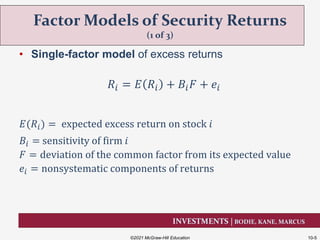
• Single-factor model of excess returns
𝑅𝑖 = 𝐸 𝑅𝑖 + 𝐵𝑖 𝐹 + 𝑒𝑖
𝐸(𝑅𝑖) = expected excess return on stock 𝑖
𝐵𝑖 = sensitivity of firm 𝑖
𝐹 = deviation of the common factor from its expected value
𝑒𝑖 = nonsystematic components of returns
Factor Models of Security Returns
(1 of 3)
©2021 McGraw-Hill Education 10-5
INVESTMENTS | BODIE, KANE, MARCUS
• Extra market sources of risk may arise from
several sources
• E.g., uncertainty about interest rates or inflation.
• Multifactor models posit that returns respond
to several systematic risk factors, as well as
firm-specific influences
• Useful in risk management applications
Factor Models of Security Returns
(2 of 3)
©2021 McGraw-Hill Education 10-6
INVESTMENTS | BODIE, KANE, MARCUS
𝑅𝑖 = excess return on security i
𝐵 𝐺𝐷𝑃 = sensitivity of returns to GDP
𝐵𝐼𝑅 = sensitivity of returns to interest rates
𝑒𝑖 = nonsystematic components of returns
Factor Models of Security Returns
(3 of 3)
©2021 McGraw-Hill Education 10-7
  iiIRiGDPii eIRGDPRER  
INVESTMENTS | BODIE, KANE, MARCUS
• Arbitrage pricing theory (APT) was developed
by Stephen Ross
• Predicts a SML linking expected returns to risk, but
the path is takes to the SML is quite different
• APT relies on three key propositions:
1. Security returns can be described by a factor model
2. There are sufficient securities to diversify away
idiosyncratic risk
3. Well-functioning security markets do not allow for
the persistence of arbitrage opportunities
Arbitrage Pricing Theory
©2021 McGraw-Hill Education 10-8
INVESTMENTS | BODIE, KANE, MARCUS
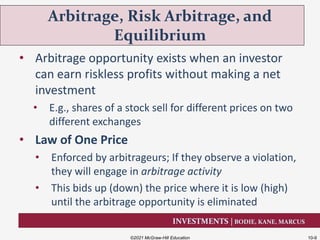
• Arbitrage opportunity exists when an investor
can earn riskless profits without making a net
investment
• E.g., shares of a stock sell for different prices on two
different exchanges
• Law of One Price
• Enforced by arbitrageurs; If they observe a violation,
they will engage in arbitrage activity
• This bids up (down) the price where it is low (high)
until the arbitrage opportunity is eliminated
Arbitrage, Risk Arbitrage, and
Equilibrium
©2021 McGraw-Hill Education 10-9
INVESTMENTS | BODIE, KANE, MARCUS
• In a well-diversified portfolio, firm-specific
risk becomes negligible, so that only factor
risk remains
• One effect of diversification is that, when n is
large, nonsystematic variance approaches
zero
• A well-diversified portfolio is on with
each weight small enough that for
practices purposes the nonsystematic
variance is negligible
Well-Diversified Portfolios
©2021 McGraw-Hill Education 10-10
INVESTMENTS | BODIE, KANE, MARCUS
Excess Returns as a Function of
the Systematic Factor
©2021 McGraw-Hill Education 10-11
INVESTMENTS | BODIE, KANE, MARCUS
Returns as a Function of the Systematic
Factor: An Arbitrage Opportunity
©2021 McGraw-Hill Education 10-12
INVESTMENTS | BODIE, KANE, MARCUS
• All well-diversified portfolio with the same beta
must have the same expected return
• Generally, for any well-diversified P, the
expected excess return must be:
• Risk premium on portfolio P is the product of its
beta and the risk premium of the market index
• SML of the CAPM must also apply to well-diversified
portfolios
The SML of the APT
©2021 McGraw-Hill Education 10-13
( ) ( )P P ME R E R
INVESTMENTS | BODIE, KANE, MARCUS
An Arbitrage Opportunity
©2021 McGraw-Hill Education 10-14
INVESTMENTS | BODIE, KANE, MARCUS
APT
• Built on the foundation
of well-diversified
portfolios
– Cannot rule out a
violation of the expected
return-beta relationship
for any particular asset
• Does not assume
investors are mean-
variance optimizers
• Uses an observable
market index
CAPM
• Model is based on an
inherently unobservable
“market” portfolio
• Provides unequivocal
statement on the
expected return-beta
relationship for all
securities
APT and CAPM
©2021 McGraw-Hill Education 10-15
INVESTMENTS | BODIE, KANE, MARCUS
• To this point, we have examined the APT in a
one-factor world
• However, there are several sources of systematic
risk and exposure to these factors will affect a
stock’s appropriate expected return
• APT can be generalized to accommodate these
multiple sources of risk
• Assume a two-factor model:
A Multifactor APT
(1 of 2)
©2021 McGraw-Hill Education 10-16
1 1 2 2( )i i i i iR E R F F e    
INVESTMENTS | BODIE, KANE, MARCUS
• Benchmark portfolios in the APT are factor
portfolios
• β=1 for one of the factors and β= 0 for any other
factors
• Factor portfolios track a particular source of
macroeconomic risk, but are uncorrelated with
other sources of risk
• Referred to as a “tracking portfolio”
A Multifactor APT
(2 of 2)
©2021 McGraw-Hill Education 10-17
INVESTMENTS | BODIE, KANE, MARCUS
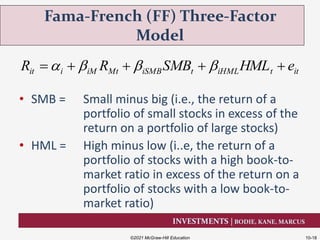
• SMB = Small minus big (i.e., the return of a
portfolio of small stocks in excess of the
return on a portfolio of large stocks)
• HML = High minus low (i..e, the return of a
portfolio of stocks with a high book-to-
market ratio in excess of the return on a
portfolio of stocks with a low book-to-
market ratio)
Fama-French (FF) Three-Factor
Model
©2021 McGraw-Hill Education 10-18
ittiHMLtiSMBMtiMiit eHMLSMBRR  
INVESTMENTS | BODIE, KANE, MARCUS
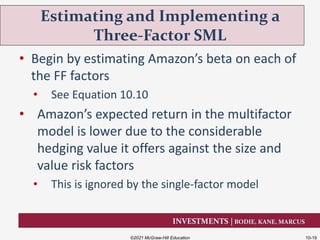
• Begin by estimating Amazon’s beta on each of
the FF factors
• See Equation 10.10
• Amazon’s expected return in the multifactor
model is lower due to the considerable
hedging value it offers against the size and
value risk factors
• This is ignored by the single-factor model
Estimating and Implementing a
Three-Factor SML
©2021 McGraw-Hill Education 10-19

Chapter (10).

  • 1.
    Dr. Muath Asmar Investment& Portfolio Management AN-NAJAH NATIONAL UNIVERSITY Faculty of Graduate Studies
  • 2.
    INVESTMENTS | BODIE,KANE, MARCUS ©2021 McGraw-Hill Education. All rights reserved. Authorized only for instructor use in the classroom. No reproduction or further distribution permitted without the prior written consent of McGraw-Hill Education. Chapter Ten Arbitrage Pricing Theory and Multifactor Models of Risk and Return
  • 3.
    INVESTMENTS | BODIE,KANE, MARCUS • Arbitrage is the exploitation of security mispricing in such a way that risk-free profits can be earned • Most basic principle of capital market theory is that well-functioning security markets rule out arbitrage opportunities • Generalization of the security market line of the CAPM to gain richer insight into the risk- return relationship • Arbitrage pricing theory (APT) Overview ©2021 McGraw-Hill Education
  • 4.
    INVESTMENTS | BODIE,KANE, MARCUS • Recall stock variability may be decomposed into the following sources: • Market (i.e., systemic) risk • Largely due to macroeconomic events • Firm-specific (i.e., idiosyncratic) effects • Risk premiums may depend on correlations with extra-market risk factors • E.g., inflation, interest rates, volatility, etc. Multifactor Models: A Preview ©2021 McGraw-Hill Education 10-4
  • 5.
    INVESTMENTS | BODIE,KANE, MARCUS • Single-factor model of excess returns 𝑅𝑖 = 𝐸 𝑅𝑖 + 𝐵𝑖 𝐹 + 𝑒𝑖 𝐸(𝑅𝑖) = expected excess return on stock 𝑖 𝐵𝑖 = sensitivity of firm 𝑖 𝐹 = deviation of the common factor from its expected value 𝑒𝑖 = nonsystematic components of returns Factor Models of Security Returns (1 of 3) ©2021 McGraw-Hill Education 10-5
  • 6.
    INVESTMENTS | BODIE,KANE, MARCUS • Extra market sources of risk may arise from several sources • E.g., uncertainty about interest rates or inflation. • Multifactor models posit that returns respond to several systematic risk factors, as well as firm-specific influences • Useful in risk management applications Factor Models of Security Returns (2 of 3) ©2021 McGraw-Hill Education 10-6
  • 7.
    INVESTMENTS | BODIE,KANE, MARCUS 𝑅𝑖 = excess return on security i 𝐵 𝐺𝐷𝑃 = sensitivity of returns to GDP 𝐵𝐼𝑅 = sensitivity of returns to interest rates 𝑒𝑖 = nonsystematic components of returns Factor Models of Security Returns (3 of 3) ©2021 McGraw-Hill Education 10-7   iiIRiGDPii eIRGDPRER  
  • 8.
    INVESTMENTS | BODIE,KANE, MARCUS • Arbitrage pricing theory (APT) was developed by Stephen Ross • Predicts a SML linking expected returns to risk, but the path is takes to the SML is quite different • APT relies on three key propositions: 1. Security returns can be described by a factor model 2. There are sufficient securities to diversify away idiosyncratic risk 3. Well-functioning security markets do not allow for the persistence of arbitrage opportunities Arbitrage Pricing Theory ©2021 McGraw-Hill Education 10-8
  • 9.
    INVESTMENTS | BODIE,KANE, MARCUS • Arbitrage opportunity exists when an investor can earn riskless profits without making a net investment • E.g., shares of a stock sell for different prices on two different exchanges • Law of One Price • Enforced by arbitrageurs; If they observe a violation, they will engage in arbitrage activity • This bids up (down) the price where it is low (high) until the arbitrage opportunity is eliminated Arbitrage, Risk Arbitrage, and Equilibrium ©2021 McGraw-Hill Education 10-9
  • 10.
    INVESTMENTS | BODIE,KANE, MARCUS • In a well-diversified portfolio, firm-specific risk becomes negligible, so that only factor risk remains • One effect of diversification is that, when n is large, nonsystematic variance approaches zero • A well-diversified portfolio is on with each weight small enough that for practices purposes the nonsystematic variance is negligible Well-Diversified Portfolios ©2021 McGraw-Hill Education 10-10
  • 11.
    INVESTMENTS | BODIE,KANE, MARCUS Excess Returns as a Function of the Systematic Factor ©2021 McGraw-Hill Education 10-11
  • 12.
    INVESTMENTS | BODIE,KANE, MARCUS Returns as a Function of the Systematic Factor: An Arbitrage Opportunity ©2021 McGraw-Hill Education 10-12
  • 13.
    INVESTMENTS | BODIE,KANE, MARCUS • All well-diversified portfolio with the same beta must have the same expected return • Generally, for any well-diversified P, the expected excess return must be: • Risk premium on portfolio P is the product of its beta and the risk premium of the market index • SML of the CAPM must also apply to well-diversified portfolios The SML of the APT ©2021 McGraw-Hill Education 10-13 ( ) ( )P P ME R E R
  • 14.
    INVESTMENTS | BODIE,KANE, MARCUS An Arbitrage Opportunity ©2021 McGraw-Hill Education 10-14
  • 15.
    INVESTMENTS | BODIE,KANE, MARCUS APT • Built on the foundation of well-diversified portfolios – Cannot rule out a violation of the expected return-beta relationship for any particular asset • Does not assume investors are mean- variance optimizers • Uses an observable market index CAPM • Model is based on an inherently unobservable “market” portfolio • Provides unequivocal statement on the expected return-beta relationship for all securities APT and CAPM ©2021 McGraw-Hill Education 10-15
  • 16.
    INVESTMENTS | BODIE,KANE, MARCUS • To this point, we have examined the APT in a one-factor world • However, there are several sources of systematic risk and exposure to these factors will affect a stock’s appropriate expected return • APT can be generalized to accommodate these multiple sources of risk • Assume a two-factor model: A Multifactor APT (1 of 2) ©2021 McGraw-Hill Education 10-16 1 1 2 2( )i i i i iR E R F F e    
  • 17.
    INVESTMENTS | BODIE,KANE, MARCUS • Benchmark portfolios in the APT are factor portfolios • β=1 for one of the factors and β= 0 for any other factors • Factor portfolios track a particular source of macroeconomic risk, but are uncorrelated with other sources of risk • Referred to as a “tracking portfolio” A Multifactor APT (2 of 2) ©2021 McGraw-Hill Education 10-17
  • 18.
    INVESTMENTS | BODIE,KANE, MARCUS • SMB = Small minus big (i.e., the return of a portfolio of small stocks in excess of the return on a portfolio of large stocks) • HML = High minus low (i..e, the return of a portfolio of stocks with a high book-to- market ratio in excess of the return on a portfolio of stocks with a low book-to- market ratio) Fama-French (FF) Three-Factor Model ©2021 McGraw-Hill Education 10-18 ittiHMLtiSMBMtiMiit eHMLSMBRR  
  • 19.
    INVESTMENTS | BODIE,KANE, MARCUS • Begin by estimating Amazon’s beta on each of the FF factors • See Equation 10.10 • Amazon’s expected return in the multifactor model is lower due to the considerable hedging value it offers against the size and value risk factors • This is ignored by the single-factor model Estimating and Implementing a Three-Factor SML ©2021 McGraw-Hill Education 10-19

Editor's Notes

  • #7 Recall the single-factor model (introduced in Ch. 8) decomposes returns into systematic and firm-specific components. But, it confines systematic risk to a single factor.
  • #8 Note the coefficients on each macro factor measures the sensitivity of share returns to that factor (and are therefore referred to as factor loadings or factor betas).
  • #10 The Law of One Price: states that if two assets are equivalent in all economically relevant respects, then they should have the same market price.
  • #11 Proofs are located on p314.
  • #16 Note that while each model takes a different path to get there, they both arrive at the same security market line. More importantly, they both highlight the distinction between firm-specific and systematic risk.
  • #17 The generalization of the APT to accommodate these multiple sources of risk is done in a manner similar to the multifactor CAPM.
  • #19 Note: FF is an approach to identify the most likely sources of systematic risk, in which case it uses firm characteristics that seem on empirical grounds to proxy for exposure to systematic risk.