Copyright © 2020 McGraw-Hill Education. All rights reserved. No reproduction or distribution without the prior written consent of McGraw-Hill Education.
AN-NAJAH
NATIONAL UNIVERSITY
Dr. Muath Asmar
Faculty of Economics and
Social Sciences
Department of Finance
Copyright © 2020 McGraw-Hill Education. All rights reserved. No reproduction or distribution without the prior written consent of McGraw-Hill Education.
Chapter 06
Introduction to Consumer Credit
Copyright © 2020 McGraw-Hill Education. All rights reserved. No reproduction or distribution without the prior written consent of McGraw-Hill Education.
Chapter 6
Learning Objectives
LO6-1 Define consumer credit and analyze its
advantages and disadvantages.
LO6-2 Differentiate among various types of
credit.
LO6-3 Assess your credit capacity and build your
credit rating.
LO6-4 Describe the information creditors look for
when you apply for credit.
LO6-5 Identify the steps you can take to avoid
and correct credit mistakes.
LO6-6 Describe the laws that protect you if
you have a complaint about
consumer credit.
6-3
Copyright © 2020 McGraw-Hill Education. All rights reserved. No reproduction or distribution without the prior written consent of McGraw-Hill Education.
What is Consumer Credit?
LO6-1:
Define consumer credit and analyze its advantages and
disadvantages.
– CREDIT is an arrangement to receive cash, goods,
or services now and pay for them in the future
– CONSUMER CREDIT is the use of credit for personal
needs (except a home mortgage) by individuals and
families
6-4
Copyright © 2020 McGraw-Hill Education. All rights reserved. No reproduction or distribution without the prior written consent of McGraw-Hill Education.
Financing Alternatives
and Trade-offs
– THREE WAYS CONSUMERS CAN FINANCE
PURCHASES
• Draw on savings
• Use present earnings
• Borrow against expected future income
– TRADE-OFFS WITH EACH ALTERNATIVE
• Depleting savings reduces emergency funds
• Spending current income on luxuries will eventually
reduce future well-being
• Spending future income now reduces funds available
for future expenses
6-5
Copyright © 2020 McGraw-Hill Education. All rights reserved. No reproduction or distribution without the prior written consent of McGraw-Hill Education.
Uses and Misuses of Credit
– Before you use credit for a major purchase,
consider these questions:
• Do I have the cash for the down payment?
• Do I want to use my savings for this purchase?
• Does the purchase fit my budget?
• Could I use the credit I need in some better way?
• Can I postpone this purchase?
• What are the opportunity costs of postponing this
purchase?
• What are the dollar and psychological costs of using
credit for this purchase?
6-6
Copyright © 2020 McGraw-Hill Education. All rights reserved. No reproduction or distribution without the prior written consent of McGraw-Hill Education.
Importance and
Advantages of Credit (1 of 2)
– CONSUMER CREDIT IMPORTANCE
• A major force in American economy
– ADVANTAGES OF CREDIT
• Immediate access to goods and services
• Permits purchase even when funds are low
• A cushion for financial emergencies
• Advance notice of sales
• Easier to return merchandise
• Convenient when shopping
6-7
Copyright © 2020 McGraw-Hill Education. All rights reserved. No reproduction or distribution without the prior written consent of McGraw-Hill Education.
Importance and
Advantages of Credit (2 of 2)
• One monthly payment
• Safer than cash
• Needed for hotel reservations, car rentals, and
shopping by phone
• Can take advantage of float time and grace period
• May get rebates, extended manufacturer’s
warranties, or emergency medical evacuation for
travelers, and other bonuses
• Indicates financial stability
6-8
Copyright © 2020 McGraw-Hill Education. All rights reserved. No reproduction or distribution without the prior written consent of McGraw-Hill Education.
Disadvantages of Credit
– Temptation to overspend
– Failure to repay loan may result in loss of
income, valuable property, and your good
reputation
– Misuse of credit can create serious long-term
financial problems, damage to family
relationships, and a slowing of progress toward
financial goals
– It does not increase total purchasing power
– Credit costs money
6-9
Copyright © 2020 McGraw-Hill Education. All rights reserved. No reproduction or distribution without the prior written consent of McGraw-Hill Education.
Types of Credit
LO6-2:
Differentiate among various types of credit.
– CLOSED-END CREDIT
• Single loan for a specific purpose and a specified
amount that you pay back in a specified period of
time and in payments of equal amounts
• Installment sales credit, installment cash credit, and
single lump-sum credit
• Mortgage, automobile, and installment loans for
furniture or appliances
6-10
Copyright © 2020 McGraw-Hill Education. All rights reserved. No reproduction or distribution without the prior written consent of McGraw-Hill Education.
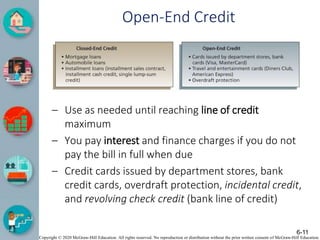
6-11
Open-End Credit
– Use as needed until reaching line of credit
maximum
– You pay interest and finance charges if you do not
pay the bill in full when due
– Credit cards issued by department stores, bank
credit cards, overdraft protection, incidental credit,
and revolving check credit (bank line of credit)
Copyright © 2020 McGraw-Hill Education. All rights reserved. No reproduction or distribution without the prior written consent of McGraw-Hill Education.
Credit Cards
– 7 out of 10 U.S. households carry one or more
credit cards
– About half of all credit card users are convenience
users and pay balances in full each month
– Others are borrowers, carrying a balance over and
paying finance charges
– Some use cards for cash advances, paying a
transaction fee and interest
– Co-branding — linking a credit card with a business
trade name offering points or rebates on products
and services
6-12
Copyright © 2020 McGraw-Hill Education. All rights reserved. No reproduction or distribution without the prior written consent of McGraw-Hill Education.
Smart Cards and Debit Cards
– SMART CARDS
• Have an embedded computer chip
• Combine credit cards, a driver’s license, a health care
ID with your medical history and insurance
information, etc.
– DEBIT CARDS
• Often called bank cards, ATM cards, cash cards, and
check cards
• Electronically subtracts from your account at the
moment you make a purchase (no delay in payment)
6-13
Copyright © 2020 McGraw-Hill Education. All rights reserved. No reproduction or distribution without the prior written consent of McGraw-Hill Education.
Stored-Value (or Gift) Cards
– Are prepaid cards
– Resemble a debit card
– Used in lieu of paper gift certificates
– Used for business purposes (payroll, travel
expenses, government benefit payments)
– Retailer bankruptcy can make the cards worthless
6-14
Copyright © 2020 McGraw-Hill Education. All rights reserved. No reproduction or distribution without the prior written consent of McGraw-Hill Education.
Travel and Entertainment Cards
– These cards are not really credit cards
– Monthly balance is due in full
– Diners Club or American Express cards
– American Express is now also issuing credit cards
6-15
Copyright © 2020 McGraw-Hill Education. All rights reserved. No reproduction or distribution without the prior written consent of McGraw-Hill Education.
Smartphones
and Home Equity Loans
– SMART PHONES
• Use of mobile phone to make purchases, called
mobile commerce
– HOME EQUITY LOANS
• Based on the difference between current market
value of your home and the amount owed on the
mortgage
• Borrow up to 85% of the appraised value of the
home less amount still owed
• Interest on loan is tax deductible
• It is set up like a revolving line of credit
6-16
Copyright © 2020 McGraw-Hill Education. All rights reserved. No reproduction or distribution without the prior written consent of McGraw-Hill Education.
Debit/Credit Card Fraud
– PROTECTING YOURSELF AGAINST DEBIT/CREDIT CARD
FRAUD
• Sign new cards as soon as they arrive
• Treat cards like money and keep them in a secure place
• Shred anything with your account number on it
• Don’t give your card number over the phone or online
unless you initiate the call and don’t write it on postcards
• Get card and receipt after every transaction and check
for billing statement errors
• Notify the card issuer if you don’t get your billing
statement or if your card is lost or stolen
6-17
Copyright © 2020 McGraw-Hill Education. All rights reserved. No reproduction or distribution without the prior written consent of McGraw-Hill Education.
Making Purchases Online
– Use a secure browser
– Keep records of online transactions
– Review monthly bank and credit card statements
– Read policies of the websites you visit concerning
refunds, site security, and privacy
– Keep personal information private unless you know who
is gathering it and why
– Give payment information only to businesses you know
and trust
– Never give your password to anyone online
– Do not download files sent to you by strangers
6-18
Copyright © 2020 McGraw-Hill Education. All rights reserved. No reproduction or distribution without the prior written consent of McGraw-Hill Education.
Measuring Your Credit Capacity
LO6-3:
Assess your credit capacity and build your credit rating.
– CAN YOU AFFORD A LOAN?
• Ask yourself if you can meet all essential expenses
and still afford the monthly loan payments
• Ask yourself what do you plan to give up in order to
make the monthly payment?
– Are you prepared to make this trade-off?
6-19
Copyright © 2020 McGraw-Hill Education. All rights reserved. No reproduction or distribution without the prior written consent of McGraw-Hill Education.
Debt Payments-To-Income Ratio
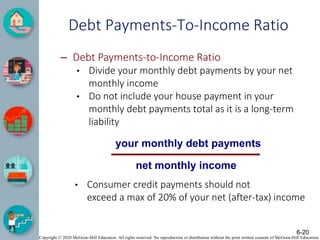
– Debt Payments-to-Income Ratio
• Divide your monthly debt payments by your net
monthly income
• Do not include your house payment in your
monthly debt payments total as it is a long-term
liability
your monthly debt payments
net monthly income
• Consumer credit payments should not
exceed a max of 20% of your net (after-tax) income
6-20
Copyright © 2020 McGraw-Hill Education. All rights reserved. No reproduction or distribution without the prior written consent of McGraw-Hill Education.
Calculating
Debt Payments-To-Income Ratio
– Example
If your monthly net income is $2,136 (gross income less
taxes and monthly IRA contribution) and your monthly
installment credit payments total $426 (includes credit
cards and auto loan), then your debt payments-to-
income ratio is 19.94%.
$426 / $2,136 = 19.94%
6-21
Copyright © 2020 McGraw-Hill Education. All rights reserved. No reproduction or distribution without the prior written consent of McGraw-Hill Education.
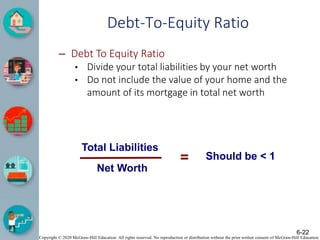
Debt-To-Equity Ratio
– Debt To Equity Ratio
• Divide your total liabilities by your net worth
• Do not include the value of your home and the
amount of its mortgage in total net worth
Total Liabilities
Net Worth
= Should be < 1
6-22
Copyright © 2020 McGraw-Hill Education. All rights reserved. No reproduction or distribution without the prior written consent of McGraw-Hill Education.
Cosigning a Loan
– The creditor will give you a notice that tells you…
• You are being asked to guarantee the debt, so consider
if you can afford it if the borrower defaults
• If the borrow does not pay, you may have to pay up to
the full amount and also any late or collection fees
• If a payment is missed, the creditor can collect the debt
from you without first trying to get it from the
borrower
– Some studies show that three of four cosigners are
asked to wholly or partially repay the loan
6-23
Copyright © 2020 McGraw-Hill Education. All rights reserved. No reproduction or distribution without the prior written consent of McGraw-Hill Education.
If You Do Cosign
– If you do cosign, consider...
• Can you afford to pay the loan? If not, your credit
rating could be damaged
• Liability for this debt may prevent you from getting
other credit that you want
• If you pledge property, you could lose it if the loan
goes into default
• Check your state’s law to learn about cosigner’s
rights
• Request that a copy of overdue-payment notices be
sent to you
6-24
Copyright © 2020 McGraw-Hill Education. All rights reserved. No reproduction or distribution without the prior written consent of McGraw-Hill Education.
Credit Rating
– BUILDING AND MAINTAINING YOUR CREDIT
RATING
• A good credit rating is a valuable asset that should
be nurtured and protected
• Limit your borrowing to your capacity to repay
• Live up to the terms of contracts
• Check to see what is in your credit report as most
creditors rely on credit reports in considering loan
applications
6-25
Copyright © 2020 McGraw-Hill Education. All rights reserved. No reproduction or distribution without the prior written consent of McGraw-Hill Education.
Building and Maintaining Your Credit
(1 of 2)
– CREDIT BUREAUS
• Consumer Reporting Agencies (CRAs) collect
information about consumers
• Experian, TransUnion, and Equifax
• The Consumer Financial Protection Bureau gets
about 36,000 complaints about credit bureaus each
year
– WHO PROVIDES DATA TO CREDIT BUREAUS?
• Bureaus get information from banks, court records,
finance companies, merchants, credit card
companies, and other creditors
6-26
Copyright © 2020 McGraw-Hill Education. All rights reserved. No reproduction or distribution without the prior written consent of McGraw-Hill Education.
Building and Maintaining Your Credit
(2 of 2)
– WHAT IS IN YOUR CREDIT FILES?
The credit bureau file contains your name, address,
Social Security number, and birth date. It may also
include the following information:
• Your employer, position, and income.
• Your former address.
• Your former employer.
• Your spouse’s name, Social Security number, employer, and
income.
• Whether you own your home, rent, or board.
• Checks returned for insufficient funds.
6-27
Copyright © 2020 McGraw-Hill Education. All rights reserved. No reproduction or distribution without the prior written consent of McGraw-Hill Education.
Fair Credit Reporting
– FAIR CREDIT REPORTING ACT
• This act regulates the use of credit reports
• Requires the deletion of obsolete information
• Gives consumers the right to have erroneous data
corrected
• Only authorized persons have access to your report
• Adverse data can be reported for seven years;
personal bankruptcy for ten years
6-28
Copyright © 2020 McGraw-Hill Education. All rights reserved. No reproduction or distribution without the prior written consent of McGraw-Hill Education.
Who May Obtain a Credit Report?
– Only properly identified persons for
approved purposes
• Ex: to prospective employers in compliance with
a court order, underwriting of insurance, or some
other legitimate business need, or in determining
eligibility for a license or other benefit granted by
a government agency
6-29
Copyright © 2020 McGraw-Hill Education. All rights reserved. No reproduction or distribution without the prior written consent of McGraw-Hill Education.
Time Limits on Adverse Data
– Most of the information in your credit file may be
reported for only seven years
• May be reported for 10 years if bankruptcy has been
declared
• Unpaid tax liens can be reported for 15 years
– After 7, 10, or 15 years, a credit reporting agency
can’t disclose the information in your credit file
unless you are being investigated for a credit
application of $75,000 or more or for an
application to purchase life insurance of $150,000
or more
6-30
Copyright © 2020 McGraw-Hill Education. All rights reserved. No reproduction or distribution without the prior written consent of McGraw-Hill Education.
Incorrect Information in Your Credit File
– Mistakes may occur even though credit bureaus
are required to follow reasonable procedures
– When notified, a bureau must investigate the
proposed inaccurate data
– If you contest an item on your credit report, the
reporting agency must remove the item unless the
creditor verifies that the information is accurate
6-31
Copyright © 2020 McGraw-Hill Education. All rights reserved. No reproduction or distribution without the prior written consent of McGraw-Hill Education.
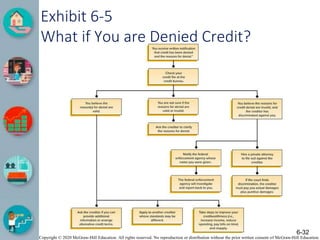
Exhibit 6-5
What if You are Denied Credit?
6-32
Copyright © 2020 McGraw-Hill Education. All rights reserved. No reproduction or distribution without the prior written consent of McGraw-Hill Education.
Applying for Credit
LO6-4:
Describe the information creditors look for when you apply for credit.
– The Equal Credit Opportunity Act (ECOA) starts all credit applicants off on
the same footing. It states that race, color, age, sex, marital status, and
certain other factors may not be used to discriminate against you in any
part of a credit dealing.
• Credit rights of women are protected under the ECOA.
– WHAT CREDITORS LOOK FOR: 5 Cs
• Character — Do you pay bills on time?
• Capacity — Can you repay the loan?
• Capital — What are your assets
and net worth?
• Collateral — What property do you have to pledge that the lender can
repossess if you default on the loan?
• Conditions — What economic conditions could affect your ability to repay
the loan?
*Additionally, age, public assistance, housing loans, and FICO and
VantageScore may be assessed.
6-33
Copyright © 2020 McGraw-Hill Education. All rights reserved. No reproduction or distribution without the prior written consent of McGraw-Hill Education.
FICO and Vantagescore
– The information in your credit report is used to
calculate your FICO credit score
• Between 300 and 850
• Higher the score, less risky you are
– VantageScore was launched in 2006
• Does not count debt collections that have been paid
off
• Model allows predictive score for those with short
credit histories
• Ignores negative credit history if affected by natural
disasters
6-34
Copyright © 2020 McGraw-Hill Education. All rights reserved. No reproduction or distribution without the prior written consent of McGraw-Hill Education.
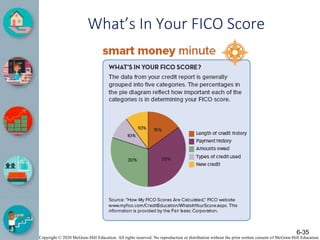
What’s In Your FICO Score
6-35
Copyright © 2020 McGraw-Hill Education. All rights reserved. No reproduction or distribution without the prior written consent of McGraw-Hill Education.
What if Your Application is Denied?
1. Ask questions
2. ECOA gives you the right to know the specific reasons
for denial
• If the denial is based on a credit report, you are
entitled to know the specific information in the
credit report that led to it
3. After you receive this information from the creditor,
you should contact the local credit bureau to find out
what information it reported
4. You may ask the bureau to investigate any inaccurate
or incomplete information and correct its records
6-36
Copyright © 2020 McGraw-Hill Education. All rights reserved. No reproduction or distribution without the prior written consent of McGraw-Hill Education.
How to Improve
Your Credit Score
1. Get copies of your credit report — review for
accuracy
2. Pay your bills on time
3. Understand how your credit score is determined
4. Learn the legal steps to take to improve your credit
report
5. Beware of credit-repair scams
6-37
Copyright © 2020 McGraw-Hill Education. All rights reserved. No reproduction or distribution without the prior written consent of McGraw-Hill Education.
Avoiding and Correcting
Credit Mistakes
LO6-5:
Identify the steps you can take to avoid and correct
credit mistakes.
– FAIR CREDIT BILLING ACT
• Passed in 1975
• Sets procedures for promptly correcting billing
mistakes, refusing to make credit card or revolving
credit payments on defective goods, and promptly
crediting your payments
6-38
Copyright © 2020 McGraw-Hill Education. All rights reserved. No reproduction or distribution without the prior written consent of McGraw-Hill Education.
In Case of a Billing Error
– First, call your creditor
– If dispute exists, notify creditor of error in writing
within 60 days
– Include your explanation of the error and your
account number to the billing inquiries address
– They must respond within 30 days
– Credit card company has two billing periods but no
longer than 90 days to correct your account or tell
you why they think the bill is correct
– Your credit rating is not affected while item is in
dispute
6-39
Copyright © 2020 McGraw-Hill Education. All rights reserved. No reproduction or distribution without the prior written consent of McGraw-Hill Education.
Your Credit During the Dispute
– A creditor may not threaten your credit rating while you
are resolving a billing dispute
– Once you have written about a possible error, a creditor
is prohibited from giving out information that would
damage your credit reputation to other creditors or
credit bureaus
– Until your complaint has been answered, the creditor
may not take any action to collect the disputed amount
– After explaining the bill, the creditor may report you as
delinquent on the amount in dispute and take action to
collect if you do not pay in the time allowed
• Even so, you can still disagree in writing
6-40
Copyright © 2020 McGraw-Hill Education. All rights reserved. No reproduction or distribution without the prior written consent of McGraw-Hill Education.
Defective Goods or Services
– You may withhold payment on any damaged or shoddy
goods or poor services if you have paid for them with a
credit card as long as you have made a sincere attempt
to resolve the problem with the merchant
6-41
Copyright © 2020 McGraw-Hill Education. All rights reserved. No reproduction or distribution without the prior written consent of McGraw-Hill Education.
Identity Crisis (1 of 2)
– WHAT TO DO IF YOUR IDENTITY IS STOLEN
• Contact the fraud department of each of the three
major credit bureaus
– tell them to flag your file with a fraud alert
– include a statement that creditors should call you for
permission before opening any new accounts in your
name
• Contact the creditors for any accounts that have
been tampered with or opened fraudulently
• File a police report and keep a copy in case your
creditors need proof of the crime
6-42
Copyright © 2020 McGraw-Hill Education. All rights reserved. No reproduction or distribution without the prior written consent of McGraw-Hill Education.
Identity Crisis (2 of 2)
• Tear or shred personal information before placing in
trash
• Close bank accounts immediately if you believe an
identify thief has accessed them
• Cancel checks and ATM card if compromised
• Contact the Privacy Rights Clearinghouse or call 619-
298-3396
• File a complaint with the Federal Trade Commission
at 1-877-FTC-HELP
6-43
Copyright © 2020 McGraw-Hill Education. All rights reserved. No reproduction or distribution without the prior written consent of McGraw-Hill Education.
Complaining About Consumer Credit
LO6-6:
Describe the laws that protect you if you have a
complaint about consumer credit.
– If you have a complaint about credit, first try to
solve the problem directly with the creditor
– If that does not work, there are more formal
complaint procedures
– There are a variety of major federal consumer
credit laws
 See Exhibit 6-10
6-44
Copyright © 2020 McGraw-Hill Education. All rights reserved. No reproduction or distribution without the prior written consent of McGraw-Hill Education.
Consumer Credit Laws
– You may take legal action as a creditor but you
should be aware of the following important
consumer credit laws:
• Truth in Lending and Consumer Leasing Acts
• Equal Credit Opportunity Act
• Fair Credit Billing Act
• Fair Credit Reporting Act
• Consumer Credit Reporting Reform Act
• Credit Card Accountability, Responsibility and
Disclosure Act
6-45
Copyright © 2020 McGraw-Hill Education. All rights reserved. No reproduction or distribution without the prior written consent of McGraw-Hill Education.
Your Rights
Under Consumer Credit Laws
– If you believe you have been refused credit due to
discrimination, you can
• Complain to the creditor and let the creditor know
you are aware of the law
• File a complaint with the government
 See Exhibit 6-11
• If all else fails, sue the creditor in a federal district
court
6-46

Chapter(6)

  • 1.
    Copyright © 2020McGraw-Hill Education. All rights reserved. No reproduction or distribution without the prior written consent of McGraw-Hill Education. AN-NAJAH NATIONAL UNIVERSITY Dr. Muath Asmar Faculty of Economics and Social Sciences Department of Finance
  • 2.
    Copyright © 2020McGraw-Hill Education. All rights reserved. No reproduction or distribution without the prior written consent of McGraw-Hill Education. Chapter 06 Introduction to Consumer Credit
  • 3.
    Copyright © 2020McGraw-Hill Education. All rights reserved. No reproduction or distribution without the prior written consent of McGraw-Hill Education. Chapter 6 Learning Objectives LO6-1 Define consumer credit and analyze its advantages and disadvantages. LO6-2 Differentiate among various types of credit. LO6-3 Assess your credit capacity and build your credit rating. LO6-4 Describe the information creditors look for when you apply for credit. LO6-5 Identify the steps you can take to avoid and correct credit mistakes. LO6-6 Describe the laws that protect you if you have a complaint about consumer credit. 6-3
  • 4.
    Copyright © 2020McGraw-Hill Education. All rights reserved. No reproduction or distribution without the prior written consent of McGraw-Hill Education. What is Consumer Credit? LO6-1: Define consumer credit and analyze its advantages and disadvantages. – CREDIT is an arrangement to receive cash, goods, or services now and pay for them in the future – CONSUMER CREDIT is the use of credit for personal needs (except a home mortgage) by individuals and families 6-4
  • 5.
    Copyright © 2020McGraw-Hill Education. All rights reserved. No reproduction or distribution without the prior written consent of McGraw-Hill Education. Financing Alternatives and Trade-offs – THREE WAYS CONSUMERS CAN FINANCE PURCHASES • Draw on savings • Use present earnings • Borrow against expected future income – TRADE-OFFS WITH EACH ALTERNATIVE • Depleting savings reduces emergency funds • Spending current income on luxuries will eventually reduce future well-being • Spending future income now reduces funds available for future expenses 6-5
  • 6.
    Copyright © 2020McGraw-Hill Education. All rights reserved. No reproduction or distribution without the prior written consent of McGraw-Hill Education. Uses and Misuses of Credit – Before you use credit for a major purchase, consider these questions: • Do I have the cash for the down payment? • Do I want to use my savings for this purchase? • Does the purchase fit my budget? • Could I use the credit I need in some better way? • Can I postpone this purchase? • What are the opportunity costs of postponing this purchase? • What are the dollar and psychological costs of using credit for this purchase? 6-6
  • 7.
    Copyright © 2020McGraw-Hill Education. All rights reserved. No reproduction or distribution without the prior written consent of McGraw-Hill Education. Importance and Advantages of Credit (1 of 2) – CONSUMER CREDIT IMPORTANCE • A major force in American economy – ADVANTAGES OF CREDIT • Immediate access to goods and services • Permits purchase even when funds are low • A cushion for financial emergencies • Advance notice of sales • Easier to return merchandise • Convenient when shopping 6-7
  • 8.
    Copyright © 2020McGraw-Hill Education. All rights reserved. No reproduction or distribution without the prior written consent of McGraw-Hill Education. Importance and Advantages of Credit (2 of 2) • One monthly payment • Safer than cash • Needed for hotel reservations, car rentals, and shopping by phone • Can take advantage of float time and grace period • May get rebates, extended manufacturer’s warranties, or emergency medical evacuation for travelers, and other bonuses • Indicates financial stability 6-8
  • 9.
    Copyright © 2020McGraw-Hill Education. All rights reserved. No reproduction or distribution without the prior written consent of McGraw-Hill Education. Disadvantages of Credit – Temptation to overspend – Failure to repay loan may result in loss of income, valuable property, and your good reputation – Misuse of credit can create serious long-term financial problems, damage to family relationships, and a slowing of progress toward financial goals – It does not increase total purchasing power – Credit costs money 6-9
  • 10.
    Copyright © 2020McGraw-Hill Education. All rights reserved. No reproduction or distribution without the prior written consent of McGraw-Hill Education. Types of Credit LO6-2: Differentiate among various types of credit. – CLOSED-END CREDIT • Single loan for a specific purpose and a specified amount that you pay back in a specified period of time and in payments of equal amounts • Installment sales credit, installment cash credit, and single lump-sum credit • Mortgage, automobile, and installment loans for furniture or appliances 6-10
  • 11.
    Copyright © 2020McGraw-Hill Education. All rights reserved. No reproduction or distribution without the prior written consent of McGraw-Hill Education. 6-11 Open-End Credit – Use as needed until reaching line of credit maximum – You pay interest and finance charges if you do not pay the bill in full when due – Credit cards issued by department stores, bank credit cards, overdraft protection, incidental credit, and revolving check credit (bank line of credit)
  • 12.
    Copyright © 2020McGraw-Hill Education. All rights reserved. No reproduction or distribution without the prior written consent of McGraw-Hill Education. Credit Cards – 7 out of 10 U.S. households carry one or more credit cards – About half of all credit card users are convenience users and pay balances in full each month – Others are borrowers, carrying a balance over and paying finance charges – Some use cards for cash advances, paying a transaction fee and interest – Co-branding — linking a credit card with a business trade name offering points or rebates on products and services 6-12
  • 13.
    Copyright © 2020McGraw-Hill Education. All rights reserved. No reproduction or distribution without the prior written consent of McGraw-Hill Education. Smart Cards and Debit Cards – SMART CARDS • Have an embedded computer chip • Combine credit cards, a driver’s license, a health care ID with your medical history and insurance information, etc. – DEBIT CARDS • Often called bank cards, ATM cards, cash cards, and check cards • Electronically subtracts from your account at the moment you make a purchase (no delay in payment) 6-13
  • 14.
    Copyright © 2020McGraw-Hill Education. All rights reserved. No reproduction or distribution without the prior written consent of McGraw-Hill Education. Stored-Value (or Gift) Cards – Are prepaid cards – Resemble a debit card – Used in lieu of paper gift certificates – Used for business purposes (payroll, travel expenses, government benefit payments) – Retailer bankruptcy can make the cards worthless 6-14
  • 15.
    Copyright © 2020McGraw-Hill Education. All rights reserved. No reproduction or distribution without the prior written consent of McGraw-Hill Education. Travel and Entertainment Cards – These cards are not really credit cards – Monthly balance is due in full – Diners Club or American Express cards – American Express is now also issuing credit cards 6-15
  • 16.
    Copyright © 2020McGraw-Hill Education. All rights reserved. No reproduction or distribution without the prior written consent of McGraw-Hill Education. Smartphones and Home Equity Loans – SMART PHONES • Use of mobile phone to make purchases, called mobile commerce – HOME EQUITY LOANS • Based on the difference between current market value of your home and the amount owed on the mortgage • Borrow up to 85% of the appraised value of the home less amount still owed • Interest on loan is tax deductible • It is set up like a revolving line of credit 6-16
  • 17.
    Copyright © 2020McGraw-Hill Education. All rights reserved. No reproduction or distribution without the prior written consent of McGraw-Hill Education. Debit/Credit Card Fraud – PROTECTING YOURSELF AGAINST DEBIT/CREDIT CARD FRAUD • Sign new cards as soon as they arrive • Treat cards like money and keep them in a secure place • Shred anything with your account number on it • Don’t give your card number over the phone or online unless you initiate the call and don’t write it on postcards • Get card and receipt after every transaction and check for billing statement errors • Notify the card issuer if you don’t get your billing statement or if your card is lost or stolen 6-17
  • 18.
    Copyright © 2020McGraw-Hill Education. All rights reserved. No reproduction or distribution without the prior written consent of McGraw-Hill Education. Making Purchases Online – Use a secure browser – Keep records of online transactions – Review monthly bank and credit card statements – Read policies of the websites you visit concerning refunds, site security, and privacy – Keep personal information private unless you know who is gathering it and why – Give payment information only to businesses you know and trust – Never give your password to anyone online – Do not download files sent to you by strangers 6-18
  • 19.
    Copyright © 2020McGraw-Hill Education. All rights reserved. No reproduction or distribution without the prior written consent of McGraw-Hill Education. Measuring Your Credit Capacity LO6-3: Assess your credit capacity and build your credit rating. – CAN YOU AFFORD A LOAN? • Ask yourself if you can meet all essential expenses and still afford the monthly loan payments • Ask yourself what do you plan to give up in order to make the monthly payment? – Are you prepared to make this trade-off? 6-19
  • 20.
    Copyright © 2020McGraw-Hill Education. All rights reserved. No reproduction or distribution without the prior written consent of McGraw-Hill Education. Debt Payments-To-Income Ratio – Debt Payments-to-Income Ratio • Divide your monthly debt payments by your net monthly income • Do not include your house payment in your monthly debt payments total as it is a long-term liability your monthly debt payments net monthly income • Consumer credit payments should not exceed a max of 20% of your net (after-tax) income 6-20
  • 21.
    Copyright © 2020McGraw-Hill Education. All rights reserved. No reproduction or distribution without the prior written consent of McGraw-Hill Education. Calculating Debt Payments-To-Income Ratio – Example If your monthly net income is $2,136 (gross income less taxes and monthly IRA contribution) and your monthly installment credit payments total $426 (includes credit cards and auto loan), then your debt payments-to- income ratio is 19.94%. $426 / $2,136 = 19.94% 6-21
  • 22.
    Copyright © 2020McGraw-Hill Education. All rights reserved. No reproduction or distribution without the prior written consent of McGraw-Hill Education. Debt-To-Equity Ratio – Debt To Equity Ratio • Divide your total liabilities by your net worth • Do not include the value of your home and the amount of its mortgage in total net worth Total Liabilities Net Worth = Should be < 1 6-22
  • 23.
    Copyright © 2020McGraw-Hill Education. All rights reserved. No reproduction or distribution without the prior written consent of McGraw-Hill Education. Cosigning a Loan – The creditor will give you a notice that tells you… • You are being asked to guarantee the debt, so consider if you can afford it if the borrower defaults • If the borrow does not pay, you may have to pay up to the full amount and also any late or collection fees • If a payment is missed, the creditor can collect the debt from you without first trying to get it from the borrower – Some studies show that three of four cosigners are asked to wholly or partially repay the loan 6-23
  • 24.
    Copyright © 2020McGraw-Hill Education. All rights reserved. No reproduction or distribution without the prior written consent of McGraw-Hill Education. If You Do Cosign – If you do cosign, consider... • Can you afford to pay the loan? If not, your credit rating could be damaged • Liability for this debt may prevent you from getting other credit that you want • If you pledge property, you could lose it if the loan goes into default • Check your state’s law to learn about cosigner’s rights • Request that a copy of overdue-payment notices be sent to you 6-24
  • 25.
    Copyright © 2020McGraw-Hill Education. All rights reserved. No reproduction or distribution without the prior written consent of McGraw-Hill Education. Credit Rating – BUILDING AND MAINTAINING YOUR CREDIT RATING • A good credit rating is a valuable asset that should be nurtured and protected • Limit your borrowing to your capacity to repay • Live up to the terms of contracts • Check to see what is in your credit report as most creditors rely on credit reports in considering loan applications 6-25
  • 26.
    Copyright © 2020McGraw-Hill Education. All rights reserved. No reproduction or distribution without the prior written consent of McGraw-Hill Education. Building and Maintaining Your Credit (1 of 2) – CREDIT BUREAUS • Consumer Reporting Agencies (CRAs) collect information about consumers • Experian, TransUnion, and Equifax • The Consumer Financial Protection Bureau gets about 36,000 complaints about credit bureaus each year – WHO PROVIDES DATA TO CREDIT BUREAUS? • Bureaus get information from banks, court records, finance companies, merchants, credit card companies, and other creditors 6-26
  • 27.
    Copyright © 2020McGraw-Hill Education. All rights reserved. No reproduction or distribution without the prior written consent of McGraw-Hill Education. Building and Maintaining Your Credit (2 of 2) – WHAT IS IN YOUR CREDIT FILES? The credit bureau file contains your name, address, Social Security number, and birth date. It may also include the following information: • Your employer, position, and income. • Your former address. • Your former employer. • Your spouse’s name, Social Security number, employer, and income. • Whether you own your home, rent, or board. • Checks returned for insufficient funds. 6-27
  • 28.
    Copyright © 2020McGraw-Hill Education. All rights reserved. No reproduction or distribution without the prior written consent of McGraw-Hill Education. Fair Credit Reporting – FAIR CREDIT REPORTING ACT • This act regulates the use of credit reports • Requires the deletion of obsolete information • Gives consumers the right to have erroneous data corrected • Only authorized persons have access to your report • Adverse data can be reported for seven years; personal bankruptcy for ten years 6-28
  • 29.
    Copyright © 2020McGraw-Hill Education. All rights reserved. No reproduction or distribution without the prior written consent of McGraw-Hill Education. Who May Obtain a Credit Report? – Only properly identified persons for approved purposes • Ex: to prospective employers in compliance with a court order, underwriting of insurance, or some other legitimate business need, or in determining eligibility for a license or other benefit granted by a government agency 6-29
  • 30.
    Copyright © 2020McGraw-Hill Education. All rights reserved. No reproduction or distribution without the prior written consent of McGraw-Hill Education. Time Limits on Adverse Data – Most of the information in your credit file may be reported for only seven years • May be reported for 10 years if bankruptcy has been declared • Unpaid tax liens can be reported for 15 years – After 7, 10, or 15 years, a credit reporting agency can’t disclose the information in your credit file unless you are being investigated for a credit application of $75,000 or more or for an application to purchase life insurance of $150,000 or more 6-30
  • 31.
    Copyright © 2020McGraw-Hill Education. All rights reserved. No reproduction or distribution without the prior written consent of McGraw-Hill Education. Incorrect Information in Your Credit File – Mistakes may occur even though credit bureaus are required to follow reasonable procedures – When notified, a bureau must investigate the proposed inaccurate data – If you contest an item on your credit report, the reporting agency must remove the item unless the creditor verifies that the information is accurate 6-31
  • 32.
    Copyright © 2020McGraw-Hill Education. All rights reserved. No reproduction or distribution without the prior written consent of McGraw-Hill Education. Exhibit 6-5 What if You are Denied Credit? 6-32
  • 33.
    Copyright © 2020McGraw-Hill Education. All rights reserved. No reproduction or distribution without the prior written consent of McGraw-Hill Education. Applying for Credit LO6-4: Describe the information creditors look for when you apply for credit. – The Equal Credit Opportunity Act (ECOA) starts all credit applicants off on the same footing. It states that race, color, age, sex, marital status, and certain other factors may not be used to discriminate against you in any part of a credit dealing. • Credit rights of women are protected under the ECOA. – WHAT CREDITORS LOOK FOR: 5 Cs • Character — Do you pay bills on time? • Capacity — Can you repay the loan? • Capital — What are your assets and net worth? • Collateral — What property do you have to pledge that the lender can repossess if you default on the loan? • Conditions — What economic conditions could affect your ability to repay the loan? *Additionally, age, public assistance, housing loans, and FICO and VantageScore may be assessed. 6-33
  • 34.
    Copyright © 2020McGraw-Hill Education. All rights reserved. No reproduction or distribution without the prior written consent of McGraw-Hill Education. FICO and Vantagescore – The information in your credit report is used to calculate your FICO credit score • Between 300 and 850 • Higher the score, less risky you are – VantageScore was launched in 2006 • Does not count debt collections that have been paid off • Model allows predictive score for those with short credit histories • Ignores negative credit history if affected by natural disasters 6-34
  • 35.
    Copyright © 2020McGraw-Hill Education. All rights reserved. No reproduction or distribution without the prior written consent of McGraw-Hill Education. What’s In Your FICO Score 6-35
  • 36.
    Copyright © 2020McGraw-Hill Education. All rights reserved. No reproduction or distribution without the prior written consent of McGraw-Hill Education. What if Your Application is Denied? 1. Ask questions 2. ECOA gives you the right to know the specific reasons for denial • If the denial is based on a credit report, you are entitled to know the specific information in the credit report that led to it 3. After you receive this information from the creditor, you should contact the local credit bureau to find out what information it reported 4. You may ask the bureau to investigate any inaccurate or incomplete information and correct its records 6-36
  • 37.
    Copyright © 2020McGraw-Hill Education. All rights reserved. No reproduction or distribution without the prior written consent of McGraw-Hill Education. How to Improve Your Credit Score 1. Get copies of your credit report — review for accuracy 2. Pay your bills on time 3. Understand how your credit score is determined 4. Learn the legal steps to take to improve your credit report 5. Beware of credit-repair scams 6-37
  • 38.
    Copyright © 2020McGraw-Hill Education. All rights reserved. No reproduction or distribution without the prior written consent of McGraw-Hill Education. Avoiding and Correcting Credit Mistakes LO6-5: Identify the steps you can take to avoid and correct credit mistakes. – FAIR CREDIT BILLING ACT • Passed in 1975 • Sets procedures for promptly correcting billing mistakes, refusing to make credit card or revolving credit payments on defective goods, and promptly crediting your payments 6-38
  • 39.
    Copyright © 2020McGraw-Hill Education. All rights reserved. No reproduction or distribution without the prior written consent of McGraw-Hill Education. In Case of a Billing Error – First, call your creditor – If dispute exists, notify creditor of error in writing within 60 days – Include your explanation of the error and your account number to the billing inquiries address – They must respond within 30 days – Credit card company has two billing periods but no longer than 90 days to correct your account or tell you why they think the bill is correct – Your credit rating is not affected while item is in dispute 6-39
  • 40.
    Copyright © 2020McGraw-Hill Education. All rights reserved. No reproduction or distribution without the prior written consent of McGraw-Hill Education. Your Credit During the Dispute – A creditor may not threaten your credit rating while you are resolving a billing dispute – Once you have written about a possible error, a creditor is prohibited from giving out information that would damage your credit reputation to other creditors or credit bureaus – Until your complaint has been answered, the creditor may not take any action to collect the disputed amount – After explaining the bill, the creditor may report you as delinquent on the amount in dispute and take action to collect if you do not pay in the time allowed • Even so, you can still disagree in writing 6-40
  • 41.
    Copyright © 2020McGraw-Hill Education. All rights reserved. No reproduction or distribution without the prior written consent of McGraw-Hill Education. Defective Goods or Services – You may withhold payment on any damaged or shoddy goods or poor services if you have paid for them with a credit card as long as you have made a sincere attempt to resolve the problem with the merchant 6-41
  • 42.
    Copyright © 2020McGraw-Hill Education. All rights reserved. No reproduction or distribution without the prior written consent of McGraw-Hill Education. Identity Crisis (1 of 2) – WHAT TO DO IF YOUR IDENTITY IS STOLEN • Contact the fraud department of each of the three major credit bureaus – tell them to flag your file with a fraud alert – include a statement that creditors should call you for permission before opening any new accounts in your name • Contact the creditors for any accounts that have been tampered with or opened fraudulently • File a police report and keep a copy in case your creditors need proof of the crime 6-42
  • 43.
    Copyright © 2020McGraw-Hill Education. All rights reserved. No reproduction or distribution without the prior written consent of McGraw-Hill Education. Identity Crisis (2 of 2) • Tear or shred personal information before placing in trash • Close bank accounts immediately if you believe an identify thief has accessed them • Cancel checks and ATM card if compromised • Contact the Privacy Rights Clearinghouse or call 619- 298-3396 • File a complaint with the Federal Trade Commission at 1-877-FTC-HELP 6-43
  • 44.
    Copyright © 2020McGraw-Hill Education. All rights reserved. No reproduction or distribution without the prior written consent of McGraw-Hill Education. Complaining About Consumer Credit LO6-6: Describe the laws that protect you if you have a complaint about consumer credit. – If you have a complaint about credit, first try to solve the problem directly with the creditor – If that does not work, there are more formal complaint procedures – There are a variety of major federal consumer credit laws  See Exhibit 6-10 6-44
  • 45.
    Copyright © 2020McGraw-Hill Education. All rights reserved. No reproduction or distribution without the prior written consent of McGraw-Hill Education. Consumer Credit Laws – You may take legal action as a creditor but you should be aware of the following important consumer credit laws: • Truth in Lending and Consumer Leasing Acts • Equal Credit Opportunity Act • Fair Credit Billing Act • Fair Credit Reporting Act • Consumer Credit Reporting Reform Act • Credit Card Accountability, Responsibility and Disclosure Act 6-45
  • 46.
    Copyright © 2020McGraw-Hill Education. All rights reserved. No reproduction or distribution without the prior written consent of McGraw-Hill Education. Your Rights Under Consumer Credit Laws – If you believe you have been refused credit due to discrimination, you can • Complain to the creditor and let the creditor know you are aware of the law • File a complaint with the government  See Exhibit 6-11 • If all else fails, sue the creditor in a federal district court 6-46