1920’S UNIT REVIEW:
ESSENTIAL QUESTIONS
The Automobile Culture:
1. How did the Model T revolutionize the
American economy?
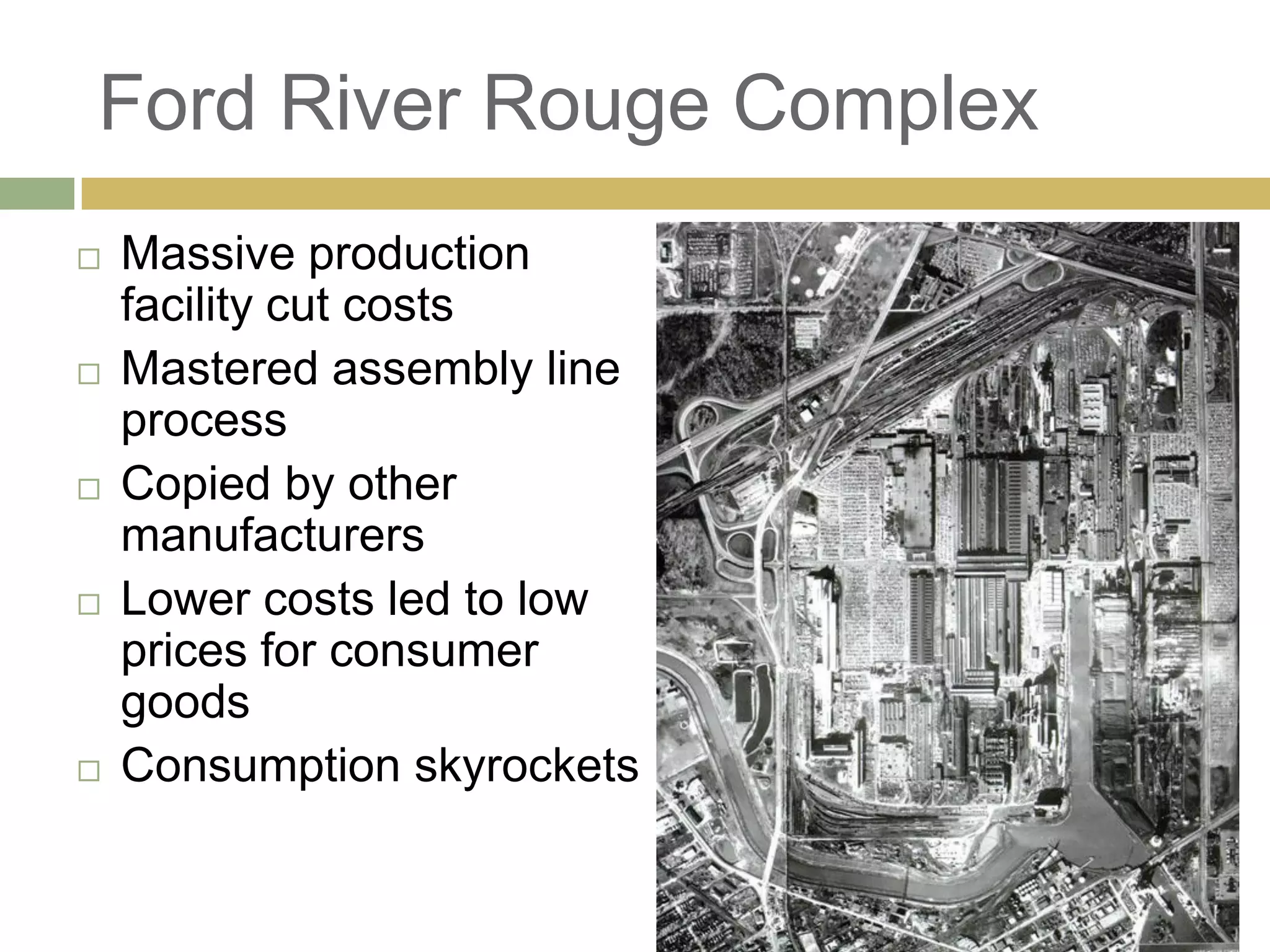
Ford River Rouge Complex
 Massive production
facility cut costs
 Mastered assembly line
process
 Copied by other
manufacturers
 Lower costs led to low
prices for consumer
goods
 Consumption skyrockets
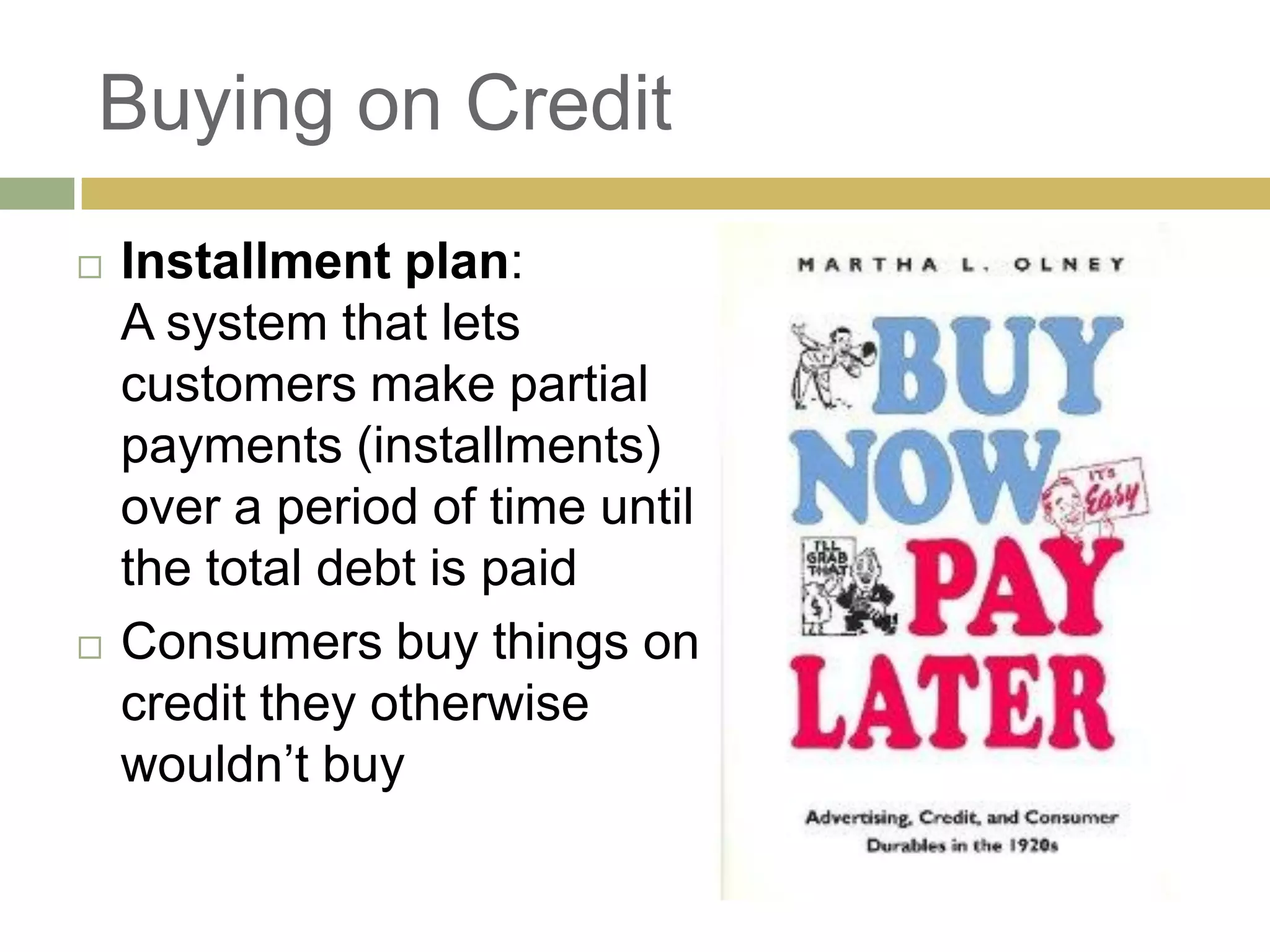
Buying on Credit
 Installment plan:
A system that lets
customers make partial
payments (installments)
over a period of time until
the total debt is paid
 Consumers buy things on
credit they otherwise
wouldn‘t buy
The Automobile Culture:
2. What is a consumer culture and why did it
develop in the 1920s?
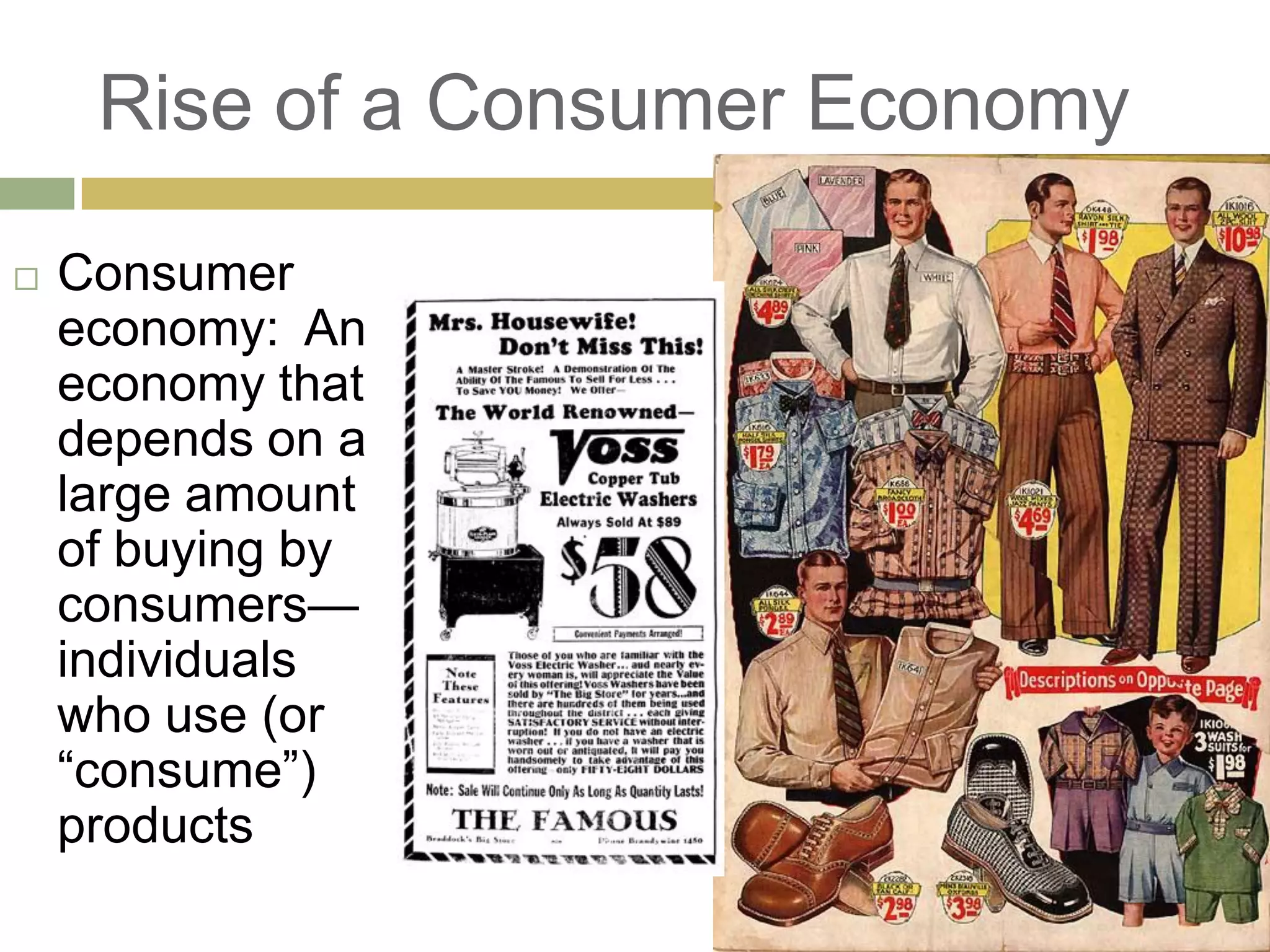
Rise of a Consumer Economy
 Consumer
economy: An
economy that
depends on a
large amount
of buying by
consumers—
individuals
who use (or
―consume‖)
products
The Automobile Culture:
3. How did the automobile revolutionize
American culture?
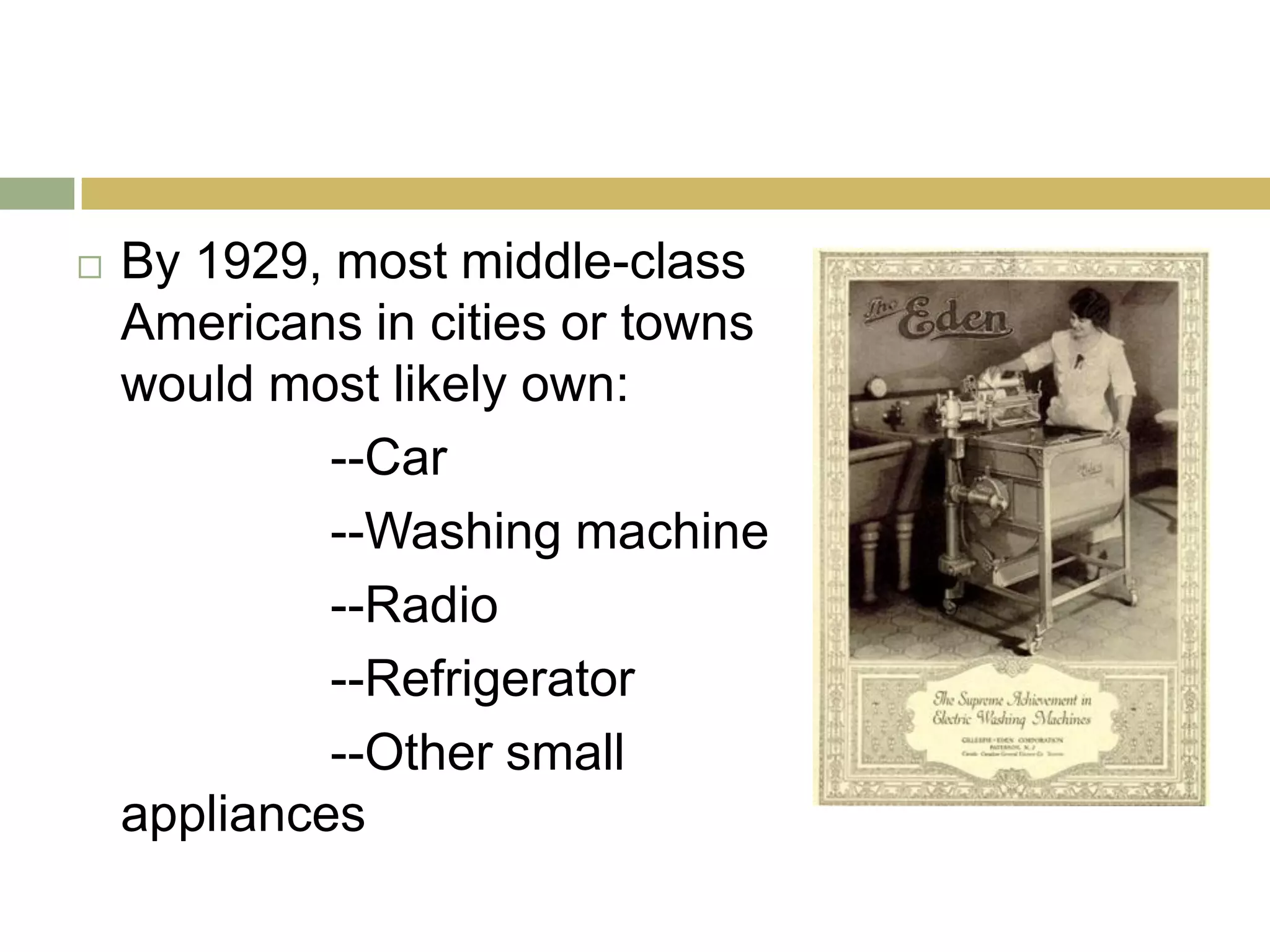
 By 1929, most middle-class
Americans in cities or towns
would most likely own:
--Car
--Washing machine
--Radio
--Refrigerator
--Other small
appliances
Things That Led to More
Independence
 25% women worked outside the home
 Automobiles
 New social values
 Voting rights
 Freud: New ideas about sexuality (It‘s normal
and healthy)
The Automobile Culture:
4. How did the automobile change living
patterns?
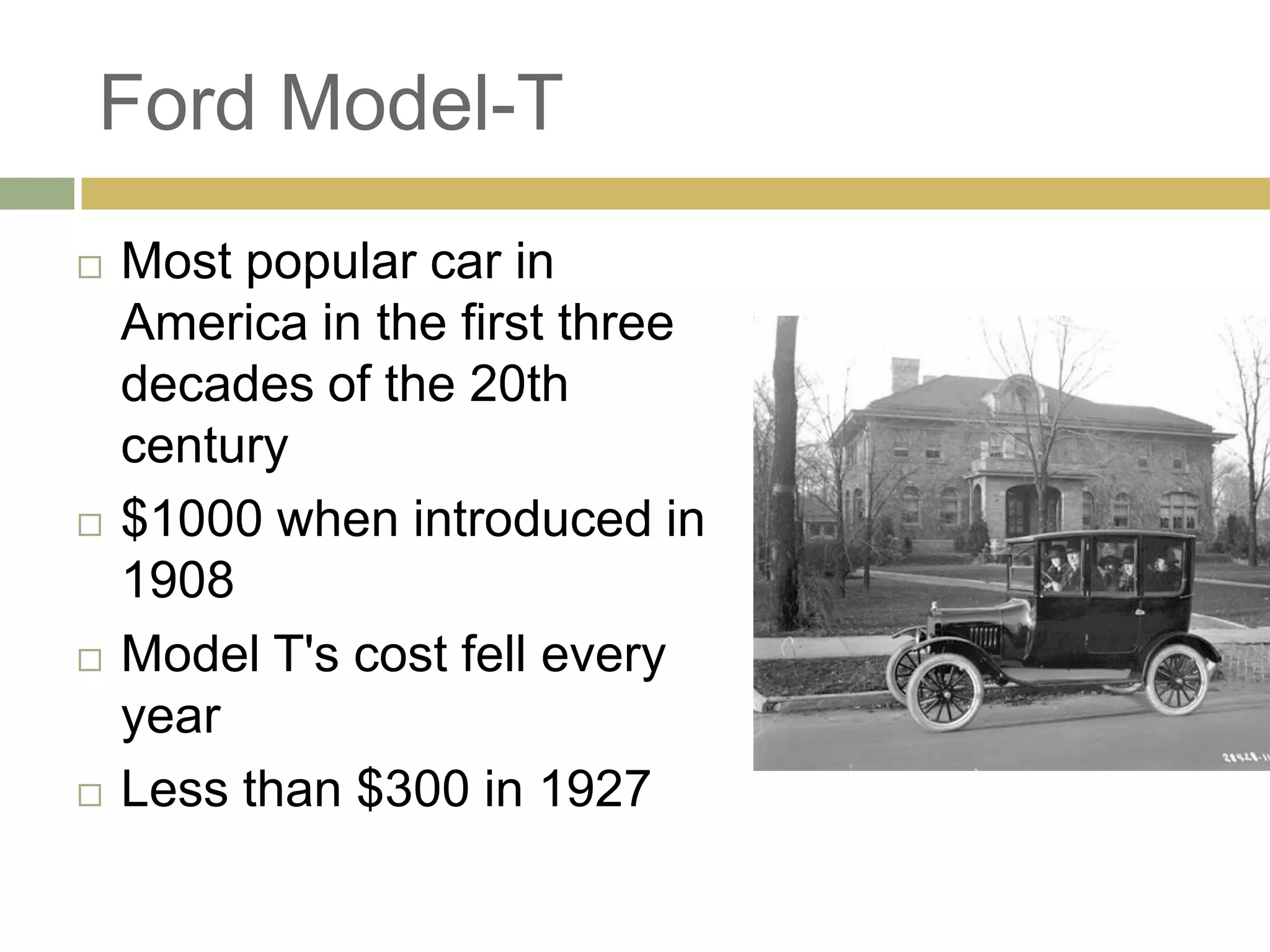
Ford Model-T
 Most popular car in
America in the first three
decades of the 20th
century
 $1000 when introduced in
1908
 Model T's cost fell every
year
 Less than $300 in 1927
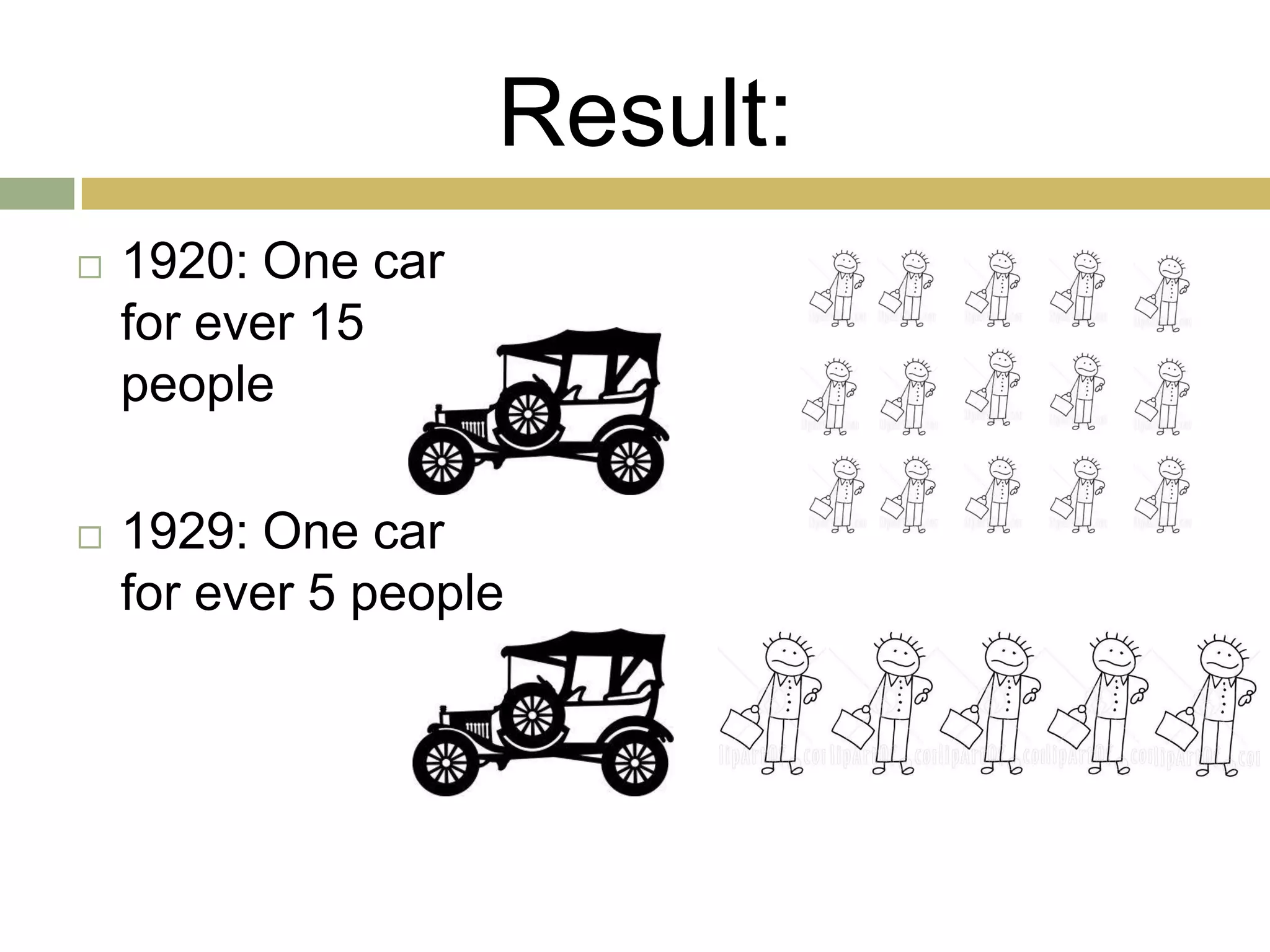
 1920: One car
for ever 15
people
 1929: One car
for ever 5 people
Result:
Popular culture; radio; jazz; heroes of
the 20s:
1. Why did a national culture develop in the
1920s?
2. What impact did the radio have on popular
culture?
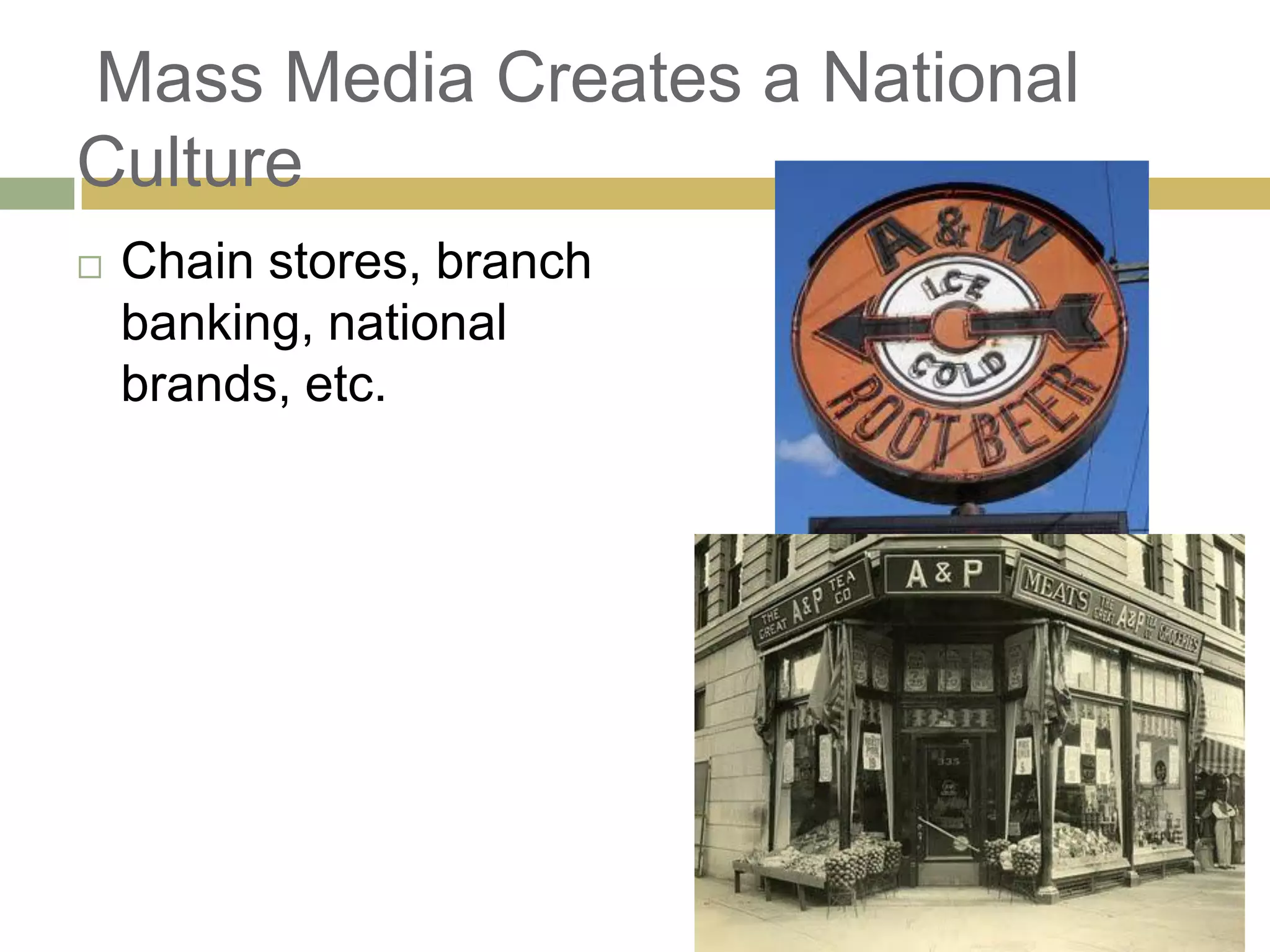
Mass Media Creates a National
Culture
 Chain stores, branch
banking, national
brands, etc.
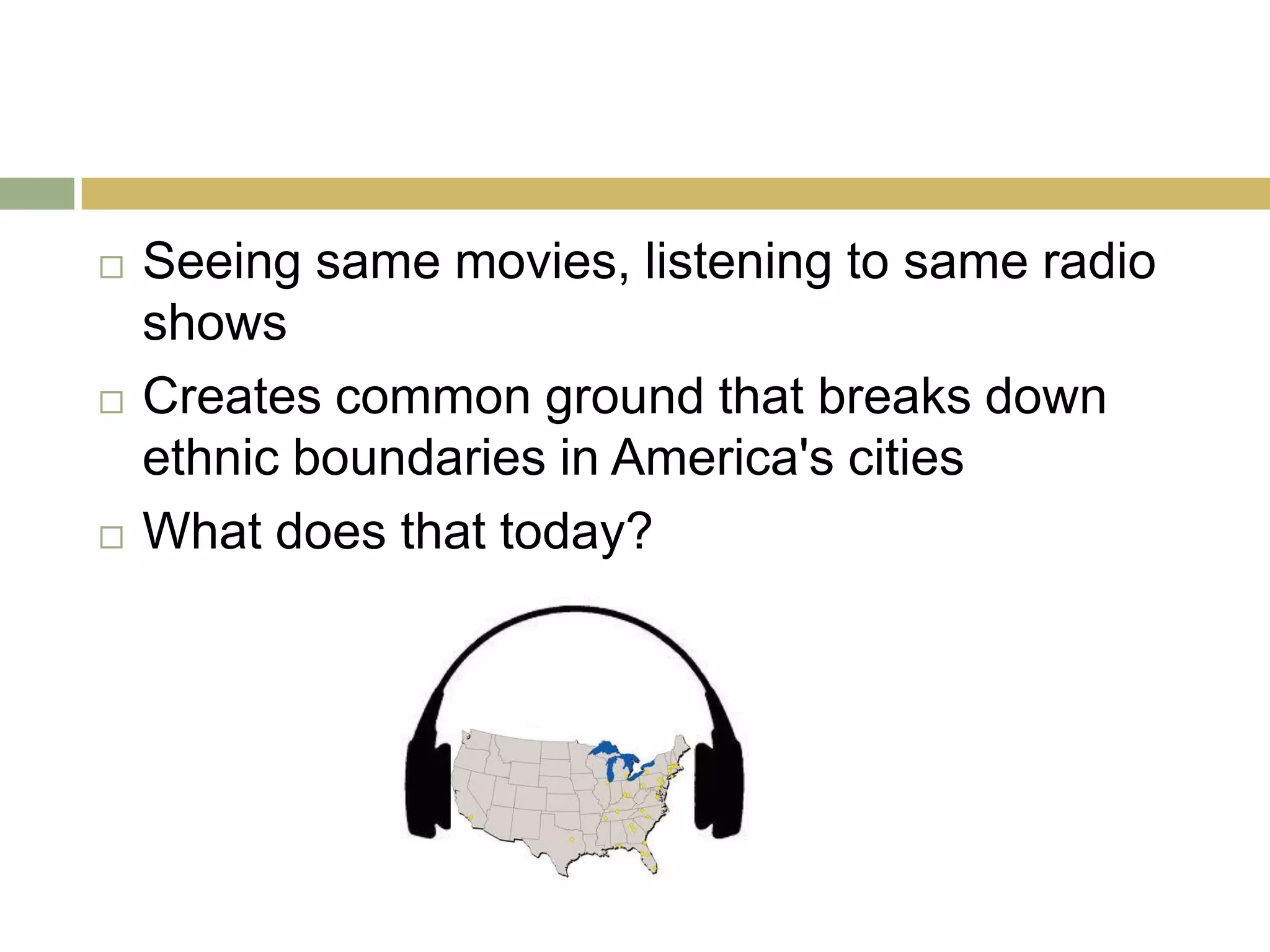
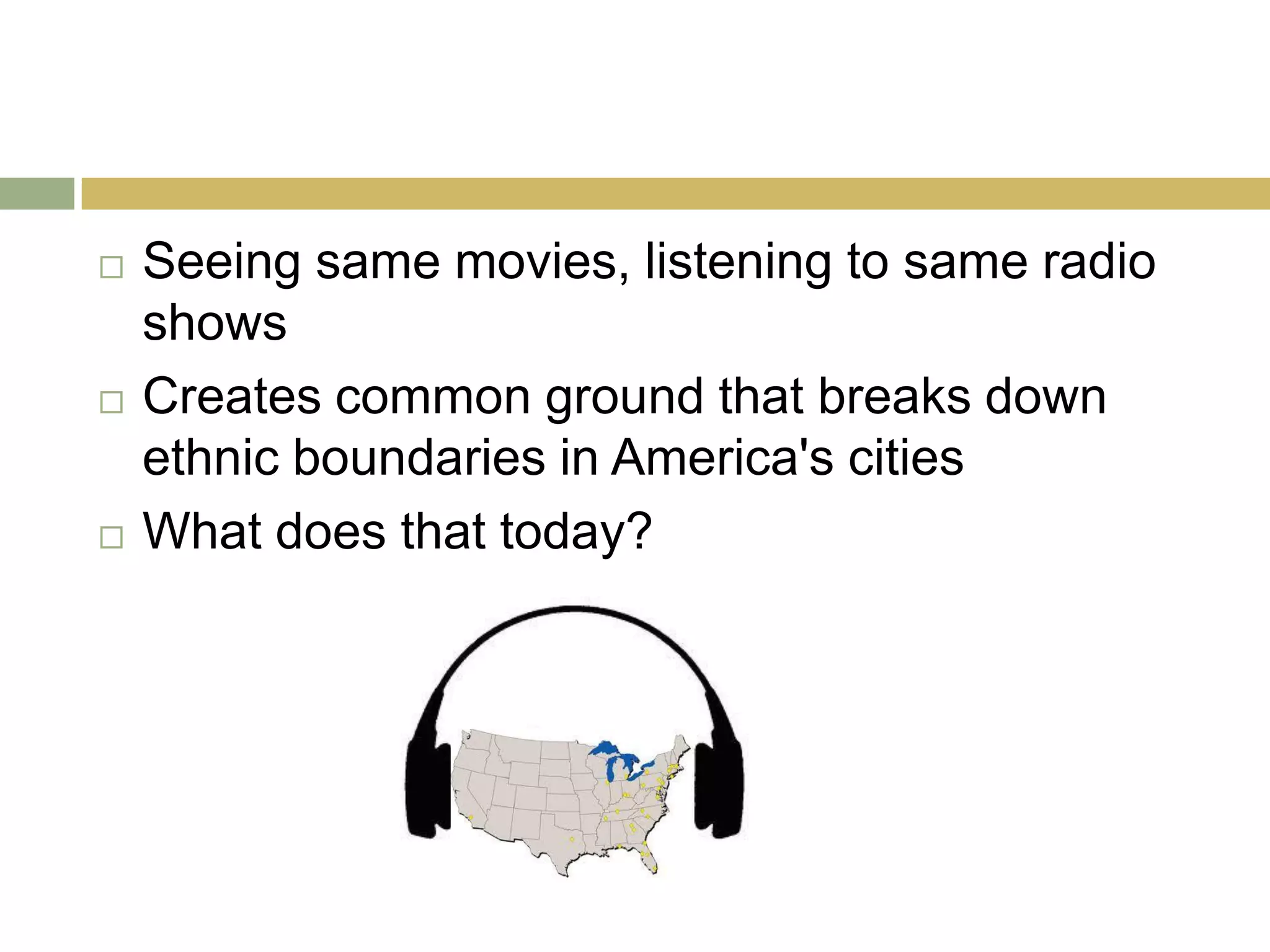
 Seeing same movies, listening to same radio
shows
 Creates common ground that breaks down
ethnic boundaries in America's cities
 What does that today?
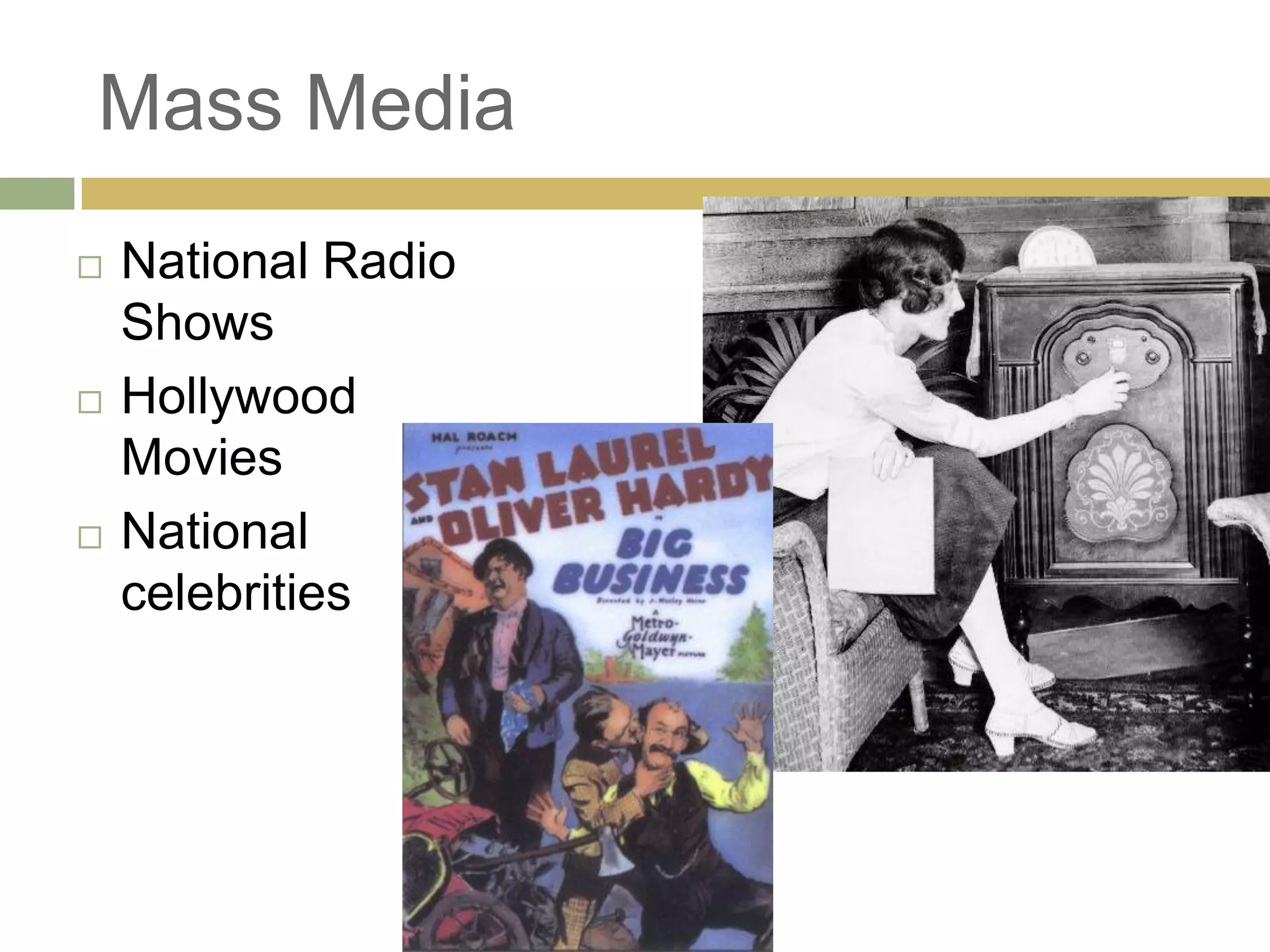
Mass Media
 National Radio
Shows
 Hollywood
Movies
 National
celebrities
Popular culture; radio; jazz;
heroes of the 20s:
3. How did trends in fashion and music reflect
the spirit of the times?
After WWI
 Americans wanted to rejoice and redefine
themselves
 Rejected the past
 Led to new lifestyles and social values
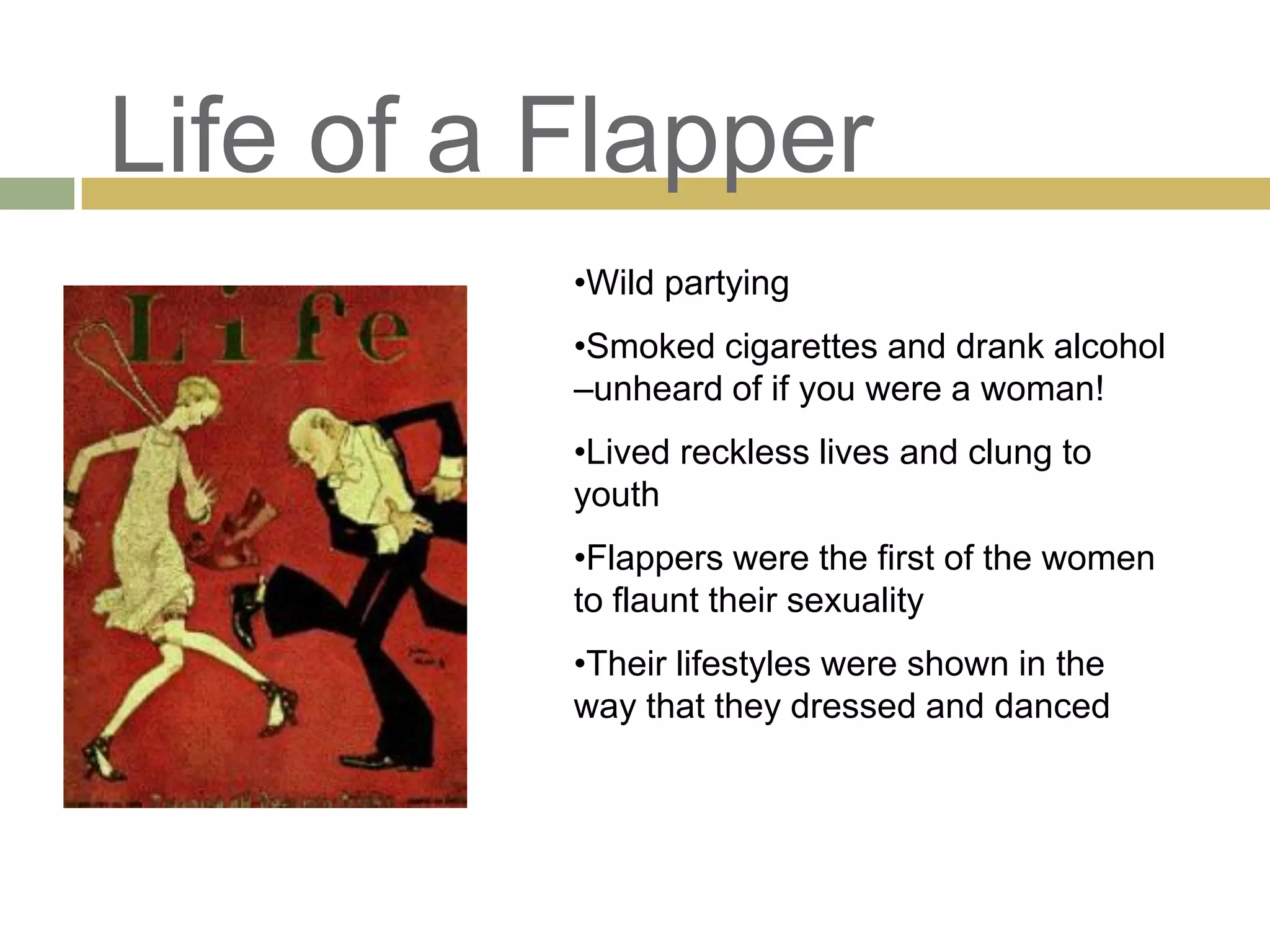
Life of a Flapper
•Wild partying
•Smoked cigarettes and drank alcohol
–unheard of if you were a woman!
•Lived reckless lives and clung to
youth
•Flappers were the first of the women
to flaunt their sexuality
•Their lifestyles were shown in the
way that they dressed and danced
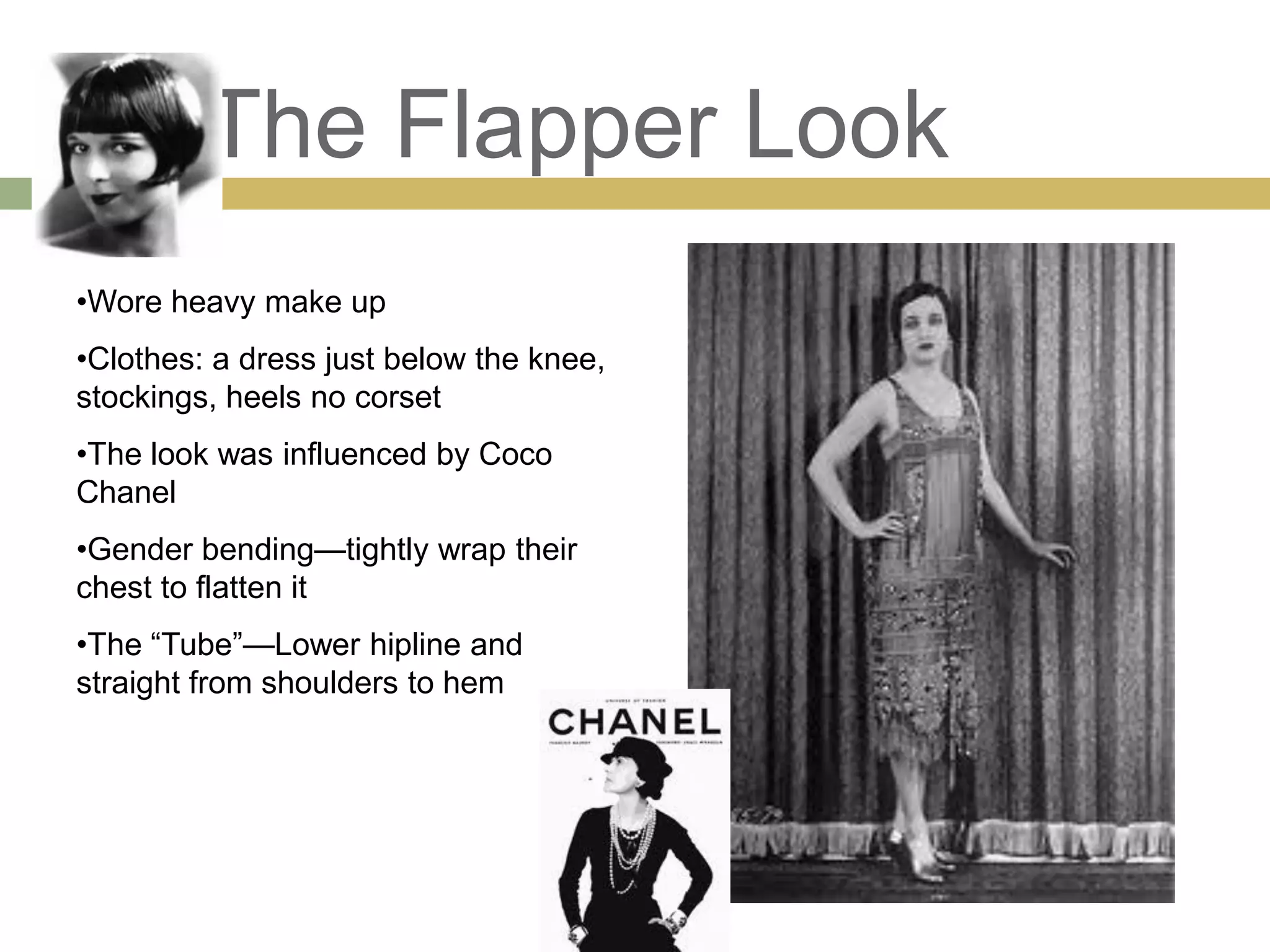
The Flapper Look
•Wore heavy make up
•Clothes: a dress just below the knee,
stockings, heels no corset
•The look was influenced by Coco
Chanel
•Gender bending—tightly wrap their
chest to flatten it
•The ―Tube‖—Lower hipline and
straight from shoulders to hem
THE JAZZ AGE
 The era from right after WWI until the stock
market crash in 1929, during which jazz
increased in popularity. It was a reaction to the
hardship of the war and was characterized by
prosperity, extravagance and self-indulgent
behavior
Popular culture; radio; jazz;
heroes of the 20s:
4. Who were the most popular heroes of this
time? Why did hero worship become popular?
Rise of the National Celebrity
 Hero worship: Intense or excessive admiration
for a hero or a person regarded as a hero;
seen widely in the 1920‘s
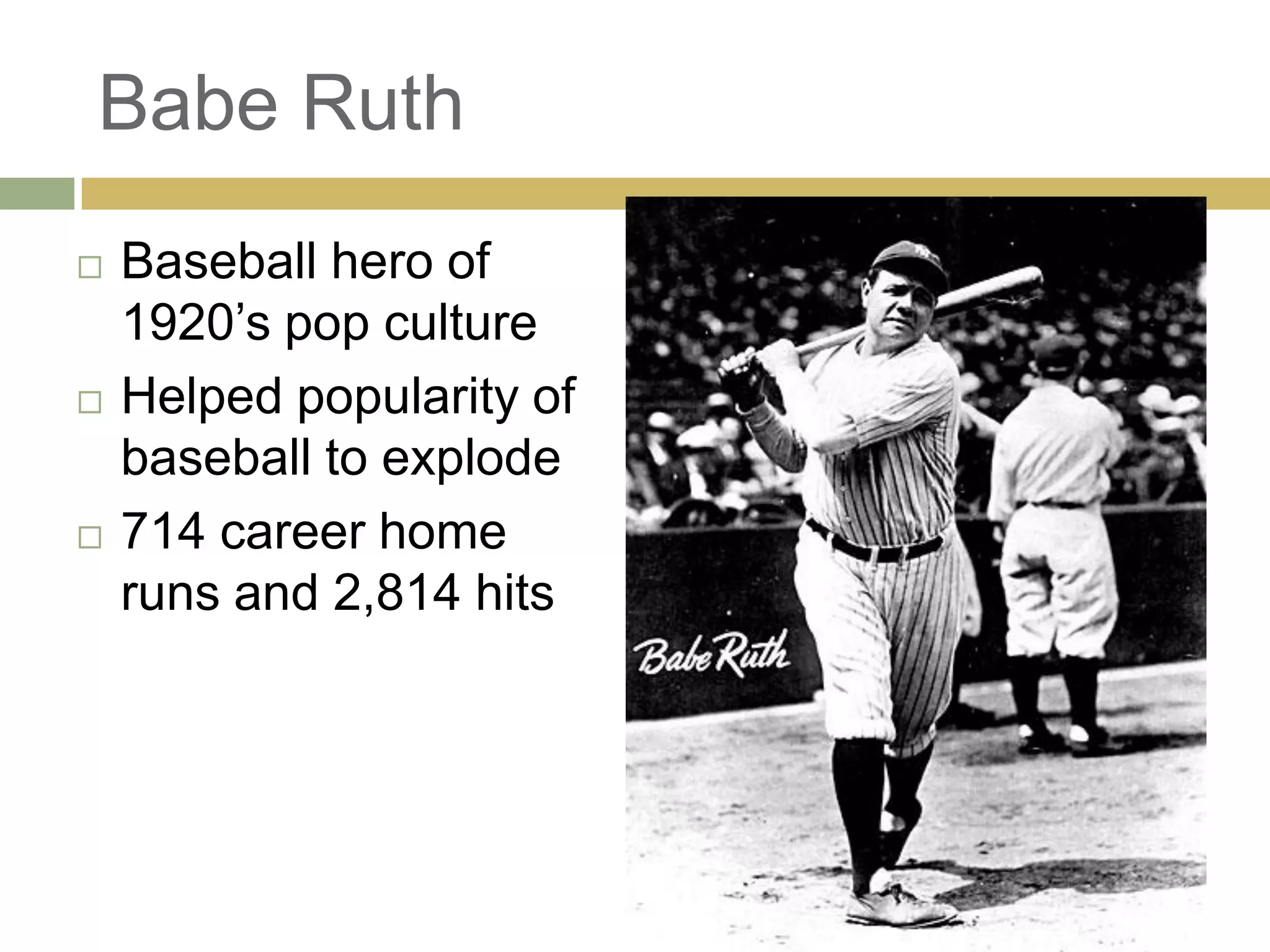
Babe Ruth
 Baseball hero of
1920‘s pop culture
 Helped popularity of
baseball to explode
 714 career home
runs and 2,814 hits
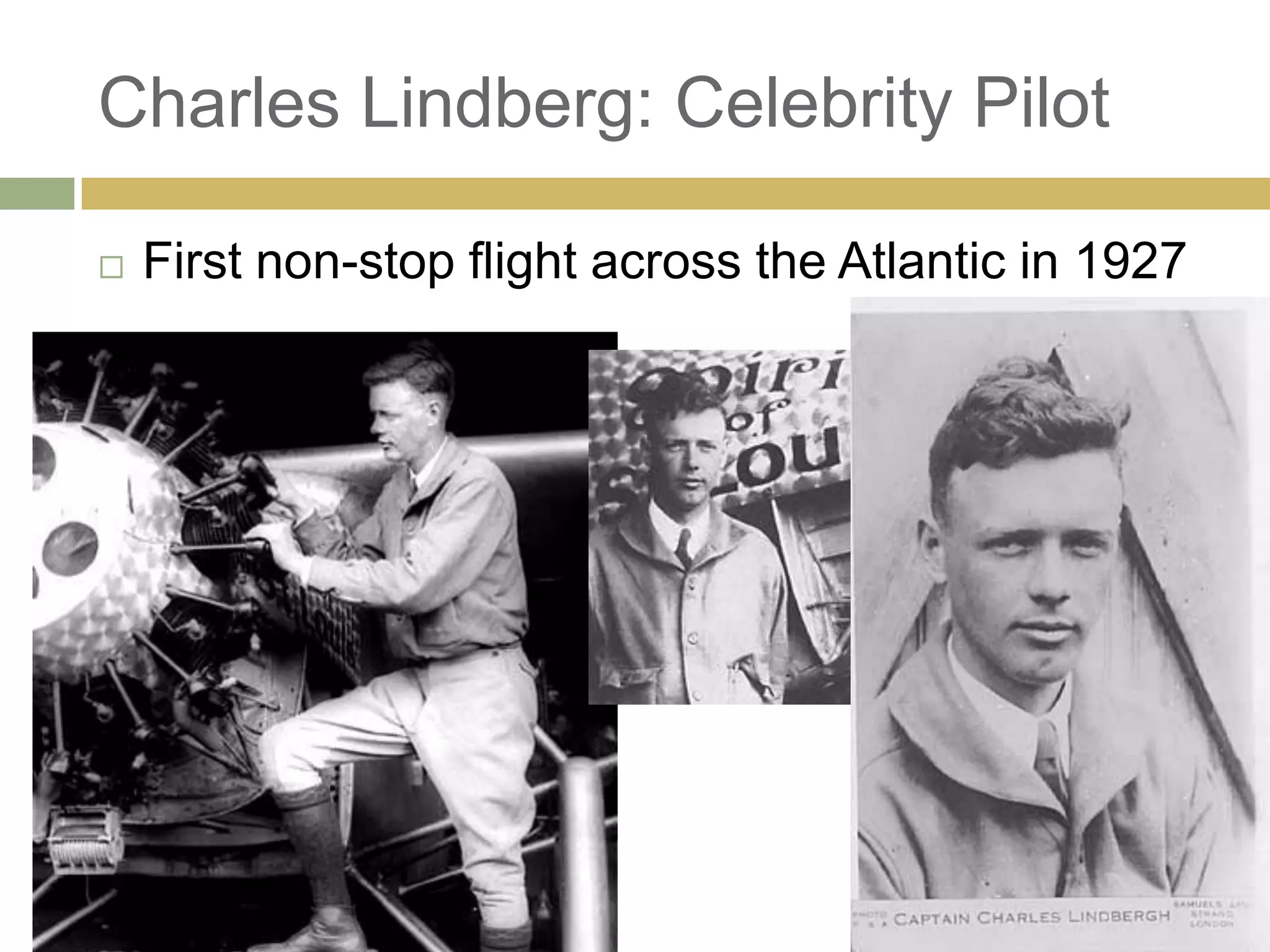
Charles Lindberg: Celebrity Pilot
 First non-stop flight across the Atlantic in 1927
 Seeing same movies, listening to same radio
shows
 Creates common ground that breaks down
ethnic boundaries in America's cities
 What does that today?
Organized crime; Cultural
backlash; Scopes Trial:
1. Why did Prohibition lead to organized crime?
Underground Market Booms
 Estimated income of bootleg liquor
industry in 1929: $3 billion
 Entire United States federal budget in
1929: $2.9 billion18
Rise of Organized Crime
• Prohibition created huge
consumer market unmet by
legitimate means
• Meant that criminals ran the
market
• Criminals get rich
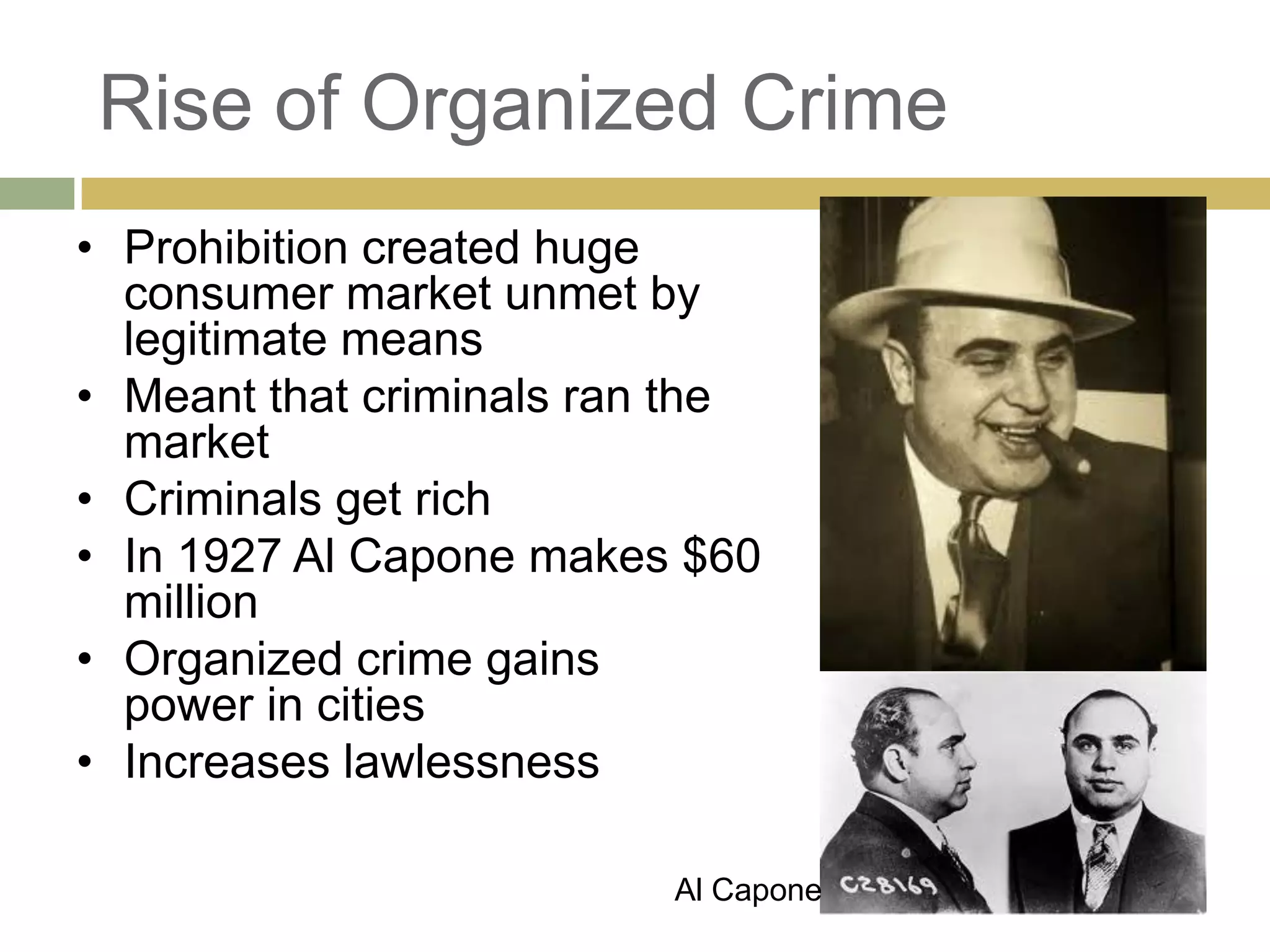
• In 1927 Al Capone makes $60
million
• Organized crime gains
power in cities
• Increases lawlessness
Al Capone
Organized crime; Cultural
backlash; Scopes Trial:
2. How did organized crime affect the American
way of life?
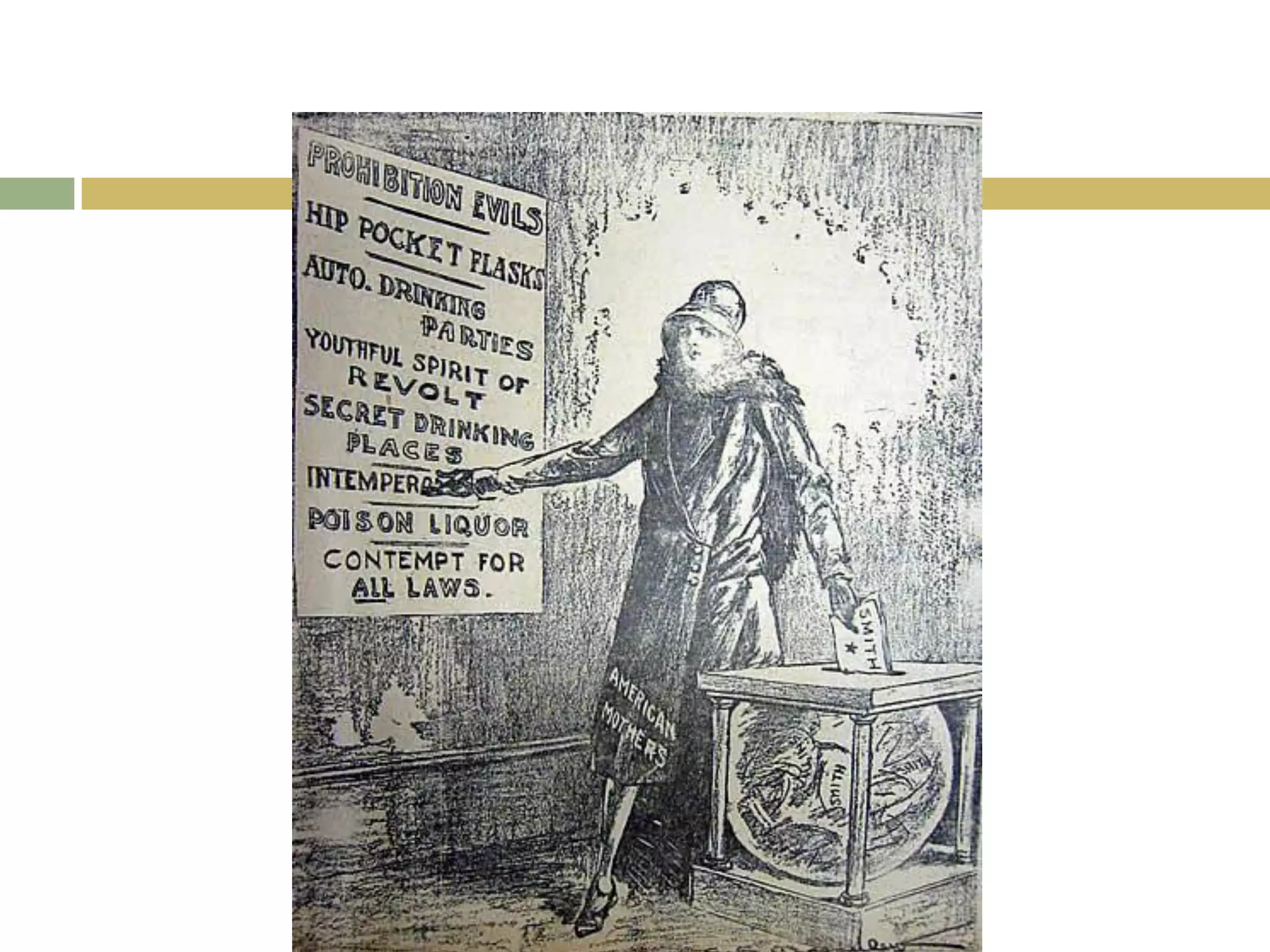
Weakened Law Enforcement
 Leads to public contempt for police
 Organized crime leaders, bootleggers and
speakeasies pay bribes to cops
 In 1927, Al Capone had half of Chicago‘s
police on his payroll
Organized crime; Cultural
backlash; Scopes Trial:
3. What is the connection between the religious
revival of the 1920s and the Scopes Trial?
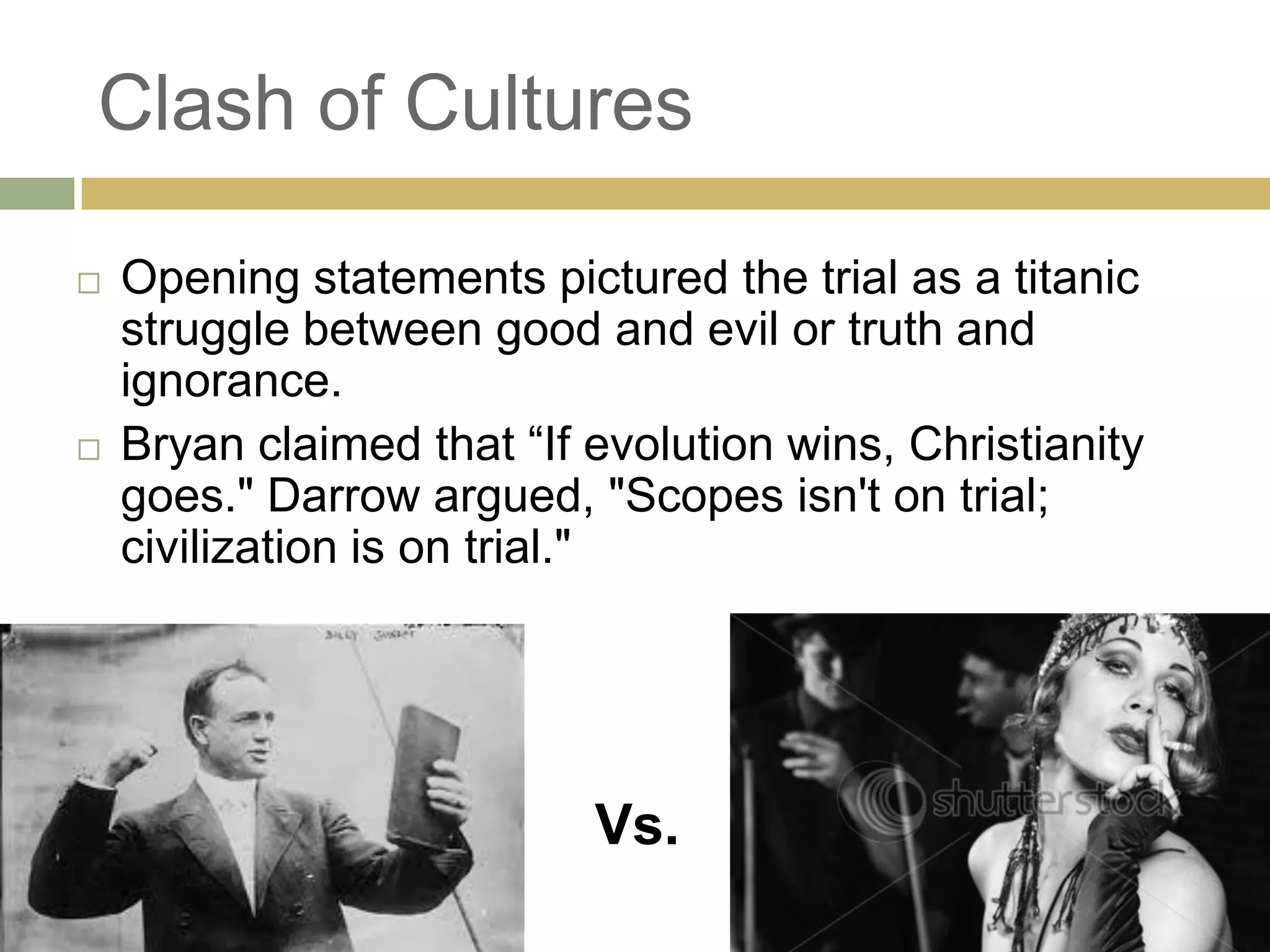
Clash of Cultures
 Opening statements pictured the trial as a titanic
struggle between good and evil or truth and
ignorance.
 Bryan claimed that ―If evolution wins, Christianity
goes." Darrow argued, "Scopes isn't on trial;
civilization is on trial."
Vs.
Showdown: Modernists v.
Traditionalists
 In response to new social patterns of
modernism, a wave of revivalism developed
 Trial emerged as a conflict between social and
intellectual values
 Journalists looking for a showdown—who
would dominate American culture?
Traditionalists or modernists?
OR
Organized crime; Cultural
backlash; Scopes Trial:
4. Why did the Scopes trial become the ―trial of
the century‖?
Clash of the Titans
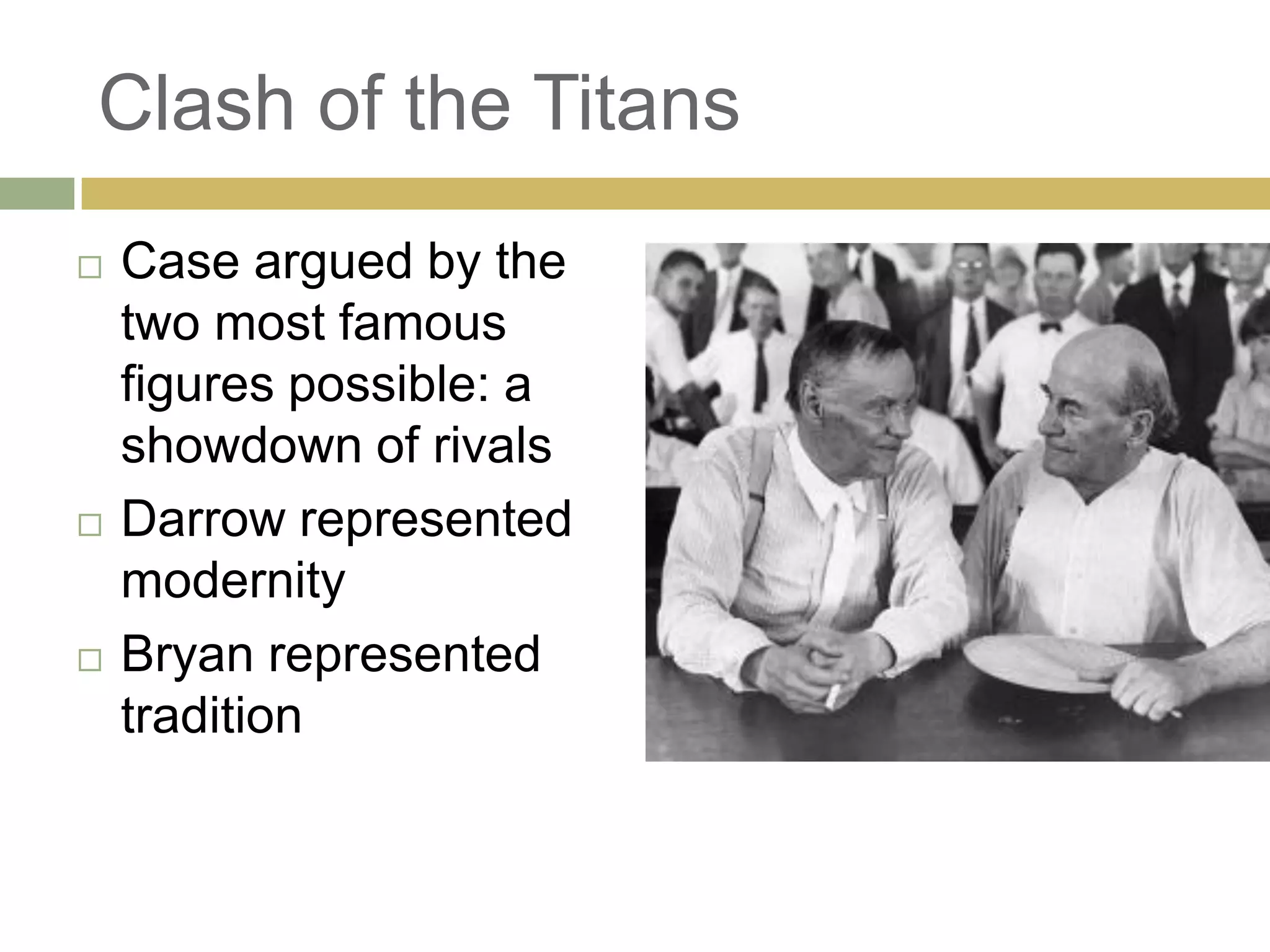
 Case argued by the
two most famous
figures possible: a
showdown of rivals
 Darrow represented
modernity
 Bryan represented
tradition
Showdown: Modernists v.
Traditionalists
 In response to new social patterns of
modernism, a wave of revivalism developed
 Trial emerged as a conflict between social and
intellectual values
 Journalists looking for a showdown—who
would dominate American culture?
Traditionalists or modernists?
OR
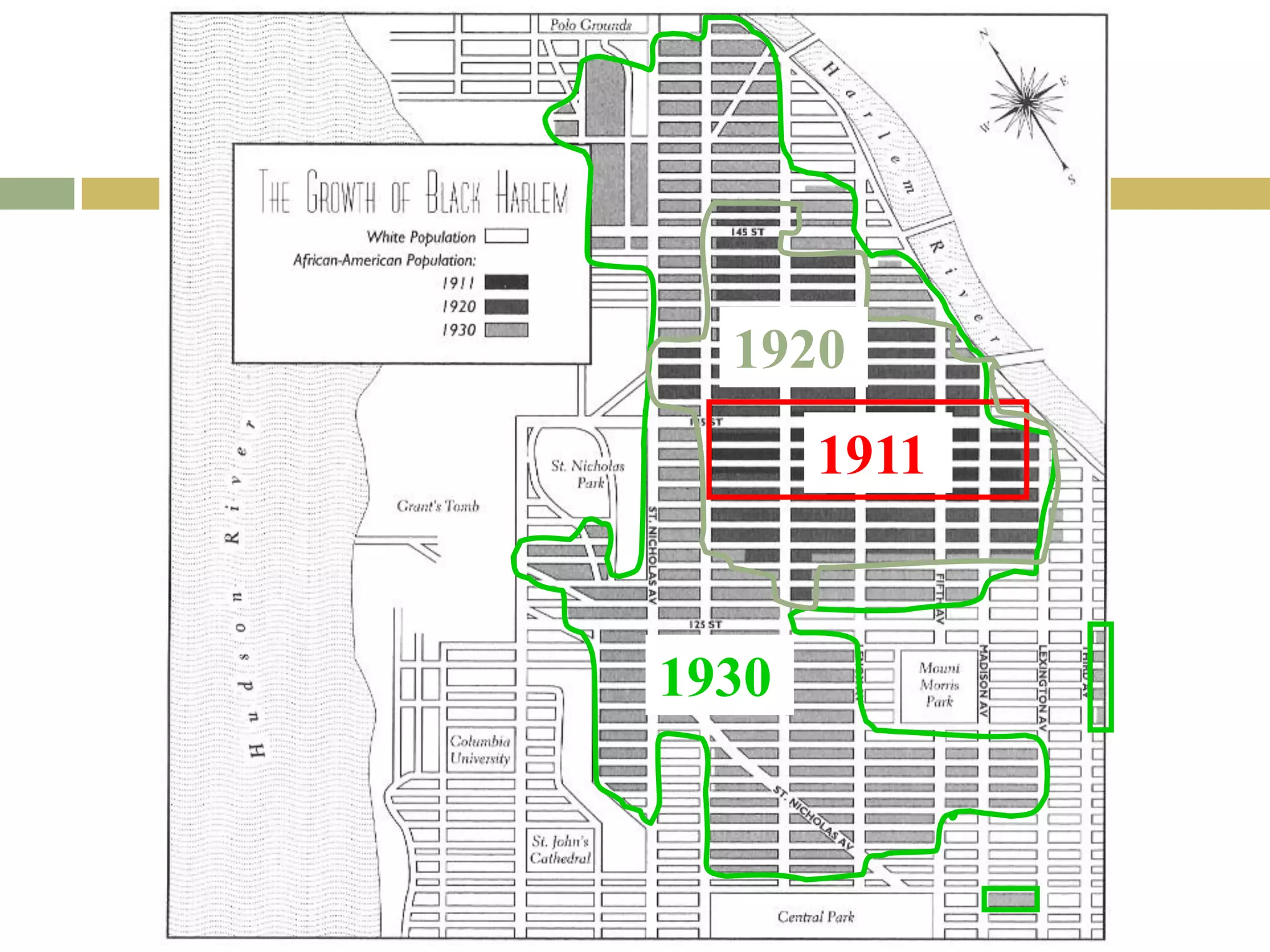
Harlem Renaissance:
1. What was the connection between the Great
Migration and the Harlem Renaissance?
Title
1930
1920
1911
1920
Harlem Renaissance:
2. What was unique about the artists‘ message?
3. How did this movement affect American pop
culture and perceptions of African-Americans?
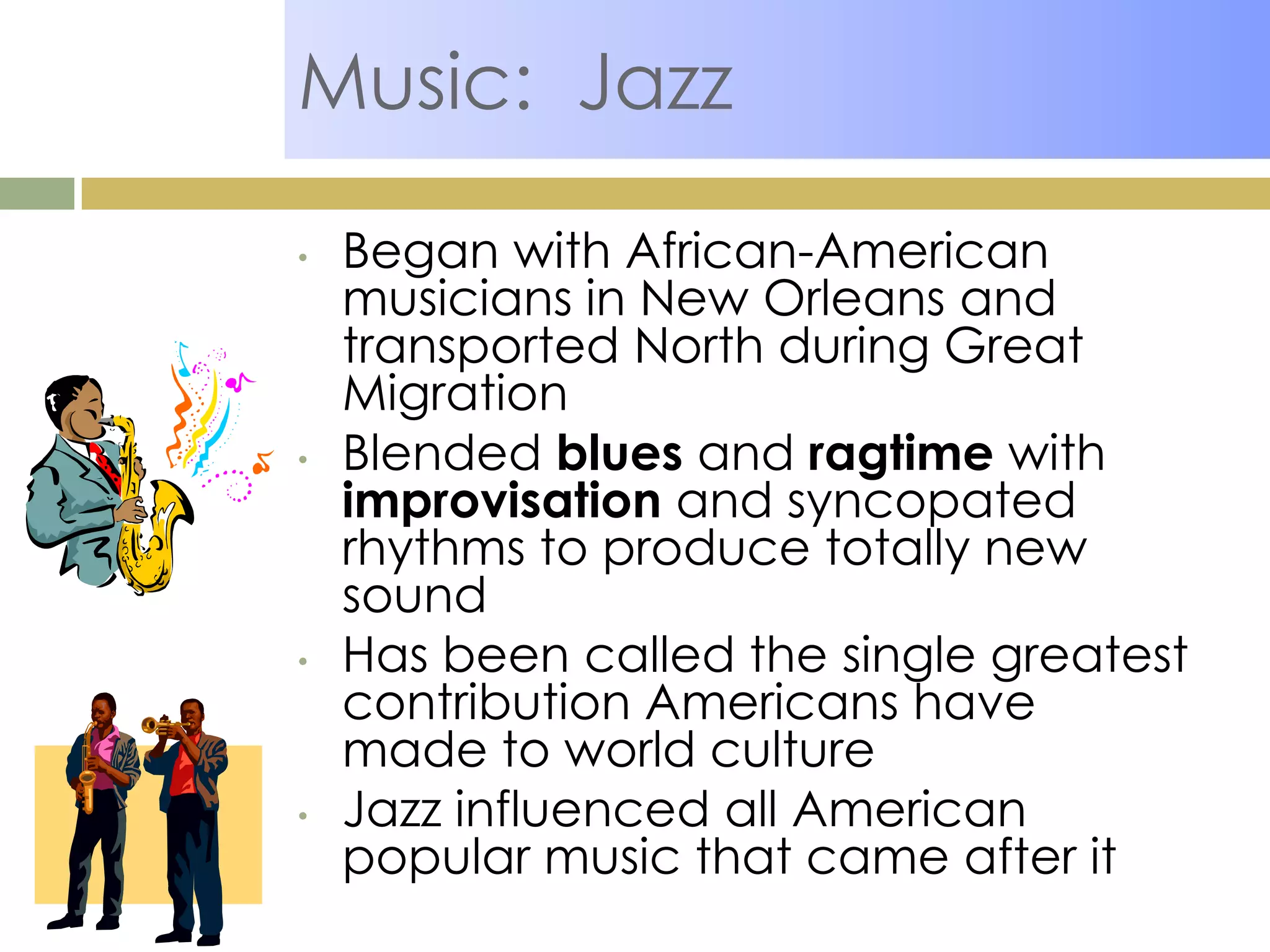
Music: Jazz
• Began with African-American
musicians in New Orleans and
transported North during Great
Migration
• Blended blues and ragtime with
improvisation and syncopated
rhythms to produce totally new
sound
• Has been called the single greatest
contribution Americans have
made to world culture
• Jazz influenced all American
popular music that came after it
Literature
 At the same time, African-
American authors were
giving their own voice to
the experience of being
black in America
 Plays depicting African-
Americans with complex
emotions are put on stage
(challenged minstrel
images)
Harlem Renaissance:
4. Who were the major figures of the Harlem
Renaissance?
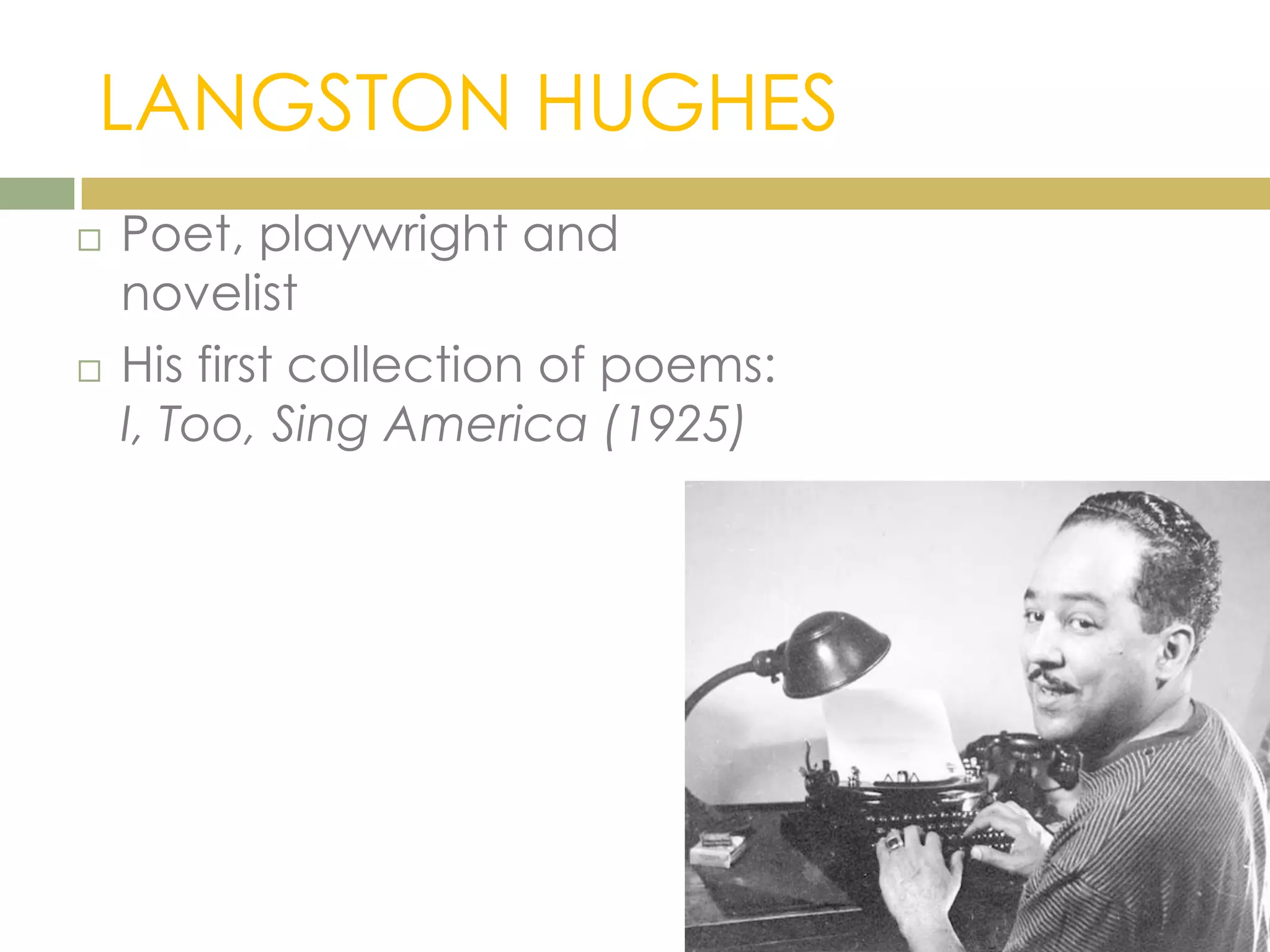
LANGSTON HUGHES
 Poet, playwright and
novelist
 His first collection of poems:
I, Too, Sing America (1925)
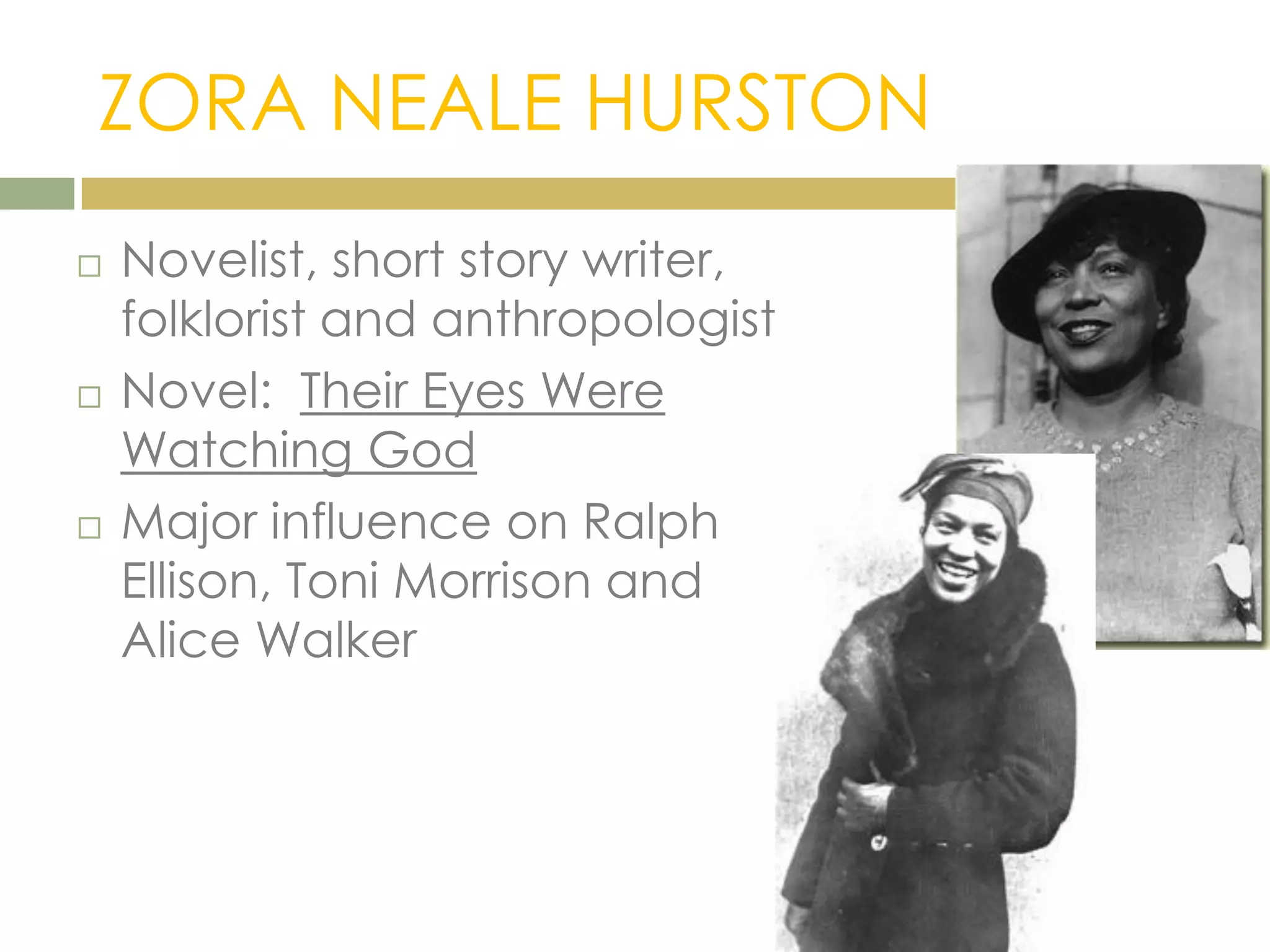
ZORA NEALE HURSTON
 Novelist, short story writer,
folklorist and anthropologist
 Novel: Their Eyes Were
Watching God
 Major influence on Ralph
Ellison, Toni Morrison and
Alice Walker
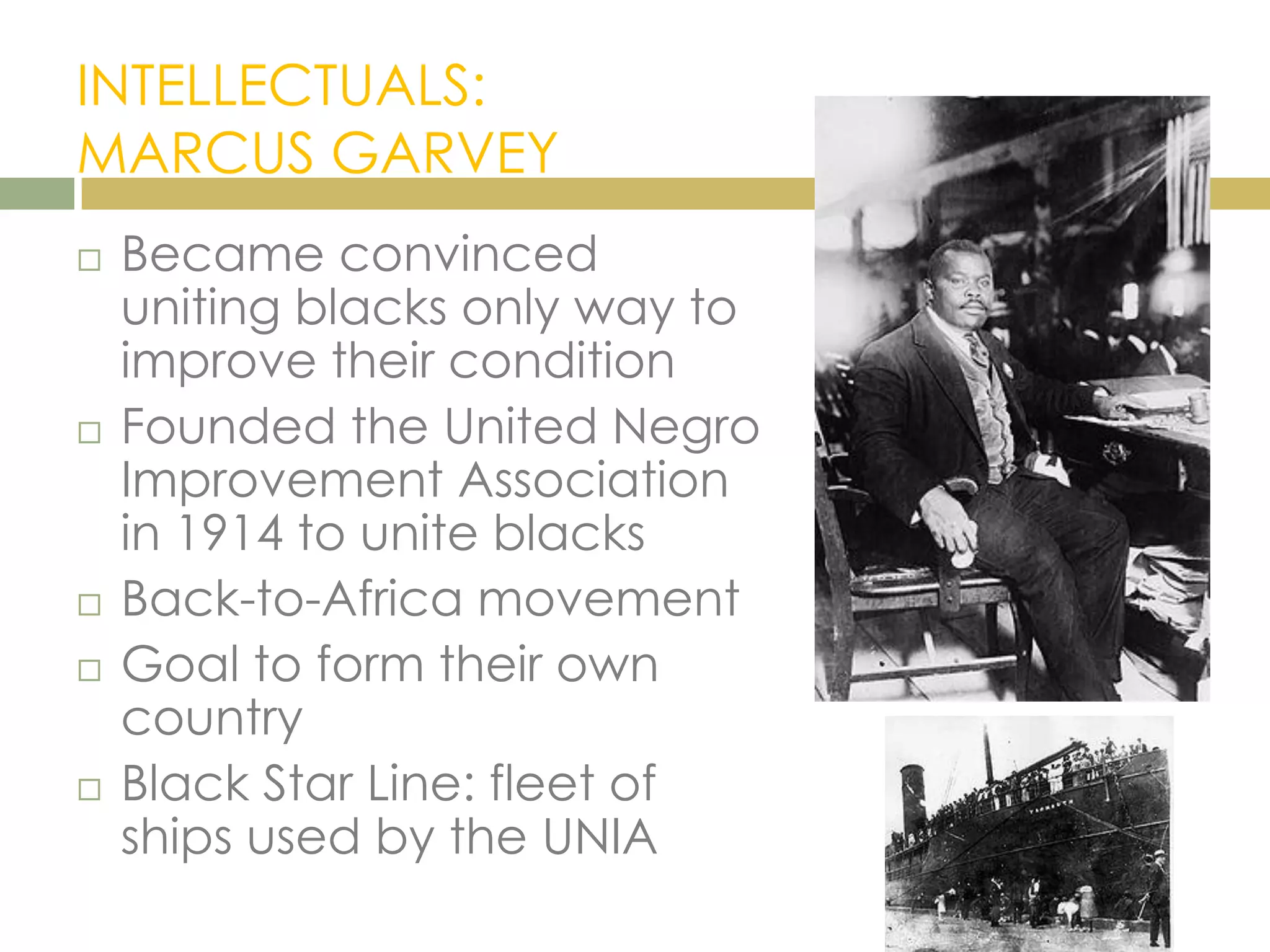
INTELLECTUALS:
MARCUS GARVEY
 Became convinced
uniting blacks only way to
improve their condition
 Founded the United Negro
Improvement Association
in 1914 to unite blacks
 Back-to-Africa movement
 Goal to form their own
country
 Black Star Line: fleet of
ships used by the UNIA
Red Scare and the Palmer Raids;
Immigration reform:
1. What made Americans ―afraid‖ of radical
ideas?
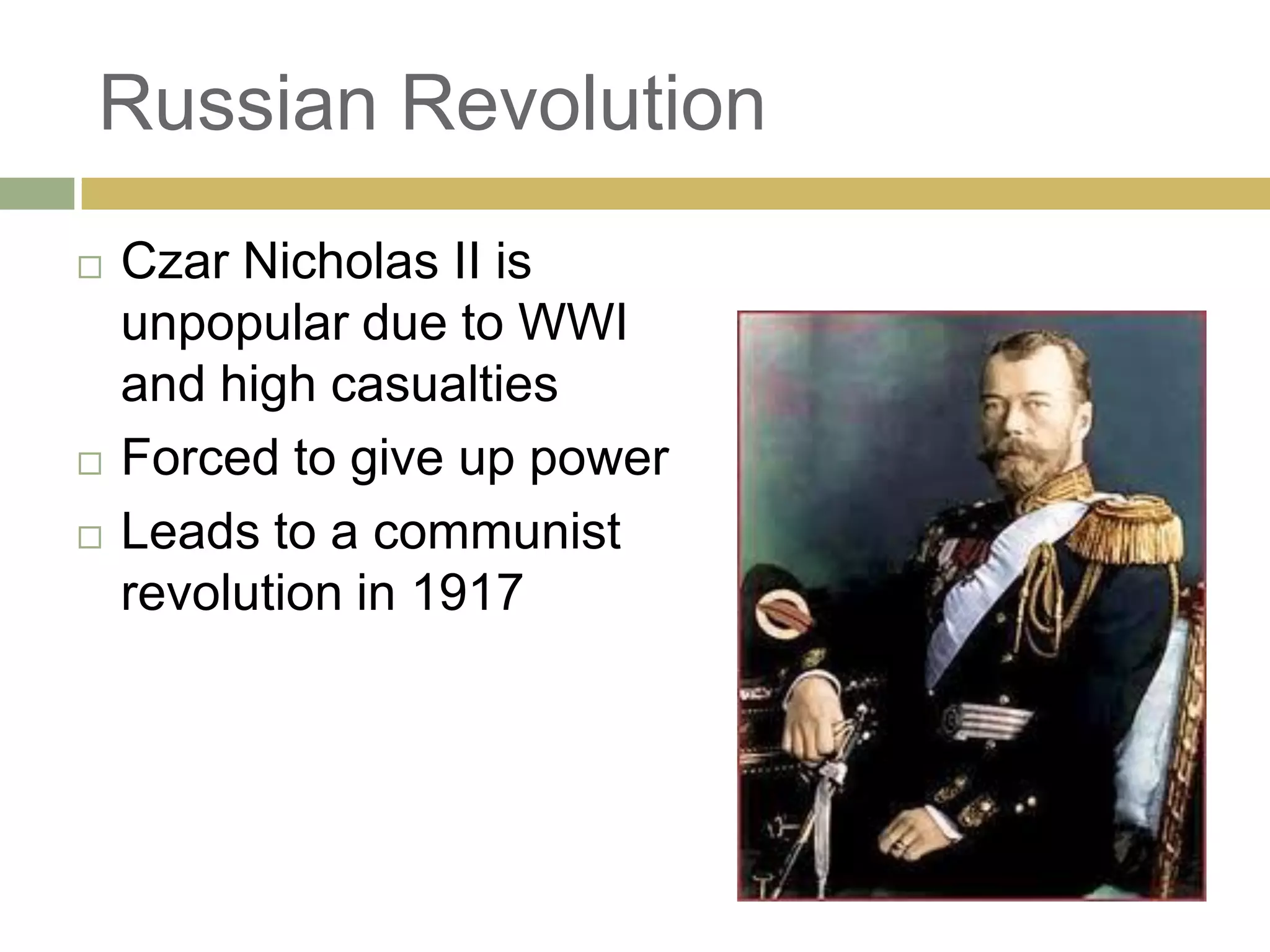
Russian Revolution
 Czar Nicholas II is
unpopular due to WWI
and high casualties
 Forced to give up power
 Leads to a communist
revolution in 1917
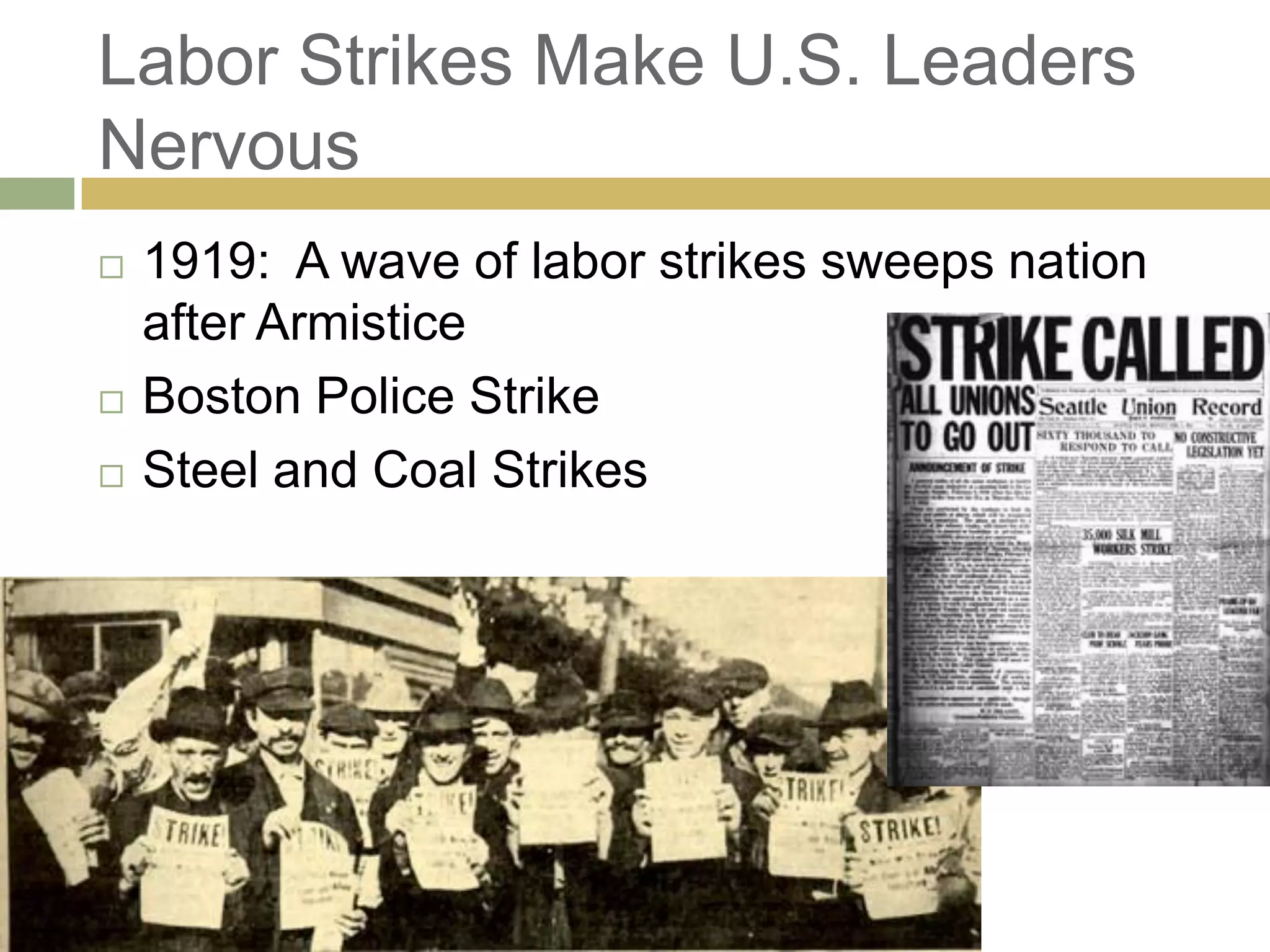
Labor Strikes Make U.S. Leaders
Nervous
 1919: A wave of labor strikes sweeps nation
after Armistice
 Boston Police Strike
 Steel and Coal Strikes
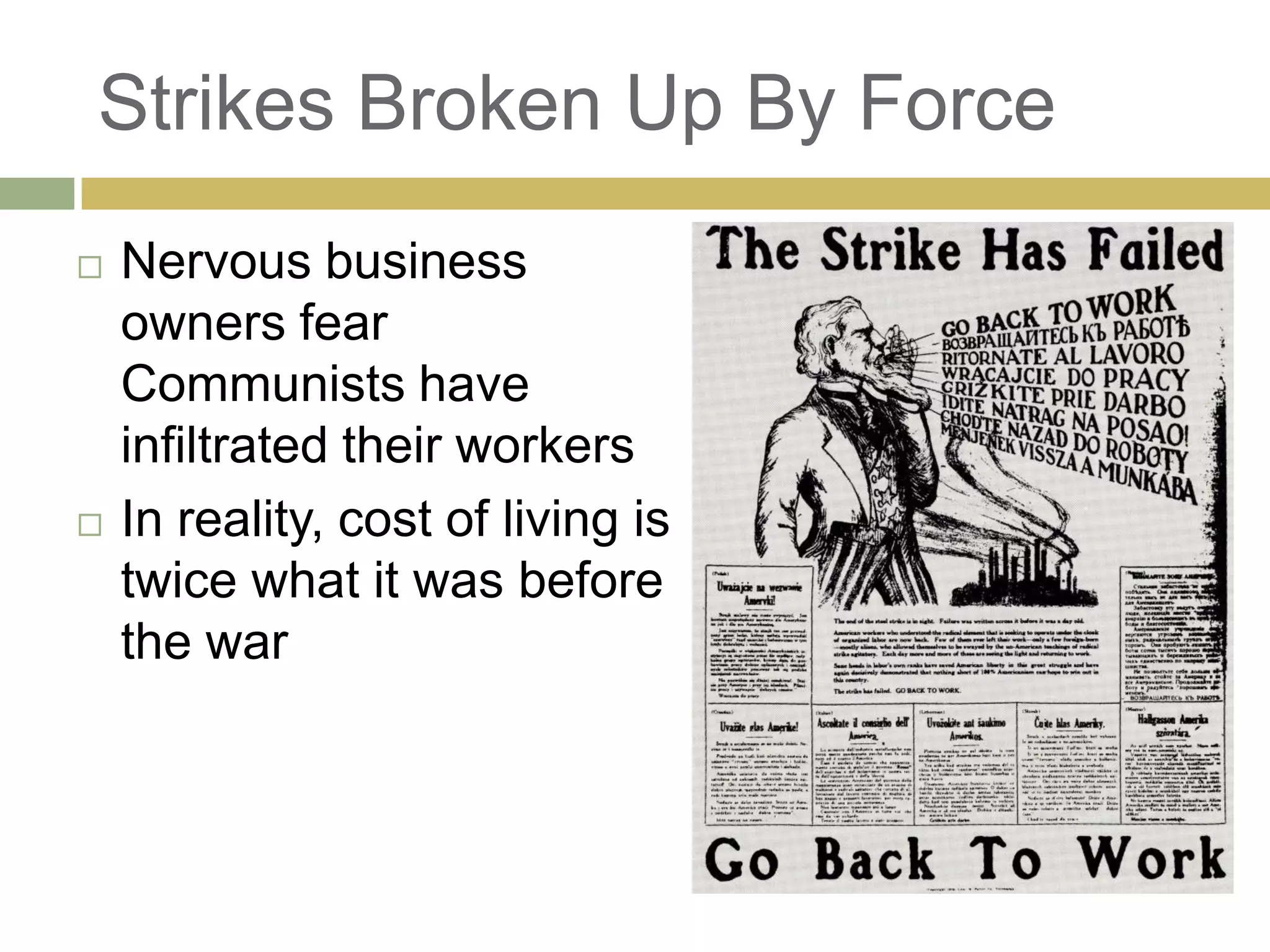
Strikes Broken Up By Force
 Nervous business
owners fear
Communists have
infiltrated their workers
 In reality, cost of living is
twice what it was before
the war
Red Scare and the Palmer Raids;
Immigration reform:
2. What actions did the federal government take
against suspected radicals?
Palmer Raids
 A campaign of raids to
identify and root out groups
whose activities posed a
"clear and present danger"
to the country, such as
communists, socialists and
anarchists
Red Scare and the Palmer Raids;
Immigration reform:
3. How did this change immigration to the US?
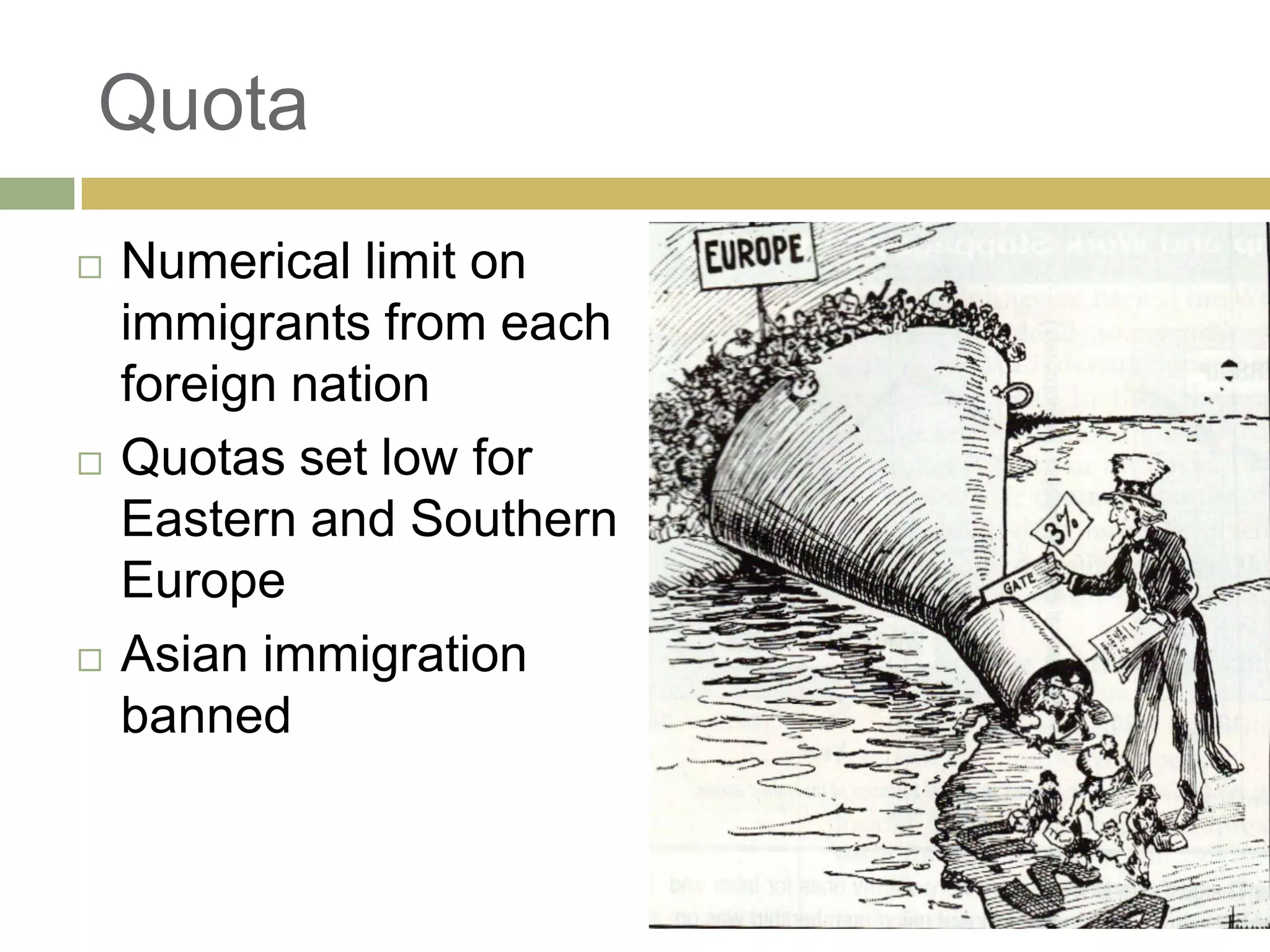
Quota
 Numerical limit on
immigrants from each
foreign nation
 Quotas set low for
Eastern and Southern
Europe
 Asian immigration
banned
Red Scare and the Palmer Raids;
Immigration reform:
4. What were the long term effects of the Red
Scare?
Red Scare
 An intense fear of communism and other ideas
considered extreme
New Immigration Laws
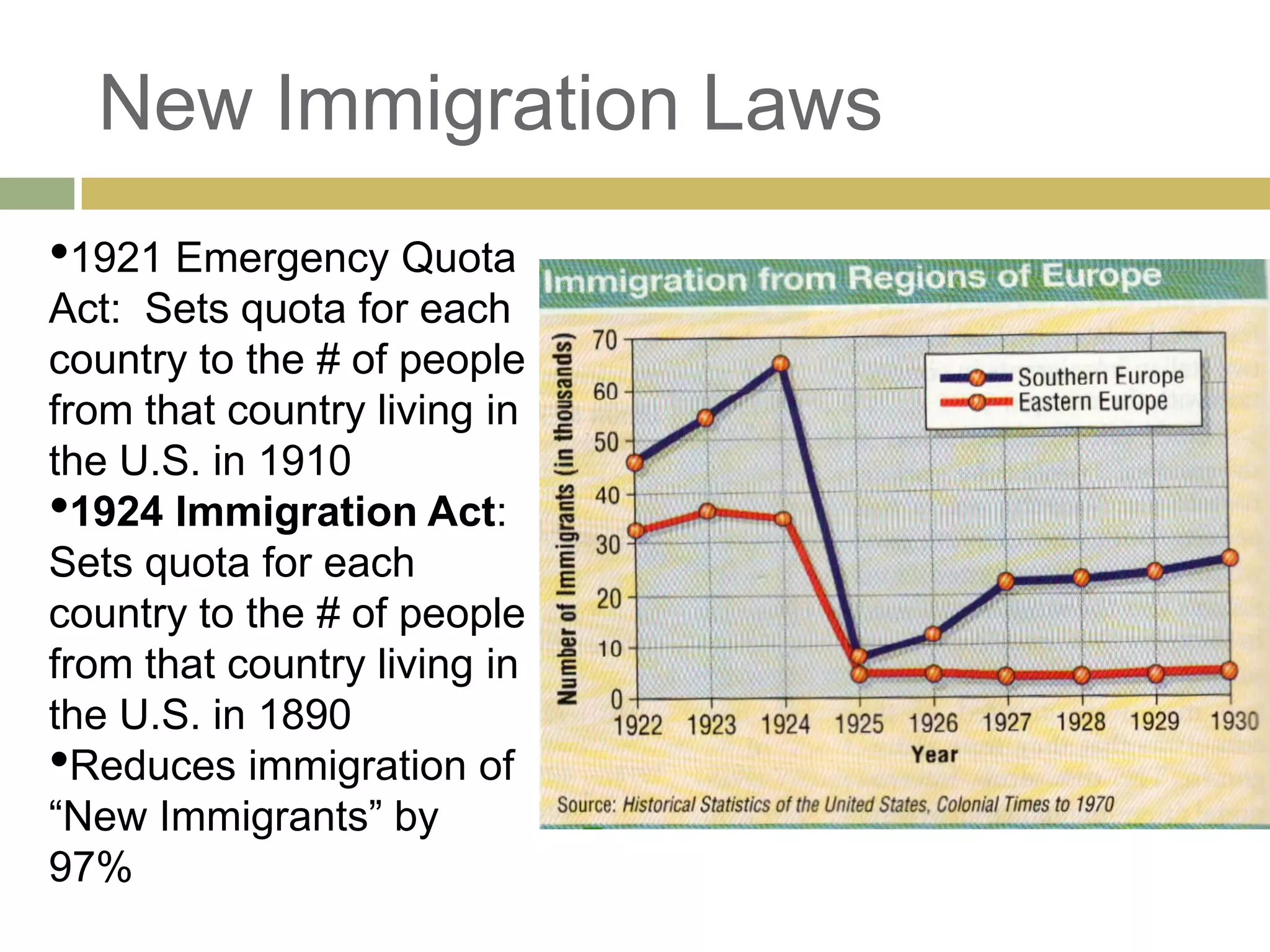
•1921 Emergency Quota
Act: Sets quota for each
country to the # of people
from that country living in
the U.S. in 1910
•1924 Immigration Act:
Sets quota for each
country to the # of people
from that country living in
the U.S. in 1890
•Reduces immigration of
―New Immigrants‖ by
97%
The Great Migration; Rise of the
KKK:
1. What caused African-Americans to move from
the South?
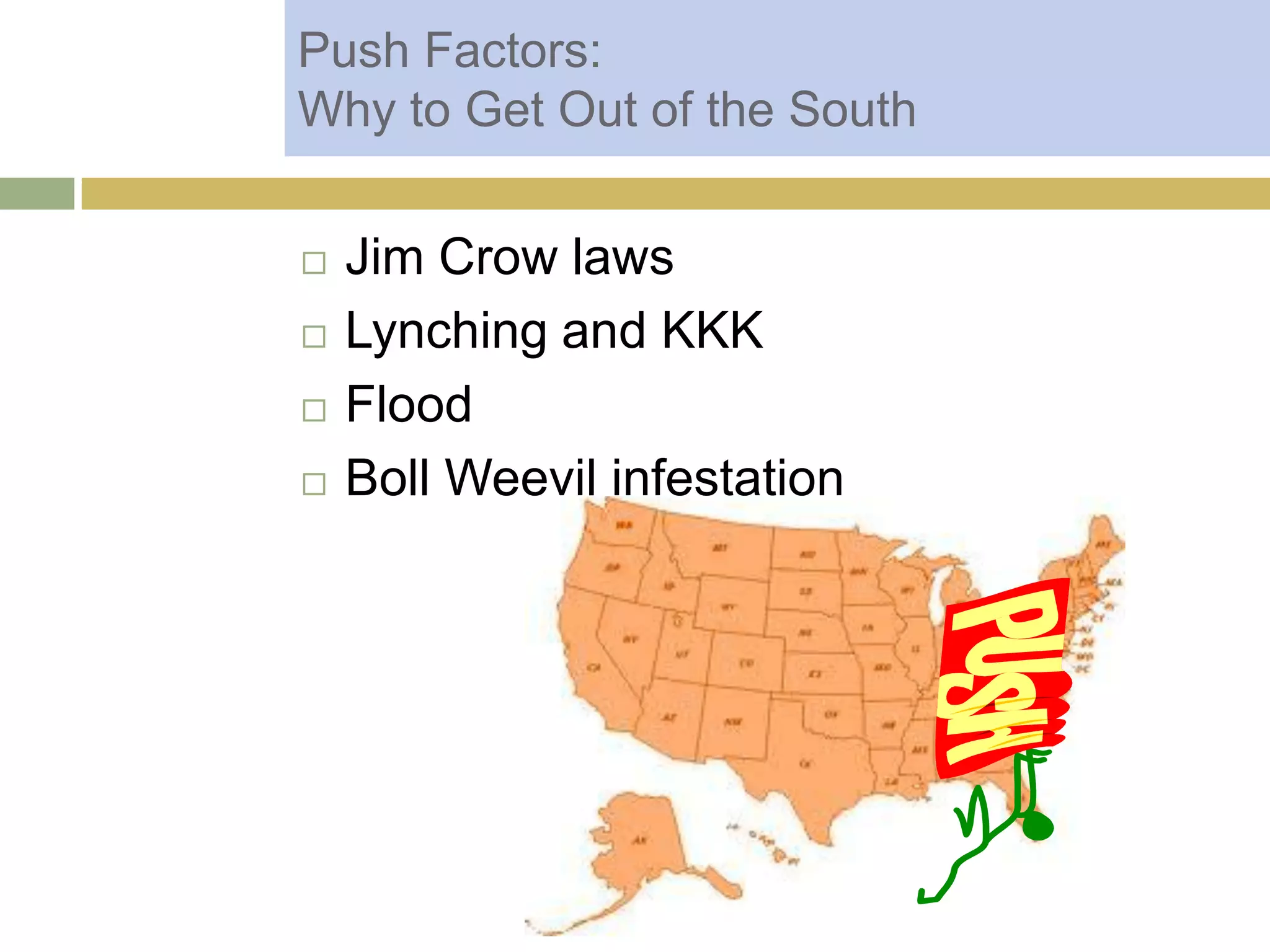
Push Factors:
Why to Get Out of the South
 Jim Crow laws
 Lynching and KKK
 Flood
 Boll Weevil infestation
The Great Migration; Rise of the
KKK:
2. Why did conditions in the North appealed to
African-Americans?
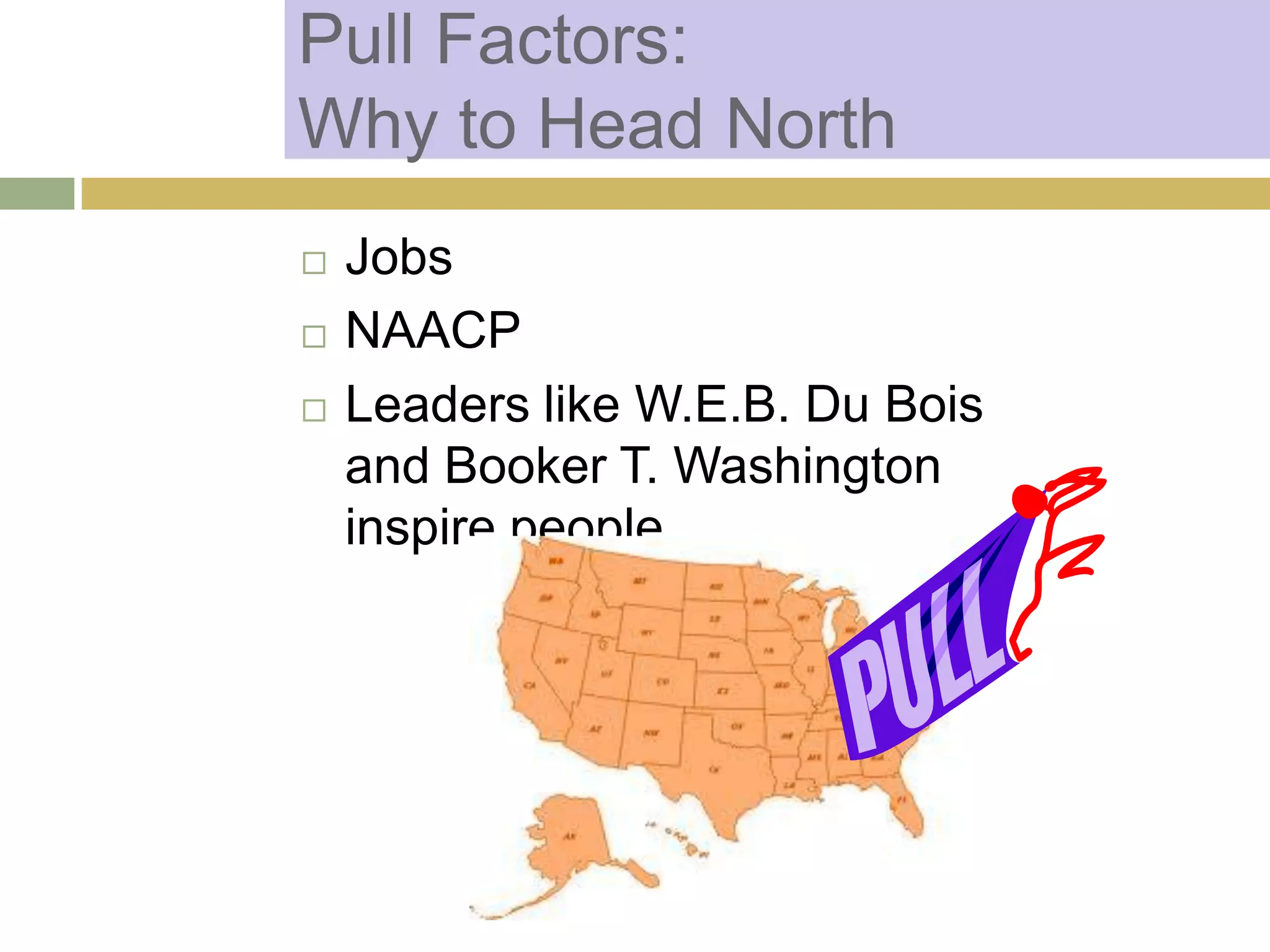
Pull Factors:
Why to Head North
 Jobs
 NAACP
 Leaders like W.E.B. Du Bois
and Booker T. Washington
inspire people
The Great Migration; Rise of the
KKK:
3. What impact did the Great Migration have on
American racial relations?
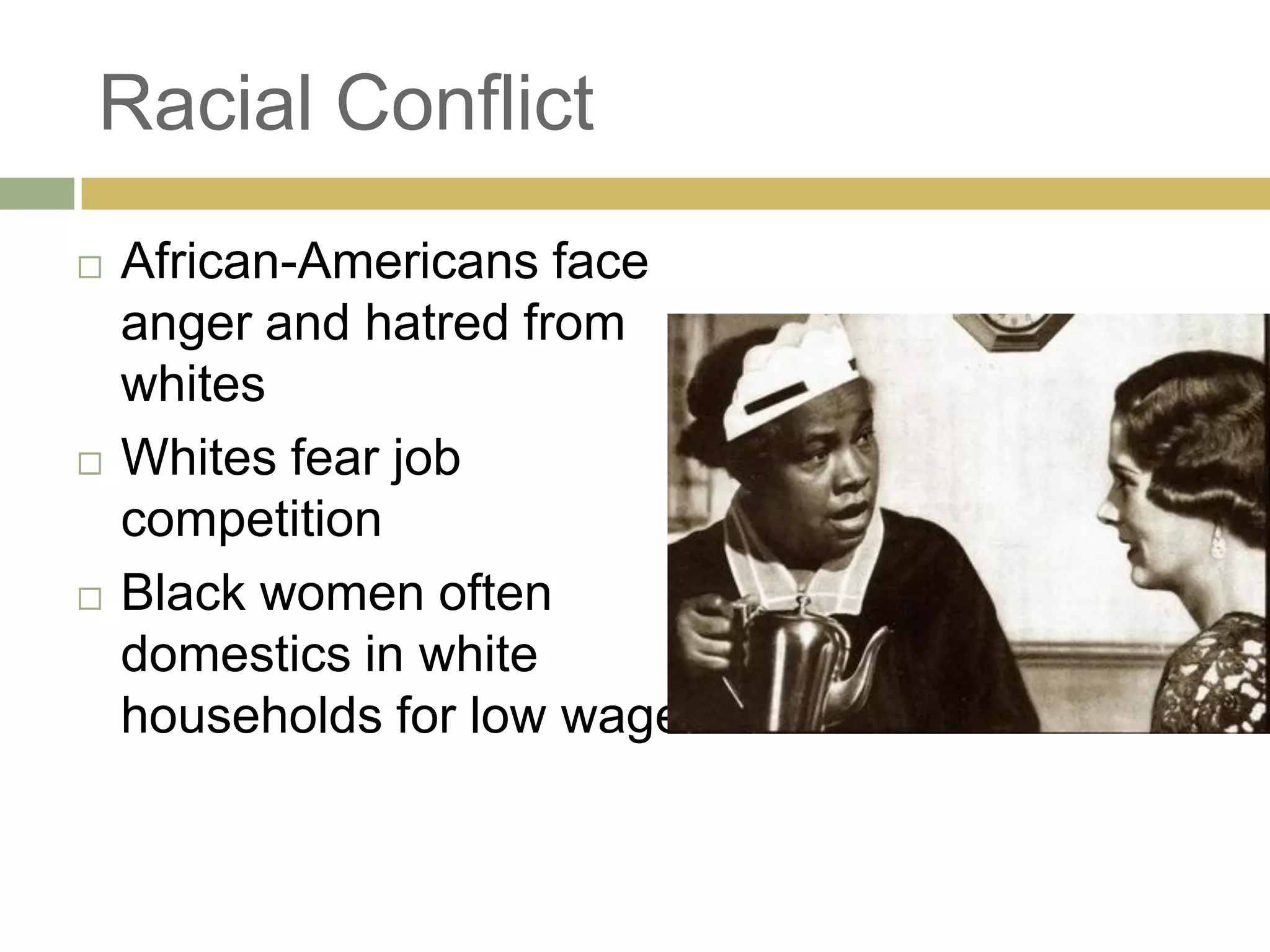
Racial Conflict
 African-Americans face
anger and hatred from
whites
 Whites fear job
competition
 Black women often
domestics in white
households for low wages
The Great Migration; Rise of the
KKK:
4. Why did the Ku Klux Klan experience a revival
in the 1920‘s and how was it different than the
KKK of the past?
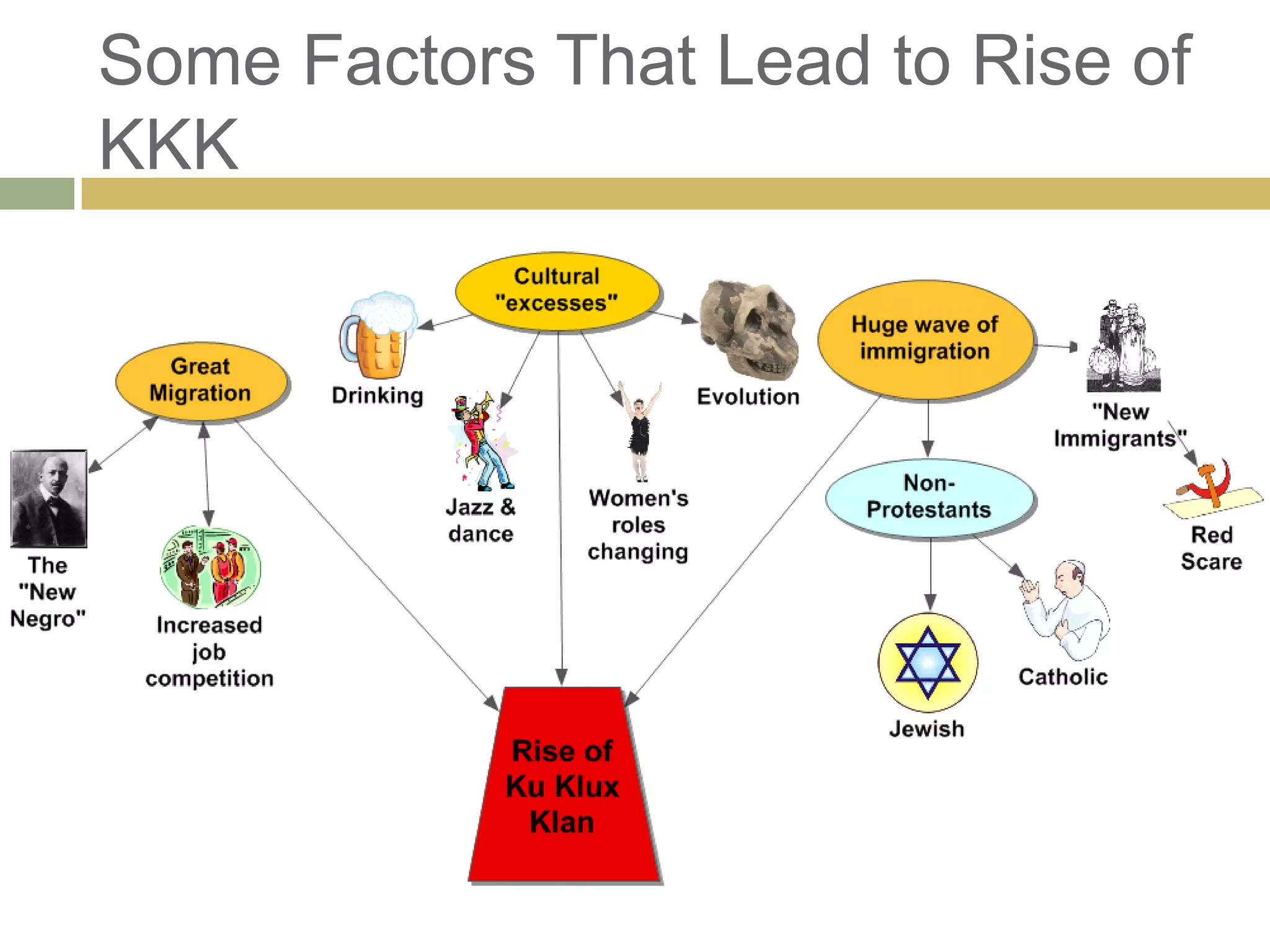
Some Factors That Lead to Rise of
KKK
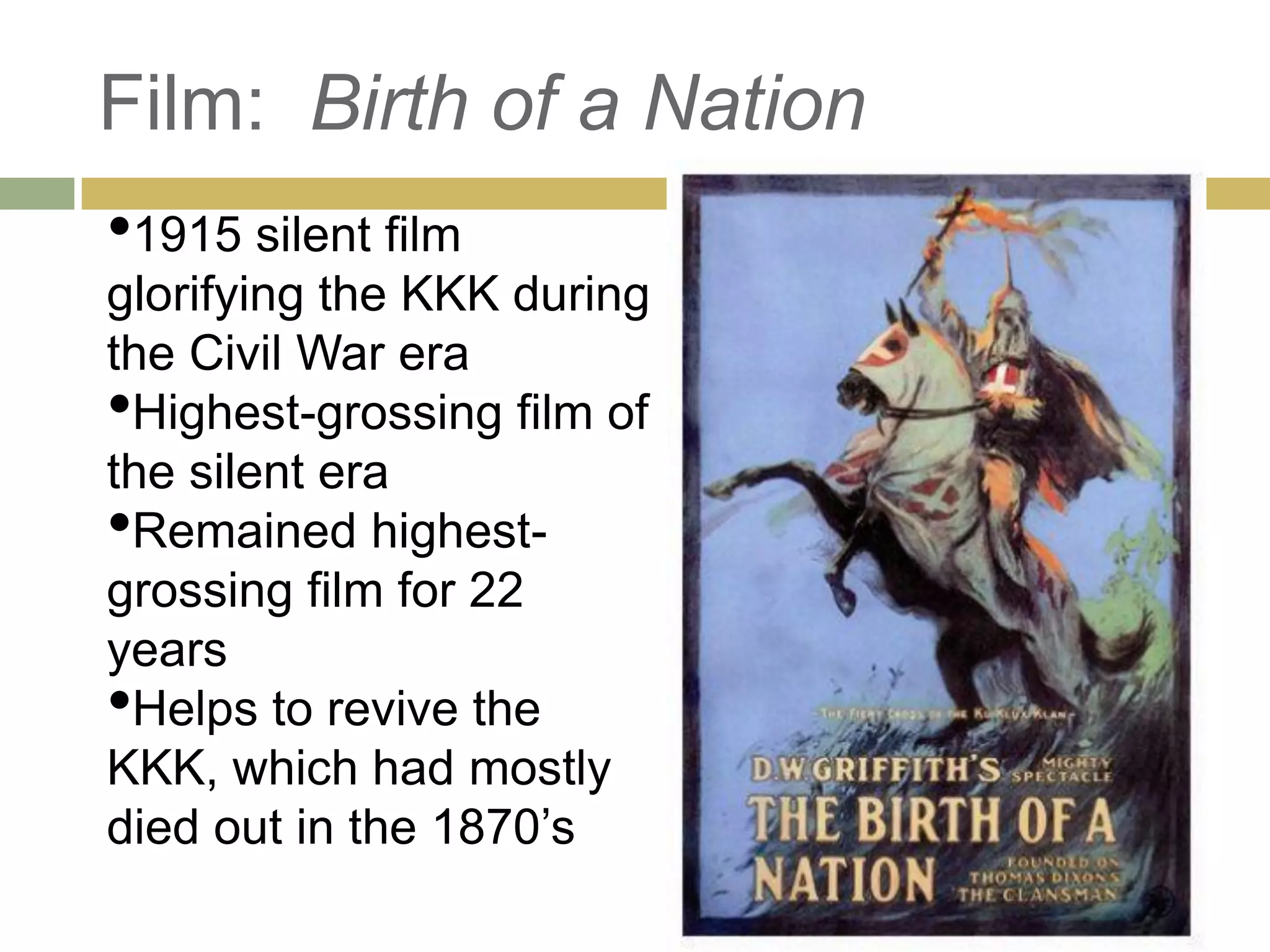
Film: Birth of a Nation
•1915 silent film
glorifying the KKK during
the Civil War era
•Highest-grossing film of
the silent era
•Remained highest-
grossing film for 22
years
•Helps to revive the
KKK, which had mostly
died out in the 1870‘s
Presidents of the 1920s;
Economic Boom:
1. How did Harding and Coolidge reflect the
laissez-faire theory?
3. Why was the 1920‘s a ―great time to be rich‖?
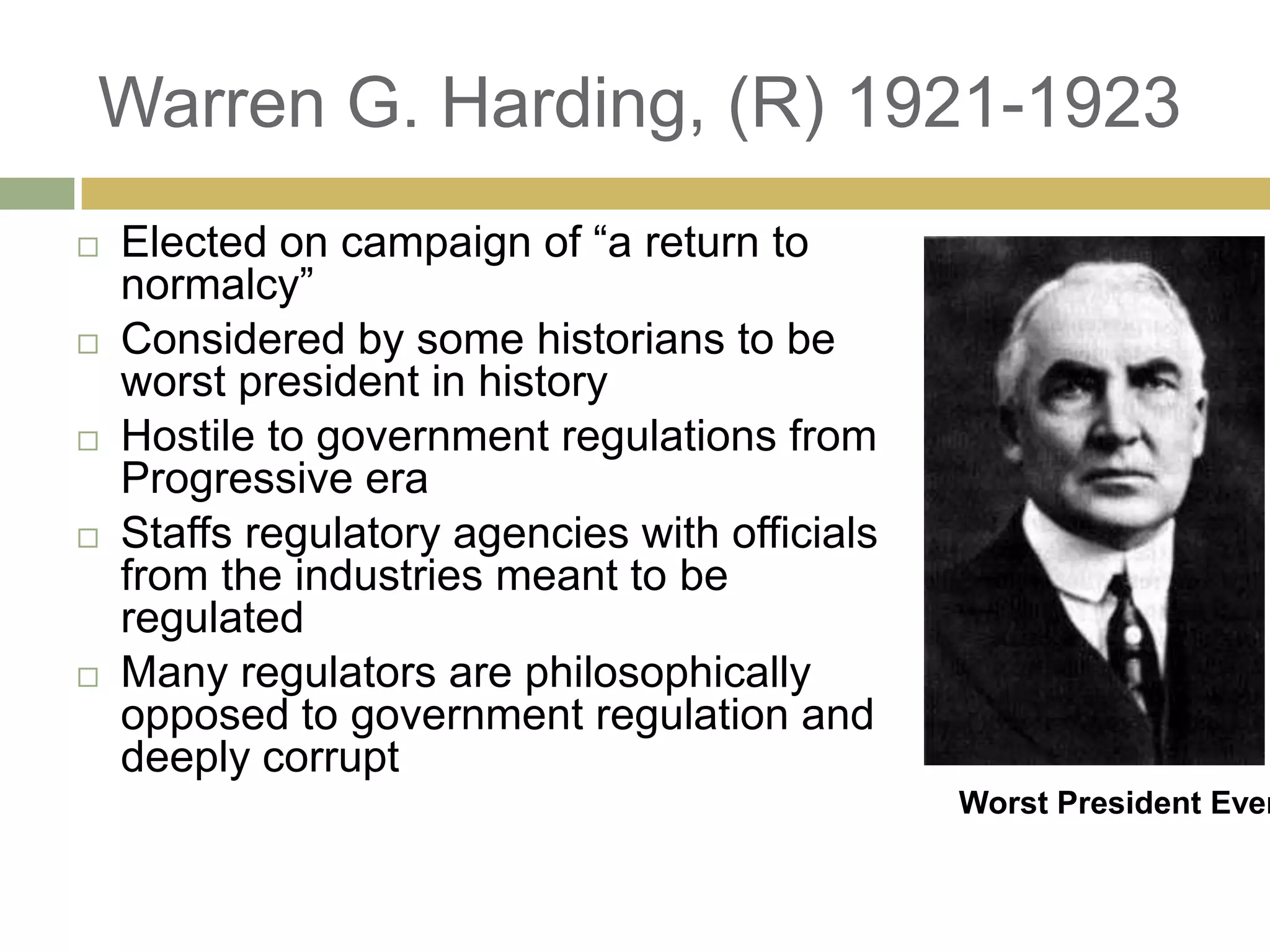
Warren G. Harding, (R) 1921-1923
 Elected on campaign of ―a return to
normalcy‖
 Considered by some historians to be
worst president in history
 Hostile to government regulations from
Progressive era
 Staffs regulatory agencies with officials
from the industries meant to be
regulated
 Many regulators are philosophically
opposed to government regulation and
deeply corrupt
Worst President Ever
A Great Time to Be Rich
 Treasury Secretary Andrew Mellon lowers
income tax rates for wealthiest Americans
from 73% to just 25%
 Investors enjoy one of the greatest periods
of market growth in U.S. history
 The Dow Jones Industrial Average peaks
in 1929 at more than six times its value in
1921
 Less than 1% of U.S. population owns
stock, so directly benefits only the wealthy
Presidents of the 1920s;
Economic Boom:
2. How did the Teapot Dome scandal affect the
American Presidency?
Teapot Dome Scandal
 Harding‘s Secretary of the
Interior, Albert B. Fall, gives
away oil drilling rights on
federal land for $300,000 in
bribes
 Fall later goes to jail
 The worst of several
scandals in Harding‘s
administration
 Harding dies before full
extent of scandal comes to
light
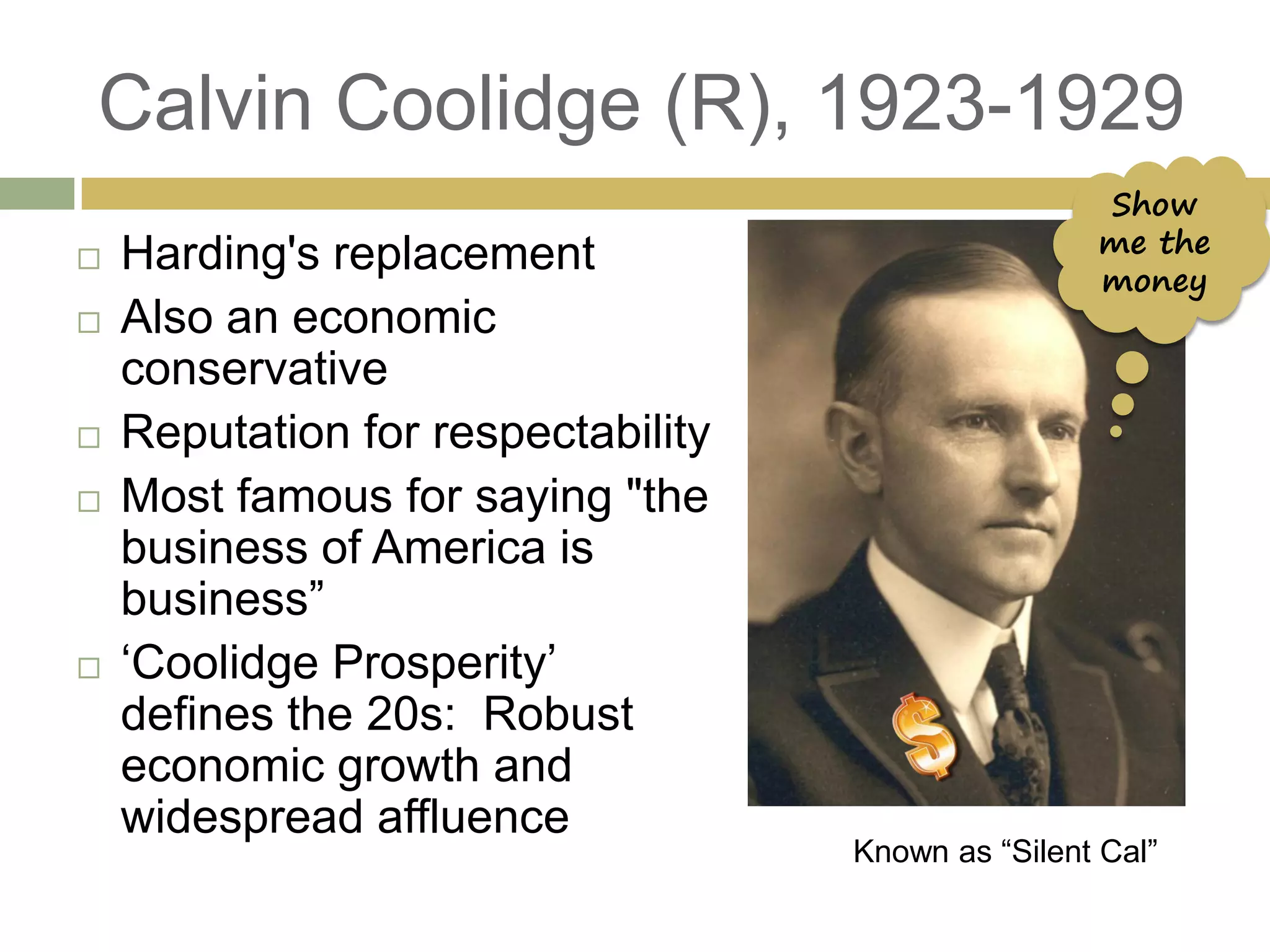
Calvin Coolidge (R), 1923-1929
 Harding's replacement
 Also an economic
conservative
 Reputation for respectability
 Most famous for saying "the
business of America is
business‖
 ‗Coolidge Prosperity‘
defines the 20s: Robust
economic growth and
widespread affluence
Known as ―Silent Cal‖
Show
me the
money
Presidents of the 1920s;
Economic Boom:
4. Why was the wealth and economic success of
the 1920‘s not felt by farmers?
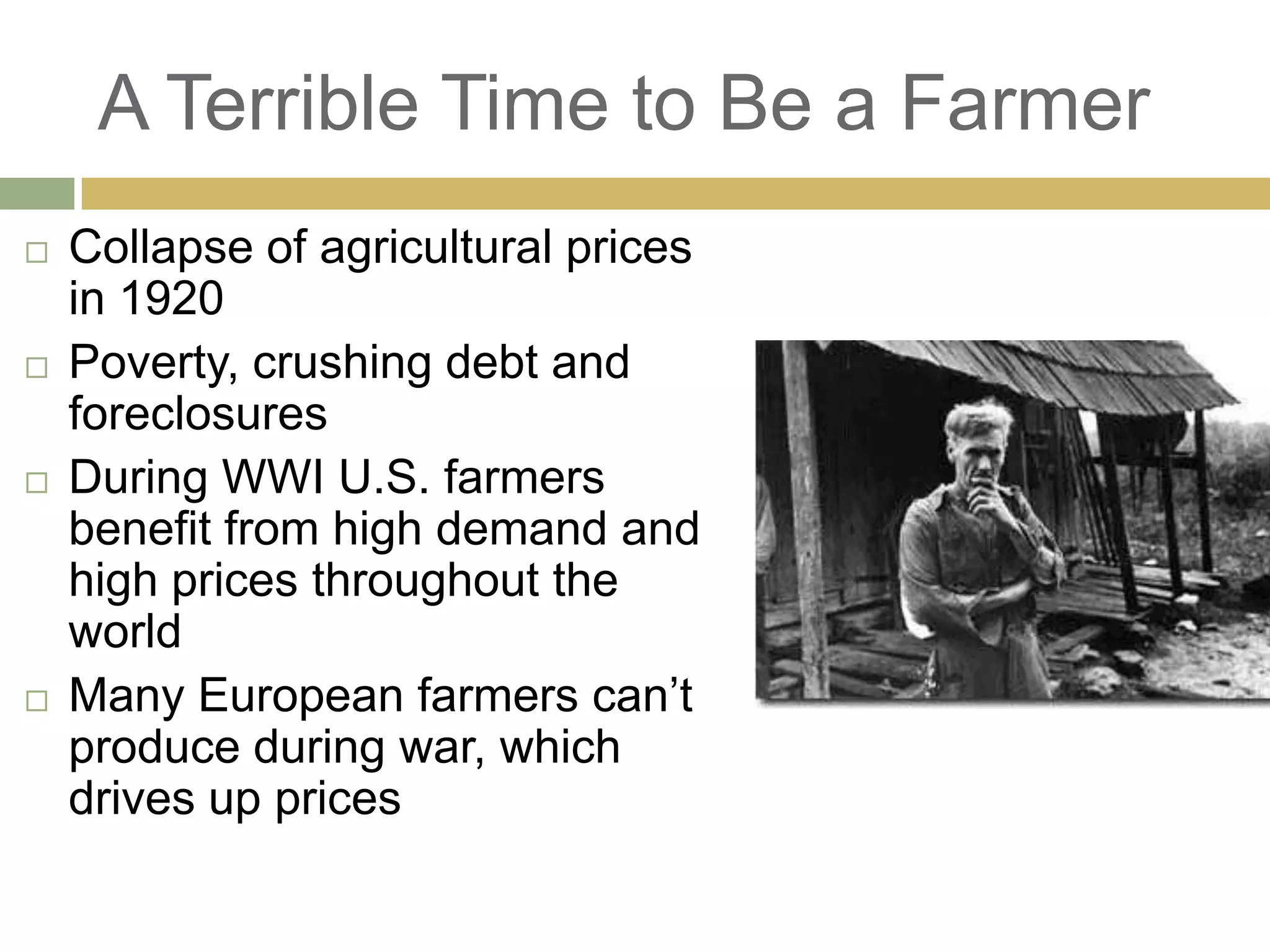
A Terrible Time to Be a Farmer
 Collapse of agricultural prices
in 1920
 Poverty, crushing debt and
foreclosures
 During WWI U.S. farmers
benefit from high demand and
high prices throughout the
world
 Many European farmers can‘t
produce during war, which
drives up prices
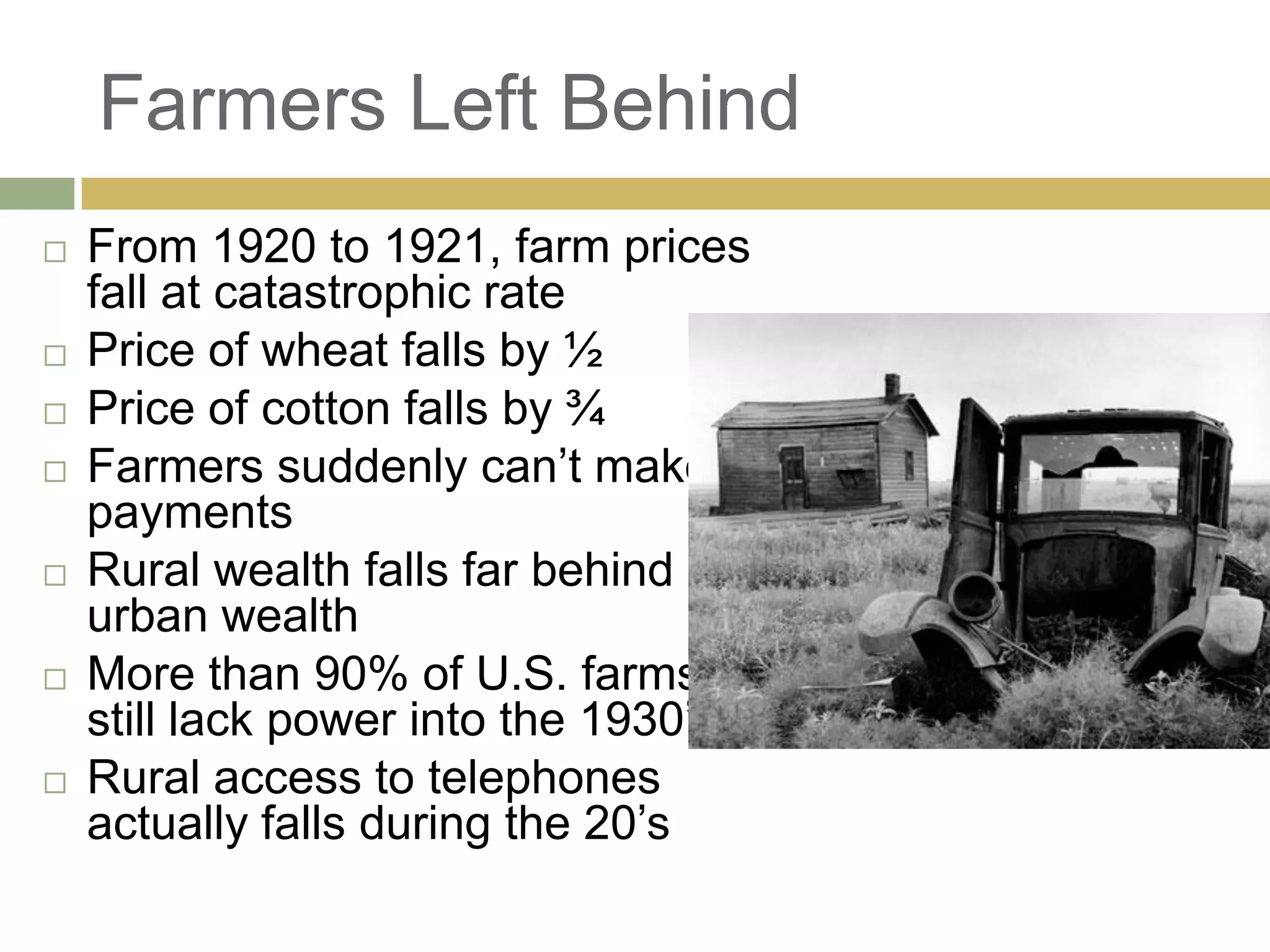
Farmers Left Behind
 From 1920 to 1921, farm prices
fall at catastrophic rate
 Price of wheat falls by ½
 Price of cotton falls by ¾
 Farmers suddenly can‘t make
payments
 Rural wealth falls far behind
urban wealth
 More than 90% of U.S. farms
still lack power into the 1930‘s
 Rural access to telephones
actually falls during the 20‘s
1920’s unit review for essential questions

1920’s unit review for essential questions

  • 1.
  • 2.
    The Automobile Culture: 1.How did the Model T revolutionize the American economy?
  • 3.
    Ford River RougeComplex  Massive production facility cut costs  Mastered assembly line process  Copied by other manufacturers  Lower costs led to low prices for consumer goods  Consumption skyrockets
  • 4.
    Buying on Credit Installment plan: A system that lets customers make partial payments (installments) over a period of time until the total debt is paid  Consumers buy things on credit they otherwise wouldn‘t buy
  • 5.
    The Automobile Culture: 2.What is a consumer culture and why did it develop in the 1920s?
  • 6.
    Rise of aConsumer Economy  Consumer economy: An economy that depends on a large amount of buying by consumers— individuals who use (or ―consume‖) products
  • 7.
    The Automobile Culture: 3.How did the automobile revolutionize American culture?
  • 8.
     By 1929,most middle-class Americans in cities or towns would most likely own: --Car --Washing machine --Radio --Refrigerator --Other small appliances
  • 9.
    Things That Ledto More Independence  25% women worked outside the home  Automobiles  New social values  Voting rights  Freud: New ideas about sexuality (It‘s normal and healthy)
  • 10.
    The Automobile Culture: 4.How did the automobile change living patterns?
  • 11.
    Ford Model-T  Mostpopular car in America in the first three decades of the 20th century  $1000 when introduced in 1908  Model T's cost fell every year  Less than $300 in 1927
  • 12.
     1920: Onecar for ever 15 people  1929: One car for ever 5 people Result:
  • 13.
    Popular culture; radio;jazz; heroes of the 20s: 1. Why did a national culture develop in the 1920s? 2. What impact did the radio have on popular culture?
  • 14.
    Mass Media Createsa National Culture  Chain stores, branch banking, national brands, etc.
  • 15.
     Seeing samemovies, listening to same radio shows  Creates common ground that breaks down ethnic boundaries in America's cities  What does that today?
  • 16.
    Mass Media  NationalRadio Shows  Hollywood Movies  National celebrities
  • 17.
    Popular culture; radio;jazz; heroes of the 20s: 3. How did trends in fashion and music reflect the spirit of the times?
  • 18.
    After WWI  Americanswanted to rejoice and redefine themselves  Rejected the past  Led to new lifestyles and social values
  • 19.
    Life of aFlapper •Wild partying •Smoked cigarettes and drank alcohol –unheard of if you were a woman! •Lived reckless lives and clung to youth •Flappers were the first of the women to flaunt their sexuality •Their lifestyles were shown in the way that they dressed and danced
  • 20.
    The Flapper Look •Woreheavy make up •Clothes: a dress just below the knee, stockings, heels no corset •The look was influenced by Coco Chanel •Gender bending—tightly wrap their chest to flatten it •The ―Tube‖—Lower hipline and straight from shoulders to hem
  • 21.
    THE JAZZ AGE The era from right after WWI until the stock market crash in 1929, during which jazz increased in popularity. It was a reaction to the hardship of the war and was characterized by prosperity, extravagance and self-indulgent behavior
  • 22.
    Popular culture; radio;jazz; heroes of the 20s: 4. Who were the most popular heroes of this time? Why did hero worship become popular?
  • 23.
    Rise of theNational Celebrity  Hero worship: Intense or excessive admiration for a hero or a person regarded as a hero; seen widely in the 1920‘s
  • 24.
    Babe Ruth  Baseballhero of 1920‘s pop culture  Helped popularity of baseball to explode  714 career home runs and 2,814 hits
  • 25.
    Charles Lindberg: CelebrityPilot  First non-stop flight across the Atlantic in 1927
  • 26.
     Seeing samemovies, listening to same radio shows  Creates common ground that breaks down ethnic boundaries in America's cities  What does that today?
  • 27.
    Organized crime; Cultural backlash;Scopes Trial: 1. Why did Prohibition lead to organized crime?
  • 28.
    Underground Market Booms Estimated income of bootleg liquor industry in 1929: $3 billion  Entire United States federal budget in 1929: $2.9 billion18
  • 29.
    Rise of OrganizedCrime • Prohibition created huge consumer market unmet by legitimate means • Meant that criminals ran the market • Criminals get rich • In 1927 Al Capone makes $60 million • Organized crime gains power in cities • Increases lawlessness Al Capone
  • 30.
    Organized crime; Cultural backlash;Scopes Trial: 2. How did organized crime affect the American way of life?
  • 31.
    Weakened Law Enforcement Leads to public contempt for police  Organized crime leaders, bootleggers and speakeasies pay bribes to cops  In 1927, Al Capone had half of Chicago‘s police on his payroll
  • 33.
    Organized crime; Cultural backlash;Scopes Trial: 3. What is the connection between the religious revival of the 1920s and the Scopes Trial?
  • 34.
    Clash of Cultures Opening statements pictured the trial as a titanic struggle between good and evil or truth and ignorance.  Bryan claimed that ―If evolution wins, Christianity goes." Darrow argued, "Scopes isn't on trial; civilization is on trial." Vs.
  • 35.
    Showdown: Modernists v. Traditionalists In response to new social patterns of modernism, a wave of revivalism developed  Trial emerged as a conflict between social and intellectual values  Journalists looking for a showdown—who would dominate American culture? Traditionalists or modernists? OR
  • 36.
    Organized crime; Cultural backlash;Scopes Trial: 4. Why did the Scopes trial become the ―trial of the century‖?
  • 37.
    Clash of theTitans  Case argued by the two most famous figures possible: a showdown of rivals  Darrow represented modernity  Bryan represented tradition
  • 38.
    Showdown: Modernists v. Traditionalists In response to new social patterns of modernism, a wave of revivalism developed  Trial emerged as a conflict between social and intellectual values  Journalists looking for a showdown—who would dominate American culture? Traditionalists or modernists? OR
  • 39.
    Harlem Renaissance: 1. Whatwas the connection between the Great Migration and the Harlem Renaissance?
  • 40.
  • 41.
    Harlem Renaissance: 2. Whatwas unique about the artists‘ message? 3. How did this movement affect American pop culture and perceptions of African-Americans?
  • 42.
    Music: Jazz • Beganwith African-American musicians in New Orleans and transported North during Great Migration • Blended blues and ragtime with improvisation and syncopated rhythms to produce totally new sound • Has been called the single greatest contribution Americans have made to world culture • Jazz influenced all American popular music that came after it
  • 43.
    Literature  At thesame time, African- American authors were giving their own voice to the experience of being black in America  Plays depicting African- Americans with complex emotions are put on stage (challenged minstrel images)
  • 44.
    Harlem Renaissance: 4. Whowere the major figures of the Harlem Renaissance?
  • 45.
    LANGSTON HUGHES  Poet,playwright and novelist  His first collection of poems: I, Too, Sing America (1925)
  • 46.
    ZORA NEALE HURSTON Novelist, short story writer, folklorist and anthropologist  Novel: Their Eyes Were Watching God  Major influence on Ralph Ellison, Toni Morrison and Alice Walker
  • 47.
    INTELLECTUALS: MARCUS GARVEY  Becameconvinced uniting blacks only way to improve their condition  Founded the United Negro Improvement Association in 1914 to unite blacks  Back-to-Africa movement  Goal to form their own country  Black Star Line: fleet of ships used by the UNIA
  • 48.
    Red Scare andthe Palmer Raids; Immigration reform: 1. What made Americans ―afraid‖ of radical ideas?
  • 49.
    Russian Revolution  CzarNicholas II is unpopular due to WWI and high casualties  Forced to give up power  Leads to a communist revolution in 1917
  • 50.
    Labor Strikes MakeU.S. Leaders Nervous  1919: A wave of labor strikes sweeps nation after Armistice  Boston Police Strike  Steel and Coal Strikes
  • 51.
    Strikes Broken UpBy Force  Nervous business owners fear Communists have infiltrated their workers  In reality, cost of living is twice what it was before the war
  • 52.
    Red Scare andthe Palmer Raids; Immigration reform: 2. What actions did the federal government take against suspected radicals?
  • 53.
    Palmer Raids  Acampaign of raids to identify and root out groups whose activities posed a "clear and present danger" to the country, such as communists, socialists and anarchists
  • 54.
    Red Scare andthe Palmer Raids; Immigration reform: 3. How did this change immigration to the US?
  • 55.
    Quota  Numerical limiton immigrants from each foreign nation  Quotas set low for Eastern and Southern Europe  Asian immigration banned
  • 56.
    Red Scare andthe Palmer Raids; Immigration reform: 4. What were the long term effects of the Red Scare?
  • 57.
    Red Scare  Anintense fear of communism and other ideas considered extreme
  • 58.
    New Immigration Laws •1921Emergency Quota Act: Sets quota for each country to the # of people from that country living in the U.S. in 1910 •1924 Immigration Act: Sets quota for each country to the # of people from that country living in the U.S. in 1890 •Reduces immigration of ―New Immigrants‖ by 97%
  • 59.
    The Great Migration;Rise of the KKK: 1. What caused African-Americans to move from the South?
  • 60.
    Push Factors: Why toGet Out of the South  Jim Crow laws  Lynching and KKK  Flood  Boll Weevil infestation
  • 61.
    The Great Migration;Rise of the KKK: 2. Why did conditions in the North appealed to African-Americans?
  • 62.
    Pull Factors: Why toHead North  Jobs  NAACP  Leaders like W.E.B. Du Bois and Booker T. Washington inspire people
  • 63.
    The Great Migration;Rise of the KKK: 3. What impact did the Great Migration have on American racial relations?
  • 64.
    Racial Conflict  African-Americansface anger and hatred from whites  Whites fear job competition  Black women often domestics in white households for low wages
  • 65.
    The Great Migration;Rise of the KKK: 4. Why did the Ku Klux Klan experience a revival in the 1920‘s and how was it different than the KKK of the past?
  • 66.
    Some Factors ThatLead to Rise of KKK
  • 67.
    Film: Birth ofa Nation •1915 silent film glorifying the KKK during the Civil War era •Highest-grossing film of the silent era •Remained highest- grossing film for 22 years •Helps to revive the KKK, which had mostly died out in the 1870‘s
  • 68.
    Presidents of the1920s; Economic Boom: 1. How did Harding and Coolidge reflect the laissez-faire theory? 3. Why was the 1920‘s a ―great time to be rich‖?
  • 69.
    Warren G. Harding,(R) 1921-1923  Elected on campaign of ―a return to normalcy‖  Considered by some historians to be worst president in history  Hostile to government regulations from Progressive era  Staffs regulatory agencies with officials from the industries meant to be regulated  Many regulators are philosophically opposed to government regulation and deeply corrupt Worst President Ever
  • 70.
    A Great Timeto Be Rich  Treasury Secretary Andrew Mellon lowers income tax rates for wealthiest Americans from 73% to just 25%  Investors enjoy one of the greatest periods of market growth in U.S. history  The Dow Jones Industrial Average peaks in 1929 at more than six times its value in 1921  Less than 1% of U.S. population owns stock, so directly benefits only the wealthy
  • 71.
    Presidents of the1920s; Economic Boom: 2. How did the Teapot Dome scandal affect the American Presidency?
  • 72.
    Teapot Dome Scandal Harding‘s Secretary of the Interior, Albert B. Fall, gives away oil drilling rights on federal land for $300,000 in bribes  Fall later goes to jail  The worst of several scandals in Harding‘s administration  Harding dies before full extent of scandal comes to light
  • 73.
    Calvin Coolidge (R),1923-1929  Harding's replacement  Also an economic conservative  Reputation for respectability  Most famous for saying "the business of America is business‖  ‗Coolidge Prosperity‘ defines the 20s: Robust economic growth and widespread affluence Known as ―Silent Cal‖ Show me the money
  • 74.
    Presidents of the1920s; Economic Boom: 4. Why was the wealth and economic success of the 1920‘s not felt by farmers?
  • 75.
    A Terrible Timeto Be a Farmer  Collapse of agricultural prices in 1920  Poverty, crushing debt and foreclosures  During WWI U.S. farmers benefit from high demand and high prices throughout the world  Many European farmers can‘t produce during war, which drives up prices
  • 76.
    Farmers Left Behind From 1920 to 1921, farm prices fall at catastrophic rate  Price of wheat falls by ½  Price of cotton falls by ¾  Farmers suddenly can‘t make payments  Rural wealth falls far behind urban wealth  More than 90% of U.S. farms still lack power into the 1930‘s  Rural access to telephones actually falls during the 20‘s