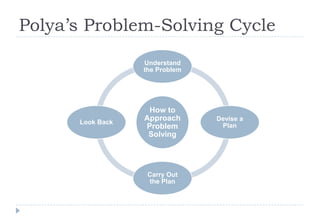
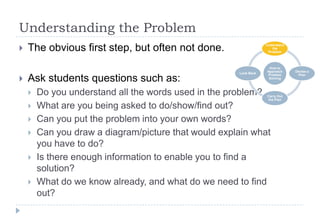
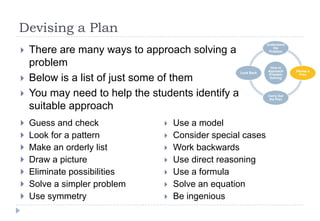
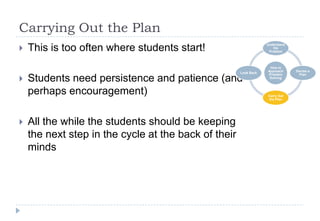
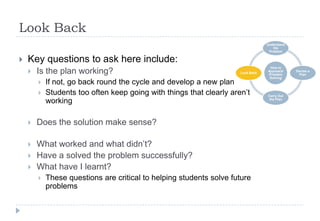
This document outlines George Polya's four-step problem-solving cycle: 1) Understand the problem by clarifying terms, concepts, and requirements; 2) Devise a plan by considering strategies like working backwards or looking for patterns; 3) Carry out the plan by persisting through calculations or experiments; 4) Look back by checking results, evaluating what worked and didn't, and determining if the problem was solved. The document provides examples of applying this cycle in subjects like math, science experiments, and essays. It encourages readers to consider how Polya's approach could work in their own disciplines.