Ethnomathematics
AND ITS ROLE IN THE CLASSROOM
What is Ethnomathematics?
 Study of the nature of mathematical ideas.
 Involves multiple perspectives on mathematics.
 Can result in cross-cultural harmony.
 Links the practical with the abstract.
(Arismendi-Pardi, 1994)
How does it compare to western
mathematics?
Ethnomathematics Western Mathematics
• Culturally based mathematics
• Promotes alternative ways of understanding
• Concepts are applicable to life outside of school
• Includes complex mathematical systems that have
evolved over time in other cultures
• Reduces the alienation felt by students from
diverse cultures
(Owens, 2017)
• Abstract concepts
• May be considered irrelevant by students
• Doesn’t allow for alternative ways of knowing
• Based on pre-determined formulas
• Includes the basic principles of mathematics
• Considered culturally-neutral
(Bishop, 1990)
The Benefits of Ethnomathematics
 Helps students connect mathematical learning to their lives.
 Culturally based mathematics – expresses multiple ways of thinking.
 Mathematics is a human activity – entwined with culture.
 Removes negative connotations associated with school mathematics.
 Encourages creativity, problem solving and multiple ways of thinking.
(Brandt & Chernoff, 2015)
Ethnomathematics and Indigenous
Students
 Ethnomathematics is related to the evaluations, quantities, qualities and the
relationships between known realities.
 May involve both physical and spiritual aspects.
 Early western mathematical searchers disregarded indigenous perspectives and ways of
understanding.
 Knowledge is obtained by discovery and revelation.
 Students benefit from exploring multiple approaches to mathematics.
(Rudder, n.d.)
Concerns and Criticisms
 Teachers will focus only on the practices of large ancient empire cultures.
 Teachers tend to romanticise foreign cultures and analyse them from a
western standpoint.
 Teacher may end up only exploring ethnomathematics as simplified
mathematics.
(Brandt & Chernoff, 2015).
Concerns and Criticisms (Solutions)
 Provide support to teachers
 Incorporate mathematical concepts from a wide range of sources
 Balance the cultural examples utilised in the classroom
 Engage community members
 Explore high-level mathematical problems with help of ethnomathematics.
(Brandt & Chernoff, 2015).
Implications on Teaching
1. Look at how different cultures use mathematics in real life
2. Explore aspects of math from different cultural perspectives e.g. geometry
3. Get students to experiment with multiple cultural counting and number
systems
Examples of Ethnomathematics in the
Classroom
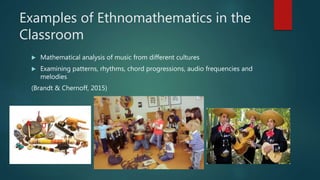
 Mathematical analysis of music from different cultures
 Examining patterns, rhythms, chord progressions, audio frequencies and
melodies
(Brandt & Chernoff, 2015)
Examples of Ethnomathematics in the
Classroom
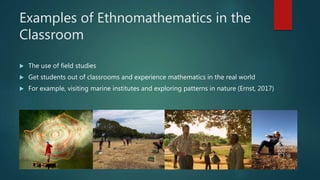
 The use of field studies
 Get students out of classrooms and experience mathematics in the real world
 For example, visiting marine institutes and exploring patterns in nature (Ernst, 2017)
Examples of Ethnomathematics in the
Classroom
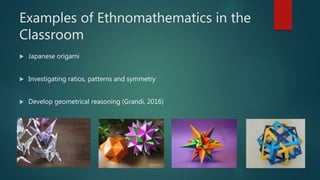
 Japanese origami
 Investigating ratios, patterns and symmetry
 Develop geometrical reasoning (Grandi, 2016)
Examples of Ethnomathematics in the
Classroom
Other examples include
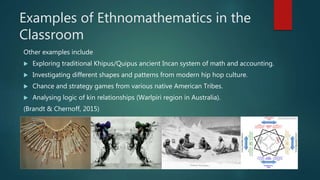
 Exploring traditional Khipus/Quipus ancient Incan system of math and accounting.
 Investigating different shapes and patterns from modern hip hop culture.
 Chance and strategy games from various native American Tribes.
 Analysing logic of kin relationships (Warlpiri region in Australia).
(Brandt & Chernoff, 2015)
References
 Adam, S. (2004). Ethnomathematical ideas in the curriculum. Mathematics Education Research Journal, 16(2), 49-68.
Retrieved from https://www.merga.net.au/ documents/RR_adams.pdf
 Arismendi-Pardi, E. (1994). What Is Ethnomathematics and Why Should We Teach It? Crossing Cultures:
Communicating through the Curriculum. Retrieved from http://files.eric.ed.gov/fulltext/ED430804.pdf
 Bishop, A. (1990). Western mathematics: the secret weapon of cultural imperialism. SAGE Journals, 32(2). 51-65.
Retrieved from http://journals.sagepub.com/doi/abs/10.1177/ 030639689003200204
 Brandt, A., & Chernoff, E.J. (2015). The importance of ethnomathematics in the math class. Ohio Journal of School
Mathematics (71). Retrieved from
https://kb.osu.edu/dspace/bitstream/handle/1811/78917/1/OJSM_71_Spring2015_31.pdf
 D’Ambrosio, U. (2001). What is ethnomathematics, and how can it help children in schools. Teaching Children
Mathematics 7(6). Retrieved from http://etnomatematica.org/ articulos/Ambrosio1.pdf
 Ernst, C. (2017). Ethnomathematics shows students their connection to math. Retrieved from
http://www.maa.org/publications/periodicals/maa-focus/ethnomathematics-shows-students-their-connections-math
 Favilli, F. (2004). Ethnomathematics and mathematics education. Proceedings of the 10th International Congress of
Mathematics Education Copenhagen. Retrieved from
http://people.dm.unipi.it/favilli/Ethnomathematics_Proceedings_ICME10.pdf
 Grandi, C. (2016). Origami in lessons. Artful Maths. Retrieved from http://www.artfulmaths.com/origami-in-
lessons.html
 Owens, K. (2017). Ethnomathematics. Retrieved from http://www.nova.org.au/everything-else/ethnomathematics
 Rudder. J. (n.d.). Ethnomathematics in Australia. Retrieved from https://aiatsis.gov.au/ collections/collections-
online/digitised-collections/ethnomathematics-australia

Ethnomathematics Presentation

  • 1.
  • 2.
    What is Ethnomathematics? Study of the nature of mathematical ideas.  Involves multiple perspectives on mathematics.  Can result in cross-cultural harmony.  Links the practical with the abstract. (Arismendi-Pardi, 1994)
  • 3.
    How does itcompare to western mathematics? Ethnomathematics Western Mathematics • Culturally based mathematics • Promotes alternative ways of understanding • Concepts are applicable to life outside of school • Includes complex mathematical systems that have evolved over time in other cultures • Reduces the alienation felt by students from diverse cultures (Owens, 2017) • Abstract concepts • May be considered irrelevant by students • Doesn’t allow for alternative ways of knowing • Based on pre-determined formulas • Includes the basic principles of mathematics • Considered culturally-neutral (Bishop, 1990)
  • 4.
    The Benefits ofEthnomathematics  Helps students connect mathematical learning to their lives.  Culturally based mathematics – expresses multiple ways of thinking.  Mathematics is a human activity – entwined with culture.  Removes negative connotations associated with school mathematics.  Encourages creativity, problem solving and multiple ways of thinking. (Brandt & Chernoff, 2015)
  • 5.
    Ethnomathematics and Indigenous Students Ethnomathematics is related to the evaluations, quantities, qualities and the relationships between known realities.  May involve both physical and spiritual aspects.  Early western mathematical searchers disregarded indigenous perspectives and ways of understanding.  Knowledge is obtained by discovery and revelation.  Students benefit from exploring multiple approaches to mathematics. (Rudder, n.d.)
  • 6.
    Concerns and Criticisms Teachers will focus only on the practices of large ancient empire cultures.  Teachers tend to romanticise foreign cultures and analyse them from a western standpoint.  Teacher may end up only exploring ethnomathematics as simplified mathematics. (Brandt & Chernoff, 2015).
  • 7.
    Concerns and Criticisms(Solutions)  Provide support to teachers  Incorporate mathematical concepts from a wide range of sources  Balance the cultural examples utilised in the classroom  Engage community members  Explore high-level mathematical problems with help of ethnomathematics. (Brandt & Chernoff, 2015).
  • 8.
    Implications on Teaching 1.Look at how different cultures use mathematics in real life 2. Explore aspects of math from different cultural perspectives e.g. geometry 3. Get students to experiment with multiple cultural counting and number systems
  • 9.
    Examples of Ethnomathematicsin the Classroom  Mathematical analysis of music from different cultures  Examining patterns, rhythms, chord progressions, audio frequencies and melodies (Brandt & Chernoff, 2015)
  • 10.
    Examples of Ethnomathematicsin the Classroom  The use of field studies  Get students out of classrooms and experience mathematics in the real world  For example, visiting marine institutes and exploring patterns in nature (Ernst, 2017)
  • 11.
    Examples of Ethnomathematicsin the Classroom  Japanese origami  Investigating ratios, patterns and symmetry  Develop geometrical reasoning (Grandi, 2016)
  • 12.
    Examples of Ethnomathematicsin the Classroom Other examples include  Exploring traditional Khipus/Quipus ancient Incan system of math and accounting.  Investigating different shapes and patterns from modern hip hop culture.  Chance and strategy games from various native American Tribes.  Analysing logic of kin relationships (Warlpiri region in Australia). (Brandt & Chernoff, 2015)
  • 13.
    References  Adam, S.(2004). Ethnomathematical ideas in the curriculum. Mathematics Education Research Journal, 16(2), 49-68. Retrieved from https://www.merga.net.au/ documents/RR_adams.pdf  Arismendi-Pardi, E. (1994). What Is Ethnomathematics and Why Should We Teach It? Crossing Cultures: Communicating through the Curriculum. Retrieved from http://files.eric.ed.gov/fulltext/ED430804.pdf  Bishop, A. (1990). Western mathematics: the secret weapon of cultural imperialism. SAGE Journals, 32(2). 51-65. Retrieved from http://journals.sagepub.com/doi/abs/10.1177/ 030639689003200204  Brandt, A., & Chernoff, E.J. (2015). The importance of ethnomathematics in the math class. Ohio Journal of School Mathematics (71). Retrieved from https://kb.osu.edu/dspace/bitstream/handle/1811/78917/1/OJSM_71_Spring2015_31.pdf  D’Ambrosio, U. (2001). What is ethnomathematics, and how can it help children in schools. Teaching Children Mathematics 7(6). Retrieved from http://etnomatematica.org/ articulos/Ambrosio1.pdf  Ernst, C. (2017). Ethnomathematics shows students their connection to math. Retrieved from http://www.maa.org/publications/periodicals/maa-focus/ethnomathematics-shows-students-their-connections-math  Favilli, F. (2004). Ethnomathematics and mathematics education. Proceedings of the 10th International Congress of Mathematics Education Copenhagen. Retrieved from http://people.dm.unipi.it/favilli/Ethnomathematics_Proceedings_ICME10.pdf  Grandi, C. (2016). Origami in lessons. Artful Maths. Retrieved from http://www.artfulmaths.com/origami-in- lessons.html  Owens, K. (2017). Ethnomathematics. Retrieved from http://www.nova.org.au/everything-else/ethnomathematics  Rudder. J. (n.d.). Ethnomathematics in Australia. Retrieved from https://aiatsis.gov.au/ collections/collections- online/digitised-collections/ethnomathematics-australia

Editor's Notes

  • #2 Good afternoon, My name is Rebecca Tribe and I am currently studying a Bachelor of Primary Education at the Charles Darwin University. I have created this presentation as a way to share my recent learning journey and new found knowledge on the field of Ethnomathematics and how it impacts on teaching pedagogy. I hope you will find some insightful new knowledge within this presentation.
  • #3 Ethnomathematics represents a field of study which moves away from the traditional western approach to mathematics. Ethnomathematics focuses on studying the nature of mathematical ideas and how such ideas can be established in cultures and ultimately result in cross-cultural harmony (Arismendi-Pardi, 1994) . The term ethnomathematics was first used in the early 1980’s by Brazilian mathematician Dr. Ubiratán D'Ambrosio and over time it has developed to involve multiple different perspectives of mathematics (D’Ambrosio, 2001). Ethnomathematics is an interesting concept to include in contemporary classrooms due to the fact, it is helpful in developing a link between the practical side of mathematical knowledge and the abstract mathematical concepts. The development of these links are often inclusive of economic, political, social and cultural issues and trends (Arismendi-Pardi, 1994). Unfortunately many individuals only have knowledge of western mathematics and often consider any other mathematical knowledge to be primitive. It is therefore important that 21st century teachers in Australian classrooms embrace and celebrate the diversity of mathematical knowledge and include ethnomathematics as a key concept in their classrooms. Furthermore, incorporating ethnomathematics in the classrooms reduces the chances of students feeling alienated from learning and assists student to develop self-confidence and a positive, intellectually stimulating attitude towards mathematical learning (Arismendi-Pardi, 1994).
  • #4 The study of ethnomathematics often compares it with the traditional idea of western mathematics which is what is often taught in today’s classrooms. There are many different definitions of western mathematics out there. However, they all tend to describe western mathematics as involving abstract, irrelevant and out of context ideals (Bishop, 1990). Some educational institutes like to argue that mathematics is universal and should be a culturally-neutral phenomenon. This is where the importance of ethnomathematics becomes apparent. Western mathematics often relies on pre-determined formulas and basic principles of mathematics but there are so many more intricate and complex mathematical systems which have evolved over time in other cultures. (Owens, 2017). Many schools study western-mathematics almost exclusively with only very little bits of Indigenous knowledge thrown in for good measure. While western mathematics has its place in the classroom. There is also a place for ethnomathematics and classrooms should reflect that. It is without a doubt that all students should learn basic principles of mathematics but what should happen is that this knowledge is explained in ways that are relative to the community surrounding the classroom (Favilli, 2004).
  • #5 There are a wide range of benefits for utilising ethnomathematics in the classroom. One benefit is that ethnomathematics can assist students in connecting their learning at school to their life outside of school. Ethnomathematics also celebrates the cultural diversity of the classroom and the interconnected world. Another important fact is that mathematics is found in every part of our lives. It is a human activity that is entwined with culture and should be enriched by intellectual diversities. Many students struggle with the abstract concepts of mathematics studies and unfortunately traditional approaches to math tend to create a sense of fear and helplessness in students. Hence, there is a need to incorporate interesting and relatable content into all aspects of mathematical teaching. Ethnomathematics is culturally accepting and is applicable to all aspects of our lives. In turn, students who are presented with ethnomathematics are more likely to find content interesting and applicable. Ethnomathematics is also beneficial for developing the fundamental values including having respect for others, solidarity with others and being able to cooperate with others. Another great point about ethnomathematics in the classroom includes the fact that it has the potential to bring students own multicultural views to the surface and allow them to challenge or support ideas from traditional western perspectives. Additionally, ethnomathematics can empower student voices which traditionally may have been marginalised and also expose multiple ways of thinking and can result in students understand diversity and accepting it as a beneficial part of life. Finally, ethnomathematics can assist students in developing creativity and problem solving. (Brandt & Chernoff, 2015)
  • #6 In its very definition, ethnomathematics refers to the mathematics used by a defined cultural group to solve problems that are often related to their immediate environment. Therefore, ethnomathematics can be considered to be related to the evaluations, quantities, qualities and the relationships between known realities. These relationships are not only physical but can also be spiritual aspects. Put simply, ethnomathematics is an expression of any group of people’s world view (Rudder, n.d.). Early mathematical western researchers regrettably only concerned themselves with quantities and rarely considered the Indigenous terms and ways of understanding to be worthwhile to study. These early researchers assumed that the Indigenous mathematical knowledge was simply an impoverished version of a number system. Luckily though, from the early 1960’s and onwards, ethnomathematics in Australia became more focused on Indigenous cultures and what the Indigenous Australians consider to be a mathematical concept. Such concepts focus on all types of relationships and aspects of the known environment. They also consider patterns of human relationships rather than focusing purely on numbers and quantity (Rudder, n.d.). Indigenous ethnomathematics often involves knowledge obtained through discovery and revelation rather than relying on predetermined formulas and traditional methods of mathematics. Teachers should aim to build a bridge between the multiple ways of understanding and help all students to understand that neither approach to problem solving is wrong and that all different approaches to mathematics are important and have a place in the world (Rudder, n.d.).
  • #7 While there are many benefits of ethnomathematics. Some individuals and educational groups have concerns about the incorporation of ethnomathematics in the contemporary classroom. The concerns about ethnomathematics can be separated into two categories which are epistemological, relating to the way ethnomathematics is related to mathematical knowledge, and pedagogical, relating to the ways ethnomathematical concepts are explored in education facilities. Both should be taken into account in order for teachers to improve their learning environment. Only once concerns are addressed can solutions be developed. For now, some concerns of individuals and educational groups are accessed. One concern is that teachers may end up focusing only on the practices of large ancient cultures such as the Chinese, Muslim and Hindu and may possibly leave out the knowledges of other lessor known Indigenous societies. Another criticism of ethnomathematics in the classroom, is that it will be difficult for teachers to share the different Indigenous mathematical knowledges without losing touch with the original cultural context of such ideas. Often when looking at other cultures, teachers tend to romanticise foreign cultures and analyse them from a very western standpoint. One other final concern, is that some believe teachers may end up relying on ethnomathematics only for less challenging and simplified mathematics and ‘simple’ counting procedures. (Brandt & Chernoff, 2015).
  • #8 While there are quite a few concerns and criticisms for the implementation of ethnomathematics in the classroom. There are also some possible solutions that could be developed to ease the transition from traditional methods of mathematical teaching to more culturally diverse ethnomathematical teaching. Some possible solutions to the concerns raised on the previous slide include providing support to teachers to incorporate mathematical concepts from a wide range of sources and striking a balance between the cultural examples they utilise in the classroom. Another alternative is to encourage community members to come into the classroom and share their cultural knowledge of mathematics to the class. Finally, teachers should be encouraged to explore higher-level mathematical problems with the help of ethnomathematics and using the many innovative methods of mathematics that have been developed over time (Brandt & Chernoff, 2015).
  • #9 There are vast amounts of methods, activities and resources available out there. One only needs to do a quick search online to find a wealth of different ideas for the implementation of ethnomathematics in the contemporary classroom. However, three important aspects to consider in the implementation include 1. looking at how different cultures use mathematics in real life 2. exploring aspects of math from different cultural perspectives for example - geometry 3. getting students to experiment with multiple cultural counting and number systems Teachers should aim to create a classroom that teaches the required curriculum in a way that is actually engaging for students and provides a meaningful context to their lives. School is a demanding part of a child’s life and without appropriate cultural constructs in all subject areas, a student will only be learning the material to please the teacher. Furthermore, according to Adam (2004), learning environments should never be isolated from the communities in which they are built in. Communities provide a wealth of knowledge and traditions and should be encouraged and celebrated in schools.
  • #10 There are so many examples of successful implementation of ethnomathematics that it would take days to explain them all. Therefore, this slideshow demonstrates three interesting examples of ethnomathematics in the classroom. One example of ethnomathematics in action is the analysis of music in classrooms. Music is a very diverse medium and can be adjusted to intrigue students from many different cultural backgrounds. Every culture has their own understanding of what music is and how it should work (Brandt & Chernoff, 2015). Music is very versatile and the analysis of music can be simplified or expanded upon depending on the skill level of students. The mathematical analysis of music can involve analysing various patterns, rhythms, chord progressions, audio frequencies and melodies. The best part of utilising music in a mathematical lesson is that it is an enjoyable medium and it also appeals to most students (Brandt & Chernoff, 2015).
  • #11 Another example of ethnomathematics in action is the use of field studies in classrooms. Field studies get students out of the regular classrooms and into the real world where they are able to apply the skills they learn in the classroom. There are many different approaches to field studies and ultimately, they depend on the size, location and age of the class. One example of an ethnomathematical field study involves students visiting marine institutes on the coast which provides the opportunity for students to explore patterns in nature which were once used by sailors and fishermen to sail long distances. Students also have the opportunity to explore coastal conservation and the equations, functions and geographical locations required to make sense of how we can sustain such precious island resources (Ernst, 2017).
  • #12 Another very interesting example of ethnomathematics in the classroom is the investigating of ratios, patterns and symmetry through the use of Japanese origami (Brandt & Chernoff). The use of origami in mathematical lessons can assist students in developing geometrical reasoning (Grandi, 2016). Origami allows for a hands-on approach for understanding shapes and the construction of geometric shapes. Activities such as paper-folding challenges encourages the development of problem solving skills and can also provide opportunity for teamwork. There is plenty of activities available online for utilising origami in the mathematical classroom and the possibilities are endless (Grandi, 2016).
  • #13 In the previous slides, some examples were explored in detail. However, there are many more examples out there. Some more examples include: exploring the traditional Khipus/Quipus ancient Incan system of math and accounting which involved the knot tying of different coloured cords of cotton investigating the different shapes and patterns from modern hip hop culture playing a wide range of chance and strategy games from various native American Tribes finally, analysing the logic of kin relationships especially from the Walpiri region in Australia. (Brandt & Chernoff, 2015).