ARC FLASH MITIGATION
          STRATEGIES
              for
          METALCLAD
         SWITCHGEAR

                    PEDERSEN POWER PRODUCTS
Th Sign o Quality
  e      f
Discussion Topics


 Arc Flash Standards

 Arc Flash Prevention

 Arc Flash Protection

 Mitigation Techniques
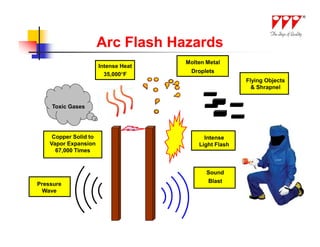
Arc Flash Hazards
                                      Molten Metal
                       Intense Heat
                                       Droplets
                         35,000F
                                                        Flying Objects
                                                          & Shrapnel


    Toxic Gases


     Copper Solid to                        Intense
    Vapor Expansion                       Light Flash
      67,000 Times


                                             Sound
                                             Blast
Pressure
  Wave
ARC FLASH
                    STANDARDS

                    PEDERSEN POWER PRODUCTS
Th Sign o Quality
  e      f
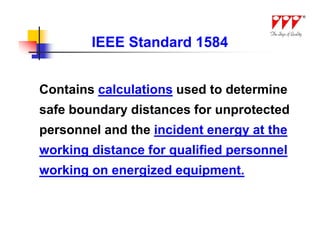
IEEE Standard 1584


Contains calculations used to determine
safe boundary distances for unprotected
personnel and the incident energy at the
working distance for qualified personnel
working on energized equipment.
IEEE Standard 1584
      Incident Energy Calculation for
         Arc Flash in a Cubic Box

E =1038.7D-1.4738 x T[0.0093F2-0.3453F+5.9675]
E = Incident Energy in cal/cm2
D = Distance to arcing point
T = Time to clear arcing fault
F = Available bolted fault short circuit current
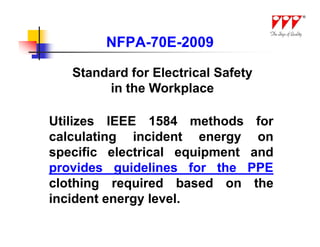
NFPA-70E-2009

   Standard for Electrical Safety
        in the Workplace

Utilizes IEEE 1584 methods for
calculating incident energy on
specific electrical equipment and
provides guidelines for the PPE
clothing required based on the
incident energy level.
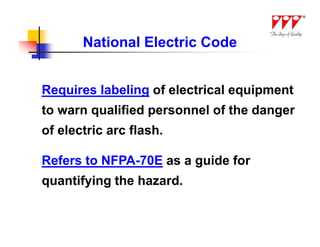
National Electric Code


Requires labeling of electrical equipment
to warn qualified personnel of the danger
of electric arc flash.

Refers to NFPA-70E as a guide for
quantifying the hazard.
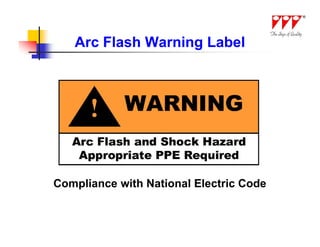
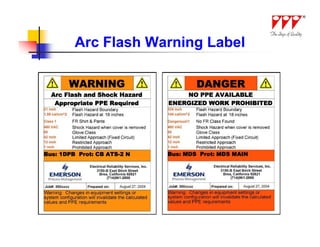
Arc Flash Warning Label


Compliance with National Electric Code
Arc Flash Warning Label
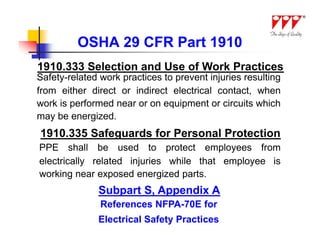
OSHA 29 CFR Part 1910
1910.333 Selection and Use of Work Practices
Safety-related work practices to prevent injuries resulting
from either direct or indirect electrical contact, when
work is performed near or on equipment or circuits which
may be energized.
1910.335 Safeguards for Personal Protection
PPE shall be used to protect employees from
electrically related injuries while that employee is
working near exposed energized parts.
              Subpart S, Appendix A
               References NFPA-70E for
              Electrical Safety Practices
ARC FLASH
          PREVENTION

                    PEDERSEN POWER PRODUCTS
Th Sign o Quality
  e      f
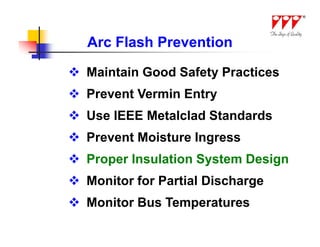
Arc Flash Prevention


DON’T
 WORK ON
      ENERGIZED
        ELECTRICAL
           EQUIPMENT!
Causes of Electric Arc Flash
  Contact with Live Parts
  Unsafe Work Procedures
  Misoperation
  Insufficient Maintenance
  Overvoltages
  Insulation Failure
  Entry of Small Animals
Arc Flash Prevention
 Maintain Sound Safety Practices
 Prevent Entry of Critters
 Use IEEE Metalclad Standards
 Prevent Moisture Ingress
 Proper Insulation System Design
 Monitor for Partial Discharge
 Monitor Bus Temperatures
IEEE Standard C37.20.7

“There is little likelihood of an internal arc in
equipment meeting the requirements of IEEE Standard
C37.20.1-2002 or IEEE Standard C37.20.3-2001. There
is even less likelihood of an internal arc in equipment
that has insulated bus, compartmentalization, barriers,
and interlocks, such as those described in IEEE
Standard C37.20.2-1999.”


          Metalclad Switchgear Design Standard
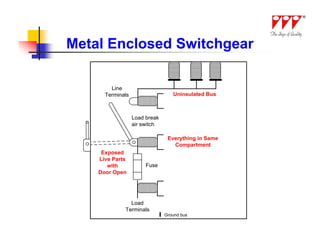
Metal Enclosed Switchgear

        Line
      Terminals                   Uninsulated Bus


                  Load break
                  air switch

                                Everything in Same
                                  Compartment
     Exposed
    Live Parts
       with            Fuse
    Door Open


               Load
             Terminals
                               Ground bus
Metalclad Switchgear
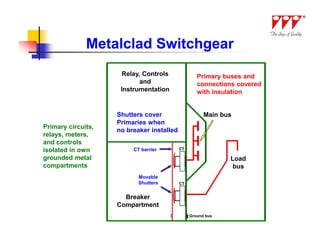
                      Relay, Controls              Primary buses and
                            and                    connections covered
                     Instrumentation               with insulation


                    Shutters cover                    Main bus
                    Primaries when
Primary circuits,
                    no breaker installed
relays, meters,
and controls
isolated in own          CT barrier        CT

grounded metal                                               Load
compartments                                                  bus
                           Movable
                           Shutters        CT


                      Breaker
                    Compartment
                                                Ground bus
Metalclad Switchgear
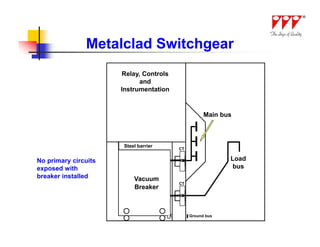
                       Relay, Controls
                             and
                      Instrumentation


                                                    Main bus


                       Steel barrier
                                         CT


No primary circuits                                        Load
exposed with                                                bus
breaker installed          Vacuum
                                         CT
                           Breaker


                                              Ground bus
Arc Flash Prevention

 Maintain Good Safety Practices
 Prevent Vermin Entry
 Use IEEE Metalclad Standards
 Prevent Moisture Ingress
 Proper Insulation System Design
 Monitor for Partial Discharge
 Monitor Bus Temperatures
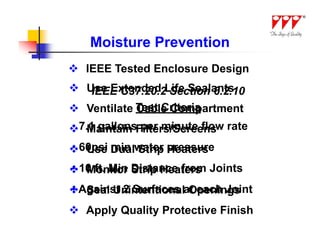
Moisture Prevention
 IEEE Tested Enclosure Design
 Use Extended Life Sealants
   IEEE C37.20.2 Section 6.2.10
 Ventilate Test Criteria
            Cable Compartment
7.1 gallonsFilters/Screens rate
• Maintain per minute flow

60psi Dualwater pressure
• Use min Strip Heaters
10 ft. Min Distance from Joints
• Monitor Strip Heaters
Against 2 Surfaces at each Joint
• Seal Unintentional Openings
 Apply Quality Protective Finish
Arc Flash Prevention

 Maintain Good Safety Practices
 Prevent Vermin Entry
 Use IEEE Metalclad Standards
 Prevent Moisture Ingress
 Proper Insulation System Design
 Monitor for Partial Discharge
 Monitor Bus Temperatures
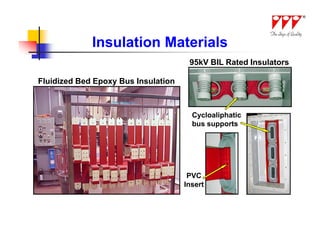
Insulation Materials
                                      95kV BIL Rated Insulators

Fluidized Bed Epoxy Bus Insulation


                                       Cycloaliphatic
                                       bus supports


                                      PVC
                                     Insert
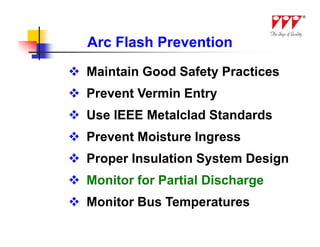
Arc Flash Prevention
 Maintain Good Safety Practices
 Prevent Vermin Entry
 Use IEEE Metalclad Standards
 Prevent Moisture Ingress
 Proper Insulation System Design
 Monitor for Partial Discharge
 Monitor Bus Temperatures
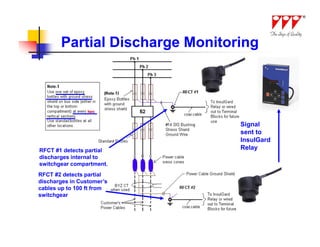
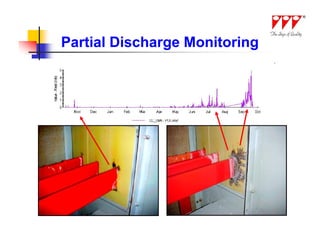
Partial Discharge Monitoring


                                Signal
                                sent to
                                InsulGard
RFCT #1 detects partial         Relay
discharges internal to
switchgear compartment.
RFCT #2 detects partial
discharges in Customer’s
cables up to 100 ft from
switchgear
Partial Discharge Monitoring
Arc Flash Prevention
 Maintain Good Safety Practices
 Prevent Vermin Entry
 Use IEEE Metalclad Standards
 Prevent Moisture Ingress
 Proper Insulation System Design
 Monitor for Partial Discharge
 Monitor Bus Temperatures
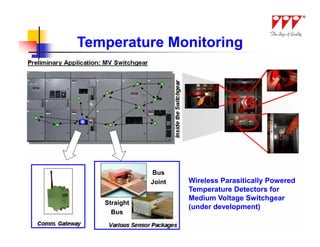
Temperature Monitoring


              Bus
              Joint   Wireless Parasitically Powered
                      Temperature Detectors for
                      Medium Voltage Switchgear
   Straight
                      (under development)

     Bus
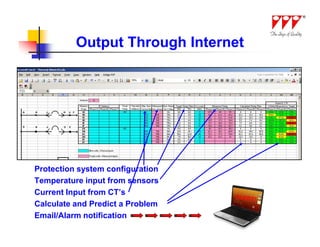
Output Through Internet


Protection system configuration
Temperature input from sensors
Current Input from CT’s
Calculate and Predict a Problem
Email/Alarm notification
ARC FLASH
          PROTECTION

                    PEDERSEN POWER PRODUCTS
Th Sign o Quality
  e      f
Arc Flash Protection
 Train Personnel
 Wear Proper PPE
 Install Warning Labels
 Maintain Good Safety Practices
 Build Sturdy Enclosure
 Reduce the Human Interface
 Redirect the Blast Energy
Safety Practices
 De-Energize Equipment
 Use Lockout/Tagout Procedures
 Latch and Secure All Panels
 Label Line and Load Side Bus
 Isolate Potential Backfeeds
 Open Tie Breaker/Redundant Sources
 Ground De-Energized Conductors
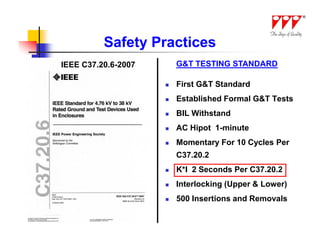
Safety Practices
IEEE C37.20.6-2007       G&T TESTING STANDARD

                        First G&T Standard
                        Established Formal G&T Tests
                        BIL Withstand
                        AC Hipot 1-minute
                        Momentary For 10 Cycles Per
                         C37.20.2
                        K*I 2 Seconds Per C37.20.2
                        Interlocking (Upper & Lower)
                        500 Insertions and Removals
Safety Practices

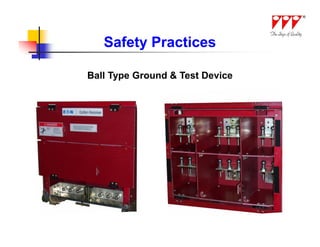
Ball Type Ground & Test Device
Safety Practices

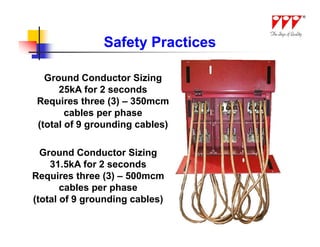
   Ground Conductor Sizing
      25kA for 2 seconds
 Requires three (3) – 350mcm
        cables per phase
 (total of 9 grounding cables)

  Ground Conductor Sizing
    31.5kA for 2 seconds
Requires three (3) – 500mcm
       cables per phase
(total of 9 grounding cables)
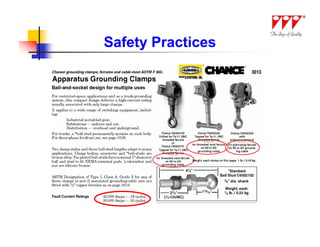
Safety Practices
Arc Flash Protection
 Train Personnel
 Wear Proper PPE
 Install Warning Labels
 Maintain Good Safety Practices
 Build Sturdy Enclosure
 Reduce the Human Interface
 Redirect the Blast Energy
Sturdy Enclosure Design

 Use Only 11 Gauge Steel

 Weld Cubicles

 Two Walls Between Sections

 Heavy Duty Door Hinges

 Heavy Duty Door Latches
Arc Flash Protection
 Train Personnel
 Wear Proper PPE
 Install Warning Labels
 Maintain Good Safety Practices
 Build Sturdy Enclosure
 Reduce Human Interface
 Redirect the Blast Energy
Reduce Human Interface
 Opening & Closing Breaker
 Relocate control switch
 Use remote communications
 Use local HMI
 Use remote control station
 Use Remote Operator
 Use Time Delay Control Switch
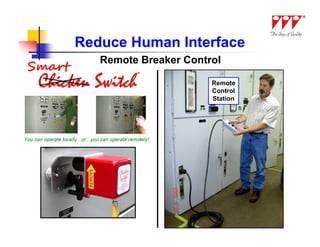
Reduce Human Interface
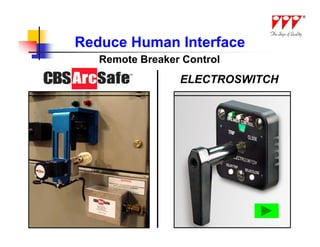
           Remote Breaker Control
Smart
                               Remote
                               Control
                               Station
Reduce Human Interface
   Remote Breaker Control
                 ELECTROSWITCH
Reduce Human Interface
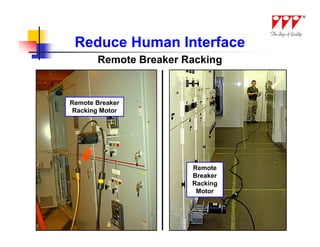
       Remote Breaker Racking


Remote Breaker
 Racking Motor


                       Remote
                       Breaker
                       Racking
                        Motor
Reduce Human Interface
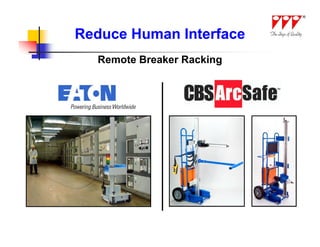
  Remote Breaker Racking
Reduce Human Interface
  Remote Breaker Racking
Arc Flash Protection
 Train Personnel
 Wear Proper PPE
 Install Warning Labels
 Maintain Good Safety Practices
 Build Sturdy Enclosure
 Reduce the Human Interface
 Redirect the Blast Energy
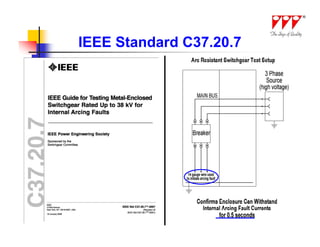
IEEE Standard C37.20.7


A procedure for testing and evaluating
the performance of medium-voltage
metal-enclosed switchgear for internal
arcing faults and identifying the
capabilities of the equipment relative
to specific zones of protection.

       NOT A DESIGN STANDARD
IEEE Standard C37.20.7


 Arc-Resistant Definition:

“Equipment designed to withstand
the effects of an internal arcing
fault as indicated by successfully
meeting the requirements of IEEE
Standard C37.20.7-2007.”
IEEE Standard C37.20.7

Term Arc Resistant can be misleading.

In the event of an internal arcing fault,
the dangerous effects of the arc are
vented away from the zone of
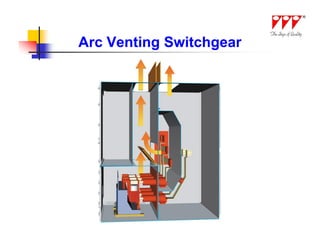
protection for personnel.

Term Arc Venting is more accurate
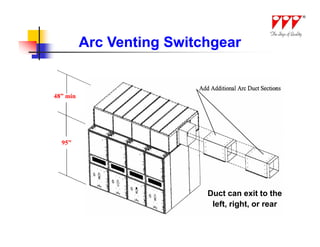
Arc Venting Switchgear


48” min


  95”


                           Duct can exit to the
                            left, right, or rear
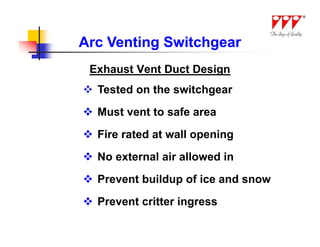
Arc Venting Switchgear
 Exhaust Vent Duct Design
 Tested on the switchgear
 Must vent to safe area
 Fire rated at wall opening
 No external air allowed in
 Prevent buildup of ice and snow
 Prevent critter ingress
IEEE Standard C37.20.7


“Not intended to provide this additional degree of
“Intended to provide an additional degree of
protection to operating personnel who, in thenormal
protection to the personnel performing normal
performance of their duties, would be required to
operating duties in close proximity to the equipment
open enclosure doors or panels or otherwise alter the
while equipment is operating under normal
equipment from its normal operating conditions.”
conditions”
IEEE Standard C37.20.7


IEEE does not require that metalclad
switchgear to be manufactured to
pass the IEEE Standard C37.20.7
Testing Procedures.
IEEE Standard C37.20.7


     Zones
       of
   Protection
Zones of Protection


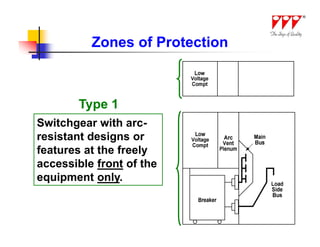
        Type 1
Switchgear with arc-
resistant designs or
features at the freely
accessible front of the
equipment only.
Zones of Protection


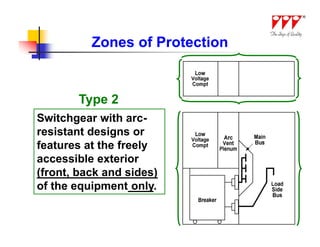
       Type 2
Switchgear with arc-
resistant designs or
features at the freely
accessible exterior
(front, back and sides)
of the equipment only.
Zones of Protection


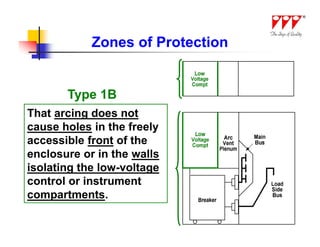
       Type 1B
That arcing does not
cause holes in the freely
accessible front of the
enclosure or in the walls
isolating the low-voltage
control or instrument
compartments.
Zones of Protection


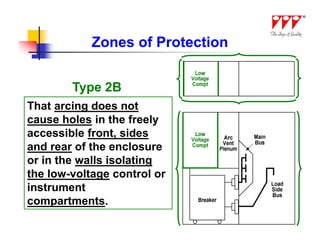
        Type 2B
That arcing does not
cause holes in the freely
accessible front, sides
and rear of the enclosure
or in the walls isolating
the low-voltage control or
instrument
compartments.
Zones of Protection


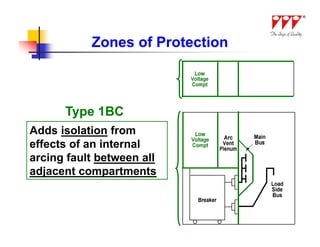
      Type 1BC
Adds isolation from
effects of an internal
arcing fault between all
adjacent compartments
Zones of Protection


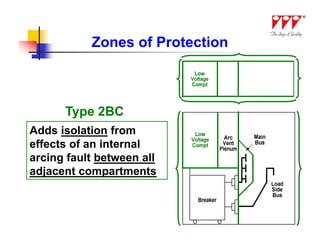
      Type 2BC
Adds isolation from
effects of an internal
arcing fault between all
adjacent compartments
Arc Venting Switchgear
        Considerations
 Initial cost (up to 25% more)

 Need breaker lift device

 Must design room accordingly

 Must seal all cable entries

 Low voltage wiring protection

 Loss of protection if door/panel open
IEEE Standard C37.20.7
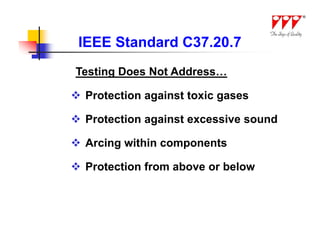
Testing Does Not Address…

 Protection against toxic gases

 Protection against excessive sound

 Arcing within components

 Protection from above or below
ARC FLASH
                MITIGATION

                    PEDERSEN POWER PRODUCTS
Th Sign o Quality
  e      f
Arc Flash Mitigation

       Incident Energy Calculation

E =1038.7D-1.4738 x T[0.0093F2-0.3453F+5.9675]
E = Incident Energy in cal/cm2
D = Distance to arcing point
T = Time to clear arcing fault
F = Available short circuit current
Arc Flash Mitigation
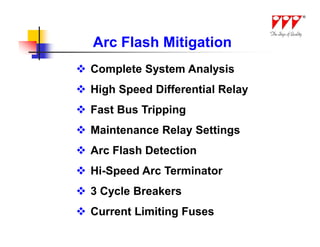
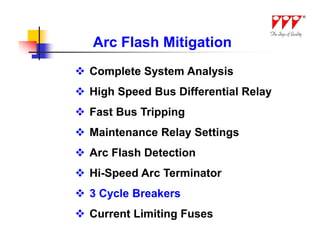
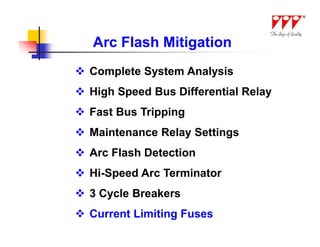
 Complete System Analysis
 High Speed Differential Relay
 Fast Bus Tripping
 Maintenance Relay Settings
 Arc Flash Detection
 Hi-Speed Arc Terminator
 3 Cycle Breakers
 Current Limiting Fuses
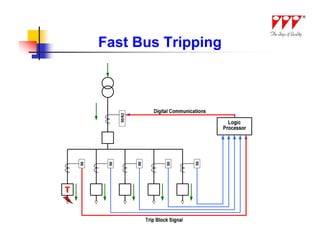
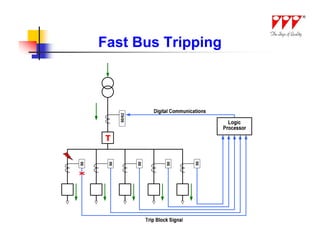
Fast Bus Tripping


               50/62


                                 50
    50


          50


                       50


                            50


T
Fast Bus Tripping


           50/62


      T


                             50
50


      50


                   50


                        50
Arc Flash Mitigation
 Complete System Analysis
 High Speed Bus Differential Relay
 Fast Bus Tripping
 Maintenance Relay Settings
 Arc Flash Detection
 Hi-Speed Arc Terminator
 3 Cycle Breakers
 Current Limiting Fuses
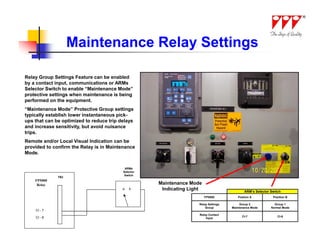
Maintenance Relay Settings

Relay Group Settings Feature can be enabled
by a contact input, communications or ARMs
Selector Switch to enable “Maintenance Mode”
protective settings when maintenance is being
performed on the equipment.
“Maintenance Mode” Protective Group settings
typically establish lower instantaneous pick-
ups that can be optimized to reduce trip delays
and increase sensitivity, but avoid nuisance
trips.
Remote and/or Local Visual Indication can be
provided to confirm the Relay is in Maintenance
Mode.


                                           ARMs
                                          Selector
                                           Switch
              TB2
    FP5000
     Relay                                           Maintenance Mode
                                          a   b       Indicating Light                       ARM’s Selector Switch
                                                                         FP5000          Postion A           Position B

                                                                     Relay Settings        Group 2            Group 1
                                                                         Group        Maintenance Mode      Normal Mode
    CI - 7
                                                                     Relay Contact
    CI - 8                                                                                  CI-7                CI-8
                                                                         Input
Arc Flash Mitigation
 Complete System Analysis
 High Speed Bus Differential Relay
 Fast Bus Tripping
 Maintenance Relay Settings
 Arc Flash Detection
 Hi-Speed Arc Terminator
 3 Cycle Breakers
 Current Limiting Fuses
Arc Flash Detection

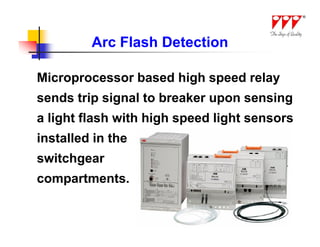
Microprocessor based high speed relay
sends trip signal to breaker upon sensing
a light flash with high speed light sensors
installed in the
switchgear
compartments.
Arc Flash Detection

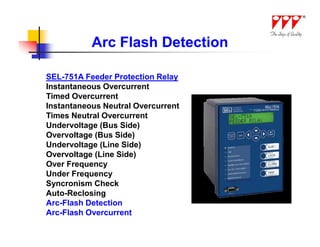
SEL-751A Feeder Protection Relay
Instantaneous Overcurrent
Timed Overcurrent
Instantaneous Neutral Overcurrent
Times Neutral Overcurrent
Undervoltage (Bus Side)
Overvoltage (Bus Side)
Undervoltage (Line Side)
Overvoltage (Line Side)
Over Frequency
Under Frequency
Syncronism Check
Auto-Reclosing
Arc-Flash Detection
Arc-Flash Overcurrent
Arc Flash Detection
Test Cell Without Arc Flash Detection
Arc Flash Detection
Test Cell With Arc Flash Detection
Arc Flash Detection
Switchgear Without Arc Flash Detection
Arc Flash Detection
Switchgear With Arc Flash Detection
Arc Flash Detection
Test Dummy Without Arc Flash Detection
Arc Flash Detection
Test Dummy With Arc Flash Detection
Arc Flash Mitigation
 Complete System Analysis
 High Speed Bus Differential Relay
 Fast Bus Tripping
 Maintenance Relay Settings
 Arc Flash Detection
 Hi-Speed Arc Terminator
 3 Cycle Breakers
 Current Limiting Fuses
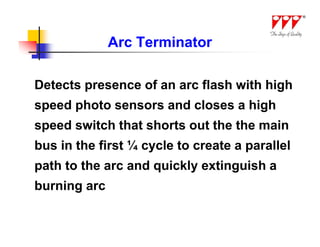
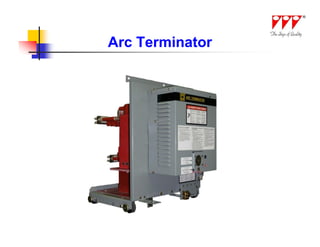
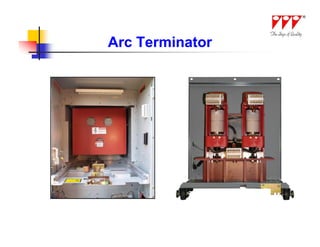
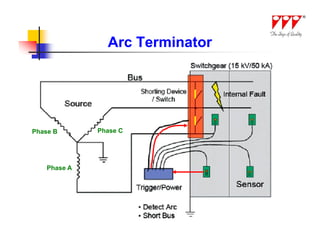
Arc Terminator

Detects presence of an arc flash with high
speed photo sensors and closes a high
speed switch that shorts out the the main
bus in the first ¼ cycle to create a parallel
path to the arc and quickly extinguish a
burning arc
Arc Terminator
Arc Terminator
Arc Terminator


Phase B       Phase C


    Phase A
Arc Terminator
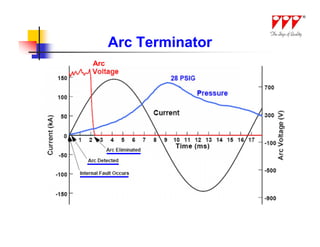
Arc
Arc Terminator

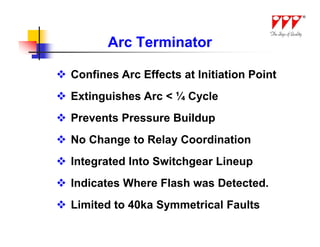
 Confines Arc Effects at Initiation Point
 Extinguishes Arc < ¼ Cycle
 Prevents Pressure Buildup
 No Change to Relay Coordination
 Integrated Into Switchgear Lineup
 Indicates Where Flash was Detected.
 Limited to 40ka Symmetrical Faults
Arc Flash Mitigation
 Complete System Analysis
 High Speed Bus Differential Relay
 Fast Bus Tripping
 Maintenance Relay Settings
 Arc Flash Detection
 Hi-Speed Arc Terminator
 3 Cycle Breakers
 Current Limiting Fuses
Arc Flash Mitigation
 Complete System Analysis
 High Speed Bus Differential Relay
 Fast Bus Tripping
 Maintenance Relay Settings
 Arc Flash Detection
 Hi-Speed Arc Terminator
 3 Cycle Breakers
 Current Limiting Fuses
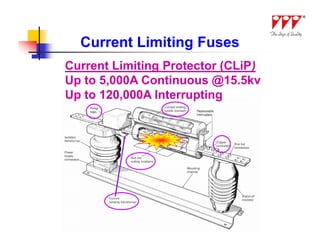
Current Limiting Fuses
Current Limiting Protector (CLiP)
Up to 5,000A Continuous @15.5kv
Up to 120,000A Interrupting
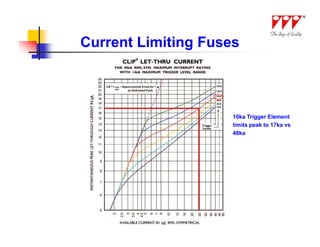
Current Limiting Fuses


                     10ka Trigger Element
                     limits peak to 17ka vs
                     48ka
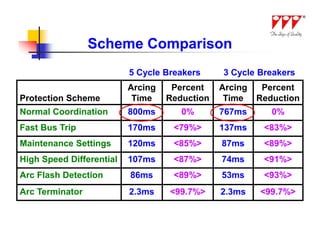
Scheme Comparison
                          5 Cycle Breakers     3 Cycle Breakers
                          Arcing    Percent    Arcing    Percent
Protection Scheme          Time    Reduction    Time    Reduction
Normal Coordination       800ms       0%       767ms       0%
Fast Bus Trip             170ms     <79%>      137ms     <83%>
Maintenance Settings      120ms     <85%>      87ms      <89%>
High Speed Differential   107ms     <87%>      74ms      <91%>
Arc Flash Detection       86ms      <89%>      53ms      <93%>
Arc Terminator            2.3ms    <99.7%>     2.3ms    <99.7%>
NFPA
                      Personal
                     Protective
                     Equipment
                    Requirements
                    PEDERSEN POWER PRODUCTS
Th Sign o Quality
  e      f
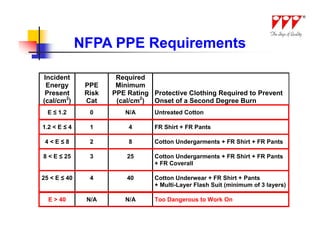
NFPA PPE Requirements

Incident               Required
 Energy        PPE     Minimum
 Present       Risk   PPE Rating Protective Clothing Required to Prevent
(cal/cm2)      Cat     (cal/cm2) Onset of a Second Degree Burn
  E ≤ 1.2       0        N/A      Untreated Cotton

1.2 < E ≤ 4     1         4       FR Shirt + FR Pants

 4<E≤8          2         8       Cotton Undergarments + FR Shirt + FR Pants

8 < E ≤ 25      3         25      Cotton Undergarments + FR Shirt + FR Pants
                                  + FR Coverall

25 < E ≤ 40     4         40      Cotton Underwear + FR Shirt + Pants
                                  + Multi-Layer Flash Suit (minimum of 3 layers)

  E > 40       N/A       N/A      Too Dangerous to Work On
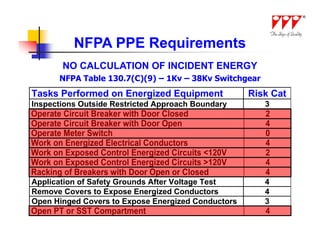
NFPA PPE Requirements
       NO CALCULATION OF INCIDENT ENERGY
      NFPA Table 130.7(C)(9) – 1Kv – 38Kv Switchgear
Tasks Performed on Energized Equipment              Risk Cat
Inspections Outside Restricted Approach Boundary       3
Operate Circuit Breaker with Door Closed               2
Operate Circuit Breaker with Door Open                 4
Operate Meter Switch                                   0
Work on Energized Electrical Conductors                4
Work on Exposed Control Energized Circuits <120V       2
Work on Exposed Control Energized Circuits >120V       4
Racking of Breakers with Door Open or Closed           4
Application of Safety Grounds After Voltage Test       4
Remove Covers to Expose Energized Conductors           4
Open Hinged Covers to Expose Energized Conductors      3
Open PT or SST Compartment                             4
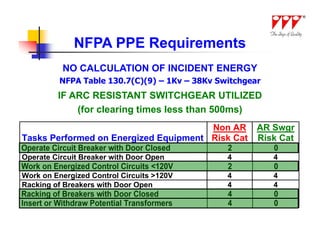
NFPA PPE Requirements
           NO CALCULATION OF INCIDENT ENERGY
          NFPA Table 130.7(C)(9) – 1Kv – 38Kv Switchgear
         IF ARC RESISTANT SWITCHGEAR UTILIZED
             (for clearing times less than 500ms)
                                       Non AR          AR Swgr
Tasks Performed on Energized Equipment Risk Cat        Risk Cat
Operate Circuit Breaker with Door Closed        2          0
Operate Circuit Breaker with Door Open          4          4
Work on Energized Control Circuits <120V        2          0
Work on Energized Control Circuits >120V        4          4
Racking of Breakers with Door Open              4          4
Racking of Breakers with Door Closed            4          0
Insert or Withdraw Potential Transformers       4          0
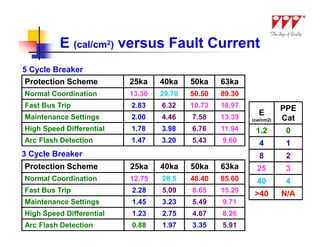
E (cal/cm2) versus Fault Current
5 Cycle Breaker
 Protection Scheme        25ka    40ka    50ka    63ka
Normal Coordination       13.30   29.70   50.50   89.30
Fast Bus Trip             2.83    6.32    10.73   18.97               PPE
                                                             E
Maintenance Settings      2.00    4.46    7.58    13.39   (cal/cm2)   Cat
High Speed Differential   1.78    3.98    6.76    11.94    1.2         0
Arc Flash Detection       1.47    3.20    5.43    9.60       4         1
3 Cycle Breaker                                              8         2
Protection Scheme         25ka    40ka    50ka    63ka      25         3
Normal Coordination       12.75   28.5    48.40   85.60     40         4
Fast Bus Trip             2.28    5.09    8.65    15.29
                                                           >40        N/A
Maintenance Settings      1.45    3.23    5.49    9.71
High Speed Differential   1.23    2.75    4.67    8.26
Arc Flash Detection       0.88    1.97    3.35    5.91
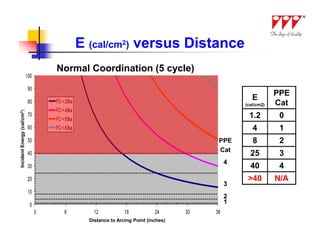
E (cal/cm2) versus Distance
                                     Normal Coordination (5 cycle)
                       100

                            90
                                                                                                                 PPE
                                                                                                        E
                            80       FC = 25ka                                                       (cal/cm2)   Cat
                                     FC = 40ka
                                                                                                      1.2         0
Incident Energy (cal/cm2)


                            70
                                     FC = 50ka
                            60       FC = 63ka                                                          4         1
                            50                                                               PPE        8         2
                                                                                             Cat
                            40                                                                         25         3
                                                                                                 4
                            30                                                                         40         4
                            20                                                                        >40        N/A
                                                                                                 3
                            10
                                                                                                 2
                            0                                                                    1
                                 0       6           12           18           24      30   36
                                                   Distance to Arcing Point (inches)
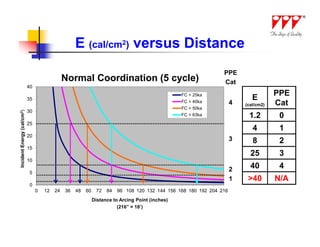
E (cal/cm2) versus Distance
                                                                                                                 PPE
                                               Normal Coordination (5 cycle)                                     Cat
                            40
                                                                                                                                      PPE
                            35
                                                                                                  FC = 25ka
                                                                                                                             E
                                                                                                  FC = 40ka           4   (cal/cm2)   Cat
                                                                                                  FC = 50ka
                            30
                                                                                                                           1.2         0
Incident Energy (cal/cm2)


                                                                                                  FC = 63ka
                            25
                                                                                                                             4         1
                            20
                                                                                                                      3      8         2
                            15
                                                                                                                            25         3
                            10
                                                                                                                      2     40         4
                            5
                                                                                                                      1    >40        N/A
                            0
                                 0   12   24   36   48   60    72   84   96 108 120 132 144 156 168 180 192 204 216
                                                              Distance to Arcing Point (inches)
                                                                         (216” = 18’)
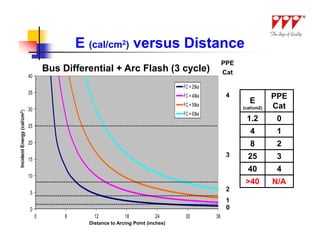
E (cal/cm2) versus Distance
                                                                                                     PPE
                                     Bus Differential + Arc Flash (3 cycle)                          Cat
                            40
                                                                                    FC = 25ka
                            35
                                                                                    FC = 40ka         4                PPE
                                                                                                              E
                            30
                                                                                    FC = 50ka
                                                                                                           (cal/cm2)   Cat
Incident Energy (cal/cm2)


                                                                                    FC = 63ka
                                                                                                            1.2         0
                            25
                                                                                                              4         1
                            20                                                                                8         2
                                                                                                      3      25         3
                            15
                                                                                                             40         4
                            10
                                                                                                            >40        N/A
                                                                                                      2
                            5
                                                                                                      1
                            0                                                                         0
                                 0        6       12           18           24       30         36
                                                Distance to Arcing Point (inches)
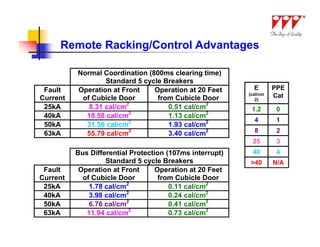
Remote Racking/Control Advantages

          Normal Coordination (800ms clearing time)
                  Standard 5 cycle Breakers
 Fault    Operation at Front    Operation at 20 Feet        E       PPE
Current    of Cubicle Door       from Cubicle Door
                                                          (cal/cm   Cat
                                                             2)
                        2
 25kA        8.31 cal/cm            0.51 cal/cm2           1.2       0
 40kA       18.58 cal/cm2           1.13 cal/cm2
                                                            4        1
 50kA       31.56 cal/cm2           1.93 cal/cm2
 63kA       55.79 cal/cm2           3.40 cal/cm2            8        2
                                                           25        3
          Bus Differential Protection (107ms interrupt)    40        4
                   Standard 5 cycle Breakers               >40      N/A
 Fault     Operation at Front      Operation at 20 Feet
Current     of Cubicle Door         from Cubicle Door
                          2
 25kA         1.78 cal/cm              0.11 cal/cm2
 40kA         3.98 cal/cm2             0.24 cal/cm2
 50kA         6.76 cal/cm2             0.41 cal/cm2
 63kA        11.94 cal/cm2             0.73 cal/cm2
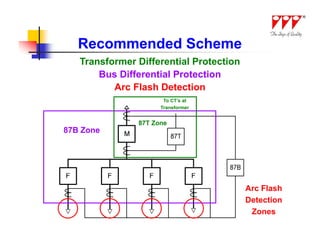
Recommended Scheme
   Transformer Differential Protection
       Bus Differential Protection
          Arc Flash Detection
                      To CT’s at
                     Transformer


               87T Zone
87B Zone


                                         Arc Flash
                                         Detection
                                          Zones
PPP


 Think
PEDERSEN

20120504 LISAT slides Dube

  • 1.
    ARC FLASH MITIGATION STRATEGIES for METALCLAD SWITCHGEAR PEDERSEN POWER PRODUCTS Th Sign o Quality e f
  • 2.
    Discussion Topics  ArcFlash Standards  Arc Flash Prevention  Arc Flash Protection  Mitigation Techniques
  • 3.
    Arc Flash Hazards Molten Metal Intense Heat Droplets 35,000F Flying Objects & Shrapnel Toxic Gases Copper Solid to Intense Vapor Expansion Light Flash 67,000 Times Sound Blast Pressure Wave
  • 4.
    ARC FLASH STANDARDS PEDERSEN POWER PRODUCTS Th Sign o Quality e f
  • 5.
    IEEE Standard 1584 Containscalculations used to determine safe boundary distances for unprotected personnel and the incident energy at the working distance for qualified personnel working on energized equipment.
  • 6.
    IEEE Standard 1584 Incident Energy Calculation for Arc Flash in a Cubic Box E =1038.7D-1.4738 x T[0.0093F2-0.3453F+5.9675] E = Incident Energy in cal/cm2 D = Distance to arcing point T = Time to clear arcing fault F = Available bolted fault short circuit current
  • 7.
    NFPA-70E-2009 Standard for Electrical Safety in the Workplace Utilizes IEEE 1584 methods for calculating incident energy on specific electrical equipment and provides guidelines for the PPE clothing required based on the incident energy level.
  • 8.
    National Electric Code Requireslabeling of electrical equipment to warn qualified personnel of the danger of electric arc flash. Refers to NFPA-70E as a guide for quantifying the hazard.
  • 9.
    Arc Flash WarningLabel Compliance with National Electric Code
  • 10.
  • 11.
    OSHA 29 CFRPart 1910 1910.333 Selection and Use of Work Practices Safety-related work practices to prevent injuries resulting from either direct or indirect electrical contact, when work is performed near or on equipment or circuits which may be energized. 1910.335 Safeguards for Personal Protection PPE shall be used to protect employees from electrically related injuries while that employee is working near exposed energized parts. Subpart S, Appendix A References NFPA-70E for Electrical Safety Practices
  • 12.
    ARC FLASH PREVENTION PEDERSEN POWER PRODUCTS Th Sign o Quality e f
  • 13.
    Arc Flash Prevention DON’T WORK ON ENERGIZED ELECTRICAL EQUIPMENT!
  • 14.
    Causes of ElectricArc Flash  Contact with Live Parts  Unsafe Work Procedures  Misoperation  Insufficient Maintenance  Overvoltages  Insulation Failure  Entry of Small Animals
  • 15.
    Arc Flash Prevention Maintain Sound Safety Practices  Prevent Entry of Critters  Use IEEE Metalclad Standards  Prevent Moisture Ingress  Proper Insulation System Design  Monitor for Partial Discharge  Monitor Bus Temperatures
  • 16.
    IEEE Standard C37.20.7 “Thereis little likelihood of an internal arc in equipment meeting the requirements of IEEE Standard C37.20.1-2002 or IEEE Standard C37.20.3-2001. There is even less likelihood of an internal arc in equipment that has insulated bus, compartmentalization, barriers, and interlocks, such as those described in IEEE Standard C37.20.2-1999.” Metalclad Switchgear Design Standard
  • 17.
    Metal Enclosed Switchgear Line Terminals Uninsulated Bus Load break air switch Everything in Same Compartment Exposed Live Parts with Fuse Door Open Load Terminals Ground bus
  • 18.
    Metalclad Switchgear Relay, Controls Primary buses and and connections covered Instrumentation with insulation Shutters cover Main bus Primaries when Primary circuits, no breaker installed relays, meters, and controls isolated in own CT barrier CT grounded metal Load compartments bus Movable Shutters CT Breaker Compartment Ground bus
  • 19.
    Metalclad Switchgear Relay, Controls and Instrumentation Main bus Steel barrier CT No primary circuits Load exposed with bus breaker installed Vacuum CT Breaker Ground bus
  • 20.
    Arc Flash Prevention Maintain Good Safety Practices  Prevent Vermin Entry  Use IEEE Metalclad Standards  Prevent Moisture Ingress  Proper Insulation System Design  Monitor for Partial Discharge  Monitor Bus Temperatures
  • 21.
    Moisture Prevention  IEEETested Enclosure Design  Use Extended Life Sealants IEEE C37.20.2 Section 6.2.10  Ventilate Test Criteria Cable Compartment 7.1 gallonsFilters/Screens rate • Maintain per minute flow 60psi Dualwater pressure • Use min Strip Heaters 10 ft. Min Distance from Joints • Monitor Strip Heaters Against 2 Surfaces at each Joint • Seal Unintentional Openings  Apply Quality Protective Finish
  • 22.
    Arc Flash Prevention Maintain Good Safety Practices  Prevent Vermin Entry  Use IEEE Metalclad Standards  Prevent Moisture Ingress  Proper Insulation System Design  Monitor for Partial Discharge  Monitor Bus Temperatures
  • 23.
    Insulation Materials 95kV BIL Rated Insulators Fluidized Bed Epoxy Bus Insulation Cycloaliphatic bus supports PVC Insert
  • 24.
    Arc Flash Prevention Maintain Good Safety Practices  Prevent Vermin Entry  Use IEEE Metalclad Standards  Prevent Moisture Ingress  Proper Insulation System Design  Monitor for Partial Discharge  Monitor Bus Temperatures
  • 25.
    Partial Discharge Monitoring Signal sent to InsulGard RFCT #1 detects partial Relay discharges internal to switchgear compartment. RFCT #2 detects partial discharges in Customer’s cables up to 100 ft from switchgear
  • 26.
  • 27.
    Arc Flash Prevention Maintain Good Safety Practices  Prevent Vermin Entry  Use IEEE Metalclad Standards  Prevent Moisture Ingress  Proper Insulation System Design  Monitor for Partial Discharge  Monitor Bus Temperatures
  • 28.
    Temperature Monitoring Bus Joint Wireless Parasitically Powered Temperature Detectors for Medium Voltage Switchgear Straight (under development) Bus
  • 29.
    Output Through Internet Protectionsystem configuration Temperature input from sensors Current Input from CT’s Calculate and Predict a Problem Email/Alarm notification
  • 30.
    ARC FLASH PROTECTION PEDERSEN POWER PRODUCTS Th Sign o Quality e f
  • 31.
    Arc Flash Protection Train Personnel  Wear Proper PPE  Install Warning Labels  Maintain Good Safety Practices  Build Sturdy Enclosure  Reduce the Human Interface  Redirect the Blast Energy
  • 32.
    Safety Practices  De-EnergizeEquipment  Use Lockout/Tagout Procedures  Latch and Secure All Panels  Label Line and Load Side Bus  Isolate Potential Backfeeds  Open Tie Breaker/Redundant Sources  Ground De-Energized Conductors
  • 33.
    Safety Practices IEEE C37.20.6-2007 G&T TESTING STANDARD  First G&T Standard  Established Formal G&T Tests  BIL Withstand  AC Hipot 1-minute  Momentary For 10 Cycles Per C37.20.2  K*I 2 Seconds Per C37.20.2  Interlocking (Upper & Lower)  500 Insertions and Removals
  • 34.
    Safety Practices Ball TypeGround & Test Device
  • 35.
    Safety Practices Ground Conductor Sizing 25kA for 2 seconds Requires three (3) – 350mcm cables per phase (total of 9 grounding cables) Ground Conductor Sizing 31.5kA for 2 seconds Requires three (3) – 500mcm cables per phase (total of 9 grounding cables)
  • 36.
  • 37.
    Arc Flash Protection Train Personnel  Wear Proper PPE  Install Warning Labels  Maintain Good Safety Practices  Build Sturdy Enclosure  Reduce the Human Interface  Redirect the Blast Energy
  • 38.
    Sturdy Enclosure Design Use Only 11 Gauge Steel  Weld Cubicles  Two Walls Between Sections  Heavy Duty Door Hinges  Heavy Duty Door Latches
  • 39.
    Arc Flash Protection Train Personnel  Wear Proper PPE  Install Warning Labels  Maintain Good Safety Practices  Build Sturdy Enclosure  Reduce Human Interface  Redirect the Blast Energy
  • 40.
    Reduce Human Interface Opening & Closing Breaker  Relocate control switch  Use remote communications  Use local HMI  Use remote control station  Use Remote Operator  Use Time Delay Control Switch
  • 41.
    Reduce Human Interface Remote Breaker Control Smart Remote Control Station
  • 42.
    Reduce Human Interface Remote Breaker Control ELECTROSWITCH
  • 43.
    Reduce Human Interface Remote Breaker Racking Remote Breaker Racking Motor Remote Breaker Racking Motor
  • 44.
    Reduce Human Interface Remote Breaker Racking
  • 45.
    Reduce Human Interface Remote Breaker Racking
  • 46.
    Arc Flash Protection Train Personnel  Wear Proper PPE  Install Warning Labels  Maintain Good Safety Practices  Build Sturdy Enclosure  Reduce the Human Interface  Redirect the Blast Energy
  • 47.
  • 48.
    IEEE Standard C37.20.7 Aprocedure for testing and evaluating the performance of medium-voltage metal-enclosed switchgear for internal arcing faults and identifying the capabilities of the equipment relative to specific zones of protection. NOT A DESIGN STANDARD
  • 49.
    IEEE Standard C37.20.7 Arc-Resistant Definition: “Equipment designed to withstand the effects of an internal arcing fault as indicated by successfully meeting the requirements of IEEE Standard C37.20.7-2007.”
  • 50.
    IEEE Standard C37.20.7 TermArc Resistant can be misleading. In the event of an internal arcing fault, the dangerous effects of the arc are vented away from the zone of protection for personnel. Term Arc Venting is more accurate
  • 51.
  • 52.
    Arc Venting Switchgear 48”min 95” Duct can exit to the left, right, or rear
  • 53.
    Arc Venting Switchgear Exhaust Vent Duct Design  Tested on the switchgear  Must vent to safe area  Fire rated at wall opening  No external air allowed in  Prevent buildup of ice and snow  Prevent critter ingress
  • 54.
    IEEE Standard C37.20.7 “Notintended to provide this additional degree of “Intended to provide an additional degree of protection to operating personnel who, in thenormal protection to the personnel performing normal performance of their duties, would be required to operating duties in close proximity to the equipment open enclosure doors or panels or otherwise alter the while equipment is operating under normal equipment from its normal operating conditions.” conditions”
  • 55.
    IEEE Standard C37.20.7 IEEEdoes not require that metalclad switchgear to be manufactured to pass the IEEE Standard C37.20.7 Testing Procedures.
  • 56.
    IEEE Standard C37.20.7 Zones of Protection
  • 57.
    Zones of Protection Type 1 Switchgear with arc- resistant designs or features at the freely accessible front of the equipment only.
  • 58.
    Zones of Protection Type 2 Switchgear with arc- resistant designs or features at the freely accessible exterior (front, back and sides) of the equipment only.
  • 59.
    Zones of Protection Type 1B That arcing does not cause holes in the freely accessible front of the enclosure or in the walls isolating the low-voltage control or instrument compartments.
  • 60.
    Zones of Protection Type 2B That arcing does not cause holes in the freely accessible front, sides and rear of the enclosure or in the walls isolating the low-voltage control or instrument compartments.
  • 61.
    Zones of Protection Type 1BC Adds isolation from effects of an internal arcing fault between all adjacent compartments
  • 62.
    Zones of Protection Type 2BC Adds isolation from effects of an internal arcing fault between all adjacent compartments
  • 63.
    Arc Venting Switchgear Considerations  Initial cost (up to 25% more)  Need breaker lift device  Must design room accordingly  Must seal all cable entries  Low voltage wiring protection  Loss of protection if door/panel open
  • 64.
    IEEE Standard C37.20.7 TestingDoes Not Address…  Protection against toxic gases  Protection against excessive sound  Arcing within components  Protection from above or below
  • 65.
    ARC FLASH MITIGATION PEDERSEN POWER PRODUCTS Th Sign o Quality e f
  • 66.
    Arc Flash Mitigation Incident Energy Calculation E =1038.7D-1.4738 x T[0.0093F2-0.3453F+5.9675] E = Incident Energy in cal/cm2 D = Distance to arcing point T = Time to clear arcing fault F = Available short circuit current
  • 67.
    Arc Flash Mitigation Complete System Analysis  High Speed Differential Relay  Fast Bus Tripping  Maintenance Relay Settings  Arc Flash Detection  Hi-Speed Arc Terminator  3 Cycle Breakers  Current Limiting Fuses
  • 68.
    Fast Bus Tripping 50/62 50 50 50 50 50 T
  • 69.
    Fast Bus Tripping 50/62 T 50 50 50 50 50
  • 70.
    Arc Flash Mitigation Complete System Analysis  High Speed Bus Differential Relay  Fast Bus Tripping  Maintenance Relay Settings  Arc Flash Detection  Hi-Speed Arc Terminator  3 Cycle Breakers  Current Limiting Fuses
  • 71.
    Maintenance Relay Settings RelayGroup Settings Feature can be enabled by a contact input, communications or ARMs Selector Switch to enable “Maintenance Mode” protective settings when maintenance is being performed on the equipment. “Maintenance Mode” Protective Group settings typically establish lower instantaneous pick- ups that can be optimized to reduce trip delays and increase sensitivity, but avoid nuisance trips. Remote and/or Local Visual Indication can be provided to confirm the Relay is in Maintenance Mode. ARMs Selector Switch TB2 FP5000 Relay Maintenance Mode a b Indicating Light ARM’s Selector Switch FP5000 Postion A Position B Relay Settings Group 2 Group 1 Group Maintenance Mode Normal Mode CI - 7 Relay Contact CI - 8 CI-7 CI-8 Input
  • 72.
    Arc Flash Mitigation Complete System Analysis  High Speed Bus Differential Relay  Fast Bus Tripping  Maintenance Relay Settings  Arc Flash Detection  Hi-Speed Arc Terminator  3 Cycle Breakers  Current Limiting Fuses
  • 73.
    Arc Flash Detection Microprocessorbased high speed relay sends trip signal to breaker upon sensing a light flash with high speed light sensors installed in the switchgear compartments.
  • 74.
    Arc Flash Detection SEL-751AFeeder Protection Relay Instantaneous Overcurrent Timed Overcurrent Instantaneous Neutral Overcurrent Times Neutral Overcurrent Undervoltage (Bus Side) Overvoltage (Bus Side) Undervoltage (Line Side) Overvoltage (Line Side) Over Frequency Under Frequency Syncronism Check Auto-Reclosing Arc-Flash Detection Arc-Flash Overcurrent
  • 75.
    Arc Flash Detection TestCell Without Arc Flash Detection
  • 76.
    Arc Flash Detection TestCell With Arc Flash Detection
  • 77.
    Arc Flash Detection SwitchgearWithout Arc Flash Detection
  • 78.
    Arc Flash Detection SwitchgearWith Arc Flash Detection
  • 79.
    Arc Flash Detection TestDummy Without Arc Flash Detection
  • 80.
    Arc Flash Detection TestDummy With Arc Flash Detection
  • 81.
    Arc Flash Mitigation Complete System Analysis  High Speed Bus Differential Relay  Fast Bus Tripping  Maintenance Relay Settings  Arc Flash Detection  Hi-Speed Arc Terminator  3 Cycle Breakers  Current Limiting Fuses
  • 82.
    Arc Terminator Detects presenceof an arc flash with high speed photo sensors and closes a high speed switch that shorts out the the main bus in the first ¼ cycle to create a parallel path to the arc and quickly extinguish a burning arc
  • 83.
  • 84.
  • 85.
    Arc Terminator Phase B Phase C Phase A
  • 86.
  • 87.
    Arc Terminator  ConfinesArc Effects at Initiation Point  Extinguishes Arc < ¼ Cycle  Prevents Pressure Buildup  No Change to Relay Coordination  Integrated Into Switchgear Lineup  Indicates Where Flash was Detected.  Limited to 40ka Symmetrical Faults
  • 88.
    Arc Flash Mitigation Complete System Analysis  High Speed Bus Differential Relay  Fast Bus Tripping  Maintenance Relay Settings  Arc Flash Detection  Hi-Speed Arc Terminator  3 Cycle Breakers  Current Limiting Fuses
  • 89.
    Arc Flash Mitigation Complete System Analysis  High Speed Bus Differential Relay  Fast Bus Tripping  Maintenance Relay Settings  Arc Flash Detection  Hi-Speed Arc Terminator  3 Cycle Breakers  Current Limiting Fuses
  • 90.
    Current Limiting Fuses CurrentLimiting Protector (CLiP) Up to 5,000A Continuous @15.5kv Up to 120,000A Interrupting
  • 91.
    Current Limiting Fuses 10ka Trigger Element limits peak to 17ka vs 48ka
  • 92.
    Scheme Comparison 5 Cycle Breakers 3 Cycle Breakers Arcing Percent Arcing Percent Protection Scheme Time Reduction Time Reduction Normal Coordination 800ms 0% 767ms 0% Fast Bus Trip 170ms <79%> 137ms <83%> Maintenance Settings 120ms <85%> 87ms <89%> High Speed Differential 107ms <87%> 74ms <91%> Arc Flash Detection 86ms <89%> 53ms <93%> Arc Terminator 2.3ms <99.7%> 2.3ms <99.7%>
  • 93.
    NFPA Personal Protective Equipment Requirements PEDERSEN POWER PRODUCTS Th Sign o Quality e f
  • 94.
    NFPA PPE Requirements Incident Required Energy PPE Minimum Present Risk PPE Rating Protective Clothing Required to Prevent (cal/cm2) Cat (cal/cm2) Onset of a Second Degree Burn E ≤ 1.2 0 N/A Untreated Cotton 1.2 < E ≤ 4 1 4 FR Shirt + FR Pants 4<E≤8 2 8 Cotton Undergarments + FR Shirt + FR Pants 8 < E ≤ 25 3 25 Cotton Undergarments + FR Shirt + FR Pants + FR Coverall 25 < E ≤ 40 4 40 Cotton Underwear + FR Shirt + Pants + Multi-Layer Flash Suit (minimum of 3 layers) E > 40 N/A N/A Too Dangerous to Work On
  • 95.
    NFPA PPE Requirements NO CALCULATION OF INCIDENT ENERGY NFPA Table 130.7(C)(9) – 1Kv – 38Kv Switchgear Tasks Performed on Energized Equipment Risk Cat Inspections Outside Restricted Approach Boundary 3 Operate Circuit Breaker with Door Closed 2 Operate Circuit Breaker with Door Open 4 Operate Meter Switch 0 Work on Energized Electrical Conductors 4 Work on Exposed Control Energized Circuits <120V 2 Work on Exposed Control Energized Circuits >120V 4 Racking of Breakers with Door Open or Closed 4 Application of Safety Grounds After Voltage Test 4 Remove Covers to Expose Energized Conductors 4 Open Hinged Covers to Expose Energized Conductors 3 Open PT or SST Compartment 4
  • 96.
    NFPA PPE Requirements NO CALCULATION OF INCIDENT ENERGY NFPA Table 130.7(C)(9) – 1Kv – 38Kv Switchgear IF ARC RESISTANT SWITCHGEAR UTILIZED (for clearing times less than 500ms) Non AR AR Swgr Tasks Performed on Energized Equipment Risk Cat Risk Cat Operate Circuit Breaker with Door Closed 2 0 Operate Circuit Breaker with Door Open 4 4 Work on Energized Control Circuits <120V 2 0 Work on Energized Control Circuits >120V 4 4 Racking of Breakers with Door Open 4 4 Racking of Breakers with Door Closed 4 0 Insert or Withdraw Potential Transformers 4 0
  • 97.
    E (cal/cm2) versusFault Current 5 Cycle Breaker Protection Scheme 25ka 40ka 50ka 63ka Normal Coordination 13.30 29.70 50.50 89.30 Fast Bus Trip 2.83 6.32 10.73 18.97 PPE E Maintenance Settings 2.00 4.46 7.58 13.39 (cal/cm2) Cat High Speed Differential 1.78 3.98 6.76 11.94 1.2 0 Arc Flash Detection 1.47 3.20 5.43 9.60 4 1 3 Cycle Breaker 8 2 Protection Scheme 25ka 40ka 50ka 63ka 25 3 Normal Coordination 12.75 28.5 48.40 85.60 40 4 Fast Bus Trip 2.28 5.09 8.65 15.29 >40 N/A Maintenance Settings 1.45 3.23 5.49 9.71 High Speed Differential 1.23 2.75 4.67 8.26 Arc Flash Detection 0.88 1.97 3.35 5.91
  • 98.
    E (cal/cm2) versusDistance Normal Coordination (5 cycle) 100 90 PPE E 80 FC = 25ka (cal/cm2) Cat FC = 40ka 1.2 0 Incident Energy (cal/cm2) 70 FC = 50ka 60 FC = 63ka 4 1 50 PPE 8 2 Cat 40 25 3 4 30 40 4 20 >40 N/A 3 10 2 0 1 0 6 12 18 24 30 36 Distance to Arcing Point (inches)
  • 99.
    E (cal/cm2) versusDistance PPE Normal Coordination (5 cycle) Cat 40 PPE 35 FC = 25ka E FC = 40ka 4 (cal/cm2) Cat FC = 50ka 30 1.2 0 Incident Energy (cal/cm2) FC = 63ka 25 4 1 20 3 8 2 15 25 3 10 2 40 4 5 1 >40 N/A 0 0 12 24 36 48 60 72 84 96 108 120 132 144 156 168 180 192 204 216 Distance to Arcing Point (inches) (216” = 18’)
  • 100.
    E (cal/cm2) versusDistance PPE Bus Differential + Arc Flash (3 cycle) Cat 40 FC = 25ka 35 FC = 40ka 4 PPE E 30 FC = 50ka (cal/cm2) Cat Incident Energy (cal/cm2) FC = 63ka 1.2 0 25 4 1 20 8 2 3 25 3 15 40 4 10 >40 N/A 2 5 1 0 0 0 6 12 18 24 30 36 Distance to Arcing Point (inches)
  • 101.
    Remote Racking/Control Advantages Normal Coordination (800ms clearing time) Standard 5 cycle Breakers Fault Operation at Front Operation at 20 Feet E PPE Current of Cubicle Door from Cubicle Door (cal/cm Cat 2) 2 25kA 8.31 cal/cm 0.51 cal/cm2 1.2 0 40kA 18.58 cal/cm2 1.13 cal/cm2 4 1 50kA 31.56 cal/cm2 1.93 cal/cm2 63kA 55.79 cal/cm2 3.40 cal/cm2 8 2 25 3 Bus Differential Protection (107ms interrupt) 40 4 Standard 5 cycle Breakers >40 N/A Fault Operation at Front Operation at 20 Feet Current of Cubicle Door from Cubicle Door 2 25kA 1.78 cal/cm 0.11 cal/cm2 40kA 3.98 cal/cm2 0.24 cal/cm2 50kA 6.76 cal/cm2 0.41 cal/cm2 63kA 11.94 cal/cm2 0.73 cal/cm2
  • 102.
    Recommended Scheme Transformer Differential Protection Bus Differential Protection Arc Flash Detection To CT’s at Transformer 87T Zone 87B Zone Arc Flash Detection Zones
  • 103.