A Technical Introduction to WiredTiger
Michael Cahill
Director of Engineering (Storage), MongoDB
We’ll begin shortly.
Thanks for joining:
About The Presenter
• Michael Cahill
• WiredTiger team lead at MongoDB
• Sydney, Australia
• michael.cahill@mongodb.com
• @m_j_cahill
What You Will Learn
• WiredTiger Architecture
• In-memory performance
• Document-level concurrency
• Compression and checksums
• Durability and the journal
• What’s next?
4
This webinar is not…
• How to write stand-alone WiredTiger apps
– contact info@wiredtiger.com if you are interested
• How to configure MongoDB with WiredTiger for your workload
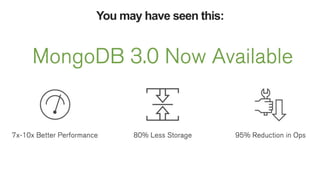
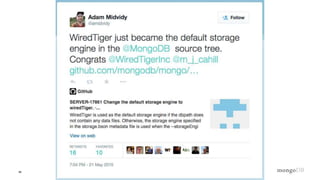
You may have seen this:
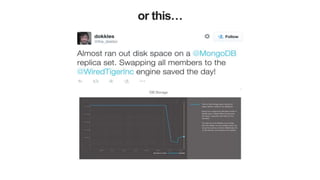
or this…
What You Will Learn
 WiredTiger Architecture
• In-memory performance
• Document-level concurrency
• Compression and checksums
• Durability and the journal
• What’s next?
8
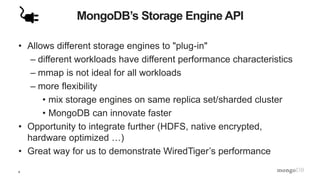
MongoDB’s Storage Engine API
• Allows different storage engines to "plug-in"
– different workloads have different performance characteristics
– mmap is not ideal for all workloads
– more flexibility
• mix storage engines on same replica set/sharded cluster
• MongoDB can innovate faster
• Opportunity to integrate further (HDFS, native encrypted,
hardware optimized …)
• Great way for us to demonstrate WiredTiger’s performance
9
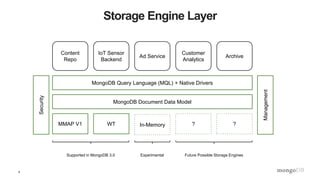
Storage Engine Layer
Content
Repo
IoT Sensor
Backend
Ad Service
Customer
Analytics
Archive
MongoDB Query Language (MQL) + Native Drivers
MongoDB Document Data Model
MMAP V1 WT In-Memory ? ?
Supported in MongoDB 3.0 Future Possible Storage Engines
Management
Security
Example Future State
Experimental
10
Motivation for WiredTiger
• Take advantage of modern hardware:
– many CPU cores
– lots of RAM
• Minimize contention between threads
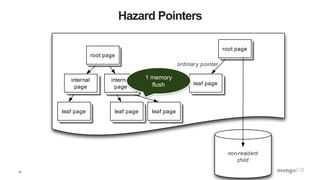
– lock-free algorithms, e.g., hazard pointers
– eliminate blocking due to concurrency control
• Hotter cache and more work per I/O
– compact file formats
– compression
11
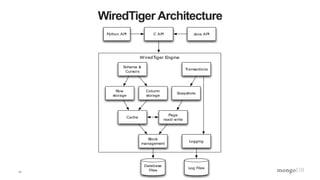
WiredTiger Architecture
WiredTiger Engine
Schema &
Cursors
Python API C API Java API
Database
Files
Transactions
Page
read/ write
Logging
Column
storage
Block
management
Row
storage
Snapshots
Log Files
Cache
What You Will Learn
 WiredTiger Architecture
 In-memory performance
• Document-level concurrency
• Compression and checksums
• Durability and the journal
• What’s next?
13
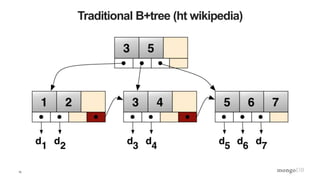
Traditional B+tree (ht wikipedia)
14
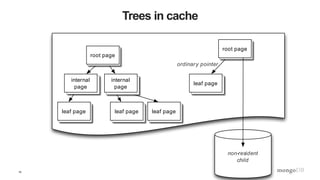
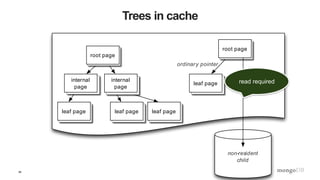
Trees in cache
non-resident
child
ordinary pointer
root page
internal
page
internal
page
root page
leaf page
leaf page leaf page leaf page
15
Hazard Pointers
non-resident
child
ordinary pointer
root page
internal
page
internal
page
root page
leaf page
leaf page leaf page leaf page
1 memory
flush
16
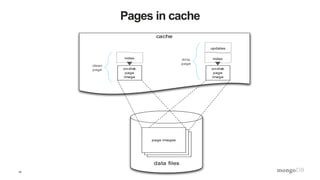
Pages in cache
cache
data files
page images
on-disk
page
image
index
clean
page on-disk
page
image
indexdirty
page
updates
17
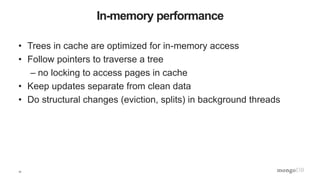
In-memory performance
• Trees in cache are optimized for in-memory access
• Follow pointers to traverse a tree
– no locking to access pages in cache
• Keep updates separate from clean data
• Do structural changes (eviction, splits) in background threads
What You Will Learn
 WiredTiger Architecture
 In-memory performance
 Document-level concurrency
• Compression and checksums
• Durability and the journal
• What’s next?
19
What is Concurrency Control?
• Computers have
– multiple CPU cores
– multiple I/O paths
• To make the most of the hardware, software has to execute
multiple operations in parallel
• Concurrency control has to keep data consistent
• Common approaches:
– locking
– keeping multiple versions of data (MVCC)
20
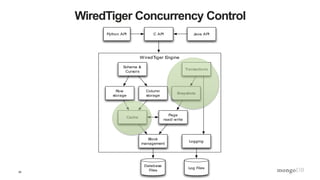
WiredTiger Concurrency Control
WiredTiger Engine
Schema &
Cursors
Python API C API Java API
Database
Files
Transactions
Page
read/ write
Logging
Column
storage
Block
management
Row
storage
Snapshots
Log Files
Cache
21
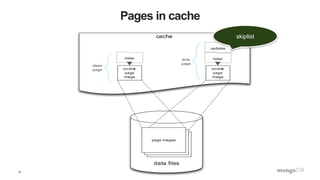
Pages in cache
cache
data files
page images
on-disk
page
image
index
clean
page on-disk
page
image
indexdirty
page
updates
skiplist
22
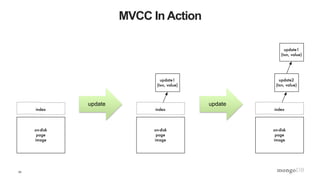
Multiversion Concurrency Control (MVCC)
• Multiple versions of records kept in cache
• Readers see the committed version before the transaction started
– MongoDB “yields” turn large operations into small transactions
• Writers can create new versions concurrent with readers
• Concurrent updates to a single record cause write conflicts
– MongoDB retries with back-off
23
MVCC In Action
updateupdate
What You Will Learn
 WiredTiger Architecture
 In-memory performance
 Document-level concurrency
 Compression and checksums
• Durability and the journal
• What’s next?
25
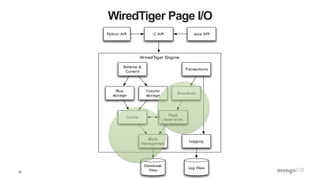
WiredTiger Page I/O
WiredTiger Engine
Schema &
Cursors
Python API C API Java API
Database
Files
Transactions
Page
read/ write
Logging
Column
storage
Block
management
Row
storage
Snapshots
Log Files
Cache
26
Trees in cache
non-resident
child
ordinary pointer
root page
internal
page
internal
page
root page
leaf page
leaf page leaf page leaf page
read required
27
Pages in cache
cache
data files
page images
on-disk
page
image
index
clean
page on-disk
page
image
indexdirty
page
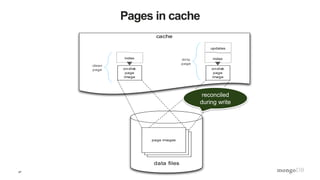
updates
reconciled
during write
28
Checksums
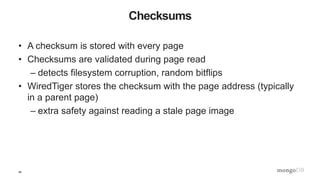
• A checksum is stored with every page
• Checksums are validated during page read
– detects filesystem corruption, random bitflips
• WiredTiger stores the checksum with the page address (typically
in a parent page)
– extra safety against reading a stale page image
29
Compression
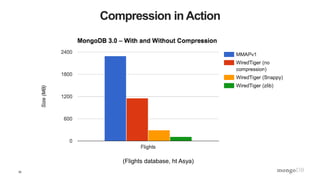
• WiredTiger uses snappy compression by default in MongoDB
• Supported compression algorithms:
– snappy [default]: good compression, low overhead
– zlib: better compression, more CPU
– none
• Indexes also use prefix compression
– stays compressed in memory
30
Compression in Action
(Flights database, ht Asya)
What You Will Learn
 WiredTiger Architecture
 In-memory performance
 Document-level concurrency
 Compression and checksums
 Durability and the journal
• What’s next?
32
Journal and Recovery
• Write-ahead logging (aka journal) enabled by default
• Only written at transaction commit
• Log records are compressed with snappy by default
• Group commit for concurrency
• Automatic log archive / removal
• On startup, we rely on finding a consistent checkpoint in the
metadata
• Use the metadata to figure out how much to roll forward
33
Durability without Journaling
• MMAPv1 require the journal for consistency
– running with “nojournal” is unsafe
• WiredTiger doesn't have this need: no in-place updates
– checkpoints every 60 seconds by default
– with “nojournal”, updates since the last checkpoint may be lost
– data will still be consistent
• Replication can guarantee durability
34
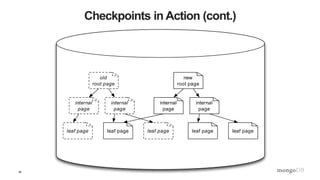
Writing a checkpoint
1. Write dirty leaf pages
– don’t overwrite, write new versions into free space
2. Write the internal pages, including the root
– the old checkpoint is still valid
3. Sync the file
4. Write the new root’s address to the metadata
– free pages from old checkpoints once the metadata is durable
35
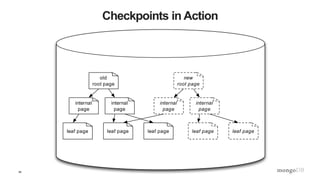
Checkpoints in Action
old
root page
internal
page
internal
page
leaf page leaf page leaf page
new
root page
internal
page
internal
page
leaf page leaf page
36
Checkpoints in Action (cont.)
old
root page
internal
page
internal
page
leaf page leaf page leaf page
new
root page
internal
page
internal
page
leaf page leaf page
What You Will Learn
 WiredTiger Architecture
 In-memory performance
 Document-level concurrency
 Compression and checksums
 Durability and the journal
 What’s next?
38
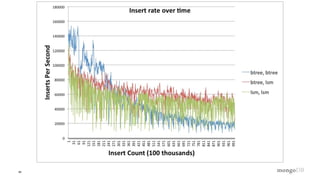
39
WiredTiger LSM support
• Out-of-order insert workloads
• Data set much larger than cache
• Query performance is not (as) important
• Resource overhead of background maintenance
acceptable
40
41
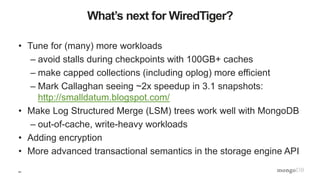
What’s next for WiredTiger?
• Tune for (many) more workloads
– avoid stalls during checkpoints with 100GB+ caches
– make capped collections (including oplog) more efficient
– Mark Callaghan seeing ~2x speedup in 3.1 snapshots:
http://smalldatum.blogspot.com/
• Make Log Structured Merge (LSM) trees work well with MongoDB
– out-of-cache, write-heavy workloads
• Adding encryption
• More advanced transactional semantics in the storage engine API
Thanks!
Questions?
Michael Cahill
michael.cahill@mongodb.com

A Technical Introduction to WiredTiger

  • 1.
    A Technical Introductionto WiredTiger Michael Cahill Director of Engineering (Storage), MongoDB We’ll begin shortly. Thanks for joining:
  • 2.
    About The Presenter •Michael Cahill • WiredTiger team lead at MongoDB • Sydney, Australia • michael.cahill@mongodb.com • @m_j_cahill
  • 3.
    What You WillLearn • WiredTiger Architecture • In-memory performance • Document-level concurrency • Compression and checksums • Durability and the journal • What’s next?
  • 4.
    4 This webinar isnot… • How to write stand-alone WiredTiger apps – contact info@wiredtiger.com if you are interested • How to configure MongoDB with WiredTiger for your workload
  • 5.
    You may haveseen this:
  • 6.
  • 7.
    What You WillLearn  WiredTiger Architecture • In-memory performance • Document-level concurrency • Compression and checksums • Durability and the journal • What’s next?
  • 8.
    8 MongoDB’s Storage EngineAPI • Allows different storage engines to "plug-in" – different workloads have different performance characteristics – mmap is not ideal for all workloads – more flexibility • mix storage engines on same replica set/sharded cluster • MongoDB can innovate faster • Opportunity to integrate further (HDFS, native encrypted, hardware optimized …) • Great way for us to demonstrate WiredTiger’s performance
  • 9.
    9 Storage Engine Layer Content Repo IoTSensor Backend Ad Service Customer Analytics Archive MongoDB Query Language (MQL) + Native Drivers MongoDB Document Data Model MMAP V1 WT In-Memory ? ? Supported in MongoDB 3.0 Future Possible Storage Engines Management Security Example Future State Experimental
  • 10.
    10 Motivation for WiredTiger •Take advantage of modern hardware: – many CPU cores – lots of RAM • Minimize contention between threads – lock-free algorithms, e.g., hazard pointers – eliminate blocking due to concurrency control • Hotter cache and more work per I/O – compact file formats – compression
  • 11.
    11 WiredTiger Architecture WiredTiger Engine Schema& Cursors Python API C API Java API Database Files Transactions Page read/ write Logging Column storage Block management Row storage Snapshots Log Files Cache
  • 12.
    What You WillLearn  WiredTiger Architecture  In-memory performance • Document-level concurrency • Compression and checksums • Durability and the journal • What’s next?
  • 13.
  • 14.
    14 Trees in cache non-resident child ordinarypointer root page internal page internal page root page leaf page leaf page leaf page leaf page
  • 15.
    15 Hazard Pointers non-resident child ordinary pointer rootpage internal page internal page root page leaf page leaf page leaf page leaf page 1 memory flush
  • 16.
    16 Pages in cache cache datafiles page images on-disk page image index clean page on-disk page image indexdirty page updates
  • 17.
    17 In-memory performance • Treesin cache are optimized for in-memory access • Follow pointers to traverse a tree – no locking to access pages in cache • Keep updates separate from clean data • Do structural changes (eviction, splits) in background threads
  • 18.
    What You WillLearn  WiredTiger Architecture  In-memory performance  Document-level concurrency • Compression and checksums • Durability and the journal • What’s next?
  • 19.
    19 What is ConcurrencyControl? • Computers have – multiple CPU cores – multiple I/O paths • To make the most of the hardware, software has to execute multiple operations in parallel • Concurrency control has to keep data consistent • Common approaches: – locking – keeping multiple versions of data (MVCC)
  • 20.
    20 WiredTiger Concurrency Control WiredTigerEngine Schema & Cursors Python API C API Java API Database Files Transactions Page read/ write Logging Column storage Block management Row storage Snapshots Log Files Cache
  • 21.
    21 Pages in cache cache datafiles page images on-disk page image index clean page on-disk page image indexdirty page updates skiplist
  • 22.
    22 Multiversion Concurrency Control(MVCC) • Multiple versions of records kept in cache • Readers see the committed version before the transaction started – MongoDB “yields” turn large operations into small transactions • Writers can create new versions concurrent with readers • Concurrent updates to a single record cause write conflicts – MongoDB retries with back-off
  • 23.
  • 24.
    What You WillLearn  WiredTiger Architecture  In-memory performance  Document-level concurrency  Compression and checksums • Durability and the journal • What’s next?
  • 25.
    25 WiredTiger Page I/O WiredTigerEngine Schema & Cursors Python API C API Java API Database Files Transactions Page read/ write Logging Column storage Block management Row storage Snapshots Log Files Cache
  • 26.
    26 Trees in cache non-resident child ordinarypointer root page internal page internal page root page leaf page leaf page leaf page leaf page read required
  • 27.
    27 Pages in cache cache datafiles page images on-disk page image index clean page on-disk page image indexdirty page updates reconciled during write
  • 28.
    28 Checksums • A checksumis stored with every page • Checksums are validated during page read – detects filesystem corruption, random bitflips • WiredTiger stores the checksum with the page address (typically in a parent page) – extra safety against reading a stale page image
  • 29.
    29 Compression • WiredTiger usessnappy compression by default in MongoDB • Supported compression algorithms: – snappy [default]: good compression, low overhead – zlib: better compression, more CPU – none • Indexes also use prefix compression – stays compressed in memory
  • 30.
  • 31.
    What You WillLearn  WiredTiger Architecture  In-memory performance  Document-level concurrency  Compression and checksums  Durability and the journal • What’s next?
  • 32.
    32 Journal and Recovery •Write-ahead logging (aka journal) enabled by default • Only written at transaction commit • Log records are compressed with snappy by default • Group commit for concurrency • Automatic log archive / removal • On startup, we rely on finding a consistent checkpoint in the metadata • Use the metadata to figure out how much to roll forward
  • 33.
    33 Durability without Journaling •MMAPv1 require the journal for consistency – running with “nojournal” is unsafe • WiredTiger doesn't have this need: no in-place updates – checkpoints every 60 seconds by default – with “nojournal”, updates since the last checkpoint may be lost – data will still be consistent • Replication can guarantee durability
  • 34.
    34 Writing a checkpoint 1.Write dirty leaf pages – don’t overwrite, write new versions into free space 2. Write the internal pages, including the root – the old checkpoint is still valid 3. Sync the file 4. Write the new root’s address to the metadata – free pages from old checkpoints once the metadata is durable
  • 35.
    35 Checkpoints in Action old rootpage internal page internal page leaf page leaf page leaf page new root page internal page internal page leaf page leaf page
  • 36.
    36 Checkpoints in Action(cont.) old root page internal page internal page leaf page leaf page leaf page new root page internal page internal page leaf page leaf page
  • 37.
    What You WillLearn  WiredTiger Architecture  In-memory performance  Document-level concurrency  Compression and checksums  Durability and the journal  What’s next?
  • 38.
  • 39.
    39 WiredTiger LSM support •Out-of-order insert workloads • Data set much larger than cache • Query performance is not (as) important • Resource overhead of background maintenance acceptable
  • 40.
  • 41.
    41 What’s next forWiredTiger? • Tune for (many) more workloads – avoid stalls during checkpoints with 100GB+ caches – make capped collections (including oplog) more efficient – Mark Callaghan seeing ~2x speedup in 3.1 snapshots: http://smalldatum.blogspot.com/ • Make Log Structured Merge (LSM) trees work well with MongoDB – out-of-cache, write-heavy workloads • Adding encryption • More advanced transactional semantics in the storage engine API
  • 42.

Editor's Notes

  • #9 <Exciting, good fit for lots of MongoDB workloads>
  • #17 Different in-memory representation vs on-disk – opportunities to optimize plus some interesting fetures Writing a page: Combine the previous page image with in-memory changes Allocate new space in the file If the result is too big, split Always write multiples of the allocation size Can configure direct I/O to keep reads and writes out of the filesystem cache
  • #22 Different in-memory representation vs on-disk – opportunities to optimize plus some interesting fetures Writing a page: Combine the previous page image with in-memory changes Allocate new space in the file If the result is too big, split Always write multiples of the allocation size Can configure direct I/O to keep reads and writes out of the filesystem cache
  • #28 Different in-memory representation vs on-disk – opportunities to optimize plus some interesting fetures Writing a page: Combine the previous page image with in-memory changes Allocate new space in the file If the result is too big, split Always write multiples of the allocation size Can configure direct I/O to keep reads and writes out of the filesystem cache