Radium: Secure Policy Engine in
Hypervisor
Tawfiq Shah
Agenda
› Defining the problem
› Introduction
› Background Technologies (SRTM, DRTM,FLASK)
› Radium Architecture Overview
› Radium Prototype Overview
› Adversary Model
› Access Control Policy (XSM)
› Radium Security and Performance
› Related Works
› Conclusion
› Future Works
2
Problem
› How many of us here have sensitive and/or private data stored in
their personal devices?
› Laptops
› iPads/Tablets
› Cell phones
› The Cloud
› How many of you actually implicitly trust those devices???
› Fact: everyone!!! (passwords, bank accounts, pictures, etc., )
 We need a way to help us assess the state of our computing
devices (The computing components/environments)
› Access control
3
Agenda
› Defining the problem
› Introduction
› Background Technologies (SRTM, DRTM,FLASK)
› Radium Architecture Overview
› Radium Prototype Overview
› Adversary Model
› Access Control Policy (XSM)
› Radium Security and Performance
› Related Works
› Conclusion
› Future Works
4
Introduction
› Given two software stacks, how can one differentiate between a
certified stack and one with sophisticated malware??
› A computing platform is trustworthy if it behaves as expected.
› Computing components:
– Firmware (BIOS)
– System Software (OS)
– Application Software
› Integrity Measurement ( An approach to verify the trustworthiness of a computing
platform is to measure each individual component.)
– Measurement represents the state/behavior of an entity
– Integrity measurement acts as a basis for trust
5
› Trusted Computing Group (Consortium of companies, e.g. AMD,
CISCO, IBM, Intel, etc.,)
– TCG Design Solution
› Trusted Platform Module (TPM)
› Current TPM employed solutions
– SRTM (static root of trust for measurement)
– DRTM (dynamic root of trust for measurement)
› Axiom
– Measured components do not change after measurement
› Radium ARTM (Asynchronous Root of Trust for Measurement)
– Leverage ARTM to overcome TOCTOU attacks
– Allow concurrent execution of untrusted/trusted virtual domains
– Zero down time
– Secure MAC policy in hypervisor (hypercall granularity)
– Remote attestation capability
6
Introduction Cont…
Agenda
› Defining the problem
› Introduction
› Background Technologies (SRTM, DRTM, FLASK)
› Radium Architecture Overview
› Radium Prototype Overview
› Adversary Model
› Access Control Policy (XSM)
› Radium Security and Performance
› Related Works
› Conclusion
› Future Works
7
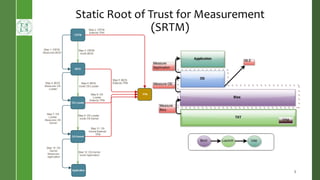
Static Root of Trust for Measurement
(SRTM)
8
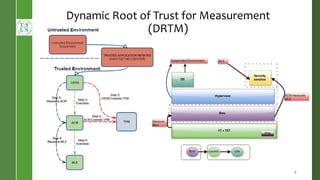
Dynamic Root of Trust for Measurement
(DRTM)
9
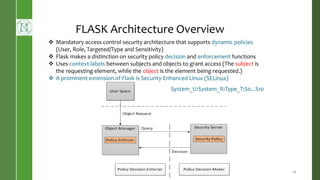
FLASK Architecture Overview
10
 Mandatory access control security architecture that supports dynamic policies
(User, Role, Targeted/Type and Sensitivity)
 Flask makes a distinction on security policy decision and enforcement functions
 Uses context labels between subjects and objects to grant access (The subject is
the requesting element, while the object is the element being requested.)
 A prominent extension of Flask is Security-Enhanced Linux (SELinux)
System_U:System_R:Type_T:S0...S10
Agenda
› Defining the problem
› Introduction
› Background Technologies (SRTM, DRTM,FLASK)
› Radium Architecture Overview
› Radium Prototype Overview
› Adversary Model
› Access Control Policy (XSM)
› Radium Security and Performance
› Related Works
› Conclusion
› Future Works
11
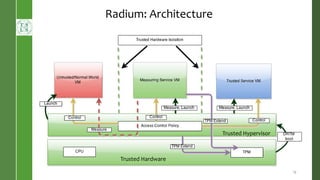
Radium Design Overview
› Employs DRTM to boot trusted Hypervisor
› Use of ARTM to overcome TOCTOU attacks
› Provide efficient and detailed measurements
› Allow more than one measured environment to co-exist and
co-operate
› Contain an Access Control Policy which regulates access
between all trusted and untrusted environments
12
Radium: Architecture
13
Trusted Hardware
Trusted Hypervisor
Agenda
› Defining the problem
› Introduction
› Background Technologies (SRTM, DRTM,FLASK)
› Radium Architecture Overview
› Radium Prototype Overview
› Adversary Model
› Access Control Policy (XSM)
› Radium Security and Performance
› Related Works
› Conclusion
› Future Works
14
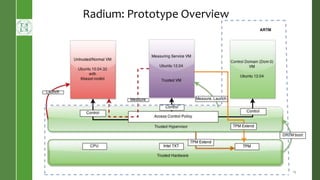
Radium: Prototype Overview
15
Agenda
› Defining the problem
› Introduction
› Background Technologies (SRTM, DRTM,FLASK)
› Radium Architecture Overview
› Radium Prototype Overview
› Adversary Model
› Access Control Policy (XSM)
› Radium Security and Performance
› Related Works
› Conclusion
› Future Works
16
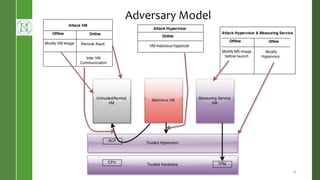
Adversary Model
17
Agenda
› Defining the problem
› Introduction
› Background Technologies (SRTM, DRTM,FLASK)
› Radium Architecture Overview
› Radium Prototype Overview
› Adversary Model
› Access Control Policy (XSM)
› Radium Security and Performance
› Related Works
› Conclusion
› Future Works
18
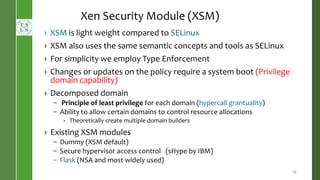
› XSM is light weight compared to SELinux
› XSM also uses the same semantic concepts and tools as SELinux
› For simplicity we employ Type Enforcement
› Changes or updates on the policy require a system boot (Privilege
domain capability)
› Decomposed domain
– Principle of least privilege for each domain (hypercall grantuality)
– Ability to allow certain domains to control resource allocations
› Theoretically create multiple domain builders
› Existing XSM modules
– Dummy (XSM default)
– Secure hypervisor access control (sHype by IBM)
– Flask (NSA and most widely used)
19
Xen Security Module (XSM)
20
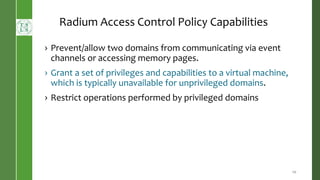
Radium Access Control Policy Capabilities
› Prevent/allow two domains from communicating via event
channels or accessing memory pages.
› Grant a set of privileges and capabilities to a virtual machine,
which is typically unavailable for unprivileged domains.
› Restrict operations performed by privileged domains
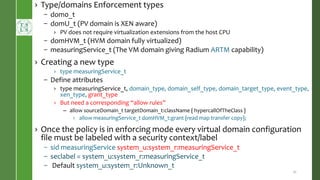
› Type/domains Enforcement types
– dom0_t
– domU_t (PV domain is XEN aware)
› PV does not require virtualization extensions from the host CPU
– domHVM_t (HVM domain fully virtualized)
– measuringService_t (The VM domain giving Radium ARTM capability)
› Creating a new type
› type measuringService_t
– Define attributes
› type measuringService_t, domain_type, domain_self_type, domain_target_type, event_type,
xen_type, grant_type
› But need a corresponding “allow rules”
– allow sourceDomain_t targetDomain_t:className { hypercallOfTheClass }
› allow measuringService_t domHVM_t:grant {read map transfer copy};
› Once the policy is in enforcing mode every virtual domain configuration
file must be labeled with a security context/label
– sid measuringService system_u:system_r:measuringService_t
– seclabel = system_u:system_r:measuringService_t
– Default system_u:system_r:Unknown_t
21
XSM Classes
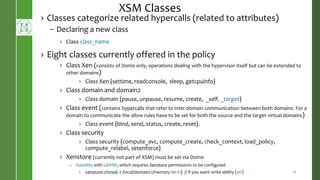
› Classes categorize related hypercalls (related to attributes)
– Declaring a new class
› Class class_name
› Eight classes currently offered in the policy
› Class Xen (consists of Dom0 only, operations dealing with the hypervisor itself but can be extended to
other domains)
› Class Xen {settime, readconsole, sleep, getcpuinfo}
› Class domain and domain2
› Class domain {pause, unpause, resume, create, _self, _target}
› Class event (contains hypercalls that refer to inter-domain communication between both domains. For a
domain to communicate the allow rules have to be set for both the source and the target virtual domains)
› Class event {bind, send, status, create, reset}.
› Class security
› Class security {compute_avc, compute_create, check_context, load_policy,
compute_relabel, setenforce}
› Xenstore (currently not part of XSM) must be set via Dom0
– Volatility with LibVMI, which requires Xenstore permissions to be configured
› xenstore-chmod -r /local/domain/2/memory n0 r1} // if you want write ability (w1) 22
Agenda
› Defining the problem
› Introduction
› Background Technologies (SRTM, DRTM,FLASK)
› Radium Architecture Overview
› Radium Prototype Overview
› Adversary Model
› Access Control Policy (XSM)
› Radium Security and Performance
› Related Works
› Conclusion
› Future Works
23
Radium: Security and Performance
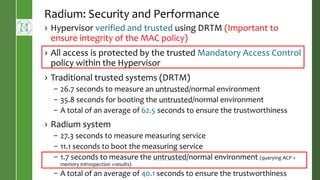
› Hypervisor verified and trusted using DRTM (Important to
ensure integrity of the MAC policy)
› All access is protected by the trusted Mandatory Access Control
policy within the Hypervisor
› Traditional trusted systems (DRTM)
– 26.7 seconds to measure an untrusted/normal environment
– 35.8 seconds for booting the untrusted/normal environment
– A total of an average of 62.5 seconds to ensure the trustworthiness
› Radium system
– 27.3 seconds to measure measuring service
– 11.1 seconds to boot the measuring service
– 1.7 seconds to measure the untrusted/normal environment (querying ACP +
memory introspection +results)
– A total of an average of 40.1 seconds to ensure the trustworthiness
Agenda
› Defining the problem
› Introduction
› Background Technologies (SRTM, DRTM,FLASK)
› Radium Architecture Overview
› Radium Prototype Overview
› Adversary Model
› Access Control Policy (XSM)
› Radium Security and Performance
› Related Works
› Conclusion
› Future Works
25
Related Works
› Trusted Computing
– Trusted Platform Module: Building a Trusted Software Stack and Remote
Attestation
› Trusted hypervisors
– Flicker
› Rootkit Detectors
– Rootkit Detection on Virtual Machines through Deep Information Extraction at
Hypervisor Level
› Hypervisor based secure access control
– Flux Advanced Security Kernel (Flask)
– Meeting Critical Security Objectives with SELinux
– Using the Flask Security Architecture to Facilitate Risk Adaptable Access Control
Agenda
› Defining the problem
› Introduction
› Background Technologies (SRTM, DRTM,FLASK)
› Radium Architecture Overview
› Radium Prototype Overview
› Adversary Model
› Access Control Policy (XSM)
› Radium Security and Performance
› Related Works
› Conclusion
› Future Works
27
Conclusion
› DRTM + VT-d boot of the hypervisor ensures integrity of the
secure MAC policy
› Using secure MAC policy to create a measuring service with the
ability to provide use time measurements.
› Using use time measurements to prevent TOCTOU attacks (you
can measure at anytime)
› Use of a trusted measuring service with a secure MAC policy is
more efficient than rebooting/resetting an environment
› Radium architecture achieves measurements with zero downtime
› The use of a secure MAC policy guarantees that hypercall
invocation can be controlled (unprivileged domains have access to
few hypercalls)
28
Agenda
› Defining the problem
› Introduction
› Background Technologies (SRTM, DRTM,FLASK)
› Radium Architecture Overview
› Radium Prototype Overview
› Adversary Model
› Access Control Policy (XSM)
› Radium Security and Performance
› Related Works
› Conclusion
› Future Works
29
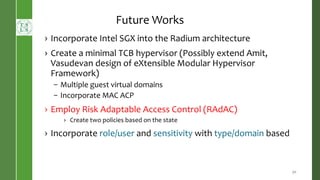
Future Works
› Incorporate Intel SGX into the Radium architecture
› Create a minimal TCB hypervisor (Possibly extend Amit,
Vasudevan design of eXtensible Modular Hypervisor
Framework)
– Multiple guest virtual domains
– Incorporate MAC ACP
› Employ Risk Adaptable Access Control (RAdAC)
› Create two policies based on the state
› Incorporate role/user and sensitivity with type/domain based
30
References
1. Trusted computing using AMD "Pacifica" and "Presidio" secure virtual machine technology; Geoffrey Strongin, Advanced Micro Devices, Inc.
2. BIOS chronomancy: fixing the core root of trust for measurement; John Butterworth, Corey Kallenberg, Xeno Kovah, Amy Herzog
3. Trusted Boot: Veriifyiing the Xen Launch; Joseph Cihula
4. Flicker: an execution infrastructure for TCB minimization; Jonathan M. McCune, Bryan J. Parno, Adrian Perrig, Michael K. Reiter, Hiroshi Isozaki
5. TrustVisor: Efficient TCB Reduction and Attestation; Jonathan M. McCune, Yanlin Li, Ning Qu, Zongwei Zhou, Anupam Datta, Virgil Gligor, Adrian Perrig
6. An architecture for concurrent execution of secure environments in clouds; Ramya Jayaram Masti, Claudio Marforio, Srdjan Capkun
7. Copilot - a coprocessor-based kernel runtime integrity monitor; Nick L. Petroni, Jr., Timothy Fraser, Jesus Molina, William A. Arbaugh
8. Terra: a virtual machine-based platform for trusted computing; Tal Garfinkel, Ben Pfaff, Jim Chow, Mendel Rosenblum, Dan Boneh
9. NoHype: virtualized cloud infrastructure without the virtualization; E Keller, J Szefer, J Rexford, RB Lee
10. Building a MAC-based security architecture for the Xen open-source hypervisor; Sailer, R.; Jaeger, T.; Valdez, E.; Caceres, R.; Perez, R.; Berger, S.; Griffin, J.L.;
van Doorn, L.
11. Srujan Kotikela , Tawfiq Shah, Mahadevan Gomathisankaran, Gelareh Tabani, et al. Radium: Racefree on-demand integrity measurement
architecture. 2015.
12. ELI: Bare-Metal Performance for I/O Virtualization; Abel Gordon, Nadav Amit, Nadav Har’El, Muli Ben-Yehuda, Alex Landau, Assaf Schuster, Dan Tsafrir
13. Breaking up is hard to do: security and functionality in a commodity hypervisor; Colp, Patrick and Nanavati, Mihir and Zhu, Jun and Aiello, William and Coker,
George and Deegan, Tim and Loscocco, Peter and Warfield, Andrew
14. Innovative Instructions and Software Model for Isolated Execution; McKeen, Frank and Alexandrovich, Ilya and Berenzon, Alex and Rozas, Carlos V. and Shafi,
Hisham and Shanbhogue, Vedvyas and Savagaonkar, Uday R
Questions???
32

Defense

  • 1.
    Radium: Secure PolicyEngine in Hypervisor Tawfiq Shah
  • 2.
    Agenda › Defining theproblem › Introduction › Background Technologies (SRTM, DRTM,FLASK) › Radium Architecture Overview › Radium Prototype Overview › Adversary Model › Access Control Policy (XSM) › Radium Security and Performance › Related Works › Conclusion › Future Works 2
  • 3.
    Problem › How manyof us here have sensitive and/or private data stored in their personal devices? › Laptops › iPads/Tablets › Cell phones › The Cloud › How many of you actually implicitly trust those devices??? › Fact: everyone!!! (passwords, bank accounts, pictures, etc., )  We need a way to help us assess the state of our computing devices (The computing components/environments) › Access control 3
  • 4.
    Agenda › Defining theproblem › Introduction › Background Technologies (SRTM, DRTM,FLASK) › Radium Architecture Overview › Radium Prototype Overview › Adversary Model › Access Control Policy (XSM) › Radium Security and Performance › Related Works › Conclusion › Future Works 4
  • 5.
    Introduction › Given twosoftware stacks, how can one differentiate between a certified stack and one with sophisticated malware?? › A computing platform is trustworthy if it behaves as expected. › Computing components: – Firmware (BIOS) – System Software (OS) – Application Software › Integrity Measurement ( An approach to verify the trustworthiness of a computing platform is to measure each individual component.) – Measurement represents the state/behavior of an entity – Integrity measurement acts as a basis for trust 5
  • 6.
    › Trusted ComputingGroup (Consortium of companies, e.g. AMD, CISCO, IBM, Intel, etc.,) – TCG Design Solution › Trusted Platform Module (TPM) › Current TPM employed solutions – SRTM (static root of trust for measurement) – DRTM (dynamic root of trust for measurement) › Axiom – Measured components do not change after measurement › Radium ARTM (Asynchronous Root of Trust for Measurement) – Leverage ARTM to overcome TOCTOU attacks – Allow concurrent execution of untrusted/trusted virtual domains – Zero down time – Secure MAC policy in hypervisor (hypercall granularity) – Remote attestation capability 6 Introduction Cont…
  • 7.
    Agenda › Defining theproblem › Introduction › Background Technologies (SRTM, DRTM, FLASK) › Radium Architecture Overview › Radium Prototype Overview › Adversary Model › Access Control Policy (XSM) › Radium Security and Performance › Related Works › Conclusion › Future Works 7
  • 8.
    Static Root ofTrust for Measurement (SRTM) 8
  • 9.
    Dynamic Root ofTrust for Measurement (DRTM) 9
  • 10.
    FLASK Architecture Overview 10 Mandatory access control security architecture that supports dynamic policies (User, Role, Targeted/Type and Sensitivity)  Flask makes a distinction on security policy decision and enforcement functions  Uses context labels between subjects and objects to grant access (The subject is the requesting element, while the object is the element being requested.)  A prominent extension of Flask is Security-Enhanced Linux (SELinux) System_U:System_R:Type_T:S0...S10
  • 11.
    Agenda › Defining theproblem › Introduction › Background Technologies (SRTM, DRTM,FLASK) › Radium Architecture Overview › Radium Prototype Overview › Adversary Model › Access Control Policy (XSM) › Radium Security and Performance › Related Works › Conclusion › Future Works 11
  • 12.
    Radium Design Overview ›Employs DRTM to boot trusted Hypervisor › Use of ARTM to overcome TOCTOU attacks › Provide efficient and detailed measurements › Allow more than one measured environment to co-exist and co-operate › Contain an Access Control Policy which regulates access between all trusted and untrusted environments 12
  • 13.
  • 14.
    Agenda › Defining theproblem › Introduction › Background Technologies (SRTM, DRTM,FLASK) › Radium Architecture Overview › Radium Prototype Overview › Adversary Model › Access Control Policy (XSM) › Radium Security and Performance › Related Works › Conclusion › Future Works 14
  • 15.
  • 16.
    Agenda › Defining theproblem › Introduction › Background Technologies (SRTM, DRTM,FLASK) › Radium Architecture Overview › Radium Prototype Overview › Adversary Model › Access Control Policy (XSM) › Radium Security and Performance › Related Works › Conclusion › Future Works 16
  • 17.
  • 18.
    Agenda › Defining theproblem › Introduction › Background Technologies (SRTM, DRTM,FLASK) › Radium Architecture Overview › Radium Prototype Overview › Adversary Model › Access Control Policy (XSM) › Radium Security and Performance › Related Works › Conclusion › Future Works 18
  • 19.
    › XSM islight weight compared to SELinux › XSM also uses the same semantic concepts and tools as SELinux › For simplicity we employ Type Enforcement › Changes or updates on the policy require a system boot (Privilege domain capability) › Decomposed domain – Principle of least privilege for each domain (hypercall grantuality) – Ability to allow certain domains to control resource allocations › Theoretically create multiple domain builders › Existing XSM modules – Dummy (XSM default) – Secure hypervisor access control (sHype by IBM) – Flask (NSA and most widely used) 19 Xen Security Module (XSM)
  • 20.
    20 Radium Access ControlPolicy Capabilities › Prevent/allow two domains from communicating via event channels or accessing memory pages. › Grant a set of privileges and capabilities to a virtual machine, which is typically unavailable for unprivileged domains. › Restrict operations performed by privileged domains
  • 21.
    › Type/domains Enforcementtypes – dom0_t – domU_t (PV domain is XEN aware) › PV does not require virtualization extensions from the host CPU – domHVM_t (HVM domain fully virtualized) – measuringService_t (The VM domain giving Radium ARTM capability) › Creating a new type › type measuringService_t – Define attributes › type measuringService_t, domain_type, domain_self_type, domain_target_type, event_type, xen_type, grant_type › But need a corresponding “allow rules” – allow sourceDomain_t targetDomain_t:className { hypercallOfTheClass } › allow measuringService_t domHVM_t:grant {read map transfer copy}; › Once the policy is in enforcing mode every virtual domain configuration file must be labeled with a security context/label – sid measuringService system_u:system_r:measuringService_t – seclabel = system_u:system_r:measuringService_t – Default system_u:system_r:Unknown_t 21
  • 22.
    XSM Classes › Classescategorize related hypercalls (related to attributes) – Declaring a new class › Class class_name › Eight classes currently offered in the policy › Class Xen (consists of Dom0 only, operations dealing with the hypervisor itself but can be extended to other domains) › Class Xen {settime, readconsole, sleep, getcpuinfo} › Class domain and domain2 › Class domain {pause, unpause, resume, create, _self, _target} › Class event (contains hypercalls that refer to inter-domain communication between both domains. For a domain to communicate the allow rules have to be set for both the source and the target virtual domains) › Class event {bind, send, status, create, reset}. › Class security › Class security {compute_avc, compute_create, check_context, load_policy, compute_relabel, setenforce} › Xenstore (currently not part of XSM) must be set via Dom0 – Volatility with LibVMI, which requires Xenstore permissions to be configured › xenstore-chmod -r /local/domain/2/memory n0 r1} // if you want write ability (w1) 22
  • 23.
    Agenda › Defining theproblem › Introduction › Background Technologies (SRTM, DRTM,FLASK) › Radium Architecture Overview › Radium Prototype Overview › Adversary Model › Access Control Policy (XSM) › Radium Security and Performance › Related Works › Conclusion › Future Works 23
  • 24.
    Radium: Security andPerformance › Hypervisor verified and trusted using DRTM (Important to ensure integrity of the MAC policy) › All access is protected by the trusted Mandatory Access Control policy within the Hypervisor › Traditional trusted systems (DRTM) – 26.7 seconds to measure an untrusted/normal environment – 35.8 seconds for booting the untrusted/normal environment – A total of an average of 62.5 seconds to ensure the trustworthiness › Radium system – 27.3 seconds to measure measuring service – 11.1 seconds to boot the measuring service – 1.7 seconds to measure the untrusted/normal environment (querying ACP + memory introspection +results) – A total of an average of 40.1 seconds to ensure the trustworthiness
  • 25.
    Agenda › Defining theproblem › Introduction › Background Technologies (SRTM, DRTM,FLASK) › Radium Architecture Overview › Radium Prototype Overview › Adversary Model › Access Control Policy (XSM) › Radium Security and Performance › Related Works › Conclusion › Future Works 25
  • 26.
    Related Works › TrustedComputing – Trusted Platform Module: Building a Trusted Software Stack and Remote Attestation › Trusted hypervisors – Flicker › Rootkit Detectors – Rootkit Detection on Virtual Machines through Deep Information Extraction at Hypervisor Level › Hypervisor based secure access control – Flux Advanced Security Kernel (Flask) – Meeting Critical Security Objectives with SELinux – Using the Flask Security Architecture to Facilitate Risk Adaptable Access Control
  • 27.
    Agenda › Defining theproblem › Introduction › Background Technologies (SRTM, DRTM,FLASK) › Radium Architecture Overview › Radium Prototype Overview › Adversary Model › Access Control Policy (XSM) › Radium Security and Performance › Related Works › Conclusion › Future Works 27
  • 28.
    Conclusion › DRTM +VT-d boot of the hypervisor ensures integrity of the secure MAC policy › Using secure MAC policy to create a measuring service with the ability to provide use time measurements. › Using use time measurements to prevent TOCTOU attacks (you can measure at anytime) › Use of a trusted measuring service with a secure MAC policy is more efficient than rebooting/resetting an environment › Radium architecture achieves measurements with zero downtime › The use of a secure MAC policy guarantees that hypercall invocation can be controlled (unprivileged domains have access to few hypercalls) 28
  • 29.
    Agenda › Defining theproblem › Introduction › Background Technologies (SRTM, DRTM,FLASK) › Radium Architecture Overview › Radium Prototype Overview › Adversary Model › Access Control Policy (XSM) › Radium Security and Performance › Related Works › Conclusion › Future Works 29
  • 30.
    Future Works › IncorporateIntel SGX into the Radium architecture › Create a minimal TCB hypervisor (Possibly extend Amit, Vasudevan design of eXtensible Modular Hypervisor Framework) – Multiple guest virtual domains – Incorporate MAC ACP › Employ Risk Adaptable Access Control (RAdAC) › Create two policies based on the state › Incorporate role/user and sensitivity with type/domain based 30
  • 31.
    References 1. Trusted computingusing AMD "Pacifica" and "Presidio" secure virtual machine technology; Geoffrey Strongin, Advanced Micro Devices, Inc. 2. BIOS chronomancy: fixing the core root of trust for measurement; John Butterworth, Corey Kallenberg, Xeno Kovah, Amy Herzog 3. Trusted Boot: Veriifyiing the Xen Launch; Joseph Cihula 4. Flicker: an execution infrastructure for TCB minimization; Jonathan M. McCune, Bryan J. Parno, Adrian Perrig, Michael K. Reiter, Hiroshi Isozaki 5. TrustVisor: Efficient TCB Reduction and Attestation; Jonathan M. McCune, Yanlin Li, Ning Qu, Zongwei Zhou, Anupam Datta, Virgil Gligor, Adrian Perrig 6. An architecture for concurrent execution of secure environments in clouds; Ramya Jayaram Masti, Claudio Marforio, Srdjan Capkun 7. Copilot - a coprocessor-based kernel runtime integrity monitor; Nick L. Petroni, Jr., Timothy Fraser, Jesus Molina, William A. Arbaugh 8. Terra: a virtual machine-based platform for trusted computing; Tal Garfinkel, Ben Pfaff, Jim Chow, Mendel Rosenblum, Dan Boneh 9. NoHype: virtualized cloud infrastructure without the virtualization; E Keller, J Szefer, J Rexford, RB Lee 10. Building a MAC-based security architecture for the Xen open-source hypervisor; Sailer, R.; Jaeger, T.; Valdez, E.; Caceres, R.; Perez, R.; Berger, S.; Griffin, J.L.; van Doorn, L. 11. Srujan Kotikela , Tawfiq Shah, Mahadevan Gomathisankaran, Gelareh Tabani, et al. Radium: Racefree on-demand integrity measurement architecture. 2015. 12. ELI: Bare-Metal Performance for I/O Virtualization; Abel Gordon, Nadav Amit, Nadav Har’El, Muli Ben-Yehuda, Alex Landau, Assaf Schuster, Dan Tsafrir 13. Breaking up is hard to do: security and functionality in a commodity hypervisor; Colp, Patrick and Nanavati, Mihir and Zhu, Jun and Aiello, William and Coker, George and Deegan, Tim and Loscocco, Peter and Warfield, Andrew 14. Innovative Instructions and Software Model for Isolated Execution; McKeen, Frank and Alexandrovich, Ilya and Berenzon, Alex and Rozas, Carlos V. and Shafi, Hisham and Shanbhogue, Vedvyas and Savagaonkar, Uday R
  • 32.

Editor's Notes

  • #9 1.Chain of trust anchored in CRTM (immutable function) in the CPU unit 2. CRTM initiates the measurement of the firmware
  • #10 Suspension of environment Intel TXT's first verify the digital signature of the (ACM) and validate it ACM digital key is hardcoded in the platform by manufacture multitasking ability of computing systems and makes it an expensive implementation 4. DRTM architecture does allow multiple trusted applications to run but does not allow the trusted environments to run concurrently
  • #16 1. Crtm, bios, tboot, drtm invoked, acm validated + vtd, extend tpm, xen hpervisor 2. Measuring service boot if pcr 17 and 18 are good 3. LibVMI and volatility 4. Rootkit detection done without the knowledge of the environment 5. measureMe hypercall