Backcasting 101 Collaborative Strategy Development for Information Architects Matthew Milan Director of Insight and Planning Critical Mass [email_address] ASIS&T IA Summit Pre-Conference April 10, 2008 ASIS&T 1320 Fenwick Lane, Suite 510 Silver Spring, MD 20910, USA Phone (301) 495-0900 Fax (301) 495-0810 [email_address]
Backcasting 101 Objectives History Method and Madness Planning and Facilitation Method Walkthrough Break Backcasting Exercise Break Exercise Debrief Reporting and Informing Selling Backcasting Workshop Overview
Backcasting 101 Expose you to the thinking and theory behind the method, and how it came to be used by information architects. Show you how to plan, facilitate and conduct a backcasting session. Give you walkthrough of the method and then conduct a short backcasting session with you, followed by a debrief Give you some ideas on how to think about documenting and leveraging the results of a backcasting session Give you some thoughts on how to sell the backcasting method to peers and/or clients  Workshop Objectives
Backcasting 101 History
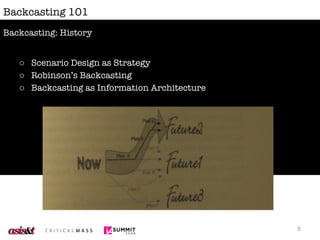
Backcasting 101 Scenario Design as Strategy Robinson’s Backcasting Backcasting as Information Architecture Backcasting: History
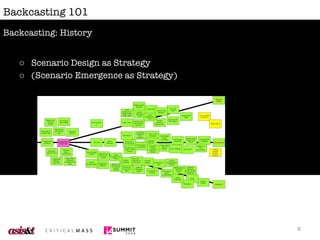
Backcasting 101 Scenario Design as Strategy (Scenario Emergence as Strategy) Backcasting: History
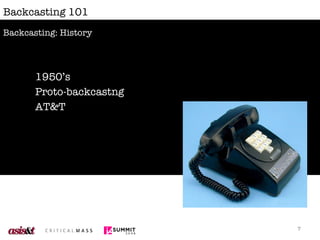
Backcasting 101 1950’s Proto-backcastng AT&T Backcasting: History
Backcasting 101 1970’s Multi-Scenario Planning Shell Backcasting: History
Backcasting 101 1990’s Great Whale Project Hydro-Québec Backcasting: History
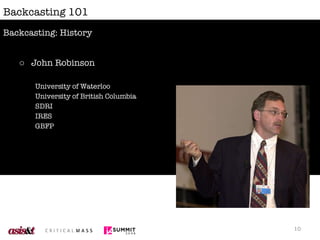
Backcasting 101 John Robinson University of Waterloo University of British Columbia SDRI IRES GBFP Backcasting: History
Backcasting 101 Futures Under Glass 1990  “Futures Under Glass – A Recipe for People Who Hate to Predict” Backwards Looking Analysis Explicitly Normative and Design Oriented Not “what future was is likely to occur”, But “how desirable futures might be obtained” Backcasting: History
Backcasting 101 Future Subjunctive 2003  Future Subjunctive:  Backcasting as Social Learning Subjunctive:  “designating a mood, the forms of which are employed to denote an action or a state as conceived (and not as fact) and therefore used to express…a contingent, hypothetical or prospective event” – Oxford English Dictionary The desired future is not determined in advance of analysis, but is an emergent property of engaging with users and project partners Backcasting: History
Backcasting 101 IA Institute Supported research in 2005 on the development of strategy tools based on environmental planning techniques. Cumulative Effects Assessment Backcasting http://iainstitute.org/documents/research/results/Environmental.Assessment.Tools.pdf Backcasting: History
Backcasting 101 Why Information Architecture? “ The structural design of shared information environments” Increasingly, IA’s are getting a seat at the strategy table The “Incomplete Toolkit” Backcasting: History
Backcasting 101 The Strategic Design of Shared Information Environments… Information Architecture as visual organization and modeling Information Architecture as a thinking framework Information Architecture as structuring information  environments through time Backcasting: History
Backcasting 101 The challenges with “Big” Backcasting Complex, model based and driven by quantitative analysis Best suited to skilled practitioners with experience in the method. Focus on the “method”, not the “method of the method” No simple framework for building a conceptual model of the problem space Resource intensive and time consuming Backcasting: History
Backcasting 101 Simplifying the Method What we’ve done: Taken a complex quantitative method and made it simple and qualitative Wrapped into a workshop format that can be done in a day Tied it to a basic framework for identifying measurement indicators Developed a visual thinking framework to capture stakeholder outputs Baked in an established facilitation framework to drive consensus Backcasting: History
Backcasting 101 Method and Madness
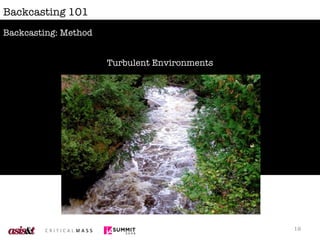
Backcasting 101 Turbulent Environments Backcasting: Method
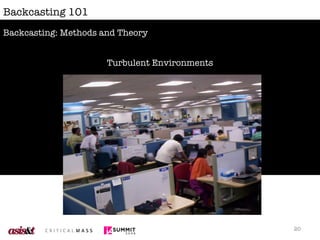
Backcasting 101 Turbulent Environments Backcasting: Methods and Theory
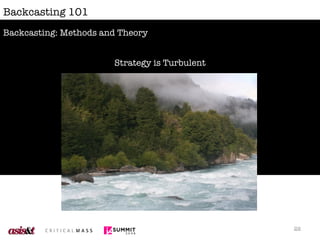
Backcasting 101 Strategy is Turbulent Backcasting: Methods and Theory
Backcasting 101 Stability :: Complexity :: Chaos Backcasting: Methods and Theory
Backcasting 101 Wicked Problems The problem is not understood until after formulation of a solution. Stakeholders have radically different world views and different frames for understanding the problem. Constraints and resources to solve the problem change over time. The problem is never solved Backcasting: Methods and Theory
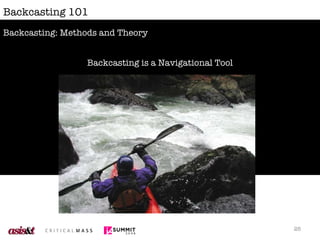
Backcasting 101 Backcasting is a Navigational Tool Backcasting: Methods and Theory
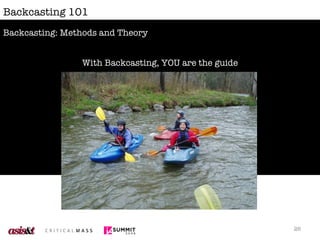
Backcasting 101 With Backcasting, YOU are the guide Backcasting: Methods and Theory
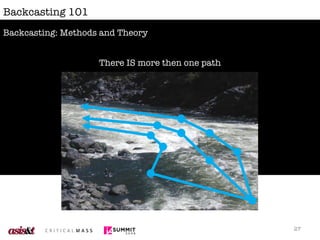
Backcasting 101 There IS more then one path Backcasting: Methods and Theory
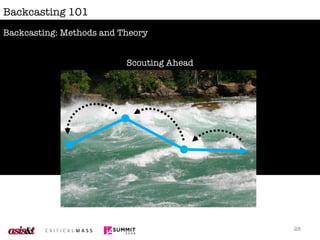
Backcasting 101 Scouting Ahead Backcasting: Methods and Theory
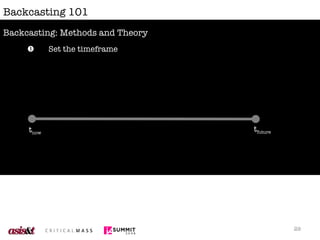
Backcasting 101 Backcasting: Methods and Theory Set the timeframe  t now t future
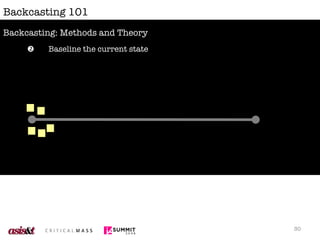
Backcasting 101 Backcasting: Methods and Theory Baseline the current state
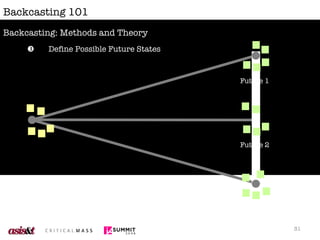
Backcasting 101 Backcasting: Methods and Theory Define Possible Future States  Future 1 Future 2 Future 3
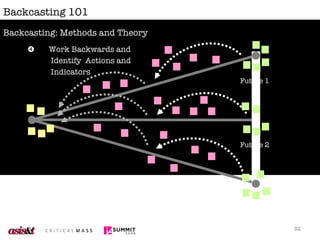
Backcasting 101 Backcasting: Methods and Theory Work Backwards and   Identify  Actions and Indicators  Future 1 Future 2 Future 3
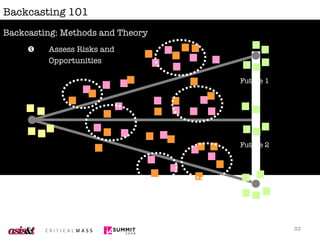
Backcasting 101 Backcasting: Methods and Theory Assess Risks and Opportunities  Future 1 Future 2 Future 3
Backcasting 101 Q: So great, this is  (just) a bunch of post-it notes on the wall… A: Yes, in the same way that a site architecture is (just) a bunch of boxes and arrows… Don’t let the participants focus just on the visual thinking and miss the value of the process.  There is value in both, but the map’s role is to bring the process to the forefront, not to serve as the sole output of your workshop.  The value is in the shared understanding of the problem space and the possible outcomes. Backcasting: Methods and Theory
Backcasting 101 Planning and Facilitation
Backcasting 101 Planning Overview 4 Core Components: Location Materials Attendees Facilitation Backcasting: Planning and Facilitation
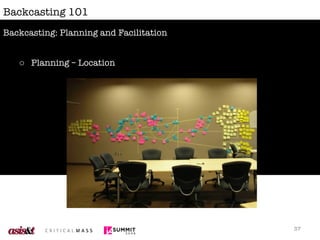
Backcasting 101 Planning – Location Backcasting: Planning and Facilitation
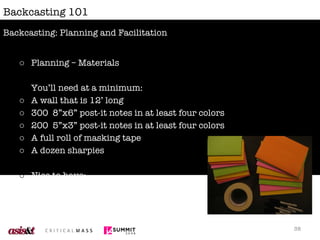
Backcasting 101 Planning – Materials You’ll need at a minimum: A wall that is 12’ long 300  8”x6” post-it notes in at least four colors 200  5”x3” post-it notes in at least four colors A full roll of masking tape A dozen sharpies Nice to have: Flipcharts, Whiteboard, Kraft Paper Backcasting: Planning and Facilitation
Backcasting 101 Planning – Stakeholders and Attendees No set size or standard makeup for your group, but: Small groups may not include the range of inputs you need Large groups may be difficult to control Be inclusive rather then exclusive, but don’t be exhaustive Invite thinkers in addition to owners Backcasting: Planning and Facilitation
Backcasting 101 Planning – Setup Arrive early Prep the room Check the facilitation guides No laptops, no devices, no phones No participants over the phone If possible, plan for a speedy takedown Bring a camera; audio is nice but optional Backcasting: Planning and Facilitation
Backcasting 101 Planning – Session Cadence Dependent of the following factors: Session length Number of attendees Number of possible end states you are exploring Attendee comfort level with structured brainstorming Organizational and political alignment of the participants Backcasting: Planning and Facilitation
Backcasting 101 Facilitation – Overview The “method of the method” Backcasting sessions became more productive as more capable facilitation techniques were applied Started with “we’re doing facilitation” and moved to a formal facilitation method. The choice of how you facilitate the backcasting session is up to you; consider the needs of the participants. Backcasting: Planning and Facilitation
Backcasting 101 Facilitation – Backcasting as Focused Conversations We currently use a formal facilitation method called the “Focused Conversation Method”, developed by an organization called ICA that specializes in facilitation services and training. We’ll use this method today to help support the backcasting exercise.  We’ll conduct a number of focused conversations throughout the exercise to help the group gain consensus as part of each step. Backcasting: Planning and Facilitation
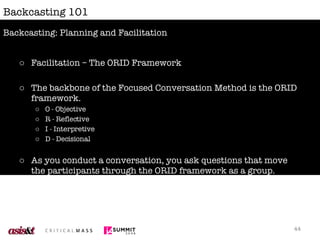
Backcasting 101 Facilitation – The ORID Framework The backbone of the Focused Conversation Method is the ORID framework. O - Objective R - Reflective I - Interpretive D - Decisional As you conduct a conversation, you ask questions that move the participants through the ORID framework as a group. Backcasting: Planning and Facilitation
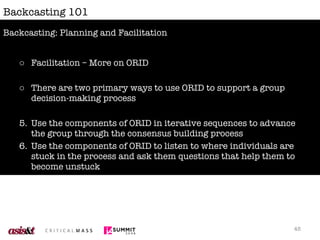
Backcasting 101 Facilitation – More on ORID There are two primary ways to use ORID to support a group decision-making process Use the components of ORID in iterative sequences to advance the group through the consensus building process Use the components of ORID to listen to where individuals are stuck in the process and ask them questions that help them to become unstuck  Backcasting: Planning and Facilitation
Backcasting 101 Facilitation – Driving a Workshop with Focused Conversation Your workshop should have both a rational aim, and an experiential aim You open each conversation with context, and close with confirmation of a resolution ORID is use to drive a conversational process of ideation, relationship formation and consensus building You’ll want to prepare a clear focus question at the start of the exercise and structure it so that the resolution of the question at the end of the exercise supports the rational and experiential aims of your exercise. Backcasting: Planning and Facilitation
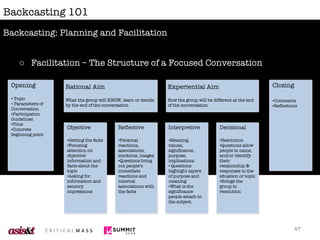
Facilitation – The Structure of a Focused Conversation Backcasting 101 Closing Comments Reflections Backcasting: Planning and Facilitation Opening Topic Parameters of Conversation Participation Guidelines Time Concrete beginning point Objective Getting the facts Focusing  attention on objective information and facts about the topic Asking for information and sensory impressions Reflective Personal reactions, associations, emotions, images Questions bring out people’s immediate reactions and internal associations with the facts Rational Aim What the group will KNOW, learn or decide by the end of the conversation Experiential Aim How the group will be different at the end of the conversation Interpretive Meaning, values, significance, purpose, implications. Questions highlight layers of purpose and meaning What is the significance people attach to the subject. Decisional Resolution Questions allow people to name, and/or identify their relationship & responses to the situation or topic Brings the group to resolution
Backcasting 101 Facilitation – Objective Focus of the questions:  Data, the facts about the topic and external realities The goal is to have the group deal with the same body of data Questions should be in relation to the senses; tangible Avoid asking closed questions or unspecific questions Backcasting: Planning and Facilitation
Backcasting 101 Facilitation – Reflective Focus of the questions: internal and/or personal relationships to the data The goal is to reveal initial reactions to the information and validate the knowledge and experience of the participants Questions should be in relation to moods, emotional tones, memories or associations Avoid turning the discussion into a survey of likes/dislikes Backcasting: Planning and Facilitation
Backcasting 101 Facilitation – Interpretive Focus of the questions: the meaning of the topic The goal is to draw out significance from the objective and reflective data/inputs Questions should be in relation to layers of meaning, purpose, significance and implications; consideration of alternatives and options Avoid inserting “pre-cooked” meaning, intellectualizing or abstracting Backcasting: Planning and Facilitation
Backcasting 101 Facilitation – Decisional Focus of the questions: direct accomplishment of the rational aim along with resolution and new directions The goal is to make the conversation relevant for the future and complete the current conversation Questions are in relation to consensus, implementation and action Avoid forcing a decision if the group is not ready or alternately, not pushing the group when a decision is needed. Backcasting: Planning and Facilitation
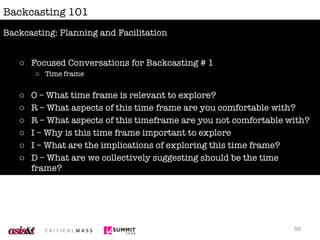
Backcasting 101 Focused Conversations for Backcasting # 1 Time frame O – What time frame is relevant to explore? R – What aspects of this time frame are you comfortable with? R – What aspects of this timeframe are you not comfortable with? I – Why is this time frame important to explore I – What are the implications of exploring this time frame? D – What are we collectively suggesting should be the time frame? D – What is our consensus on the time frame to use for this exercise?  Backcasting: Planning and Facilitation
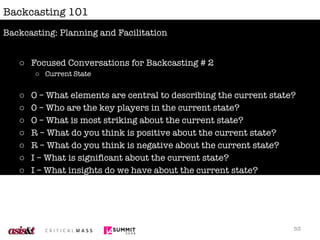
Backcasting 101 Focused Conversations for Backcasting # 2 Current State O – What elements are central to describing the current state? 0 – Who are the key players in the current state? O – What is most striking about the current state? R – What do you think is positive about the current state? R – What do you think is negative about the current state? I – What is significant about the current state? I – What insights do we have about the current state? D – Can we agree on a definition of the current state? Backcasting: Planning and Facilitation
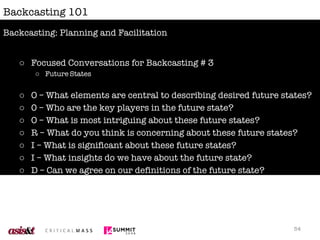
Backcasting 101 Focused Conversations for Backcasting # 3 Future States O – What elements are central to describing desired future states? 0 – Who are the key players in the future state? O – What is most intriguing about these future states? R – What do you think is concerning about these future states? I – What is significant about these future states? I – What insights do we have about the future state? D – Can we agree on our definitions of the future state? Backcasting: Planning and Facilitation
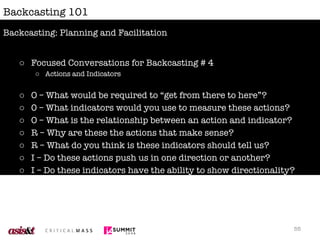
Backcasting 101 Focused Conversations for Backcasting # 4 Actions and Indicators O – What would be required to “get from there to here”? 0 – What indicators would you use to measure these actions? O – What is the relationship between an action and indicator? R – Why are these the actions that make sense? R – What do you think is these indicators should tell us? I – Do these actions push us in one direction or another? I – Do these indicators have the ability to show directionality? D – Can we agree on these actions, these indicators? Backcasting: Planning and Facilitation
Backcasting 101 Focused Conversations for Backcasting # 5 Risks and Opportunities O – What specific opportunities do you see? 0 – What specific risks do you see? O – What are the relationships between opportunities and risks? R – Why are these opportunities compelling or interesting? R – What is concerning or threatening about these risks? I – Do we feel we need additional actions  and indicators? I – Is there overarching significance in the opportunities/risks ? D – Can we agree that these opportunities and risks are work exploring further? Backcasting: Planning and Facilitation
Backcasting 101 Case Study
Backcasting 101 Method Walkthrough
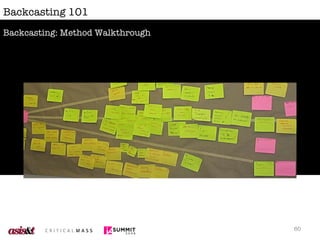
Backcasting 101 Step 1: Determine the Timeline Step 2:  Describe the Current State Step 3:  Draw out the Future States Step 4: Determine Actions and Indicators Step 5: Assess Risks and Opportunities Backcasting: Method Walkthrough
Backcasting 101 Backcasting: Method Walkthrough
Backcasting 101 Backcasting Exercise
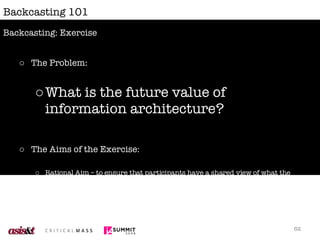
Backcasting 101 The Problem: What is the future value of  information architecture? The Aims of the Exercise: Rational Aim – to ensure that participants have a shared view of what the future value of information architecture ought to be. Experiential Aim – to ensure that all participants are exposed to the backcasting method and are intrigued by its possibilities for their work. Backcasting: Exercise
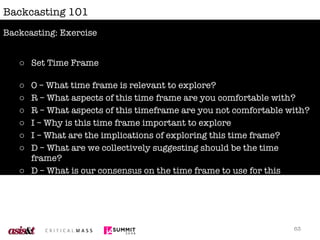
Backcasting 101 Set Time Frame O – What time frame is relevant to explore? R – What aspects of this time frame are you comfortable with? R – What aspects of this timeframe are you not comfortable with? I – Why is this time frame important to explore I – What are the implications of exploring this time frame? D – What are we collectively suggesting should be the time frame? D – What is our consensus on the time frame to use for this exercise?  Backcasting: Exercise
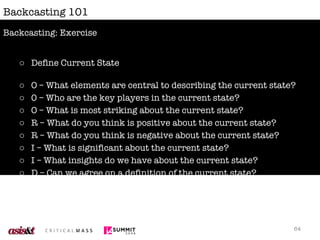
Backcasting 101 Define Current State O – What elements are central to describing the current state? 0 – Who are the key players in the current state? O – What is most striking about the current state? R – What do you think is positive about the current state? R – What do you think is negative about the current state? I – What is significant about the current state? I – What insights do we have about the current state? D – Can we agree on a definition of the current state? Backcasting: Exercise
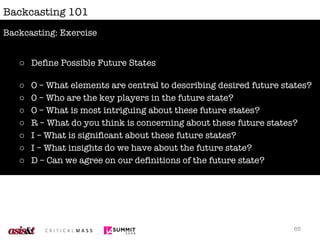
Backcasting 101 Define Possible Future States O – What elements are central to describing desired future states? 0 – Who are the key players in the future state? O – What is most intriguing about these future states? R – What do you think is concerning about these future states? I – What is significant about these future states? I – What insights do we have about the future state? D – Can we agree on our definitions of the future state? Backcasting: Exercise
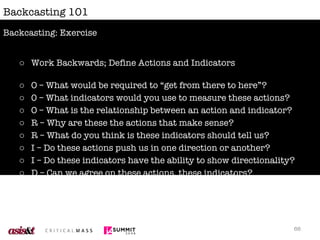
Backcasting 101 Work Backwards; Define Actions and Indicators O – What would be required to “get from there to here”? 0 – What indicators would you use to measure these actions? O – What is the relationship between an action and indicator? R – Why are these the actions that make sense? R – What do you think is these indicators should tell us? I – Do these actions push us in one direction or another? I – Do these indicators have the ability to show directionality? D – Can we agree on these actions, these indicators? Backcasting: Exercise
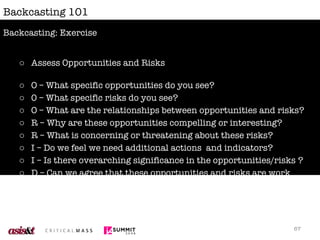
Backcasting 101 Assess Opportunities and Risks O – What specific opportunities do you see? 0 – What specific risks do you see? O – What are the relationships between opportunities and risks? R – Why are these opportunities compelling or interesting? R – What is concerning or threatening about these risks? I – Do we feel we need additional actions  and indicators? I – Is there overarching significance in the opportunities/risks ? D – Can we agree that these opportunities and risks are work exploring further? Backcasting: Exercise
Backcasting 101 Exercise Debrief
Backcasting 101 To Start: What Worked? What Didn’t? What Could We Do Differently Next Time? What Surprised You? What Gaps Do You Still Have With Your Understanding of the Method? Backcasting: Exercise Debrief
Backcasting 101 Reporting and Informing
Backcasting 101 Goals of Reporting Communicating back results of the workshop to the participants:  “Here’s what we thought” Communicating the results of the workshop to stakeholders who did not attend:  “Here is what the group agreed on” Moving the organizational perspective and focus from decisions to solutions:  “Here is what you see as the road ahead, and here is how we can help you more forward” Supporting strategic goal setting by documenting end states and the efforts required to achieve them Cementing your role as a partner in further strategy and solution work Backcasting: Reporting and Informing
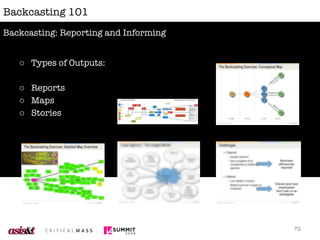
Backcasting 101 Types of Outputs: Reports Maps Stories Backcasting: Reporting and Informing
Backcasting 101 Using Outputs for Project Planning Break the opportunities and indicators out of the mix and focus on two perspectives: “ What can we start to work on immediately and what is a downstream initiative?” “ How are we going to measure these activities so that we not only measure success/failure, but also the impact of the activates to the overall strategy map Bubble 30, 60 and 90 Day “quick wins to the surface” and move forward with those, having a clear understanding of how they feed into downstream initiatives. Backcasting: Reporting and Informing
Backcasting 101 Regular Revisits Help! This should not be the last time you talk about the exercise Arrange regular regroups with the stakeholders to review progress. Address current state progress in Quarterly Business Reviews, etc. Integrate the backcasting findings into strategic planning work; start planning your next workshop. Backcasting: Reporting and Informing
Backcasting 101 Selling Backcasting
Backcasting 101 Selling Backcasting – Why and How Your long-term value and revenue pipeline often is created without your initial involvement Clients and/or internal groups may not be ready to involve you in strategic decision-making, but are more open to involvement in planning support Most strategic planning happens around poorly formed “brainstorming”/ideation workshops.  These are prime opportunities to sell in backcasting. Sell based on immediate tangible value;  90 day plans and actionable outcomes are more appealing then a discussion about the method itself. Backcasting: Selling
Backcasting 101 Selling Backcasting – Showing Value Most groups will have significant frustration with past planning processes, not due to the method but the lack of activity afterwards. Talk to the actionable and measureable outcomes of a backcasting session, as well as the development of the strategic landscape. Teams love workshops, but rarely enjoy planning them.  Be the guide, not the guru in order to support the team Backcasting: Selling
Backcasting 101 Selling Backcasting: Organizational Considerations Before proposing the use of backcasting, understand the landscape in which it will be placed A good workshop opens up opportunities and avoids alignment with specific agendas Backcasting listens, and does not prescribe; set expectations around its value.  It is not a silver bullet. If it seems like you’re trying to hard to fit it in, you probably are.  Wait for the right opportunity, don’t leap for the first one. Backcasting: Selling
Backcasting 101 Wrap-up
Backcasting 101 A tool not for prediction, but knowing. Flexible, fast and inclusive Actionable, but only if you decide to make it so Builds shared perspective through social learning Allows you to demonstrate leadership through support as well as ideas Backcasting: Wrap-up
Backcasting 101 The Workshop Objectives Revisited: Expose you to the thinking and theory behind the method, and how it came to be used by information architects. Show you how to plan, facilitate and conduct a backcasting session. Give you walkthrough of the method and then conduct a short backcasting session with you, followed by a debrief Give you some ideas on how to think about documenting and leveraging the results of a backcasting session Give you some thoughts on how to sell the backcasting method to peers and/or clients  Do you understand the basics of the method and feel comfortable in starting to explore its use in your work? Did you enjoy the session and get to participate in a way that was meaningful and enjoyable to you? Backcasting: Wrap-up
Thanks [email_address] [email_address]

Backcasting 101

  • 1.
    Backcasting 101 CollaborativeStrategy Development for Information Architects Matthew Milan Director of Insight and Planning Critical Mass [email_address] ASIS&T IA Summit Pre-Conference April 10, 2008 ASIS&T 1320 Fenwick Lane, Suite 510 Silver Spring, MD 20910, USA Phone (301) 495-0900 Fax (301) 495-0810 [email_address]
  • 2.
    Backcasting 101 ObjectivesHistory Method and Madness Planning and Facilitation Method Walkthrough Break Backcasting Exercise Break Exercise Debrief Reporting and Informing Selling Backcasting Workshop Overview
  • 3.
    Backcasting 101 Exposeyou to the thinking and theory behind the method, and how it came to be used by information architects. Show you how to plan, facilitate and conduct a backcasting session. Give you walkthrough of the method and then conduct a short backcasting session with you, followed by a debrief Give you some ideas on how to think about documenting and leveraging the results of a backcasting session Give you some thoughts on how to sell the backcasting method to peers and/or clients Workshop Objectives
  • 4.
  • 5.
    Backcasting 101 ScenarioDesign as Strategy Robinson’s Backcasting Backcasting as Information Architecture Backcasting: History
  • 6.
    Backcasting 101 ScenarioDesign as Strategy (Scenario Emergence as Strategy) Backcasting: History
  • 7.
    Backcasting 101 1950’sProto-backcastng AT&T Backcasting: History
  • 8.
    Backcasting 101 1970’sMulti-Scenario Planning Shell Backcasting: History
  • 9.
    Backcasting 101 1990’sGreat Whale Project Hydro-Québec Backcasting: History
  • 10.
    Backcasting 101 JohnRobinson University of Waterloo University of British Columbia SDRI IRES GBFP Backcasting: History
  • 11.
    Backcasting 101 FuturesUnder Glass 1990 “Futures Under Glass – A Recipe for People Who Hate to Predict” Backwards Looking Analysis Explicitly Normative and Design Oriented Not “what future was is likely to occur”, But “how desirable futures might be obtained” Backcasting: History
  • 12.
    Backcasting 101 FutureSubjunctive 2003 Future Subjunctive: Backcasting as Social Learning Subjunctive: “designating a mood, the forms of which are employed to denote an action or a state as conceived (and not as fact) and therefore used to express…a contingent, hypothetical or prospective event” – Oxford English Dictionary The desired future is not determined in advance of analysis, but is an emergent property of engaging with users and project partners Backcasting: History
  • 13.
    Backcasting 101 IAInstitute Supported research in 2005 on the development of strategy tools based on environmental planning techniques. Cumulative Effects Assessment Backcasting http://iainstitute.org/documents/research/results/Environmental.Assessment.Tools.pdf Backcasting: History
  • 14.
    Backcasting 101 WhyInformation Architecture? “ The structural design of shared information environments” Increasingly, IA’s are getting a seat at the strategy table The “Incomplete Toolkit” Backcasting: History
  • 15.
    Backcasting 101 TheStrategic Design of Shared Information Environments… Information Architecture as visual organization and modeling Information Architecture as a thinking framework Information Architecture as structuring information environments through time Backcasting: History
  • 16.
    Backcasting 101 Thechallenges with “Big” Backcasting Complex, model based and driven by quantitative analysis Best suited to skilled practitioners with experience in the method. Focus on the “method”, not the “method of the method” No simple framework for building a conceptual model of the problem space Resource intensive and time consuming Backcasting: History
  • 17.
    Backcasting 101 Simplifyingthe Method What we’ve done: Taken a complex quantitative method and made it simple and qualitative Wrapped into a workshop format that can be done in a day Tied it to a basic framework for identifying measurement indicators Developed a visual thinking framework to capture stakeholder outputs Baked in an established facilitation framework to drive consensus Backcasting: History
  • 18.
  • 19.
    Backcasting 101 TurbulentEnvironments Backcasting: Method
  • 20.
    Backcasting 101 TurbulentEnvironments Backcasting: Methods and Theory
  • 21.
    Backcasting 101 TurbulentEnvironments Backcasting: Methods and Theory
  • 22.
    Backcasting 101 Strategyis Turbulent Backcasting: Methods and Theory
  • 23.
    Backcasting 101 Stability:: Complexity :: Chaos Backcasting: Methods and Theory
  • 24.
    Backcasting 101 WickedProblems The problem is not understood until after formulation of a solution. Stakeholders have radically different world views and different frames for understanding the problem. Constraints and resources to solve the problem change over time. The problem is never solved Backcasting: Methods and Theory
  • 25.
    Backcasting 101 Backcastingis a Navigational Tool Backcasting: Methods and Theory
  • 26.
    Backcasting 101 WithBackcasting, YOU are the guide Backcasting: Methods and Theory
  • 27.
    Backcasting 101 ThereIS more then one path Backcasting: Methods and Theory
  • 28.
    Backcasting 101 ScoutingAhead Backcasting: Methods and Theory
  • 29.
    Backcasting 101 Backcasting:Methods and Theory Set the timeframe t now t future
  • 30.
    Backcasting 101 Backcasting:Methods and Theory Baseline the current state
  • 31.
    Backcasting 101 Backcasting:Methods and Theory Define Possible Future States Future 1 Future 2 Future 3
  • 32.
    Backcasting 101 Backcasting:Methods and Theory Work Backwards and Identify Actions and Indicators Future 1 Future 2 Future 3
  • 33.
    Backcasting 101 Backcasting:Methods and Theory Assess Risks and Opportunities Future 1 Future 2 Future 3
  • 34.
    Backcasting 101 Q:So great, this is (just) a bunch of post-it notes on the wall… A: Yes, in the same way that a site architecture is (just) a bunch of boxes and arrows… Don’t let the participants focus just on the visual thinking and miss the value of the process. There is value in both, but the map’s role is to bring the process to the forefront, not to serve as the sole output of your workshop. The value is in the shared understanding of the problem space and the possible outcomes. Backcasting: Methods and Theory
  • 35.
    Backcasting 101 Planningand Facilitation
  • 36.
    Backcasting 101 PlanningOverview 4 Core Components: Location Materials Attendees Facilitation Backcasting: Planning and Facilitation
  • 37.
    Backcasting 101 Planning– Location Backcasting: Planning and Facilitation
  • 38.
    Backcasting 101 Planning– Materials You’ll need at a minimum: A wall that is 12’ long 300 8”x6” post-it notes in at least four colors 200 5”x3” post-it notes in at least four colors A full roll of masking tape A dozen sharpies Nice to have: Flipcharts, Whiteboard, Kraft Paper Backcasting: Planning and Facilitation
  • 39.
    Backcasting 101 Planning– Stakeholders and Attendees No set size or standard makeup for your group, but: Small groups may not include the range of inputs you need Large groups may be difficult to control Be inclusive rather then exclusive, but don’t be exhaustive Invite thinkers in addition to owners Backcasting: Planning and Facilitation
  • 40.
    Backcasting 101 Planning– Setup Arrive early Prep the room Check the facilitation guides No laptops, no devices, no phones No participants over the phone If possible, plan for a speedy takedown Bring a camera; audio is nice but optional Backcasting: Planning and Facilitation
  • 41.
    Backcasting 101 Planning– Session Cadence Dependent of the following factors: Session length Number of attendees Number of possible end states you are exploring Attendee comfort level with structured brainstorming Organizational and political alignment of the participants Backcasting: Planning and Facilitation
  • 42.
    Backcasting 101 Facilitation– Overview The “method of the method” Backcasting sessions became more productive as more capable facilitation techniques were applied Started with “we’re doing facilitation” and moved to a formal facilitation method. The choice of how you facilitate the backcasting session is up to you; consider the needs of the participants. Backcasting: Planning and Facilitation
  • 43.
    Backcasting 101 Facilitation– Backcasting as Focused Conversations We currently use a formal facilitation method called the “Focused Conversation Method”, developed by an organization called ICA that specializes in facilitation services and training. We’ll use this method today to help support the backcasting exercise. We’ll conduct a number of focused conversations throughout the exercise to help the group gain consensus as part of each step. Backcasting: Planning and Facilitation
  • 44.
    Backcasting 101 Facilitation– The ORID Framework The backbone of the Focused Conversation Method is the ORID framework. O - Objective R - Reflective I - Interpretive D - Decisional As you conduct a conversation, you ask questions that move the participants through the ORID framework as a group. Backcasting: Planning and Facilitation
  • 45.
    Backcasting 101 Facilitation– More on ORID There are two primary ways to use ORID to support a group decision-making process Use the components of ORID in iterative sequences to advance the group through the consensus building process Use the components of ORID to listen to where individuals are stuck in the process and ask them questions that help them to become unstuck Backcasting: Planning and Facilitation
  • 46.
    Backcasting 101 Facilitation– Driving a Workshop with Focused Conversation Your workshop should have both a rational aim, and an experiential aim You open each conversation with context, and close with confirmation of a resolution ORID is use to drive a conversational process of ideation, relationship formation and consensus building You’ll want to prepare a clear focus question at the start of the exercise and structure it so that the resolution of the question at the end of the exercise supports the rational and experiential aims of your exercise. Backcasting: Planning and Facilitation
  • 47.
    Facilitation – TheStructure of a Focused Conversation Backcasting 101 Closing Comments Reflections Backcasting: Planning and Facilitation Opening Topic Parameters of Conversation Participation Guidelines Time Concrete beginning point Objective Getting the facts Focusing attention on objective information and facts about the topic Asking for information and sensory impressions Reflective Personal reactions, associations, emotions, images Questions bring out people’s immediate reactions and internal associations with the facts Rational Aim What the group will KNOW, learn or decide by the end of the conversation Experiential Aim How the group will be different at the end of the conversation Interpretive Meaning, values, significance, purpose, implications. Questions highlight layers of purpose and meaning What is the significance people attach to the subject. Decisional Resolution Questions allow people to name, and/or identify their relationship & responses to the situation or topic Brings the group to resolution
  • 48.
    Backcasting 101 Facilitation– Objective Focus of the questions: Data, the facts about the topic and external realities The goal is to have the group deal with the same body of data Questions should be in relation to the senses; tangible Avoid asking closed questions or unspecific questions Backcasting: Planning and Facilitation
  • 49.
    Backcasting 101 Facilitation– Reflective Focus of the questions: internal and/or personal relationships to the data The goal is to reveal initial reactions to the information and validate the knowledge and experience of the participants Questions should be in relation to moods, emotional tones, memories or associations Avoid turning the discussion into a survey of likes/dislikes Backcasting: Planning and Facilitation
  • 50.
    Backcasting 101 Facilitation– Interpretive Focus of the questions: the meaning of the topic The goal is to draw out significance from the objective and reflective data/inputs Questions should be in relation to layers of meaning, purpose, significance and implications; consideration of alternatives and options Avoid inserting “pre-cooked” meaning, intellectualizing or abstracting Backcasting: Planning and Facilitation
  • 51.
    Backcasting 101 Facilitation– Decisional Focus of the questions: direct accomplishment of the rational aim along with resolution and new directions The goal is to make the conversation relevant for the future and complete the current conversation Questions are in relation to consensus, implementation and action Avoid forcing a decision if the group is not ready or alternately, not pushing the group when a decision is needed. Backcasting: Planning and Facilitation
  • 52.
    Backcasting 101 FocusedConversations for Backcasting # 1 Time frame O – What time frame is relevant to explore? R – What aspects of this time frame are you comfortable with? R – What aspects of this timeframe are you not comfortable with? I – Why is this time frame important to explore I – What are the implications of exploring this time frame? D – What are we collectively suggesting should be the time frame? D – What is our consensus on the time frame to use for this exercise? Backcasting: Planning and Facilitation
  • 53.
    Backcasting 101 FocusedConversations for Backcasting # 2 Current State O – What elements are central to describing the current state? 0 – Who are the key players in the current state? O – What is most striking about the current state? R – What do you think is positive about the current state? R – What do you think is negative about the current state? I – What is significant about the current state? I – What insights do we have about the current state? D – Can we agree on a definition of the current state? Backcasting: Planning and Facilitation
  • 54.
    Backcasting 101 FocusedConversations for Backcasting # 3 Future States O – What elements are central to describing desired future states? 0 – Who are the key players in the future state? O – What is most intriguing about these future states? R – What do you think is concerning about these future states? I – What is significant about these future states? I – What insights do we have about the future state? D – Can we agree on our definitions of the future state? Backcasting: Planning and Facilitation
  • 55.
    Backcasting 101 FocusedConversations for Backcasting # 4 Actions and Indicators O – What would be required to “get from there to here”? 0 – What indicators would you use to measure these actions? O – What is the relationship between an action and indicator? R – Why are these the actions that make sense? R – What do you think is these indicators should tell us? I – Do these actions push us in one direction or another? I – Do these indicators have the ability to show directionality? D – Can we agree on these actions, these indicators? Backcasting: Planning and Facilitation
  • 56.
    Backcasting 101 FocusedConversations for Backcasting # 5 Risks and Opportunities O – What specific opportunities do you see? 0 – What specific risks do you see? O – What are the relationships between opportunities and risks? R – Why are these opportunities compelling or interesting? R – What is concerning or threatening about these risks? I – Do we feel we need additional actions and indicators? I – Is there overarching significance in the opportunities/risks ? D – Can we agree that these opportunities and risks are work exploring further? Backcasting: Planning and Facilitation
  • 57.
  • 58.
  • 59.
    Backcasting 101 Step1: Determine the Timeline Step 2: Describe the Current State Step 3: Draw out the Future States Step 4: Determine Actions and Indicators Step 5: Assess Risks and Opportunities Backcasting: Method Walkthrough
  • 60.
    Backcasting 101 Backcasting:Method Walkthrough
  • 61.
  • 62.
    Backcasting 101 TheProblem: What is the future value of information architecture? The Aims of the Exercise: Rational Aim – to ensure that participants have a shared view of what the future value of information architecture ought to be. Experiential Aim – to ensure that all participants are exposed to the backcasting method and are intrigued by its possibilities for their work. Backcasting: Exercise
  • 63.
    Backcasting 101 SetTime Frame O – What time frame is relevant to explore? R – What aspects of this time frame are you comfortable with? R – What aspects of this timeframe are you not comfortable with? I – Why is this time frame important to explore I – What are the implications of exploring this time frame? D – What are we collectively suggesting should be the time frame? D – What is our consensus on the time frame to use for this exercise? Backcasting: Exercise
  • 64.
    Backcasting 101 DefineCurrent State O – What elements are central to describing the current state? 0 – Who are the key players in the current state? O – What is most striking about the current state? R – What do you think is positive about the current state? R – What do you think is negative about the current state? I – What is significant about the current state? I – What insights do we have about the current state? D – Can we agree on a definition of the current state? Backcasting: Exercise
  • 65.
    Backcasting 101 DefinePossible Future States O – What elements are central to describing desired future states? 0 – Who are the key players in the future state? O – What is most intriguing about these future states? R – What do you think is concerning about these future states? I – What is significant about these future states? I – What insights do we have about the future state? D – Can we agree on our definitions of the future state? Backcasting: Exercise
  • 66.
    Backcasting 101 WorkBackwards; Define Actions and Indicators O – What would be required to “get from there to here”? 0 – What indicators would you use to measure these actions? O – What is the relationship between an action and indicator? R – Why are these the actions that make sense? R – What do you think is these indicators should tell us? I – Do these actions push us in one direction or another? I – Do these indicators have the ability to show directionality? D – Can we agree on these actions, these indicators? Backcasting: Exercise
  • 67.
    Backcasting 101 AssessOpportunities and Risks O – What specific opportunities do you see? 0 – What specific risks do you see? O – What are the relationships between opportunities and risks? R – Why are these opportunities compelling or interesting? R – What is concerning or threatening about these risks? I – Do we feel we need additional actions and indicators? I – Is there overarching significance in the opportunities/risks ? D – Can we agree that these opportunities and risks are work exploring further? Backcasting: Exercise
  • 68.
  • 69.
    Backcasting 101 ToStart: What Worked? What Didn’t? What Could We Do Differently Next Time? What Surprised You? What Gaps Do You Still Have With Your Understanding of the Method? Backcasting: Exercise Debrief
  • 70.
  • 71.
    Backcasting 101 Goalsof Reporting Communicating back results of the workshop to the participants: “Here’s what we thought” Communicating the results of the workshop to stakeholders who did not attend: “Here is what the group agreed on” Moving the organizational perspective and focus from decisions to solutions: “Here is what you see as the road ahead, and here is how we can help you more forward” Supporting strategic goal setting by documenting end states and the efforts required to achieve them Cementing your role as a partner in further strategy and solution work Backcasting: Reporting and Informing
  • 72.
    Backcasting 101 Typesof Outputs: Reports Maps Stories Backcasting: Reporting and Informing
  • 73.
    Backcasting 101 UsingOutputs for Project Planning Break the opportunities and indicators out of the mix and focus on two perspectives: “ What can we start to work on immediately and what is a downstream initiative?” “ How are we going to measure these activities so that we not only measure success/failure, but also the impact of the activates to the overall strategy map Bubble 30, 60 and 90 Day “quick wins to the surface” and move forward with those, having a clear understanding of how they feed into downstream initiatives. Backcasting: Reporting and Informing
  • 74.
    Backcasting 101 RegularRevisits Help! This should not be the last time you talk about the exercise Arrange regular regroups with the stakeholders to review progress. Address current state progress in Quarterly Business Reviews, etc. Integrate the backcasting findings into strategic planning work; start planning your next workshop. Backcasting: Reporting and Informing
  • 75.
  • 76.
    Backcasting 101 SellingBackcasting – Why and How Your long-term value and revenue pipeline often is created without your initial involvement Clients and/or internal groups may not be ready to involve you in strategic decision-making, but are more open to involvement in planning support Most strategic planning happens around poorly formed “brainstorming”/ideation workshops. These are prime opportunities to sell in backcasting. Sell based on immediate tangible value; 90 day plans and actionable outcomes are more appealing then a discussion about the method itself. Backcasting: Selling
  • 77.
    Backcasting 101 SellingBackcasting – Showing Value Most groups will have significant frustration with past planning processes, not due to the method but the lack of activity afterwards. Talk to the actionable and measureable outcomes of a backcasting session, as well as the development of the strategic landscape. Teams love workshops, but rarely enjoy planning them. Be the guide, not the guru in order to support the team Backcasting: Selling
  • 78.
    Backcasting 101 SellingBackcasting: Organizational Considerations Before proposing the use of backcasting, understand the landscape in which it will be placed A good workshop opens up opportunities and avoids alignment with specific agendas Backcasting listens, and does not prescribe; set expectations around its value. It is not a silver bullet. If it seems like you’re trying to hard to fit it in, you probably are. Wait for the right opportunity, don’t leap for the first one. Backcasting: Selling
  • 79.
  • 80.
    Backcasting 101 Atool not for prediction, but knowing. Flexible, fast and inclusive Actionable, but only if you decide to make it so Builds shared perspective through social learning Allows you to demonstrate leadership through support as well as ideas Backcasting: Wrap-up
  • 81.
    Backcasting 101 TheWorkshop Objectives Revisited: Expose you to the thinking and theory behind the method, and how it came to be used by information architects. Show you how to plan, facilitate and conduct a backcasting session. Give you walkthrough of the method and then conduct a short backcasting session with you, followed by a debrief Give you some ideas on how to think about documenting and leveraging the results of a backcasting session Give you some thoughts on how to sell the backcasting method to peers and/or clients Do you understand the basics of the method and feel comfortable in starting to explore its use in your work? Did you enjoy the session and get to participate in a way that was meaningful and enjoyable to you? Backcasting: Wrap-up
  • 82.