Chapter 9 Collective NegotiationsThe Terrific TrioFormerly known as: The Fabulous Four (Brendan Broderick)Jessny Burch MiMi JensenJoseph Judkowitz
Collective Negotiations Anticipation Guide
Collective Negotiationshttp://www.youtube.com/watch?v=22YI8Vj5nW0&feature=relatedKWL
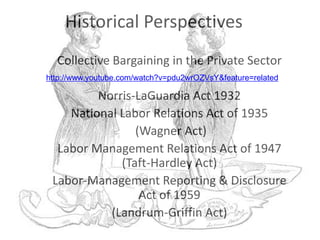
Historical PerspectivesCollective Bargaining in the Private Sector Norris-LaGuardia Act 1932National Labor Relations Act of 1935   (Wagner Act) Labor Management Relations Act of 1947 (Taft-Hardley Act)Labor-Management Reporting & Disclosure Act of 1959 (Landrum-Griffin Act)http://www.youtube.com/watch?v=pdu2wrOZVsY&feature=related
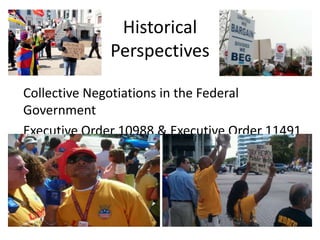
Historical Perspectives	Collective Negotiations in the Federal Government	Executive Order 10988 & Executive Order 11491
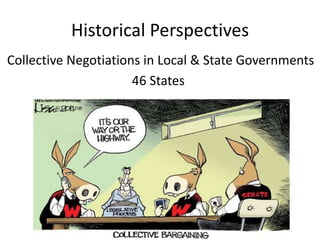
Historical Perspectives Collective Negotiations in Local & State Governments									46 States
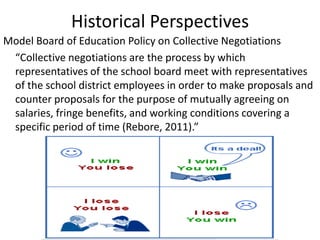
Historical PerspectivesModel Board of Education Policy on Collective Negotiations	“Collective negotiations are the process by which representatives of the school board meet with representatives of the school district employees in order to make proposals and counter proposals for the purpose of mutually agreeing on salaries, fringe benefits, and working conditions covering a specific period of time (Rebore, 2011).”
Recognition & Bargaining Unit Determinationhttp://www.youtube.com/watch?v=BG2sdkNVZ_MRecognition - “Who represents Whom?”Representation – MultipleRepresentation – ExclusiveRecognition Procedures – Membership List								     Authorization Cards								     ElectionsRecognition – 51% of employees
Recognition & Bargaining Unit DeterminationCommon Practice – Representation 								 Elections 								 BTUThird Party Agencies – Intervene  Non-Certified Employees - Bus Drivers 										 Facilities 									 Maintenance 		            									 Food Service 				Agency Shop – One Voice Administration – Organizing
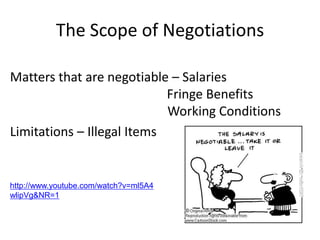
The Scope of NegotiationsMatters that are negotiable – Salaries                    										    Fringe Benefits          					                             Working ConditionsLimitations – Illegal Itemshttp://www.youtube.com/watch?v=ml5A4wlipVg&NR=1
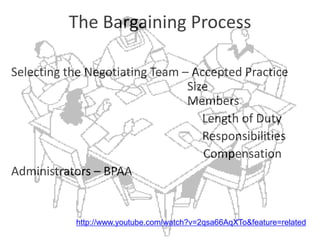
The Bargaining ProcessSelecting the Negotiating Team – Accepted Practice   												Size 				          												Members												     Length of Duty 												     Responsibilities													CompensationAdministrators – BPAAhttp://www.youtube.com/watch?v=2qsa66AqXTo&feature=related
The Bargaining ProcessDeveloping Strategies -      Need AssessmentEstablishes Goals/ObjectivesReview current master agreement, Study previous negotiating sessions, Analyze the formal grievances filed, Study arbitration decisions, Meet with school district administrators, Meet informally with union, Confer with the board of education and superintendent
The Bargaining ProcessSetting the Ground Rules:- time & place for the session	- number of participants who will sit at the table	- role of each participant	- manner in which each side will present its proposals	- target date for completing negotiations	- kinds of school district data that will be needed by each side	- conditions governing caucuses	- provisions for recording the sessions	- method to be used in recording counterproposals		- policy on press release	- types of impasse procedures that will be employed and when 	- format for the written agreement	- procedure for agreement approval by the school board & the union membership 	- procedures that will be used in publishing the ratified agreement
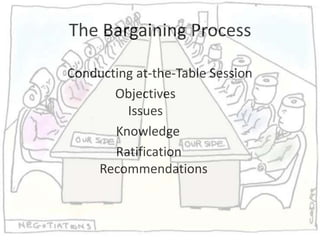
The Bargaining Process    				Conducting at-the-Table Session 								Objectives  										                   	 	    Issues 						                                                                         Knowledge                                         Ratification                       	      				                    Recommendations
http://www.youtube.com/watch?v=txHitONH29M&playnext=1&list=PLCD36F4EA352292D1
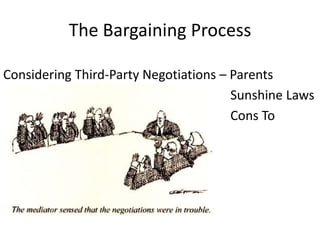
The Bargaining ProcessConsidering Third-Party Negotiations – Parents 															 Sunshine Laws															 Cons To
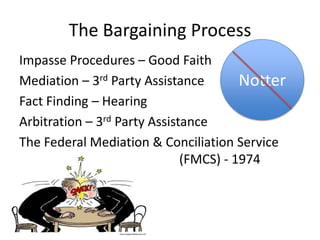
The Bargaining ProcessNotterImpasse Procedures – Good FaithMediation – 3rd Party AssistanceFact Finding – Hearing Arbitration – 3rd Party AssistanceThe Federal Mediation & Conciliation Service 											(FMCS) - 1974
Work Stoppage StrategiesThe Scope of Strikes – Disruptive 									 Business as Usual									 Illegal/Limited (State Law)School Employee Strike Tactics – Bargaining FailureAdministrative Strategies – Plan of Action (page 318)
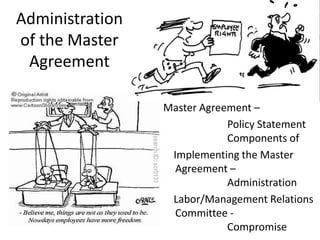
Administration       of the Master   AgreementMaster Agreement – 					Policy Statement 				Components of    Implementing the Master Agreement – 					                      				Administration    Labor/Management Relations Committee - 		  	                       				Compromise
Collaborative Bargaining Mid 1980’s One Team Ashland School District	- communication skills 	- problem solving skills	- creative thinking skills	- orientation to collaborative bargaining 	- development of group agreements 	- development of super-ordinate goals			“Enhancing teaching and learning”
Technology & Collective Negotiations  Availability of InformationEvidence Based ApproachAdministrative PoliciesSalariesDatabasesCommunicationhttp://www.broward.k12.fl.us/employeerelations/Contracts.htmhttp://www.transparencyflorida.gov/http://www.browardschools.com/http://www.broward.k12.fl.us/employeerelations/http://www.broward.k12.fl.us/sbbcpolicies/index.asp?search=&page=1http://www.browardschools.com/schools/http://www.broward.k12.fl.us/employeerelations/http://www.btuonline.com/index.asphttp://www.federationmembers.org/officers-staff_public.phphttp://www.bpaa.us/http://bcpba.org/index2.htmlhttp://webcab.browardschools.com/
Implications for Small & Medium-Size School Districts PersonnelNegotiations Process-teachers & staff members should be represented by the union(s) that they 	 	  	designate through a formal process of selection 	- negotiations should be centered on salaries, fringe benefits, & working conditions	- those charged with representing the board of education & the teachers & staff  	   	should agree on a set of ground rules on how the at-the-table meetings will take 	place	- representatives of the board & the teachers & staff should agree on data that 	the district should provide for the negotiating process	- final agreement must be ratified by the board of education & the teachers & 	staff members in the aggregate through a formal vote	- work stoppage should be avoided at all costs
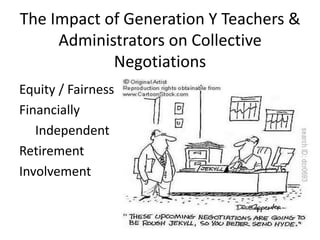
The Impact of Generation Y Teachers & Administrators on Collective NegotiationsEquity / FairnessFinancially 		IndependentRetirementInvolvement
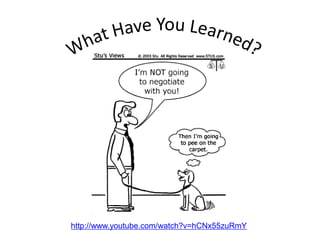
What Have You Learned?http://www.youtube.com/watch?v=hCNx55zuRmY
http://www.youtube.com/watch?v=WBlYTWVoDUg
Collective NegotiationsWord Search  http://www.edcreate.com/wordsearch/wordsearchonline.php?id=6040
Collective Negotiations Hidden Word FamilyFeud

Collective negotiations

  • 1.
    Chapter 9 CollectiveNegotiationsThe Terrific TrioFormerly known as: The Fabulous Four (Brendan Broderick)Jessny Burch MiMi JensenJoseph Judkowitz
  • 2.
  • 3.
  • 4.
    Historical PerspectivesCollective Bargainingin the Private Sector Norris-LaGuardia Act 1932National Labor Relations Act of 1935 (Wagner Act) Labor Management Relations Act of 1947 (Taft-Hardley Act)Labor-Management Reporting & Disclosure Act of 1959 (Landrum-Griffin Act)http://www.youtube.com/watch?v=pdu2wrOZVsY&feature=related
  • 5.
    Historical Perspectives Collective Negotiationsin the Federal Government Executive Order 10988 & Executive Order 11491
  • 6.
    Historical Perspectives CollectiveNegotiations in Local & State Governments 46 States
  • 7.
    Historical PerspectivesModel Boardof Education Policy on Collective Negotiations “Collective negotiations are the process by which representatives of the school board meet with representatives of the school district employees in order to make proposals and counter proposals for the purpose of mutually agreeing on salaries, fringe benefits, and working conditions covering a specific period of time (Rebore, 2011).”
  • 8.
    Recognition & BargainingUnit Determinationhttp://www.youtube.com/watch?v=BG2sdkNVZ_MRecognition - “Who represents Whom?”Representation – MultipleRepresentation – ExclusiveRecognition Procedures – Membership List Authorization Cards ElectionsRecognition – 51% of employees
  • 9.
    Recognition & BargainingUnit DeterminationCommon Practice – Representation Elections BTUThird Party Agencies – Intervene Non-Certified Employees - Bus Drivers Facilities Maintenance Food Service Agency Shop – One Voice Administration – Organizing
  • 10.
    The Scope ofNegotiationsMatters that are negotiable – Salaries Fringe Benefits Working ConditionsLimitations – Illegal Itemshttp://www.youtube.com/watch?v=ml5A4wlipVg&NR=1
  • 11.
    The Bargaining ProcessSelectingthe Negotiating Team – Accepted Practice Size Members Length of Duty Responsibilities CompensationAdministrators – BPAAhttp://www.youtube.com/watch?v=2qsa66AqXTo&feature=related
  • 12.
    The Bargaining ProcessDevelopingStrategies - Need AssessmentEstablishes Goals/ObjectivesReview current master agreement, Study previous negotiating sessions, Analyze the formal grievances filed, Study arbitration decisions, Meet with school district administrators, Meet informally with union, Confer with the board of education and superintendent
  • 13.
    The Bargaining ProcessSettingthe Ground Rules:- time & place for the session - number of participants who will sit at the table - role of each participant - manner in which each side will present its proposals - target date for completing negotiations - kinds of school district data that will be needed by each side - conditions governing caucuses - provisions for recording the sessions - method to be used in recording counterproposals - policy on press release - types of impasse procedures that will be employed and when - format for the written agreement - procedure for agreement approval by the school board & the union membership - procedures that will be used in publishing the ratified agreement
  • 14.
    The Bargaining Process Conducting at-the-Table Session Objectives Issues Knowledge Ratification Recommendations
  • 15.
  • 16.
    The Bargaining ProcessConsideringThird-Party Negotiations – Parents Sunshine Laws Cons To
  • 17.
    The Bargaining ProcessNotterImpasseProcedures – Good FaithMediation – 3rd Party AssistanceFact Finding – Hearing Arbitration – 3rd Party AssistanceThe Federal Mediation & Conciliation Service (FMCS) - 1974
  • 18.
    Work Stoppage StrategiesTheScope of Strikes – Disruptive Business as Usual Illegal/Limited (State Law)School Employee Strike Tactics – Bargaining FailureAdministrative Strategies – Plan of Action (page 318)
  • 19.
    Administration of the Master AgreementMaster Agreement – Policy Statement Components of Implementing the Master Agreement – Administration Labor/Management Relations Committee - Compromise
  • 20.
    Collaborative Bargaining Mid1980’s One Team Ashland School District - communication skills - problem solving skills - creative thinking skills - orientation to collaborative bargaining - development of group agreements - development of super-ordinate goals “Enhancing teaching and learning”
  • 21.
    Technology & CollectiveNegotiations Availability of InformationEvidence Based ApproachAdministrative PoliciesSalariesDatabasesCommunicationhttp://www.broward.k12.fl.us/employeerelations/Contracts.htmhttp://www.transparencyflorida.gov/http://www.browardschools.com/http://www.broward.k12.fl.us/employeerelations/http://www.broward.k12.fl.us/sbbcpolicies/index.asp?search=&page=1http://www.browardschools.com/schools/http://www.broward.k12.fl.us/employeerelations/http://www.btuonline.com/index.asphttp://www.federationmembers.org/officers-staff_public.phphttp://www.bpaa.us/http://bcpba.org/index2.htmlhttp://webcab.browardschools.com/
  • 22.
    Implications for Small& Medium-Size School Districts PersonnelNegotiations Process-teachers & staff members should be represented by the union(s) that they designate through a formal process of selection - negotiations should be centered on salaries, fringe benefits, & working conditions - those charged with representing the board of education & the teachers & staff should agree on a set of ground rules on how the at-the-table meetings will take place - representatives of the board & the teachers & staff should agree on data that the district should provide for the negotiating process - final agreement must be ratified by the board of education & the teachers & staff members in the aggregate through a formal vote - work stoppage should be avoided at all costs
  • 23.
    The Impact ofGeneration Y Teachers & Administrators on Collective NegotiationsEquity / FairnessFinancially IndependentRetirementInvolvement
  • 24.
    What Have YouLearned?http://www.youtube.com/watch?v=hCNx55zuRmY
  • 25.
  • 26.
    Collective NegotiationsWord Search http://www.edcreate.com/wordsearch/wordsearchonline.php?id=6040
  • 27.

Editor's Notes

  • #2 JESSNY
  • #3 MIMI
  • #4 JOE
  • #5 JESSNY 1st general public policy on unionizationGuaranteed workers the right to organize & join labor unions for the purpose of collective bargaining Amendment to Wagner - Workers right not to join a union & to protect employers from mistreatment by unionsResult of internal corruption in some unions, contained Bill of Rights for Union members including freedom of speech & use of secret ballot & protection against improper disciplinary action, established conditions for electing union officers
  • #6 MIMI1962 President John Kennedy – affirmed the right of federal employees to join labor unions & bargain collectively but prohibited the union shop & banned strikes1969 President Richard Nixon – order to standardize procedures among federal agencies to bring federal labor relations in line with private sector
  • #7 JOEFlorida “Right to Work State”
  • #8 JESSNYEmanating from this board of education policy is the following definition for negotiation
  • #9 MIMIRecognition – authorized representative of 2 or more employees for the purpose of collective negotiationsMultiple – more than 1 union representing, recognition granted by the board of education, # of members proportional to representation Exclusive – 1 union representation, reasons most accepted (1) supported by National Education Association & American Federation of Teachers (2) mandated by law for public sector for many states (3) private business & industry are witness to it being the most effective form of recognition Federal Mediation & Conciliation Service & the League of Women Voters
  • #10 JOEBTU speaks for all paying & non paying members Administrators forming bargaining associations
  • #11 JESSNYObjective = consider what is best for the teacher, school, & the students (win-win situation) Ultimate goal = student achievement Salary – steps / years in system, coast of living allowance Fringe Benefits include medical insurance, hospitalization insurance, pension benefits, sick pay, dental insurance, & professional liability insuranceWorking Conditions – quality of employment situation – class size, duty free lunch, preparation periods, sabbatical leave, desirability of locationSchool Boards are required by state to set the education policy – NOT subject to negotiationsVarious states negotiate different items
  • #12 MIMINo universally accepted practiceOdd # of members to avoid deadlock (7 or more members impedes decision making), by job description, appointment, or election, should include building principals at each level (compensation/stipend or additional admin assistance in their building), 1 member knowledgeable about District’s financial situation
  • #13 JOE
  • #14 JESSNY
  • #15 MIMIP#311Knowledge of bargaining powerRatification = final step, formal ratification = majority of the school board members vote to accept the agreementP#312 read
  • #16 JOE
  • #17 JESSNY3rd party = bring confusion & interfere with employment between school board & the employees
  • #18 MIMILack of Good Faith, Product of closed ??Mediation – voluntary, 1st procedure used when impasse is reached (3rd party assistance – both management & labor party must agree to assistance), mediator has no authority to make decision, facilitates separate or joint meetings, mediator gives his/her recommendation (impasse)Fact Finding – individual or panel reviews evidence & make recommendations for settling a dispute (governed by state statue), report & recommendations are public & parties involved may reject all or part of the reportArbitration – parties submit their dispute to an impartial 3rd person or panel - required to accept (why haven’t we gone to)FMCS – independent agency of federal government created to promote labor management peace, resolves disagreements arising out of collective negotiations in the public sector, Federal Labor laws do not cover employees of state & local governments Order – Mediation, Fact Finding, Arbitration (where permmited by law)
  • #19 JOESEST- pupil teacher ratio, planning time, extra pay per duty, job security, compensation (teacher’s unions generally are aware weeks or even months in advance that certain negotiation demands are strike producing issuesAdmin Strategies – adequate plan similar to rainy day dismissal plan however, in FL …
  • #20 JESSNYGoverning the board & union in relation to issues & rights of the parties that were agreed to Pages # 317-319Management prerogative - Interpret & manage the agreement, grievances (violation or misinterpretation of the master agreement) ***p328 Miami Dade***LMRC – work through concerns & problems before they appear at the table in the next round of negotiations
  • #21 MIMIMovement to diffuse the hostility that sometimes accompanies collective negotiations1 team – teachers, board members, & administrators Oregon collaborative model was operationalized
  • #22 JOEInformation – because of technology more information is readily available to all partiesDecision making moved into a more complete & focused, evidence based approach Culture in the school district that values & uses data in all decision making (2) complete transparency with the school’s budgeting process (must be available on district’s websiteDo not have to be listed only the salaries of the superintendant & assistant superintendants should be listedDatabases can make data available that give a complete picture of the school districts financial situationTechnology provides the school board of education, administration, teacher unions the opportunity to remain informed throughout the negotiations process via emails, podcasts, & other electronic means
  • #23 JESSNYSize of staff dependant upon size of district
  • #24 MIMIConcerned about being treated equal and fairConcerned about their ability to financially support themselves & begin their familySaving $ for retirementWant to affect policy via active involvement at all levels of the political processTry to get ahead faster than individuals from other generations (ambitious) want staff development & tuition reimbursement
  • #25 JOE
  • #26 JESSNY
  • #27 MIMIThanks to Dr. Gallagan
  • #28 JOE