COLLECTIVE BARGAINING


             Presented
             June 20, 2012
             EDU 718
             Dr. Anthony Knight
             • Jon Duim
             • Juan Herrera
             • Barry Stockhamer
QUOTE FROM TEXT BOOK:


“XXXXXXXXXXXXXXXXXXXXX
XXXXXXXXXXXX”
Collective Bargaining
 Definition: A process of negotiations between employers and
 a group of employees (a union) aimed at reaching
 agreements that regulate working conditions.

  Major Certificated Unions in CA

• California Teachers Association (CTA): Membership 340,000.
Affiliated with National Education Assn (NEA)
• California Federation of Teachers (CFT): Formed as a labor
alternative to CTA which included school administrators. 120,000
members. Affiliated with:
Amer. Fed, Teachers (AFT)
• United Teachers of Los Angeles (UTLA): 35,000 members.
Originally CTA/CFT blend.
CTA History of Activism in CA
• 1866 – Free public school in CA
• 1867 – Free public schools for non-whites
• 1878 – Bans public funds for religious schools
• 1911 – Free textbooks for all students 1-8
• 1912 – Teacher tenure and due process
• 1913 – CA State Teacher’s Retirement System
• 1975 – Collective Bargaining – Educational
  Employee Relations Act (Rodda Act)
A force in defeating voucher initiatives, passing
  school bonds and propositions. Passed Prop. 98
  in 1988 – guarantees that 40% of general funds
  go to schools.
Educational
           Employee Relations Act
A compromise between public education unions and employers.
Established the Educational Employee Relations Board (EERB)
Duties: Meet & consult, good faith bargaining, sunshining

Established the Public Employment Relations Board (PERB)

Scope of Bargaining:
Health and welfare benefits         Leaves
Transfer and reassignment           Safety conditions
Class size                          Evaluation procedures
Organizational security             Grievance procedures
Probationary certificated
 employee layoffs
Collective Bargaining
    Hot Issues
                  TEXT BOOK
                  QUOTE:


                  XXXXXXXXXX
                  XXXXXXXXXX
• Insert l min clip on animation of 2
  individuals speaking about union.
• “Parody” --- Jon’s video.
Salary Cuts
• Governor Jerry Brown facing $15.7 Billion
  deficit through June 2013.
• Teacher’s salary cut 5.5% statewide for
  the 2011-2012 school year. This
  surpasses the 3% cut from the previous
  school year.
• About 37 school districts across California
  recorded teacher pay cuts during the last
  school year.
Class Sizes
• Approximately 15,000 teachers cut last
  school year across the state.
• Most cuts came from the top and bottom
  of the pay scale.
• Cuts = larger class sizes
• Larger class sizes = less individualized
  attention to the students
Furlough Days
-In an attempt to balance their budgets,
  many school districts have offered to
  shorten their school year.
-The number of furlough days varies by
  each district. The number of furlough days
  for upcoming school years depends on the
  outcome of the November ballot measure
-Furloughs= less instructional days. They
  affect various stakeholders.
http://www.youtube.com/watch?v=5kxc6kzH-uI&feature=related
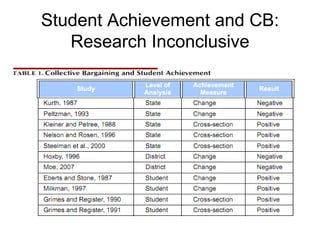
Student Achievement and CB:
   Research Inconclusive
Class Exercise….or case study
• Groups of 4-6.
• Take Union or School Board Position
  on these issues: Merit Pay, Tenure,
  Length of CB agreement, Furlough Days
• Each group faces a budget cut of 15% in
  each of next 2 years. History: Mistrust.
• Make up data that supports your position
• What flexibility will you show and why
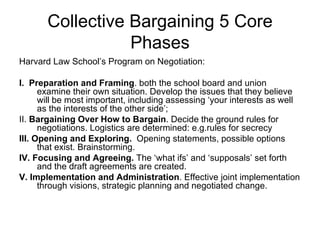
Collective Bargaining 5 Core
                  Phases
Harvard Law School’s Program on Negotiation:

I. Preparation and Framing. both the school board and union
      examine their own situation. Develop the issues that they believe
      will be most important, including assessing ‘your interests as well
      as the interests of the other side’;
II. Bargaining Over How to Bargain. Decide the ground rules for
      negotiations. Logistics are determined: e.g.rules for secrecy
III. Opening and Exploring. Opening statements, possible options
      that exist. Brainstorming.
IV. Focusing and Agreeing. The ‘what ifs’ and ‘supposals’ set forth
      and the draft agreements are created.
V. Implementation and Administration. Effective joint implementation
      through visions, strategic planning and negotiated change.
From Negotiators: The Relationship
“Try to remember and envision that [union representatives]
   are people who care about kids and families and are
   trying to do the right things.
They are not the enemy. I think it helps you to try to work
   toward reaching solutions that you both can live with.
Are you ever going to get your ideal? Rarely ever, but you’ll
   be able to reach positions that you both can live with.
I don’t think you can emphasize enough the importance of
   the relationship piece in bargaining “
You will want to look at the long‑range history, and where
   [you have] been in the last 10, 15, 20 years. …
• Insert 30 sec - l min clip of 2 twin
  babies????? Collective bargaining
Public Opinion…Wisconsin
• Republican Gov. Scott Walker made his case about fiscal
  implications of collective bargaining. His office highlighted some of
  the most outrageous behavior that unions have institutionalized
• Milwaukee teacher Megan Sampson’: Less than a week after the
  Wisconsin Council of English Teachers named Sampson its
  “Outstanding First Year Teacher,” she lost her job. The cause?
  Sampson got the pink slip because she lacked seniority.
• The school’s collective bargaining agreement left no choice.
  Decisions had to be based on seniority rather than merit.
• the teachers’ union refused to accept a lower-cost health care plan.
• Sampson told the Milwaukee Journal Sentinel,
• “Given the given the opportunity,
   of course I would switch to a
   different plan to save my job,
   or the jobs of 10 other teachers.”
Collective Bargaining $
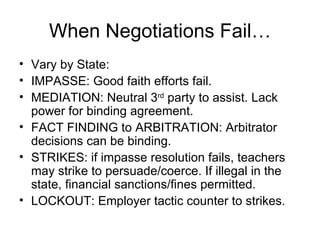
When Negotiations Fail…
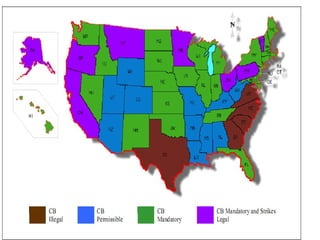
• Vary by State:
• IMPASSE: Good faith efforts fail.
• MEDIATION: Neutral 3rd party to assist. Lack
  power for binding agreement.
• FACT FINDING to ARBITRATION: Arbitrator
  decisions can be binding.
• STRIKES: if impasse resolution fails, teachers
  may strike to persuade/coerce. If illegal in the
  state, financial sanctions/fines permitted.
• LOCKOUT: Employer tactic counter to strikes.
COLLECTIVE BARGAINING J E O P A R D Y

  UNIONS   ISSUES STAGES   CB   HOW TO
TEST 1 Collective bargainin presentation june 20

TEST 1 Collective bargainin presentation june 20

  • 1.
    COLLECTIVE BARGAINING Presented June 20, 2012 EDU 718 Dr. Anthony Knight • Jon Duim • Juan Herrera • Barry Stockhamer
  • 2.
    QUOTE FROM TEXTBOOK: “XXXXXXXXXXXXXXXXXXXXX XXXXXXXXXXXX”
  • 5.
    Collective Bargaining Definition:A process of negotiations between employers and a group of employees (a union) aimed at reaching agreements that regulate working conditions. Major Certificated Unions in CA • California Teachers Association (CTA): Membership 340,000. Affiliated with National Education Assn (NEA) • California Federation of Teachers (CFT): Formed as a labor alternative to CTA which included school administrators. 120,000 members. Affiliated with: Amer. Fed, Teachers (AFT) • United Teachers of Los Angeles (UTLA): 35,000 members. Originally CTA/CFT blend.
  • 6.
    CTA History ofActivism in CA • 1866 – Free public school in CA • 1867 – Free public schools for non-whites • 1878 – Bans public funds for religious schools • 1911 – Free textbooks for all students 1-8 • 1912 – Teacher tenure and due process • 1913 – CA State Teacher’s Retirement System • 1975 – Collective Bargaining – Educational Employee Relations Act (Rodda Act) A force in defeating voucher initiatives, passing school bonds and propositions. Passed Prop. 98 in 1988 – guarantees that 40% of general funds go to schools.
  • 7.
    Educational Employee Relations Act A compromise between public education unions and employers. Established the Educational Employee Relations Board (EERB) Duties: Meet & consult, good faith bargaining, sunshining Established the Public Employment Relations Board (PERB) Scope of Bargaining: Health and welfare benefits Leaves Transfer and reassignment Safety conditions Class size Evaluation procedures Organizational security Grievance procedures Probationary certificated employee layoffs
  • 8.
    Collective Bargaining Hot Issues TEXT BOOK QUOTE: XXXXXXXXXX XXXXXXXXXX
  • 9.
    • Insert lmin clip on animation of 2 individuals speaking about union. • “Parody” --- Jon’s video.
  • 10.
    Salary Cuts • GovernorJerry Brown facing $15.7 Billion deficit through June 2013. • Teacher’s salary cut 5.5% statewide for the 2011-2012 school year. This surpasses the 3% cut from the previous school year. • About 37 school districts across California recorded teacher pay cuts during the last school year.
  • 11.
    Class Sizes • Approximately15,000 teachers cut last school year across the state. • Most cuts came from the top and bottom of the pay scale. • Cuts = larger class sizes • Larger class sizes = less individualized attention to the students
  • 12.
    Furlough Days -In anattempt to balance their budgets, many school districts have offered to shorten their school year. -The number of furlough days varies by each district. The number of furlough days for upcoming school years depends on the outcome of the November ballot measure -Furloughs= less instructional days. They affect various stakeholders.
  • 13.
  • 14.
    Student Achievement andCB: Research Inconclusive
  • 15.
    Class Exercise….or casestudy • Groups of 4-6. • Take Union or School Board Position on these issues: Merit Pay, Tenure, Length of CB agreement, Furlough Days • Each group faces a budget cut of 15% in each of next 2 years. History: Mistrust. • Make up data that supports your position • What flexibility will you show and why
  • 16.
    Collective Bargaining 5Core Phases Harvard Law School’s Program on Negotiation: I. Preparation and Framing. both the school board and union examine their own situation. Develop the issues that they believe will be most important, including assessing ‘your interests as well as the interests of the other side’; II. Bargaining Over How to Bargain. Decide the ground rules for negotiations. Logistics are determined: e.g.rules for secrecy III. Opening and Exploring. Opening statements, possible options that exist. Brainstorming. IV. Focusing and Agreeing. The ‘what ifs’ and ‘supposals’ set forth and the draft agreements are created. V. Implementation and Administration. Effective joint implementation through visions, strategic planning and negotiated change.
  • 17.
    From Negotiators: TheRelationship “Try to remember and envision that [union representatives] are people who care about kids and families and are trying to do the right things. They are not the enemy. I think it helps you to try to work toward reaching solutions that you both can live with. Are you ever going to get your ideal? Rarely ever, but you’ll be able to reach positions that you both can live with. I don’t think you can emphasize enough the importance of the relationship piece in bargaining “ You will want to look at the long‑range history, and where [you have] been in the last 10, 15, 20 years. …
  • 18.
    • Insert 30sec - l min clip of 2 twin babies????? Collective bargaining
  • 19.
    Public Opinion…Wisconsin • RepublicanGov. Scott Walker made his case about fiscal implications of collective bargaining. His office highlighted some of the most outrageous behavior that unions have institutionalized • Milwaukee teacher Megan Sampson’: Less than a week after the Wisconsin Council of English Teachers named Sampson its “Outstanding First Year Teacher,” she lost her job. The cause? Sampson got the pink slip because she lacked seniority. • The school’s collective bargaining agreement left no choice. Decisions had to be based on seniority rather than merit. • the teachers’ union refused to accept a lower-cost health care plan. • Sampson told the Milwaukee Journal Sentinel, • “Given the given the opportunity, of course I would switch to a different plan to save my job, or the jobs of 10 other teachers.”
  • 20.
  • 21.
    When Negotiations Fail… •Vary by State: • IMPASSE: Good faith efforts fail. • MEDIATION: Neutral 3rd party to assist. Lack power for binding agreement. • FACT FINDING to ARBITRATION: Arbitrator decisions can be binding. • STRIKES: if impasse resolution fails, teachers may strike to persuade/coerce. If illegal in the state, financial sanctions/fines permitted. • LOCKOUT: Employer tactic counter to strikes.
  • 22.
    COLLECTIVE BARGAINING JE O P A R D Y UNIONS ISSUES STAGES CB HOW TO