According to Dale Yoder, “Collective Bargaining is
  the term
used to describe a situation in which the essential
  conditions of
employment are determined by bargaining process
  undertaken by
representative group of workers on one hand and
  one or more
employers on the other hand.”
   Prime objective is to maintain cordial relations
    between the management and the workers
   settle disputes relating to wages and working
    conditions.
   Safe guard the interest of workers through collective
    action
   Prevent unilateral action on part of the employers
   To raise workers standard of living and win a better
    share in company's profit
   Democratic participation in decision making on the
    working conditions
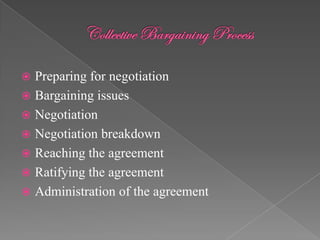
 Preparing for negotiation
 Bargaining issues
 Negotiation
 Negotiation breakdown
 Reaching the agreement
 Ratifying the agreement
 Administration of the agreement
   The Borg-Warner Doctrine, derived from the Supreme
    Court decision in the case of NLRB v. Wooster Division of
    Borg-Warner Corporation (1958), empowered the NLRB
    to categorize bargaining issues as:
     › Mandatory - wages, hours, etc.
     › Permissive – may be discussed, i.e., representation of
       the union on the company Board of Directors. Also
       referred to as voluntary bargaining
     › Prohibited - statutorily outlawed, i.e., closed shop or
       proposing work rules that would violate the Civil Rights
       Act
Document that results from collective bargaining
 process is labor agreement or contract
                   Recognition
               Management Rights
                 Union Security
           Compensation and Benefits
               Grievance Procedure
                Employee Security
 Begins with each side presenting initial demands
 Suggests a certain amount of give and take
 Each side does not expect to obtain all demands
  presented
 Third party intervention
 Union strategies for overcoming breakdowns
 Management strategies for overcoming
  breakdowns
   Outline a high-level financial plan that defines
    your financial model and pricing assumptions.
    › This plan should include expected annual sales and
      profits for the next three years.
    › Use several slides to cover this material appropriately.
 Lockout – keep employees out; operate firm by
  placing management and nonunion workers in
  striking workers‟ jobs
 Hire replacement for strikers
 May be more difficult for union
 Until approved by majority of members,
  proposed agreement is not final
 Larger and perhaps more important part of
  collective bargaining
 Seldom viewed by public
 Agreement establishes the union-management
  relationship for duration of the contract
 Executive Order 10988 (1962) established basic framework
  of collective bargaining in federal agencies
 Later transferred to Title VII of the Civil Service Reform
  Act of 1978
   › Established Federal Labor Relations Authority (FLRA),
     modeled after the NLRB, to manage the process of
     negotiation with unions that represent federal Ee‟s
 Title V of the U.S. Code, which dictates personnel rules for
  federal employees, narrows the EO somewhat by taking
  wages off the table, except for U.S. Postal Service workers
Effective negotiations and enforcement requires a systematic
preparation of the base or ground for bargaining which involves
the following three steps:
 RIGHT TO ORGANISE AND RIGH TO COLLECTIVE
   BARGAIN:
     The extent to which, the workers enjoy the right to organize
   and bargain is the key success factors to which collective
   bargaining works in any country. There are two prerequisites for
   the successful implementation of this condition, first is the
   effective enjoyment of the freedom of association in accordance
   with the principles set out in the “Freedom of association and
   the protection of right to organize convention”, and the second is
   the “workers and the employers organization should be free and
   sufficiently strong but also relatively equal in strength with the
   management.
    STRONG AND STABLE TRADE UNIONS:
   The impact of unionization has a strong
    influence on the growth and development of
    collective bargaining in a country. The rate of
    unionization varies from country to country. The
    strong and stable trade unions lead to the
    success of collective bargaining. Whereas the
    fragmentation of the unions, inter union and
    intra union rivalries hinders the progress of the
    collective bargaining process. This also leads to
    the host of other problems both for the
    employer as well as the state, in addition to the
    above said. Example:
    A union in the plant level may have conflict
    with the central union, ultimately affecting the
    collective bargaining process.
   Recognition of the Bargaining Agent. The management should
    give recognition to the trade union for participating in the
    collective bargaining process. In case there is more than one
    union, selection could be done through verification of
    membership by a government agency giving representation to all
    the major unions through joint consultations. Thus, the
    bargaining agent of the workers should be properly identified
    before initiating any action.
   Deciding the Level of Bargaining. Whether the dealings are
    confined to enterprise level, industry level, regional or national
    level should be decided as the contents, scope and enforcement
    agencies differ in each case.
   Determining the Scope and Coverage of Bargaining. It would
    be better to have a clear understanding of what are the issues to
    be covered under bargaining. Many a time, bargaining is
    restricted to wage and working conditions related issues but it
    would be advantageous for both the management and union to
    cover as many issues as possible to prevent further friction and
    disputes. Therefore, all the important and interrelated issues are
    to be taken for consideration.
   ATITUDE OF EMPLOYERS AND TRADE
    UNIONS: The attitude of the parties involved is
    also a crucial factor in the success of the
    bargaining. If the parties are rigid, non-
    compromising and close minded it will
    beimpossible for collective bargaining to
    function. In that case the common consensus is
    hard to be reached upon. On the contrary, if, the
    parties have a compromising and flexible
    attitude, then only the possibilities of an
    agreement can take place.
   A SUITABLE FRAMEWORK:
   A set of established procedures and a governing body is
    required for the smooth and effective functioning of the
    collective bargaining procedures. In case of developing
    countries the lack of a suitable frame work is so acute
    that, the collective bargaining procedure may come to a
    standstill.
    These statutory bodies are established in many of the
    developing countries where they may vary in regards of
    composition, terms of reference and level of operations.
    The machineries for the effective work out of the process
    of collective bargaining have been laid down either by
    the legislation of the country or by mutual agreement.
    Therefore setting up of the well organized negotiating
    bodies for the purpose of collective bargaining is of
    immense importance.
   Due to the dominance of outsiders in trade unionism in
    the country, there is multiplicity of unions which are
    weak and unstable, and do not represent majority of the
    employees. Moreover, there are inter-union
    rivalries, which further hinder the process of collective
    bargaining between the labour and the management.
   Since most of the trade unions are having political
    affiliations, they continue to be dominated by
    politicians, who use the unions and their members to
    meet their political ends.
   There is a lack of definite procedure to determine
    which union is to be recognised to serve as a bargaining
    agent on behalf of the workers
   In India, the law provides an easy access to
    adjudication. Under the Industrial Disputes
    Act, the parties to the dispute may request the
    Government to refer the matter to adjudication
    and the Government will constitute the
    adjudication machinery, i.e., labour court or
    industrial tribunal. Thus, the faith in the
    collective bargaining process is discouraged.

   There has been very close association between
    the trade unions and political parties. As a
    result, trade union movement has leaned towards
    political orientations rather than collective
    bargaining.
 Based on this, broadly, we can categorize five forms of collective bargaining:
 · Conjunctive / Distributive Bargaining: Distributive bargaining
   is the most common type of bargaining & involves zero-sum
   negotiations, in other words, one side wins and the other loses.
   Both parties try to maximize their respective gains. They try to
   settle economic issues such as wages, benefits, bonus, etc.
 For Example, Unions negotiate for maximum wages & the management
  wants to yield as little as possible – while getting things done through
  workers. Union workers may try to convince the management that they will go
  on strike if they don‟t get the wages or working conditions they desire.
  Management, in turn,may be willing to try to ride the strike out; especially if
  they have cross trained other workers or have external replacements to fill in
  for those on strike. In distributive bargaining, unions and management have
  initial offers or demands, target points (e.g.:desired wage level), resistance
  points (e.g.: unacceptable wage levels) & settlement ranges (e.g.: acceptable
  wage level). Another name for this type of bargaining is conjunctive
  bargaining.
  · Cooperative /Integrative Bargaining:
   Integrative bargaining is similar to problem solving sessions in which both
   sides are trying to reach a mutually beneficial alternative, i.e. a win-win
   situation.
 Both the employer & the union try to resolve the conflict to the
  benefit of both parties. Both sides share information about their interests and
   concerns and they create a list of possible solutions to best meet everyone‟s
   needs. For Example, when companies are hit by recession, they cannot offer
   the kind of wages and benefits demanded by workers. At the same time they
   cannot survive without the latter‟s support. Both parties realize the importance
   of surviving in such difficult times and are willing to negotiate the terms of
   employment in a flexible way. Labor may accept a cut in wages in return for
   job security and higher wages when things improve. Management, on the
   other hand, agrees to modernize and bring in new technology and invest in
   marketing efforts in a phased manner. In India, companies like TELCO
   resorted to integrative bargaining during the recession in the automobile
   sector. Another name for this type of bargaining is „interest-based
   bargaining‟and some people term it as „cooperative bargaining‟.
  The objective for both parties is to find the common ground
 between them, to build relationship and to eliminate the
 adversarial elements of traditional bargaining.
   Productivity Bargaining: The concept of productivity
    bargain involves a good understanding of the following
    concepts. Based onthese concepts both the parties must
    develop a productivity linkedscheme.
   Ø Difference between productivity & work intensity
   Ø How to conduct work study
   Ø ILO guidelines for work study – Personal needs
   allowance, Fatigue allowance, hazardous allowance,
   etc.
   Ø Other Methods like MOST (Maynard Operational
   Sequence Techniques)
   Ø Systems improvement and method improvement
   Ø Required Skills and Knowledge for productivity
   settlement
   · Composite Bargaining:
    Workers believed that productivity bargaining
    agreements increased their workloads.
    Rationalization introduction of new technology, tight
    productivity norms have added to this burden and
    made the life of a worker somewhat uneasy. As an
    answer to such problems, labor has come in favor of
    composite bargaining. In this method, labor bargains
    for wages as usual, but goes a step further
    demanding equity in matters relating to work norms,
    employment levels, manning standards,
    environmental hazards, sub-contracting clauses etc.
    This works in the favor of the workers, for e.g.,
    when unions negotiate manning standards they
    ensure the workload of workers don‟t exceed.
   Concessionary Bargaining:
    Quite opposite to the other forms of
    bargaining, where the unions demanded
    from the employers, in concessionary
    bargaining, the objective is to giving back
    to management some of what it has
    gained in previous bargaining. Why should
    labor be willing to give back what it has
    worked so hard to obtain? Usually such a
    move is prompted by labor leaders who
    recognize the need to assist employers in
    reducing operating cost in order to prevent
    layoffs and plant closings. Thus, it is often
    economic adversity that motivates
    concessionary bargaining.
   Lack of proper appreciation as to the philosophy,objectives and
    advantages of collective bargainingamong workers and also on
    the part of employersand policy makers.
   Multiplicity of trade unions and rivalry amongunions.
   Organizational and financial weakness of tradeunions
   Lack of definite procedure to determine as torecognition of trade
    union
   Frequent political intervention in the process of collective
    bargaining which gives political colourand orientation to the
    collective bargaining process
   Provision of elaborate adjudication machineries
   Comprehensive coverage of labour laws

Collective bargaining

  • 2.
    According to DaleYoder, “Collective Bargaining is the term used to describe a situation in which the essential conditions of employment are determined by bargaining process undertaken by representative group of workers on one hand and one or more employers on the other hand.”
  • 3.
    Prime objective is to maintain cordial relations between the management and the workers  settle disputes relating to wages and working conditions.  Safe guard the interest of workers through collective action  Prevent unilateral action on part of the employers  To raise workers standard of living and win a better share in company's profit  Democratic participation in decision making on the working conditions
  • 4.
     Preparing fornegotiation  Bargaining issues  Negotiation  Negotiation breakdown  Reaching the agreement  Ratifying the agreement  Administration of the agreement
  • 5.
    The Borg-Warner Doctrine, derived from the Supreme Court decision in the case of NLRB v. Wooster Division of Borg-Warner Corporation (1958), empowered the NLRB to categorize bargaining issues as: › Mandatory - wages, hours, etc. › Permissive – may be discussed, i.e., representation of the union on the company Board of Directors. Also referred to as voluntary bargaining › Prohibited - statutorily outlawed, i.e., closed shop or proposing work rules that would violate the Civil Rights Act
  • 6.
    Document that resultsfrom collective bargaining process is labor agreement or contract  Recognition  Management Rights  Union Security  Compensation and Benefits  Grievance Procedure  Employee Security
  • 7.
     Begins witheach side presenting initial demands  Suggests a certain amount of give and take  Each side does not expect to obtain all demands presented
  • 8.
     Third partyintervention  Union strategies for overcoming breakdowns  Management strategies for overcoming breakdowns
  • 9.
    Outline a high-level financial plan that defines your financial model and pricing assumptions. › This plan should include expected annual sales and profits for the next three years. › Use several slides to cover this material appropriately.
  • 10.
     Lockout –keep employees out; operate firm by placing management and nonunion workers in striking workers‟ jobs  Hire replacement for strikers
  • 11.
     May bemore difficult for union  Until approved by majority of members, proposed agreement is not final
  • 12.
     Larger andperhaps more important part of collective bargaining  Seldom viewed by public  Agreement establishes the union-management relationship for duration of the contract
  • 13.
     Executive Order10988 (1962) established basic framework of collective bargaining in federal agencies  Later transferred to Title VII of the Civil Service Reform Act of 1978 › Established Federal Labor Relations Authority (FLRA), modeled after the NLRB, to manage the process of negotiation with unions that represent federal Ee‟s  Title V of the U.S. Code, which dictates personnel rules for federal employees, narrows the EO somewhat by taking wages off the table, except for U.S. Postal Service workers
  • 14.
    Effective negotiations andenforcement requires a systematic preparation of the base or ground for bargaining which involves the following three steps:  RIGHT TO ORGANISE AND RIGH TO COLLECTIVE BARGAIN: The extent to which, the workers enjoy the right to organize and bargain is the key success factors to which collective bargaining works in any country. There are two prerequisites for the successful implementation of this condition, first is the effective enjoyment of the freedom of association in accordance with the principles set out in the “Freedom of association and the protection of right to organize convention”, and the second is the “workers and the employers organization should be free and sufficiently strong but also relatively equal in strength with the management.
  • 15.
    STRONG AND STABLE TRADE UNIONS:  The impact of unionization has a strong influence on the growth and development of collective bargaining in a country. The rate of unionization varies from country to country. The strong and stable trade unions lead to the success of collective bargaining. Whereas the fragmentation of the unions, inter union and intra union rivalries hinders the progress of the collective bargaining process. This also leads to the host of other problems both for the employer as well as the state, in addition to the above said. Example: A union in the plant level may have conflict with the central union, ultimately affecting the collective bargaining process.
  • 16.
    Recognition of the Bargaining Agent. The management should give recognition to the trade union for participating in the collective bargaining process. In case there is more than one union, selection could be done through verification of membership by a government agency giving representation to all the major unions through joint consultations. Thus, the bargaining agent of the workers should be properly identified before initiating any action.  Deciding the Level of Bargaining. Whether the dealings are confined to enterprise level, industry level, regional or national level should be decided as the contents, scope and enforcement agencies differ in each case.  Determining the Scope and Coverage of Bargaining. It would be better to have a clear understanding of what are the issues to be covered under bargaining. Many a time, bargaining is restricted to wage and working conditions related issues but it would be advantageous for both the management and union to cover as many issues as possible to prevent further friction and disputes. Therefore, all the important and interrelated issues are to be taken for consideration.
  • 17.
    ATITUDE OF EMPLOYERS AND TRADE UNIONS: The attitude of the parties involved is also a crucial factor in the success of the bargaining. If the parties are rigid, non- compromising and close minded it will beimpossible for collective bargaining to function. In that case the common consensus is hard to be reached upon. On the contrary, if, the parties have a compromising and flexible attitude, then only the possibilities of an agreement can take place.
  • 18.
    A SUITABLE FRAMEWORK:  A set of established procedures and a governing body is required for the smooth and effective functioning of the collective bargaining procedures. In case of developing countries the lack of a suitable frame work is so acute that, the collective bargaining procedure may come to a standstill.  These statutory bodies are established in many of the developing countries where they may vary in regards of composition, terms of reference and level of operations. The machineries for the effective work out of the process of collective bargaining have been laid down either by the legislation of the country or by mutual agreement. Therefore setting up of the well organized negotiating bodies for the purpose of collective bargaining is of immense importance.
  • 19.
    Due to the dominance of outsiders in trade unionism in the country, there is multiplicity of unions which are weak and unstable, and do not represent majority of the employees. Moreover, there are inter-union rivalries, which further hinder the process of collective bargaining between the labour and the management.  Since most of the trade unions are having political affiliations, they continue to be dominated by politicians, who use the unions and their members to meet their political ends.  There is a lack of definite procedure to determine which union is to be recognised to serve as a bargaining agent on behalf of the workers
  • 20.
    In India, the law provides an easy access to adjudication. Under the Industrial Disputes Act, the parties to the dispute may request the Government to refer the matter to adjudication and the Government will constitute the adjudication machinery, i.e., labour court or industrial tribunal. Thus, the faith in the collective bargaining process is discouraged.  There has been very close association between the trade unions and political parties. As a result, trade union movement has leaned towards political orientations rather than collective bargaining.
  • 21.
     Based onthis, broadly, we can categorize five forms of collective bargaining:  · Conjunctive / Distributive Bargaining: Distributive bargaining is the most common type of bargaining & involves zero-sum negotiations, in other words, one side wins and the other loses. Both parties try to maximize their respective gains. They try to settle economic issues such as wages, benefits, bonus, etc.  For Example, Unions negotiate for maximum wages & the management wants to yield as little as possible – while getting things done through workers. Union workers may try to convince the management that they will go on strike if they don‟t get the wages or working conditions they desire. Management, in turn,may be willing to try to ride the strike out; especially if they have cross trained other workers or have external replacements to fill in for those on strike. In distributive bargaining, unions and management have initial offers or demands, target points (e.g.:desired wage level), resistance points (e.g.: unacceptable wage levels) & settlement ranges (e.g.: acceptable wage level). Another name for this type of bargaining is conjunctive bargaining.
  • 22.
     ·Cooperative /Integrative Bargaining:  Integrative bargaining is similar to problem solving sessions in which both sides are trying to reach a mutually beneficial alternative, i.e. a win-win situation.  Both the employer & the union try to resolve the conflict to the benefit of both parties. Both sides share information about their interests and concerns and they create a list of possible solutions to best meet everyone‟s needs. For Example, when companies are hit by recession, they cannot offer the kind of wages and benefits demanded by workers. At the same time they cannot survive without the latter‟s support. Both parties realize the importance of surviving in such difficult times and are willing to negotiate the terms of employment in a flexible way. Labor may accept a cut in wages in return for job security and higher wages when things improve. Management, on the other hand, agrees to modernize and bring in new technology and invest in marketing efforts in a phased manner. In India, companies like TELCO resorted to integrative bargaining during the recession in the automobile sector. Another name for this type of bargaining is „interest-based bargaining‟and some people term it as „cooperative bargaining‟. The objective for both parties is to find the common ground  between them, to build relationship and to eliminate the  adversarial elements of traditional bargaining.
  • 23.
    Productivity Bargaining: The concept of productivity bargain involves a good understanding of the following concepts. Based onthese concepts both the parties must develop a productivity linkedscheme.  Ø Difference between productivity & work intensity  Ø How to conduct work study  Ø ILO guidelines for work study – Personal needs  allowance, Fatigue allowance, hazardous allowance,  etc.  Ø Other Methods like MOST (Maynard Operational  Sequence Techniques)  Ø Systems improvement and method improvement  Ø Required Skills and Knowledge for productivity  settlement
  • 24.
    · Composite Bargaining: Workers believed that productivity bargaining agreements increased their workloads. Rationalization introduction of new technology, tight productivity norms have added to this burden and made the life of a worker somewhat uneasy. As an answer to such problems, labor has come in favor of composite bargaining. In this method, labor bargains for wages as usual, but goes a step further demanding equity in matters relating to work norms, employment levels, manning standards, environmental hazards, sub-contracting clauses etc. This works in the favor of the workers, for e.g., when unions negotiate manning standards they ensure the workload of workers don‟t exceed.
  • 25.
    Concessionary Bargaining: Quite opposite to the other forms of bargaining, where the unions demanded from the employers, in concessionary bargaining, the objective is to giving back to management some of what it has gained in previous bargaining. Why should labor be willing to give back what it has worked so hard to obtain? Usually such a move is prompted by labor leaders who recognize the need to assist employers in reducing operating cost in order to prevent layoffs and plant closings. Thus, it is often economic adversity that motivates concessionary bargaining.
  • 26.
    Lack of proper appreciation as to the philosophy,objectives and advantages of collective bargainingamong workers and also on the part of employersand policy makers.  Multiplicity of trade unions and rivalry amongunions.  Organizational and financial weakness of tradeunions  Lack of definite procedure to determine as torecognition of trade union  Frequent political intervention in the process of collective bargaining which gives political colourand orientation to the collective bargaining process  Provision of elaborate adjudication machineries  Comprehensive coverage of labour laws