Adv. Vijay Jayshwal
Kathmandu University School of Law
Collective Bargaining (CB)
12/27/2019
Collective Bargaining..
 Industrial disputes between the employee and
employer can also be settled by discussion and
negotiation between these two parties in order to
arrive at a decision.
 According to Beach, “Collective Bargaining is
concerned with the relations between unions reporting
employees and employers (or their representatives).
 According to Flippo, “Collective Bargaining is a
process in which the representatives of a labor
organization and the representatives of business
organization meet and attempt to negotiate a contract
or agreement, which specifies the nature of
employee-employer union relationship”.
 “Collective Bargaining is a mode of fixing the terms of
employment by means of bargaining between
organized body of employees and an employer or
association of employees acting usually through
authorized agents. The essence of Collective
12/27/2019
12/27/2019
 In A Manifesto for Labour Law (2016, UK) has referred the
Four Pillars of collective bargaining:-
(i) workplace democracy,
(ii) social justice,
(iii) economic efficiency and
(iv) the fulfillment of the relevant international legal
obligations.
 Collective bargaining, as enshrined in the Conventions of
the International Labour Organisation, is a basic labour
standard provided for workers.(Freedom of Association
and Protection of the Right to Organise Convention (ILO
No 87), 1948.
 Collective representation and bargaining laws provide
workers with an opportunity, in association with their
fellows, to improve the conditions under which they labour.
 It is a self-help mechanism, facilitating worker voice,
aiding industrial democracy and overcoming market
failures which would otherwise leave workers with little
individual capacity positively to impact their working
12/27/2019
 In terms of the subject matter of negotiations
and standard setting, ILO Convention No. 154
describes collective bargaining to mean:
(a) determining working conditions and terms of
employment; and/or
(b) regulating relations between employers and
workers; and/or
(c) regulating relations between employers or
their organisations and a workers’
organisation or workers’ organisations.
 Note : C154 - Collective Bargaining
Convention, 1981 (No. 154) Convention
concerning the Promotion of Collective
Bargaining (Entry into force: 11 Aug 1983)
ILO Manual in 1960
 “Negotiations about working conditions and terms of
employment between an employer, a group of
employees or one or more employers organization on
the other, with a view to reaching an agreement.”-
Collective Bargaining
 It is also asserted that “the terms of agreement serve
as a code defining the rights and obligations of each
party in their employment relations with one another, if
fixes large number of detailed conditions of
employees and during its validity none of the matters
it deals with, internal circumstances give grounds for
a dispute counseling and individual workers”.
 Collective Bargaining Involves:-
(i) Negotiations
(ii) Drafting
(iii) Administration
(iv) Interpretation of documents written by employers,
employees and the union representatives
(v) Organizational Trade Unions with open mind.
12/27/2019
12/27/2019
 In the ILO’s instruments, collective bargaining is
deemed to be the activity or process leading up to
the conclusion of a collective agreement. In
Recommendation No. 91, Paragraph 2
“all agreements in writing regarding working
conditions and terms of employment concluded
between an employer, a group of employers or
one or more employers’ organisations, on the one
hand, and one or more representative workers’
organisations, or, in the absence of such
organisations, the representatives of the workers
duly elected and authorised by them in
accordance with national laws and regulations, on
the other.”(the Collective Agreements
Recommendation, 1952 (No. 91)
12/27/2019
 Convention No. 98 does not contain a definition of
collective agreements, but outlines their
fundamental aspects in Article 4:
“Measures appropriate to national conditions shall be
taken ... to encourage and promote the full
development and utilisation of machinery for
voluntary negotiation between employers or
employers’ organisations and workers’
organisations with a view to the regulation of terms
and conditions of employment by means of
collective agreements”
In the preparatory work for Convention No. 151
(1978) the interpretation of the term “negotiation”
was accepted as being “any form of discussion,
formal or informal, that was designed to reach
agreement”, the term “negotiation” being deemed
preferable to “discussion”, which did not emphasize
Principles of Collective
Bargaining
12/27/2019
 The principle of free and voluntary
negotiation
 Free choice of bargaining level
 The principle of good faith
>d P]g, @)&$
12/27/2019
 -k_ æ;fd"lxs ;Demf}tfÆ eGgfn] /f]huf/bftf jf /f]huf/bftfsf] ;Ë7g/ 6«]8
o'lgog jf ;fd"lxs ;f}bfafhL ;ldltaLr >ldssf] kfl/>lds, ;]jfsf zt{, ;'ljwf jf
/f]huf/bftf / >ldssf] cfk;L;/f]sf/sf ljifodf ePsf] ;Demf}tf ;Demg'k5{ .
kl/R5]b !(
;fd"lxs ljjfbsf] ;dfwfg
!!^=;fd"lxs dfu bfaL k]z ug{ ;Sg]
!!&=;fd"lxs dfu bfaLsf ;DaGwdf jftf{ ug
!!*=d]nldnfk u/fpg
!!(=dWo:ytfåf/f ljjfb ;dfwfg ug{' kg
!@)=>d dWo:ytf 6«fO{Ao"gn u7gug{ ;Sg]
!@!=;fd"lxs ljjfb ;dfwfgsf] nflu x8tfn ug{ ;lsg
!@@=dWo:ysf] lg0f{o tyf ;fd"lxs ;Demf}tf afWosf/L x'g
!@#=;fd"lxs dfu bfaL k]zug{] ;DaGwL ljz]if Joj:yf
!@$=tfnfaGbL ug{ ;Sg
Forms of Collective Bargaining
 Single Plant Bargaining:-Bargaining may be
between the single employer and the single union.
This form prevails in the United States as well as in
India.
 Multiple Plants Bargaining:-The bargaining may be
between a single firm having several plants and
workers employed in all those plants. Here the
workers bargain with the common employer through
different unions.
 Multiple Employer Bargaining:-Instead of a
separate union bargaining with separate employer, all
the unions belonging to the same industry bargain
through their federation with the employer’s federation
of that industry. It is possible both at the local and
12/27/2019
Essential Pre-Requisites for Collective
Bargaining
(i) Existence of a strong representative trade union in
the industry that believes in constitutional means for
settling the disputes.
(ii) Existence of a fact-finding approach and willingness
to use new methods and tools for the solution of
industrial problems. The negotiation should be based
on facts and figures and both the parties should adopt
constructive approach.
(iii) Existence of strong and enlightened management
which can integrate the different parties, i.e.,
employees, owners, consumers and society or
Government.
(iv) Agreement on basic objectives of the organisation
between the employer and the employees and on
mutual rights and liabilities should be there.
(v) In order that collective bargaining functions properly,12/27/2019
(vii) Collective bargaining should be best conducted
at plant level. It means if there are more than one
plant of the firm, the local management should be
delegated proper authority to negotiate with the
local trade union.
(viii) There must be change in the attitude of
employers and employees. They should realise
that differences can be resolved peacefully on
negotiating table without the assistance of third
party.
(ix) No party should take rigid attitude. They should
enter into negotiation with a view to reaching an
agreement.
12/27/2019
Main Features of Collective
Bargaining
12/27/2019
1. It is a Group Action
2. It is a Continuous Process
3. It is a Bipartite Process
4.It is Flexible and Mobile and not Fixed or Static
5.It is Industrial Democracy at Work
6.It is Dynamic
7. It is a Complementary and not a Competitive Process
8. It is an Art
“The principle of the independence and autonomy of the
parties and the free and voluntary nature of the
negotiations; it requires the minimum possible level of
interference by the public authorities in bipartite
negotiations and gives primacy to employers and their
organizations and workers’ organizations as the
parties to the bargaining”- ILO Affirms a STRONG
believe.
Means/methods of Collective
Bargaining
12/27/2019
 Generally, there are four important methods of
collective bargaining, namely, negotiation,
mediation, conciliation and arbitration for the
settlement of trade disputes.
 R.F. Hoxie said that arbitration is often provided
for in collective bargaining under certain
contingencies and for certain purposes,
especially when the parties cannot reach
agreement, and in the interpretation of an
agreement through negotiation.
 Conciliation is a term often applied to the art of
collective bargaining, a term often applied to the
action of the public board which attempts to
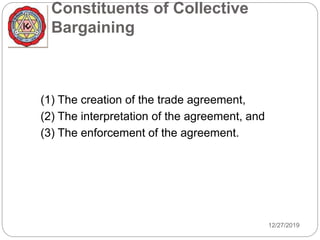
Constituents of Collective
Bargaining
12/27/2019
(1) The creation of the trade agreement,
(2) The interpretation of the agreement, and
(3) The enforcement of the agreement.
Theories of Collective Bargaining
12/27/2019
1. The Marketing Concept and the Agreement as
a Contract
2. The Governmental Concept and the
Agreement as Law
3. The Industrial Relations (Managerial) Concept
as Jointly Decided Directives
Importance of Collective
Bargaining
12/27/2019
(1) From Management Point of View
(2) From Labour and Trade Union Point of View
(3) From Government Point of View
Prof. Butler, Labour Economic and Institutions
(1961,p.154).
1. Collective Bargaining as a s process of Social
Change
2. CB as a peace treaty
3. CB as a system of industrial jurisprudence
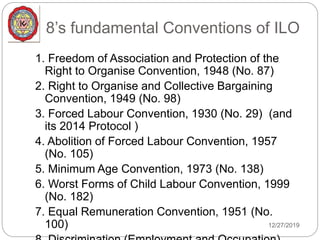
8’s fundamental Conventions of ILO
12/27/2019
1. Freedom of Association and Protection of the
Right to Organise Convention, 1948 (No. 87)
2. Right to Organise and Collective Bargaining
Convention, 1949 (No. 98)
3. Forced Labour Convention, 1930 (No. 29) (and
its 2014 Protocol )
4. Abolition of Forced Labour Convention, 1957
(No. 105)
5. Minimum Age Convention, 1973 (No. 138)
6. Worst Forms of Child Labour Convention, 1999
(No. 182)
7. Equal Remuneration Convention, 1951 (No.
100)
Governance (priority) Conventions
12/27/2019
1. Labour Inspection Convention, 1947 (No. 81)
2. Employment Policy Convention, 1964 (No. 122)
3. Labour Inspection (Agriculture) Convention, 1969
(No. 129)
4. Tripartite Consultation (International Labour
Standards) Convention, 1976 (No. 144)
12/27/2019
Thank you

Collective bargaining

  • 1.
    Adv. Vijay Jayshwal KathmanduUniversity School of Law Collective Bargaining (CB) 12/27/2019
  • 2.
    Collective Bargaining..  Industrialdisputes between the employee and employer can also be settled by discussion and negotiation between these two parties in order to arrive at a decision.  According to Beach, “Collective Bargaining is concerned with the relations between unions reporting employees and employers (or their representatives).  According to Flippo, “Collective Bargaining is a process in which the representatives of a labor organization and the representatives of business organization meet and attempt to negotiate a contract or agreement, which specifies the nature of employee-employer union relationship”.  “Collective Bargaining is a mode of fixing the terms of employment by means of bargaining between organized body of employees and an employer or association of employees acting usually through authorized agents. The essence of Collective 12/27/2019
  • 3.
    12/27/2019  In AManifesto for Labour Law (2016, UK) has referred the Four Pillars of collective bargaining:- (i) workplace democracy, (ii) social justice, (iii) economic efficiency and (iv) the fulfillment of the relevant international legal obligations.  Collective bargaining, as enshrined in the Conventions of the International Labour Organisation, is a basic labour standard provided for workers.(Freedom of Association and Protection of the Right to Organise Convention (ILO No 87), 1948.  Collective representation and bargaining laws provide workers with an opportunity, in association with their fellows, to improve the conditions under which they labour.  It is a self-help mechanism, facilitating worker voice, aiding industrial democracy and overcoming market failures which would otherwise leave workers with little individual capacity positively to impact their working
  • 4.
    12/27/2019  In termsof the subject matter of negotiations and standard setting, ILO Convention No. 154 describes collective bargaining to mean: (a) determining working conditions and terms of employment; and/or (b) regulating relations between employers and workers; and/or (c) regulating relations between employers or their organisations and a workers’ organisation or workers’ organisations.  Note : C154 - Collective Bargaining Convention, 1981 (No. 154) Convention concerning the Promotion of Collective Bargaining (Entry into force: 11 Aug 1983)
  • 5.
    ILO Manual in1960  “Negotiations about working conditions and terms of employment between an employer, a group of employees or one or more employers organization on the other, with a view to reaching an agreement.”- Collective Bargaining  It is also asserted that “the terms of agreement serve as a code defining the rights and obligations of each party in their employment relations with one another, if fixes large number of detailed conditions of employees and during its validity none of the matters it deals with, internal circumstances give grounds for a dispute counseling and individual workers”.  Collective Bargaining Involves:- (i) Negotiations (ii) Drafting (iii) Administration (iv) Interpretation of documents written by employers, employees and the union representatives (v) Organizational Trade Unions with open mind. 12/27/2019
  • 6.
    12/27/2019  In theILO’s instruments, collective bargaining is deemed to be the activity or process leading up to the conclusion of a collective agreement. In Recommendation No. 91, Paragraph 2 “all agreements in writing regarding working conditions and terms of employment concluded between an employer, a group of employers or one or more employers’ organisations, on the one hand, and one or more representative workers’ organisations, or, in the absence of such organisations, the representatives of the workers duly elected and authorised by them in accordance with national laws and regulations, on the other.”(the Collective Agreements Recommendation, 1952 (No. 91)
  • 7.
    12/27/2019  Convention No.98 does not contain a definition of collective agreements, but outlines their fundamental aspects in Article 4: “Measures appropriate to national conditions shall be taken ... to encourage and promote the full development and utilisation of machinery for voluntary negotiation between employers or employers’ organisations and workers’ organisations with a view to the regulation of terms and conditions of employment by means of collective agreements” In the preparatory work for Convention No. 151 (1978) the interpretation of the term “negotiation” was accepted as being “any form of discussion, formal or informal, that was designed to reach agreement”, the term “negotiation” being deemed preferable to “discussion”, which did not emphasize
  • 8.
    Principles of Collective Bargaining 12/27/2019 The principle of free and voluntary negotiation  Free choice of bargaining level  The principle of good faith
  • 9.
    >d P]g, @)&$ 12/27/2019 -k_ æ;fd"lxs ;Demf}tfÆ eGgfn] /f]huf/bftf jf /f]huf/bftfsf] ;Ë7g/ 6«]8 o'lgog jf ;fd"lxs ;f}bfafhL ;ldltaLr >ldssf] kfl/>lds, ;]jfsf zt{, ;'ljwf jf /f]huf/bftf / >ldssf] cfk;L;/f]sf/sf ljifodf ePsf] ;Demf}tf ;Demg'k5{ . kl/R5]b !( ;fd"lxs ljjfbsf] ;dfwfg !!^=;fd"lxs dfu bfaL k]z ug{ ;Sg] !!&=;fd"lxs dfu bfaLsf ;DaGwdf jftf{ ug !!*=d]nldnfk u/fpg !!(=dWo:ytfåf/f ljjfb ;dfwfg ug{' kg !@)=>d dWo:ytf 6«fO{Ao"gn u7gug{ ;Sg] !@!=;fd"lxs ljjfb ;dfwfgsf] nflu x8tfn ug{ ;lsg !@@=dWo:ysf] lg0f{o tyf ;fd"lxs ;Demf}tf afWosf/L x'g !@#=;fd"lxs dfu bfaL k]zug{] ;DaGwL ljz]if Joj:yf !@$=tfnfaGbL ug{ ;Sg
  • 10.
    Forms of CollectiveBargaining  Single Plant Bargaining:-Bargaining may be between the single employer and the single union. This form prevails in the United States as well as in India.  Multiple Plants Bargaining:-The bargaining may be between a single firm having several plants and workers employed in all those plants. Here the workers bargain with the common employer through different unions.  Multiple Employer Bargaining:-Instead of a separate union bargaining with separate employer, all the unions belonging to the same industry bargain through their federation with the employer’s federation of that industry. It is possible both at the local and 12/27/2019
  • 11.
    Essential Pre-Requisites forCollective Bargaining (i) Existence of a strong representative trade union in the industry that believes in constitutional means for settling the disputes. (ii) Existence of a fact-finding approach and willingness to use new methods and tools for the solution of industrial problems. The negotiation should be based on facts and figures and both the parties should adopt constructive approach. (iii) Existence of strong and enlightened management which can integrate the different parties, i.e., employees, owners, consumers and society or Government. (iv) Agreement on basic objectives of the organisation between the employer and the employees and on mutual rights and liabilities should be there. (v) In order that collective bargaining functions properly,12/27/2019
  • 12.
    (vii) Collective bargainingshould be best conducted at plant level. It means if there are more than one plant of the firm, the local management should be delegated proper authority to negotiate with the local trade union. (viii) There must be change in the attitude of employers and employees. They should realise that differences can be resolved peacefully on negotiating table without the assistance of third party. (ix) No party should take rigid attitude. They should enter into negotiation with a view to reaching an agreement. 12/27/2019
  • 13.
    Main Features ofCollective Bargaining 12/27/2019 1. It is a Group Action 2. It is a Continuous Process 3. It is a Bipartite Process 4.It is Flexible and Mobile and not Fixed or Static 5.It is Industrial Democracy at Work 6.It is Dynamic 7. It is a Complementary and not a Competitive Process 8. It is an Art “The principle of the independence and autonomy of the parties and the free and voluntary nature of the negotiations; it requires the minimum possible level of interference by the public authorities in bipartite negotiations and gives primacy to employers and their organizations and workers’ organizations as the parties to the bargaining”- ILO Affirms a STRONG believe.
  • 14.
    Means/methods of Collective Bargaining 12/27/2019 Generally, there are four important methods of collective bargaining, namely, negotiation, mediation, conciliation and arbitration for the settlement of trade disputes.  R.F. Hoxie said that arbitration is often provided for in collective bargaining under certain contingencies and for certain purposes, especially when the parties cannot reach agreement, and in the interpretation of an agreement through negotiation.  Conciliation is a term often applied to the art of collective bargaining, a term often applied to the action of the public board which attempts to
  • 15.
    Constituents of Collective Bargaining 12/27/2019 (1)The creation of the trade agreement, (2) The interpretation of the agreement, and (3) The enforcement of the agreement.
  • 16.
    Theories of CollectiveBargaining 12/27/2019 1. The Marketing Concept and the Agreement as a Contract 2. The Governmental Concept and the Agreement as Law 3. The Industrial Relations (Managerial) Concept as Jointly Decided Directives
  • 17.
    Importance of Collective Bargaining 12/27/2019 (1)From Management Point of View (2) From Labour and Trade Union Point of View (3) From Government Point of View Prof. Butler, Labour Economic and Institutions (1961,p.154). 1. Collective Bargaining as a s process of Social Change 2. CB as a peace treaty 3. CB as a system of industrial jurisprudence
  • 18.
    8’s fundamental Conventionsof ILO 12/27/2019 1. Freedom of Association and Protection of the Right to Organise Convention, 1948 (No. 87) 2. Right to Organise and Collective Bargaining Convention, 1949 (No. 98) 3. Forced Labour Convention, 1930 (No. 29) (and its 2014 Protocol ) 4. Abolition of Forced Labour Convention, 1957 (No. 105) 5. Minimum Age Convention, 1973 (No. 138) 6. Worst Forms of Child Labour Convention, 1999 (No. 182) 7. Equal Remuneration Convention, 1951 (No. 100)
  • 19.
    Governance (priority) Conventions 12/27/2019 1.Labour Inspection Convention, 1947 (No. 81) 2. Employment Policy Convention, 1964 (No. 122) 3. Labour Inspection (Agriculture) Convention, 1969 (No. 129) 4. Tripartite Consultation (International Labour Standards) Convention, 1976 (No. 144)
  • 20.