Learning Object 2: Damped Oscillations
Mass of a Pencil Box
Question:
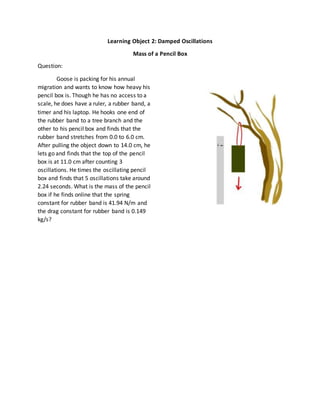
Goose is packing for his annual
migration and wants to know how heavy his
pencil box is. Though he has no access to a
scale, he does have a ruler, a rubber band, a
timer and his laptop. He hooks one end of
the rubber band to a tree branch and the
other to his pencil box and finds that the
rubber band stretches from 1.0 to 6.0 cm.
After pulling the object down to 14.0 cm, he
lets go and finds that the top of the pencil
box is at 11.0 cm after counting 3
oscillations. He times the oscillating pencil
box and finds that 5 oscillations take around
2.24 seconds. What is the mass of the pencil
box if he finds online that the spring
constant for rubber band is 41.94 N/m and
the drag constant for rubber band is 0.149
kg/s?
Solution:
1. As the rubber band stretches, a portion of its energy is lost to heat. Therefore, we
can assume that the system is a damped oscillator and that the amplitude decreases
as time increases. An equation that demonstrates the relationship between
amplitude and mass is:
A(t)= A*e(-bt/2m)
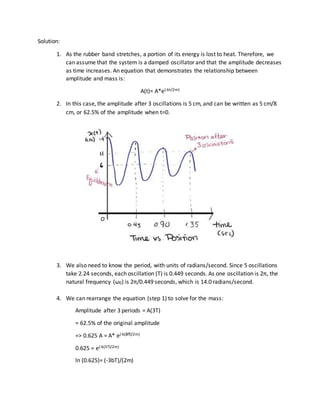
2. In this case, the amplitude after 3 oscillations is 5 cm, and can be written as 5 cm/8
cm, or 62.5% of the amplitude when t=0.
3. We also need to know the period, with units of radians/second. Since 5 oscillations
take 2.24 seconds, each oscillation (T) is 0.449 seconds. As one oscillation is 2π, the
natural frequency (ω0) is 2π/0.449 seconds, which is 14.0 radians/second.
4. We can rearrange the equation (step 1) to solve for the mass:
Amplitude after 3 periods = A(3T)
= 62.5% of the original amplitude
=> 0.625 A = A* e(-b(3T)/2m)
0.625 = e(-b(3T)/2m)
ln (0.625)= (-3bT)/(2m)
-3bT/2*ln (0.625)= m
Since b= 0.1494 kg/s and T=14.0 rad/s,
-3 (0.1494)(0.449)/2* ln (0.625)
= 0.214 kg
Check:
We are assuming that the system to be an underdamped oscillator. If the answer is
reasonable, the natural frequency without the loss of energy should be greater than the drag
constant over two times the mass, according to the equation:
ω0> b/2m
Substituting the values give:
14.0> 0.1494/2*0.214= 14.0> 0.349

Lo2: Damped Oscillations

  • 1.
    Learning Object 2:Damped Oscillations Mass of a Pencil Box Question: Goose is packing for his annual migration and wants to know how heavy his pencil box is. Though he has no access to a scale, he does have a ruler, a rubber band, a timer and his laptop. He hooks one end of the rubber band to a tree branch and the other to his pencil box and finds that the rubber band stretches from 1.0 to 6.0 cm. After pulling the object down to 14.0 cm, he lets go and finds that the top of the pencil box is at 11.0 cm after counting 3 oscillations. He times the oscillating pencil box and finds that 5 oscillations take around 2.24 seconds. What is the mass of the pencil box if he finds online that the spring constant for rubber band is 41.94 N/m and the drag constant for rubber band is 0.149 kg/s?
  • 2.
    Solution: 1. As therubber band stretches, a portion of its energy is lost to heat. Therefore, we can assume that the system is a damped oscillator and that the amplitude decreases as time increases. An equation that demonstrates the relationship between amplitude and mass is: A(t)= A*e(-bt/2m) 2. In this case, the amplitude after 3 oscillations is 5 cm, and can be written as 5 cm/8 cm, or 62.5% of the amplitude when t=0. 3. We also need to know the period, with units of radians/second. Since 5 oscillations take 2.24 seconds, each oscillation (T) is 0.449 seconds. As one oscillation is 2π, the natural frequency (ω0) is 2π/0.449 seconds, which is 14.0 radians/second. 4. We can rearrange the equation (step 1) to solve for the mass: Amplitude after 3 periods = A(3T) = 62.5% of the original amplitude => 0.625 A = A* e(-b(3T)/2m) 0.625 = e(-b(3T)/2m) ln (0.625)= (-3bT)/(2m)
  • 3.
    -3bT/2*ln (0.625)= m Sinceb= 0.1494 kg/s and T=14.0 rad/s, -3 (0.1494)(0.449)/2* ln (0.625) = 0.214 kg Check: We are assuming that the system to be an underdamped oscillator. If the answer is reasonable, the natural frequency without the loss of energy should be greater than the drag constant over two times the mass, according to the equation: ω0> b/2m Substituting the values give: 14.0> 0.1494/2*0.214= 14.0> 0.349