Nitrogen, phosphorus and fine roots
Tim Fahey
Cornell University
Audience Poll: How will fine root biomass respond to
nutrient additions?
• Increase
• Decrease
• No change
Background: Fine root biomass
Depends upon both root production and root turnover rate
(or root lifespan)
Higher root biomass could represent either or both higher
production or lower turnover rate (longer lifespan)
Functional considerations
• Lower soil resource supply should require more roots
• Evidence: high root:shoot ratio in dry or infertile sites
Simplest hypothesis
Increasing soil fertility should reduce belowground carbon
allocation and fine root biomass
Complication of nitrogen-phosphorus colimitation
If N and P are colimiting, then adding only one (N or P) might
create greater demand for the other, stimulating increased
fine root biomass
Complication of nitrogen-phosphorus colimitation
If N and P are colimiting, then adding only one (N or P) might
create greater demand for the other, stimulating increased
fine root biomass
However, Shinjini’s results…
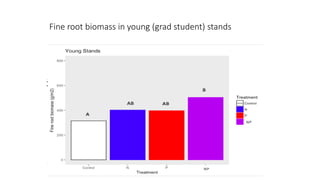
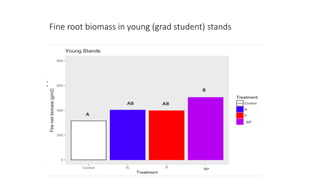
Fine root biomass in young (grad student) stands
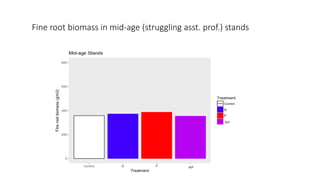
Fine root biomass in mid-age (struggling asst. prof.) stands
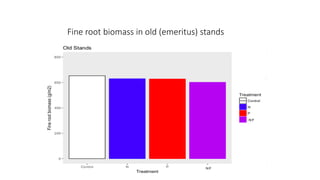
Fine root biomass in old (emeritus) stands
Fine root biomass in young (grad student) stands
Why does adding both N and P cause a big increase in
fine root biomass in the young stands?
Hypothesis: Growth of new fine roots might be nutrient
colimited – i.e. new roots require balanced mineral nutrition
Why does adding both N and P cause a big increase in
fine root biomass in the young stands?
Hypothesis: Growth of new fine roots might be nutrient
colimited – i.e. new roots require balanced mineral nutrition
Tentative plan: factorial experiment using ingrowth cores to
determine whether root production is colimited
Acknowledgments
The shoestring team
Especially Alexis Heinz, Shiyi, Geoff Wilson

Nitrogen, phosphorus and fine roots

  • 1.
    Nitrogen, phosphorus andfine roots Tim Fahey Cornell University
  • 2.
    Audience Poll: Howwill fine root biomass respond to nutrient additions? • Increase • Decrease • No change
  • 3.
    Background: Fine rootbiomass Depends upon both root production and root turnover rate (or root lifespan) Higher root biomass could represent either or both higher production or lower turnover rate (longer lifespan)
  • 4.
    Functional considerations • Lowersoil resource supply should require more roots • Evidence: high root:shoot ratio in dry or infertile sites
  • 5.
    Simplest hypothesis Increasing soilfertility should reduce belowground carbon allocation and fine root biomass
  • 6.
    Complication of nitrogen-phosphoruscolimitation If N and P are colimiting, then adding only one (N or P) might create greater demand for the other, stimulating increased fine root biomass
  • 7.
    Complication of nitrogen-phosphoruscolimitation If N and P are colimiting, then adding only one (N or P) might create greater demand for the other, stimulating increased fine root biomass However, Shinjini’s results…
  • 8.
    Fine root biomassin young (grad student) stands
  • 9.
    Fine root biomassin mid-age (struggling asst. prof.) stands
  • 10.
    Fine root biomassin old (emeritus) stands
  • 11.
    Fine root biomassin young (grad student) stands
  • 12.
    Why does addingboth N and P cause a big increase in fine root biomass in the young stands? Hypothesis: Growth of new fine roots might be nutrient colimited – i.e. new roots require balanced mineral nutrition
  • 13.
    Why does addingboth N and P cause a big increase in fine root biomass in the young stands? Hypothesis: Growth of new fine roots might be nutrient colimited – i.e. new roots require balanced mineral nutrition Tentative plan: factorial experiment using ingrowth cores to determine whether root production is colimited
  • 14.
    Acknowledgments The shoestring team EspeciallyAlexis Heinz, Shiyi, Geoff Wilson