Laws of Nature
DEVC 212 –
Environmental
communication
Anna Merlinna T.
Fontanilla
MS DEVCOM, 98-38359
January 7, 2012
Interconnectedness
• Air, water, land and the living things in and on
them are all connected in ways obvious and
subtle
• Humans are part of the ecosystems – how we
live our life affects all other life
• Butterfly effect
Interconnectedness
•
•

The interconnectedness of all matter and
all life is illustrated clearly by Zen Buddhist
Master Thich Nhat Hanh:
If you are a poet, you will see clearly that
there is a cloud floating in this sheet of
paper. Without a cloud there will be no
water; without water, the trees cannot
grow; and without trees you cannot make
paper. So the cloud is in here. The existence
of this page is dependent on the existence
of a cloud. Paper and cloud are so close.
Let us think of other things, like sunshine.
Sunshine is very important because the
forest cannot grow without sunshine, and
we humans cannot grow without sunshine.
So the logger needs sunshine in order to
cut the tree, and the tree needs sunshine in
order to be a tree. Therefore you can see
sunshine in this sheet of paper. And if you
look more deeply ... you see not only the
cloud and the sunshine in it, but that
everything is here: the wheat that became
the bread for the logger to eat, the logger’s
father ... the paper is full of everything, the
entire cosmos. The presence of this tiny
sheet of paper proves the presence of the
whole cosmos.
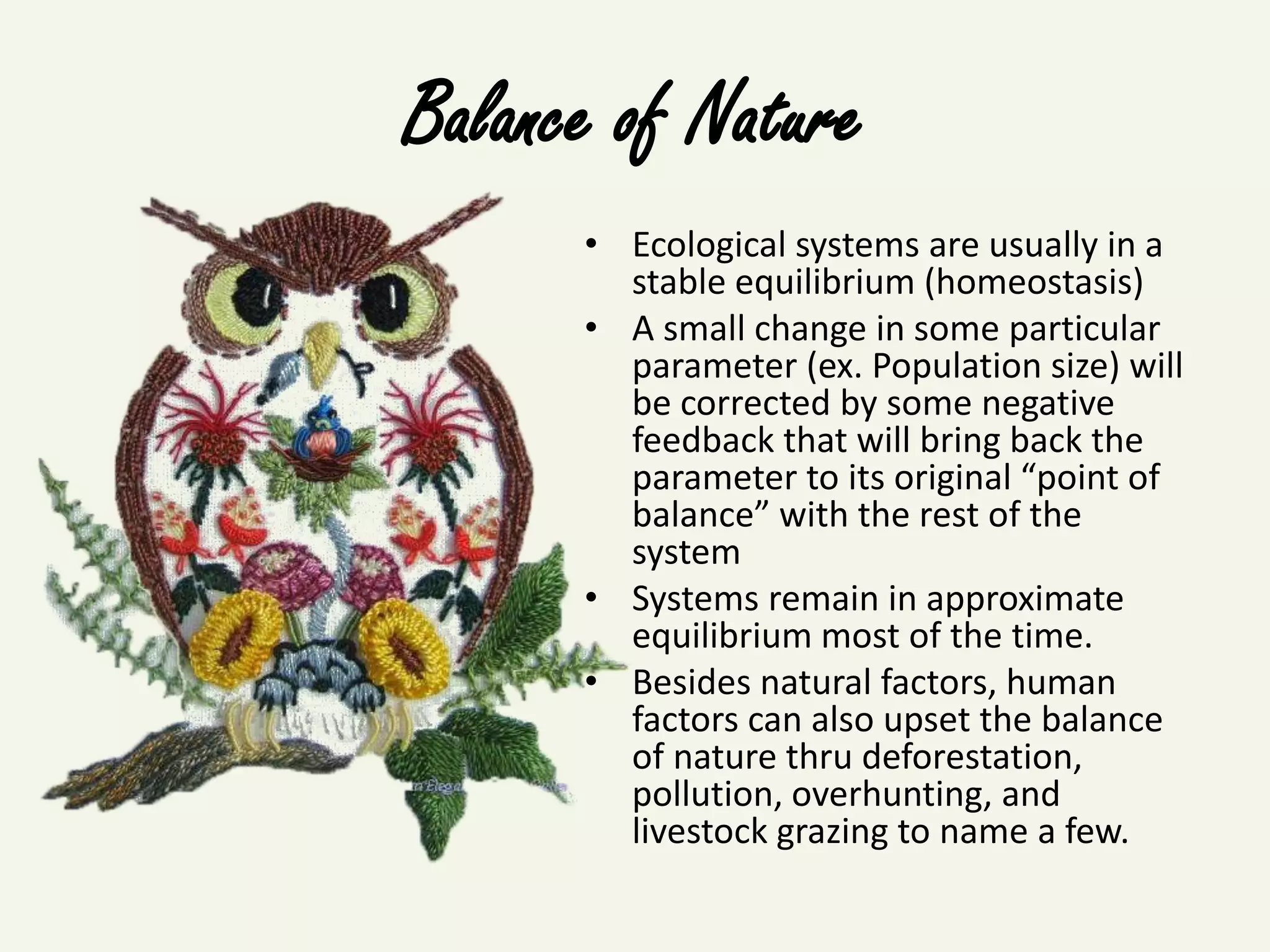
Balance of Nature
• Ecological systems are usually in a
stable equilibrium (homeostasis)
• A small change in some particular
parameter (ex. Population size) will
be corrected by some negative
feedback that will bring back the
parameter to its original “point of
balance” with the rest of the
system
• Systems remain in approximate
equilibrium most of the time.
• Besides natural factors, human
factors can also upset the balance
of nature thru deforestation,
pollution, overhunting, and
livestock grazing to name a few.
Biological Diversity
• The degree of nature’s
variety in the biosphere
(includes genetic
diversity, species diversity
and ecosystem diversity)
• The more species
present, the more stable
the community because
several species keep
other species in check,
preventing any species
from overpopulating the
habitat
Biological Diversity
• The great variety of life on Earth has provided
for man’s needs over thousands of years.
Finiteness of Natural Resources
• There are limitations and boundaries in utilization
• Even the most abundant of natural resources are in
danger of being depleted in the light of human
overpopulation and overexploitation
• Natural resources are limited by the Earth’s capability
to renew them
Finiteness of Natural Resources
• “Resources” is not, ultimately, a physical concept;
it’s an economic concept. And to be limited
physically is not necessarily to be limited
economically.
Carrying Capacity
• The maximum population
of a given species that can
survive indefinitely in a
given environment
• It depends on the condition
and resources available in
the specific area, and the
consumption habits of the
species considered
• Carrying capacity is always
changing
Laws of nature

Laws of nature

  • 1.
    Laws of Nature DEVC212 – Environmental communication Anna Merlinna T. Fontanilla MS DEVCOM, 98-38359 January 7, 2012
  • 2.
    Interconnectedness • Air, water,land and the living things in and on them are all connected in ways obvious and subtle • Humans are part of the ecosystems – how we live our life affects all other life • Butterfly effect
  • 3.
    Interconnectedness • • The interconnectedness ofall matter and all life is illustrated clearly by Zen Buddhist Master Thich Nhat Hanh: If you are a poet, you will see clearly that there is a cloud floating in this sheet of paper. Without a cloud there will be no water; without water, the trees cannot grow; and without trees you cannot make paper. So the cloud is in here. The existence of this page is dependent on the existence of a cloud. Paper and cloud are so close. Let us think of other things, like sunshine. Sunshine is very important because the forest cannot grow without sunshine, and we humans cannot grow without sunshine. So the logger needs sunshine in order to cut the tree, and the tree needs sunshine in order to be a tree. Therefore you can see sunshine in this sheet of paper. And if you look more deeply ... you see not only the cloud and the sunshine in it, but that everything is here: the wheat that became the bread for the logger to eat, the logger’s father ... the paper is full of everything, the entire cosmos. The presence of this tiny sheet of paper proves the presence of the whole cosmos.
  • 4.
    Balance of Nature •Ecological systems are usually in a stable equilibrium (homeostasis) • A small change in some particular parameter (ex. Population size) will be corrected by some negative feedback that will bring back the parameter to its original “point of balance” with the rest of the system • Systems remain in approximate equilibrium most of the time. • Besides natural factors, human factors can also upset the balance of nature thru deforestation, pollution, overhunting, and livestock grazing to name a few.
  • 5.
    Biological Diversity • Thedegree of nature’s variety in the biosphere (includes genetic diversity, species diversity and ecosystem diversity) • The more species present, the more stable the community because several species keep other species in check, preventing any species from overpopulating the habitat
  • 6.
    Biological Diversity • Thegreat variety of life on Earth has provided for man’s needs over thousands of years.
  • 7.
    Finiteness of NaturalResources • There are limitations and boundaries in utilization • Even the most abundant of natural resources are in danger of being depleted in the light of human overpopulation and overexploitation • Natural resources are limited by the Earth’s capability to renew them
  • 8.
    Finiteness of NaturalResources • “Resources” is not, ultimately, a physical concept; it’s an economic concept. And to be limited physically is not necessarily to be limited economically.
  • 9.
    Carrying Capacity • Themaximum population of a given species that can survive indefinitely in a given environment • It depends on the condition and resources available in the specific area, and the consumption habits of the species considered • Carrying capacity is always changing