REPRESENTATION THEORIES
MEGAN WEST
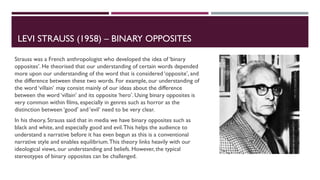
LEVI STRAUSS (1958) – BINARY OPPOSITES
Strauss was a French anthropologist who developed the idea of ‘binary
opposites’. He theorised that our understanding of certain words depended
more upon our understanding of the word that is considered ‘opposite’, and
the difference between these two words. For example, our understanding of
the word ‘villain’ may consist mainly of our ideas about the difference
between the word ‘villain’ and its opposite ‘hero’. Using binary opposites is
very common within films, especially in genres such as horror as the
distinction between ‘good’ and ‘evil’ need to be very clear.
In his theory, Strauss said that in media we have binary opposites such as
black and white, and especially good and evil.This helps the audience to
understand a narrative before it has even begun as this is a conventional
narrative style and enables equilibrium.This theory links heavily with our
ideological views, our understanding and beliefs. However, the typical
stereotypes of binary opposites can be challenged.
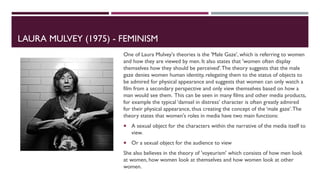
LAURA MULVEY (1975) - FEMINISM
One of Laura Mulvey's theories is the 'Male Gaze', which is referring to women
and how they are viewed by men. It also states that 'women often display
themselves how they should be perceived'.The theory suggests that the male
gaze denies women human identity, relegating them to the status of objects to
be admired for physical appearance and suggests that women can only watch a
film from a secondary perspective and only view themselves based on how a
man would see them. This can be seen in many films and other media products,
for example the typical ‘damsel in distress’ character is often greatly admired
for their physical appearance, thus creating the concept of the ‘male gaze’.The
theory states that women's roles in media have two main functions:
 A sexual object for the characters within the narrative of the media itself to
view.
 Or a sexual object for the audience to view
She also believes in the theory of 'voyeurism' which consists of how men look
at women, how women look at themselves and how women look at other
women.
MORE THEORIES…
JOHN BERGER (1972) ‘Ways of Seeing’ - Berger also believes in 'Voyeurism' as he studied the way that men and women are culturally
represented in media and how different 'gazes' show different ways in which they are viewed. He stated that 'men act women appear', which
is when men look at women and women watch themselves being looked at. His essay ‘Ways of Seeing’ was an art criticism that was written
as an accompaniment to a BBC series, that is now often used as a university text because of its importance for popular feminist culture.
TESSA PERKINS (1979) STEREOTYPES - Tessa Perkins stated that there are a number of assumptions that are involved in
stereotypes:
 Not always negative
 Not always about minority groups
 Can be held about one's own group
 Not rigid or unchanging
 Not always false
She also states that stereotyping is not simply a process and contains a number of assumptions that can be challenged.Stereotypes can be
seen frequently in films across all different genres, as societies have come to associate certain characters or props with certain connotations.
For example, a stereotypical male character may be strong and confident, and often the one who is the leader, which can be seen in many
films.
RICHARD DYER (1983)
The representation theory states that everything has a
representation behind it and that media texts are able to represent
themselves to society and to an audience through ideology.This
theory also states that everyone can interpret a given
representation in a different way depending on their own personal
values and beliefs in society. Representation can be illustrated
within mise-en-scene and the narrative structure. He stated that
'how we are seen determines how we are treated, how we treat
others is based on how we see them. How we see them comes
from representation'.This representation can often refer to any
given character’s age, gender or ethnicity, or the way in which a
particular location or culture is depicted within the media.
SUMMARY
 As we are featuring a female protagonist that will be the main focus of our entire promotional package , we need
to carefully consider the ways in which women are typically represented within the media while developing our
ideas.We would like to demonstrate a progression of our character across the trailer, as at the beginning of the
trailer, we will likely be presenting her in a more vulnerable manner due to her isolation from her peers. Being
presented as weak or vulnerable is a more typical representation of women in film, due to the ‘damsel in distress’
character being apparent in many films, but we would like to have subverted this idea by the end of our trailer.
Once she becomes provoked by her situation and the audience sees a different side to her, we will present her
as more of a strong, independent character, which is a role which stereotypically may have been reserved for male
characters. Her age is an element we will need to also consider, as she is a teenager, which are characters that
may be typically represented as rebellious characters, but still also vulnerable due to their limited independence.
The concept of this character being a killer may challenge some of these stereotypes, and it also may be more
disturbing for the audience to see a younger character commit these crimes.There are other aspects such as
location which we will have to consider in our representation, but the different locations to be used in our trailer
specifically are currently undecided.

Representation theories

  • 1.
  • 2.
    LEVI STRAUSS (1958)– BINARY OPPOSITES Strauss was a French anthropologist who developed the idea of ‘binary opposites’. He theorised that our understanding of certain words depended more upon our understanding of the word that is considered ‘opposite’, and the difference between these two words. For example, our understanding of the word ‘villain’ may consist mainly of our ideas about the difference between the word ‘villain’ and its opposite ‘hero’. Using binary opposites is very common within films, especially in genres such as horror as the distinction between ‘good’ and ‘evil’ need to be very clear. In his theory, Strauss said that in media we have binary opposites such as black and white, and especially good and evil.This helps the audience to understand a narrative before it has even begun as this is a conventional narrative style and enables equilibrium.This theory links heavily with our ideological views, our understanding and beliefs. However, the typical stereotypes of binary opposites can be challenged.
  • 3.
    LAURA MULVEY (1975)- FEMINISM One of Laura Mulvey's theories is the 'Male Gaze', which is referring to women and how they are viewed by men. It also states that 'women often display themselves how they should be perceived'.The theory suggests that the male gaze denies women human identity, relegating them to the status of objects to be admired for physical appearance and suggests that women can only watch a film from a secondary perspective and only view themselves based on how a man would see them. This can be seen in many films and other media products, for example the typical ‘damsel in distress’ character is often greatly admired for their physical appearance, thus creating the concept of the ‘male gaze’.The theory states that women's roles in media have two main functions:  A sexual object for the characters within the narrative of the media itself to view.  Or a sexual object for the audience to view She also believes in the theory of 'voyeurism' which consists of how men look at women, how women look at themselves and how women look at other women.
  • 4.
    MORE THEORIES… JOHN BERGER(1972) ‘Ways of Seeing’ - Berger also believes in 'Voyeurism' as he studied the way that men and women are culturally represented in media and how different 'gazes' show different ways in which they are viewed. He stated that 'men act women appear', which is when men look at women and women watch themselves being looked at. His essay ‘Ways of Seeing’ was an art criticism that was written as an accompaniment to a BBC series, that is now often used as a university text because of its importance for popular feminist culture. TESSA PERKINS (1979) STEREOTYPES - Tessa Perkins stated that there are a number of assumptions that are involved in stereotypes:  Not always negative  Not always about minority groups  Can be held about one's own group  Not rigid or unchanging  Not always false She also states that stereotyping is not simply a process and contains a number of assumptions that can be challenged.Stereotypes can be seen frequently in films across all different genres, as societies have come to associate certain characters or props with certain connotations. For example, a stereotypical male character may be strong and confident, and often the one who is the leader, which can be seen in many films.
  • 5.
    RICHARD DYER (1983) Therepresentation theory states that everything has a representation behind it and that media texts are able to represent themselves to society and to an audience through ideology.This theory also states that everyone can interpret a given representation in a different way depending on their own personal values and beliefs in society. Representation can be illustrated within mise-en-scene and the narrative structure. He stated that 'how we are seen determines how we are treated, how we treat others is based on how we see them. How we see them comes from representation'.This representation can often refer to any given character’s age, gender or ethnicity, or the way in which a particular location or culture is depicted within the media.
  • 6.
    SUMMARY  As weare featuring a female protagonist that will be the main focus of our entire promotional package , we need to carefully consider the ways in which women are typically represented within the media while developing our ideas.We would like to demonstrate a progression of our character across the trailer, as at the beginning of the trailer, we will likely be presenting her in a more vulnerable manner due to her isolation from her peers. Being presented as weak or vulnerable is a more typical representation of women in film, due to the ‘damsel in distress’ character being apparent in many films, but we would like to have subverted this idea by the end of our trailer. Once she becomes provoked by her situation and the audience sees a different side to her, we will present her as more of a strong, independent character, which is a role which stereotypically may have been reserved for male characters. Her age is an element we will need to also consider, as she is a teenager, which are characters that may be typically represented as rebellious characters, but still also vulnerable due to their limited independence. The concept of this character being a killer may challenge some of these stereotypes, and it also may be more disturbing for the audience to see a younger character commit these crimes.There are other aspects such as location which we will have to consider in our representation, but the different locations to be used in our trailer specifically are currently undecided.