The story…
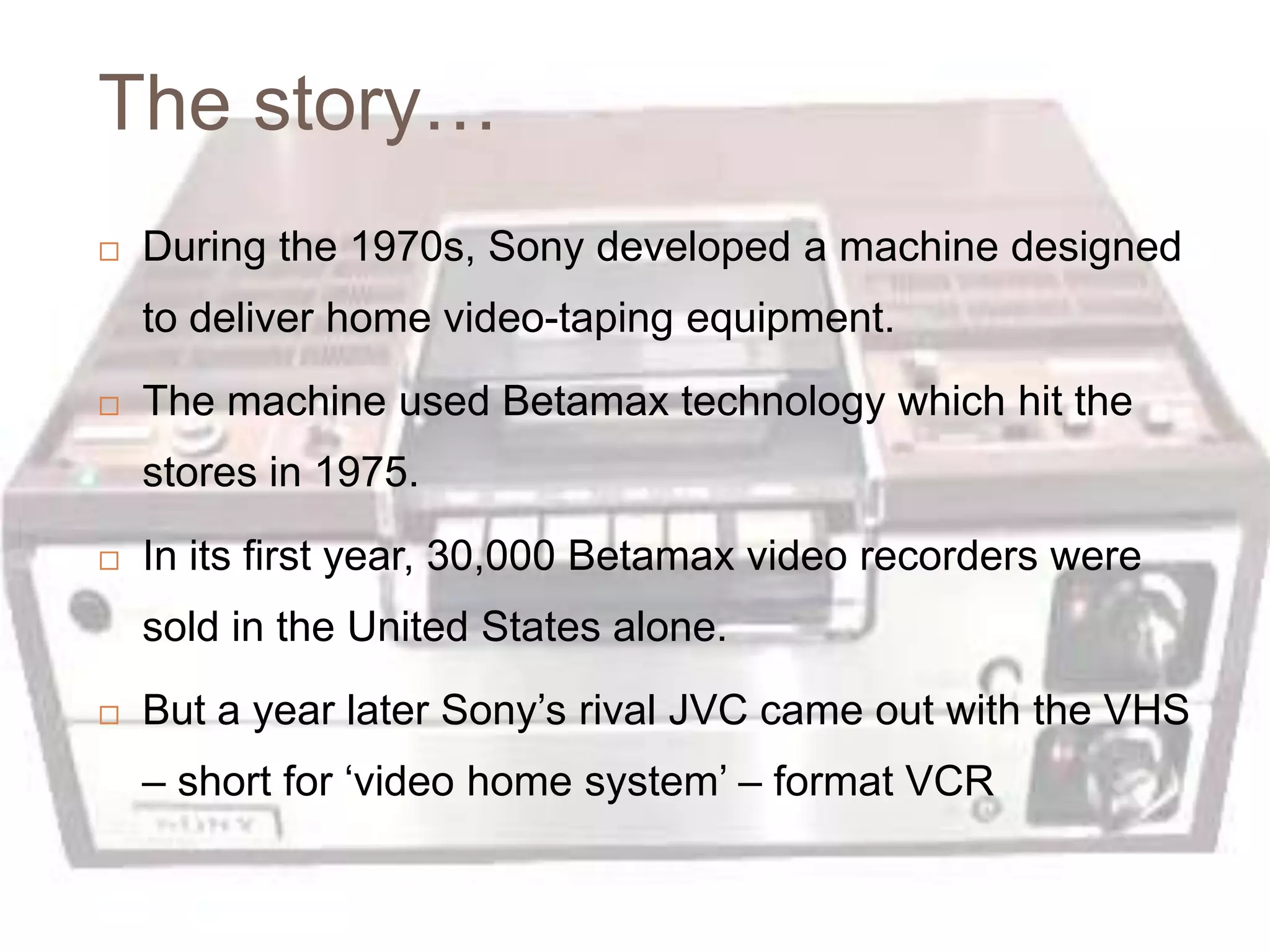
   During the 1970s, Sony developed a machine designed
    to deliver home video-taping equipment.
   The machine used Betamax technology which hit the
    stores in 1975.
   In its first year, 30,000 Betamax video recorders were
    sold in the United States alone.
   But a year later Sony‟s rival JVC came out with the VHS
    – short for „video home system‟ – format VCR
   By January 1977, there were four more Japanese
    electronics companies manufacturing and marketing
    VHS-based machines.

   Whereas Sony had either been unwilling or unable to
    license Betamax technology.

   JVC had been more than happy sharing their VHS
    format.

   This would later prove a critical factor in the demise of
    Betamax.

   Although Sony pioneered most of the advancements,
    JVC and the other VHS manufacturers were not slow to
   For instance, JVC and Panasonic introduced VHS hi-fi
    formats only weeks after Sony‟s introduction of Betamax hi-
    fi.

   However, most experts agree that the tape quality on
    Betamax was superior to that of its rival.

   As the two formats were incompatible, consumers were
    forced to decide between them.

   Sony went under pressure as its competitors started to
    drop prices to as much as US $300 below Sony‟s
    machines.

   By 1982 the price war was in full swing and Sony
Three βetamax VCRs built for American
Market


                              SL – 2000 with TT
                              tuner/timer (Base
                              Station) in 1982


                              SL-HF 300
                              Betamax HiFi in
                              1984


                             SK-HF 360
                             SuperBeta HiFi in
                             1988
Βetamax TV/VCR combo (SL-MV1) for Japanese Market
Size Comparison


                  Betamax Cassette


                     VHS Cassette
Marketing Problems
   Until the early 1980s the word „Betamax‟ was used as a
    synonym for „video recorder‟.

   This association had negative as well as positive consequences
    because in 1979, Universal Studios and Disney took legal action
    against Sony, claiming VCRs were infringing the copyrights of
    movie producers.

   Although Sony emerged apparently unharmed from the lawsuit,
    several commentators have suggested that the case had a
    detrimental impact on the way Sony marketed its Betamax
    products.
   1982 – Betamax VCRs accounted for a worthless 25 %
    of the entire market and the public were being warned
    that the selection of video rentals available for Betamax
    owners would be slightly smaller than that for VHS
    owners.

   Sony still continued to claim that Betamax was a
    technically superior format.

   Whereas, VHS machines could record for a
    considerable length of time, Betamax machines could
    only record for one hour – meaning that most films and
    football matches couldn‟t be recorded in one go
   “What made VHS succeed was that you could get a
    whole movie on a tape. Okay, maybe the picture and
    sound weren‟t as good as Beta; but what the heck, you
    didn‟t have to get up in the middle and switch cassettes.
    VHS delivered value on a dimension that mattered to
    consumers. Beta delivered excellent value on
    dimensions that did not.”

                            - VHS Fan from blockinfo.com
   3 years later VHS had gone way beyond the tipping
    point with a 95 per cent share of the market.

   In 1987, Rolling Stone magazine ran an article on
    Betamax (entitled „Format Wars‟) and declared ‘the
    battle is over’.

   On 10 January 1988, Sony finally swallowed its pride
    and announced plans for a VHS line of video recorders.

   On 25 January, only a fortnight after Sony‟s
    announcement, Time magazine published a eulogy to
    the brand with the headline, „Goodbye Beta‟.
   The same article also argued that Betamax had failed
    because it had refused to license the format to other
    firms.

   According to James Lardner, author of Fast Forward,
    Sony invited JVC and Matsushita to license the Betamax
    technology in December 1974, but both companies
    declined the offer.

   On 22 August 2002 Sony finally announced it would be
    discontinuing Betamax products.
   „With digital machines and other new recording formats
    taking hold in the market, demand has continued to
    decline and it has become difficult to secure parts,‟ the
    company said in a statement.

   2002 - Sony and eight of its competitors eventually
    joined forces to create a common format for DVD
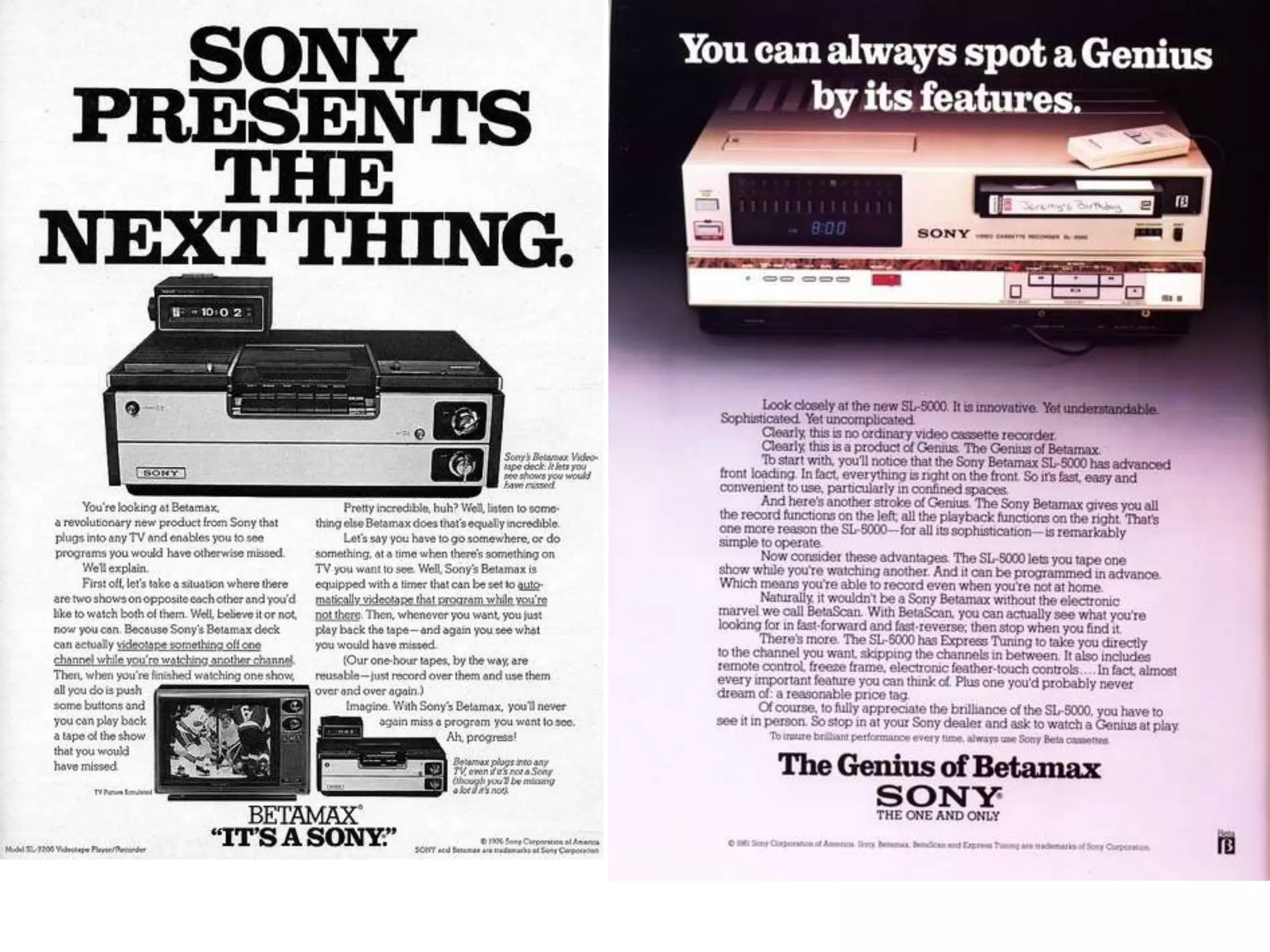
Various Advertisements for
βetamax
Betamax Tape
Mistakes by Sony for Betamax

   Going it all alone

   Refuse to license its format

   Sony‟s decision to ignore VHS
THANK YOU

Sony betamax

  • 2.
    The story…  During the 1970s, Sony developed a machine designed to deliver home video-taping equipment.  The machine used Betamax technology which hit the stores in 1975.  In its first year, 30,000 Betamax video recorders were sold in the United States alone.  But a year later Sony‟s rival JVC came out with the VHS – short for „video home system‟ – format VCR
  • 3.
    By January 1977, there were four more Japanese electronics companies manufacturing and marketing VHS-based machines.  Whereas Sony had either been unwilling or unable to license Betamax technology.  JVC had been more than happy sharing their VHS format.  This would later prove a critical factor in the demise of Betamax.  Although Sony pioneered most of the advancements, JVC and the other VHS manufacturers were not slow to
  • 4.
    For instance, JVC and Panasonic introduced VHS hi-fi formats only weeks after Sony‟s introduction of Betamax hi- fi.  However, most experts agree that the tape quality on Betamax was superior to that of its rival.  As the two formats were incompatible, consumers were forced to decide between them.  Sony went under pressure as its competitors started to drop prices to as much as US $300 below Sony‟s machines.  By 1982 the price war was in full swing and Sony
  • 5.
    Three βetamax VCRsbuilt for American Market SL – 2000 with TT tuner/timer (Base Station) in 1982 SL-HF 300 Betamax HiFi in 1984 SK-HF 360 SuperBeta HiFi in 1988
  • 6.
    Βetamax TV/VCR combo(SL-MV1) for Japanese Market
  • 7.
    Size Comparison Betamax Cassette VHS Cassette
  • 8.
    Marketing Problems  Until the early 1980s the word „Betamax‟ was used as a synonym for „video recorder‟.  This association had negative as well as positive consequences because in 1979, Universal Studios and Disney took legal action against Sony, claiming VCRs were infringing the copyrights of movie producers.  Although Sony emerged apparently unharmed from the lawsuit, several commentators have suggested that the case had a detrimental impact on the way Sony marketed its Betamax products.
  • 9.
    1982 – Betamax VCRs accounted for a worthless 25 % of the entire market and the public were being warned that the selection of video rentals available for Betamax owners would be slightly smaller than that for VHS owners.  Sony still continued to claim that Betamax was a technically superior format.  Whereas, VHS machines could record for a considerable length of time, Betamax machines could only record for one hour – meaning that most films and football matches couldn‟t be recorded in one go
  • 10.
    “What made VHS succeed was that you could get a whole movie on a tape. Okay, maybe the picture and sound weren‟t as good as Beta; but what the heck, you didn‟t have to get up in the middle and switch cassettes. VHS delivered value on a dimension that mattered to consumers. Beta delivered excellent value on dimensions that did not.” - VHS Fan from blockinfo.com
  • 11.
    3 years later VHS had gone way beyond the tipping point with a 95 per cent share of the market.  In 1987, Rolling Stone magazine ran an article on Betamax (entitled „Format Wars‟) and declared ‘the battle is over’.  On 10 January 1988, Sony finally swallowed its pride and announced plans for a VHS line of video recorders.  On 25 January, only a fortnight after Sony‟s announcement, Time magazine published a eulogy to the brand with the headline, „Goodbye Beta‟.
  • 12.
    The same article also argued that Betamax had failed because it had refused to license the format to other firms.  According to James Lardner, author of Fast Forward, Sony invited JVC and Matsushita to license the Betamax technology in December 1974, but both companies declined the offer.  On 22 August 2002 Sony finally announced it would be discontinuing Betamax products.
  • 13.
    „With digital machines and other new recording formats taking hold in the market, demand has continued to decline and it has become difficult to secure parts,‟ the company said in a statement.  2002 - Sony and eight of its competitors eventually joined forces to create a common format for DVD
  • 14.
  • 16.
  • 17.
    Mistakes by Sonyfor Betamax  Going it all alone  Refuse to license its format  Sony‟s decision to ignore VHS
  • 18.