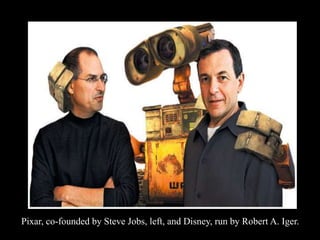
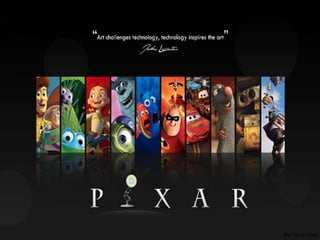
Pixar, co-founded by Steve Jobs, left, and Disney, run by Robert A. Iger.
HISTORICAL BACKGROUND
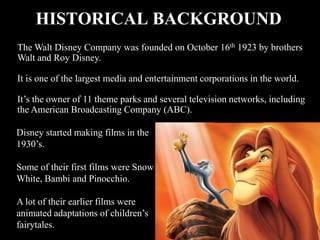
The Walt Disney Company was founded on October 16th 1923 by brothers
Walt and Roy Disney.

It is one of the largest media and entertainment corporations in the world.

It’s the owner of 11 theme parks and several television networks, including
the American Broadcasting Company (ABC).

Disney started making films in the
1930’s.

Some of their first films were Snow
White, Bambi and Pinocchio.

A lot of their earlier films were
animated adaptations of children’s
fairytales.
By: Vivek Patel
HISTORICAL BACKGROUND
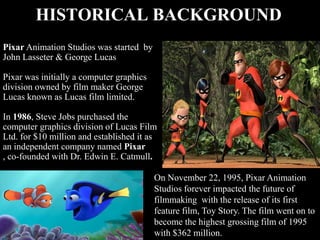
Pixar Animation Studios was started by
John Lasseter & George Lucas

Pixar was initially a computer graphics
division owned by film maker George
Lucas known as Lucas film limited.

In 1986, Steve Jobs purchased the
computer graphics division of Lucas Film
Ltd. for $10 million and established it as
an independent company named Pixar
, co-founded with Dr. Edwin E. Catmull.

                                          On November 22, 1995, Pixar Animation
                                          Studios forever impacted the future of
                                          filmmaking with the release of its first
                                          feature film, Toy Story. The film went on to
                                          become the highest grossing film of 1995
                                          with $362 million.
THE RATIONALE
Disney -
• The acquisition gave Disney ownership of the world’s most famous
  computer animation studio and its talent.

• The timing was also perfect for Disney, as its own animation films were
  failing.

• The deal brought the technology company Apple closer to Disney.

• The decrease in competition is another motive for Disney
Pixar -
• For Pixar it was a good move to face competitors like DreamWorks &
  20th century fox.

• The deal gave Apple iTunes more video content to offer.

• Pixar can focus on its core strengths of producing the computer
  animation and does not have to invest in production line for making
  merchandise and home entertainment.
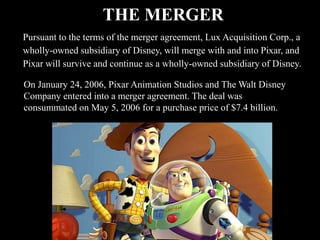
THE MERGER
Pursuant to the terms of the merger agreement, Lux Acquisition Corp., a
wholly-owned subsidiary of Disney, will merge with and into Pixar, and
Pixar will survive and continue as a wholly-owned subsidiary of Disney.

On January 24, 2006, Pixar Animation Studios and The Walt Disney
Company entered into a merger agreement. The deal was
consummated on May 5, 2006 for a purchase price of $7.4 billion.
1. Pixar's major features have been made with Walt Disney Pictures.

2. In 1997, after the release of Toy Story, a 10-year, 5-picture deal was
   signed, evenly splitting production costs and profits on subsequent
   movies. Disney alone retained rights to the films and characters. In
   addition, Disney collects 10 to 15 percent of each film's revenue as a
   distribution fee.

3. Pixar and Disney have had ongoing disagreements since the production of
   Toy Story 2 (1999). Originally intended as a straight-to-video release (and
   thus not part of Pixar's five picture deal), the film was upgraded to a
   theatrical release during production. Pixar demanded that the film then be
   counted toward the five picture agreement, but Disney refused. There
   were talks of Pixar searching for new distributors.
4. On January 24, 2006, Disney announced that it had agreed to buy Pixar
   for approximately $7.4 billion.

5. Disney was offering 2.3 shares of its stock for each Pixar share. That's a
   3.8% premium on Pixar's closing price of $57.57 (2006).

6. The transaction would catapult Steve Jobs, who was the majority
   shareholder of Pixar with 51%, to Disney's largest individual shareholder
   with 7% and a new seat on its board of directors.
THE METHOD
To purchase Pixar, Disney exchanged 2.3 shares of its common stock for
each share of Pixar common stock, resulting in the issuance of 279
million shares of Disney and converted previously issued vested and
unvested Pixar equity based awards into approx. 45 million Disney
equity based awards.

The acquisition purchase price was $7.4 billion in an all-stock deal.($6.4
billion of stock and Pixar’s cash & investments of approx. $1.0 billion).
The value of the stock issued was calculated based on the market value of
the company’s common stock using the average stock price for the five
day period beginning two days before the acquisition announcement date
on Jan 24th, 2006.

The fair value of the vested equity based awards issued at the Closing
Date was estimated using the Black-Scholes option pricing model .
THE ANALYSTS OPINION
Mr. Iger said: "The addition of Pixar significantly enhances Disney
animation, which is a critical creative engine for driving growth across our
businesses."

Doug Mitchelson at Deutsche Bank Securities called the move a "bold foray”.
"In a way, it appears that Iger has returned Disney to its roots with this deal as
the creative heart of the company will once again be a highly successful
animation unit,”.

Jessica Reif Cohen of Merrill Lynch calls the combination "a near perfect
strategic fit," adding that the Disney's brand "meshes well" with Pixar's
content.

However, analysts said that the real value to Disney was the talent the deal
would bring in-house, especially Pixar executive vice-president John
Lasseter, the man credited as being the creative driving force at the firm.
1. In terms of the revenue, stockholders got the higher share price from merging
   between two parties. Shares of Pixar gained nearly 3% from after-hours trading
   and Disney’s stock gained about 1.8% in regular trading.

2. In terms of human resource, the team up of two big animation production
   companies enabled in better human resource. They could exchange the valuable
   human resource between Disney and Pixar, which enabled them to produce top
   hit motion pictures.

3. Over the past three years Disney, which ranked 67th on the Fortune 500 last
   year, cruised to the head of the media pack in terms of both its stock performance
   and its return on invested capital.

4. Under Iger, Disney became the world's largest media conglomerate by market
   value, worth around $40 billion.

5. “Ratatouille,” “Wall-E” and “Up” have all garnered critical praise . Then there’s
   the “Toy Story” franchise. Part One – the first result of a distribution deal Disney
   and Pixar signed early in their courtship – showed the world what their
   partnership could do.
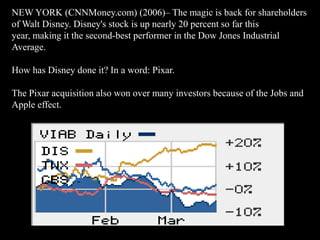
NEW YORK (CNNMoney.com) (2006)– The magic is back for shareholders
of Walt Disney. Disney's stock is up nearly 20 percent so far this
year, making it the second-best performer in the Dow Jones Industrial
Average.

How has Disney done it? In a word: Pixar.

The Pixar acquisition also won over many investors because of the Jobs and
Apple effect.

Disney & pixar

  • 2.
    Pixar, co-founded bySteve Jobs, left, and Disney, run by Robert A. Iger.
  • 4.
    HISTORICAL BACKGROUND The WaltDisney Company was founded on October 16th 1923 by brothers Walt and Roy Disney. It is one of the largest media and entertainment corporations in the world. It’s the owner of 11 theme parks and several television networks, including the American Broadcasting Company (ABC). Disney started making films in the 1930’s. Some of their first films were Snow White, Bambi and Pinocchio. A lot of their earlier films were animated adaptations of children’s fairytales.
  • 5.
  • 6.
    HISTORICAL BACKGROUND Pixar AnimationStudios was started by John Lasseter & George Lucas Pixar was initially a computer graphics division owned by film maker George Lucas known as Lucas film limited. In 1986, Steve Jobs purchased the computer graphics division of Lucas Film Ltd. for $10 million and established it as an independent company named Pixar , co-founded with Dr. Edwin E. Catmull. On November 22, 1995, Pixar Animation Studios forever impacted the future of filmmaking with the release of its first feature film, Toy Story. The film went on to become the highest grossing film of 1995 with $362 million.
  • 7.
    THE RATIONALE Disney - •The acquisition gave Disney ownership of the world’s most famous computer animation studio and its talent. • The timing was also perfect for Disney, as its own animation films were failing. • The deal brought the technology company Apple closer to Disney. • The decrease in competition is another motive for Disney
  • 8.
    Pixar - • ForPixar it was a good move to face competitors like DreamWorks & 20th century fox. • The deal gave Apple iTunes more video content to offer. • Pixar can focus on its core strengths of producing the computer animation and does not have to invest in production line for making merchandise and home entertainment.
  • 9.
    THE MERGER Pursuant tothe terms of the merger agreement, Lux Acquisition Corp., a wholly-owned subsidiary of Disney, will merge with and into Pixar, and Pixar will survive and continue as a wholly-owned subsidiary of Disney. On January 24, 2006, Pixar Animation Studios and The Walt Disney Company entered into a merger agreement. The deal was consummated on May 5, 2006 for a purchase price of $7.4 billion.
  • 10.
    1. Pixar's majorfeatures have been made with Walt Disney Pictures. 2. In 1997, after the release of Toy Story, a 10-year, 5-picture deal was signed, evenly splitting production costs and profits on subsequent movies. Disney alone retained rights to the films and characters. In addition, Disney collects 10 to 15 percent of each film's revenue as a distribution fee. 3. Pixar and Disney have had ongoing disagreements since the production of Toy Story 2 (1999). Originally intended as a straight-to-video release (and thus not part of Pixar's five picture deal), the film was upgraded to a theatrical release during production. Pixar demanded that the film then be counted toward the five picture agreement, but Disney refused. There were talks of Pixar searching for new distributors.
  • 11.
    4. On January24, 2006, Disney announced that it had agreed to buy Pixar for approximately $7.4 billion. 5. Disney was offering 2.3 shares of its stock for each Pixar share. That's a 3.8% premium on Pixar's closing price of $57.57 (2006). 6. The transaction would catapult Steve Jobs, who was the majority shareholder of Pixar with 51%, to Disney's largest individual shareholder with 7% and a new seat on its board of directors.
  • 12.
    THE METHOD To purchasePixar, Disney exchanged 2.3 shares of its common stock for each share of Pixar common stock, resulting in the issuance of 279 million shares of Disney and converted previously issued vested and unvested Pixar equity based awards into approx. 45 million Disney equity based awards. The acquisition purchase price was $7.4 billion in an all-stock deal.($6.4 billion of stock and Pixar’s cash & investments of approx. $1.0 billion). The value of the stock issued was calculated based on the market value of the company’s common stock using the average stock price for the five day period beginning two days before the acquisition announcement date on Jan 24th, 2006. The fair value of the vested equity based awards issued at the Closing Date was estimated using the Black-Scholes option pricing model .
  • 13.
    THE ANALYSTS OPINION Mr.Iger said: "The addition of Pixar significantly enhances Disney animation, which is a critical creative engine for driving growth across our businesses." Doug Mitchelson at Deutsche Bank Securities called the move a "bold foray”. "In a way, it appears that Iger has returned Disney to its roots with this deal as the creative heart of the company will once again be a highly successful animation unit,”. Jessica Reif Cohen of Merrill Lynch calls the combination "a near perfect strategic fit," adding that the Disney's brand "meshes well" with Pixar's content. However, analysts said that the real value to Disney was the talent the deal would bring in-house, especially Pixar executive vice-president John Lasseter, the man credited as being the creative driving force at the firm.
  • 14.
    1. In termsof the revenue, stockholders got the higher share price from merging between two parties. Shares of Pixar gained nearly 3% from after-hours trading and Disney’s stock gained about 1.8% in regular trading. 2. In terms of human resource, the team up of two big animation production companies enabled in better human resource. They could exchange the valuable human resource between Disney and Pixar, which enabled them to produce top hit motion pictures. 3. Over the past three years Disney, which ranked 67th on the Fortune 500 last year, cruised to the head of the media pack in terms of both its stock performance and its return on invested capital. 4. Under Iger, Disney became the world's largest media conglomerate by market value, worth around $40 billion. 5. “Ratatouille,” “Wall-E” and “Up” have all garnered critical praise . Then there’s the “Toy Story” franchise. Part One – the first result of a distribution deal Disney and Pixar signed early in their courtship – showed the world what their partnership could do.
  • 15.
    NEW YORK (CNNMoney.com)(2006)– The magic is back for shareholders of Walt Disney. Disney's stock is up nearly 20 percent so far this year, making it the second-best performer in the Dow Jones Industrial Average. How has Disney done it? In a word: Pixar. The Pixar acquisition also won over many investors because of the Jobs and Apple effect.