M-­‐Learning	
  in	
  Sub	
  Saharan	
  Africa	
  Context	


  What	
  is	
  it	
  about?	
  
M.	
  Ebner	
  	
  &	
  M.	
  Grimus	
  	
  
University	
  of	
  Technology,	
  Graz,	
  Austria	
  
	
  Victoria,	
  June	
  2013	
  
Sub	
  Sahara	
  Afrika	
  (SSA)	
  	
  
Background	
  
Current	
  SituaIon	


• EducaIon	
  
• Infrastructure	
  
• Policies	


Aims	
  
General	
  Issues	
  
specific	
  for	
  SSA	
  
Improving	
  
Quality	
  of	
  
EducaIon	
  ?	
  
Mobile	
  Learning	
  	
  
• Learning	
  with	
  
Mobiles	
  
• Projects	
  
• Teacher	
  EducaIon	
  
• Resources	
  
• Challenges/
Benefits	
  
Facts	
  -­‐	
  Sub	
  Sahara	
  Afrika	
  
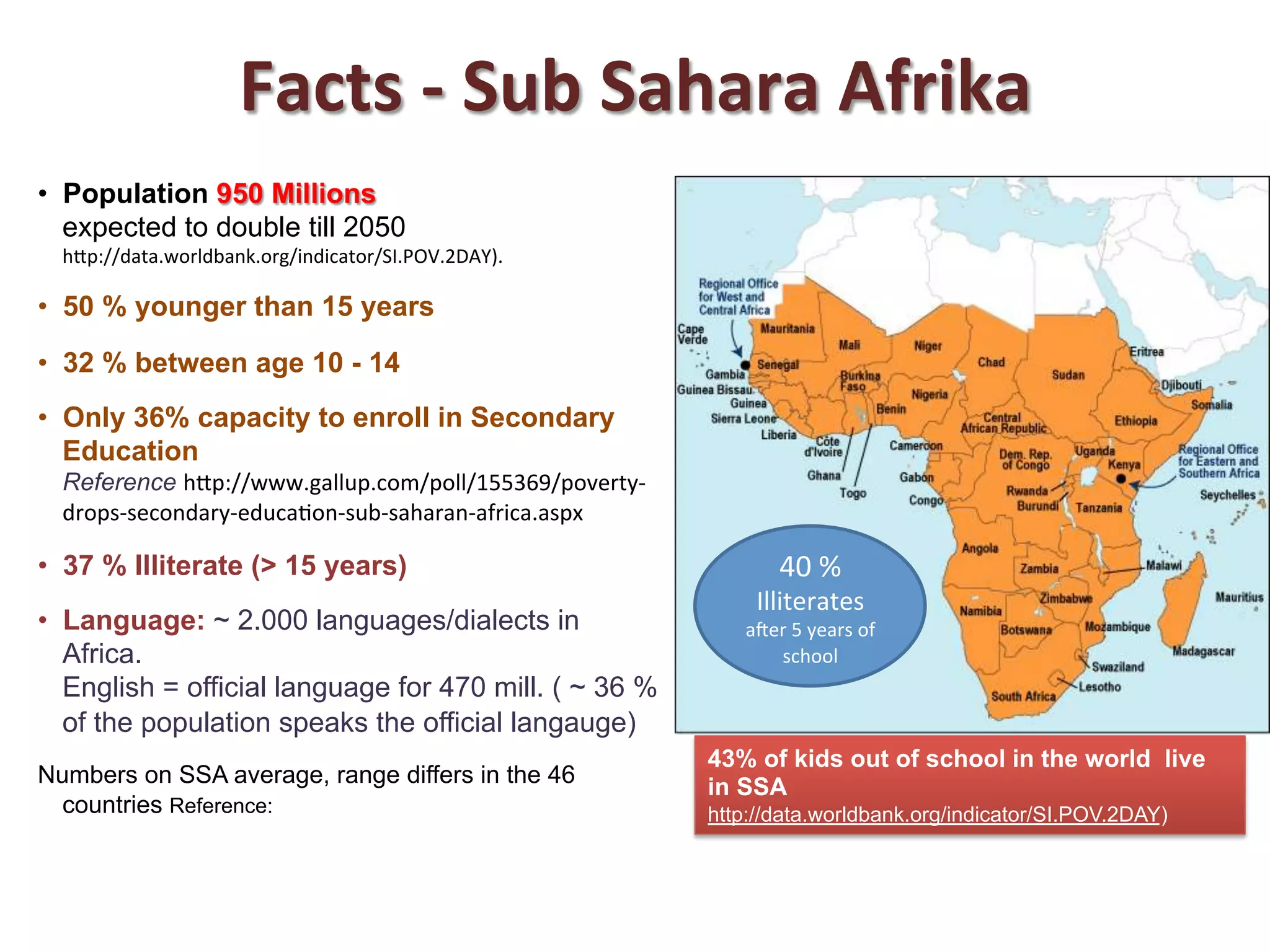
•  Population 950 Millions
expected to double till 2050
hVp://data.worldbank.org/indicator/SI.POV.2DAY).	
  
•  50 % younger than 15 years
•  32 % between age 10 - 14
•  Only 36% capacity to enroll in Secondary
Education
Reference hVp://www.gallup.com/poll/155369/poverty-­‐
drops-­‐secondary-­‐educaIon-­‐sub-­‐saharan-­‐africa.aspx	
  	
  
•  37 % Illiterate (> 15 years)
•  Language: ~ 2.000 languages/dialects in
Africa.
English = official language for 470 mill. ( ~ 36 %
of the population speaks the official langauge)
Numbers on SSA average, range differs in the 46
countries Reference:
http://www.weltbevoelkerung.de/fileadmin/user_upload/PDF/
Datenreport/Datenreport_2012.pdf
M.	
  Grimus,	
  Vienna,	
  Austria	
  
43% of kids out of school in the world live
in SSA
http://data.worldbank.org/indicator/SI.POV.2DAY) 	
  
40	
  %	
  	
  
Illiterates	
  
acer	
  5	
  years	
  of	
  
school	
  
 EducaIon-­‐	
  
Challenges	
  	
  
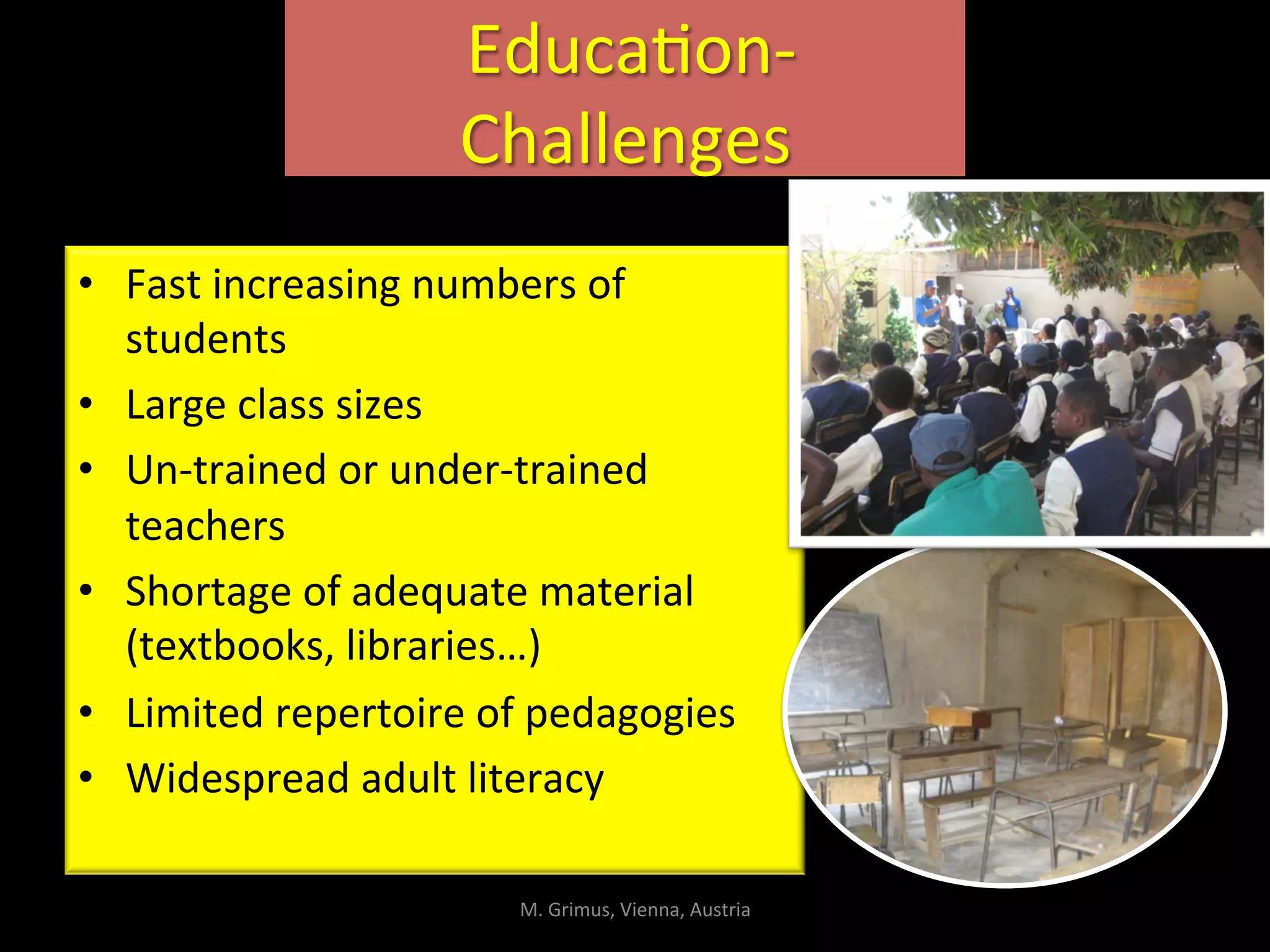
•  Fast	
  increasing	
  numbers	
  of	
  
students	
  
•  Large	
  class	
  sizes	
  
•  Un-­‐trained	
  or	
  under-­‐trained	
  
teachers	
  
•  Shortage	
  of	
  adequate	
  material	
  
(textbooks,	
  libraries…)	
  
•  Limited	
  repertoire	
  of	
  pedagogies	
  
•  Widespread	
  adult	
  literacy	
  
M.	
  Grimus,	
  Vienna,	
  Austria	
  
In	
  School	
  
•  Limited	
  books	
  	
  
•  	
  Low	
  reading	
  skills	
  
•  Scarce	
  electricity	
  in	
  
schools	
  
•  Scarce	
  access	
  to	
  
computers	
  /Internet	
  
Out	
  of	
  School	
  
•  „mobile-­‐rich“	
  
•  Read	
  and	
  write	
  on	
  	
  mobile	
  
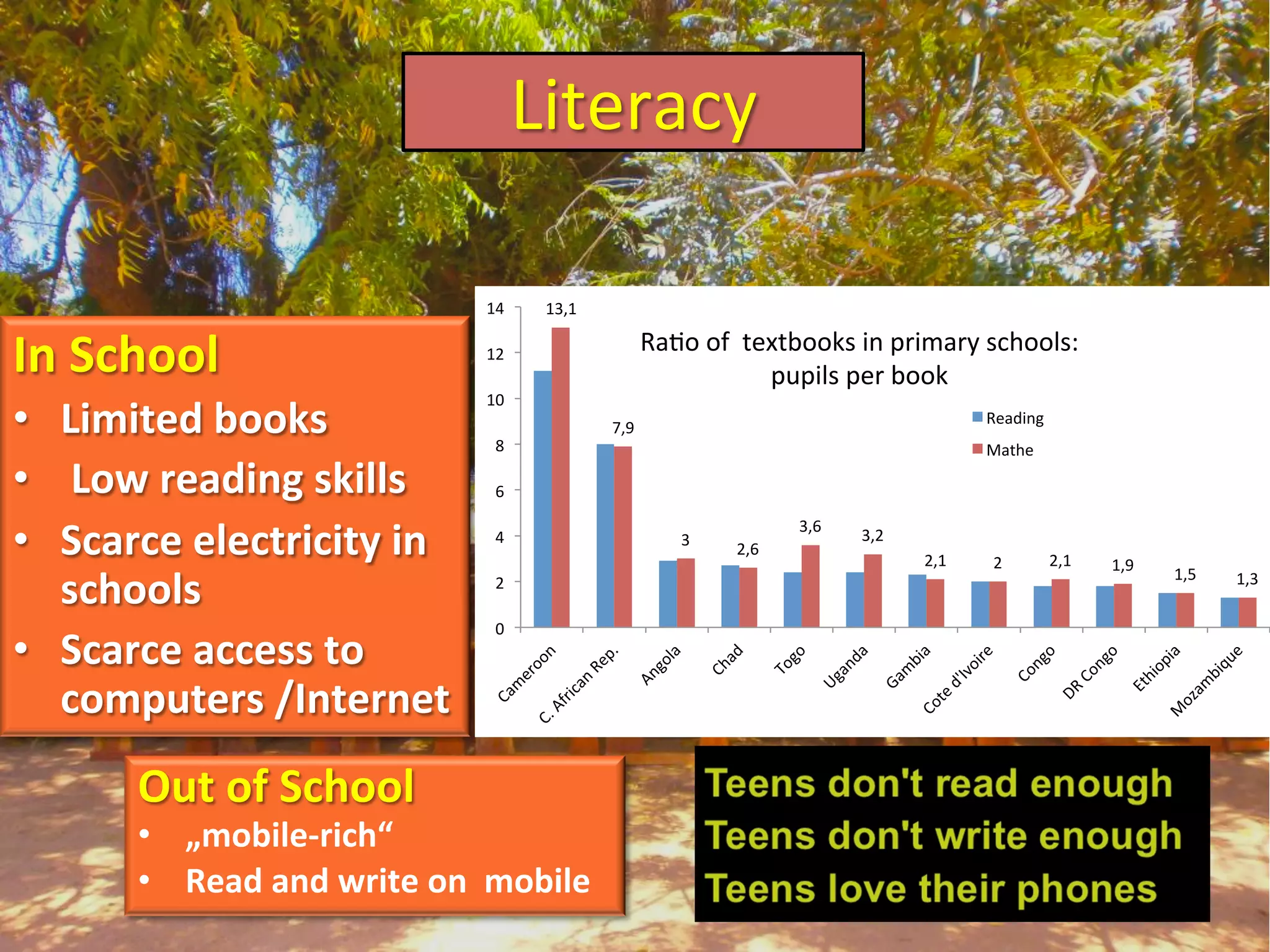
Literacy	
  
13,1	
  
7,9	
  
3	
  
2,6	
  
3,6	
  
3,2	
  
2,1	
   2	
   2,1	
   1,9	
  
1,5	
   1,3	
  
0	
  
2	
  
4	
  
6	
  
8	
  
10	
  
12	
  
14	
  
Reading	
  
Mathe	
  
RaIo	
  of	
  	
  textbooks	
  in	
  primary	
  schools:	
  
pupils	
  per	
  book	
  
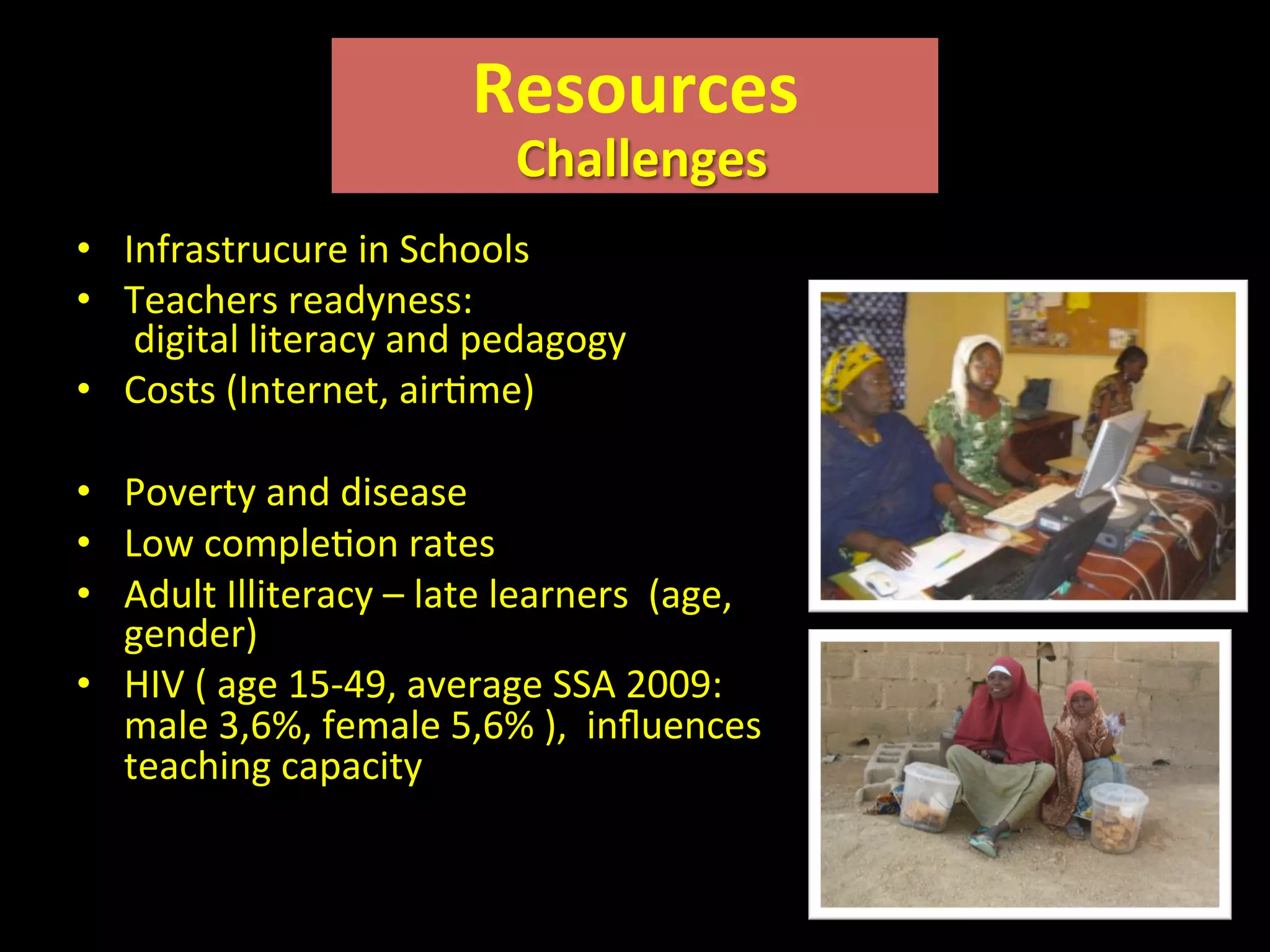
•  Infrastrucure	
  in	
  Schools	
  
•  Teachers	
  readyness:	


  digital	
  literacy	
  and	
  pedagogy	
  
•  Costs	
  (Internet,	
  airIme)	
  
•  Poverty	
  and	
  disease	
  	
  
•  Low	
  compleIon	
  rates	
  
•  Adult	
  Illiteracy	
  –	
  late	
  learners	
  	
  (age,	
  
gender)	
  	
  
•  HIV	
  (	
  age	
  15-­‐49,	
  average	
  SSA	
  2009:	
  
male	
  3,6%,	
  female	
  5,6%	
  ),	
  	
  influences	
  
teaching	
  capacity	
  
Resources	
  
	
  Challenges	
  
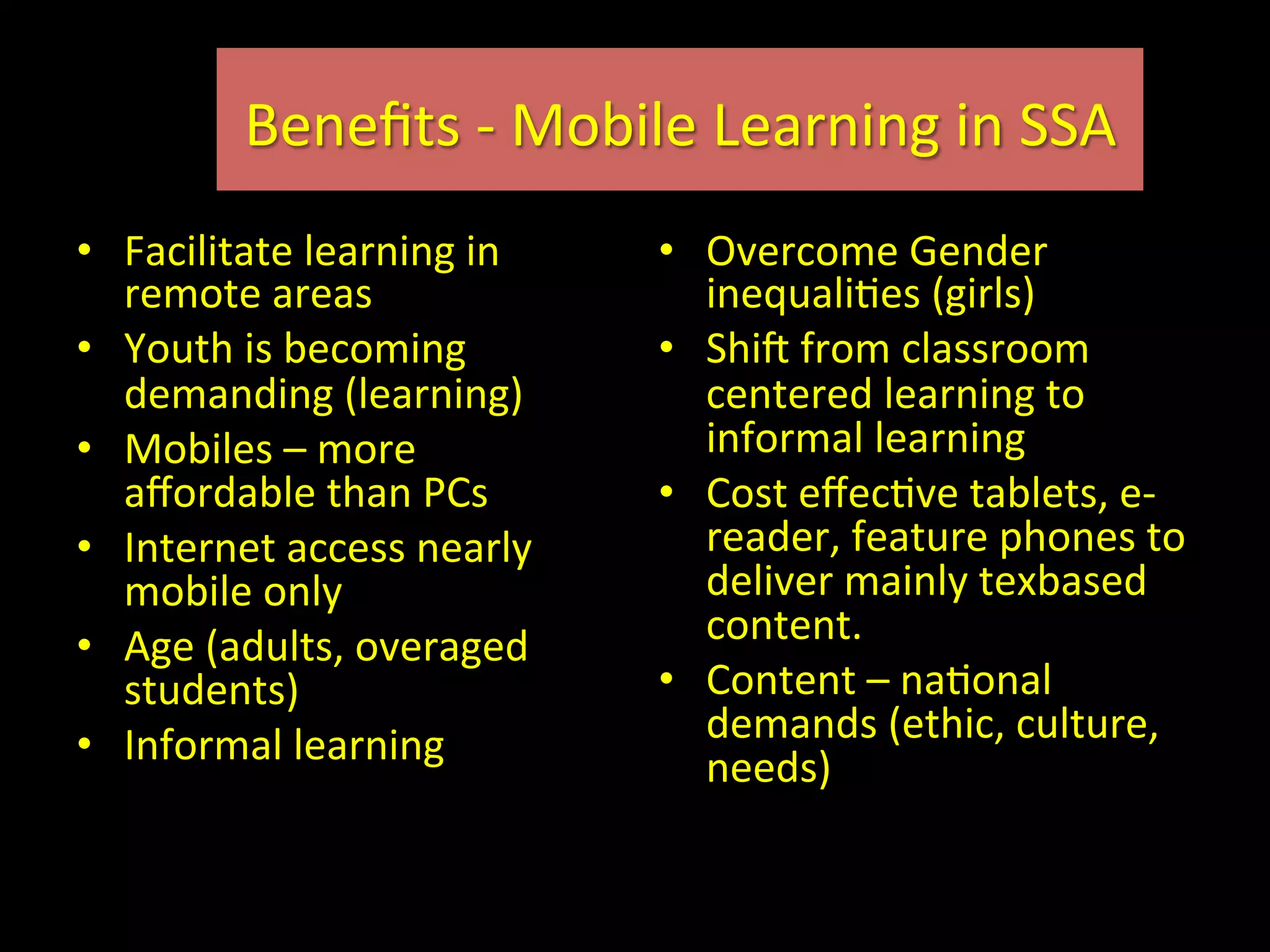
•  Facilitate	
  learning	
  in	
  
remote	
  areas	
  
•  Youth	
  is	
  becoming	
  
demanding	
  (learning)	
  
•  Mobiles	
  –	
  more	
  
affordable	
  than	
  PCs	
  
•  Internet	
  access	
  nearly	
  
mobile	
  only	
  
•  Age	
  (adults,	
  overaged	
  
students)	
  
•  Informal	
  learning	
  
•  Overcome	
  Gender	
  
inequaliIes	
  (girls)	
  
•  Shic	
  from	
  classroom	
  
centered	
  learning	
  to	
  
informal	
  learning	
  
•  Cost	
  effecIve	
  tablets,	
  e-­‐
reader,	
  feature	
  phones	
  to	
  
deliver	
  mainly	
  texbased	
  
content.	
  
•  Content	
  –	
  naIonal	
  
demands	
  (ethic,	
  culture,	
  
needs)	
  
Benefits	
  -­‐	
  Mobile	
  Learning	
  in	
  SSA	
  
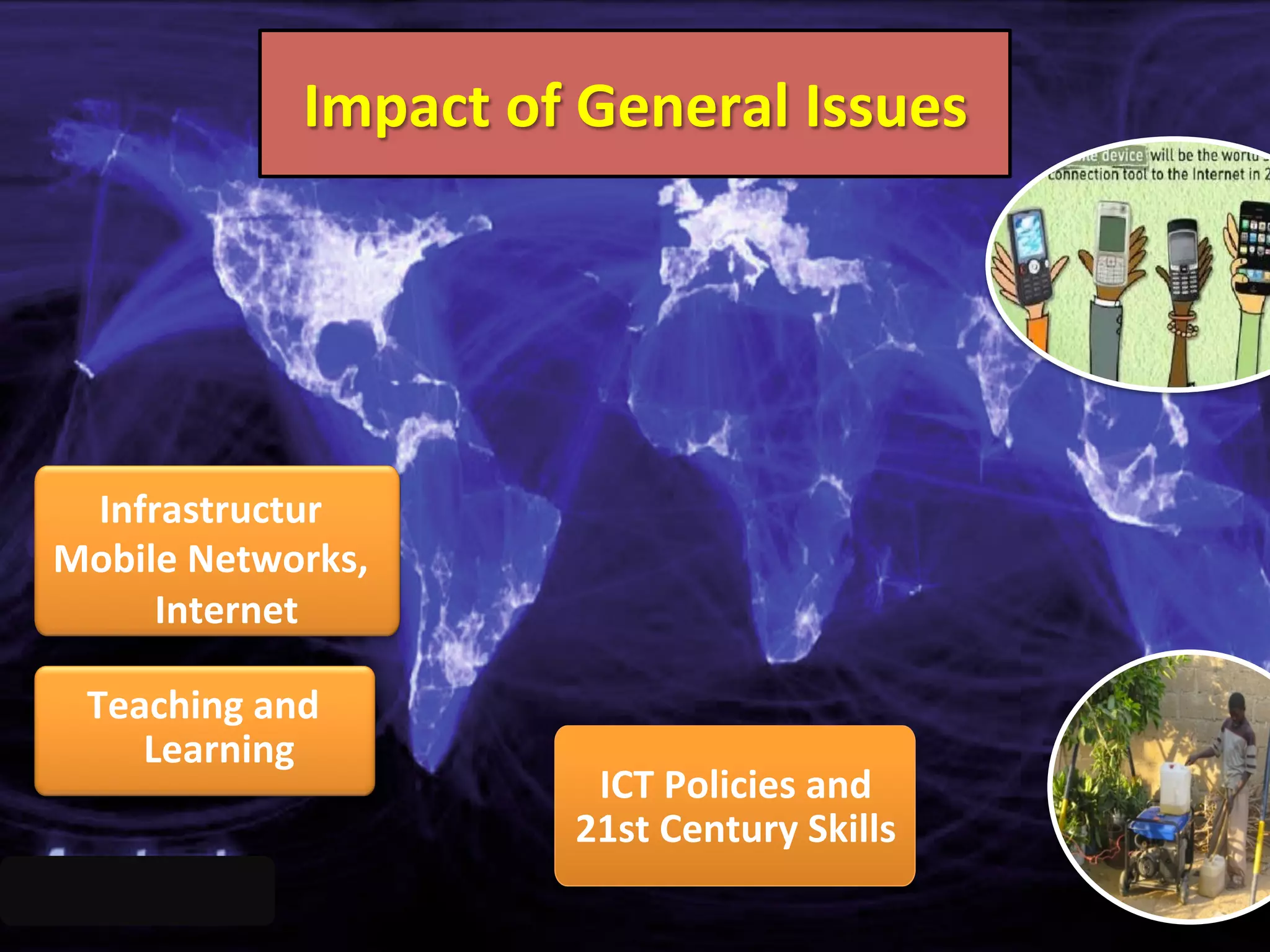
ICT	
  Policies	
  and	
  	
  
21st	
  Century	
  Skills	
  
Teaching	
  and	
  
Learning	


Impact	
  of	
  General	
  Issues	
  
Infrastructur	
  
Mobile	
  Networks,	
  
Internet	
  
Mobile	
  Learning	
  -­‐	
  a	
  Chance	
  for	
  	
  
Formal	
  and	
  Informal	
  Learning	
  
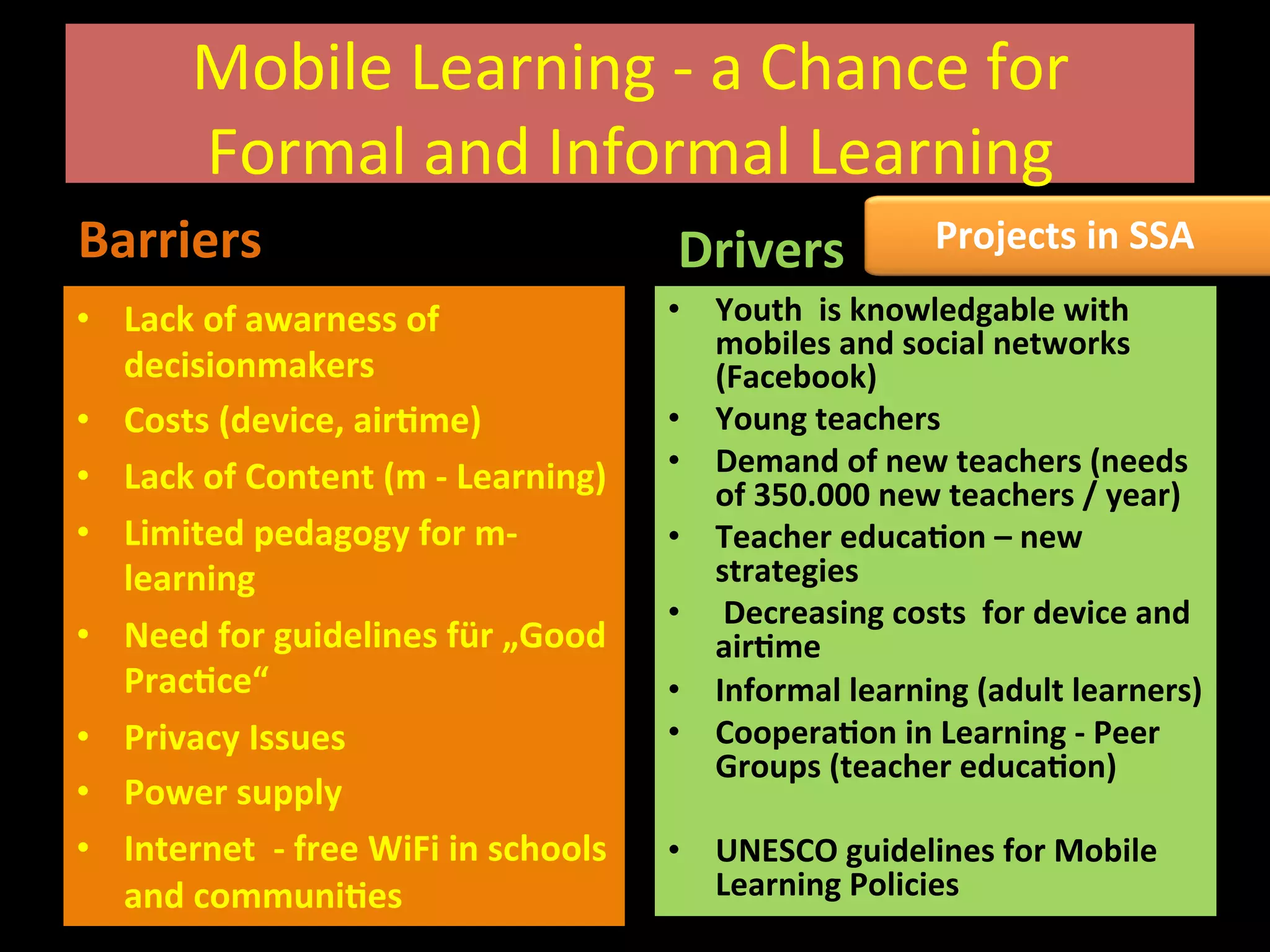
Barriers	
  
•  Lack	
  of	
  awarness	
  of	
  
decisionmakers	
  
•  Costs	
  (device,	
  airRme)	
  
•  Lack	
  of	
  Content	
  (m	
  -­‐	
  Learning)	
  
•  Limited	
  pedagogy	
  for	
  m-­‐
learning	
  
•  Need	
  for	
  guidelines	
  für	
  „Good	
  
PracRce“	
  
•  Privacy	
  Issues	
  
•  Power	
  supply	
  
•  Internet	
  	
  -­‐	
  free	
  WiFi	
  in	
  schools	
  
and	
  communiRes	
  
Drivers	
  
•  Youth	
  	
  is	
  knowledgable	
  with	
  
mobiles	
  and	
  social	
  networks	
  
(Facebook)	
  
•  Young	
  teachers	
  
•  Demand	
  of	
  new	
  teachers	
  (needs	
  
of	
  350.000	
  new	
  teachers	
  /	
  year)	
  
•  Teacher	
  educaRon	
  –	
  new	
  
strategies	
  
•  	
  Decreasing	
  costs	
  	
  for	
  device	
  and	
  
airRme	
  
•  Informal	
  learning	
  (adult	
  learners)	
  
•  CooperaRon	
  in	
  Learning	
  -­‐	
  Peer	
  
Groups	
  (teacher	
  educaRon)	
  
•  UNESCO	
  guidelines	
  for	
  Mobile	
  
Learning	
  Policies	
  
Projects	
  in	
  SSA	


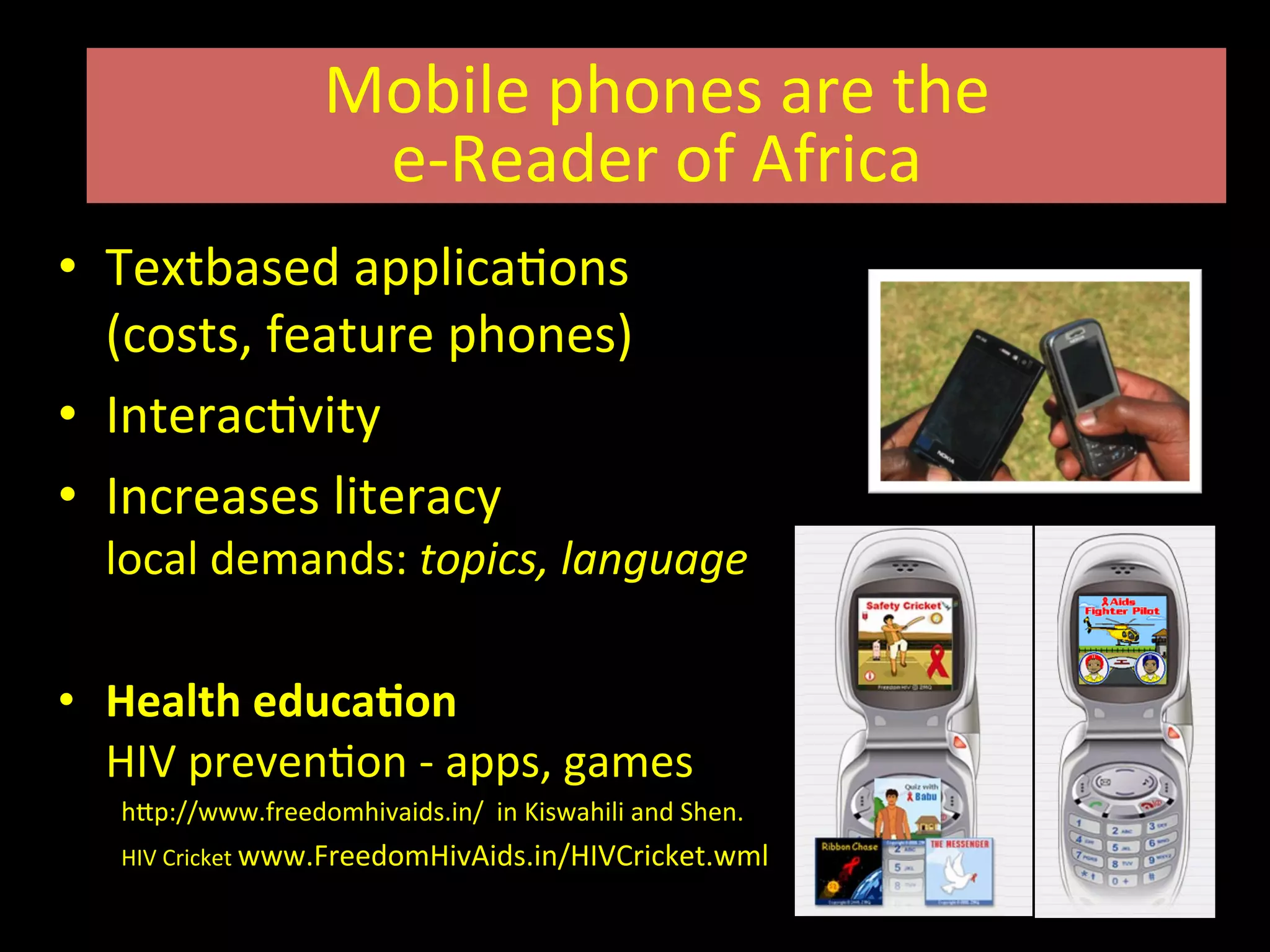
•  Textbased	
  applicaIons	
  	
  
(costs,	
  feature	
  phones)	
  
•  InteracIvity	
  
•  Increases	
  literacy	
  	
  
local	
  demands:	
  topics,	
  language	
  
•  Health	
  educaRon	


HIV	
  prevenIon	
  -­‐	
  apps,	
  games	
  	
  
hVp://www.freedomhivaids.in/	
  	
  in	
  Kiswahili	
  and	
  Shen.	
  	
  
HIV	
  Cricket	
  www.FreedomHivAids.in/HIVCricket.wml	
  	
  
Mobile	
  phones	
  are	
  the	
  	
  
e-­‐Reader	
  of	
  Africa	
  
Projects	
  in	
  SSA	
  
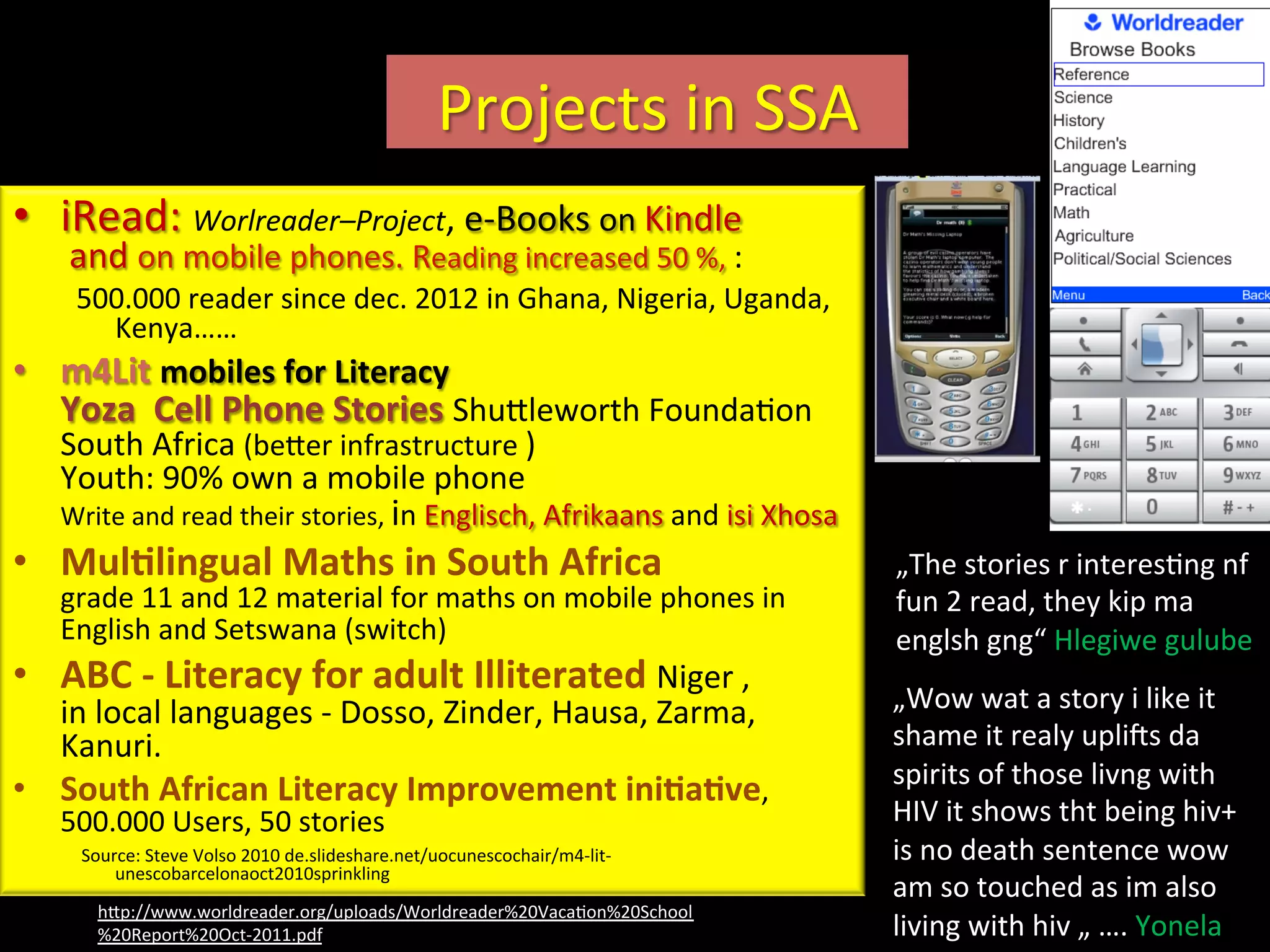
•  iRead:	
  Worlreader–Project,	
  e-­‐Books	
  on	
  Kindle	
  
	
  and	
  on	
  mobile	
  phones.	
  Reading	
  increased	
  50	
  %,	
  :	
  
500.000	
  reader	
  since	
  dec.	
  2012	
  in	
  Ghana,	
  Nigeria,	
  Uganda,	
  
Kenya……	
  
•  m4Lit	
  mobiles	
  for	
  Literacy	
  	
  
Yoza	
  	
  Cell	
  Phone	
  Stories	
  ShuVleworth	
  FoundaIon	
  
South	
  Africa	
  (beVer	
  infrastructure	
  )	
  	
  
Youth:	
  90%	
  own	
  a	
  mobile	
  phone	
  
Write	
  and	
  read	
  their	
  stories,	
  in	
  Englisch,	
  Afrikaans	
  and	
  isi	
  Xhosa	
  
•  MulRlingual	
  Maths	
  in	
  South	
  Africa	


grade	
  11	
  and	
  12	
  material	
  for	
  maths	
  on	
  mobile	
  phones	
  in	
  
English	
  and	
  Setswana	
  (switch)	
  
•  ABC	
  -­‐	
  Literacy	
  for	
  adult	
  Illiterated	
  Niger	
  ,	
  
in	
  local	
  languages	
  -­‐	
  Dosso,	
  Zinder,	
  Hausa,	
  Zarma,	
  
Kanuri.	
  
•  South	
  African	
  Literacy	
  Improvement	
  iniRaRve,	
  
500.000	
  Users,	
  50	
  stories	


  Source:	
  Steve	
  Volso	
  2010	
  de.slideshare.net/uocunescochair/m4-­‐lit-­‐
unescobarcelonaoct2010sprinkling	


hVp://www.worldreader.org/uploads/Worldreader%20VacaIon%20School
%20Report%20Oct-­‐2011.pdf	
  	
  
„The	
  stories	
  r	
  interesIng	
  nf	
  
fun	
  2	
  read,	
  they	
  kip	
  ma	
  
englsh	
  gng“	
  Hlegiwe	
  gulube	
  
„Wow	
  wat	
  a	
  story	
  i	
  like	
  it	
  
shame	
  it	
  realy	
  uplics	
  da	
  
spirits	
  of	
  those	
  livng	
  with	
  
HIV	
  it	
  shows	
  tht	
  being	
  hiv+	
  
is	
  no	
  death	
  sentence	
  wow	
  
am	
  so	
  touched	
  as	
  im	
  also	
  
living	
  with	
  hiv	
  „	
  ….	
  Yonela“	
  	
  
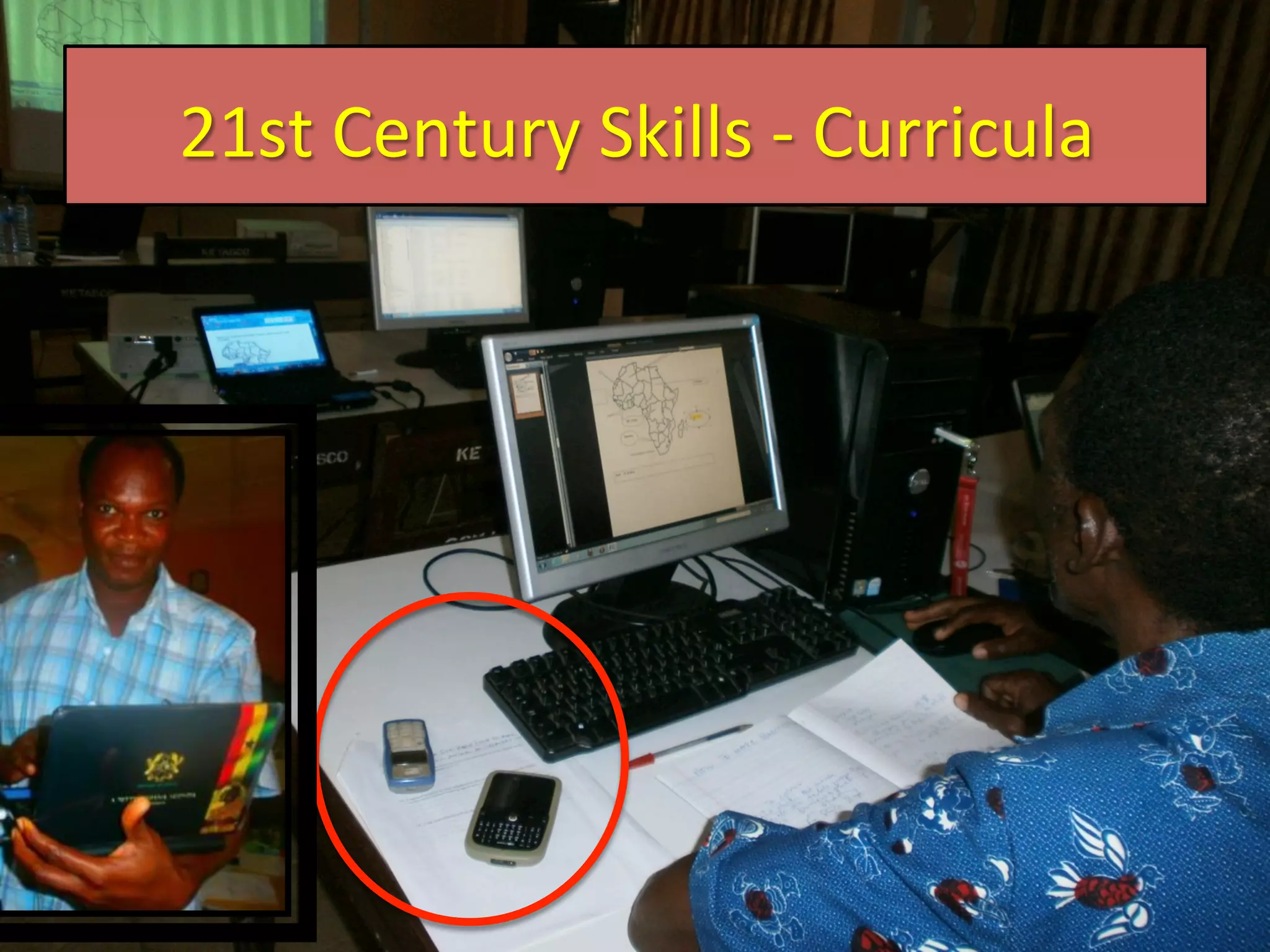
21st	
  Century	
  Skills	
  -­‐	
  Curricula	
  
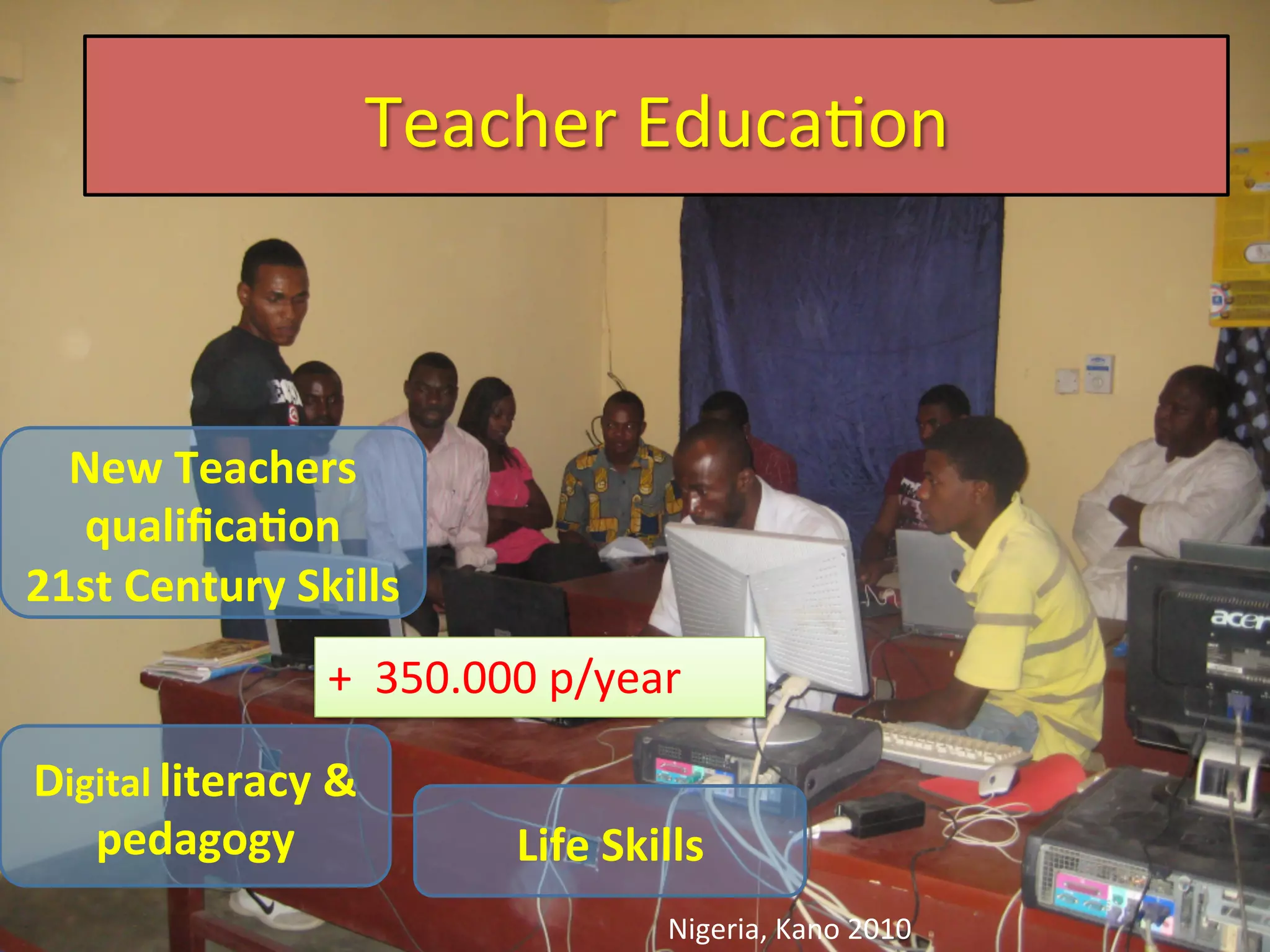
Digital	
  literacy	
  &	
  
pedagogy	
  
New	
  Teachers	
  
qualificaRon	
  	
  
21st	
  Century	
  Skills	
  
+	
  	
  350.000	
  p/year	
  
Nigeria,	
  Kano	
  2010	
  
Life	
  Skills	
  
Teacher	
  EducaIon	
  
Resources	
  	
  
•  OER	
  Open	
  EducaIonal	
  Resources	
  
CK-­‐12	
  	
  webbases	
  collaboraIve	
  	
  ‘flex-­‐books‘	
  ,	
  hVp://
www.ck12.org/)	
  
•  E-­‐books	
  (formats)	
  
•  CreaIve	
  Commons	
  
•  MOOCS	
  
•  Open	
  Courseware:	
  
MIT	
  (Masschusets	
  InsItute	
  of	
  Technology)	
  hVp://ocw.mit.edu	
  	
  
Khan	
  Academy	
  ,hVp://www.khanacademy.org/	
  
Discussion	
  
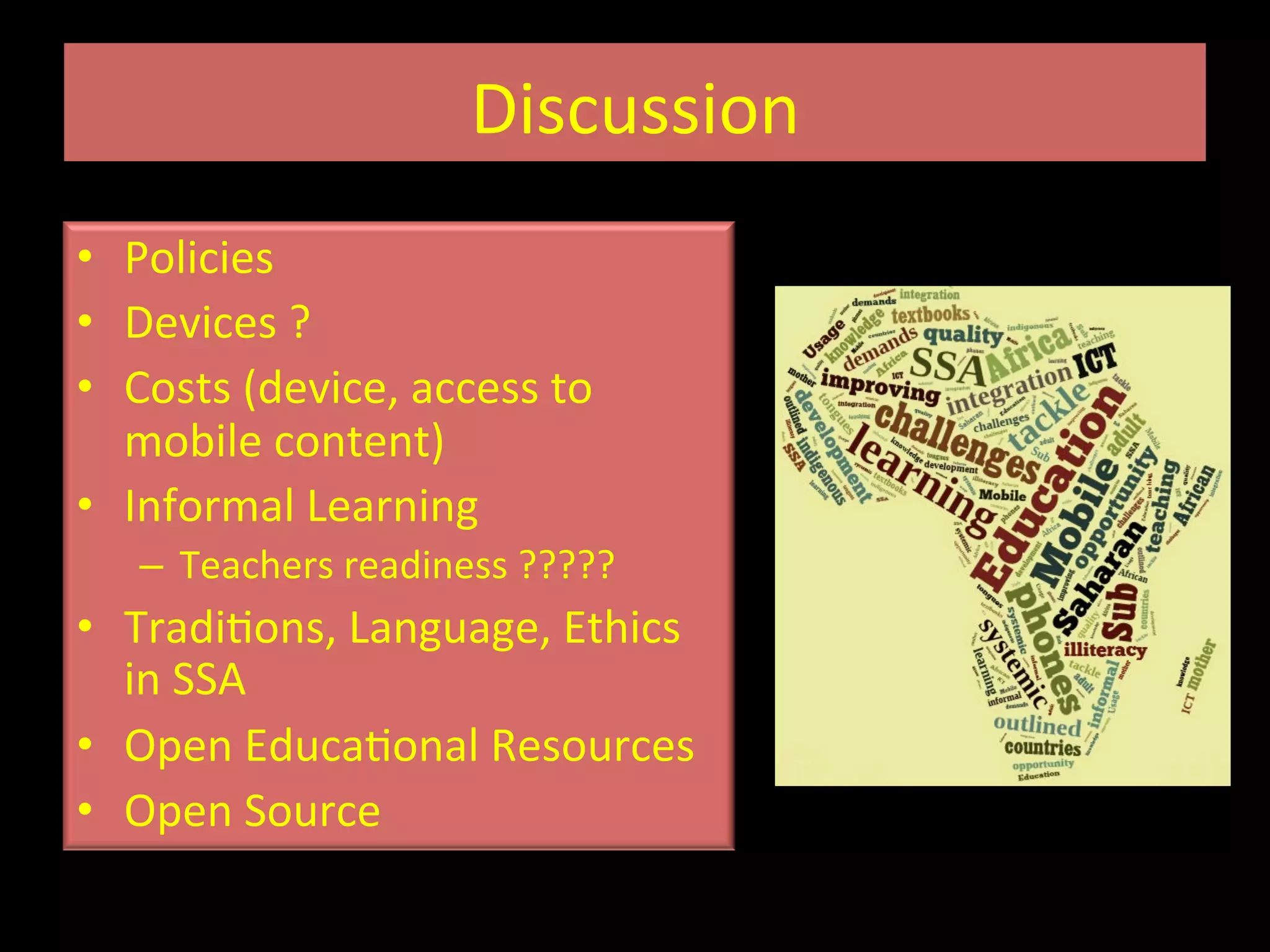
•  Policies	
  
•  Devices	
  ?	
  	
  
•  Costs	
  (device,	
  access	
  to	
  
mobile	
  content)	
  
•  Informal	
  Learning	
  
–  Teachers	
  readiness	
  ?????	
  
•  TradiIons,	
  Language,	
  Ethics	
  
in	
  SSA	
  
•  Open	
  EducaIonal	
  Resources	
  
•  Open	
  Source	
  	
  
Conclusions	
  
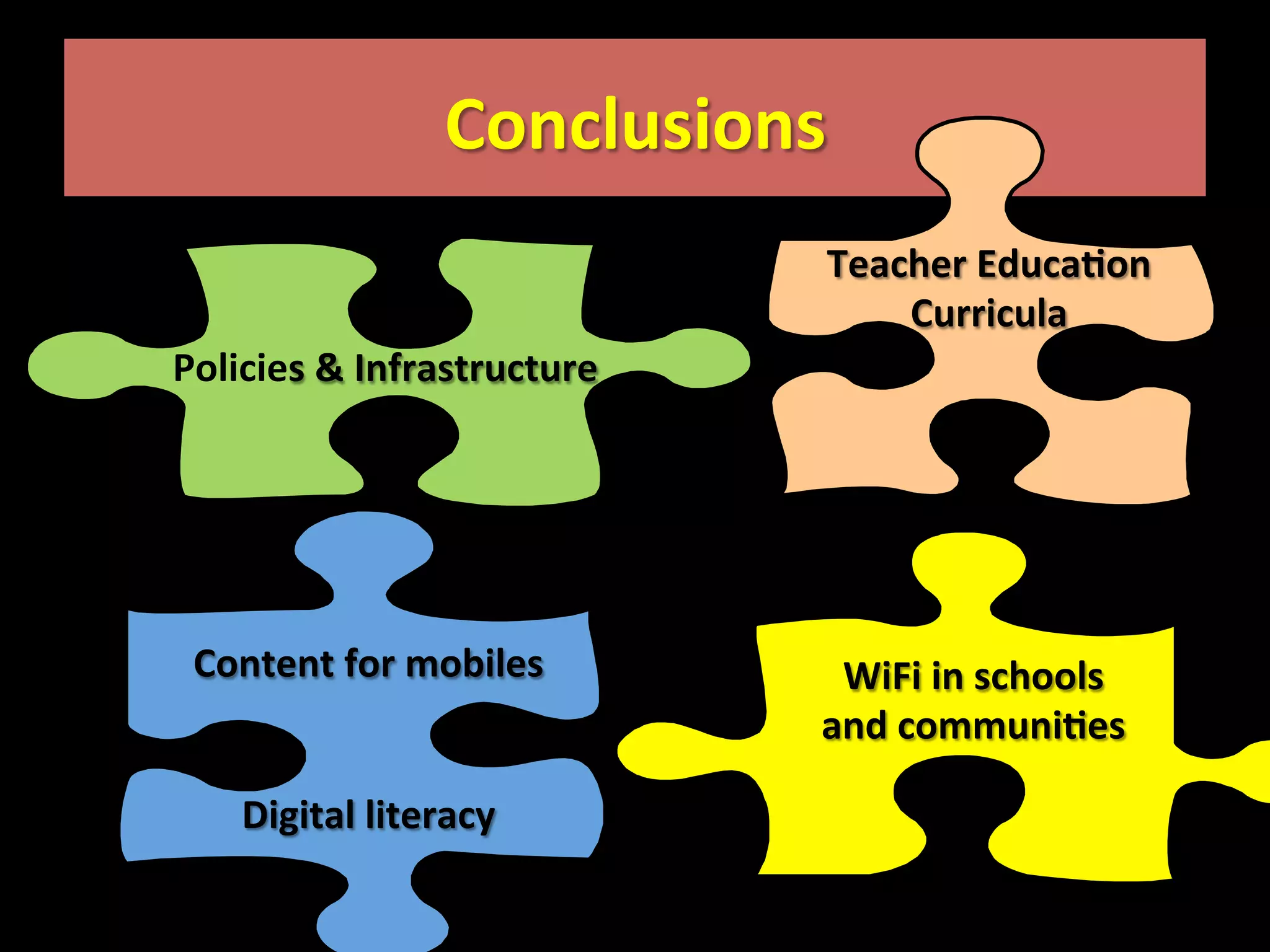
WiFi	
  in	
  schools	
  
and	
  communiRes	
  
Content	
  for	
  mobiles	


Digital	
  literacy	
  
Policies	
  &	
  Infrastructure	
  
Teacher	
  EducaRon	
  
Curricula	
  
Information Technology Services
Graz University of Technology
Martin Ebner
martin.ebner@tugraz.at
http://elearningblog.tugraz.at
http://elearning.tugraz.at
Dept. Social Learning
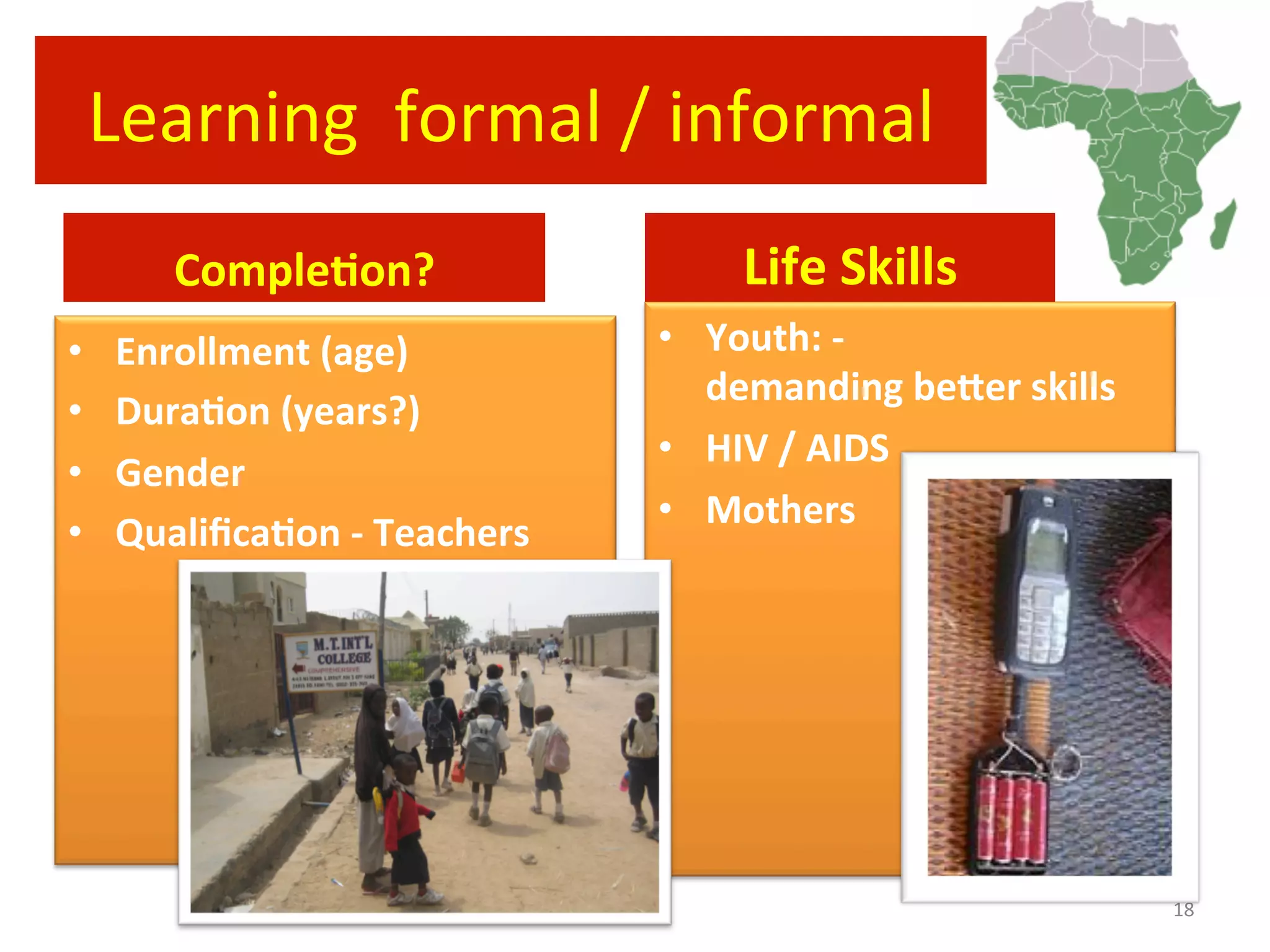
Learning	
  	
  formal	
  /	
  informal	
  
CompleRon?	
  
•  Enrollment	
  (age)	
  
•  DuraRon	
  (years?)	
  
•  Gender	
  
•  QualificaRon	
  -­‐	
  Teachers	
  
Life	
  Skills	
  
•  Youth:	
  -­‐	
  
demanding	
  befer	
  skills	
  
•  HIV	
  /	
  AIDS	
  
•  Mothers	
  
18	
  

M-Learning in Sub Saharan Africa Context- What is it about?

  • 1.
       M-­‐Learning  in  Sub  Saharan  Africa  Context      What  is  it  about?   M.  Ebner    &  M.  Grimus     University  of  Technology,  Graz,  Austria    Victoria,  June  2013  
  • 2.
    Sub  Sahara  Afrika  (SSA)     Background   Current  SituaIon     • EducaIon   • Infrastructure   • Policies     Aims   General  Issues   specific  for  SSA   Improving   Quality  of   EducaIon  ?   Mobile  Learning     • Learning  with   Mobiles   • Projects   • Teacher  EducaIon   • Resources   • Challenges/ Benefits  
  • 3.
    Facts  -­‐  Sub  Sahara  Afrika   •  Population 950 Millions expected to double till 2050 hVp://data.worldbank.org/indicator/SI.POV.2DAY).   •  50 % younger than 15 years •  32 % between age 10 - 14 •  Only 36% capacity to enroll in Secondary Education Reference hVp://www.gallup.com/poll/155369/poverty-­‐ drops-­‐secondary-­‐educaIon-­‐sub-­‐saharan-­‐africa.aspx     •  37 % Illiterate (> 15 years) •  Language: ~ 2.000 languages/dialects in Africa. English = official language for 470 mill. ( ~ 36 % of the population speaks the official langauge) Numbers on SSA average, range differs in the 46 countries Reference: http://www.weltbevoelkerung.de/fileadmin/user_upload/PDF/ Datenreport/Datenreport_2012.pdf M.  Grimus,  Vienna,  Austria   43% of kids out of school in the world live in SSA http://data.worldbank.org/indicator/SI.POV.2DAY)   40  %     Illiterates   acer  5  years  of   school  
  • 4.
     EducaIon-­‐   Challenges     •  Fast  increasing  numbers  of   students   •  Large  class  sizes   •  Un-­‐trained  or  under-­‐trained   teachers   •  Shortage  of  adequate  material   (textbooks,  libraries…)   •  Limited  repertoire  of  pedagogies   •  Widespread  adult  literacy   M.  Grimus,  Vienna,  Austria  
  • 5.
    In  School   • Limited  books     •   Low  reading  skills   •  Scarce  electricity  in   schools   •  Scarce  access  to   computers  /Internet   Out  of  School   •  „mobile-­‐rich“   •  Read  and  write  on    mobile   Literacy   13,1   7,9   3   2,6   3,6   3,2   2,1   2   2,1   1,9   1,5   1,3   0   2   4   6   8   10   12   14   Reading   Mathe   RaIo  of    textbooks  in  primary  schools:   pupils  per  book  
  • 6.
    •  Infrastrucure  in  Schools   •  Teachers  readyness:      digital  literacy  and  pedagogy   •  Costs  (Internet,  airIme)   •  Poverty  and  disease     •  Low  compleIon  rates   •  Adult  Illiteracy  –  late  learners    (age,   gender)     •  HIV  (  age  15-­‐49,  average  SSA  2009:   male  3,6%,  female  5,6%  ),    influences   teaching  capacity   Resources    Challenges  
  • 7.
    •  Facilitate  learning  in   remote  areas   •  Youth  is  becoming   demanding  (learning)   •  Mobiles  –  more   affordable  than  PCs   •  Internet  access  nearly   mobile  only   •  Age  (adults,  overaged   students)   •  Informal  learning   •  Overcome  Gender   inequaliIes  (girls)   •  Shic  from  classroom   centered  learning  to   informal  learning   •  Cost  effecIve  tablets,  e-­‐ reader,  feature  phones  to   deliver  mainly  texbased   content.   •  Content  –  naIonal   demands  (ethic,  culture,   needs)   Benefits  -­‐  Mobile  Learning  in  SSA  
  • 8.
    ICT  Policies  and     21st  Century  Skills   Teaching  and   Learning     Impact  of  General  Issues   Infrastructur   Mobile  Networks,   Internet  
  • 9.
    Mobile  Learning  -­‐  a  Chance  for     Formal  and  Informal  Learning   Barriers   •  Lack  of  awarness  of   decisionmakers   •  Costs  (device,  airRme)   •  Lack  of  Content  (m  -­‐  Learning)   •  Limited  pedagogy  for  m-­‐ learning   •  Need  for  guidelines  für  „Good   PracRce“   •  Privacy  Issues   •  Power  supply   •  Internet    -­‐  free  WiFi  in  schools   and  communiRes   Drivers   •  Youth    is  knowledgable  with   mobiles  and  social  networks   (Facebook)   •  Young  teachers   •  Demand  of  new  teachers  (needs   of  350.000  new  teachers  /  year)   •  Teacher  educaRon  –  new   strategies   •   Decreasing  costs    for  device  and   airRme   •  Informal  learning  (adult  learners)   •  CooperaRon  in  Learning  -­‐  Peer   Groups  (teacher  educaRon)   •  UNESCO  guidelines  for  Mobile   Learning  Policies   Projects  in  SSA    
  • 10.
    •  Textbased  applicaIons     (costs,  feature  phones)   •  InteracIvity   •  Increases  literacy     local  demands:  topics,  language   •  Health  educaRon         HIV  prevenIon  -­‐  apps,  games     hVp://www.freedomhivaids.in/    in  Kiswahili  and  Shen.     HIV  Cricket  www.FreedomHivAids.in/HIVCricket.wml     Mobile  phones  are  the     e-­‐Reader  of  Africa  
  • 11.
    Projects  in  SSA   •  iRead:  Worlreader–Project,  e-­‐Books  on  Kindle    and  on  mobile  phones.  Reading  increased  50  %,  :   500.000  reader  since  dec.  2012  in  Ghana,  Nigeria,  Uganda,   Kenya……   •  m4Lit  mobiles  for  Literacy     Yoza    Cell  Phone  Stories  ShuVleworth  FoundaIon   South  Africa  (beVer  infrastructure  )     Youth:  90%  own  a  mobile  phone   Write  and  read  their  stories,  in  Englisch,  Afrikaans  and  isi  Xhosa   •  MulRlingual  Maths  in  South  Africa       grade  11  and  12  material  for  maths  on  mobile  phones  in   English  and  Setswana  (switch)   •  ABC  -­‐  Literacy  for  adult  Illiterated  Niger  ,   in  local  languages  -­‐  Dosso,  Zinder,  Hausa,  Zarma,   Kanuri.   •  South  African  Literacy  Improvement  iniRaRve,   500.000  Users,  50  stories      Source:  Steve  Volso  2010  de.slideshare.net/uocunescochair/m4-­‐lit-­‐ unescobarcelonaoct2010sprinkling       hVp://www.worldreader.org/uploads/Worldreader%20VacaIon%20School %20Report%20Oct-­‐2011.pdf     „The  stories  r  interesIng  nf   fun  2  read,  they  kip  ma   englsh  gng“  Hlegiwe  gulube   „Wow  wat  a  story  i  like  it   shame  it  realy  uplics  da   spirits  of  those  livng  with   HIV  it  shows  tht  being  hiv+   is  no  death  sentence  wow   am  so  touched  as  im  also   living  with  hiv  „  ….  Yonela“    
  • 12.
    21st  Century  Skills  -­‐  Curricula  
  • 13.
    Digital  literacy  &   pedagogy   New  Teachers   qualificaRon     21st  Century  Skills   +    350.000  p/year   Nigeria,  Kano  2010   Life  Skills   Teacher  EducaIon  
  • 14.
    Resources     • OER  Open  EducaIonal  Resources   CK-­‐12    webbases  collaboraIve    ‘flex-­‐books‘  ,  hVp:// www.ck12.org/)   •  E-­‐books  (formats)   •  CreaIve  Commons   •  MOOCS   •  Open  Courseware:   MIT  (Masschusets  InsItute  of  Technology)  hVp://ocw.mit.edu     Khan  Academy  ,hVp://www.khanacademy.org/  
  • 15.
    Discussion   •  Policies   •  Devices  ?     •  Costs  (device,  access  to   mobile  content)   •  Informal  Learning   –  Teachers  readiness  ?????   •  TradiIons,  Language,  Ethics   in  SSA   •  Open  EducaIonal  Resources   •  Open  Source    
  • 16.
    Conclusions   WiFi  in  schools   and  communiRes   Content  for  mobiles       Digital  literacy   Policies  &  Infrastructure   Teacher  EducaRon   Curricula  
  • 17.
    Information Technology Services GrazUniversity of Technology Martin Ebner martin.ebner@tugraz.at http://elearningblog.tugraz.at http://elearning.tugraz.at Dept. Social Learning
  • 18.
    Learning    formal  /  informal   CompleRon?   •  Enrollment  (age)   •  DuraRon  (years?)   •  Gender   •  QualificaRon  -­‐  Teachers   Life  Skills   •  Youth:  -­‐   demanding  befer  skills   •  HIV  /  AIDS   •  Mothers   18