1
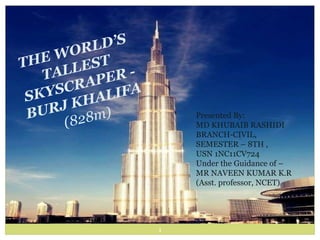
Presented By:
MD KHUBAIB RASHIDI
BRANCH-CIVIL,
SEMESTER – 8TH ,
USN 1NC11CV724
Under the Guidance of –
MR NAVEEN KUMAR K.R
(Asst. professor, NCET)
Contents
2
 Introduction
 Records
 Challenges
 Excavation
 Foundation
 Structural System
 Shape
 Buttressed core
 Casting of Structure
 Concrete Used
 Casting of RCC walls
 Mechanical Rooms
 Elevators
 Cladding
 Test for Cladding
 Glass Panels
 The spire
 Evacuation and Fire Safety
 Environment friendly
 Conclusion
 References
Introduction
3
 The Burj Khalifa is the ever built tallest
man made structure.
 Location: Dubai, United Arab Emirates
 Project Completion: 2010
 Site Area: 104,210 m2
 Project Area: 454,249 m2
 Number of Stories: 162
 Building Height: 828 m
 Use: Commercial + Office,
Hospitality, Mixed Use,
 Residential
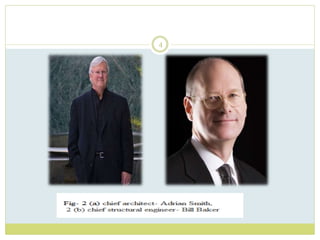
 Architect : Adrian Smith
 Structural Engineer: Bill Baker
 The tower was constructed by a UAE based construction company
EMAAR.
4
Records
5
 Tallest existing structure : 828 m ( 2,717 ft )
 Building with the most floors : 162
 Highest vertical concrete pumping( for a building) :
606 m
 World’s highest elevator installation
 World’s longest travel distance elevators : 504 m
 World’s tallest structure that includes residential space
 World’s highest installation of an aluminum and glass facade : 512 m
 World’s highest night club : 144th floor
 World’s highest restaurant (Atmosphere) : 122nd floor at 442 m
 World’s second highest swimming pool: 76th floor.(world’s highest
swimming pool is located at 118th floor of RITZ CARLTON hotel at
international commerce center, Hong Kong)

Challenges Faced
6
 High Temperature of Dubai resulted in shorter setting time.
 Devastating sandstorms in the area.
 Wind Velocity at such a height.
 Loose and weak soil in the region.
 Formation of vortex.
 Heat resistance of structure.
 Speed of construction.
Excavation
7
 The soil stratum of Dubai is very week so they had to excavate up to 50m
deep to get a hard rock structure.
 But the rock that they found was fragile and saturated with ground water
So that any hole made will be cured immediately.
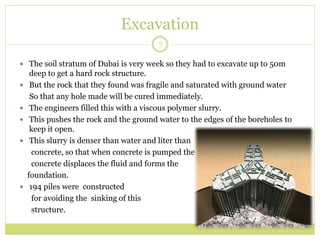
 The engineers filled this with a viscous polymer slurry.
 This pushes the rock and the ground water to the edges of the boreholes to
keep it open.
 This slurry is denser than water and liter than
concrete, so that when concrete is pumped the
concrete displaces the fluid and forms the
foundation.
 194 piles were constructed
for avoiding the sinking of this
structure.
Foundation
8
 The superstructure is supported by a large reinforced concrete mat,
which is in turn supported by bored reinforced concrete piles. The
design was based on extensive geotechnical and seismic studies.
 The 1.5 meter diameter , 43 meter long piles represent the largest and
longest piles conventionally available in the region.
 A high density, low permeability concrete was used in the foundations.
 Cathodic protection system
under the mat, to minimize
any detrimental effects form
corrosive chemicals in local
ground water.
Structural System
9
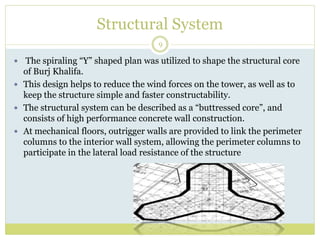
 The spiraling “Y” shaped plan was utilized to shape the structural core
of Burj Khalifa.
 This design helps to reduce the wind forces on the tower, as well as to
keep the structure simple and faster constructability.
 The structural system can be described as a “buttressed core”, and
consists of high performance concrete wall construction.
 At mechanical floors, outrigger walls are provided to link the perimeter
columns to the interior wall system, allowing the perimeter columns to
participate in the lateral load resistance of the structure
Shape
10
 They made a study on the Sears tower at Chicago.
 Burj Khalifa was designed in triangular shape because it was suitable to
deflect the wind to different ways.
 Triangular shape reduces vortex effect.
Buttressed core
11
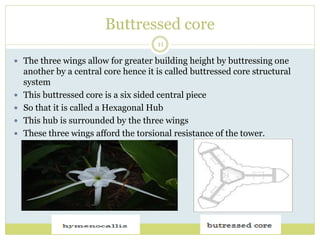
 The three wings allow for greater building height by buttressing one
another by a central core hence it is called buttressed core structural
system
 This buttressed core is a six sided central piece
 So that it is called a Hexagonal Hub
 This hub is surrounded by the three wings
 These three wings afford the torsional resistance of the tower.
Casting of the structure
12
 The casting of the whole structure is mainly done by two materials
1. Concrete
2. Steel
 Over 30,000 tons of steel were used
 About 250,000 m3 concrete was also used
 The reinforced concrete acts as the backbone of the whole structure.
 The pump needs 630HP to pump about 25000 tons of concrete
 It had took about 14mints for reaching the concrete to the 150th floor
 They completed every new floor in 3 day .
Concrete used
13
 High performance concrete(HPC) having Low permeability, High
durability
 C80-C60 cube strength concrete was used
 Two largest concrete pumping machines in the world were used for this
purpose
 For reducing cracks due to high temperature concreting was done only
at night
Casting of RCC walls
14
 For simplicity and speed the engineers made no. of steel cages
 These cages were inserted to the formworks that can be moved easily
 After installation of cages concrete was filled in these formworks
 Only took 12hrs for the setting of concrete.
 After setting the concrete the formworks would move to the next level
with in 2hrs.
Speed of construction and Cranes
15
 For erecting such a structure in the sky steel and glass panels have to be
raised
 The cranes consist of two plates on the two sides
 It could jump from one floor to the another
 So that they were called the kangaroo cranes
 So as to speed up the construction the RCC walls was done in a simple
and clever engineering way
Mechanical Floors
16
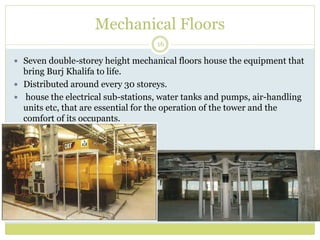
 Seven double-storey height mechanical floors house the equipment that
bring Burj Khalifa to life.
 Distributed around every 30 storeys.
 house the electrical sub-stations, water tanks and pumps, air-handling
units etc, that are essential for the operation of the tower and the
comfort of its occupants.
Elevators and Escalators
17
 The Burj can accommodate about 35,000 people at a time
 Consist of 57 elevators and 8 escalators
 The biggest elevator carries about 46 people at a time
 These elevators travel at a speed of 35km/hr
 The Burj has a service/firemans elevator which have a capacity to hold
about 5,500kg
 And this is the worlds tallest service elevator.
Cladding of the tower
18
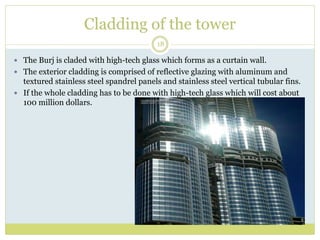
 The Burj is claded with high-tech glass which forms as a curtain wall.
 The exterior cladding is comprised of reflective glazing with aluminum and
textured stainless steel spandrel panels and stainless steel vertical tubular fins.
 If the whole cladding has to be done with high-tech glass which will cost about
100 million dollars.
Test for the Cladding against Storm
19
 The cladding should withstand the heavy sand storms that with in
include water and dust
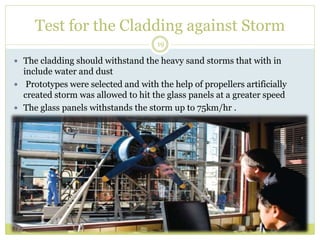
 Prototypes were selected and with the help of propellers artificially
created storm was allowed to hit the glass panels at a greater speed
 The glass panels withstands the storm up to 75km/hr .
Glass panel
20
 The outer layer of panel is coated with a thin layer of metal so that it
reflects the UV radiations
 The inner layer of panel is coated with thin layer of silver so that it
reflects the IR radiations.
 The exterior cladding is comprised of reflective glazing with
aluminum and textured stainless steel spandrel panels and stainless
steel vertical tubular fins.
 Close to 26,000 glass
panels, each individually
hand-cut, were used in
the exterior cladding of
Burj Khalifa.
The Spire
21
 The crowning touch of Burj Khalifa is its telescopic spire comprised of
more than 4,000 tons of structural steel.
 The spire was constructed from inside the building and jacked to its full
height of over 200 metres (700 feet) using a hydraulic pump.
 Creates a sense of completion for the landmark.
22
 The Burj is naturally fire resistant as the concrete backbone is already fire
resistant
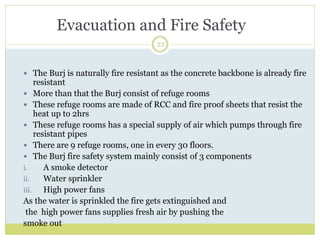
 More than that the Burj consist of refuge rooms
 These refuge rooms are made of RCC and fire proof sheets that resist the
heat up to 2hrs
 These refuge rooms has a special supply of air which pumps through fire
resistant pipes
 There are 9 refuge rooms, one in every 30 floors.
 The Burj fire safety system mainly consist of 3 components
i. A smoke detector
ii. Water sprinkler
iii. High power fans
As the water is sprinkled the fire gets extinguished and
the high power fans supplies fresh air by pushing the
smoke out
Evacuation and Fire Safety
Environment Friendly
23
Water heating
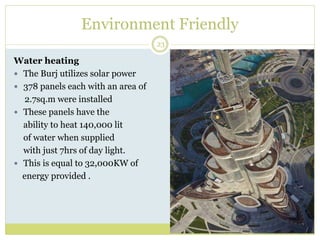
 The Burj utilizes solar power
 378 panels each with an area of
2.7sq.m were installed
 These panels have the
ability to heat 140,000 lit
of water when supplied
with just 7hrs of day light.
 This is equal to 32,000KW of
energy provided .
Environment Friendly
24
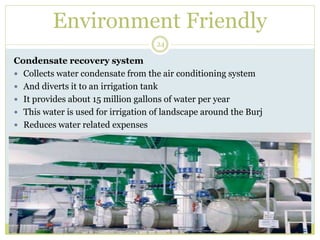
Condensate recovery system
 Collects water condensate from the air conditioning system
 And diverts it to an irrigation tank
 It provides about 15 million gallons of water per year
 This water is used for irrigation of landscape around the Burj
 Reduces water related expenses
Environment Friendly
25
Air ventilation
 Air ventilation provided at the top reduces the energy consumption
 Air at the top of the building is cooler, has low density and relatively
humid
 Its ideal for ventilation
 Less energy is required to maintain the comfortable condition
CONCLUSION
26
 More than just the world's tallest building, Burj Khalifa is an example
of international cooperation, and an emblem of the new, dynamic and
prosperous Middle East.
 In fewer than 30 years, this city has transformed itself from a regional
centre to a global one.
 It represents a significant achievement in terms of utilizing the latest
design, materials, and construction technology and methods, in order
to provide an efficient, rational structure to rise to heights never before
seen.
References
27
 Burland J.B., & Mitchell J.M (1989) piling and deep Foundation.
Proc. Int. conf. on Piling and Deep foundations, London, May 1989.
 Brief on the Construction Planning of the Burj Dubai Project, Dubai,
UAE. Ahmad Abdelrazaq, S.E., Kyung Jun Kim and Jae Ho Kim.
 Fleming W.G.K., Weltman, A.J., Randolph, M.F., Elson W.K. (1994)
piling Engineering.
 Poulous & Bounce (2008).Foundation Design For burj dubai- The
World’s Tallest Building, August 2008.
 Validating the dynamics of the burj khalifa, Ahmad Abdelrazaq.
 William F. Baker, D. Stanton Korista and Lawrence C. Novak (2007)
Burj Dubai: Engineering The World’s Tallest Building, November 2007.

burjjjj new

  • 1.
    1 Presented By: MD KHUBAIBRASHIDI BRANCH-CIVIL, SEMESTER – 8TH , USN 1NC11CV724 Under the Guidance of – MR NAVEEN KUMAR K.R (Asst. professor, NCET)
  • 2.
    Contents 2  Introduction  Records Challenges  Excavation  Foundation  Structural System  Shape  Buttressed core  Casting of Structure  Concrete Used  Casting of RCC walls  Mechanical Rooms  Elevators  Cladding  Test for Cladding  Glass Panels  The spire  Evacuation and Fire Safety  Environment friendly  Conclusion  References
  • 3.
    Introduction 3  The BurjKhalifa is the ever built tallest man made structure.  Location: Dubai, United Arab Emirates  Project Completion: 2010  Site Area: 104,210 m2  Project Area: 454,249 m2  Number of Stories: 162  Building Height: 828 m  Use: Commercial + Office, Hospitality, Mixed Use,  Residential  Architect : Adrian Smith  Structural Engineer: Bill Baker  The tower was constructed by a UAE based construction company EMAAR.
  • 4.
  • 5.
    Records 5  Tallest existingstructure : 828 m ( 2,717 ft )  Building with the most floors : 162  Highest vertical concrete pumping( for a building) : 606 m  World’s highest elevator installation  World’s longest travel distance elevators : 504 m  World’s tallest structure that includes residential space  World’s highest installation of an aluminum and glass facade : 512 m  World’s highest night club : 144th floor  World’s highest restaurant (Atmosphere) : 122nd floor at 442 m  World’s second highest swimming pool: 76th floor.(world’s highest swimming pool is located at 118th floor of RITZ CARLTON hotel at international commerce center, Hong Kong) 
  • 6.
    Challenges Faced 6  HighTemperature of Dubai resulted in shorter setting time.  Devastating sandstorms in the area.  Wind Velocity at such a height.  Loose and weak soil in the region.  Formation of vortex.  Heat resistance of structure.  Speed of construction.
  • 7.
    Excavation 7  The soilstratum of Dubai is very week so they had to excavate up to 50m deep to get a hard rock structure.  But the rock that they found was fragile and saturated with ground water So that any hole made will be cured immediately.  The engineers filled this with a viscous polymer slurry.  This pushes the rock and the ground water to the edges of the boreholes to keep it open.  This slurry is denser than water and liter than concrete, so that when concrete is pumped the concrete displaces the fluid and forms the foundation.  194 piles were constructed for avoiding the sinking of this structure.
  • 8.
    Foundation 8  The superstructureis supported by a large reinforced concrete mat, which is in turn supported by bored reinforced concrete piles. The design was based on extensive geotechnical and seismic studies.  The 1.5 meter diameter , 43 meter long piles represent the largest and longest piles conventionally available in the region.  A high density, low permeability concrete was used in the foundations.  Cathodic protection system under the mat, to minimize any detrimental effects form corrosive chemicals in local ground water.
  • 9.
    Structural System 9  Thespiraling “Y” shaped plan was utilized to shape the structural core of Burj Khalifa.  This design helps to reduce the wind forces on the tower, as well as to keep the structure simple and faster constructability.  The structural system can be described as a “buttressed core”, and consists of high performance concrete wall construction.  At mechanical floors, outrigger walls are provided to link the perimeter columns to the interior wall system, allowing the perimeter columns to participate in the lateral load resistance of the structure
  • 10.
    Shape 10  They madea study on the Sears tower at Chicago.  Burj Khalifa was designed in triangular shape because it was suitable to deflect the wind to different ways.  Triangular shape reduces vortex effect.
  • 11.
    Buttressed core 11  Thethree wings allow for greater building height by buttressing one another by a central core hence it is called buttressed core structural system  This buttressed core is a six sided central piece  So that it is called a Hexagonal Hub  This hub is surrounded by the three wings  These three wings afford the torsional resistance of the tower.
  • 12.
    Casting of thestructure 12  The casting of the whole structure is mainly done by two materials 1. Concrete 2. Steel  Over 30,000 tons of steel were used  About 250,000 m3 concrete was also used  The reinforced concrete acts as the backbone of the whole structure.  The pump needs 630HP to pump about 25000 tons of concrete  It had took about 14mints for reaching the concrete to the 150th floor  They completed every new floor in 3 day .
  • 13.
    Concrete used 13  Highperformance concrete(HPC) having Low permeability, High durability  C80-C60 cube strength concrete was used  Two largest concrete pumping machines in the world were used for this purpose  For reducing cracks due to high temperature concreting was done only at night
  • 14.
    Casting of RCCwalls 14  For simplicity and speed the engineers made no. of steel cages  These cages were inserted to the formworks that can be moved easily  After installation of cages concrete was filled in these formworks  Only took 12hrs for the setting of concrete.  After setting the concrete the formworks would move to the next level with in 2hrs.
  • 15.
    Speed of constructionand Cranes 15  For erecting such a structure in the sky steel and glass panels have to be raised  The cranes consist of two plates on the two sides  It could jump from one floor to the another  So that they were called the kangaroo cranes  So as to speed up the construction the RCC walls was done in a simple and clever engineering way
  • 16.
    Mechanical Floors 16  Sevendouble-storey height mechanical floors house the equipment that bring Burj Khalifa to life.  Distributed around every 30 storeys.  house the electrical sub-stations, water tanks and pumps, air-handling units etc, that are essential for the operation of the tower and the comfort of its occupants.
  • 17.
    Elevators and Escalators 17 The Burj can accommodate about 35,000 people at a time  Consist of 57 elevators and 8 escalators  The biggest elevator carries about 46 people at a time  These elevators travel at a speed of 35km/hr  The Burj has a service/firemans elevator which have a capacity to hold about 5,500kg  And this is the worlds tallest service elevator.
  • 18.
    Cladding of thetower 18  The Burj is claded with high-tech glass which forms as a curtain wall.  The exterior cladding is comprised of reflective glazing with aluminum and textured stainless steel spandrel panels and stainless steel vertical tubular fins.  If the whole cladding has to be done with high-tech glass which will cost about 100 million dollars.
  • 19.
    Test for theCladding against Storm 19  The cladding should withstand the heavy sand storms that with in include water and dust  Prototypes were selected and with the help of propellers artificially created storm was allowed to hit the glass panels at a greater speed  The glass panels withstands the storm up to 75km/hr .
  • 20.
    Glass panel 20  Theouter layer of panel is coated with a thin layer of metal so that it reflects the UV radiations  The inner layer of panel is coated with thin layer of silver so that it reflects the IR radiations.  The exterior cladding is comprised of reflective glazing with aluminum and textured stainless steel spandrel panels and stainless steel vertical tubular fins.  Close to 26,000 glass panels, each individually hand-cut, were used in the exterior cladding of Burj Khalifa.
  • 21.
    The Spire 21  Thecrowning touch of Burj Khalifa is its telescopic spire comprised of more than 4,000 tons of structural steel.  The spire was constructed from inside the building and jacked to its full height of over 200 metres (700 feet) using a hydraulic pump.  Creates a sense of completion for the landmark.
  • 22.
    22  The Burjis naturally fire resistant as the concrete backbone is already fire resistant  More than that the Burj consist of refuge rooms  These refuge rooms are made of RCC and fire proof sheets that resist the heat up to 2hrs  These refuge rooms has a special supply of air which pumps through fire resistant pipes  There are 9 refuge rooms, one in every 30 floors.  The Burj fire safety system mainly consist of 3 components i. A smoke detector ii. Water sprinkler iii. High power fans As the water is sprinkled the fire gets extinguished and the high power fans supplies fresh air by pushing the smoke out Evacuation and Fire Safety
  • 23.
    Environment Friendly 23 Water heating The Burj utilizes solar power  378 panels each with an area of 2.7sq.m were installed  These panels have the ability to heat 140,000 lit of water when supplied with just 7hrs of day light.  This is equal to 32,000KW of energy provided .
  • 24.
    Environment Friendly 24 Condensate recoverysystem  Collects water condensate from the air conditioning system  And diverts it to an irrigation tank  It provides about 15 million gallons of water per year  This water is used for irrigation of landscape around the Burj  Reduces water related expenses
  • 25.
    Environment Friendly 25 Air ventilation Air ventilation provided at the top reduces the energy consumption  Air at the top of the building is cooler, has low density and relatively humid  Its ideal for ventilation  Less energy is required to maintain the comfortable condition
  • 26.
    CONCLUSION 26  More thanjust the world's tallest building, Burj Khalifa is an example of international cooperation, and an emblem of the new, dynamic and prosperous Middle East.  In fewer than 30 years, this city has transformed itself from a regional centre to a global one.  It represents a significant achievement in terms of utilizing the latest design, materials, and construction technology and methods, in order to provide an efficient, rational structure to rise to heights never before seen.
  • 27.
    References 27  Burland J.B.,& Mitchell J.M (1989) piling and deep Foundation. Proc. Int. conf. on Piling and Deep foundations, London, May 1989.  Brief on the Construction Planning of the Burj Dubai Project, Dubai, UAE. Ahmad Abdelrazaq, S.E., Kyung Jun Kim and Jae Ho Kim.  Fleming W.G.K., Weltman, A.J., Randolph, M.F., Elson W.K. (1994) piling Engineering.  Poulous & Bounce (2008).Foundation Design For burj dubai- The World’s Tallest Building, August 2008.  Validating the dynamics of the burj khalifa, Ahmad Abdelrazaq.  William F. Baker, D. Stanton Korista and Lawrence C. Novak (2007) Burj Dubai: Engineering The World’s Tallest Building, November 2007.