Small Business Insurance 101
Presented by McKenzie May
ISU Insurance Services The May Agency
SBDC and SEED Corp.
April 21, 2010
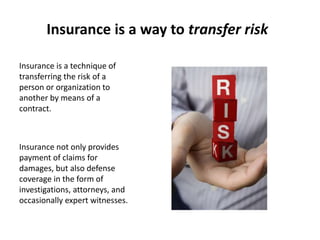
Insurance is a way to transfer risk
Insurance is a technique of
transferring the risk of a
person or organization to
another by means of a
contract.
Insurance not only provides
payment of claims for
damages, but also defense
coverage in the form of
investigations, attorneys, and
occasionally expert witnesses.
Some common definitions for today
You = you, your organization, your
business.
Your stuff = all the property of you,
your organization, your business.
The Other Guy = someone who is not
related to your business and is not
named in your insurance policies.
Every small business needs insurance
You need insurance…how
much and what kind
varies. As your business
grows and changes, so
will your insurance needs.
The first, and most
important, step is to find
an insurance agent who
you like and trust to help
you through the process.
Choosing your insurance agent
• Ask your friends, family, and other business owners for
their recommendations.
• Look for an independent agent. Independent agents work
with more than one insurance company, which will afford
you more options.
• Your agent will be able to help you determine the best
value for your dollar. Cheapest price isn’t always best.
• If you don’t feel comfortable working with or trusting your
agent, you need to find a new agent. The relationship with
your agent will be very important in the event of a loss, and
you need to feel confident that your agent will help take
care of you and look out for your best interests.
• If your agent encourages you to lie or omit information, you
should be wary of their trustworthiness. It may save you a
few dollars now, but you will pay the price in the long run.
Choosing an insurance company
• The company provides the policy, bills you for the
premium, and pays your covered losses.
• Consider the value of the coverage offered, not
just the premium that you will pay.
• Ask your independent insurance agent about
their experience with the company – how happy
are they with the company’s claims service,
coverage, and billing.
• Ask your independent agent for the financial
rating of the company, and choose a company
with at least a B+ rating. A- or better is preferred.
Commercial General Liability
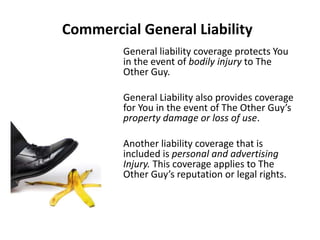
General liability coverage protects You
in the event of bodily injury to The
Other Guy.
General Liability also provides coverage
for You in the event of The Other Guy’s
property damage or loss of use.
Another liability coverage that is
included is personal and advertising
Injury. This coverage applies to The
Other Guy’s reputation or legal rights.
Commercial General Liability
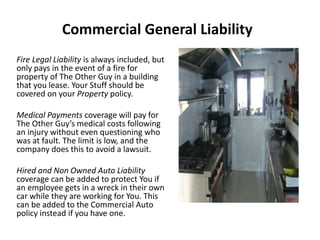
Fire Legal Liability is always included, but
only pays in the event of a fire for
property of The Other Guy in a building
that you lease. Your Stuff should be
covered on your Property policy.
Medical Payments coverage will pay for
The Other Guy’s medical costs following
an injury without even questioning who
was at fault. The limit is low, and the
company does this to avoid a lawsuit.
Hired and Non Owned Auto Liability
coverage can be added to protect You if
an employee gets in a wreck in their own
car while they are working for You. This
can be added to the Commercial Auto
policy instead if you have one.
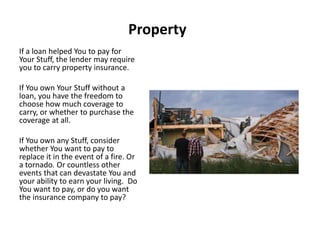
Property
If a loan helped You to pay for
Your Stuff, the lender may require
you to carry property insurance.
If You own Your Stuff without a
loan, you have the freedom to
choose how much coverage to
carry, or whether to purchase the
coverage at all.
If You own any Stuff, consider
whether You want to pay to
replace it in the event of a fire. Or
a tornado. Or countless other
events that can devastate You and
your ability to earn your living. Do
You want to pay, or do you want
the insurance company to pay?
Property
Business Income and Extra Expense
In addition to Your Stuff, you
need to protect your income.
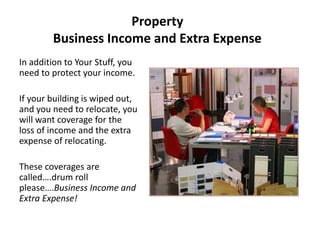
If your building is wiped out,
and you need to relocate, you
will want coverage for the
loss of income and the extra
expense of relocating.
These coverages are
called….drum roll
please….Business Income and
Extra Expense!
Property – Inland Marine
Inland Marine coverage is an
interesting name.
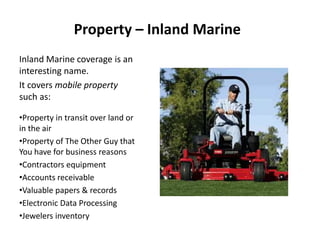
It covers mobile property
such as:
•Property in transit over land or
in the air
•Property of The Other Guy that
You have for business reasons
•Contractors equipment
•Accounts receivable
•Valuable papers & records
•Electronic Data Processing
•Jewelers inventory
The Business Owner Policy (BOP)
The BOP combines Liability
and Property coverage,
usually with lots of extras, for
a low cost.
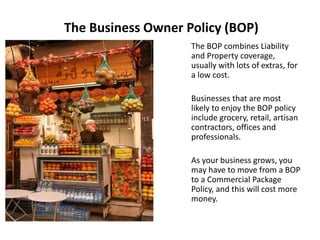
Businesses that are most
likely to enjoy the BOP policy
include grocery, retail, artisan
contractors, offices and
professionals.
As your business grows, you
may have to move from a BOP
to a Commercial Package
Policy, and this will cost more
money.
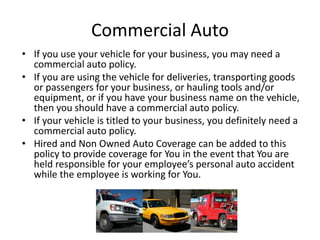
Commercial Auto
• If you use your vehicle for your business, you may need a
commercial auto policy.
• If you are using the vehicle for deliveries, transporting goods
or passengers for your business, or hauling tools and/or
equipment, or if you have your business name on the vehicle,
then you should have a commercial auto policy.
• If your vehicle is titled to your business, you definitely need a
commercial auto policy.
• Hired and Non Owned Auto Coverage can be added to this
policy to provide coverage for You in the event that You are
held responsible for your employee’s personal auto accident
while the employee is working for You.
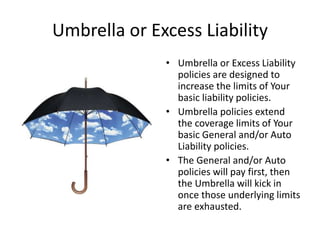
Umbrella or Excess Liability
• Umbrella or Excess Liability
policies are designed to
increase the limits of Your
basic liability policies.
• Umbrella policies extend
the coverage limits of Your
basic General and/or Auto
Liability policies.
• The General and/or Auto
policies will pay first, then
the Umbrella will kick in
once those underlying limits
are exhausted.
Workers Compensation
In Indiana, most businesses
must provide Work Comp
coverage, even if there is only
one employee.
Workers Compensation will
pay for medical expenses, lost
wages, and/or death benefits
for employees who suffer a
work related injury or illness.
Additional info can be found at:
http://www.in.gov/wcb
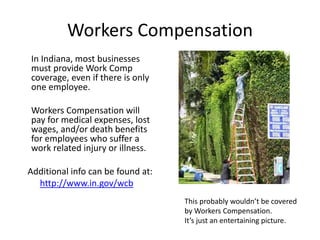
This probably wouldn’t be covered
by Workers Compensation.
It’s just an entertaining picture.
Professional Liability/
Errors & Omissions
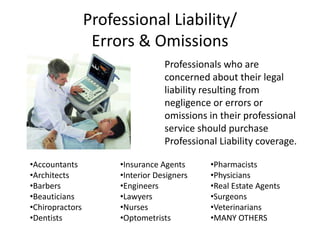
Professionals who are
concerned about their legal
liability resulting from
negligence or errors or
omissions in their professional
service should purchase
Professional Liability coverage.
•Accountants
•Architects
•Barbers
•Beauticians
•Chiropractors
•Dentists
•Insurance Agents
•Interior Designers
•Engineers
•Lawyers
•Nurses
•Optometrists
•Pharmacists
•Physicians
•Real Estate Agents
•Surgeons
•Veterinarians
•MANY OTHERS
Employment Practices Liability
Employment Practices
Liability insurance provides
coverage for You in the
event of suit against You by
a prospective, current or
former employee.
Examples:
•Discrimination
•Wrongful Termination
•Sexual Harassment
•Invasion of Privacy
•False Imprisonment
•Breach of Contract
•Emotional Distress
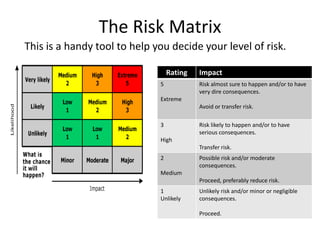
The Risk Matrix
This is a handy tool to help you decide your level of risk.
Rating Impact
5
Extreme
Risk almost sure to happen and/or to have
very dire consequences.
Avoid or transfer risk.
3
High
Risk likely to happen and/or to have
serious consequences.
Transfer risk.
2
Medium
Possible risk and/or moderate
consequences.
Proceed, preferably reduce risk.
1
Unlikely
Unlikely risk and/or minor or negligible
consequences.
Proceed.

Business Insurance 101

  • 1.
    Small Business Insurance101 Presented by McKenzie May ISU Insurance Services The May Agency SBDC and SEED Corp. April 21, 2010
  • 2.
    Insurance is away to transfer risk Insurance is a technique of transferring the risk of a person or organization to another by means of a contract. Insurance not only provides payment of claims for damages, but also defense coverage in the form of investigations, attorneys, and occasionally expert witnesses.
  • 3.
    Some common definitionsfor today You = you, your organization, your business. Your stuff = all the property of you, your organization, your business. The Other Guy = someone who is not related to your business and is not named in your insurance policies.
  • 4.
    Every small businessneeds insurance You need insurance…how much and what kind varies. As your business grows and changes, so will your insurance needs. The first, and most important, step is to find an insurance agent who you like and trust to help you through the process.
  • 5.
    Choosing your insuranceagent • Ask your friends, family, and other business owners for their recommendations. • Look for an independent agent. Independent agents work with more than one insurance company, which will afford you more options. • Your agent will be able to help you determine the best value for your dollar. Cheapest price isn’t always best. • If you don’t feel comfortable working with or trusting your agent, you need to find a new agent. The relationship with your agent will be very important in the event of a loss, and you need to feel confident that your agent will help take care of you and look out for your best interests. • If your agent encourages you to lie or omit information, you should be wary of their trustworthiness. It may save you a few dollars now, but you will pay the price in the long run.
  • 6.
    Choosing an insurancecompany • The company provides the policy, bills you for the premium, and pays your covered losses. • Consider the value of the coverage offered, not just the premium that you will pay. • Ask your independent insurance agent about their experience with the company – how happy are they with the company’s claims service, coverage, and billing. • Ask your independent agent for the financial rating of the company, and choose a company with at least a B+ rating. A- or better is preferred.
  • 7.
    Commercial General Liability Generalliability coverage protects You in the event of bodily injury to The Other Guy. General Liability also provides coverage for You in the event of The Other Guy’s property damage or loss of use. Another liability coverage that is included is personal and advertising Injury. This coverage applies to The Other Guy’s reputation or legal rights.
  • 8.
    Commercial General Liability FireLegal Liability is always included, but only pays in the event of a fire for property of The Other Guy in a building that you lease. Your Stuff should be covered on your Property policy. Medical Payments coverage will pay for The Other Guy’s medical costs following an injury without even questioning who was at fault. The limit is low, and the company does this to avoid a lawsuit. Hired and Non Owned Auto Liability coverage can be added to protect You if an employee gets in a wreck in their own car while they are working for You. This can be added to the Commercial Auto policy instead if you have one.
  • 9.
    Property If a loanhelped You to pay for Your Stuff, the lender may require you to carry property insurance. If You own Your Stuff without a loan, you have the freedom to choose how much coverage to carry, or whether to purchase the coverage at all. If You own any Stuff, consider whether You want to pay to replace it in the event of a fire. Or a tornado. Or countless other events that can devastate You and your ability to earn your living. Do You want to pay, or do you want the insurance company to pay?
  • 10.
    Property Business Income andExtra Expense In addition to Your Stuff, you need to protect your income. If your building is wiped out, and you need to relocate, you will want coverage for the loss of income and the extra expense of relocating. These coverages are called….drum roll please….Business Income and Extra Expense!
  • 11.
    Property – InlandMarine Inland Marine coverage is an interesting name. It covers mobile property such as: •Property in transit over land or in the air •Property of The Other Guy that You have for business reasons •Contractors equipment •Accounts receivable •Valuable papers & records •Electronic Data Processing •Jewelers inventory
  • 12.
    The Business OwnerPolicy (BOP) The BOP combines Liability and Property coverage, usually with lots of extras, for a low cost. Businesses that are most likely to enjoy the BOP policy include grocery, retail, artisan contractors, offices and professionals. As your business grows, you may have to move from a BOP to a Commercial Package Policy, and this will cost more money.
  • 13.
    Commercial Auto • Ifyou use your vehicle for your business, you may need a commercial auto policy. • If you are using the vehicle for deliveries, transporting goods or passengers for your business, or hauling tools and/or equipment, or if you have your business name on the vehicle, then you should have a commercial auto policy. • If your vehicle is titled to your business, you definitely need a commercial auto policy. • Hired and Non Owned Auto Coverage can be added to this policy to provide coverage for You in the event that You are held responsible for your employee’s personal auto accident while the employee is working for You.
  • 14.
    Umbrella or ExcessLiability • Umbrella or Excess Liability policies are designed to increase the limits of Your basic liability policies. • Umbrella policies extend the coverage limits of Your basic General and/or Auto Liability policies. • The General and/or Auto policies will pay first, then the Umbrella will kick in once those underlying limits are exhausted.
  • 15.
    Workers Compensation In Indiana,most businesses must provide Work Comp coverage, even if there is only one employee. Workers Compensation will pay for medical expenses, lost wages, and/or death benefits for employees who suffer a work related injury or illness. Additional info can be found at: http://www.in.gov/wcb This probably wouldn’t be covered by Workers Compensation. It’s just an entertaining picture.
  • 16.
    Professional Liability/ Errors &Omissions Professionals who are concerned about their legal liability resulting from negligence or errors or omissions in their professional service should purchase Professional Liability coverage. •Accountants •Architects •Barbers •Beauticians •Chiropractors •Dentists •Insurance Agents •Interior Designers •Engineers •Lawyers •Nurses •Optometrists •Pharmacists •Physicians •Real Estate Agents •Surgeons •Veterinarians •MANY OTHERS
  • 17.
    Employment Practices Liability EmploymentPractices Liability insurance provides coverage for You in the event of suit against You by a prospective, current or former employee. Examples: •Discrimination •Wrongful Termination •Sexual Harassment •Invasion of Privacy •False Imprisonment •Breach of Contract •Emotional Distress
  • 18.
    The Risk Matrix Thisis a handy tool to help you decide your level of risk. Rating Impact 5 Extreme Risk almost sure to happen and/or to have very dire consequences. Avoid or transfer risk. 3 High Risk likely to happen and/or to have serious consequences. Transfer risk. 2 Medium Possible risk and/or moderate consequences. Proceed, preferably reduce risk. 1 Unlikely Unlikely risk and/or minor or negligible consequences. Proceed.