What Type of Strategy, Leadership and Internal Structures are Required
to Develop and Execute a Micro-credential Strategy?
Prof. Mark Brown
https://www.deviantart.com/tag/loneranger
Graz, 4th November 2022
MicroCredX
Your institution has important choices!
https://www.deviantart.com/tag/loneranger
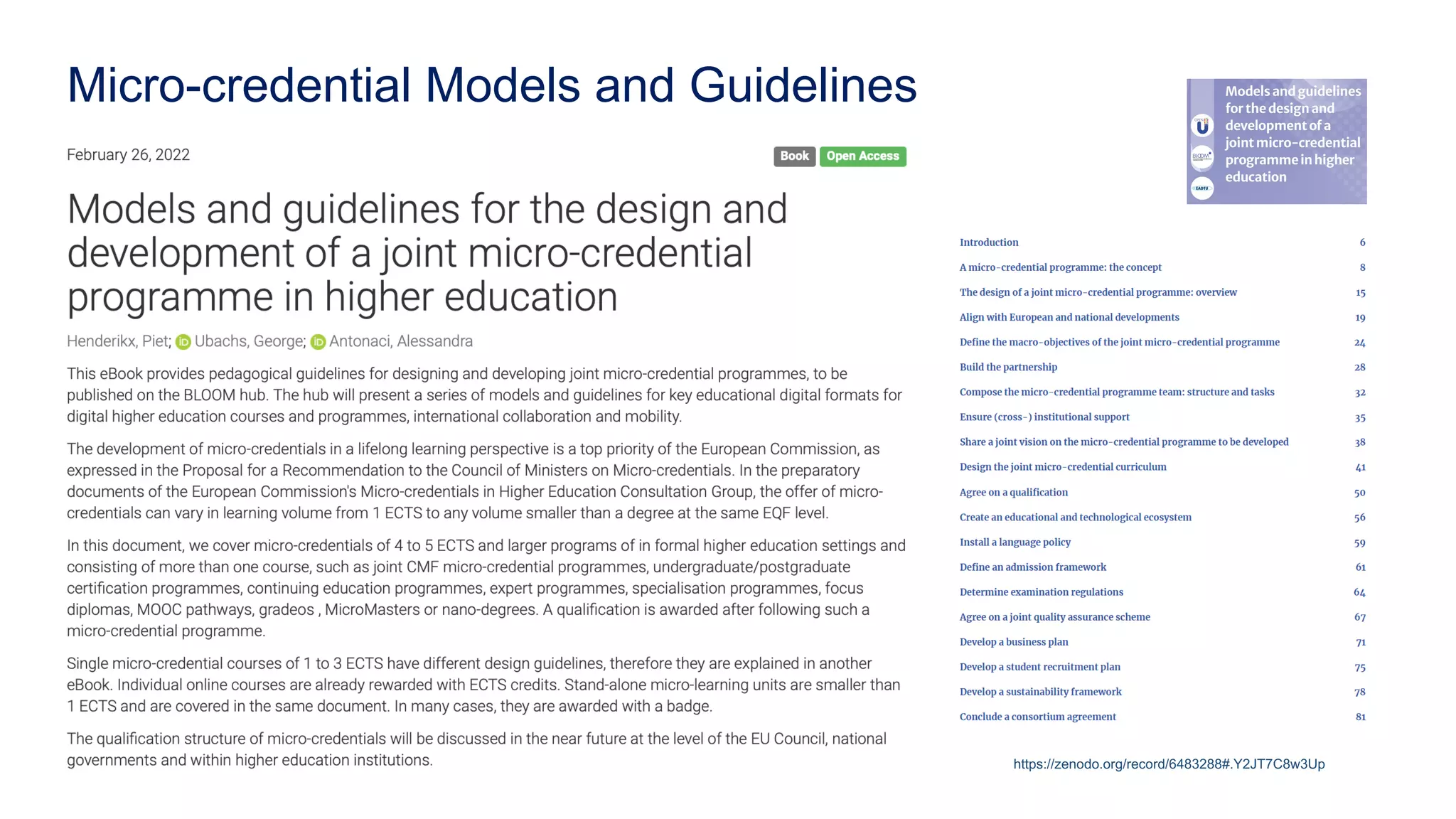
https://zenodo.org/record/6483288#.Y2JT7C8w3Up
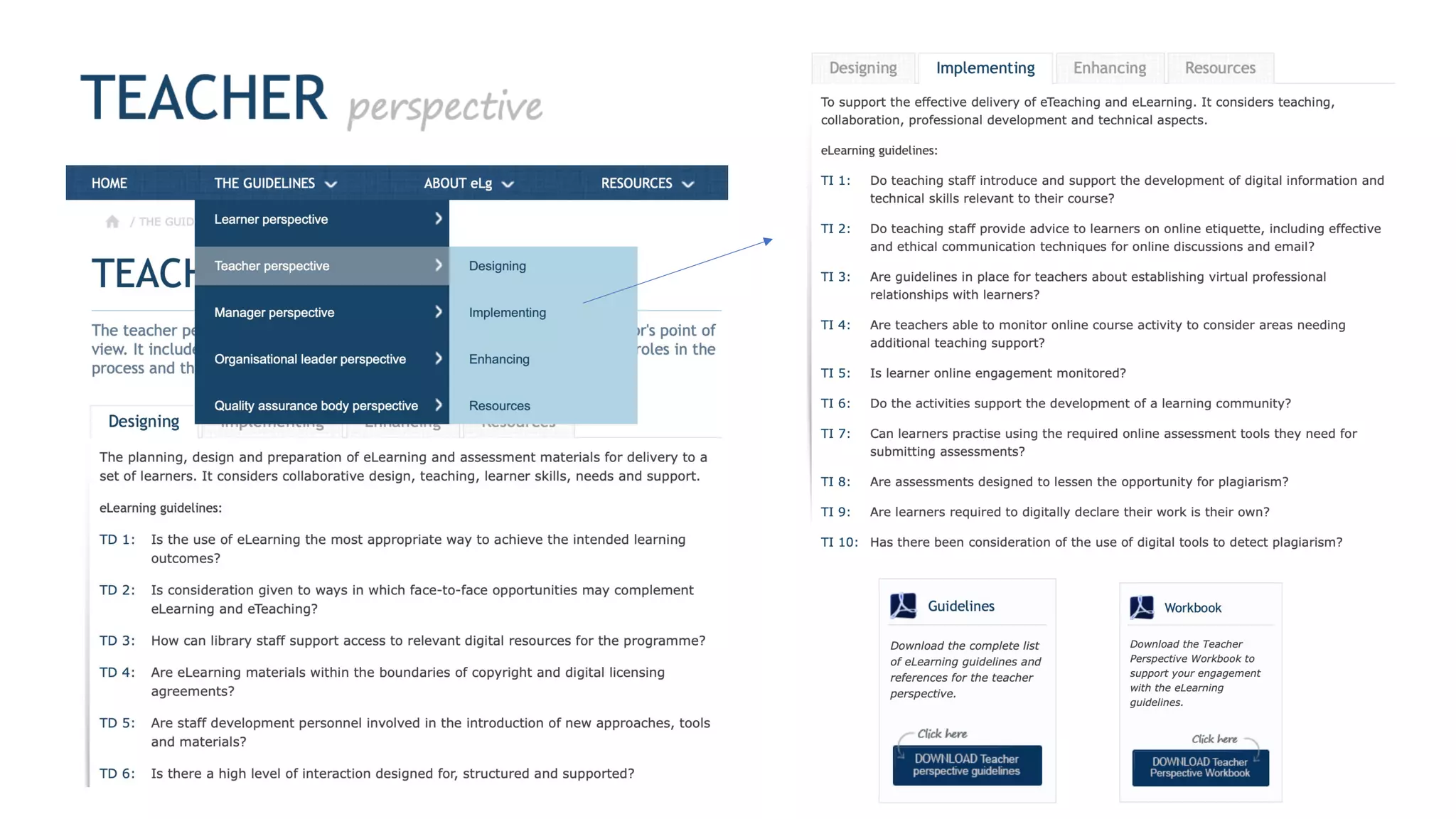
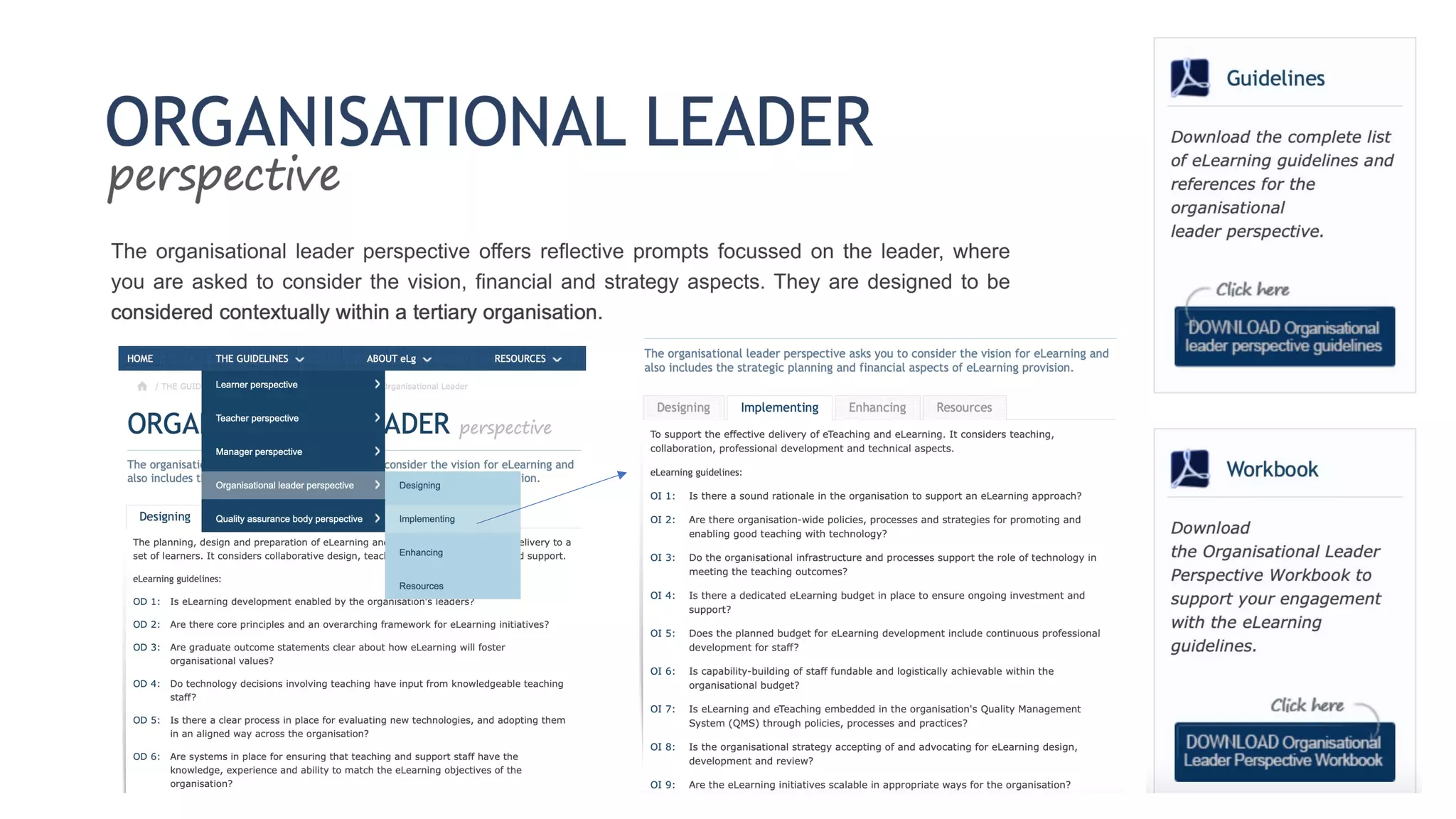
Micro-credential Models and Guidelines
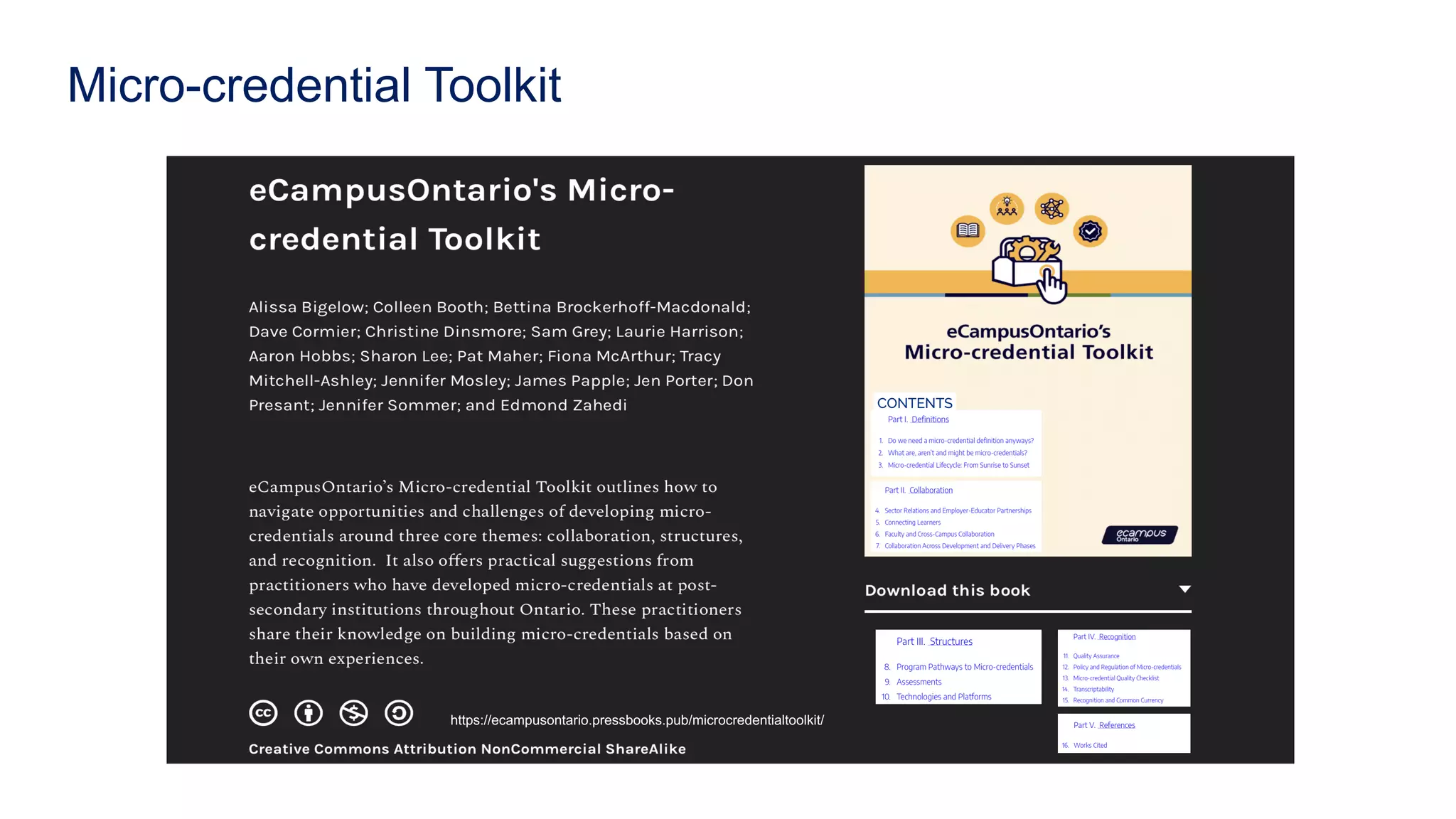
https://ecampusontario.pressbooks.pub/microcredentialtoolkit/
Micro-credential Toolkit
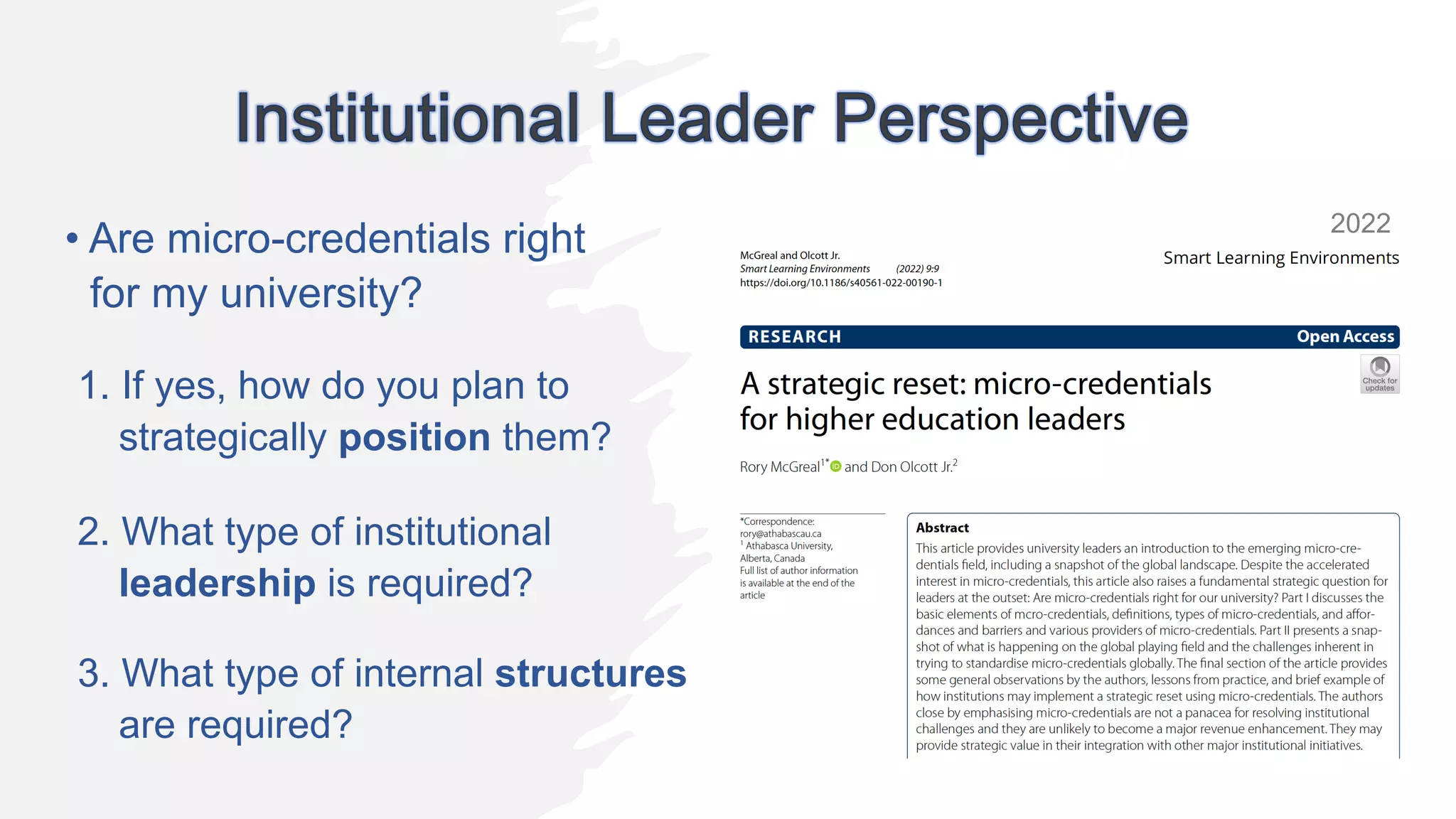
• Are micro-credentials right
for my university?
2. What type of institutional
leadership is required?
1. If yes, how do you plan to
strategically position them?
2022
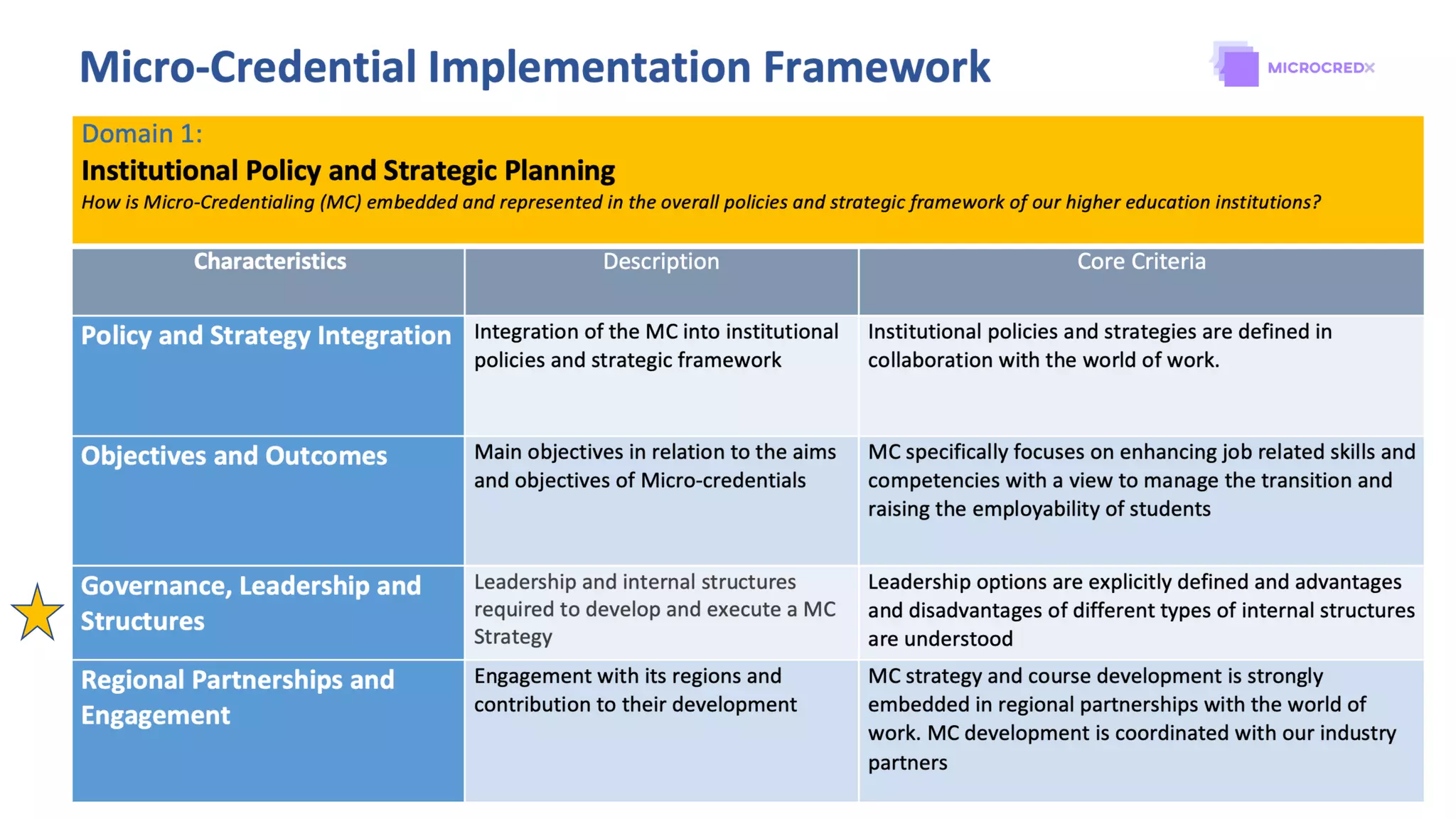
3. What type of internal structures
are required?
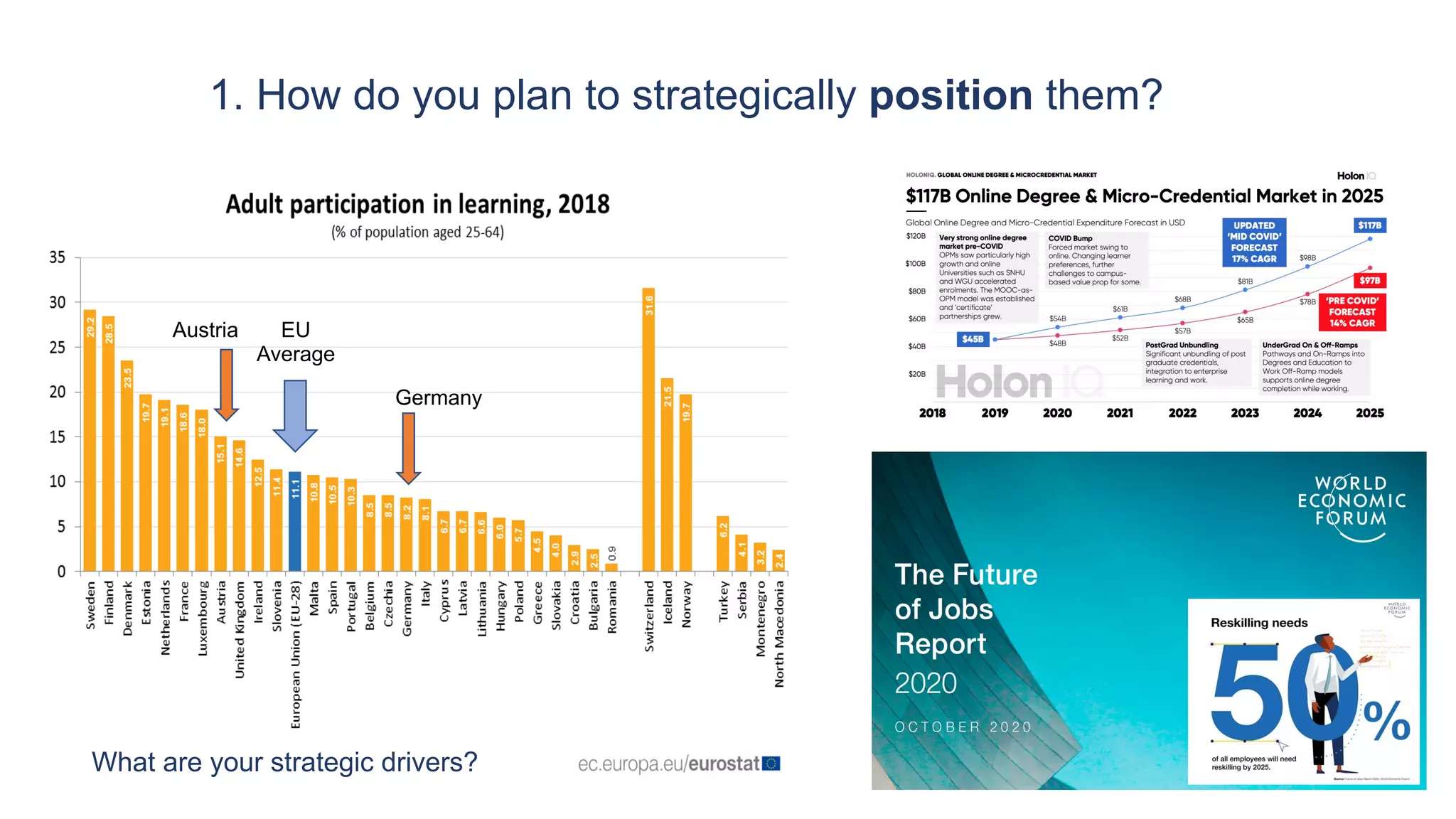
1. How do you plan to strategically position them?
Germany
EU
Average
What are your strategic drivers?
Austria
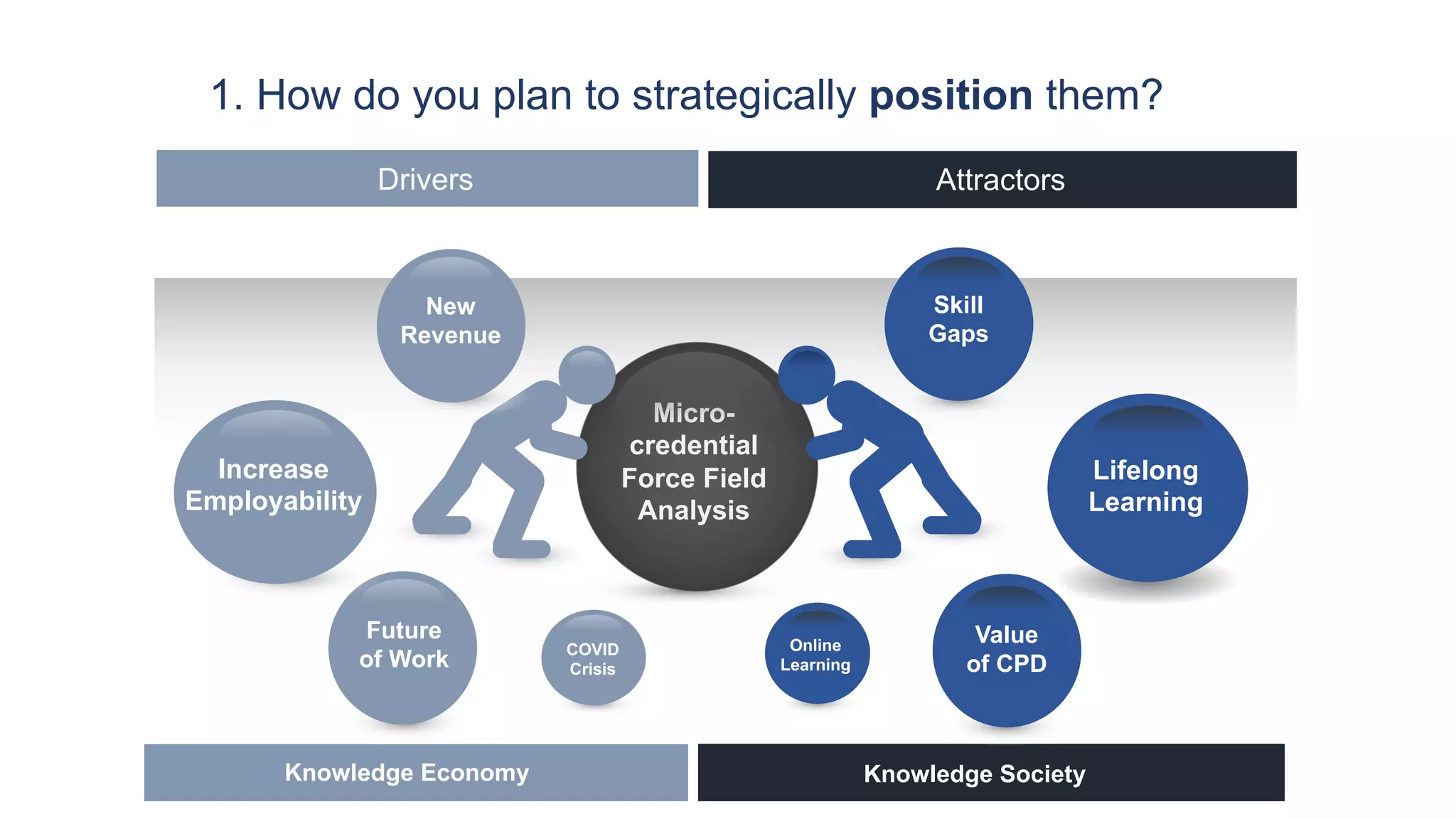
Drivers Attractors
Micro-
credential
Force Field
Analysis
Future
of Work
Increase
Employability
New
Revenue
Skill
Gaps
Lifelong
Learning
Restraining
Force 1
•Example text
•Fill in your own
•Example text
Online
Learning
1. How do you plan to strategically position them?
Restraining Force 1
•Example text
•Fill in your own
•Example text
Value
of CPD
COVID
Crisis
Knowledge Economy Knowledge Society
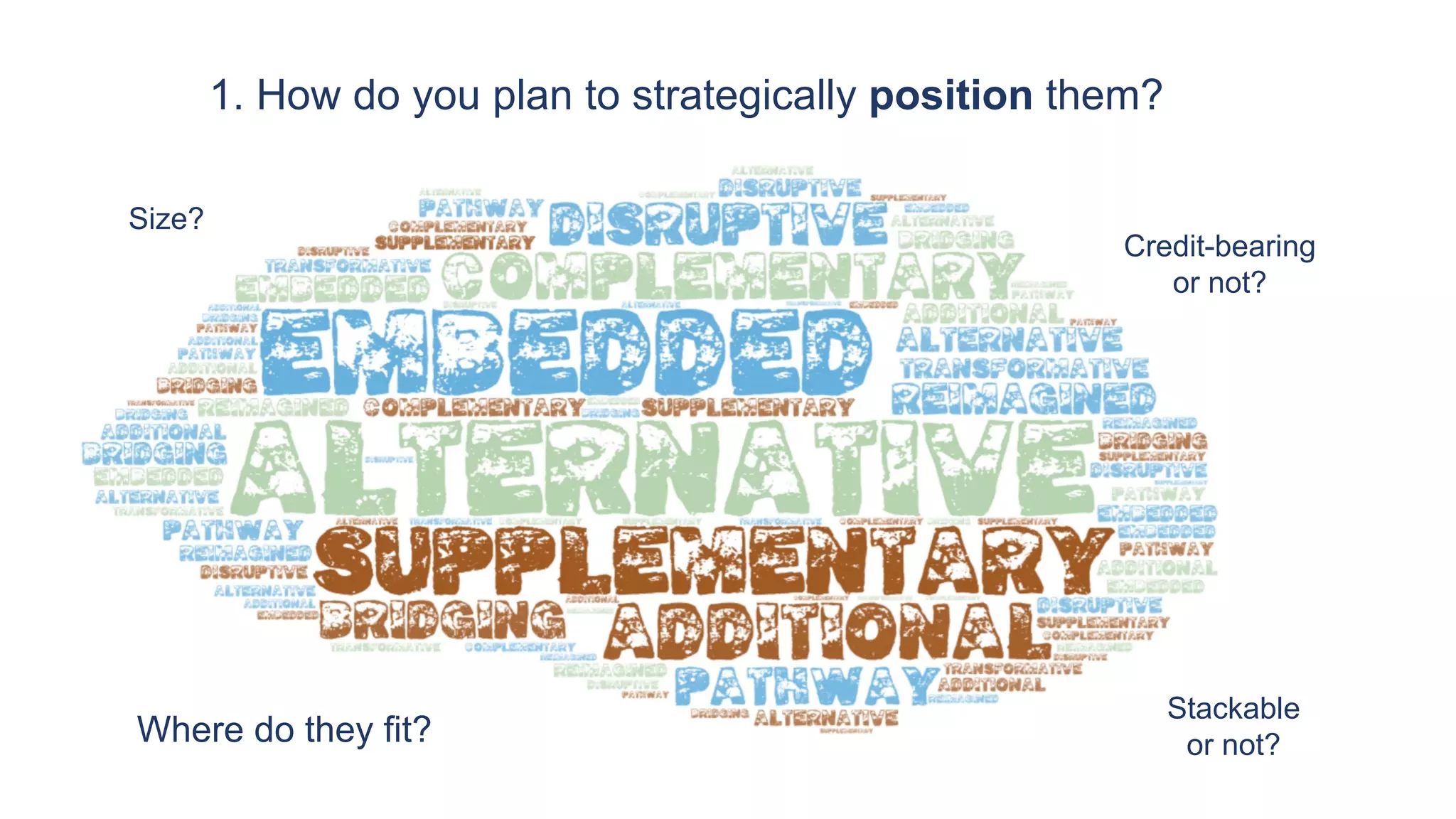
1. How do you plan to strategically position them?
Where do they fit?
Credit-bearing
or not?
Stackable
or not?
Size?
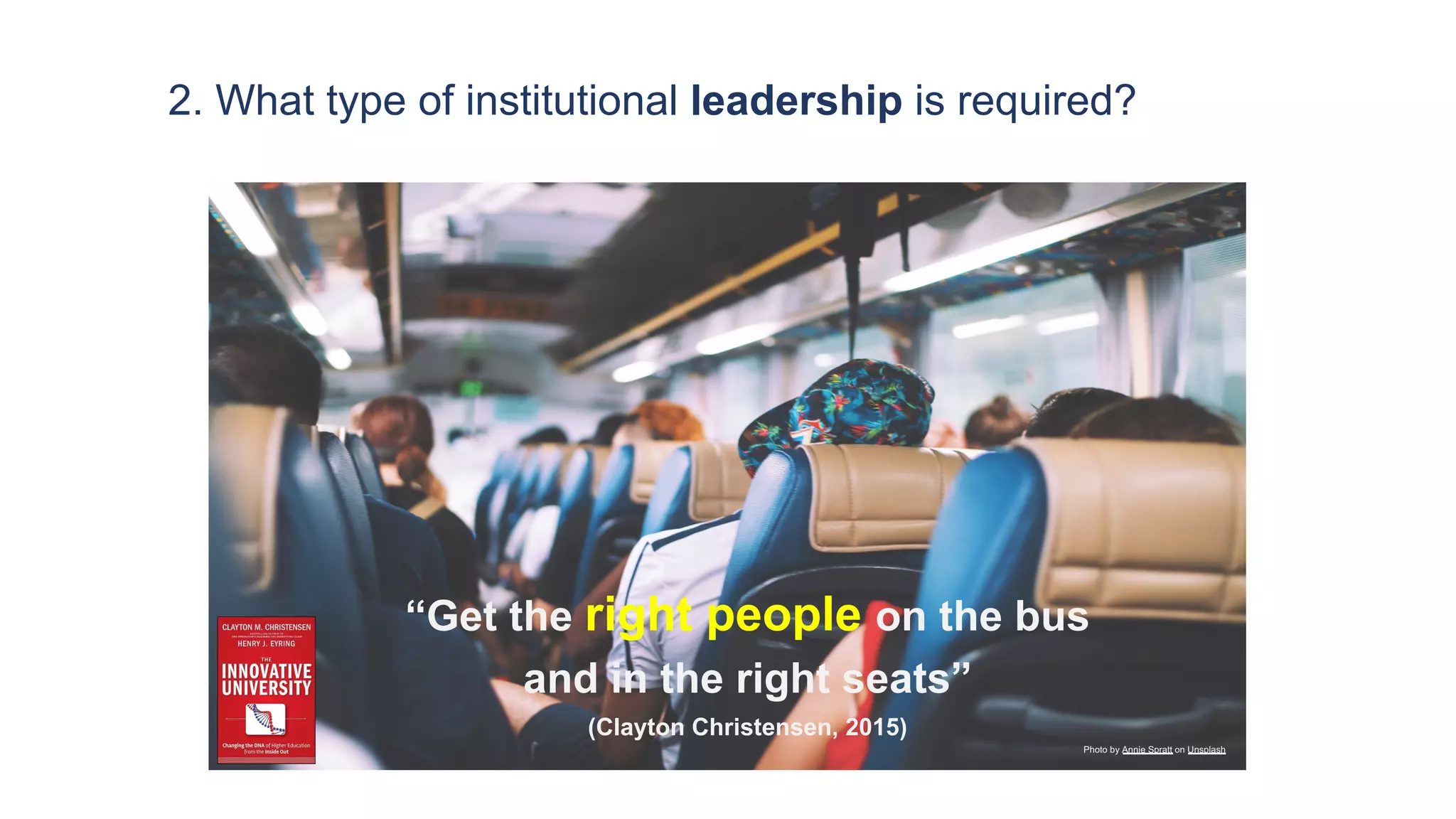
2. What type of institutional leadership is required?
Photo by Annie Spratt on Unsplash
“Get the right people on the bus
and in the right seats”
(Clayton Christensen, 2015)
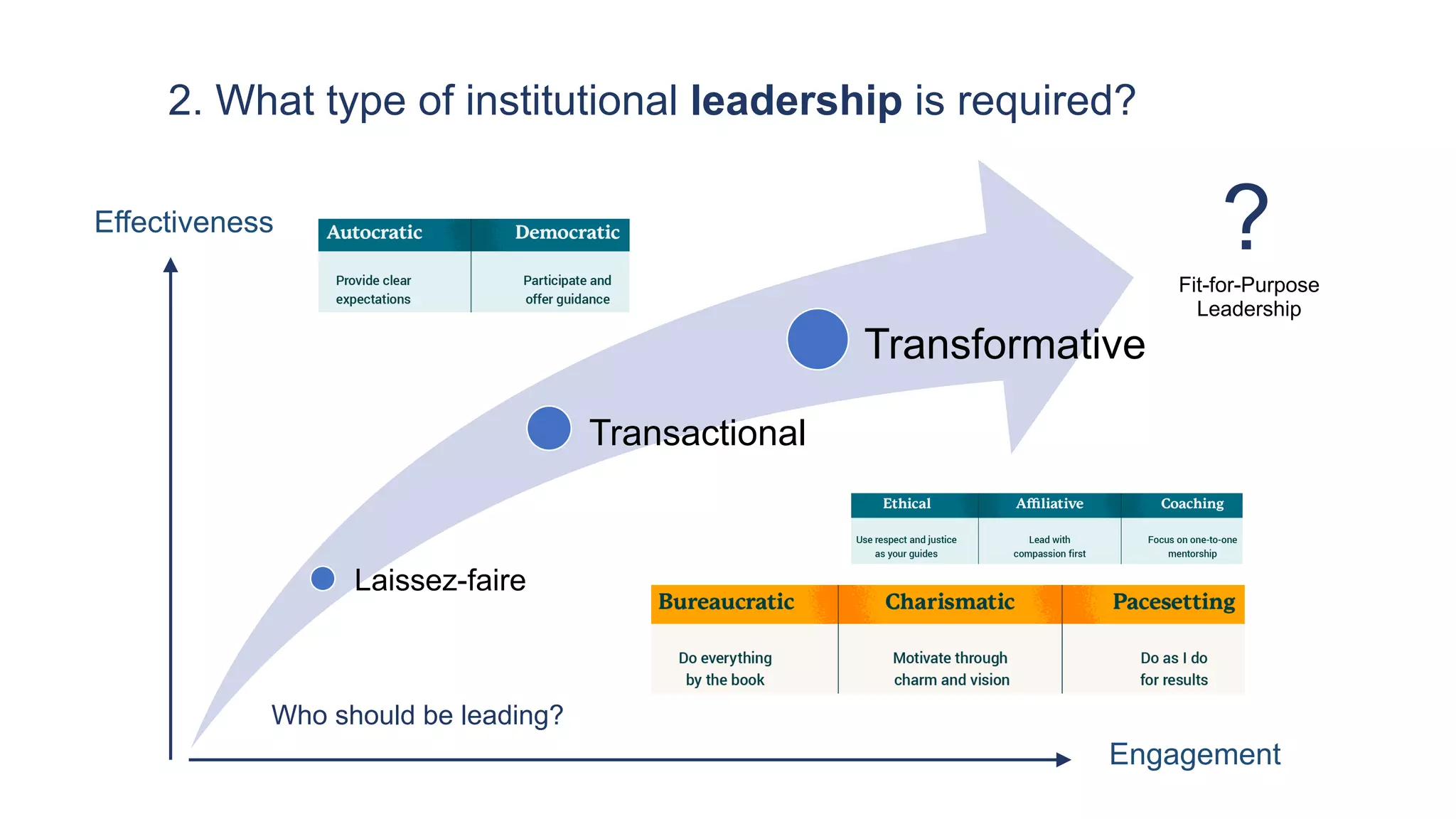
Laissez-faire
Transactional
Transformative
Effectiveness
Engagement
Who should be leading?
?
Fit-for-Purpose
Leadership
2. What type of institutional leadership is required?
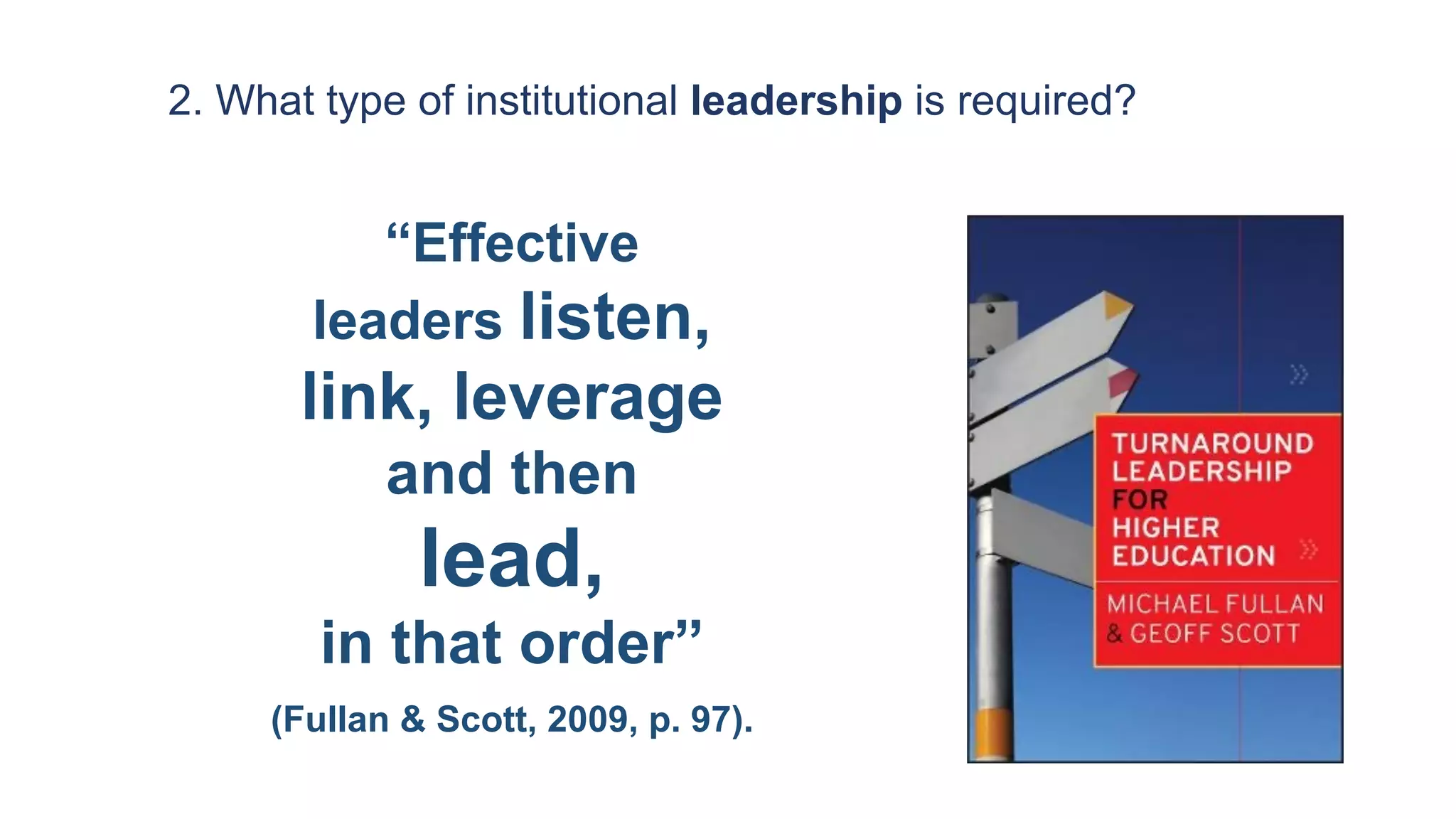
“Effective
leaders listen,
link, leverage
and then
lead,
in that order”
(Fullan & Scott, 2009, p. 97).
2. What type of institutional leadership is required?
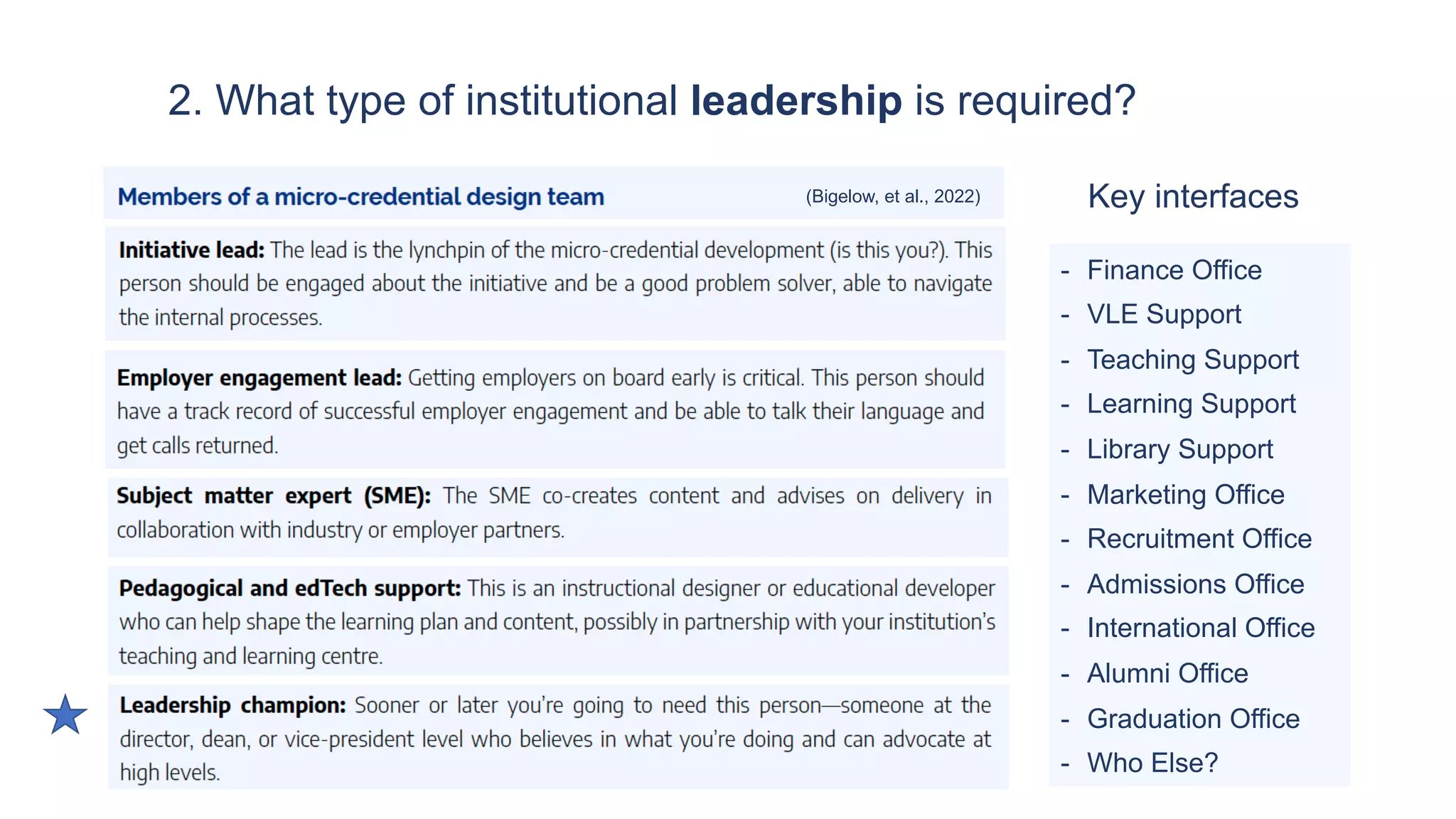
(Bigelow, et al., 2022) Key interfaces
- Finance Office
- VLE Support
- Teaching Support
- Learning Support
- Library Support
- Marketing Office
- Recruitment Office
- Admissions Office
- International Office
- Alumni Office
- Graduation Office
- Who Else?
2. What type of institutional leadership is required?
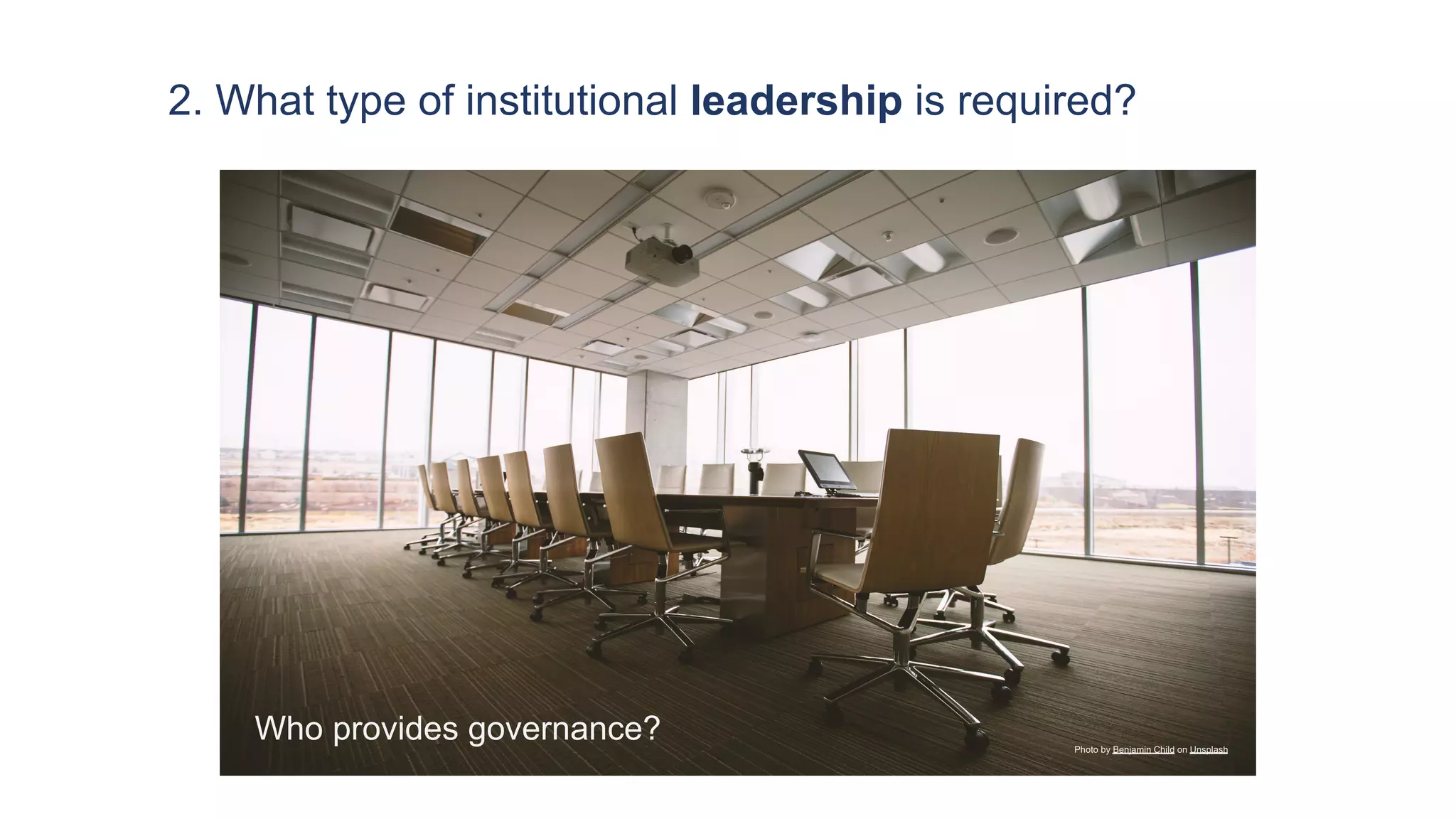
Who provides governance? Photo by Benjamin Child on Unsplash
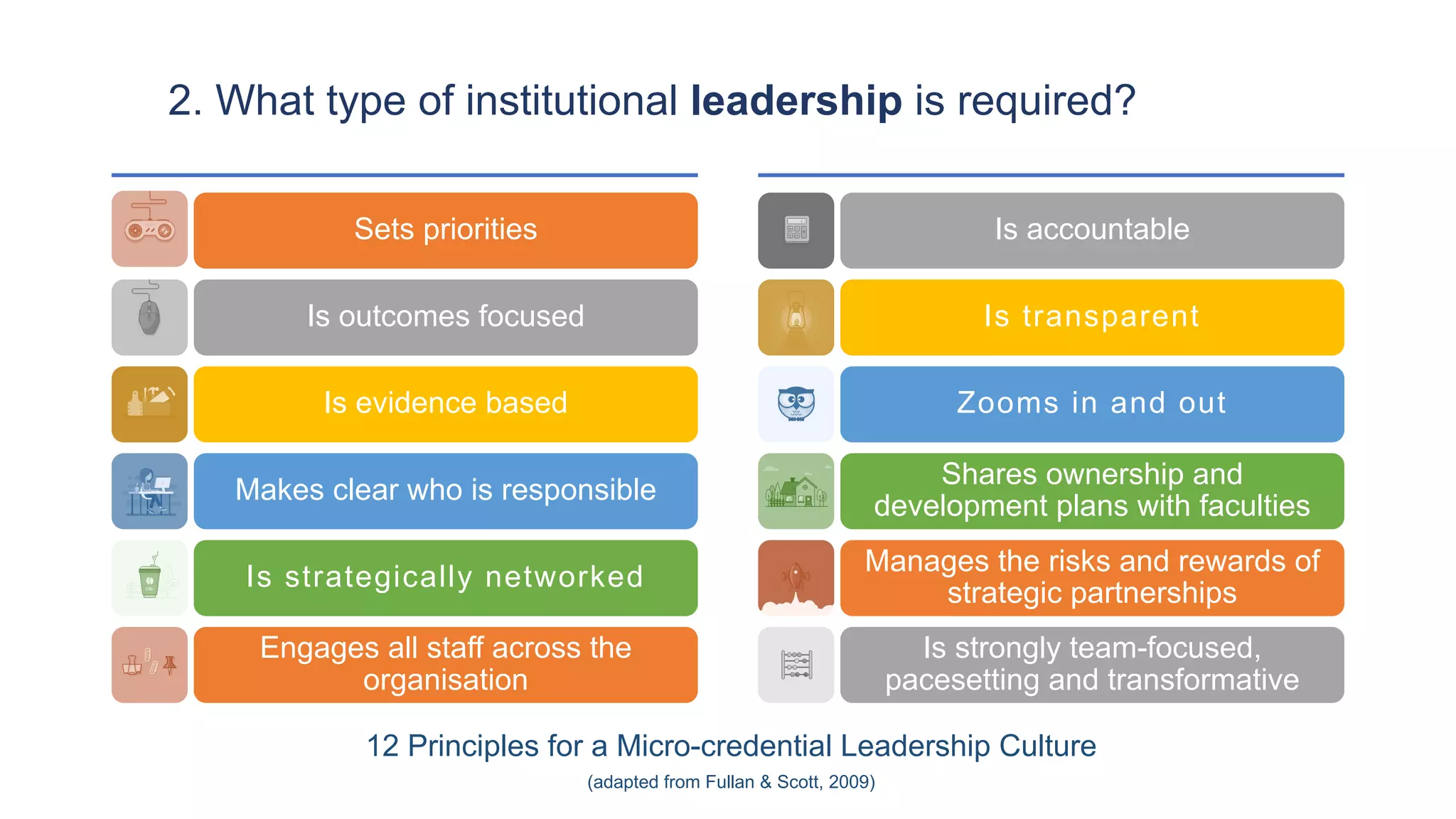
Sets priorities
Is outcomes focused
Is evidence based
Makes clear who is responsible
Is strategically networked
Engages all staff across the
organisation
Is accountable
Is transparent
Zooms in and out
Shares ownership and
development plans with faculties
Manages the risks and rewards of
strategic partnerships
Is strongly team-focused,
pacesetting and transformative
2. What type of institutional leadership is required?
12 Principles for a Micro-credential Leadership Culture
(adapted from Fullan & Scott, 2009)
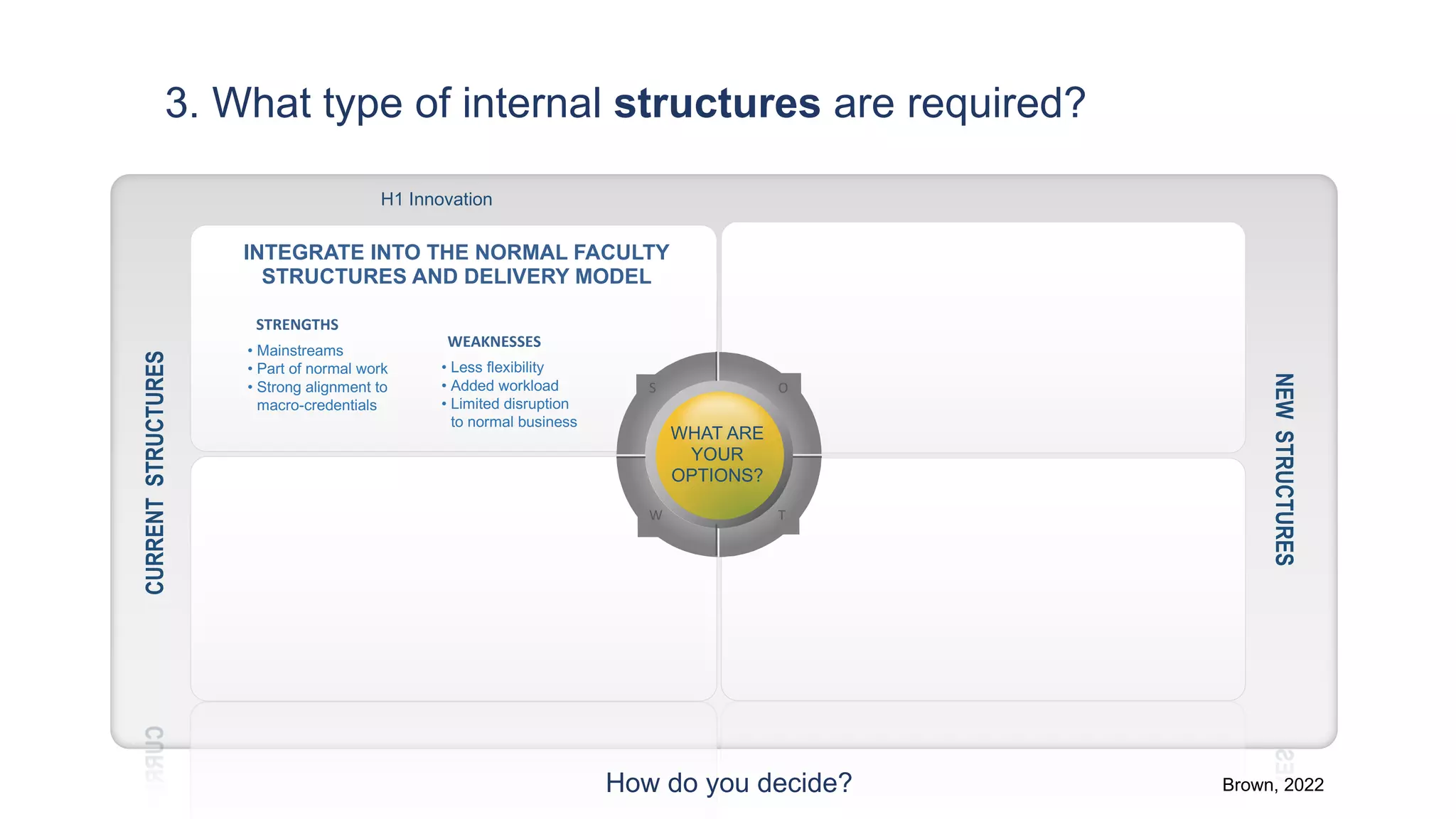
• Mainstreams
• Part of normal work
• Strong alignment to
macro-credentials
NEW
STRUCTURES
WEAKNESSES
WHAT ARE
YOUR
OPTIONS?
S O
W T
INTEGRATE INTO THE NORMAL FACULTY
STRUCTURES AND DELIVERY MODEL
STRENGTHS
CURRENT
STRUCTURES
• Less flexibility
• Added workload
• Limited disruption
to normal business
H1 Innovation
How do you decide?
3. What type of internal structures are required?
Brown, 2022
• Mainstreams
• Part of normal work
• Strong alignment to
macro-credentials
NEW
STRUCTURES
WEAKNESSES
WHAT ARE
YOUR
OPTIONS?
S O
W T
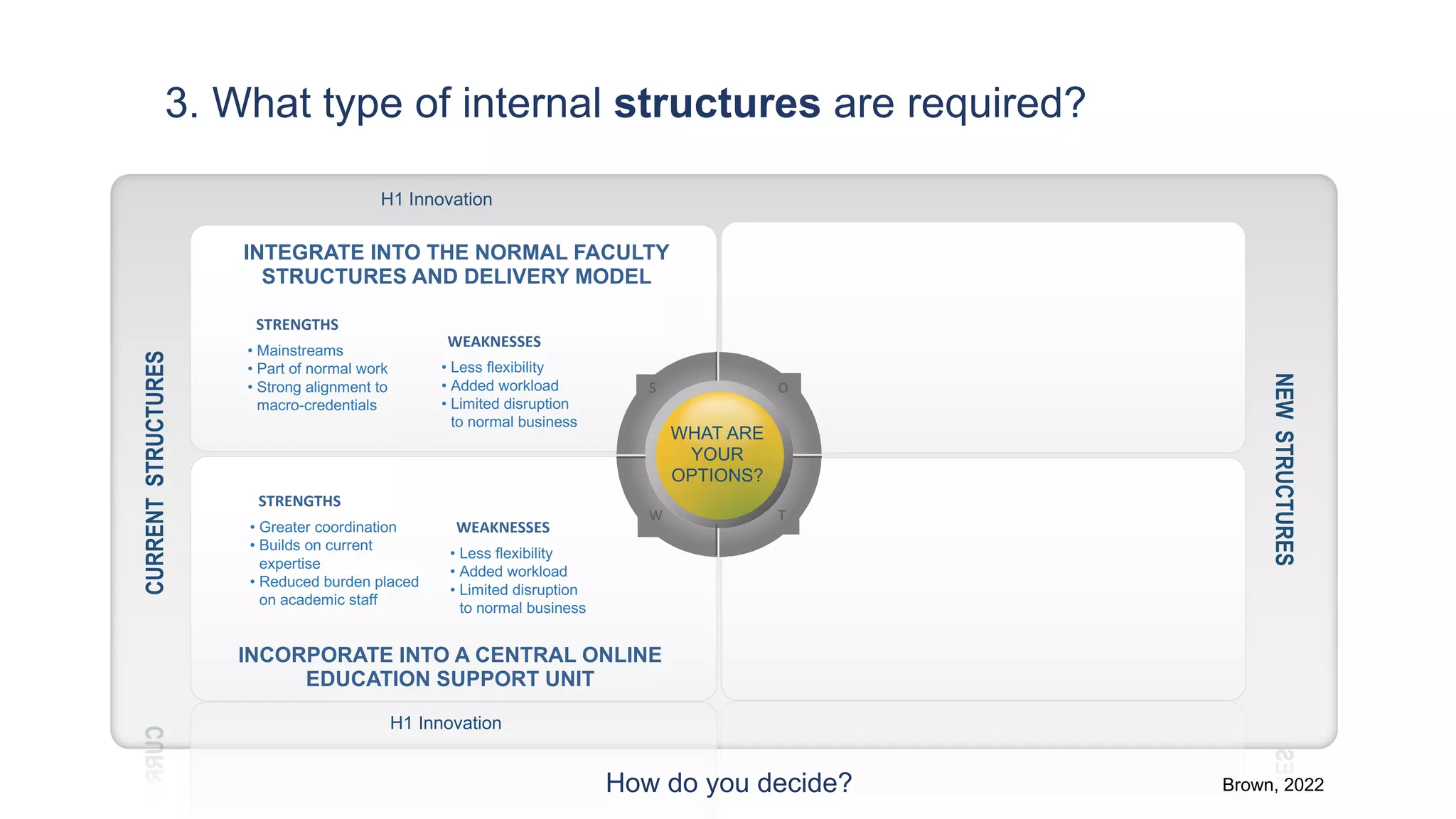
INCORPORATE INTO A CENTRAL ONLINE
EDUCATION SUPPORT UNIT
INTEGRATE INTO THE NORMAL FACULTY
STRUCTURES AND DELIVERY MODEL
STRENGTHS
CURRENT
STRUCTURES
• Less flexibility
• Added workload
• Limited disruption
to normal business
• Greater coordination
• Builds on current
expertise
• Reduced burden placed
on academic staff
STRENGTHS
WEAKNESSES
• Less flexibility
• Added workload
• Limited disruption
to normal business
H1 Innovation
H1 Innovation
How do you decide? Brown, 2022
3. What type of internal structures are required?
• Mainstreams
• Part of normal work
• Strong alignment to
macro-credentials
NEW
STRUCTURES
WEAKNESSES
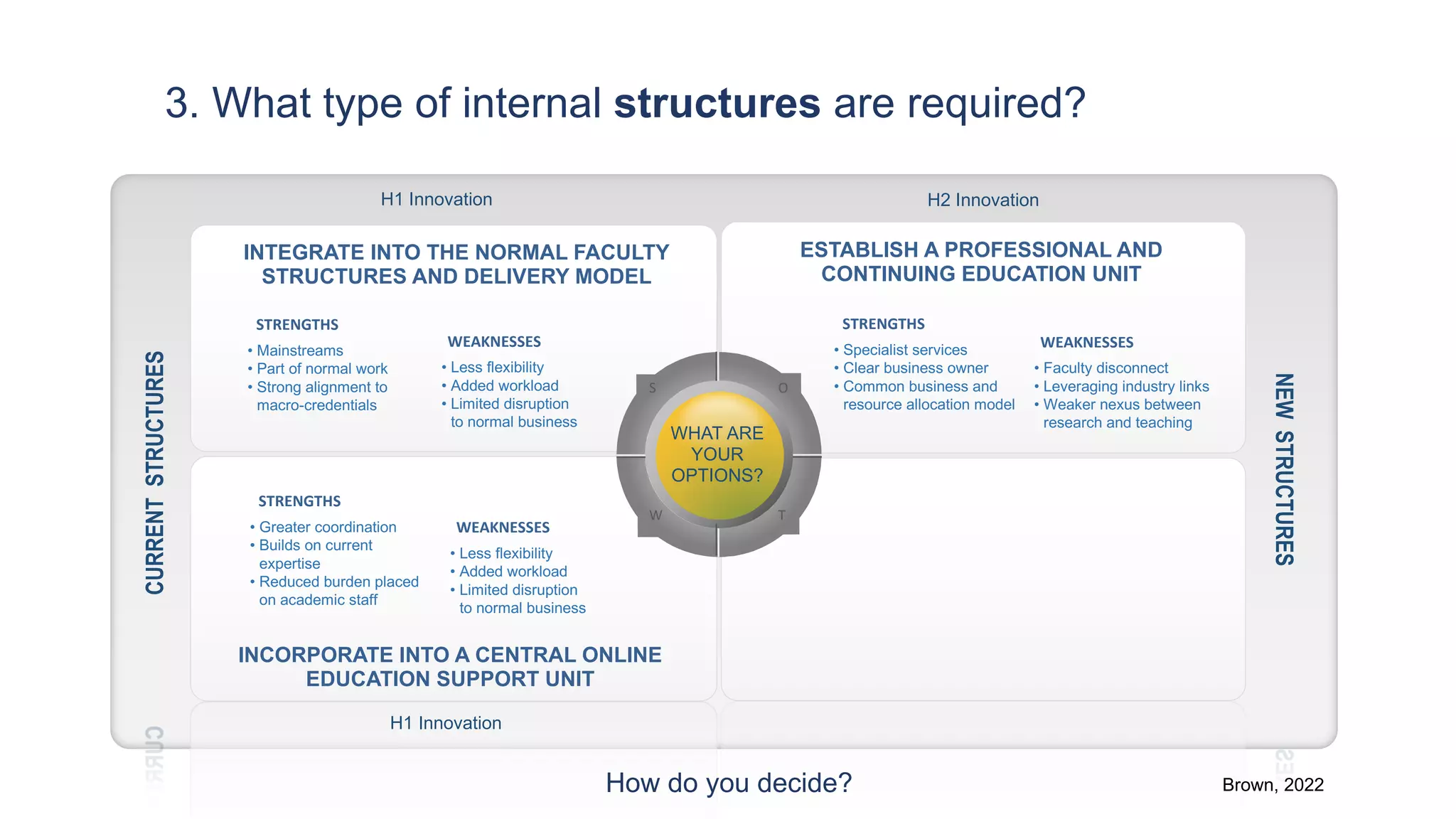
ESTABLISH A PROFESSIONAL AND
CONTINUING EDUCATION UNIT
WHAT ARE
YOUR
OPTIONS?
S O
W T
INCORPORATE INTO A CENTRAL ONLINE
EDUCATION SUPPORT UNIT
INTEGRATE INTO THE NORMAL FACULTY
STRUCTURES AND DELIVERY MODEL
STRENGTHS
CURRENT
STRUCTURES
• Less flexibility
• Added workload
• Limited disruption
to normal business
• Greater coordination
• Builds on current
expertise
• Reduced burden placed
on academic staff
STRENGTHS
WEAKNESSES
• Less flexibility
• Added workload
• Limited disruption
to normal business
• Specialist services
• Clear business owner
• Common business and
resource allocation model
WEAKNESSES
STRENGTHS
• Faculty disconnect
• Leveraging industry links
• Weaker nexus between
research and teaching
H1 Innovation
H1 Innovation
H2 Innovation
How do you decide? Brown, 2022
3. What type of internal structures are required?
• Mainstreams
• Part of normal work
• Strong alignment to
macro-credentials
NEW
STRUCTURES
WEAKNESSES
ESTABLISH A PROFESSIONAL AND
CONTINUING EDUCATION UNIT
WHAT ARE
YOUR
OPTIONS?
S O
W T
CREATE A COMPLETELY SEPARATE
STANDALONE BUSINESS UNIT
INCORPORATE INTO A CENTRAL ONLINE
EDUCATION SUPPORT UNIT
INTEGRATE INTO THE NORMAL FACULTY
STRUCTURES AND DELIVERY MODEL
STRENGTHS
CURRENT
STRUCTURES
• Less flexibility
• Added workload
• Limited disruption
to normal business
• Greater coordination
• Builds on current
expertise
• Reduced burden placed
on academic staff
STRENGTHS
WEAKNESSES
• Less flexibility
• Added workload
• Limited disruption
to normal business
• Specialist services
• Clear business owner
• Common business and
resource allocation model
WEAKNESSES
STRENGTHS
• Faculty disconnect
• Leveraging industry links
• Weaker nexus between
research and teaching
• Greater flexibility
• Adopts a commercial
business model
• Easier to establish
return on investment
WEAKNESSES
STRENGTHS
• Little cross subsidisation
• Outside of normal business
• Loss of academic
ownership
H3 Innovation
H1 Innovation
H1 Innovation
H2 Innovation
How do you decide? Brown, 2022
3. What type of internal structures are required?
(Presant, 2020)
Bonus Question - What type of business model(s) are required?
Sole Unit Sole Institution Peer Consortium NGO Led Industry Led OPM Led
What models are you using or
plan to implement and how
successful are they?
(Presant, 2020)
Other
Bonus Question - What type of business model(s) are required?
• What are the risks?
• What could possibly go wrong?
• Do you need to plan for an exit strategy?
Final remarks…
Thank you
Mark
Developing A Strategic Institutional Response:  What Type of Strategy, Leadership and Internal Structures are Required to Develop and Execute a Micro-credential Strategy?

Developing A Strategic Institutional Response: What Type of Strategy, Leadership and Internal Structures are Required to Develop and Execute a Micro-credential Strategy?

  • 1.
    What Type ofStrategy, Leadership and Internal Structures are Required to Develop and Execute a Micro-credential Strategy? Prof. Mark Brown https://www.deviantart.com/tag/loneranger Graz, 4th November 2022 MicroCredX
  • 2.
    Your institution hasimportant choices! https://www.deviantart.com/tag/loneranger
  • 4.
  • 5.
  • 8.
    • Are micro-credentialsright for my university? 2. What type of institutional leadership is required? 1. If yes, how do you plan to strategically position them? 2022 3. What type of internal structures are required?
  • 9.
    1. How doyou plan to strategically position them? Germany EU Average What are your strategic drivers? Austria
  • 10.
    Drivers Attractors Micro- credential Force Field Analysis Future ofWork Increase Employability New Revenue Skill Gaps Lifelong Learning Restraining Force 1 •Example text •Fill in your own •Example text Online Learning 1. How do you plan to strategically position them? Restraining Force 1 •Example text •Fill in your own •Example text Value of CPD COVID Crisis Knowledge Economy Knowledge Society
  • 11.
    1. How doyou plan to strategically position them? Where do they fit? Credit-bearing or not? Stackable or not? Size?
  • 12.
    2. What typeof institutional leadership is required? Photo by Annie Spratt on Unsplash “Get the right people on the bus and in the right seats” (Clayton Christensen, 2015)
  • 13.
    Laissez-faire Transactional Transformative Effectiveness Engagement Who should beleading? ? Fit-for-Purpose Leadership 2. What type of institutional leadership is required?
  • 14.
    “Effective leaders listen, link, leverage andthen lead, in that order” (Fullan & Scott, 2009, p. 97). 2. What type of institutional leadership is required?
  • 15.
    2. What typeof institutional leadership is required? (Bigelow, et al., 2022) Key interfaces - Finance Office - VLE Support - Teaching Support - Learning Support - Library Support - Marketing Office - Recruitment Office - Admissions Office - International Office - Alumni Office - Graduation Office - Who Else?
  • 16.
    2. What typeof institutional leadership is required? Who provides governance? Photo by Benjamin Child on Unsplash
  • 17.
    Sets priorities Is outcomesfocused Is evidence based Makes clear who is responsible Is strategically networked Engages all staff across the organisation Is accountable Is transparent Zooms in and out Shares ownership and development plans with faculties Manages the risks and rewards of strategic partnerships Is strongly team-focused, pacesetting and transformative 2. What type of institutional leadership is required? 12 Principles for a Micro-credential Leadership Culture (adapted from Fullan & Scott, 2009)
  • 18.
    • Mainstreams • Partof normal work • Strong alignment to macro-credentials NEW STRUCTURES WEAKNESSES WHAT ARE YOUR OPTIONS? S O W T INTEGRATE INTO THE NORMAL FACULTY STRUCTURES AND DELIVERY MODEL STRENGTHS CURRENT STRUCTURES • Less flexibility • Added workload • Limited disruption to normal business H1 Innovation How do you decide? 3. What type of internal structures are required? Brown, 2022
  • 19.
    • Mainstreams • Partof normal work • Strong alignment to macro-credentials NEW STRUCTURES WEAKNESSES WHAT ARE YOUR OPTIONS? S O W T INCORPORATE INTO A CENTRAL ONLINE EDUCATION SUPPORT UNIT INTEGRATE INTO THE NORMAL FACULTY STRUCTURES AND DELIVERY MODEL STRENGTHS CURRENT STRUCTURES • Less flexibility • Added workload • Limited disruption to normal business • Greater coordination • Builds on current expertise • Reduced burden placed on academic staff STRENGTHS WEAKNESSES • Less flexibility • Added workload • Limited disruption to normal business H1 Innovation H1 Innovation How do you decide? Brown, 2022 3. What type of internal structures are required?
  • 20.
    • Mainstreams • Partof normal work • Strong alignment to macro-credentials NEW STRUCTURES WEAKNESSES ESTABLISH A PROFESSIONAL AND CONTINUING EDUCATION UNIT WHAT ARE YOUR OPTIONS? S O W T INCORPORATE INTO A CENTRAL ONLINE EDUCATION SUPPORT UNIT INTEGRATE INTO THE NORMAL FACULTY STRUCTURES AND DELIVERY MODEL STRENGTHS CURRENT STRUCTURES • Less flexibility • Added workload • Limited disruption to normal business • Greater coordination • Builds on current expertise • Reduced burden placed on academic staff STRENGTHS WEAKNESSES • Less flexibility • Added workload • Limited disruption to normal business • Specialist services • Clear business owner • Common business and resource allocation model WEAKNESSES STRENGTHS • Faculty disconnect • Leveraging industry links • Weaker nexus between research and teaching H1 Innovation H1 Innovation H2 Innovation How do you decide? Brown, 2022 3. What type of internal structures are required?
  • 21.
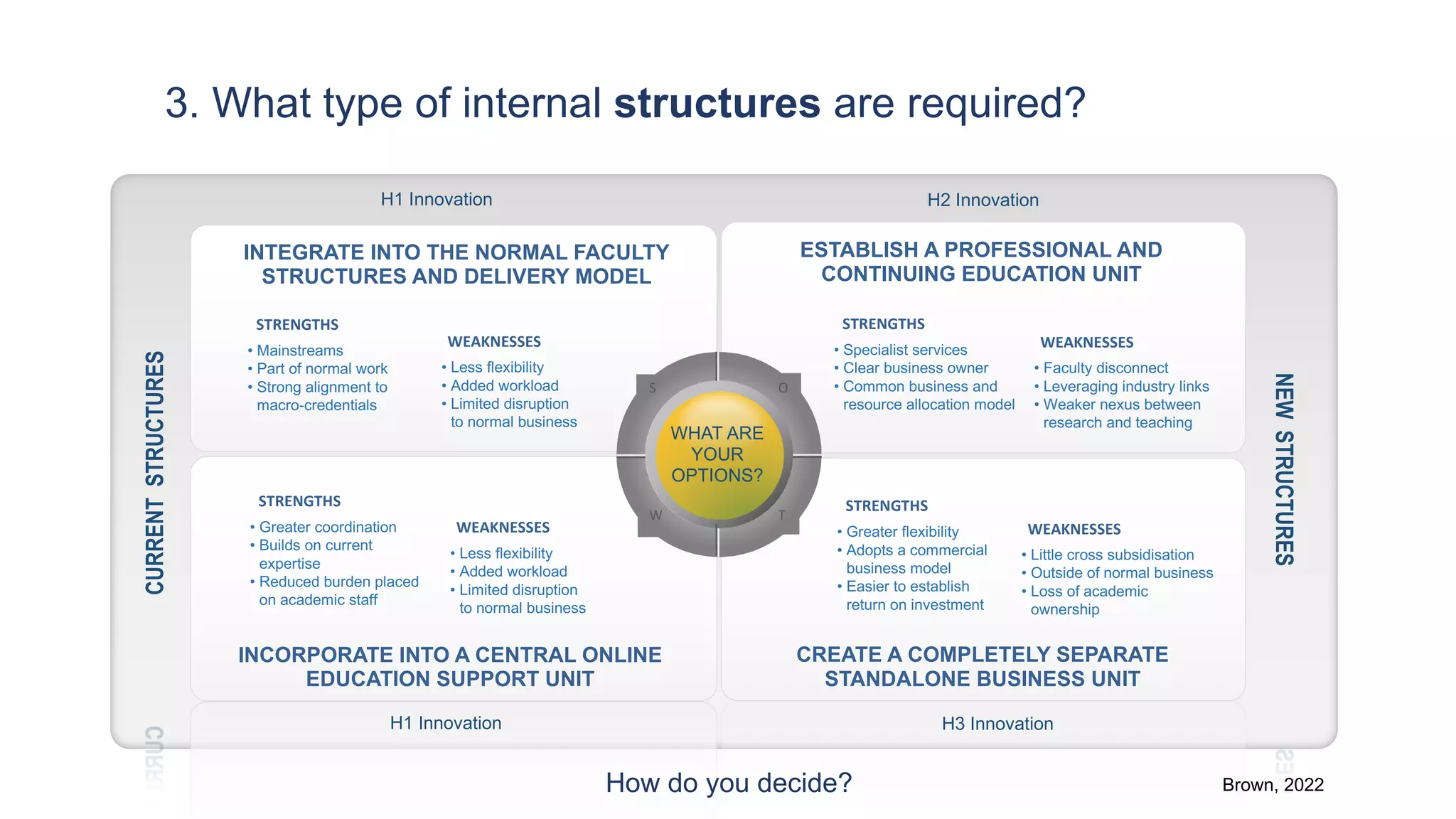
    • Mainstreams • Partof normal work • Strong alignment to macro-credentials NEW STRUCTURES WEAKNESSES ESTABLISH A PROFESSIONAL AND CONTINUING EDUCATION UNIT WHAT ARE YOUR OPTIONS? S O W T CREATE A COMPLETELY SEPARATE STANDALONE BUSINESS UNIT INCORPORATE INTO A CENTRAL ONLINE EDUCATION SUPPORT UNIT INTEGRATE INTO THE NORMAL FACULTY STRUCTURES AND DELIVERY MODEL STRENGTHS CURRENT STRUCTURES • Less flexibility • Added workload • Limited disruption to normal business • Greater coordination • Builds on current expertise • Reduced burden placed on academic staff STRENGTHS WEAKNESSES • Less flexibility • Added workload • Limited disruption to normal business • Specialist services • Clear business owner • Common business and resource allocation model WEAKNESSES STRENGTHS • Faculty disconnect • Leveraging industry links • Weaker nexus between research and teaching • Greater flexibility • Adopts a commercial business model • Easier to establish return on investment WEAKNESSES STRENGTHS • Little cross subsidisation • Outside of normal business • Loss of academic ownership H3 Innovation H1 Innovation H1 Innovation H2 Innovation How do you decide? Brown, 2022 3. What type of internal structures are required?
  • 22.
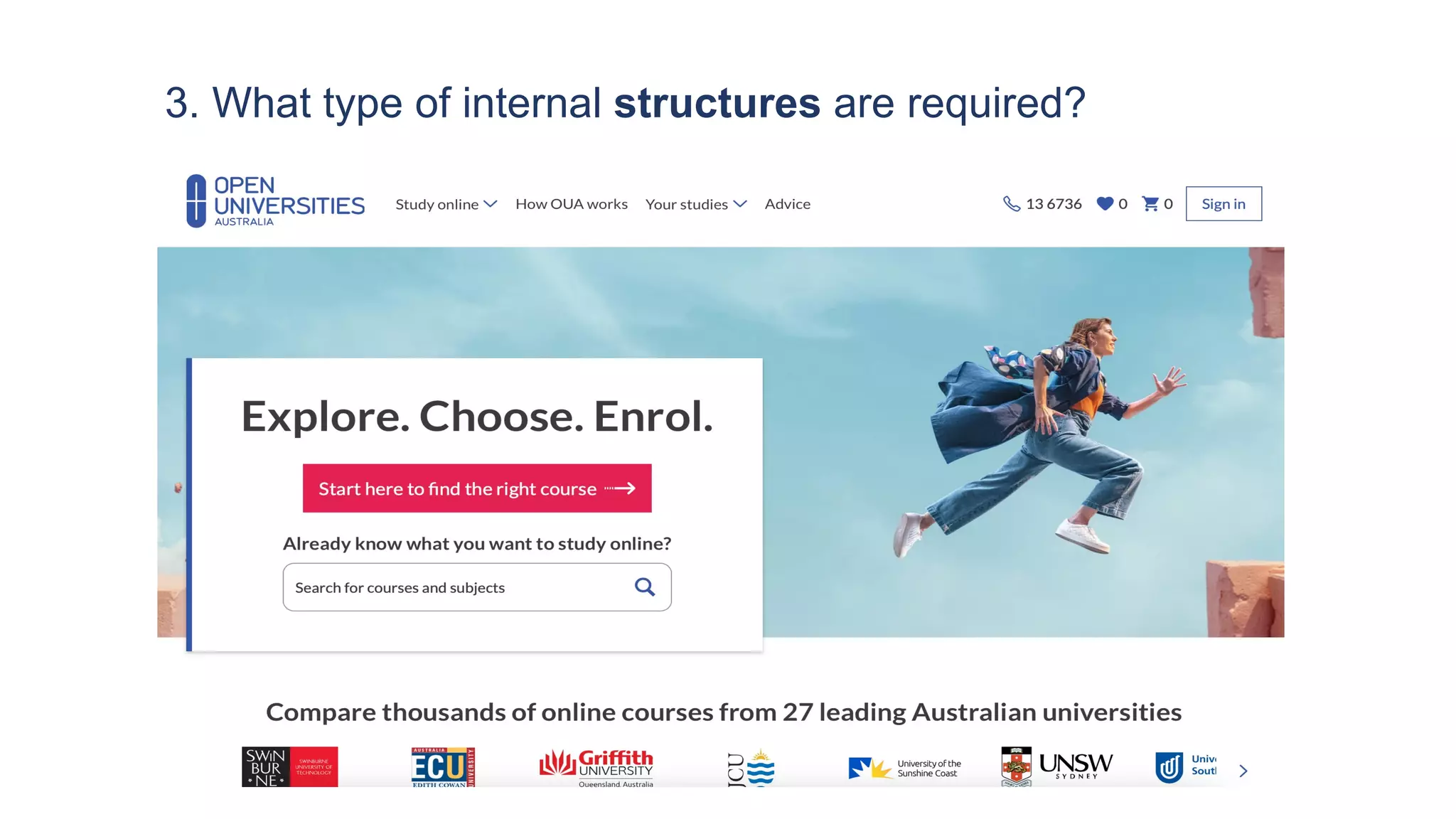
    3. What typeof internal structures are required?
  • 23.
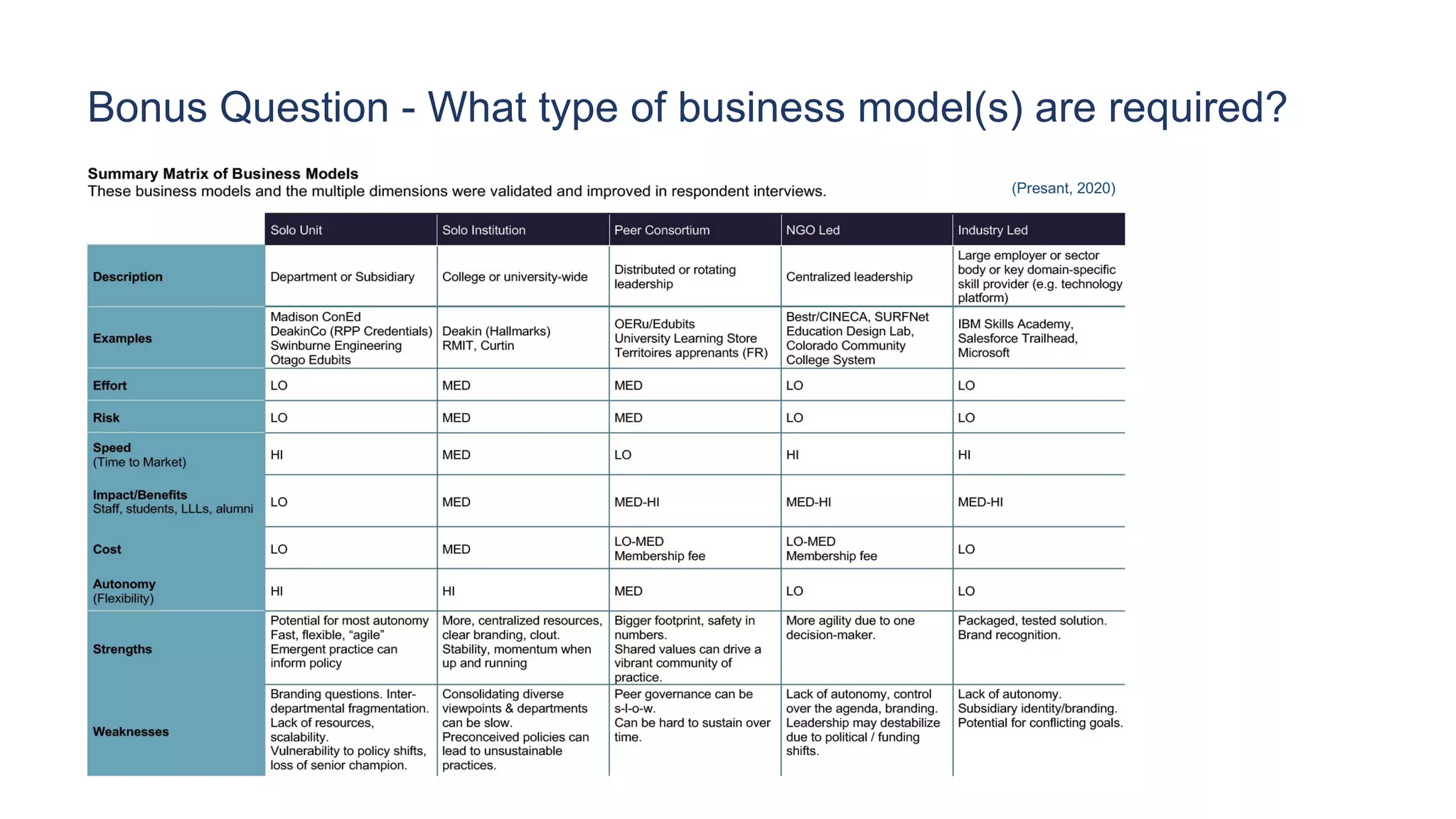
    (Presant, 2020) Bonus Question- What type of business model(s) are required?
  • 24.
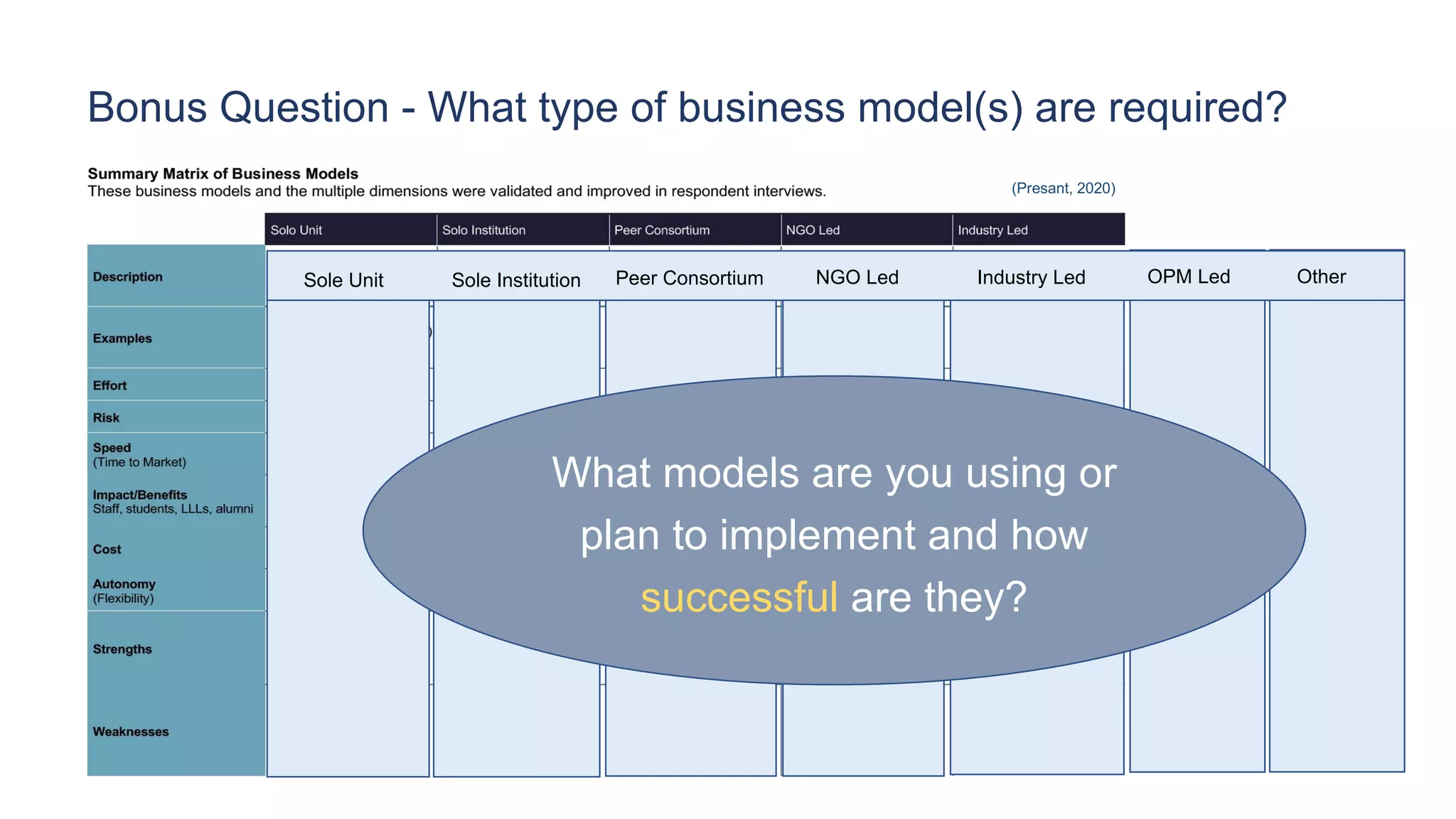
    Sole Unit SoleInstitution Peer Consortium NGO Led Industry Led OPM Led What models are you using or plan to implement and how successful are they? (Presant, 2020) Other Bonus Question - What type of business model(s) are required?
  • 25.
    • What arethe risks? • What could possibly go wrong? • Do you need to plan for an exit strategy? Final remarks…
  • 27.