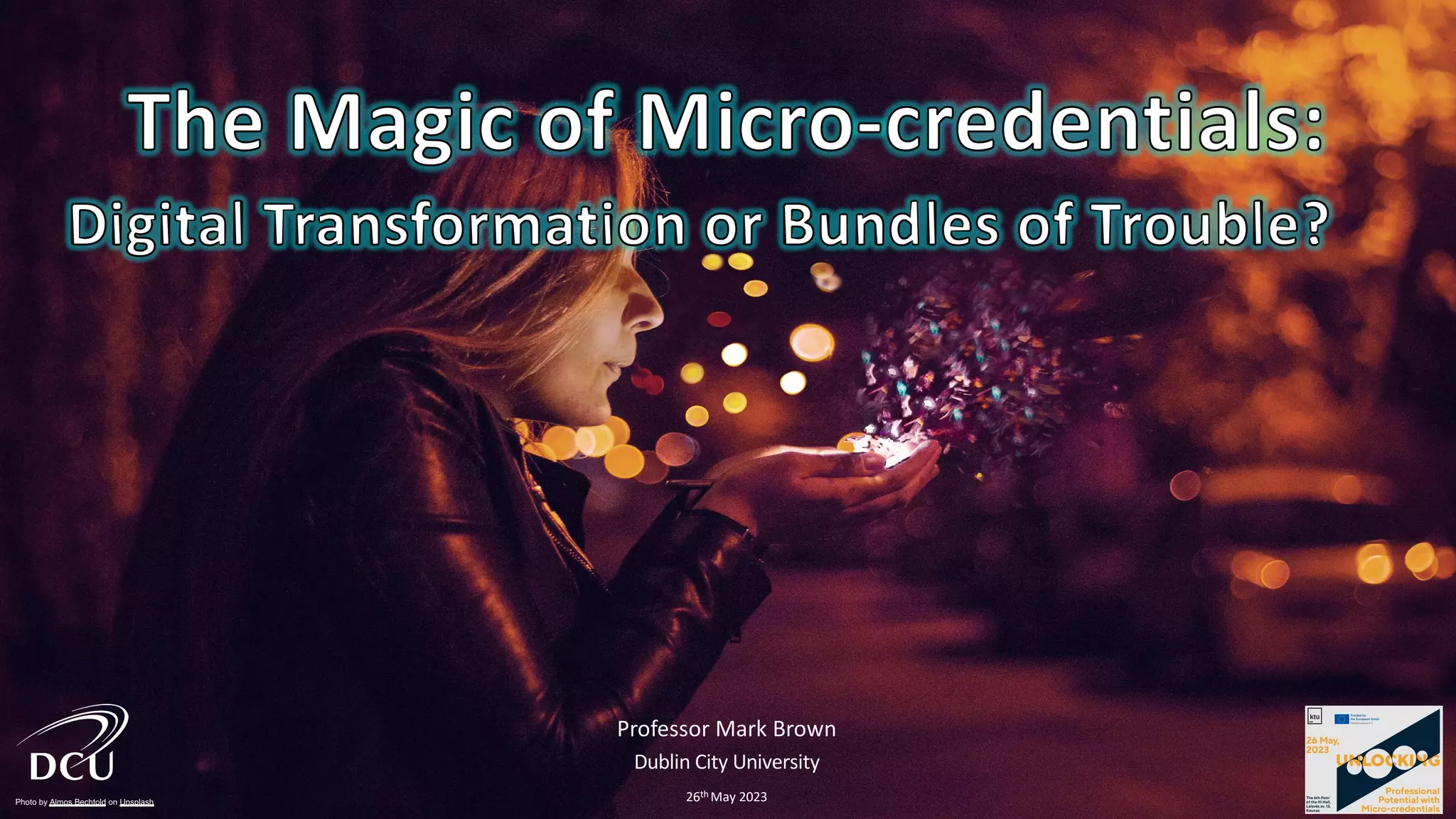
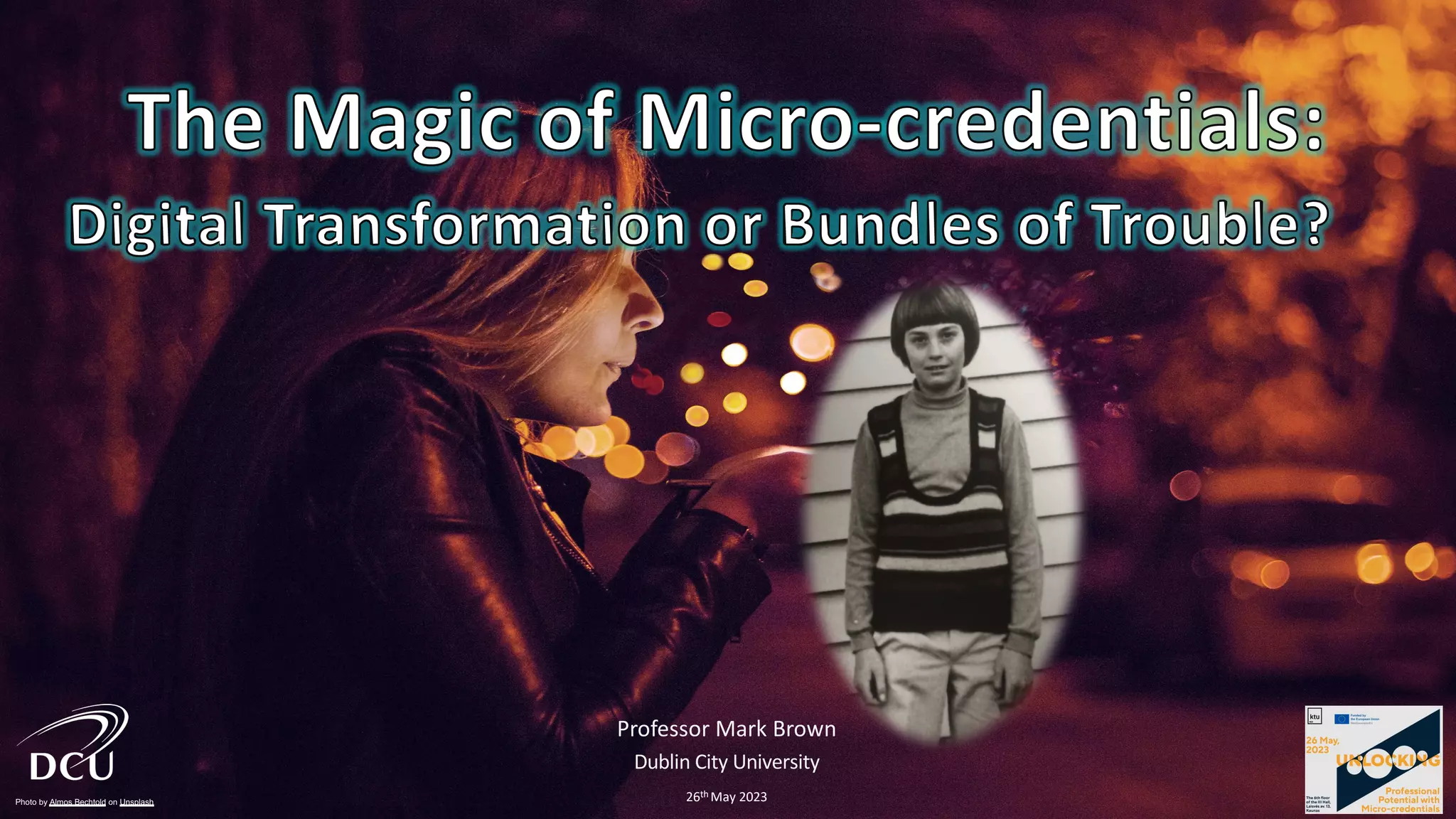
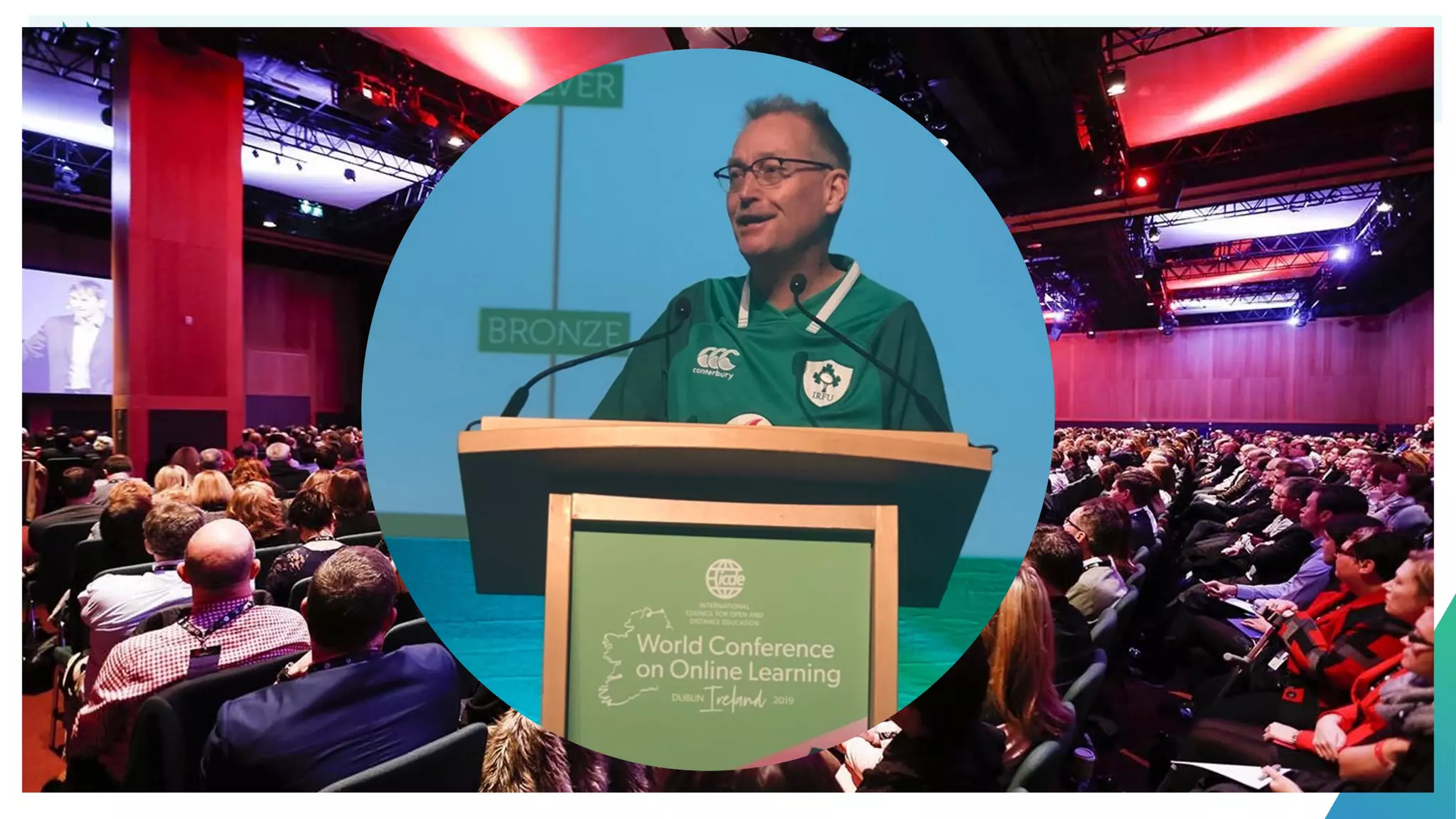



26th May 2023
Professor Mark Brown
Dublin City University
Photo by Almos Bechtold on Unsplash
26th May 2023
Professor Mark Brown
Dublin City University
Photo by Almos Bechtold on Unsplash
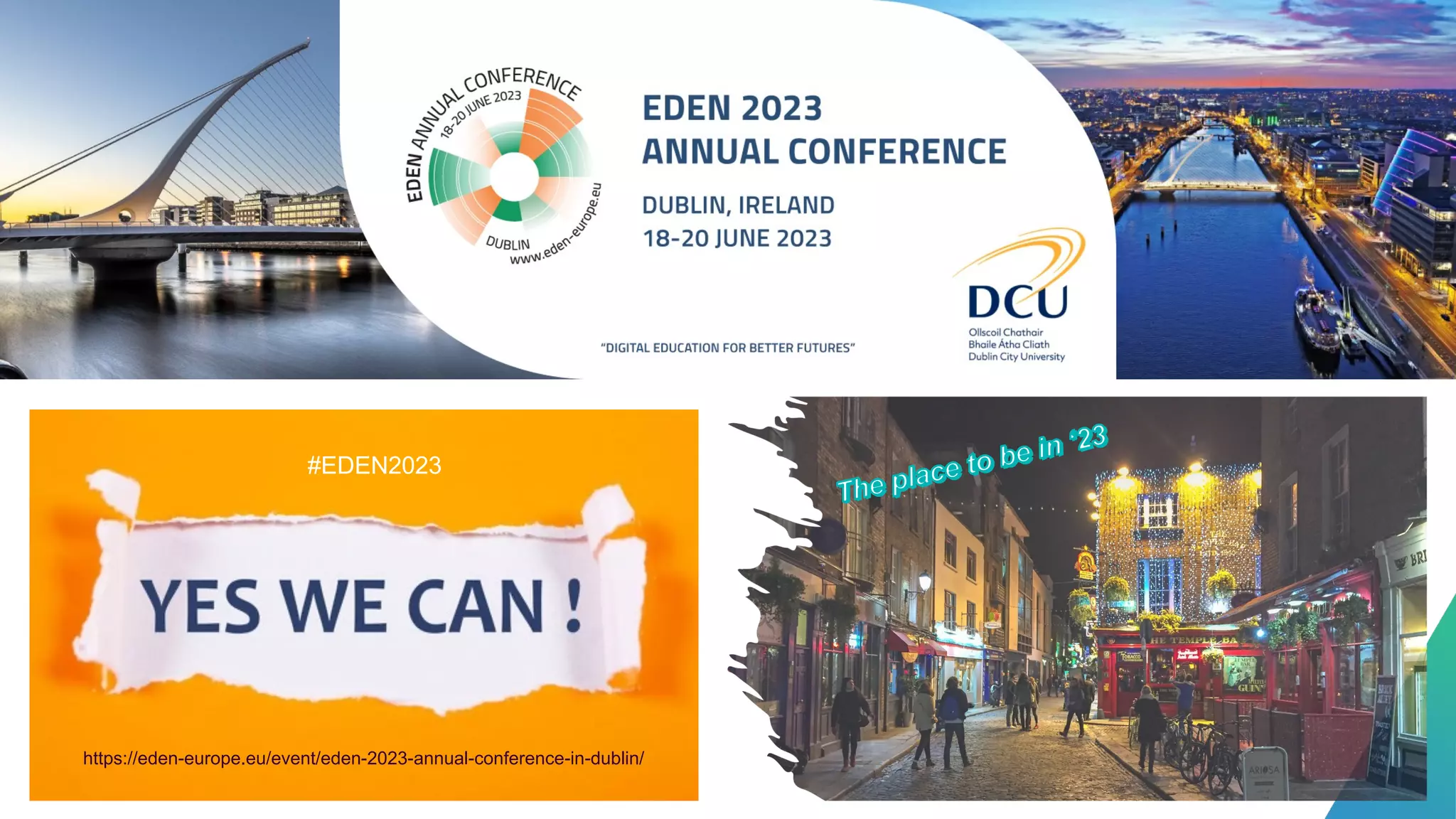
https://eden-europe.eu/event/eden-2023-annual-conference-in-dublin/
#EDEN2023
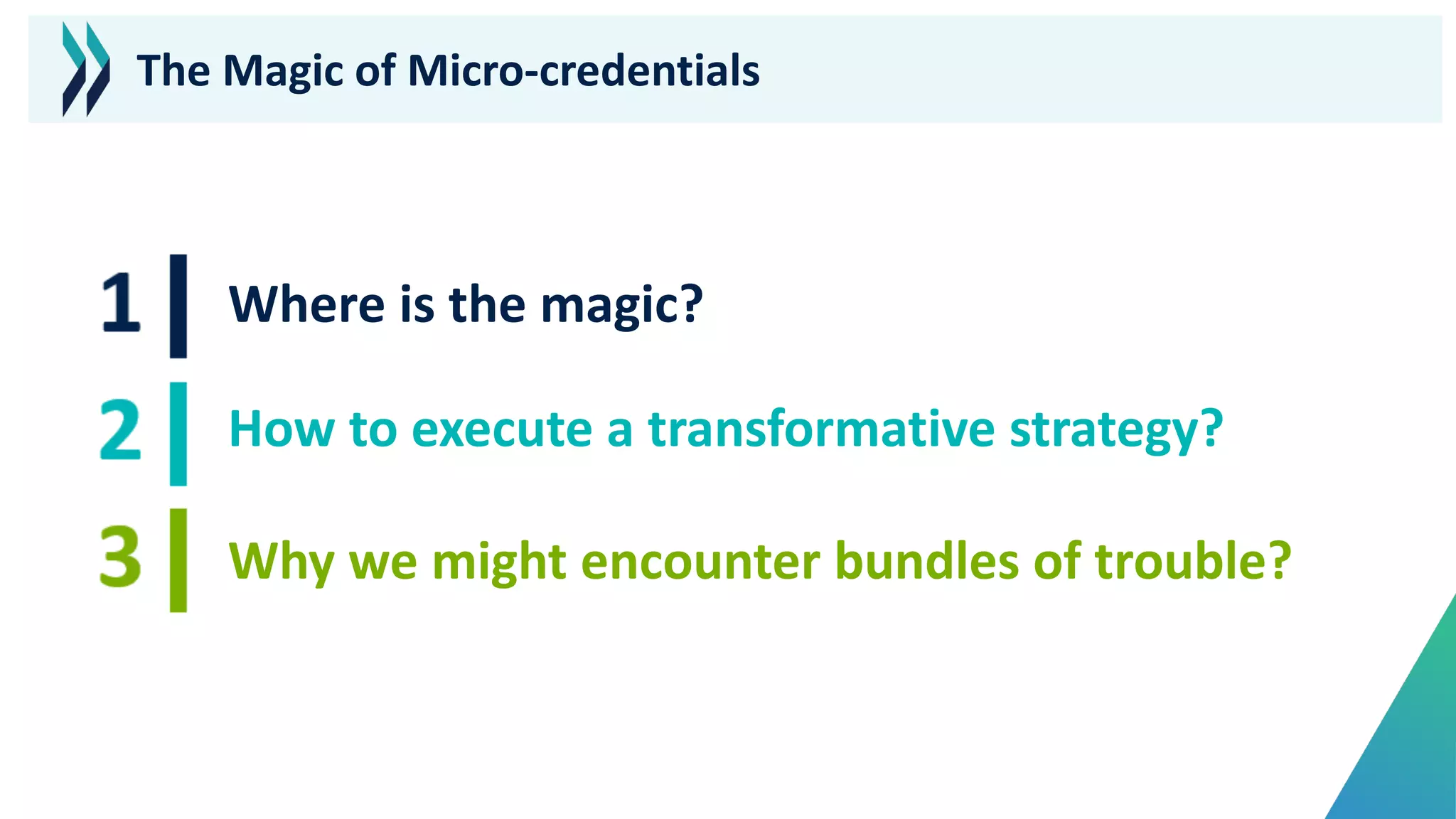
Where is the magic?
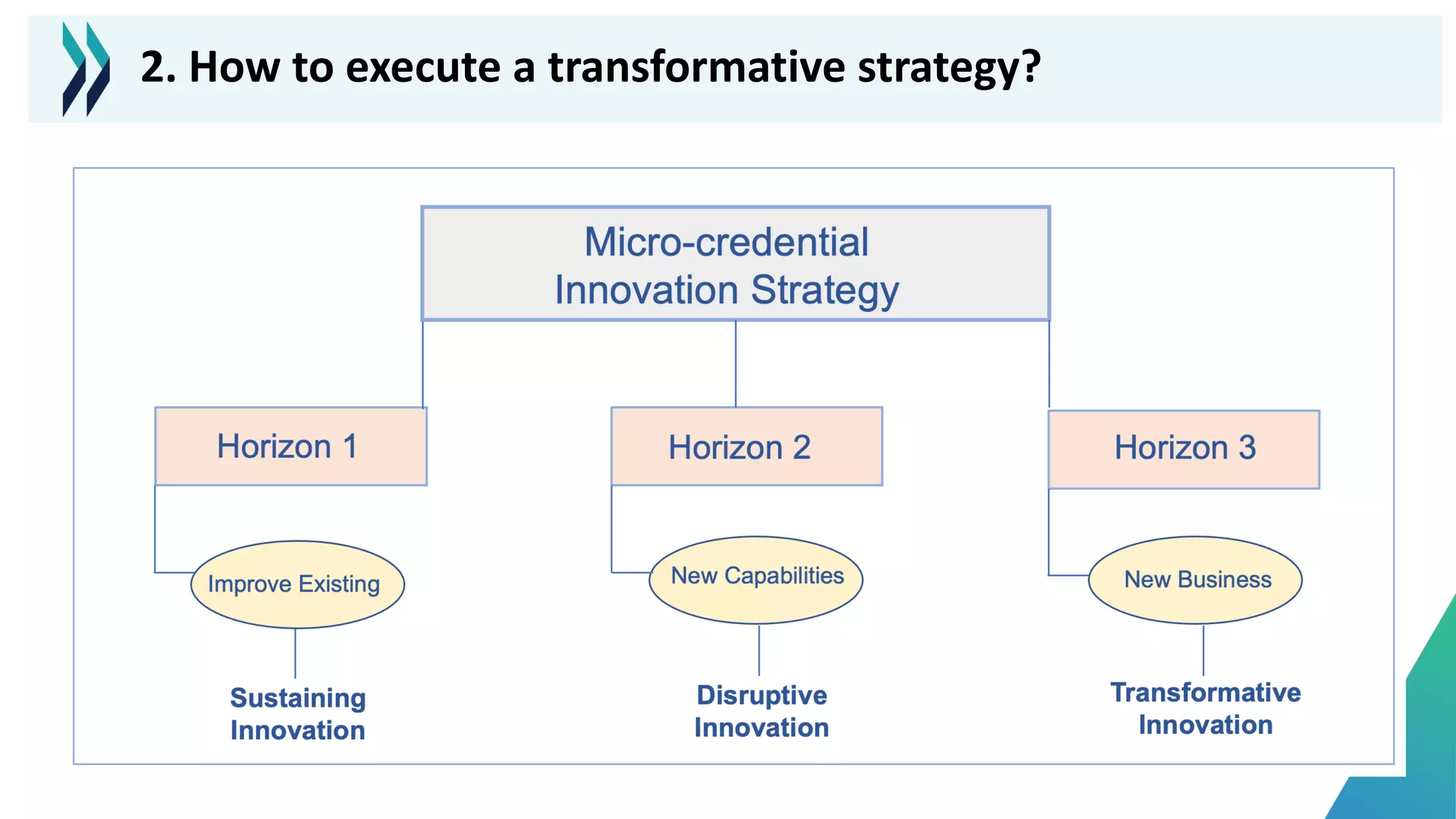
How to execute a transformative strategy?
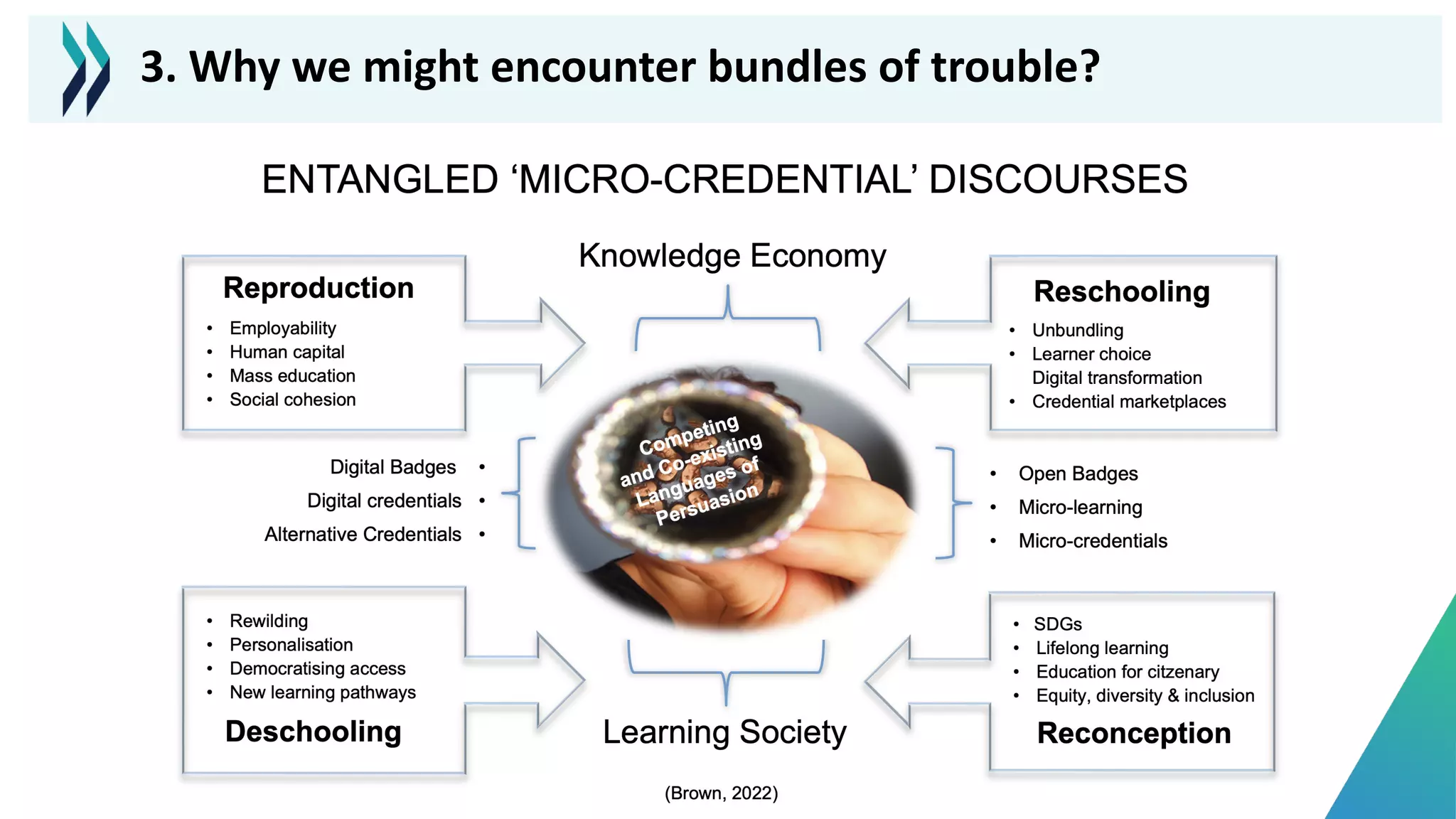
Why we might encounter bundles of trouble?
The Magic of Micro-credentials
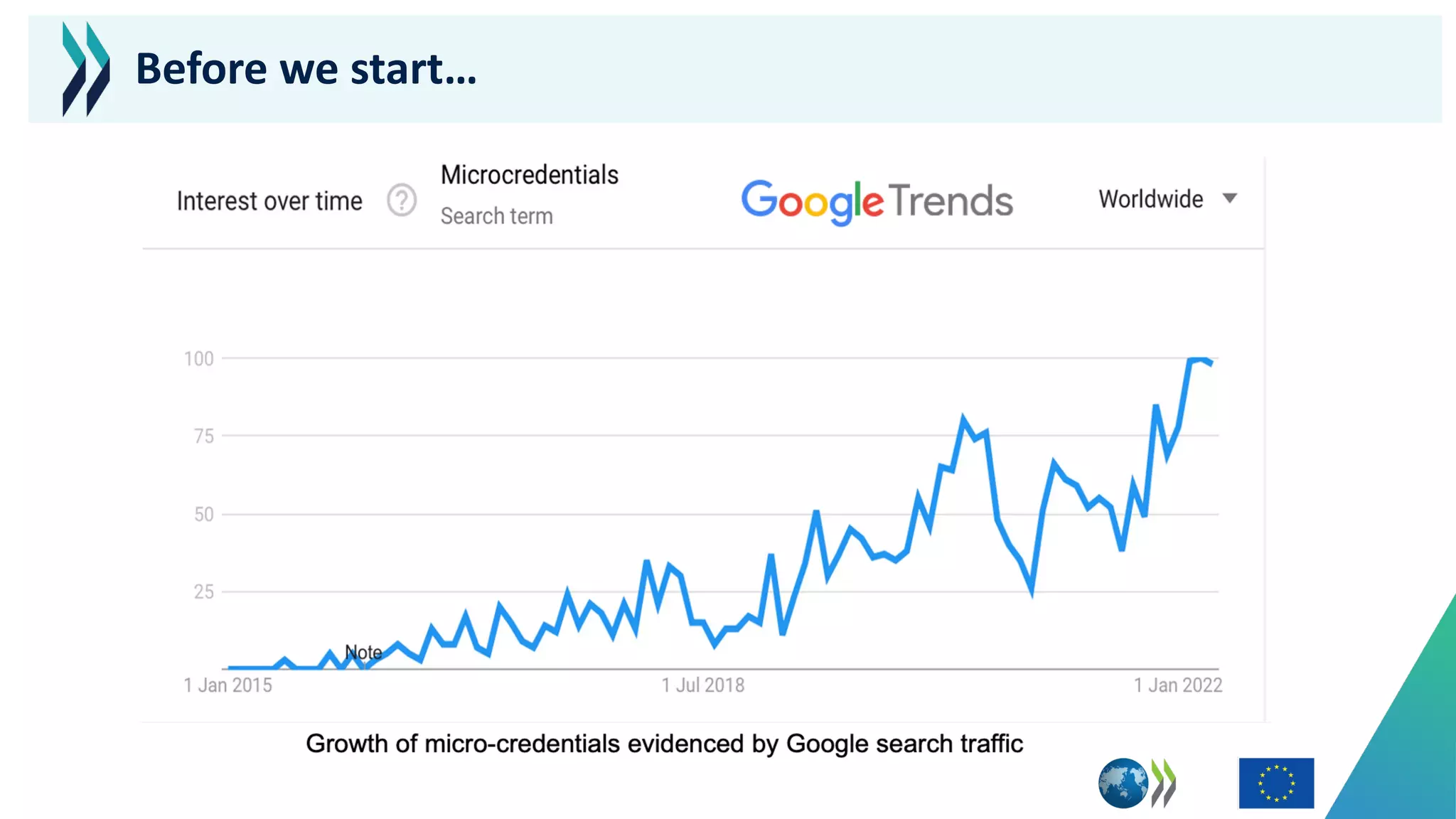
Before we start…
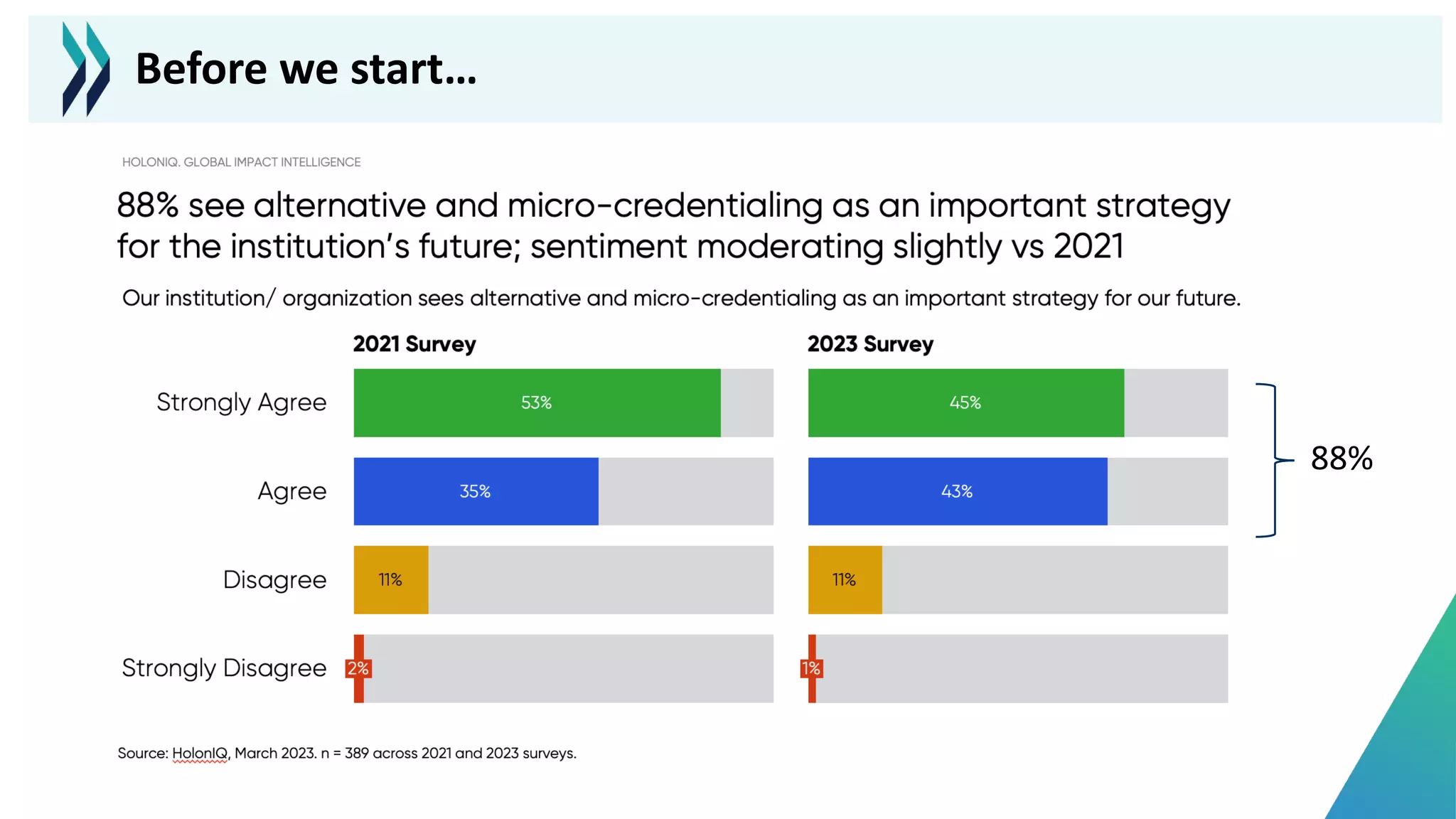
Before we start…
88%
Photo by Almos Bechtold on Unsplash
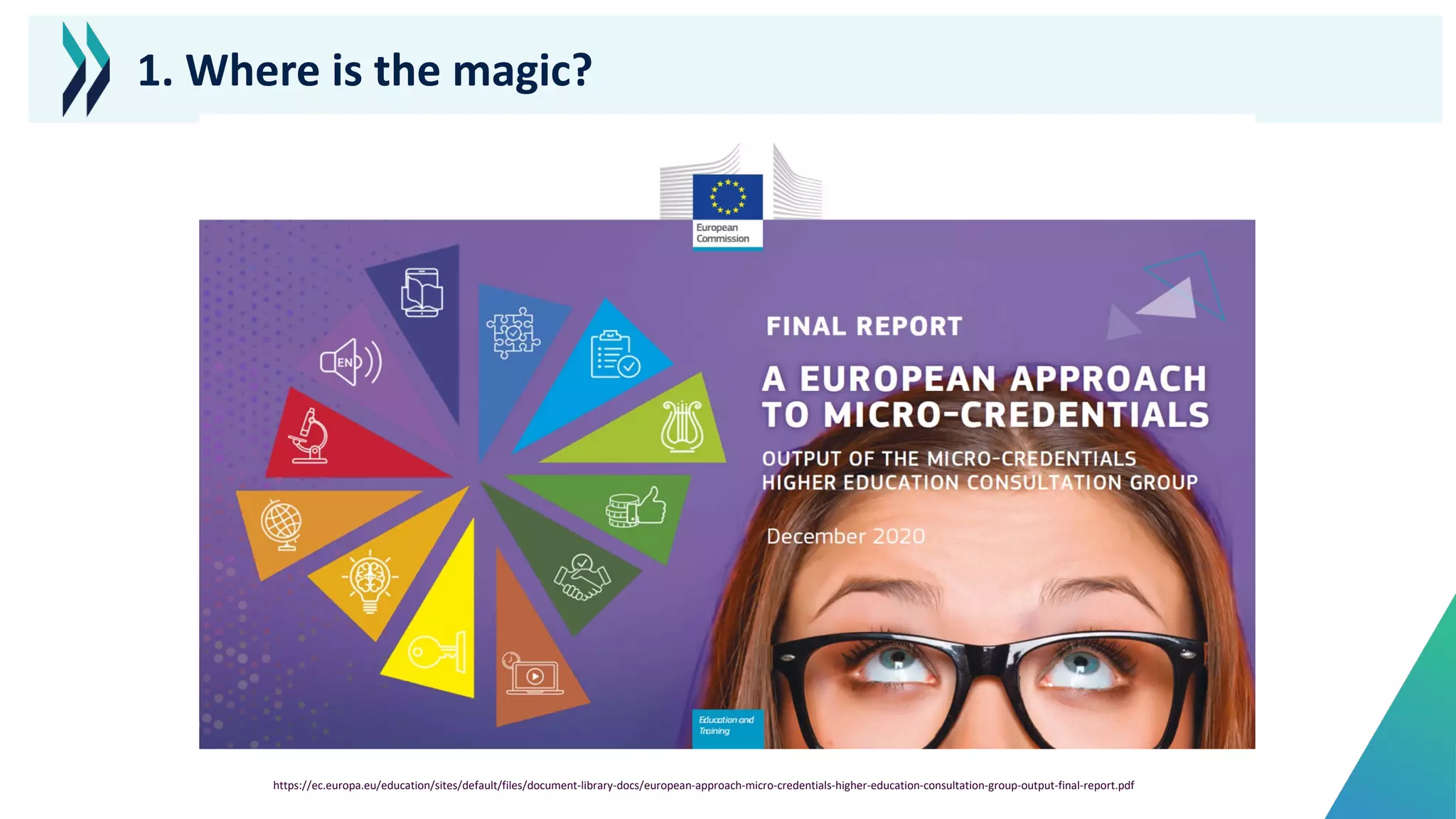
1. Where is the magic?
https://ec.europa.eu/education/sites/default/files/document-library-docs/european-approach-micro-credentials-higher-education-consultation-group-output-final-report.pdf
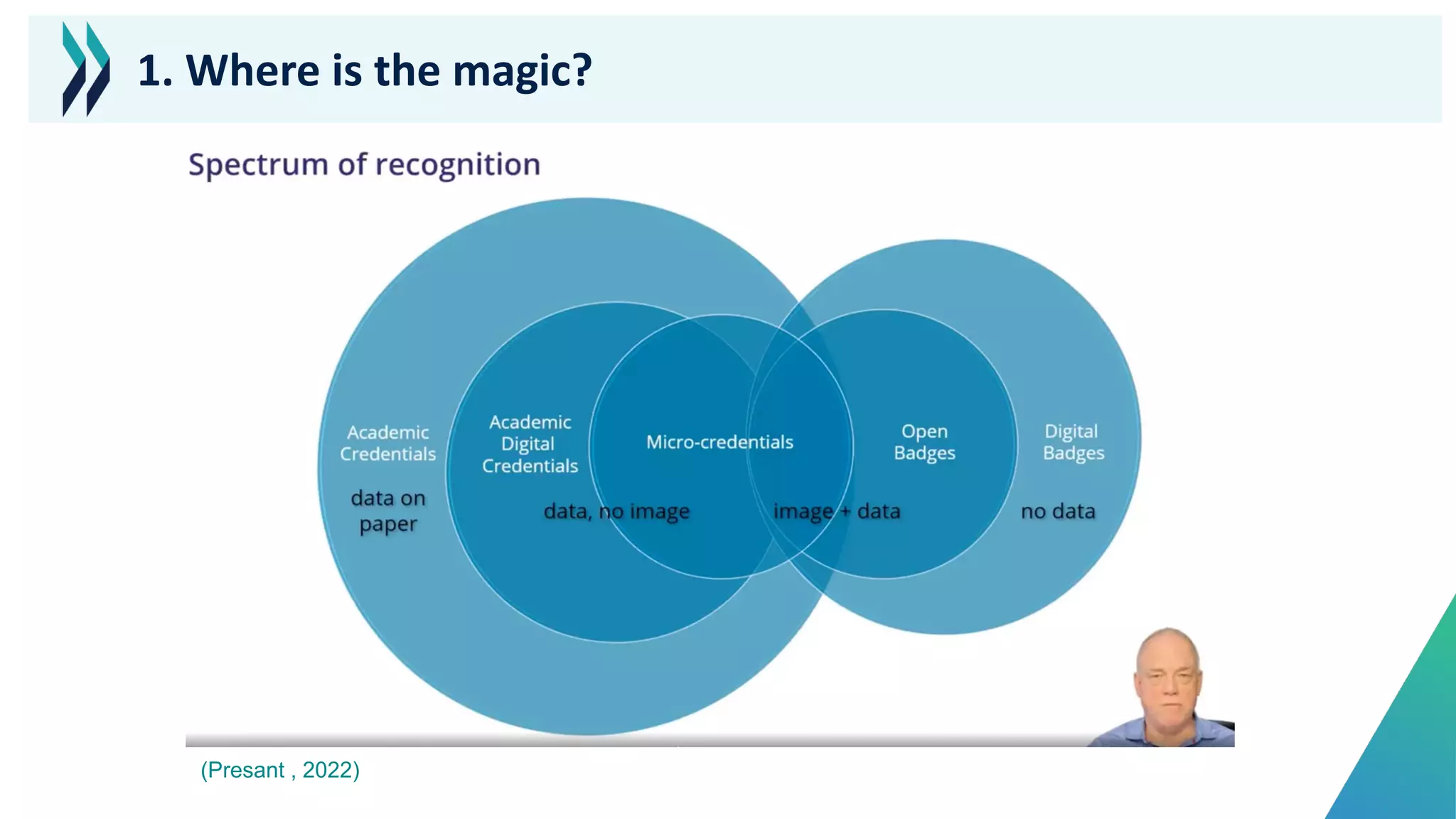
(Presant , 2022)
1. Where is the magic?
‘Micro-credential’ means the record of the learning outcomes that a learner
has acquired following a small volume of learning. These learning outcomes
will have been assessed against transparent and clearly defined criteria.
Learning experiences leading to micro-credentials are designed to provide the
learner with specific knowledge, skills and competences that respond to
societal, personal, cultural or labour market needs. Micro-
credentials are owned by the learner, can be shared and are portable. They
may be stand-alone or combined into larger credentials.
They are underpinned by quality assurance following agreed standards in
the relevant sector or area of activity (European Commission, 2022).
1. Where is the magic?
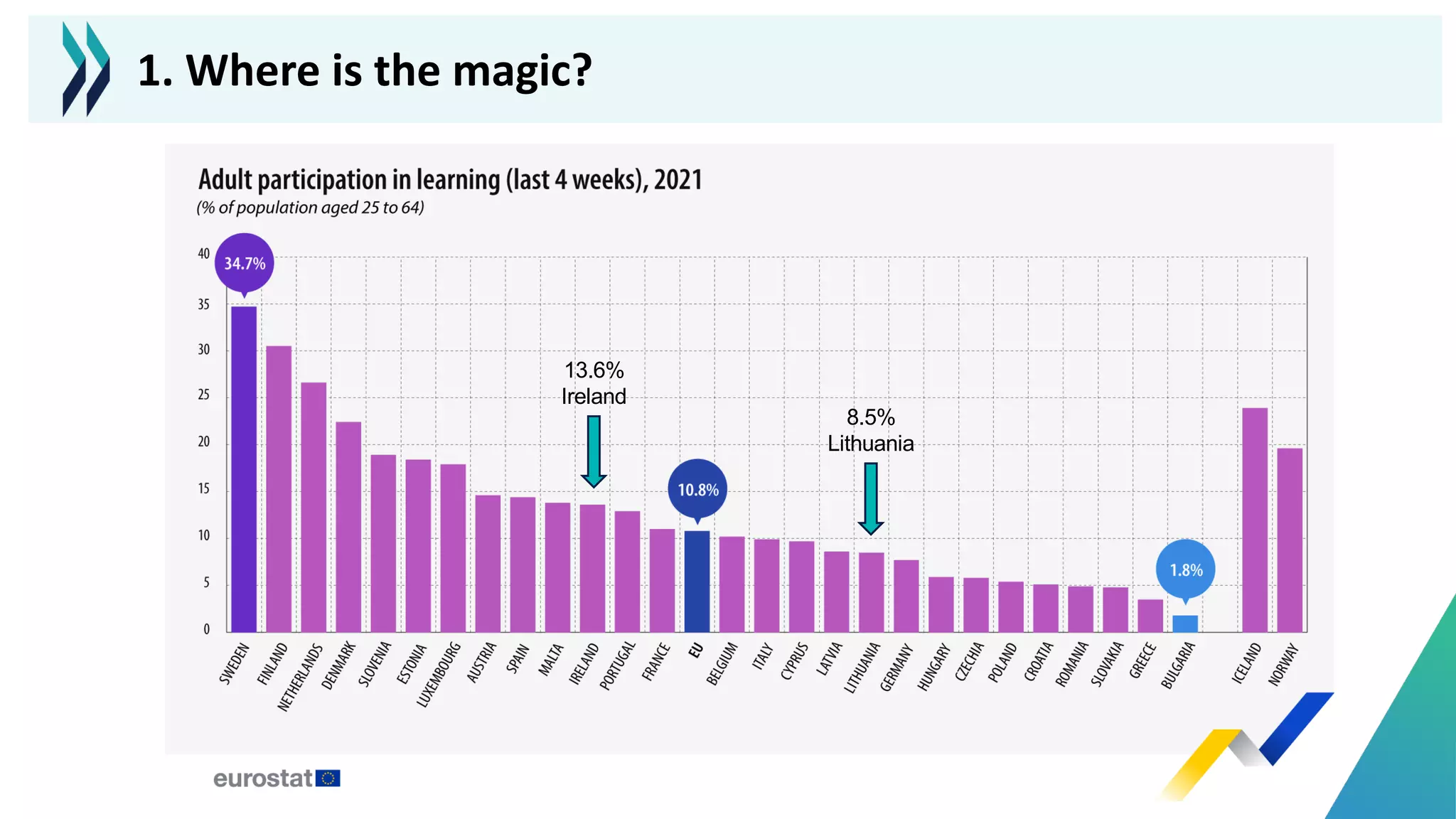
13.6%
Ireland
8.5%
Lithuania
1. Where is the magic?
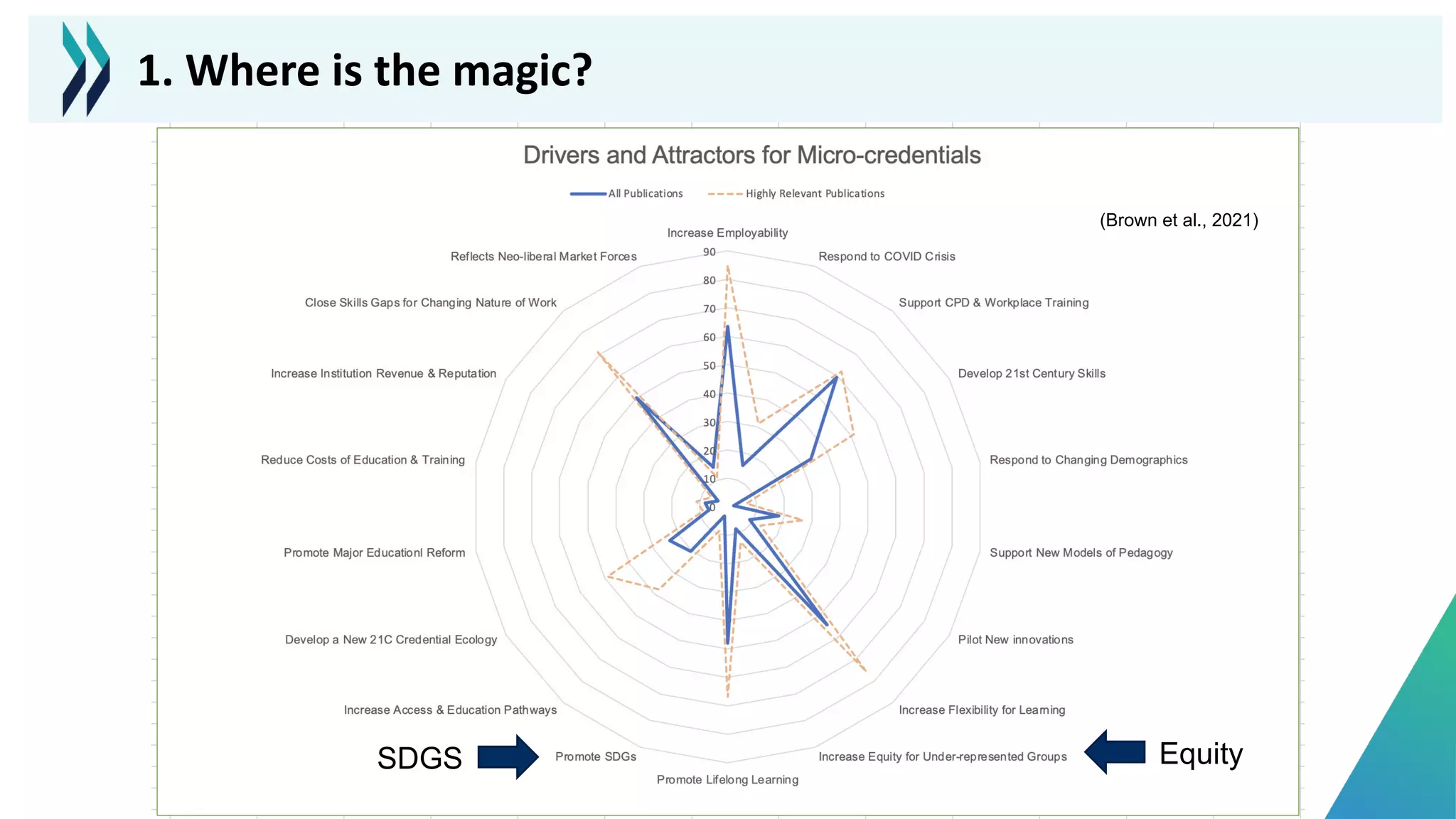
Equity
SDGS
(Brown et al., 2021)
1. Where is the magic?
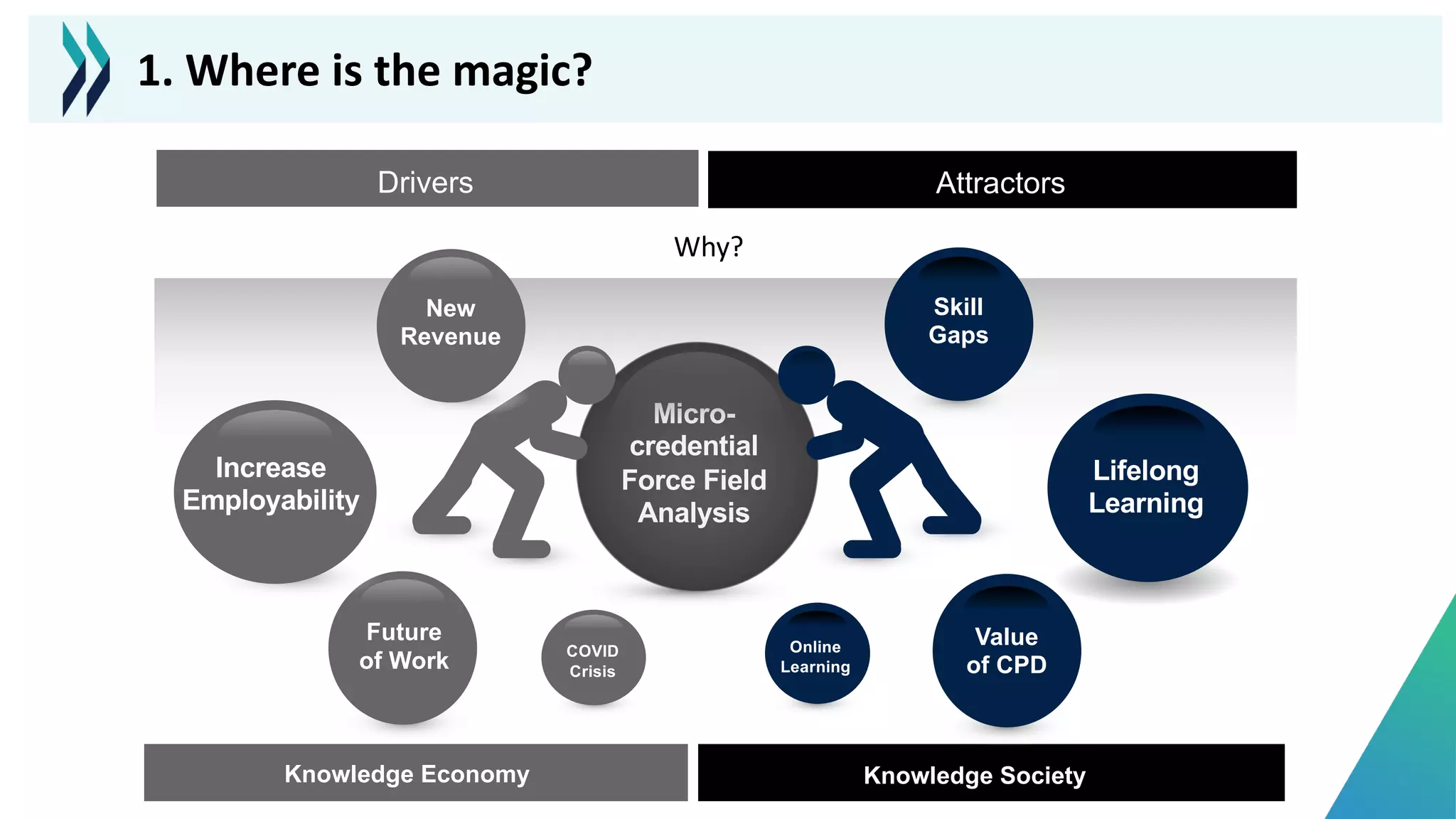
Drivers Attractors
Micro-
credential
Force Field
Analysis
Future
of Work
Increase
Employability
New
Revenue
Skill
Gaps
Lifelong
Learning
Restraining
Force 1
•Example text
•Fill in your own
•Example text
Online
Learning
Restraining Force 1
•Example text
•Fill in your own
•Example text
Value
of CPD
COVID
Crisis
Knowledge Economy Knowledge Society
Why?
1. Where is the magic?
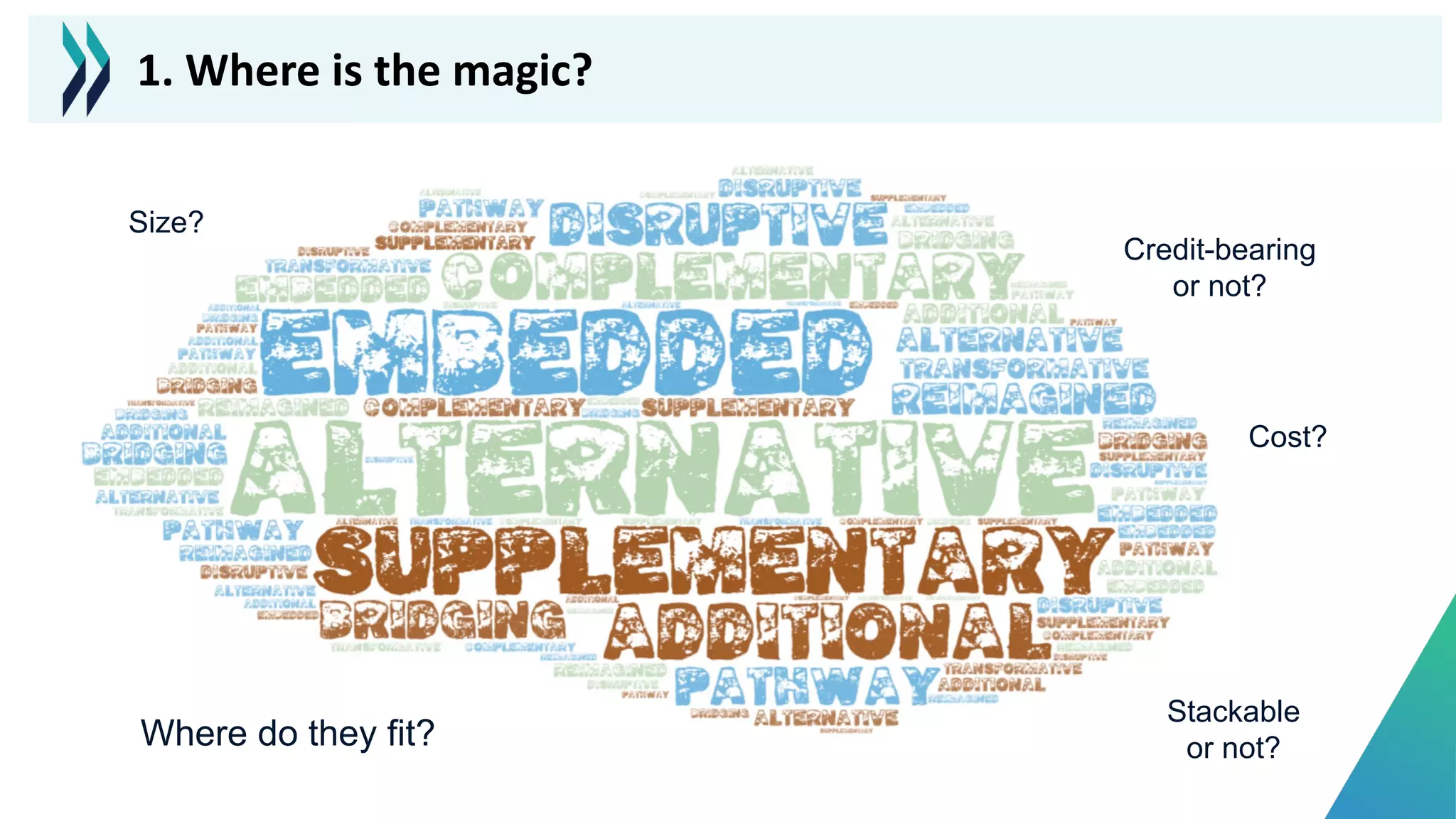
Where do they fit?
Credit-bearing
or not?
Stackable
or not?
Size?
Cost?
1. Where is the magic?
Photo by Almos Bechtold on Unsplash
2. How to execute a transformative strategy?
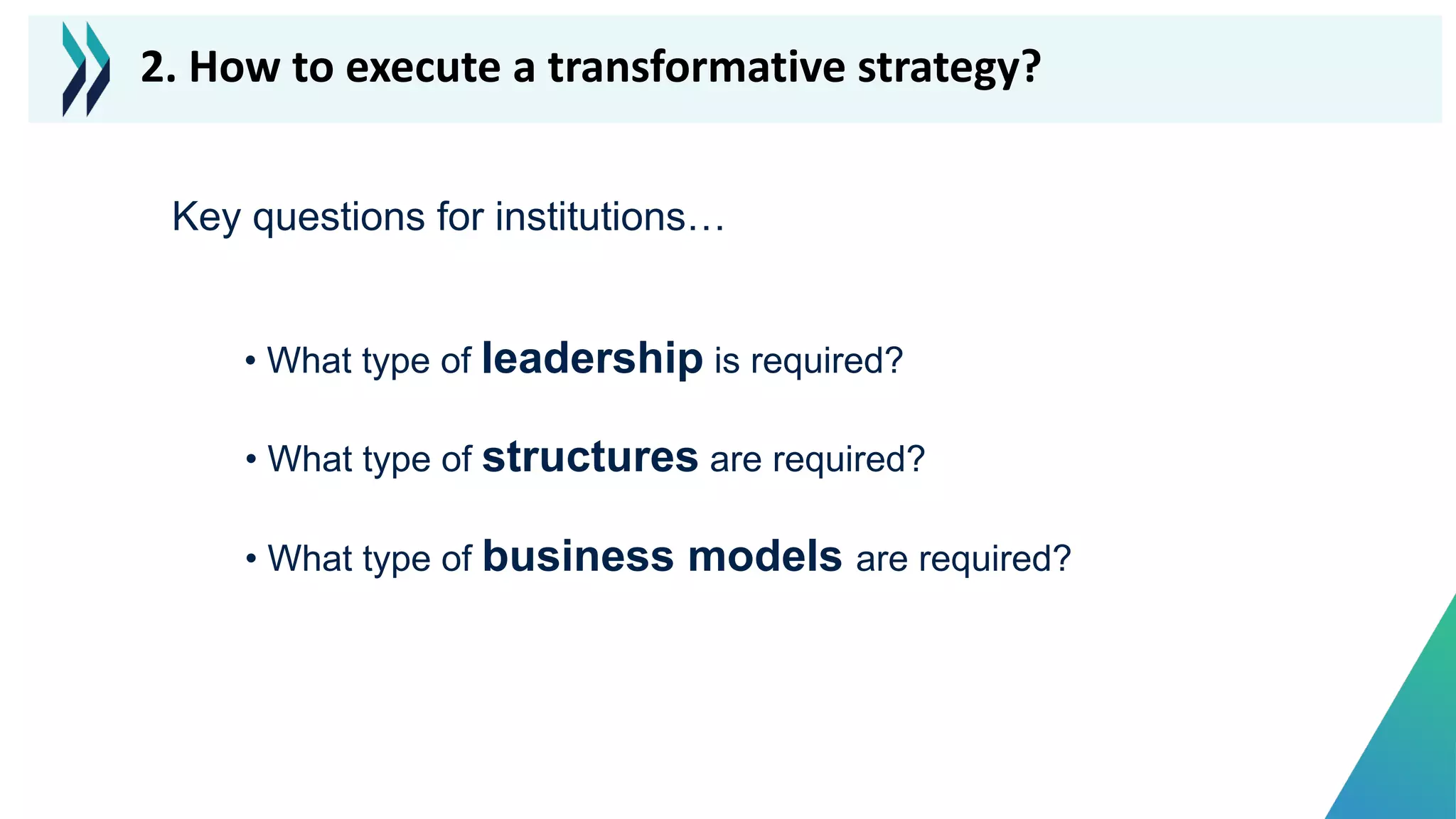
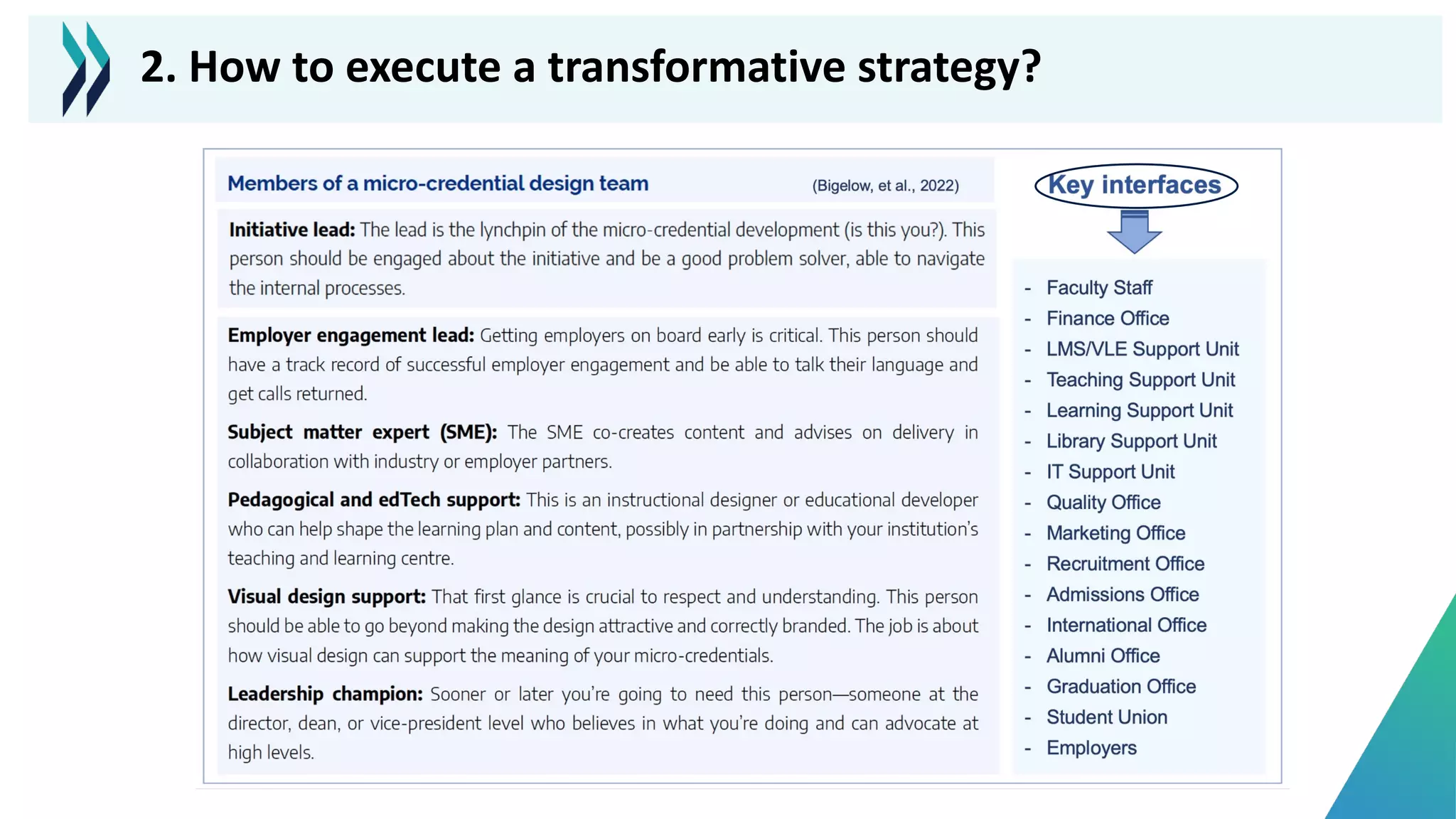
Key questions for institutions…
• What type of leadership is required?
• What type of structures are required?
• What type of business models are required?
2. How to execute a transformative strategy?
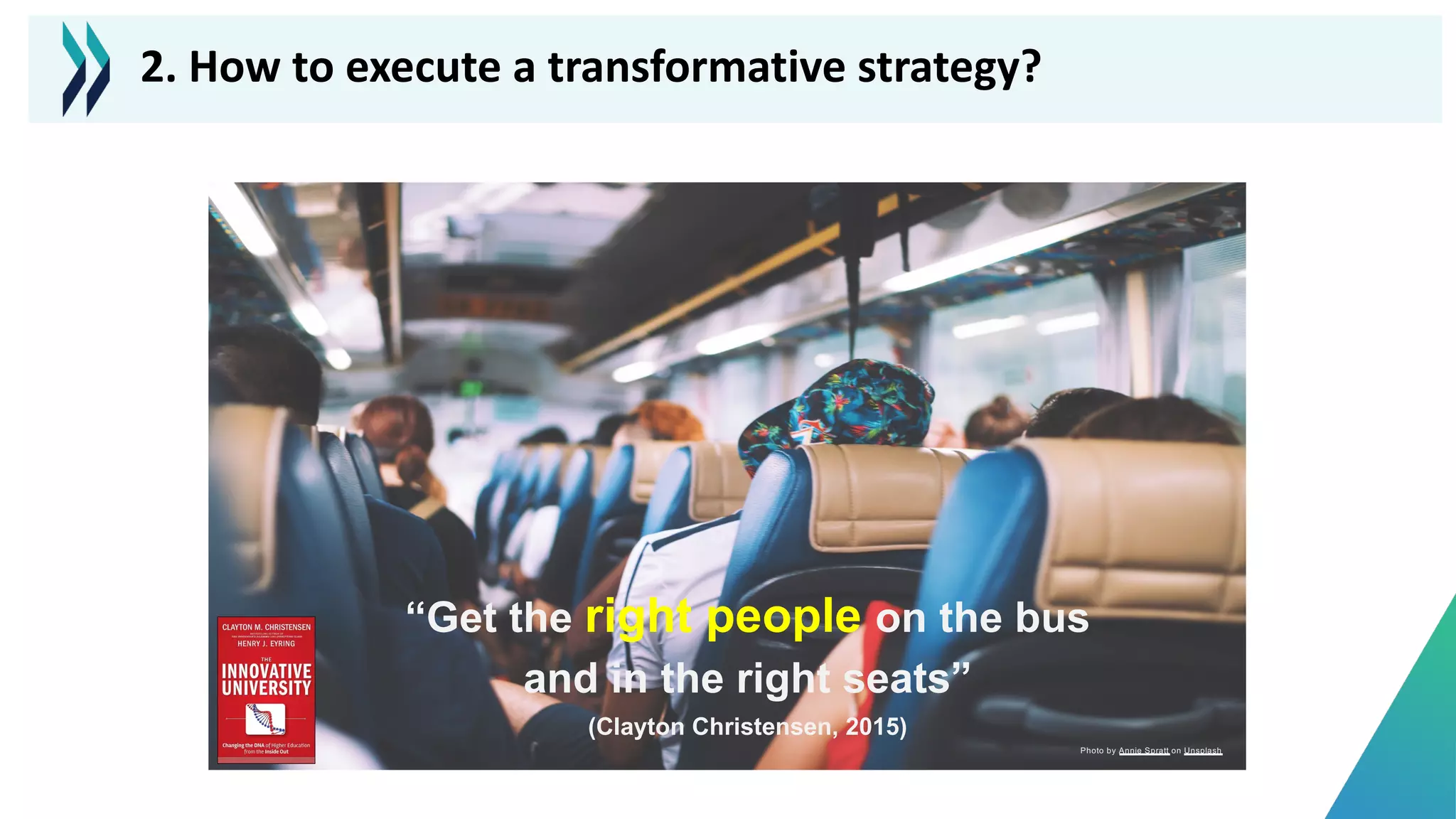
Photo by Annie Spratt on Unsplash
“Get the right people on the bus
and in the right seats”
(Clayton Christensen, 2015)
2. How to execute a transformative strategy?
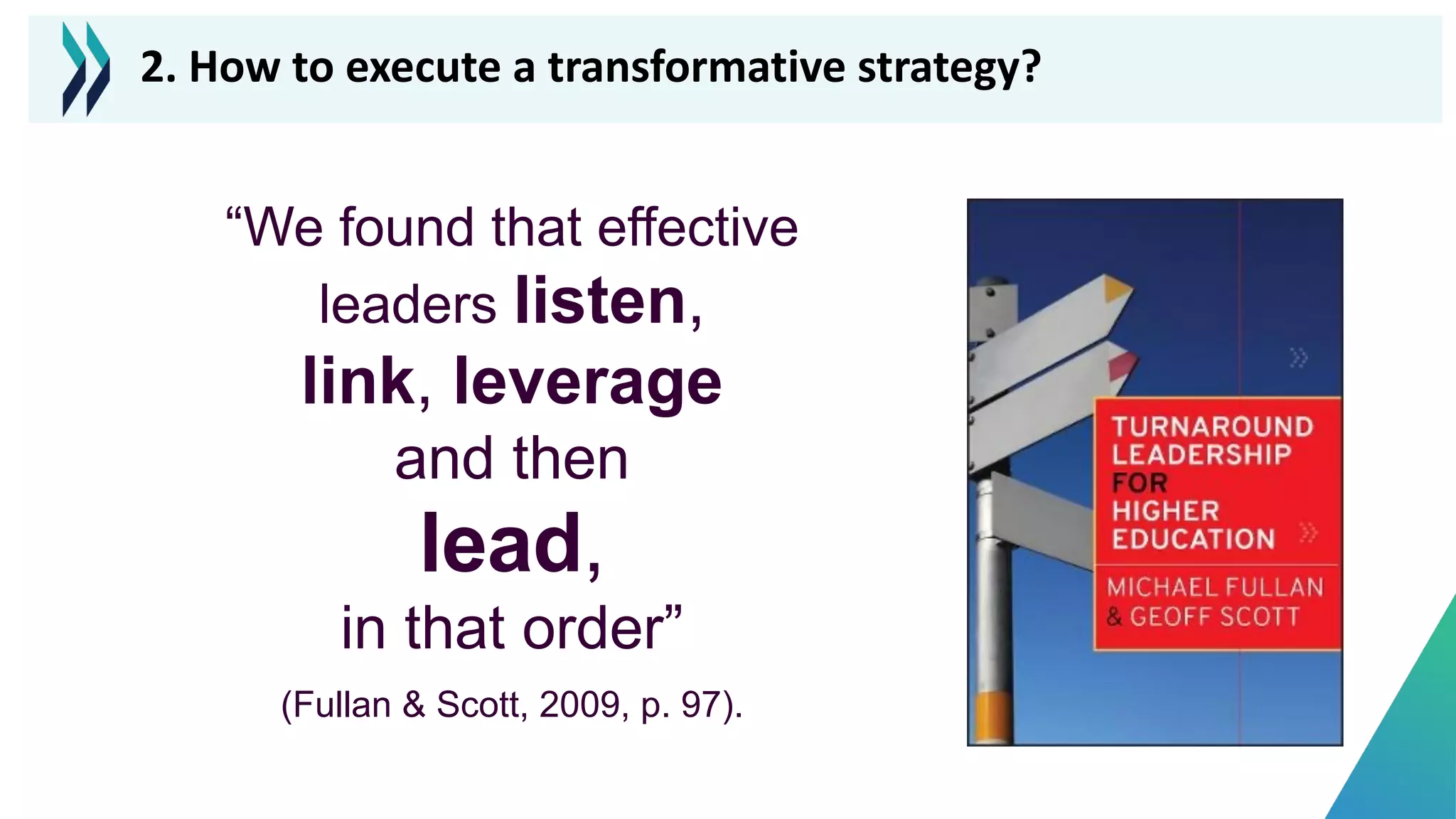
“We found that effective
leaders listen,
link, leverage
and then
lead,
in that order”
(Fullan & Scott, 2009, p. 97).
2. How to execute a transformative strategy?
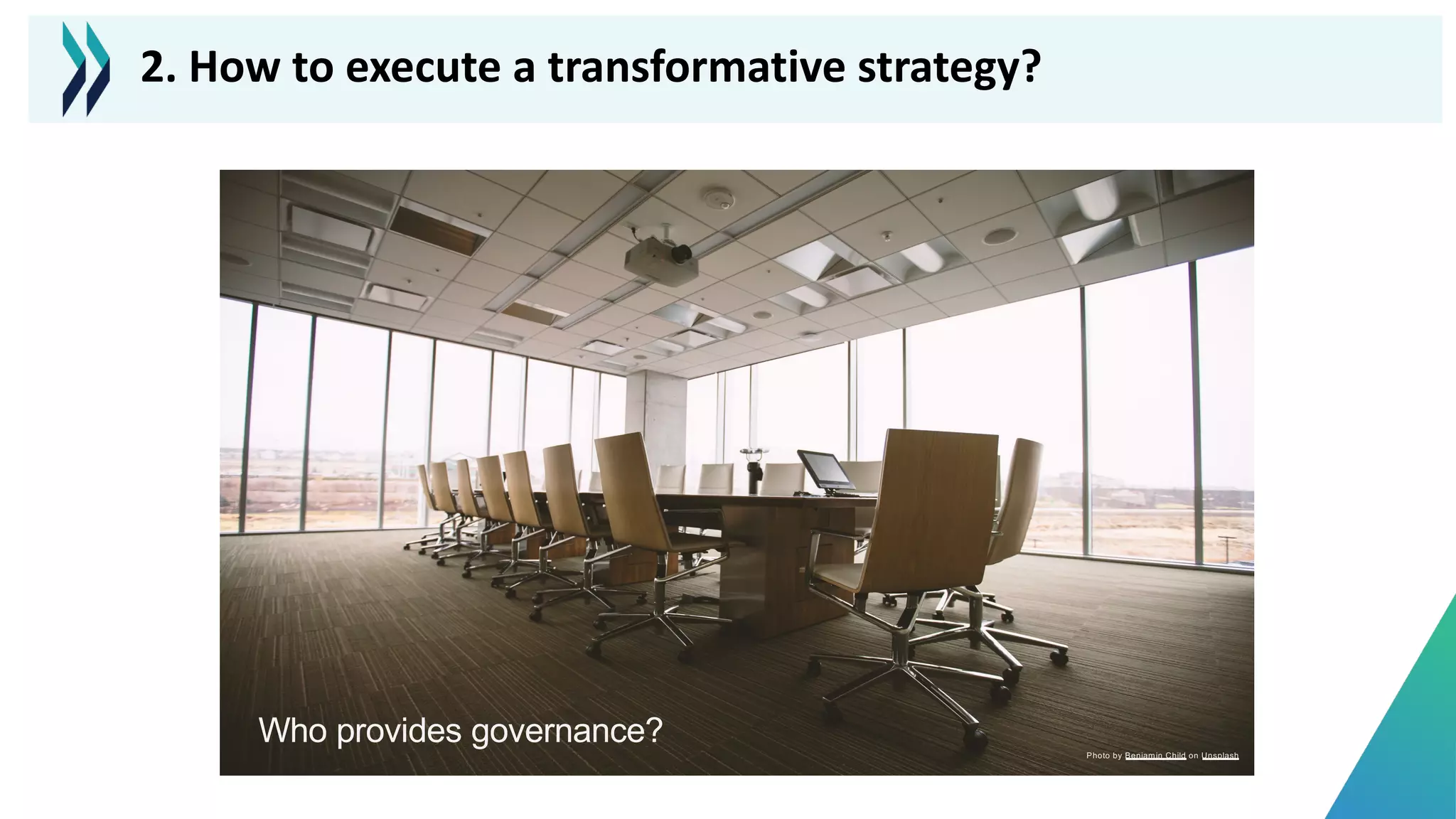
Who provides governance? Photo by Benjamin Child on Unsplash
2. How to execute a transformative strategy?
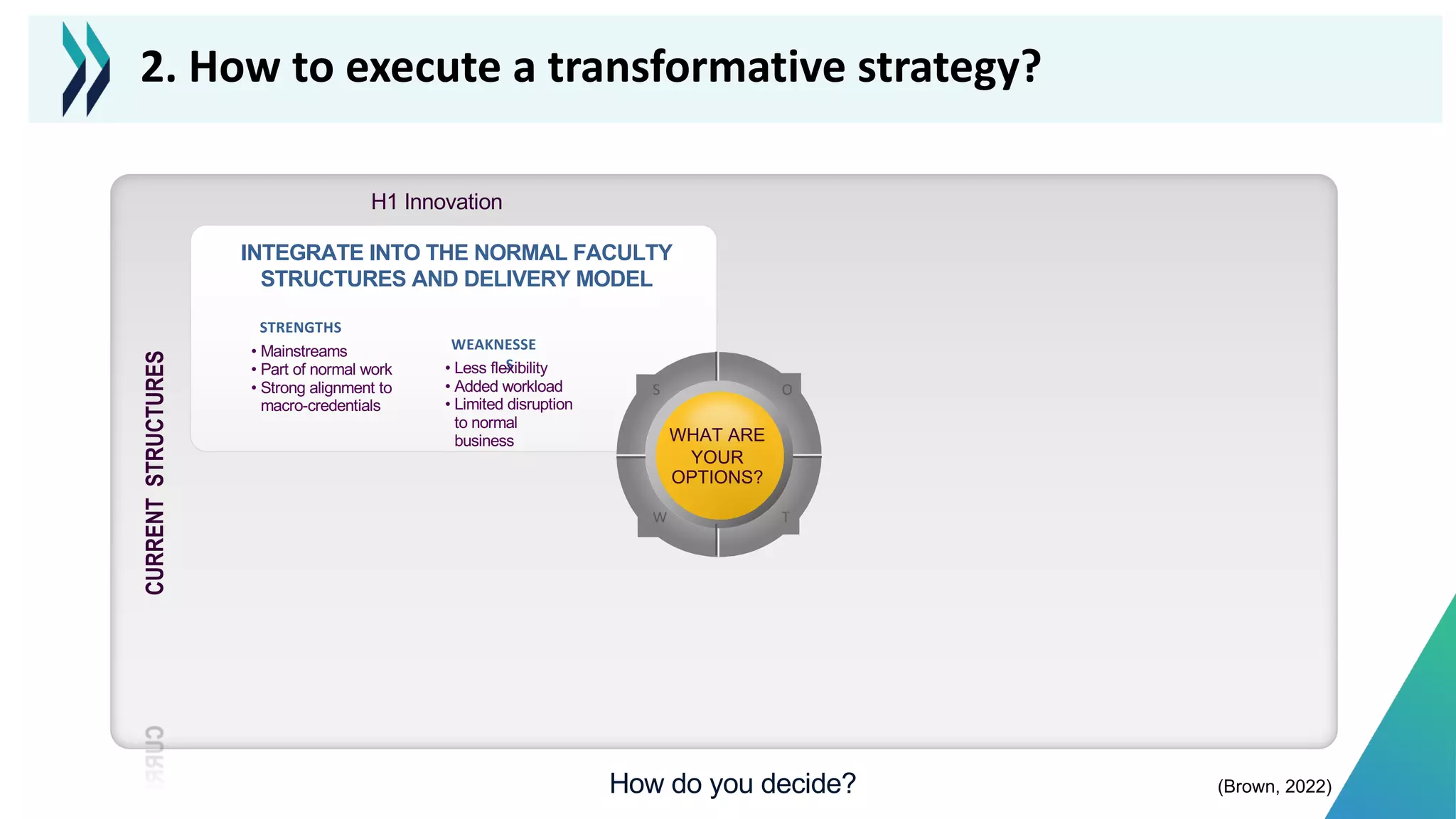
• Mainstreams
• Part of normal work
• Strong alignment to
macro-credentials
WEAKNESSE
S
WHAT ARE
YOUR
OPTIONS?
S O
W T
INTEGRATE INTO THE NORMAL FACULTY
STRUCTURES AND DELIVERY MODEL
STRENGTHS
CURRENT
STRUCTURES
• Less flexibility
• Added workload
• Limited disruption
to normal
business
H1 Innovation
How do you decide? (Brown, 2022)
2. How to execute a transformative strategy?
• Mainstreams
• Part of normal work
• Strong alignment to
macro-credentials
WEAKNESSE
S
WHAT ARE
YOUR
OPTIONS?
S O
W T
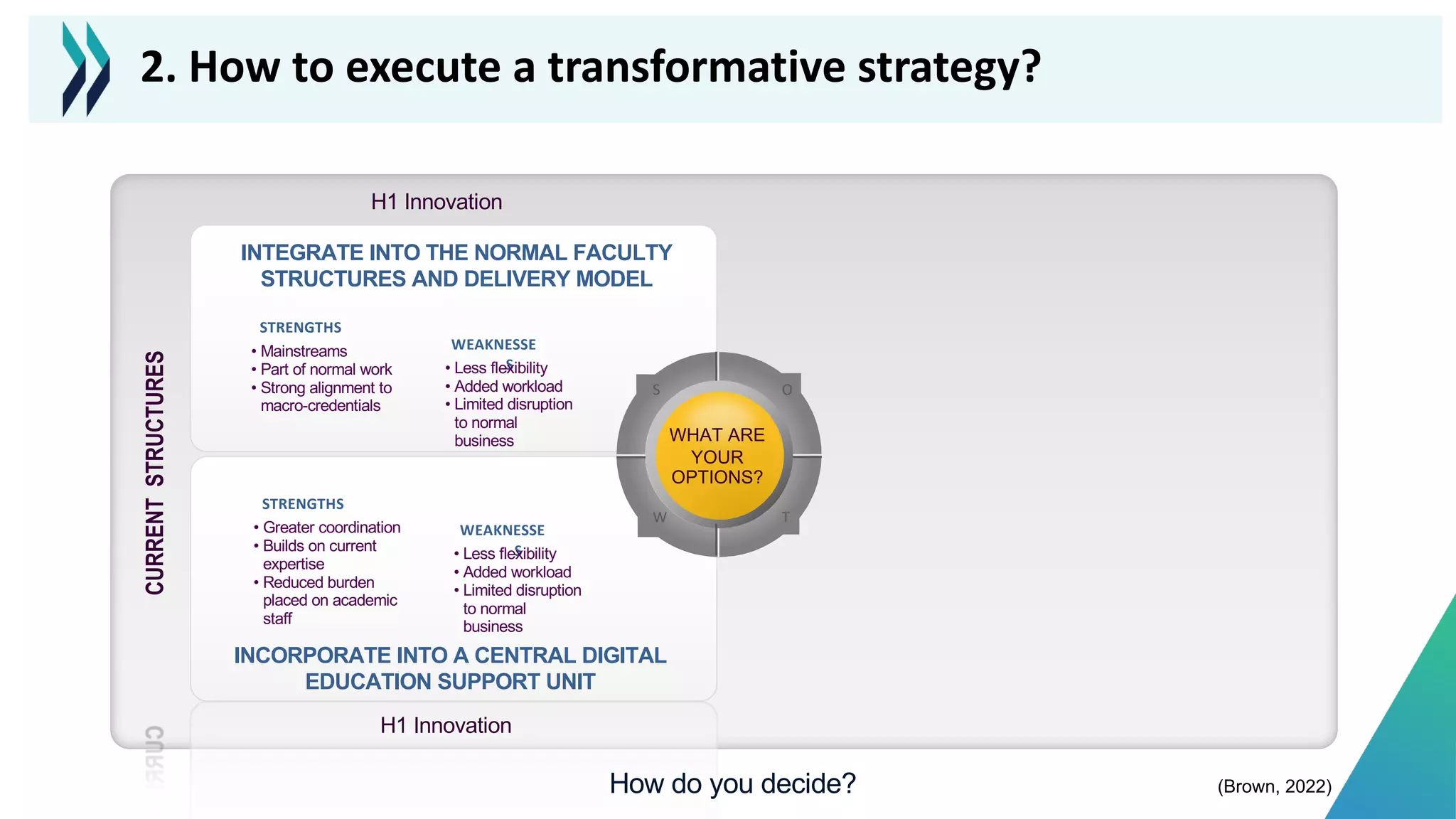
INCORPORATE INTO A CENTRAL DIGITAL
EDUCATION SUPPORT UNIT
INTEGRATE INTO THE NORMAL FACULTY
STRUCTURES AND DELIVERY MODEL
STRENGTHS
CURRENT
STRUCTURES
• Less flexibility
• Added workload
• Limited disruption
to normal
business
• Greater coordination
• Builds on current
expertise
• Reduced burden
placed on academic
staff
STRENGTHS
WEAKNESSE
S
• Less flexibility
• Added workload
• Limited disruption
to normal
business
H1 Innovation
H1 Innovation
How do you decide?
2. How to execute a transformative strategy?
(Brown, 2022)
• Mainstreams
• Part of normal work
• Strong alignment to
macro-credentials
NEW
STRUCTURES
WEAKNESSE
S
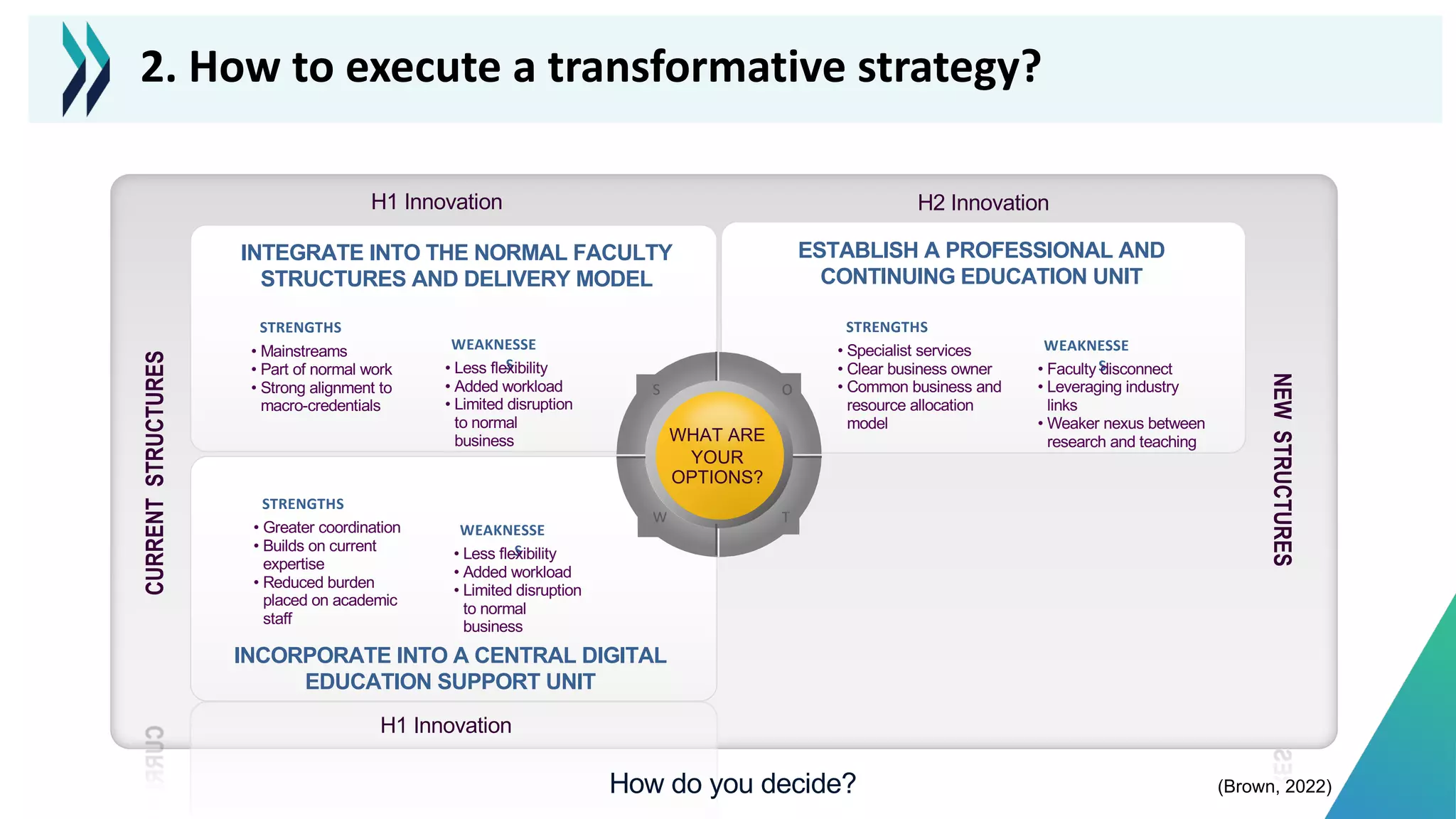
ESTABLISH A PROFESSIONAL AND
CONTINUING EDUCATION UNIT
WHAT ARE
YOUR
OPTIONS?
S O
W T
INCORPORATE INTO A CENTRAL DIGITAL
EDUCATION SUPPORT UNIT
INTEGRATE INTO THE NORMAL FACULTY
STRUCTURES AND DELIVERY MODEL
STRENGTHS
CURRENT
STRUCTURES
• Less flexibility
• Added workload
• Limited disruption
to normal
business
• Greater coordination
• Builds on current
expertise
• Reduced burden
placed on academic
staff
STRENGTHS
WEAKNESSE
S
• Less flexibility
• Added workload
• Limited disruption
to normal
business
• Specialist services
• Clear business owner
• Common business and
resource allocation
model
WEAKNESSE
S
STRENGTHS
• Faculty disconnect
• Leveraging industry
links
• Weaker nexus between
research and teaching
H1 Innovation
H1 Innovation
H2 Innovation
How do you decide?
2. How to execute a transformative strategy?
(Brown, 2022)
• Mainstreams
• Part of normal work
• Strong alignment to
macro-credentials
NEW
STRUCTURES
WEAKNESSE
S
ESTABLISH A PROFESSIONAL AND
CONTINUING EDUCATION UNIT
WHAT ARE
YOUR
OPTIONS?
S O
W T
CREATE A COMPLETELY SEPARATE
STANDALONE BUSINESS UNIT
INCORPORATE INTO A CENTRAL DIGITAL
EDUCATION SUPPORT UNIT
INTEGRATE INTO THE NORMAL FACULTY
STRUCTURES AND DELIVERY MODEL
STRENGTHS
CURRENT
STRUCTURES
• Less flexibility
• Added workload
• Limited disruption
to normal
business
• Greater coordination
• Builds on current
expertise
• Reduced burden
placed on academic
staff
STRENGTHS
WEAKNESSE
S
• Less flexibility
• Added workload
• Limited disruption
to normal
business
• Specialist services
• Clear business owner
• Common business and
resource allocation
model
WEAKNESSE
S
STRENGTHS
• Faculty disconnect
• Leveraging industry
links
• Weaker nexus between
research and teaching
• Greater flexibility
• Adopts a commercial
business model
• Easier to establish
return on investment
WEAKNESSE
S
STRENGTHS
• Little cross subsidisation
• Outside of normal
business
• Loss of academic
ownership
H3 Innovation
H1 Innovation
H1 Innovation
H2 Innovation
How do you decide?
2. How to execute a transformative strategy?
(Brown, 2022)
2. How to execute a transformative strategy?
https://www.eciu.eu
2023
2. How to execute a transformative strategy?
Photo by Almos Bechtold on Unsplash
Looking for lost sheep…
Photo by Christian Bass on Unsplash
Photo by Ben Stein on Unsplash
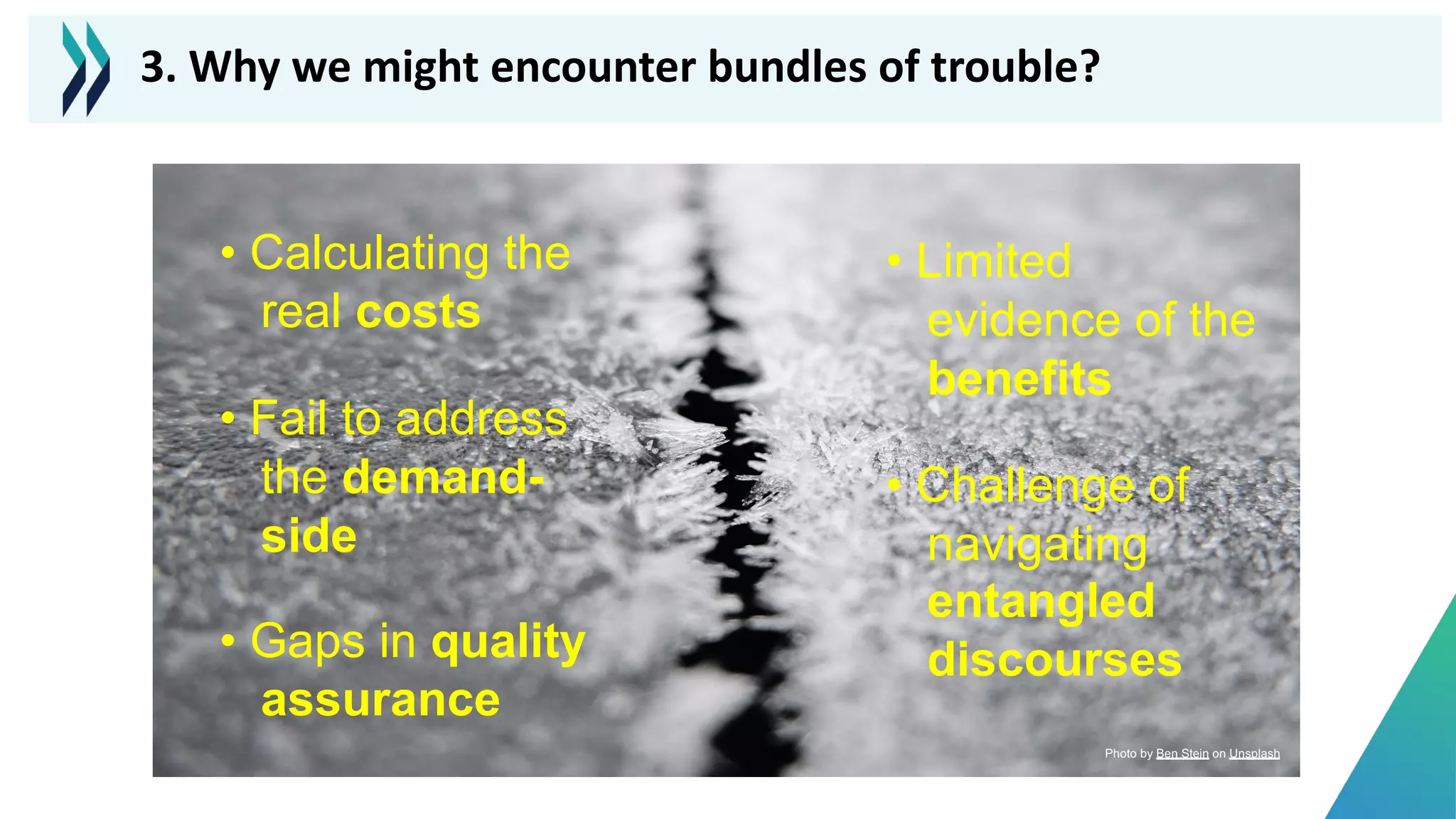
• Calculating the
real costs
• Fail to address
the demand-
side
• Gaps in quality
assurance
3. Why we might encounter bundles of trouble?
• Limited
evidence of the
benefits
• Challenge of
navigating
entangled
discourses
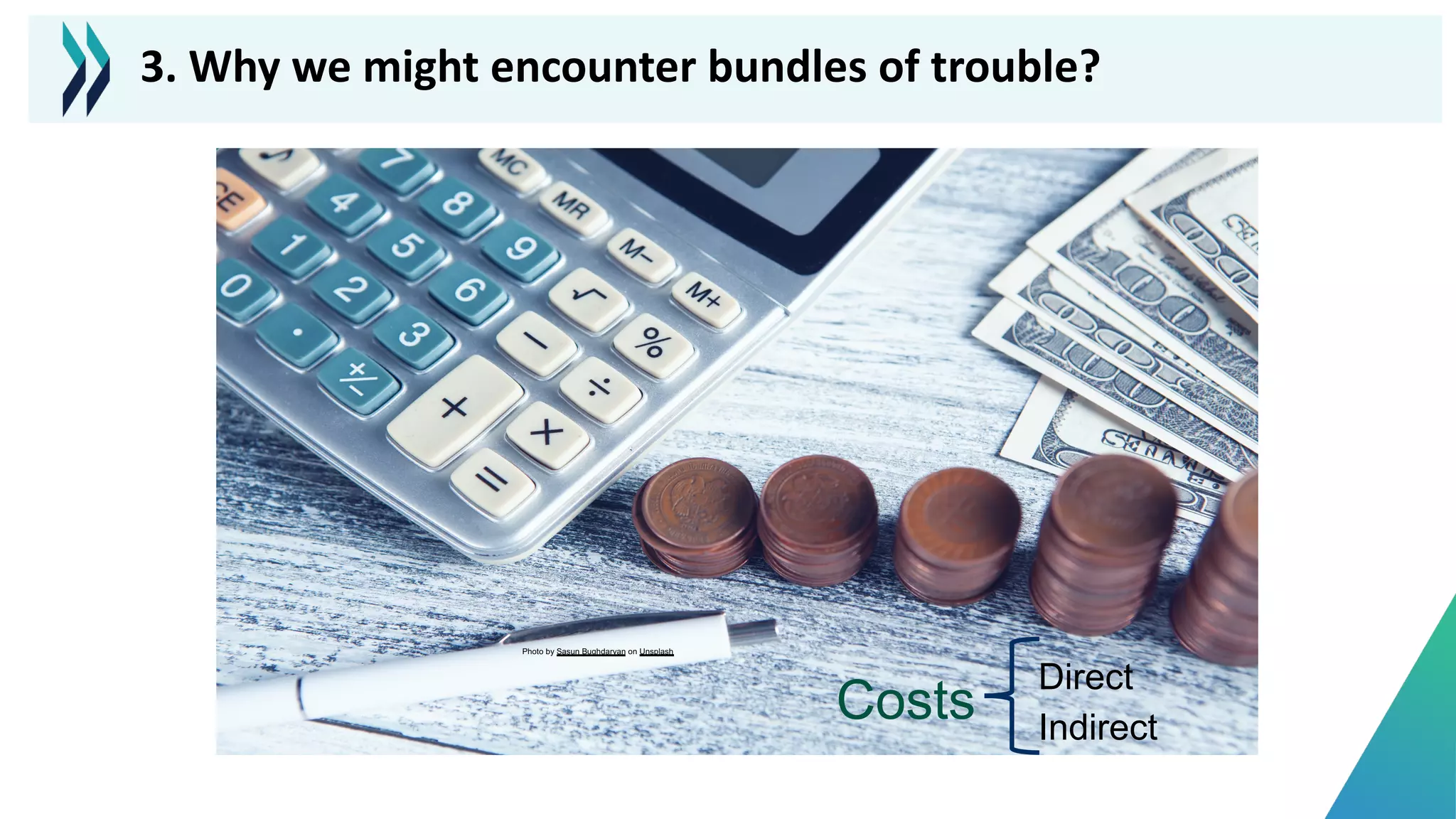
Photo by Sasun Bughdaryan on Unsplash
Costs
Direct
Indirect
3. Why we might encounter bundles of trouble?
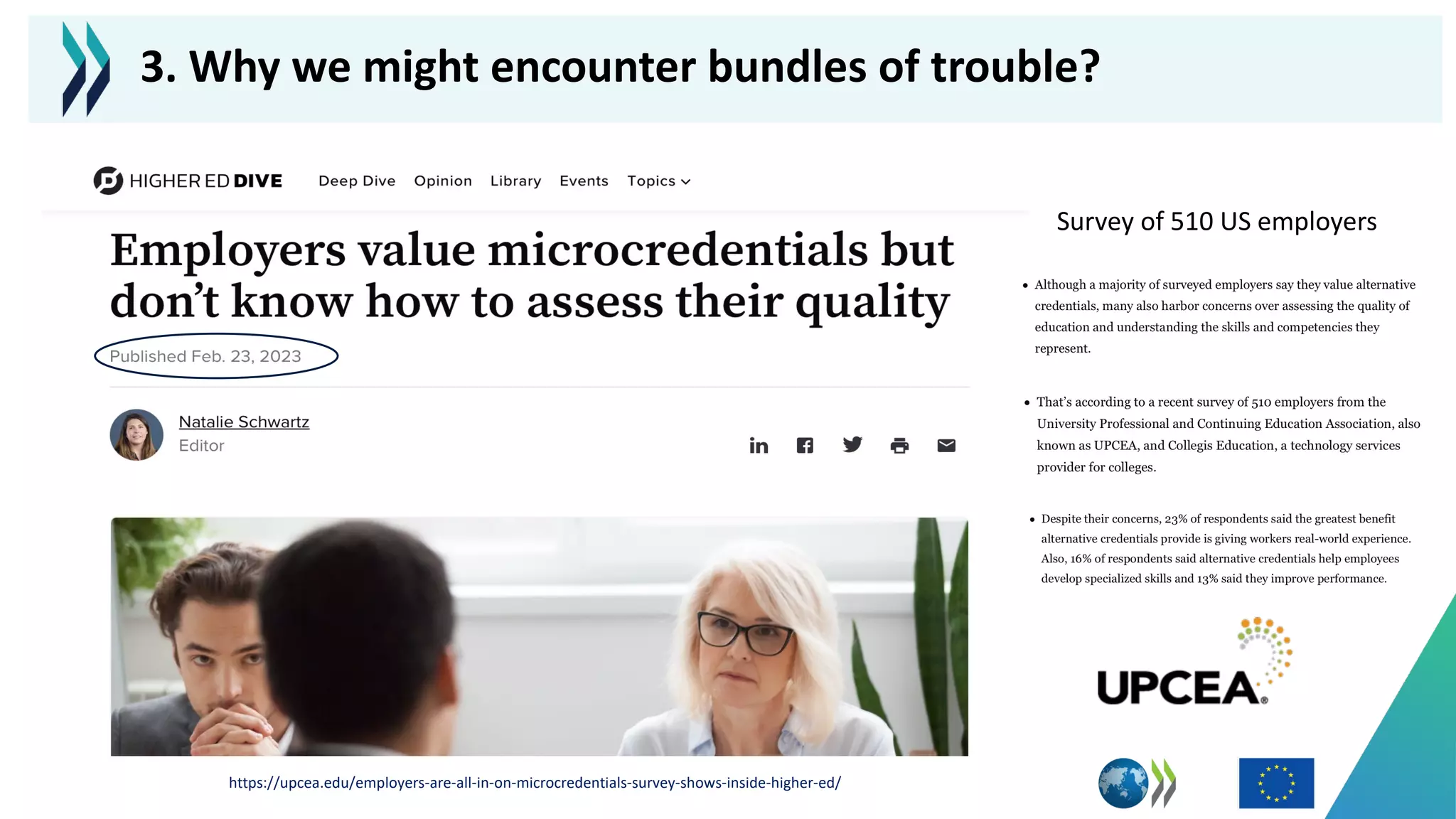
Survey of 510 US employers
https://upcea.edu/employers-are-all-in-on-microcredentials-survey-shows-inside-higher-ed/
3. Why we might encounter bundles of trouble?
1
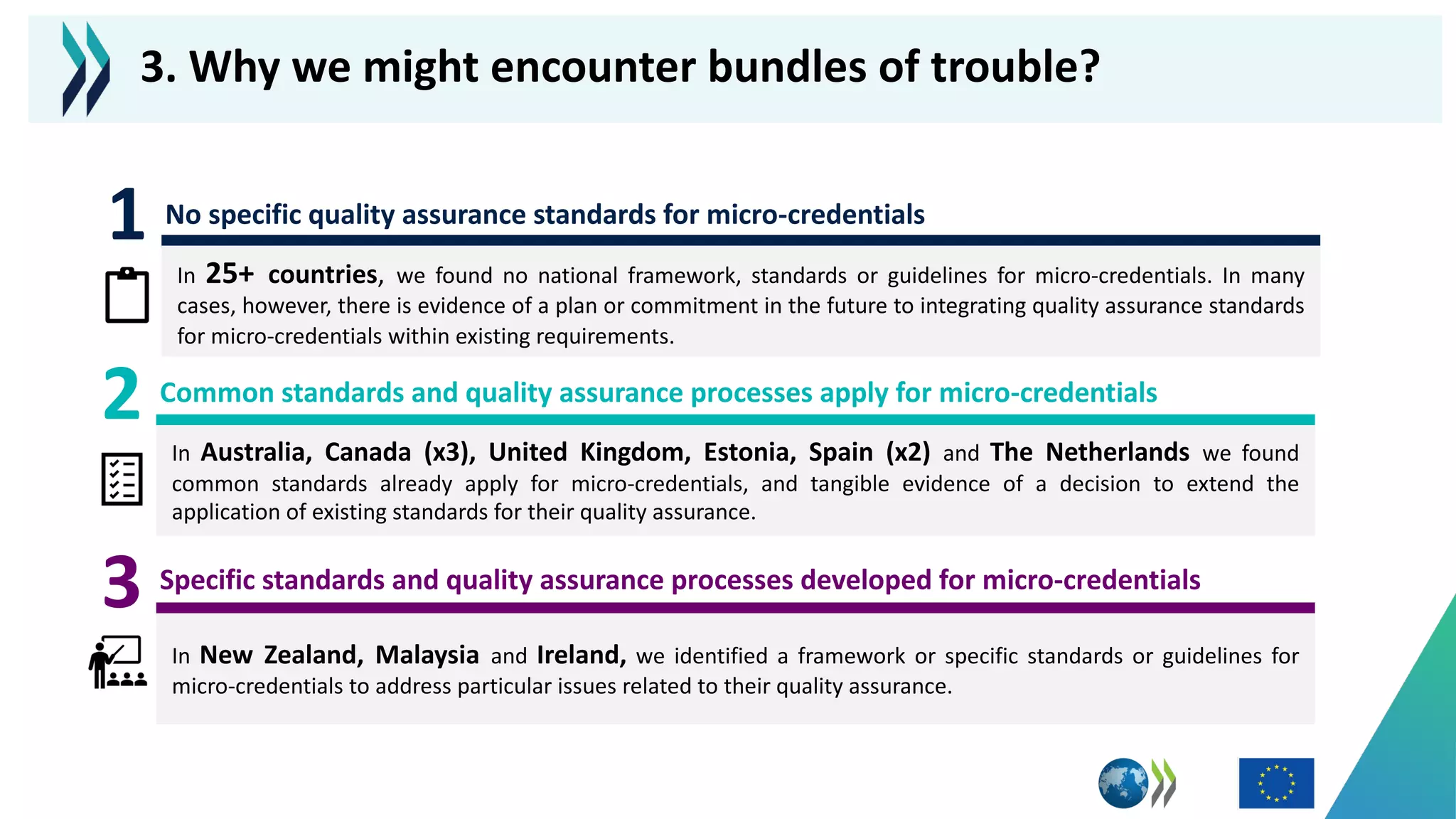
In 25+ countries, we found no national framework, standards or guidelines for micro-credentials. In many
cases, however, there is evidence of a plan or commitment in the future to integrating quality assurance standards
for micro-credentials within existing requirements.
2
In Australia, Canada (x3), United Kingdom, Estonia, Spain (x2) and The Netherlands we found
common standards already apply for micro-credentials, and tangible evidence of a decision to extend the
application of existing standards for their quality assurance.
3
In New Zealand, Malaysia and Ireland, we identified a framework or specific standards or guidelines for
micro-credentials to address particular issues related to their quality assurance.
No specific quality assurance standards for micro-credentials
Common standards and quality assurance processes apply for micro-credentials
Specific standards and quality assurance processes developed for micro-credentials
3. Why we might encounter bundles of trouble?
Specific QA issues for online [MCs]
Includes
M
icro-credentials
Organisational context
• Business continuity
• Access to IT infrastructure
• Learners outside of country
Programme context
• Online teaching experience
• Training and professional development
• Synchronous vs asynchronous delivery
Learner context
• Learner readiness
• Access to online resources
• Equivalency of learning support
3. Why we might encounter bundles of trouble?
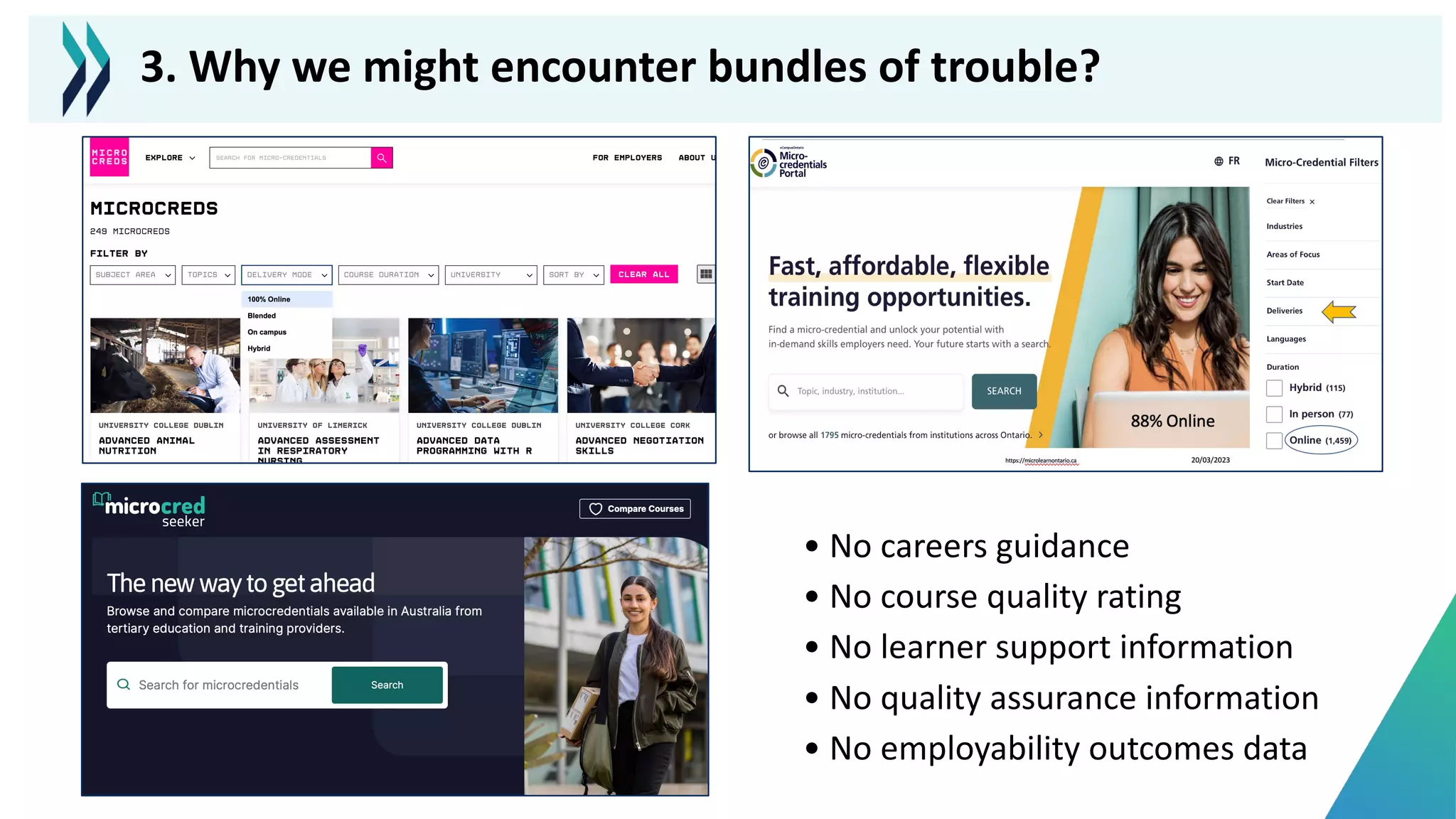
• No careers guidance
• No course quality rating
• No learner support information
• No quality assurance information
• No employability outcomes data
3. Why we might encounter bundles of trouble?
2023
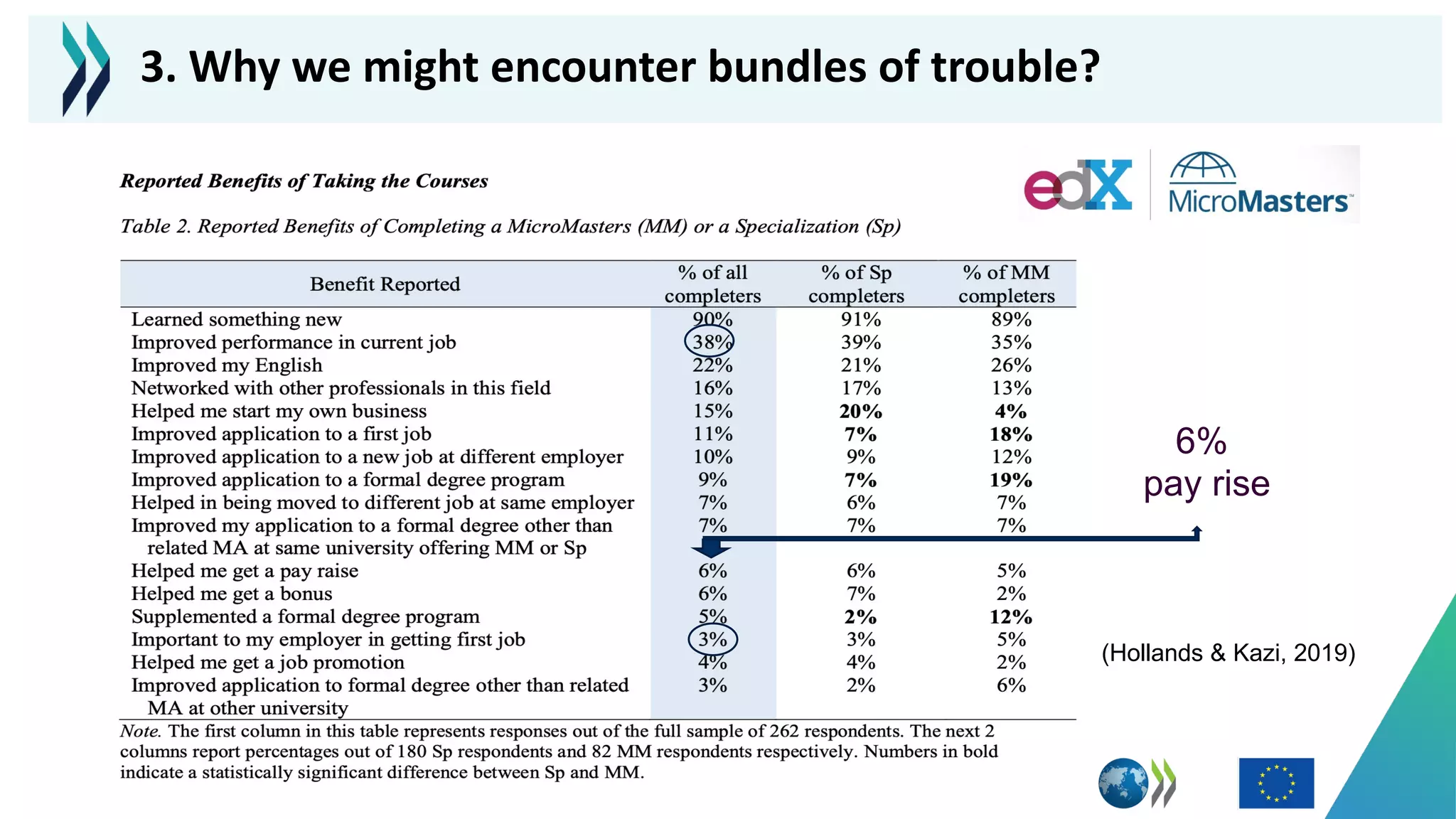
(Hollands & Kazi, 2019)
6%
pay rise
3. Why we might encounter bundles of trouble?
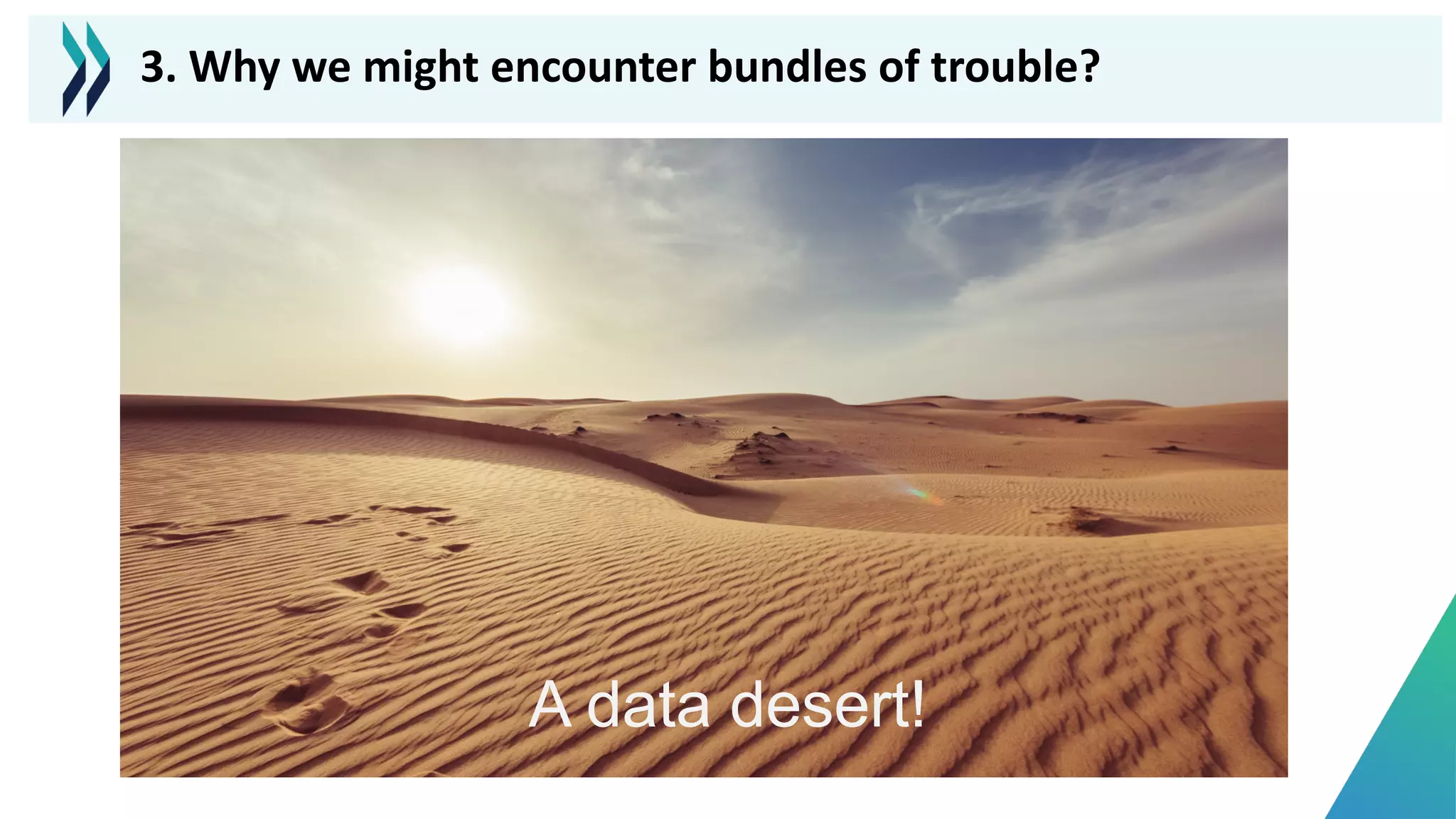
A data desert!
3. Why we might encounter bundles of trouble?
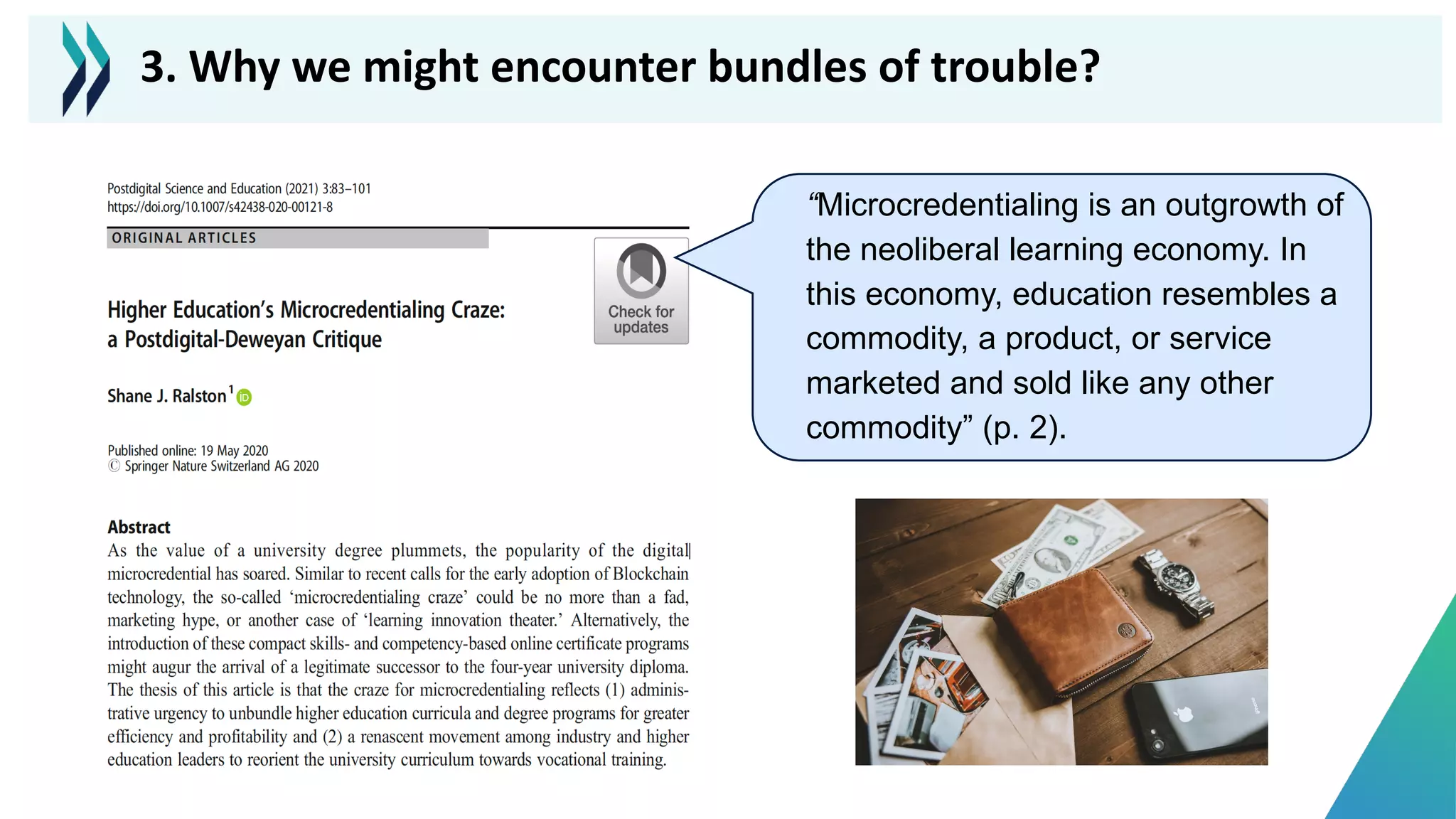
“Microcredentialing is an outgrowth of
the neoliberal learning economy. In
this economy, education resembles a
commodity, a product, or service
marketed and sold like any other
commodity” (p. 2).
3. Why we might encounter bundles of trouble?
Photo by Almos Bechtold on Unsplash
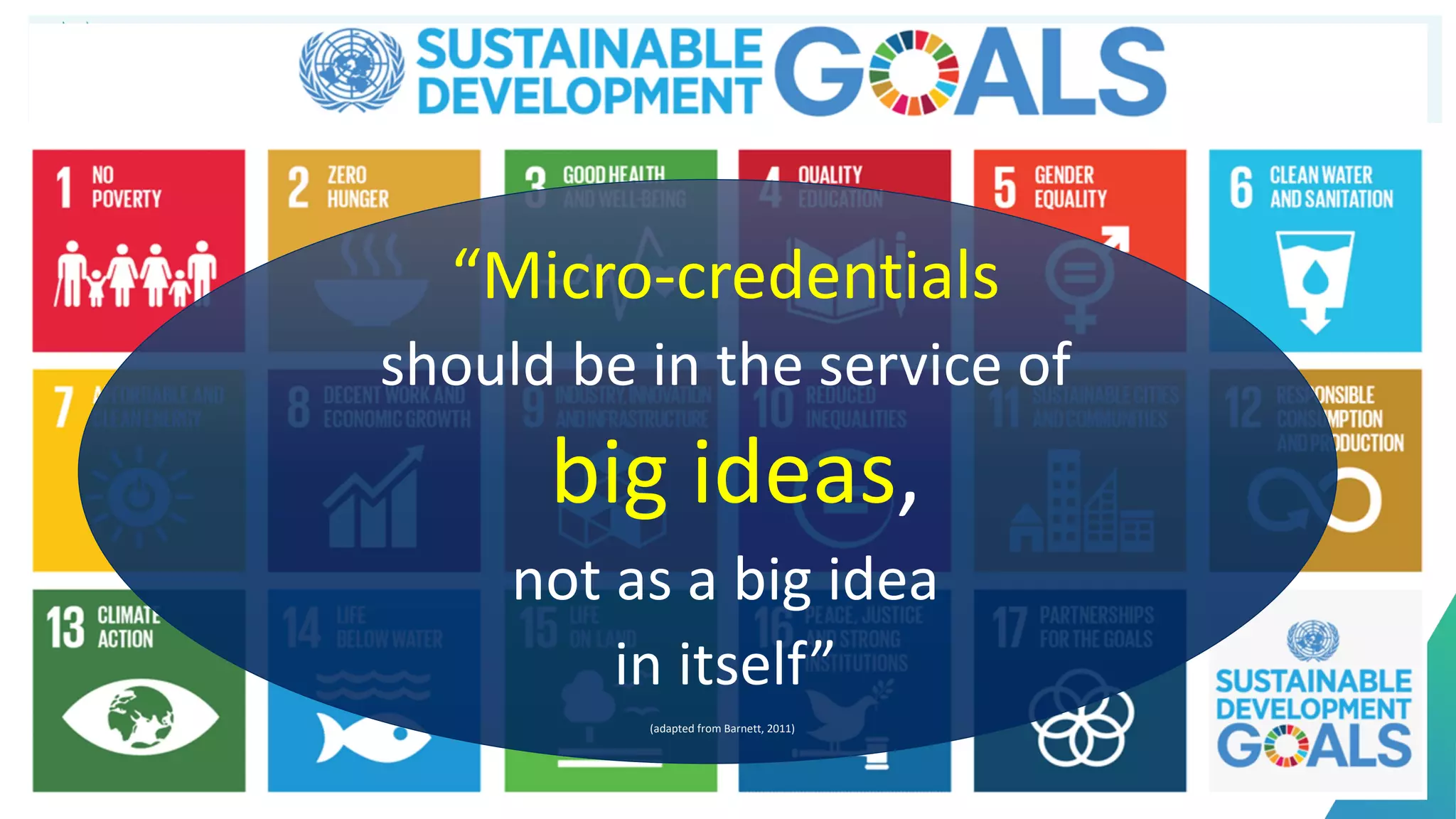
“Micro-credentials
should be in the service of
big ideas,
not as a big idea
in itself”
(adapted from Barnett, 2011)
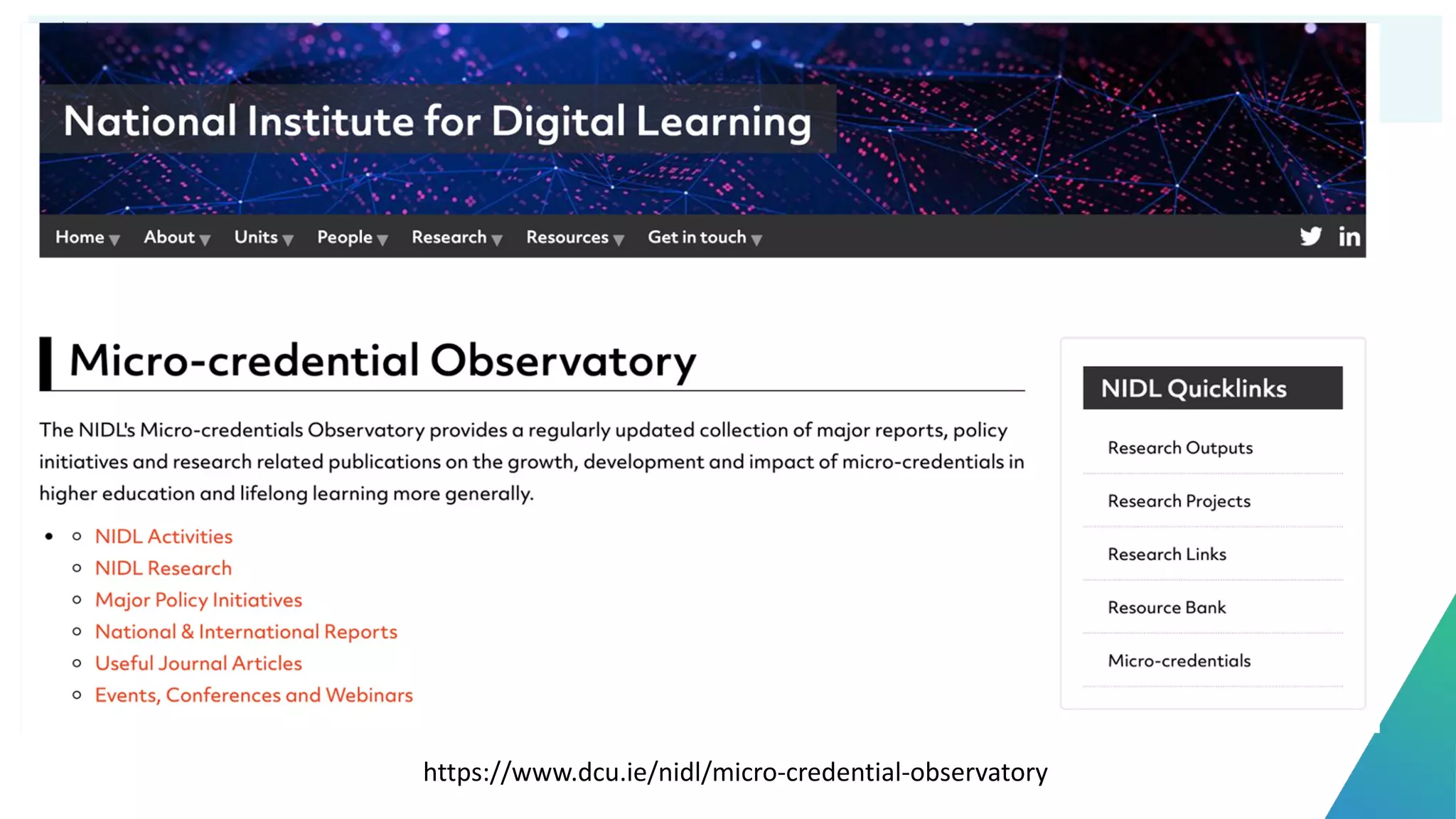
https://www.dcu.ie/nidl/micro-credential-observatory
Thank you
Professor Mark Brown
Director, National Institute for Digital Learning
Dublin City University
Ireland
mark.brown@dcu.ie
Contact details…

The Magic of Micro-credentials: Digital Transformation or Bundles of Trouble?

  • 1.
    26th May 2023 ProfessorMark Brown Dublin City University Photo by Almos Bechtold on Unsplash
  • 2.
    26th May 2023 ProfessorMark Brown Dublin City University Photo by Almos Bechtold on Unsplash
  • 6.
  • 7.
    Where is themagic? How to execute a transformative strategy? Why we might encounter bundles of trouble? The Magic of Micro-credentials
  • 8.
  • 9.
  • 10.
    Photo by AlmosBechtold on Unsplash
  • 11.
    1. Where isthe magic? https://ec.europa.eu/education/sites/default/files/document-library-docs/european-approach-micro-credentials-higher-education-consultation-group-output-final-report.pdf
  • 12.
    (Presant , 2022) 1.Where is the magic?
  • 13.
    ‘Micro-credential’ means therecord of the learning outcomes that a learner has acquired following a small volume of learning. These learning outcomes will have been assessed against transparent and clearly defined criteria. Learning experiences leading to micro-credentials are designed to provide the learner with specific knowledge, skills and competences that respond to societal, personal, cultural or labour market needs. Micro- credentials are owned by the learner, can be shared and are portable. They may be stand-alone or combined into larger credentials. They are underpinned by quality assurance following agreed standards in the relevant sector or area of activity (European Commission, 2022). 1. Where is the magic?
  • 14.
    1. Where isthe magic? 13.6% Ireland 8.5% Lithuania
  • 15.
    1. Where isthe magic?
  • 16.
    1. Where isthe magic?
  • 17.
    1. Where isthe magic?
  • 18.
    Equity SDGS (Brown et al.,2021) 1. Where is the magic?
  • 19.
    Drivers Attractors Micro- credential Force Field Analysis Future ofWork Increase Employability New Revenue Skill Gaps Lifelong Learning Restraining Force 1 •Example text •Fill in your own •Example text Online Learning Restraining Force 1 •Example text •Fill in your own •Example text Value of CPD COVID Crisis Knowledge Economy Knowledge Society Why? 1. Where is the magic?
  • 20.
    Where do theyfit? Credit-bearing or not? Stackable or not? Size? Cost? 1. Where is the magic?
  • 21.
    Photo by AlmosBechtold on Unsplash
  • 22.
    2. How toexecute a transformative strategy?
  • 23.
    Key questions forinstitutions… • What type of leadership is required? • What type of structures are required? • What type of business models are required? 2. How to execute a transformative strategy?
  • 24.
    Photo by AnnieSpratt on Unsplash “Get the right people on the bus and in the right seats” (Clayton Christensen, 2015) 2. How to execute a transformative strategy?
  • 25.
    2. How toexecute a transformative strategy?
  • 26.
    “We found thateffective leaders listen, link, leverage and then lead, in that order” (Fullan & Scott, 2009, p. 97). 2. How to execute a transformative strategy?
  • 27.
    2. How toexecute a transformative strategy?
  • 28.
    2. How toexecute a transformative strategy?
  • 29.
    2. How toexecute a transformative strategy?
  • 30.
    Who provides governance?Photo by Benjamin Child on Unsplash 2. How to execute a transformative strategy?
  • 31.
    2. How toexecute a transformative strategy?
  • 32.
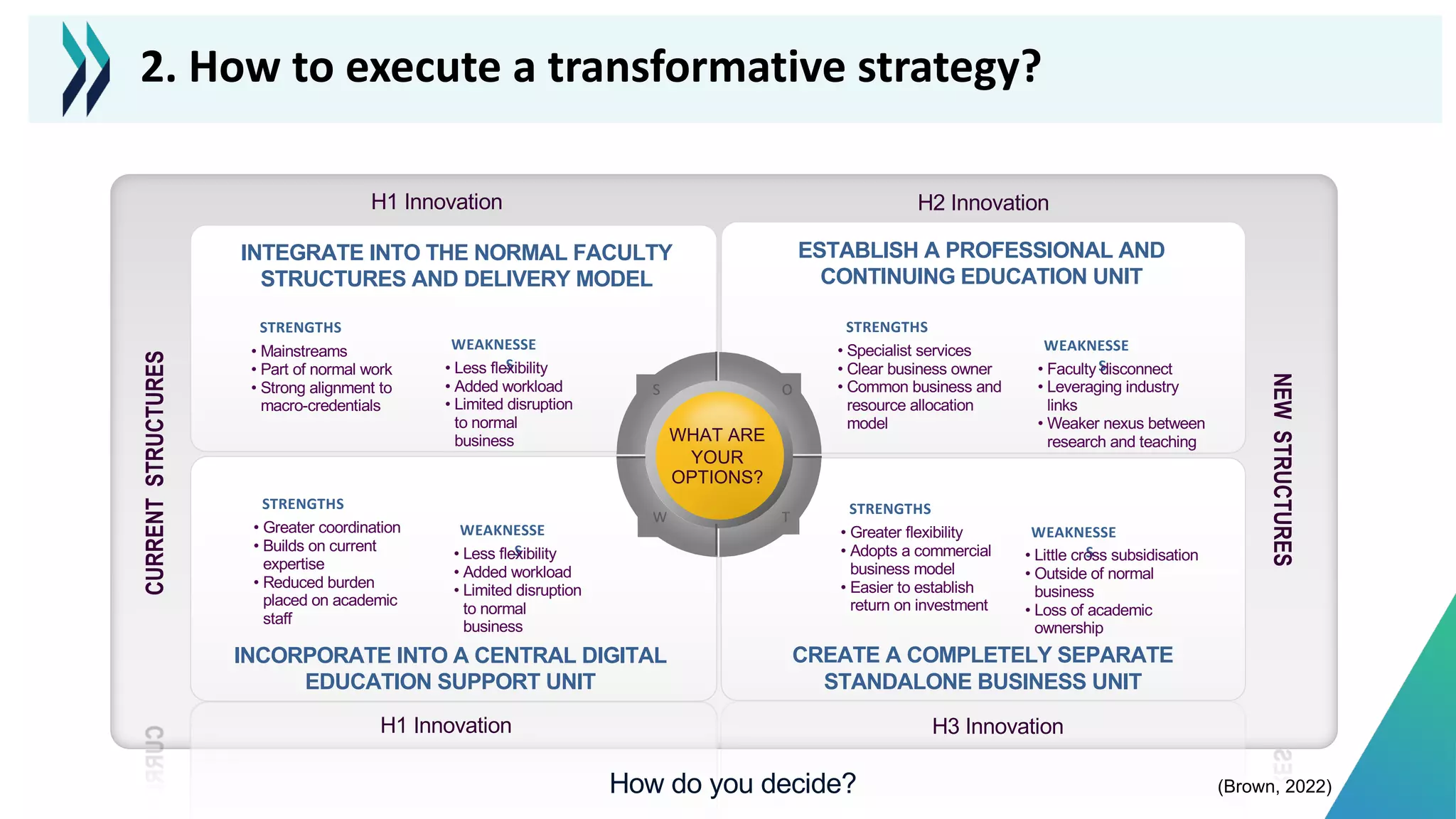
    • Mainstreams • Partof normal work • Strong alignment to macro-credentials WEAKNESSE S WHAT ARE YOUR OPTIONS? S O W T INTEGRATE INTO THE NORMAL FACULTY STRUCTURES AND DELIVERY MODEL STRENGTHS CURRENT STRUCTURES • Less flexibility • Added workload • Limited disruption to normal business H1 Innovation How do you decide? (Brown, 2022) 2. How to execute a transformative strategy?
  • 33.
    • Mainstreams • Partof normal work • Strong alignment to macro-credentials WEAKNESSE S WHAT ARE YOUR OPTIONS? S O W T INCORPORATE INTO A CENTRAL DIGITAL EDUCATION SUPPORT UNIT INTEGRATE INTO THE NORMAL FACULTY STRUCTURES AND DELIVERY MODEL STRENGTHS CURRENT STRUCTURES • Less flexibility • Added workload • Limited disruption to normal business • Greater coordination • Builds on current expertise • Reduced burden placed on academic staff STRENGTHS WEAKNESSE S • Less flexibility • Added workload • Limited disruption to normal business H1 Innovation H1 Innovation How do you decide? 2. How to execute a transformative strategy? (Brown, 2022)
  • 34.
    • Mainstreams • Partof normal work • Strong alignment to macro-credentials NEW STRUCTURES WEAKNESSE S ESTABLISH A PROFESSIONAL AND CONTINUING EDUCATION UNIT WHAT ARE YOUR OPTIONS? S O W T INCORPORATE INTO A CENTRAL DIGITAL EDUCATION SUPPORT UNIT INTEGRATE INTO THE NORMAL FACULTY STRUCTURES AND DELIVERY MODEL STRENGTHS CURRENT STRUCTURES • Less flexibility • Added workload • Limited disruption to normal business • Greater coordination • Builds on current expertise • Reduced burden placed on academic staff STRENGTHS WEAKNESSE S • Less flexibility • Added workload • Limited disruption to normal business • Specialist services • Clear business owner • Common business and resource allocation model WEAKNESSE S STRENGTHS • Faculty disconnect • Leveraging industry links • Weaker nexus between research and teaching H1 Innovation H1 Innovation H2 Innovation How do you decide? 2. How to execute a transformative strategy? (Brown, 2022)
  • 35.
    • Mainstreams • Partof normal work • Strong alignment to macro-credentials NEW STRUCTURES WEAKNESSE S ESTABLISH A PROFESSIONAL AND CONTINUING EDUCATION UNIT WHAT ARE YOUR OPTIONS? S O W T CREATE A COMPLETELY SEPARATE STANDALONE BUSINESS UNIT INCORPORATE INTO A CENTRAL DIGITAL EDUCATION SUPPORT UNIT INTEGRATE INTO THE NORMAL FACULTY STRUCTURES AND DELIVERY MODEL STRENGTHS CURRENT STRUCTURES • Less flexibility • Added workload • Limited disruption to normal business • Greater coordination • Builds on current expertise • Reduced burden placed on academic staff STRENGTHS WEAKNESSE S • Less flexibility • Added workload • Limited disruption to normal business • Specialist services • Clear business owner • Common business and resource allocation model WEAKNESSE S STRENGTHS • Faculty disconnect • Leveraging industry links • Weaker nexus between research and teaching • Greater flexibility • Adopts a commercial business model • Easier to establish return on investment WEAKNESSE S STRENGTHS • Little cross subsidisation • Outside of normal business • Loss of academic ownership H3 Innovation H1 Innovation H1 Innovation H2 Innovation How do you decide? 2. How to execute a transformative strategy? (Brown, 2022)
  • 36.
    2. How toexecute a transformative strategy?
  • 37.
    2. How toexecute a transformative strategy? https://www.eciu.eu
  • 38.
    2023 2. How toexecute a transformative strategy?
  • 39.
    Photo by AlmosBechtold on Unsplash
  • 40.
    Looking for lostsheep… Photo by Christian Bass on Unsplash Photo by Ben Stein on Unsplash • Calculating the real costs • Fail to address the demand- side • Gaps in quality assurance 3. Why we might encounter bundles of trouble? • Limited evidence of the benefits • Challenge of navigating entangled discourses
  • 41.
    Photo by SasunBughdaryan on Unsplash Costs Direct Indirect 3. Why we might encounter bundles of trouble?
  • 42.
    3. Why wemight encounter bundles of trouble?
  • 43.
    Survey of 510US employers https://upcea.edu/employers-are-all-in-on-microcredentials-survey-shows-inside-higher-ed/ 3. Why we might encounter bundles of trouble?
  • 44.
    1 In 25+ countries,we found no national framework, standards or guidelines for micro-credentials. In many cases, however, there is evidence of a plan or commitment in the future to integrating quality assurance standards for micro-credentials within existing requirements. 2 In Australia, Canada (x3), United Kingdom, Estonia, Spain (x2) and The Netherlands we found common standards already apply for micro-credentials, and tangible evidence of a decision to extend the application of existing standards for their quality assurance. 3 In New Zealand, Malaysia and Ireland, we identified a framework or specific standards or guidelines for micro-credentials to address particular issues related to their quality assurance. No specific quality assurance standards for micro-credentials Common standards and quality assurance processes apply for micro-credentials Specific standards and quality assurance processes developed for micro-credentials 3. Why we might encounter bundles of trouble?
  • 45.
    Specific QA issuesfor online [MCs] Includes M icro-credentials Organisational context • Business continuity • Access to IT infrastructure • Learners outside of country Programme context • Online teaching experience • Training and professional development • Synchronous vs asynchronous delivery Learner context • Learner readiness • Access to online resources • Equivalency of learning support 3. Why we might encounter bundles of trouble?
  • 46.
    • No careersguidance • No course quality rating • No learner support information • No quality assurance information • No employability outcomes data 3. Why we might encounter bundles of trouble?
  • 47.
    2023 (Hollands & Kazi,2019) 6% pay rise 3. Why we might encounter bundles of trouble?
  • 48.
    A data desert! 3.Why we might encounter bundles of trouble?
  • 49.
    “Microcredentialing is anoutgrowth of the neoliberal learning economy. In this economy, education resembles a commodity, a product, or service marketed and sold like any other commodity” (p. 2). 3. Why we might encounter bundles of trouble?
  • 50.
    3. Why wemight encounter bundles of trouble?
  • 51.
    Photo by AlmosBechtold on Unsplash
  • 52.
    “Micro-credentials should be inthe service of big ideas, not as a big idea in itself” (adapted from Barnett, 2011)
  • 53.
  • 54.
    Thank you Professor MarkBrown Director, National Institute for Digital Learning Dublin City University Ireland mark.brown@dcu.ie Contact details…