Effective Communication
Speaking Up Assertively
      Linda D Tillman, PhD
   www.SpeakUpForYourself.com
       This presentation is the property of Linda Tillman
          ©Linda Tillman, 2007, All rights reserved
Effective Communication
1.   Respectful
2.   Fact-based
3.   Well-thought out
4.   Assertive, not aggressive
5.   Genuine
Speakupforyourself
   Assertiveness is a philosophy of respect – it is
    not a formula for speaking
   Expressing oneself assertively occurs:
       Nonverbally
       Verbally
       Interactively
Nonverbal Aspects:
             Areas on which to focus
   Eye Contact
   Voice Tone
   Posture
   Personal Space
   Facial expression
   Use of Gesture
Eye Contact
   The nonassertive person uses very little eye
    contact
   The aggressive person never drops eye contact
   The assertive person uses direct eye contact
    about 50 % of the time
Voice Tone
   Nonassertive: Too soft, hard to hear
   Aggressive: Too loud
   Assertive:     Well-modulated tone of
                   voice
   Caution:        Letting your voice rise at the
    end of a sentence interjects a note of
    uncertainty and implies that you are asking the
    other person, rather than telling him/her
Posture
   Nonassertive person: Folds into themselves
       and makes themselves small. Fidgets
   Aggressive person: Confrontive. Stands up
       and leans into the other person’s space
   Assertive person: Stands up straight and tall
Position and Space
   Respect means keeping on the same level
   Sit when other is seated,
   Stand when other is standing
   Stay about arm’s length apart
   Standing or sitting at an angle allows each
    person to escape
Facial Expression
   Facial expression should reflect the emotion
    you are expressing
   “I am angry” requires a serious expression
   “I am delighted” requires a happy expression
Gestures:
              Notice these gestures
   Hands on hips: aggressive
   Nodding head “yes”
   Pointing with pen in aggressive gesture
   Clenching fist
   Shaking head “no”
Effective Verbal
  Communication
Nonverbal is the foundation – now
  let’s look at effective verbal
          communication
Good Assertive Listening
   Nonverbal Listening
   Verbal Responsive Listening
       Restatement
       Reflection
       Clarification
   Good Listening results in helpful free Information

Note: If you are thinking about what you are going to say next, you are NOT
  listening
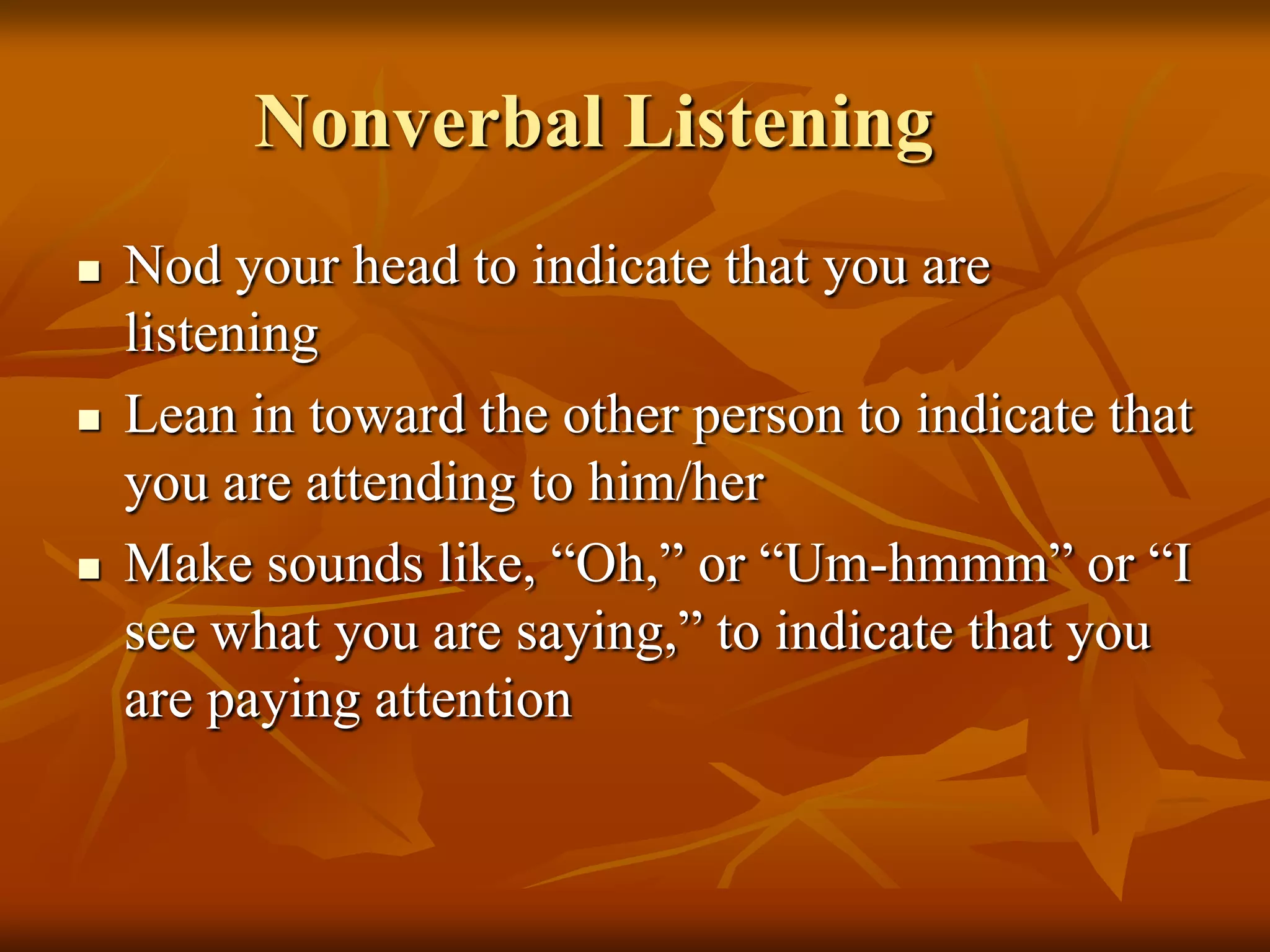
Nonverbal Listening
   Nod your head to indicate that you are
    listening
   Lean in toward the other person to indicate that
    you are attending to him/her
   Make sounds like, “Oh,” or “Um-hmmm” or “I
    see what you are saying,” to indicate that you
    are paying attention
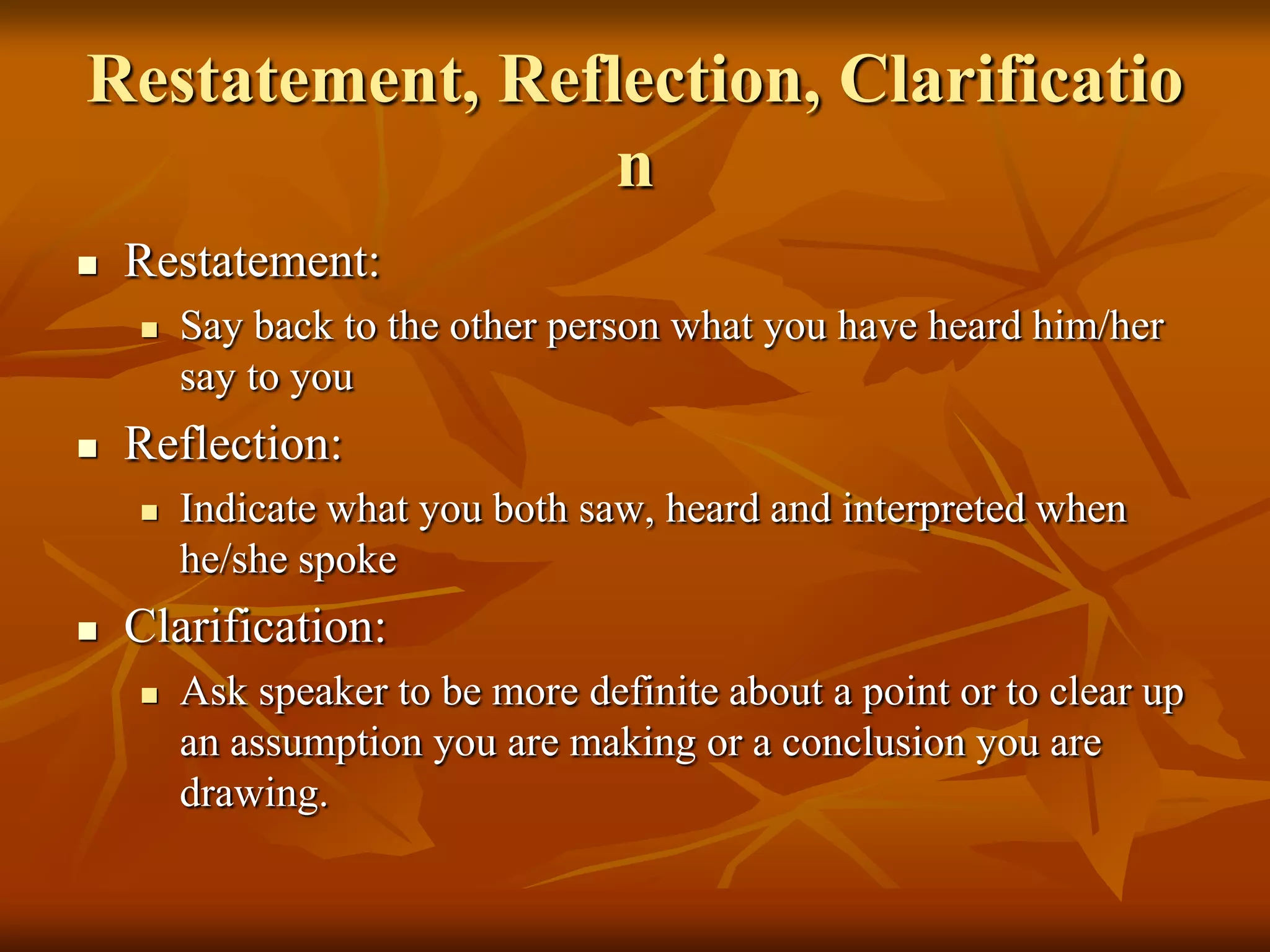
Restatement, Reflection, Clarificatio
                 n
   Restatement:
       Say back to the other person what you have heard him/her
        say to you
   Reflection:
       Indicate what you both saw, heard and interpreted when
        he/she spoke
   Clarification:
       Ask speaker to be more definite about a point or to clear up
        an assumption you are making or a conclusion you are
        drawing.
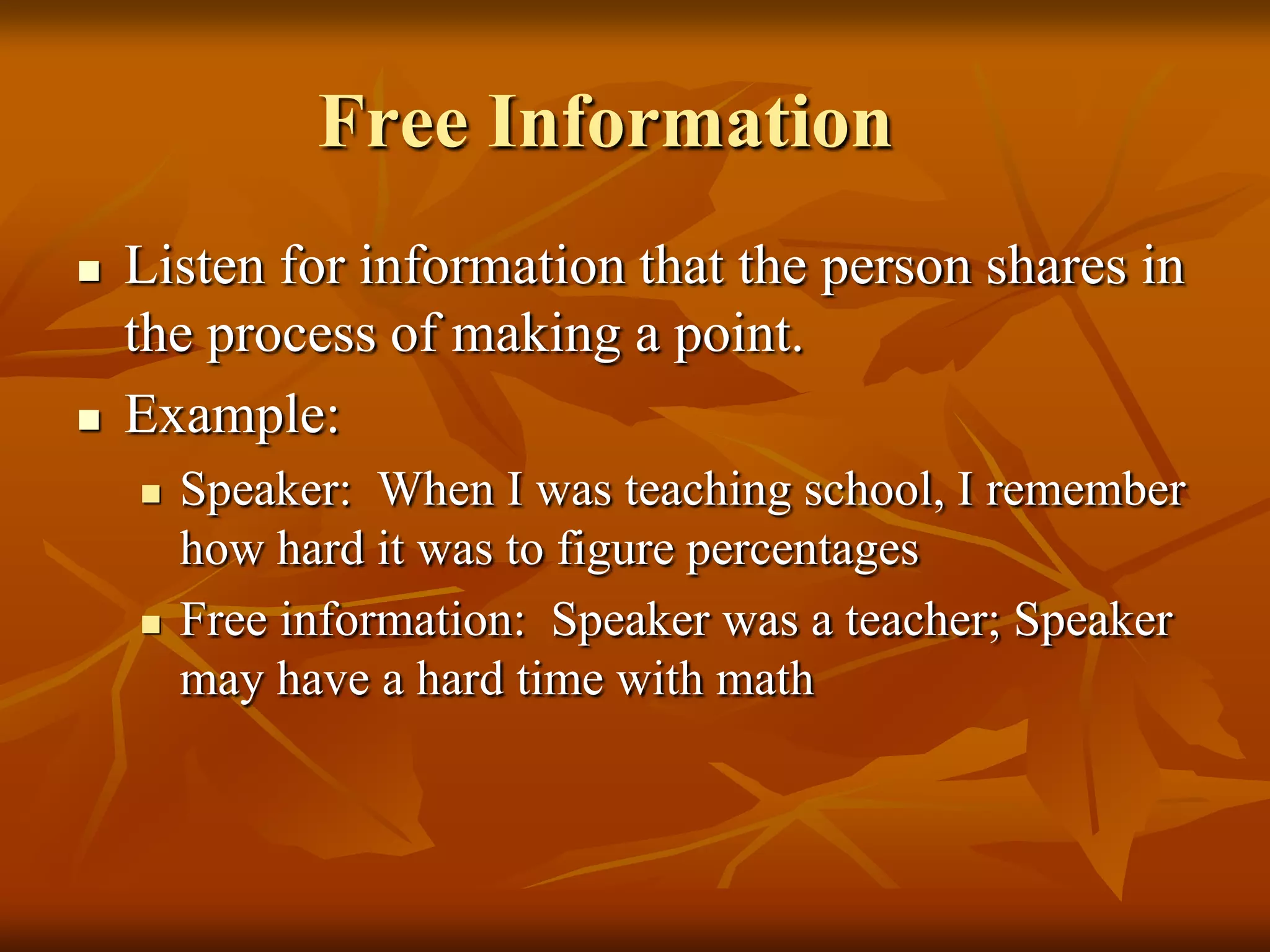
Free Information
   Listen for information that the person shares in
    the process of making a point.
   Example:
       Speaker: When I was teaching school, I remember
        how hard it was to figure percentages
       Free information: Speaker was a teacher; Speaker
        may have a hard time with math
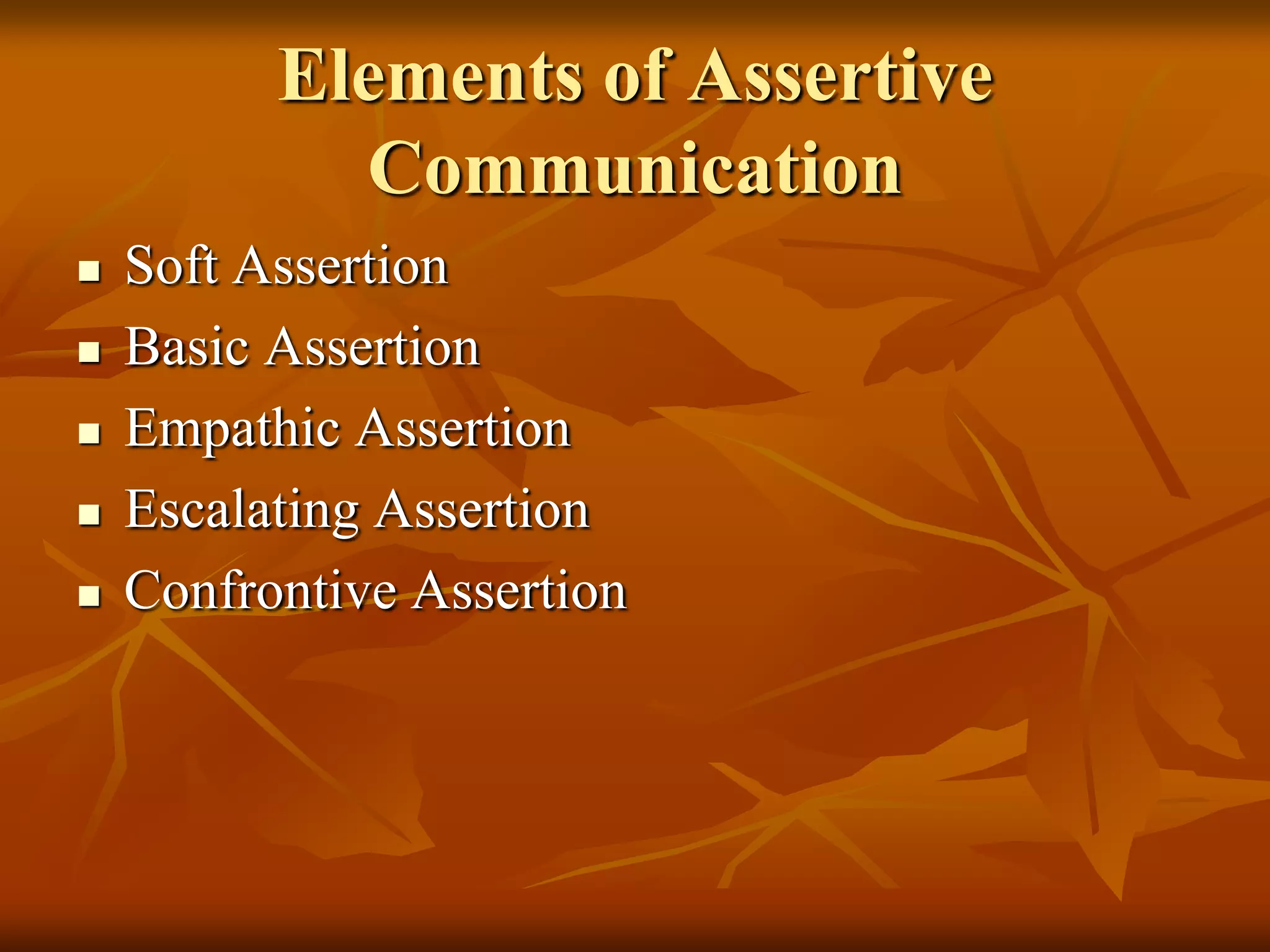
Elements of Assertive
            Communication
   Soft Assertion
   Basic Assertion
   Empathic Assertion
   Escalating Assertion
   Confrontive Assertion
Soft Assertion
   A soft assertion is a statement that does not
    require anything of the listener
       A compliment is a soft assertion because you can
        or cannot respond; you can throw the compliment
        away (“Oh, this old thing!”) or you can
        say, “Thank you.”
       A shirt that has a message on it such as “Save the
        Whales” is a soft assertion because you do not
        have to respond, but you get the stand the person is
        taking when you read the shirt
Basic Assertion
   A Basic Assertion is a simple statement of
    what you want or don’t want to happen
       “I would like to go to a movie tonight.”
       “I don’t want to have to drive carpool today.”

    The Basic Assertion is strengthened by its simplicity.
     Too much detail or explanation complicates the
     request or stand you take.
Empathic Assertion
   The Empathic Assertion is the most effective
    assertive statement one can make
       The empathic assertion attempts to imagine how
        the other person may be thinking or feeling before
        you make a basic assertion:
            “I imagine you may be feeling frustrated with the lack
             of deadlines for this project, but I want us to get
             everything right before we set an endpoint.”
            “If I were you, I’d want to avoid talking about this, but
             I’d like to discuss how to parent our 2 year old when
             he/she has a temper tantrum.”
Escalating Assertion
   The Escalating Assertion has a consequence
    attached to it.
       “If you come in after midnight one more time, I’ll
        take away your car.”
       “If you get this grant funded, I’ll make sure you
        get a raise in your next review.”
Confrontive Assertion
   A Confrontive Assertion is a statement made
    when an agreement has been violated
       “We agreed that you would take out the trash
        every Tuesday in order to earn your allowance. It
        is Wednesday and you didn’t take out the trash
        yesterday. Consequently, I won’t be giving you
        your allowance this week.”
Taking Responsibility
   A Negative Assertion is assertively accepting a
    mistake that you have made. When George
    Washington said, “I’m sorry, Dad, I chopped down
    the cherry tree,” he was making a negative assertion.
   When it’s difficult for someone to say, “I’m sorry,”
    they sometimes avoid the negative assertion in a way
    that hurts the other person:
           “I’m sorry you feel that way
           “I didn’t mean to hurt your feelings
           I’m sorry I did it, but if you hadn’t……then it never would have
            happened.
Good Communication is
          NOT Adversarial
   Connection is the cornerstone of good
    communication
   Connection requires empathy with the other
    person
   Empathy requires imagining what it is like to
    be the other person and fashioning your
    statements with their feelings in mind
Assertive Negotiation
   Identify the problem
   Listen assertively
   Brainstorm ideas
   Pick a solution to try
   Make a contract
   Try out the solution with limits
   Examine and look for problems in the contract
Follow-up in Effective Negotiation
   Make a contract
   Plan a follow-up
   Discuss pluses and minuses
   Make adjustments
   Plan another follow-up
The Power of Saying “No”
   Unassertive “No” is accompanied by weak
    excuses and rationalizations
   Aggressive “No” is done with contempt
   Assertive “No” is simple and direct
Strategies for saying “No”
   It’s OK to ask for time to “think it over”
   Shake your head “No” as you say, “No”
   It’s honorable and authentic to say “No”
   If you say, “Yes,” when you want to
    say, “No,” you’ll resent what you agreed to do
   Use an empathic response
   Start your sentence with the word “No”
Effective Communication
   Notice nonverbal language in yourself and others
   Choose your words with thought and care
   Make assertive statements that are simple and direct
   Negotiate with respect and make a follow-up plan
   Use your assertiveness skills to set limits, say “No,”
    and to move in the direction of what you want
Linda D Tillman, PhD
   1904 Monroe Dr. NE, Suite 200
    Atlanta, Ga 30324-4860
    404-873-5503 ext. 17
   Explore our website:
    www.speakupforyourself.com and learn even
    more about assertiveness
   Thank you for viewing this presentation.

Basic assertive communication

  • 1.
    Effective Communication Speaking UpAssertively Linda D Tillman, PhD www.SpeakUpForYourself.com This presentation is the property of Linda Tillman ©Linda Tillman, 2007, All rights reserved
  • 2.
    Effective Communication 1. Respectful 2. Fact-based 3. Well-thought out 4. Assertive, not aggressive 5. Genuine
  • 3.
    Speakupforyourself  Assertiveness is a philosophy of respect – it is not a formula for speaking  Expressing oneself assertively occurs:  Nonverbally  Verbally  Interactively
  • 4.
    Nonverbal Aspects: Areas on which to focus  Eye Contact  Voice Tone  Posture  Personal Space  Facial expression  Use of Gesture
  • 5.
    Eye Contact  The nonassertive person uses very little eye contact  The aggressive person never drops eye contact  The assertive person uses direct eye contact about 50 % of the time
  • 6.
    Voice Tone  Nonassertive: Too soft, hard to hear  Aggressive: Too loud  Assertive: Well-modulated tone of voice  Caution: Letting your voice rise at the end of a sentence interjects a note of uncertainty and implies that you are asking the other person, rather than telling him/her
  • 7.
    Posture  Nonassertive person: Folds into themselves and makes themselves small. Fidgets  Aggressive person: Confrontive. Stands up and leans into the other person’s space  Assertive person: Stands up straight and tall
  • 8.
    Position and Space  Respect means keeping on the same level  Sit when other is seated,  Stand when other is standing  Stay about arm’s length apart  Standing or sitting at an angle allows each person to escape
  • 9.
    Facial Expression  Facial expression should reflect the emotion you are expressing  “I am angry” requires a serious expression  “I am delighted” requires a happy expression
  • 10.
    Gestures: Notice these gestures  Hands on hips: aggressive  Nodding head “yes”  Pointing with pen in aggressive gesture  Clenching fist  Shaking head “no”
  • 11.
    Effective Verbal Communication Nonverbal is the foundation – now let’s look at effective verbal communication
  • 12.
    Good Assertive Listening  Nonverbal Listening  Verbal Responsive Listening  Restatement  Reflection  Clarification  Good Listening results in helpful free Information Note: If you are thinking about what you are going to say next, you are NOT listening
  • 13.
    Nonverbal Listening  Nod your head to indicate that you are listening  Lean in toward the other person to indicate that you are attending to him/her  Make sounds like, “Oh,” or “Um-hmmm” or “I see what you are saying,” to indicate that you are paying attention
  • 14.
    Restatement, Reflection, Clarificatio n  Restatement:  Say back to the other person what you have heard him/her say to you  Reflection:  Indicate what you both saw, heard and interpreted when he/she spoke  Clarification:  Ask speaker to be more definite about a point or to clear up an assumption you are making or a conclusion you are drawing.
  • 15.
    Free Information  Listen for information that the person shares in the process of making a point.  Example:  Speaker: When I was teaching school, I remember how hard it was to figure percentages  Free information: Speaker was a teacher; Speaker may have a hard time with math
  • 16.
    Elements of Assertive Communication  Soft Assertion  Basic Assertion  Empathic Assertion  Escalating Assertion  Confrontive Assertion
  • 17.
    Soft Assertion  A soft assertion is a statement that does not require anything of the listener  A compliment is a soft assertion because you can or cannot respond; you can throw the compliment away (“Oh, this old thing!”) or you can say, “Thank you.”  A shirt that has a message on it such as “Save the Whales” is a soft assertion because you do not have to respond, but you get the stand the person is taking when you read the shirt
  • 18.
    Basic Assertion  A Basic Assertion is a simple statement of what you want or don’t want to happen  “I would like to go to a movie tonight.”  “I don’t want to have to drive carpool today.” The Basic Assertion is strengthened by its simplicity. Too much detail or explanation complicates the request or stand you take.
  • 19.
    Empathic Assertion  The Empathic Assertion is the most effective assertive statement one can make  The empathic assertion attempts to imagine how the other person may be thinking or feeling before you make a basic assertion:  “I imagine you may be feeling frustrated with the lack of deadlines for this project, but I want us to get everything right before we set an endpoint.”  “If I were you, I’d want to avoid talking about this, but I’d like to discuss how to parent our 2 year old when he/she has a temper tantrum.”
  • 20.
    Escalating Assertion  The Escalating Assertion has a consequence attached to it.  “If you come in after midnight one more time, I’ll take away your car.”  “If you get this grant funded, I’ll make sure you get a raise in your next review.”
  • 21.
    Confrontive Assertion  A Confrontive Assertion is a statement made when an agreement has been violated  “We agreed that you would take out the trash every Tuesday in order to earn your allowance. It is Wednesday and you didn’t take out the trash yesterday. Consequently, I won’t be giving you your allowance this week.”
  • 22.
    Taking Responsibility  A Negative Assertion is assertively accepting a mistake that you have made. When George Washington said, “I’m sorry, Dad, I chopped down the cherry tree,” he was making a negative assertion.  When it’s difficult for someone to say, “I’m sorry,” they sometimes avoid the negative assertion in a way that hurts the other person:  “I’m sorry you feel that way  “I didn’t mean to hurt your feelings  I’m sorry I did it, but if you hadn’t……then it never would have happened.
  • 23.
    Good Communication is NOT Adversarial  Connection is the cornerstone of good communication  Connection requires empathy with the other person  Empathy requires imagining what it is like to be the other person and fashioning your statements with their feelings in mind
  • 24.
    Assertive Negotiation  Identify the problem  Listen assertively  Brainstorm ideas  Pick a solution to try  Make a contract  Try out the solution with limits  Examine and look for problems in the contract
  • 25.
    Follow-up in EffectiveNegotiation  Make a contract  Plan a follow-up  Discuss pluses and minuses  Make adjustments  Plan another follow-up
  • 26.
    The Power ofSaying “No”  Unassertive “No” is accompanied by weak excuses and rationalizations  Aggressive “No” is done with contempt  Assertive “No” is simple and direct
  • 27.
    Strategies for saying“No”  It’s OK to ask for time to “think it over”  Shake your head “No” as you say, “No”  It’s honorable and authentic to say “No”  If you say, “Yes,” when you want to say, “No,” you’ll resent what you agreed to do  Use an empathic response  Start your sentence with the word “No”
  • 28.
    Effective Communication  Notice nonverbal language in yourself and others  Choose your words with thought and care  Make assertive statements that are simple and direct  Negotiate with respect and make a follow-up plan  Use your assertiveness skills to set limits, say “No,” and to move in the direction of what you want
  • 29.
    Linda D Tillman,PhD  1904 Monroe Dr. NE, Suite 200 Atlanta, Ga 30324-4860 404-873-5503 ext. 17  Explore our website: www.speakupforyourself.com and learn even more about assertiveness  Thank you for viewing this presentation.