Code Review Checklist
How far is a code review going?
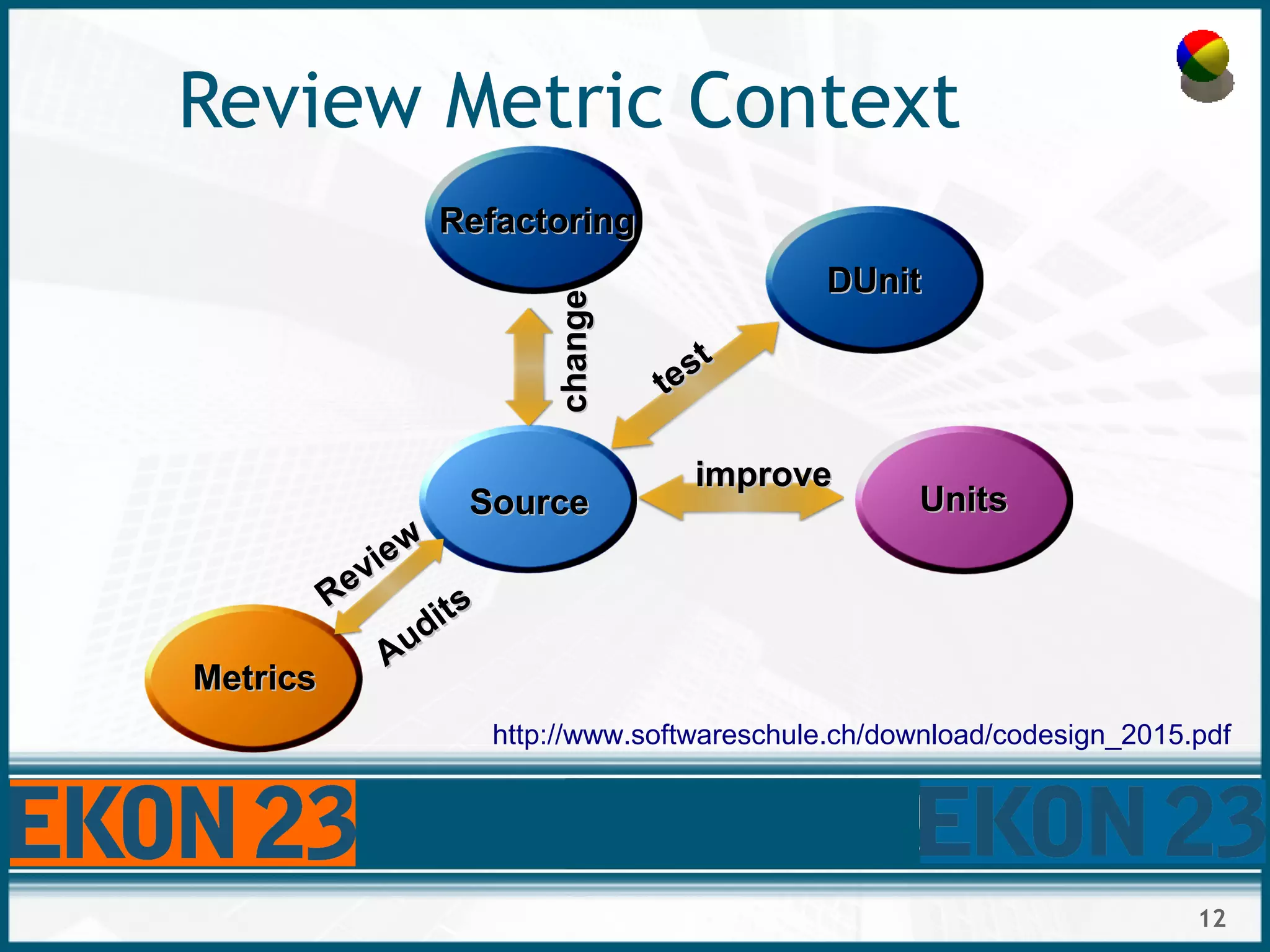
“Metrics measure the design of code after it
has been written, a Review proofs it and
Refactoring improves code.”
2
The Problem is
• That the problem of source code smells is
additive (new bugs arise but the old ones stay)
• Das kann bei uns nicht passieren! – wieso ist
das denn passiert?
• Management is arrogance and developers are
too proud to admit mistakes
• Programmers don't die, they just GOSUB
without RETURN.
3
Improve the Situation Agenda
• Check your Documents with UML API?
• A Docu Structure to the 5 Top Level Metrics
• Back to Source Code Bugs & Smells
• Improve your Code (Metric Based Refactoring)
• Optimisation and Tools
4
API Layers to Structure
Metrics are for detecting bad code entities
• Function calls for type
• Class blocks for object
• Module components for file
• Library package for directory
• Framework deployment for device
UEB: 640_API_LayerDetection_EKON23.TXT
5
API Layers to UML!
Metrics are for detecting bad code entities
• Function calls for Sequence Diagram
• Class blocks for Class Diagram
• Module components for Com.Diagram
• Library package for Package Diagram
• Framework deployment for Dep.D
http://www.kleiner.ch/kleiner/UML_bigpicture.pdf
6
What‘s API Layering?
Bad Coordination possible
• Function with Threads
• Class Access on objects with Null Pointer
• Module Bad Open/Close of Input/Output
Streams or I/O Connections component
• Package return values or package namespace
• Framework in deployment code
• Docker Composer Access of Container image
constructor on non initialized vars
7
Metrics deal with
Bad Structure (how cohesion & coupling)
• General Code Size (in module)
• Cohesion (in classes and inheritance)
• Complexity
• Coupling (between classes or units)
• Cyclic Dependency, Declare+Definition, ACD-Metric
• Interfaces or Packages (design & runtime)
• Static, Public, Private (inheritance or delegate)
UEB: 10_pas_oodesign_solution.txt
8
Finally you can measure:
Bad Habit (no naming convention, no coverage)
Duplicated, dead code (side effects), bugs & smells
Long Methods (to much code), missing layering
Temporary Fields (confusion), comments or docs
Long Parameter List (Object is missing)
Data Classes (no methods)
• Large Class with too many delegating methods
In a Kiviat Chart you get a Best Practices Circle!
UEB: 33_pas_cipher_file_1.txt
9
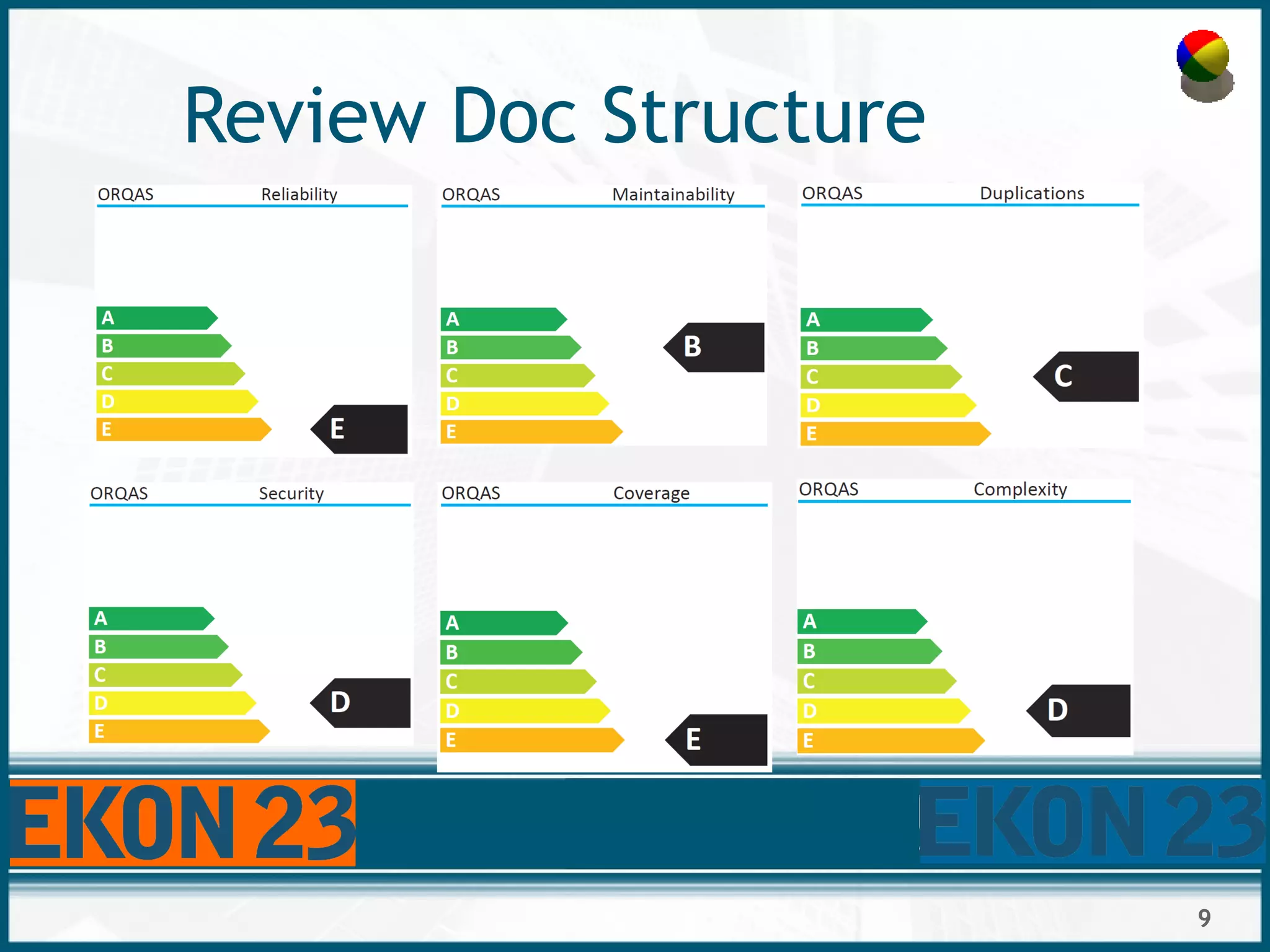
Review Doc Structure
10
Review Doc Map
TIOBE Metrics SONAR Rule Set
1. Code coverage [4] Coverage
2. Abstract documentation [6,8] Size, Issues
3. Cyclomatic complexity [7,3] Complexity, Maintainability
4. Compiler warnings [1] Reliability
5. Coding standards [1,3] Reliability, Maintainability
6. Code duplication [5] Duplication
7. Fan out [3,5] Maintainability, Duplication
8. Security flaws [2] Security
https://www.tiobe.com/tqi/definition/
https://www.sonarqube.org/
11
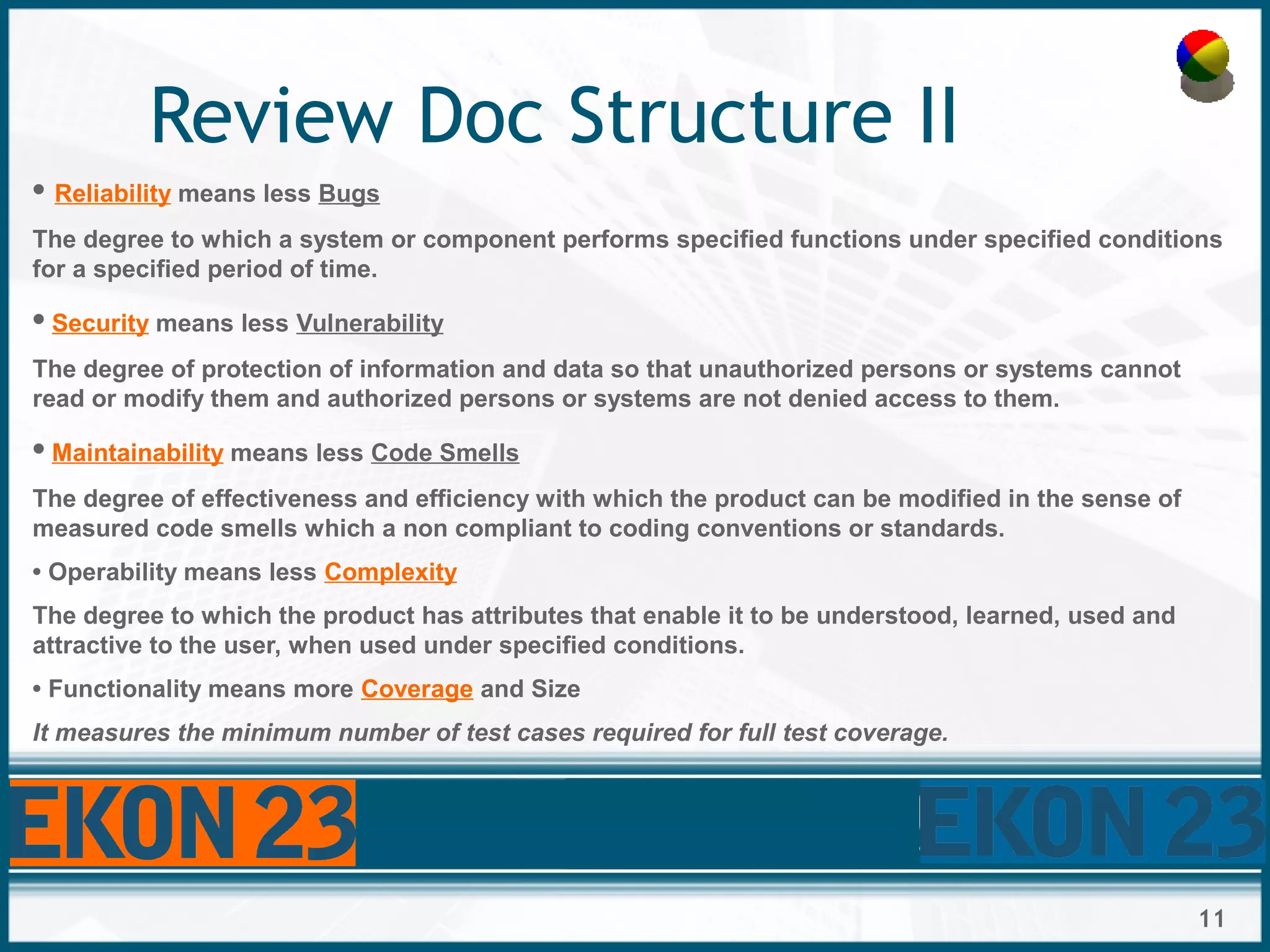
Review Doc Structure II
• Reliability means less Bugs
The degree to which a system or component performs specified functions under specified conditions
for a specified period of time.
• Security means less Vulnerability
The degree of protection of information and data so that unauthorized persons or systems cannot
read or modify them and authorized persons or systems are not denied access to them.
• Maintainability means less Code Smells
The degree of effectiveness and efficiency with which the product can be modified in the sense of
measured code smells which a non compliant to coding conventions or standards.
• Operability means less Complexity
The degree to which the product has attributes that enable it to be understood, learned, used and
attractive to the user, when used under specified conditions.
• Functionality means more Coverage and Size
It measures the minimum number of test cases required for full test coverage.
12
Review Metric Context
SourceSource
improveimprove
MetricsMetrics
DUnitDUnit
test
test
RefactoringRefactoring
changechange
UnitsUnits
Review
Review
Audits
Audits
http://www.softwareschule.ch/download/codesign_2015.pdf
13
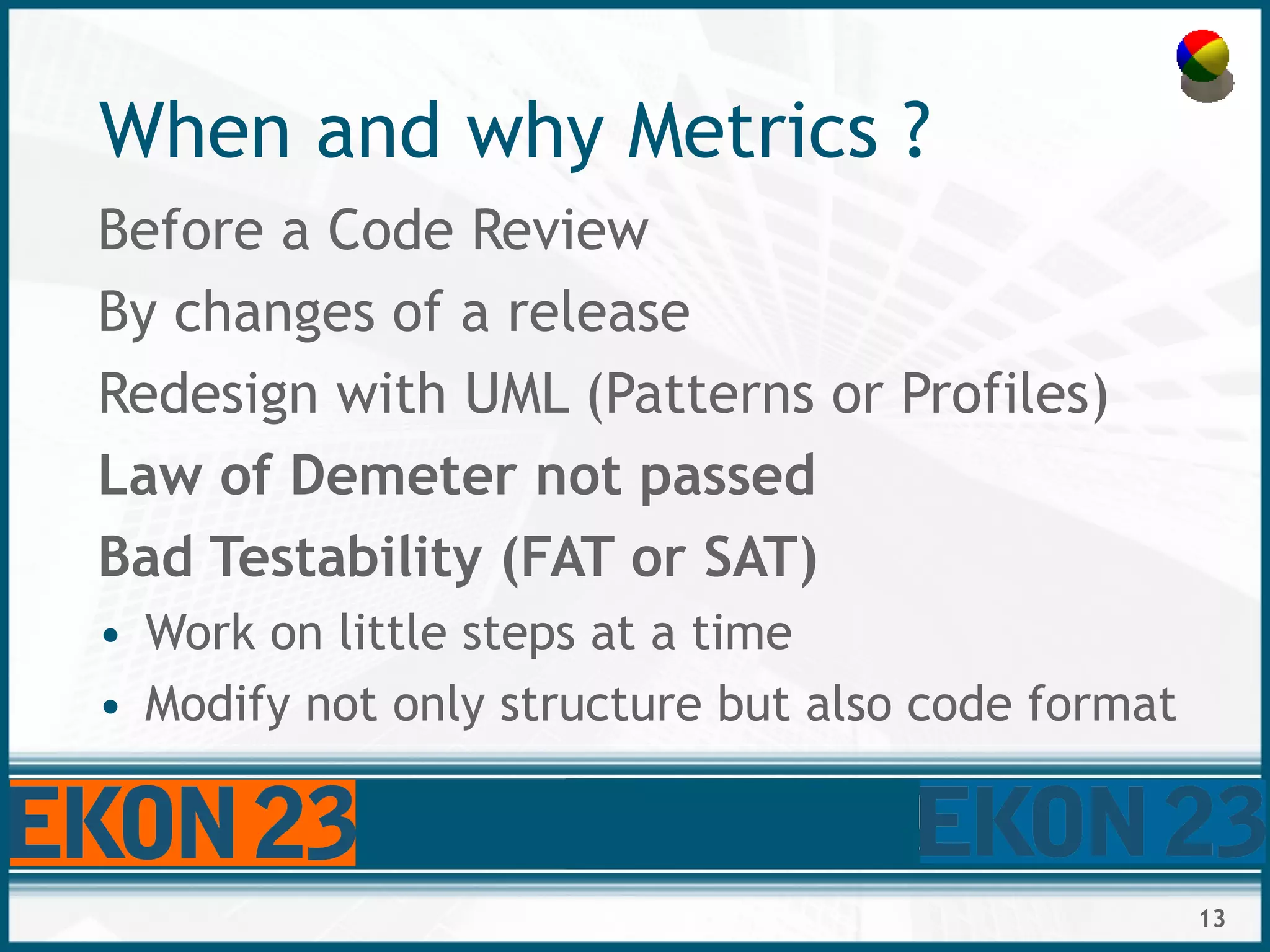
When and why Metrics ?
Before a Code Review
By changes of a release
Redesign with UML (Patterns or Profiles)
Law of Demeter not passed
Bad Testability (FAT or SAT)
• Work on little steps at a time
• Modify not only structure but also code format
14
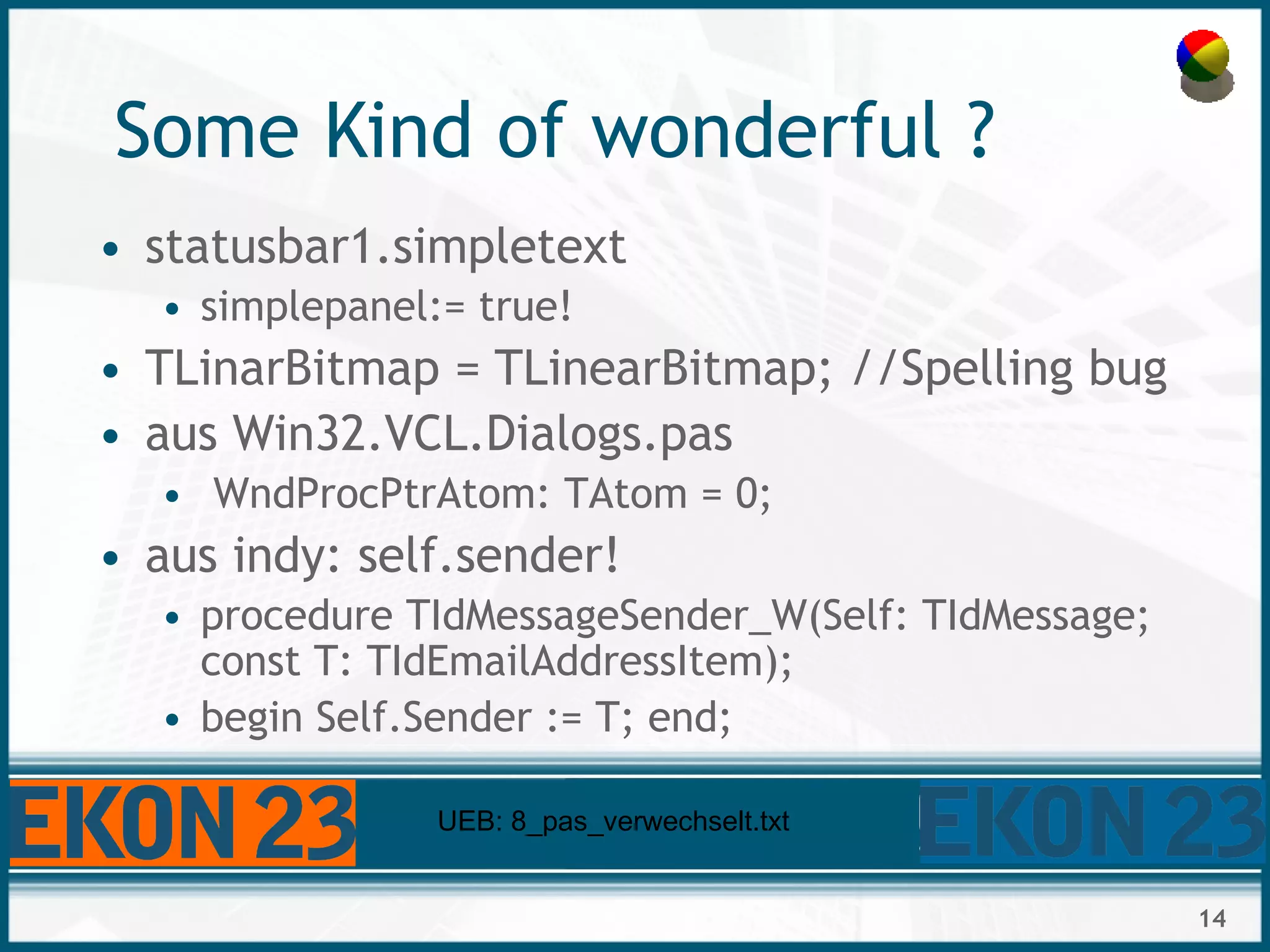
Some Kind of wonderful ?
• statusbar1.simpletext
• simplepanel:= true!
• TLinarBitmap = TLinearBitmap; //Spelling bug
• aus Win32.VCL.Dialogs.pas
• WndProcPtrAtom: TAtom = 0;
• aus indy: self.sender!
• procedure TIdMessageSender_W(Self: TIdMessage;
const T: TIdEmailAddressItem);
• begin Self.Sender := T; end;
UEB: 8_pas_verwechselt.txt
15
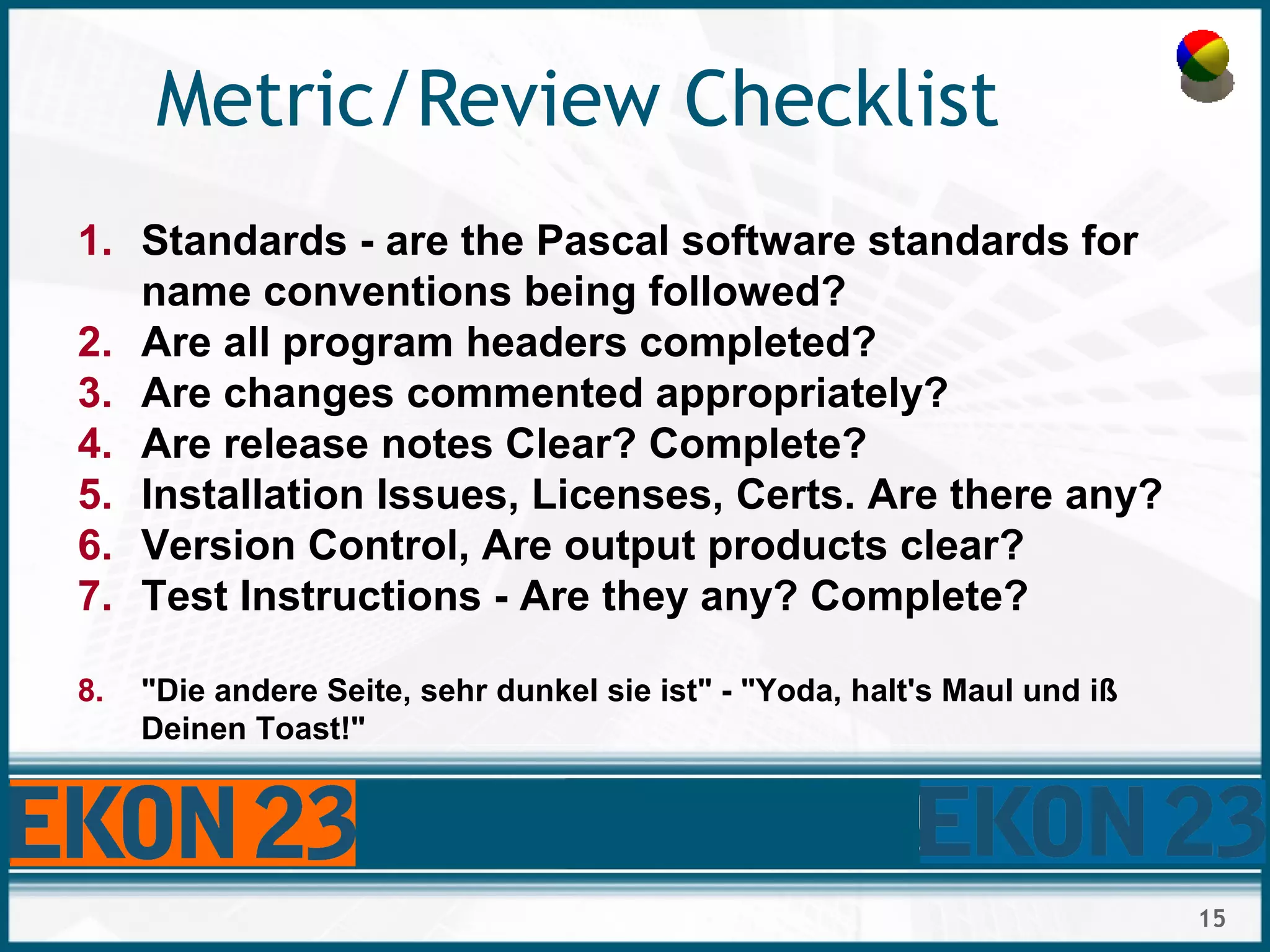
Metric/Review Checklist
1. Standards - are the Pascal software standards for
name conventions being followed?
2. Are all program headers completed?
3. Are changes commented appropriately?
4. Are release notes Clear? Complete?
5. Installation Issues, Licenses, Certs. Are there any?
6. Version Control, Are output products clear?
7. Test Instructions - Are they any? Complete?
8. "Die andere Seite, sehr dunkel sie ist" - "Yoda, halt's Maul und iß
Deinen Toast!"
16
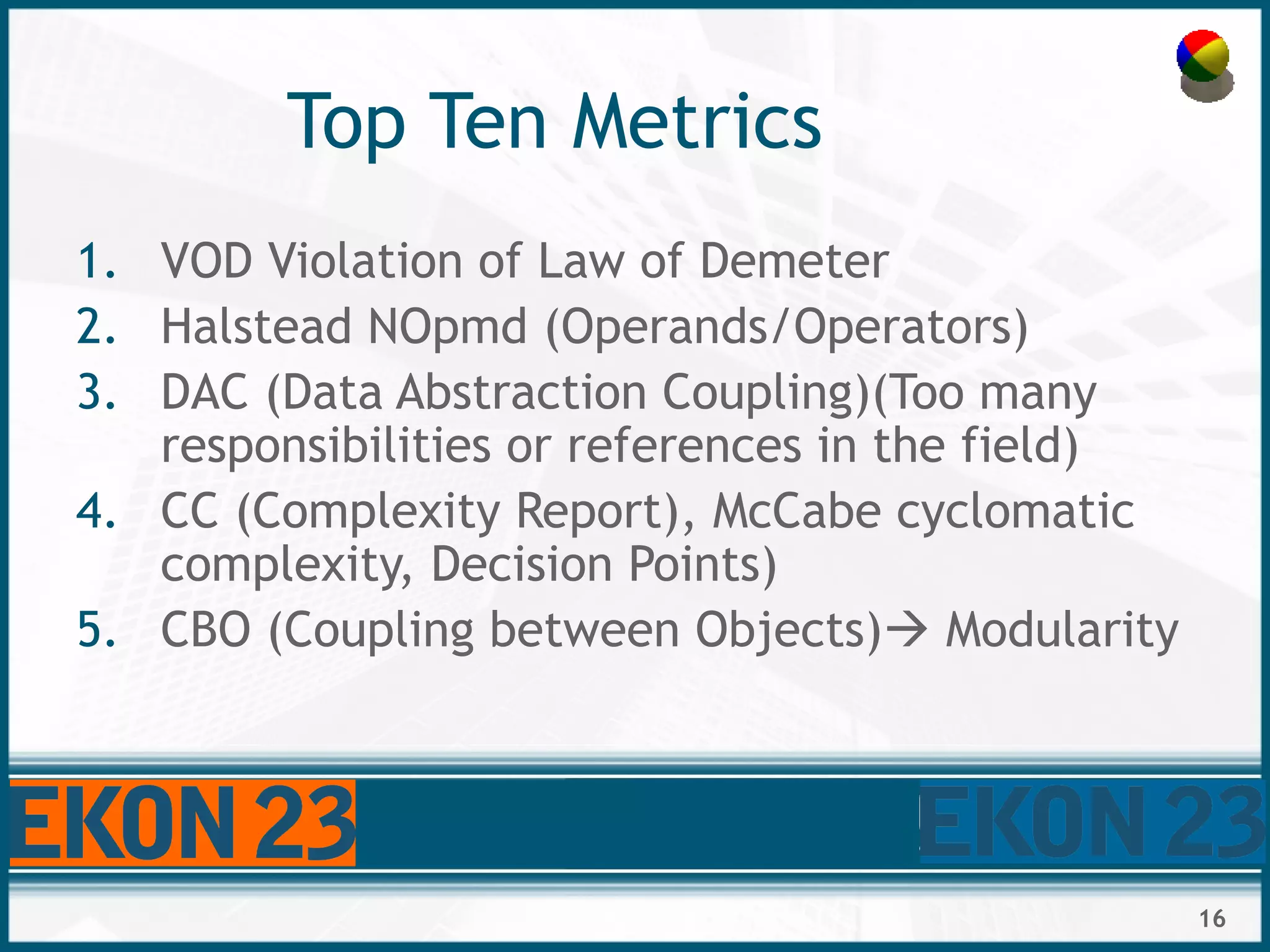
Top Ten Metrics
1. VOD Violation of Law of Demeter
2. Halstead NOpmd (Operands/Operators)
3. DAC (Data Abstraction Coupling)(Too many
responsibilities or references in the field)
4. CC (Complexity Report), McCabe cyclomatic
complexity, Decision Points)
5. CBO (Coupling between Objects) Modularity
17
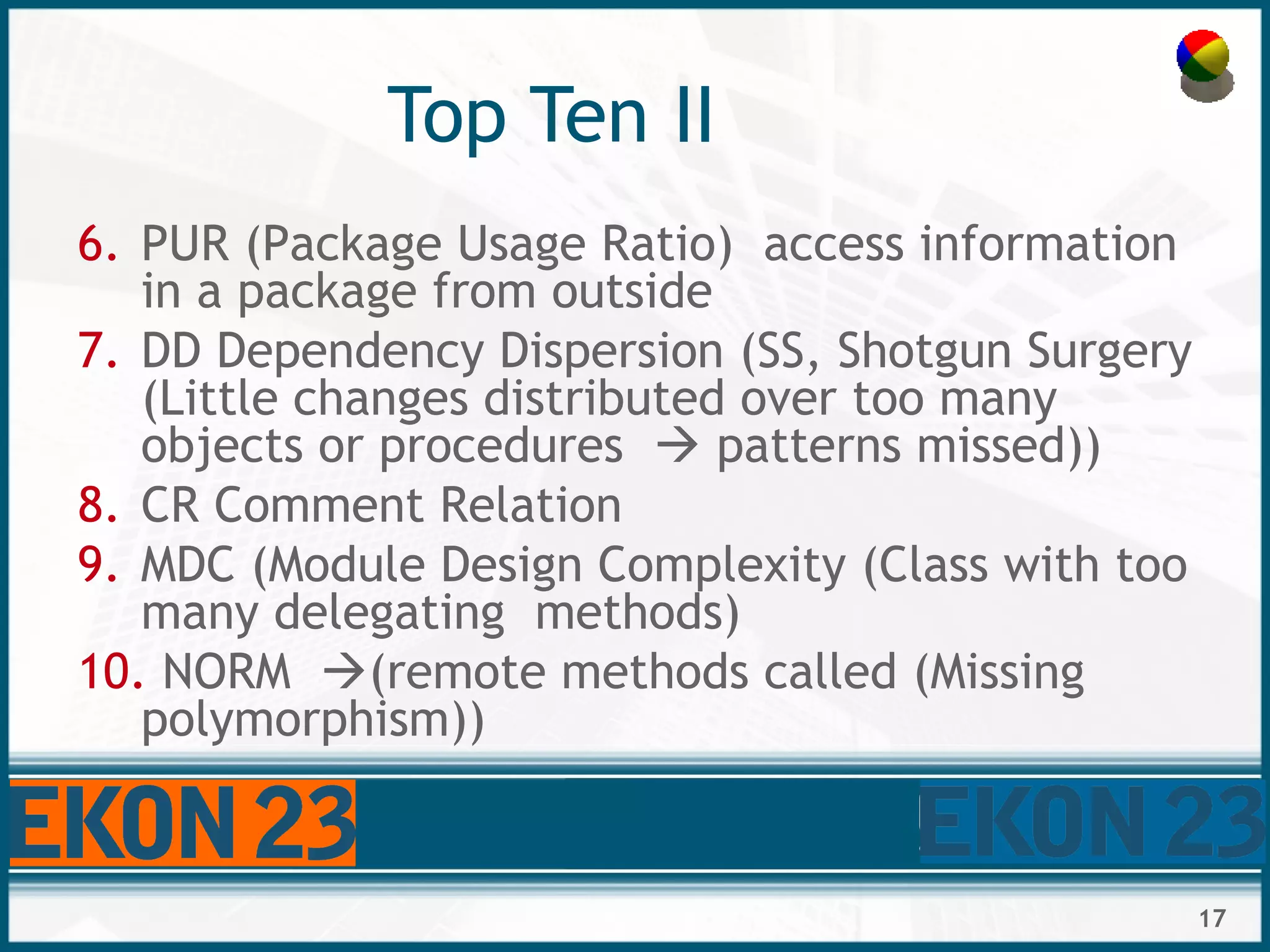
Top Ten II
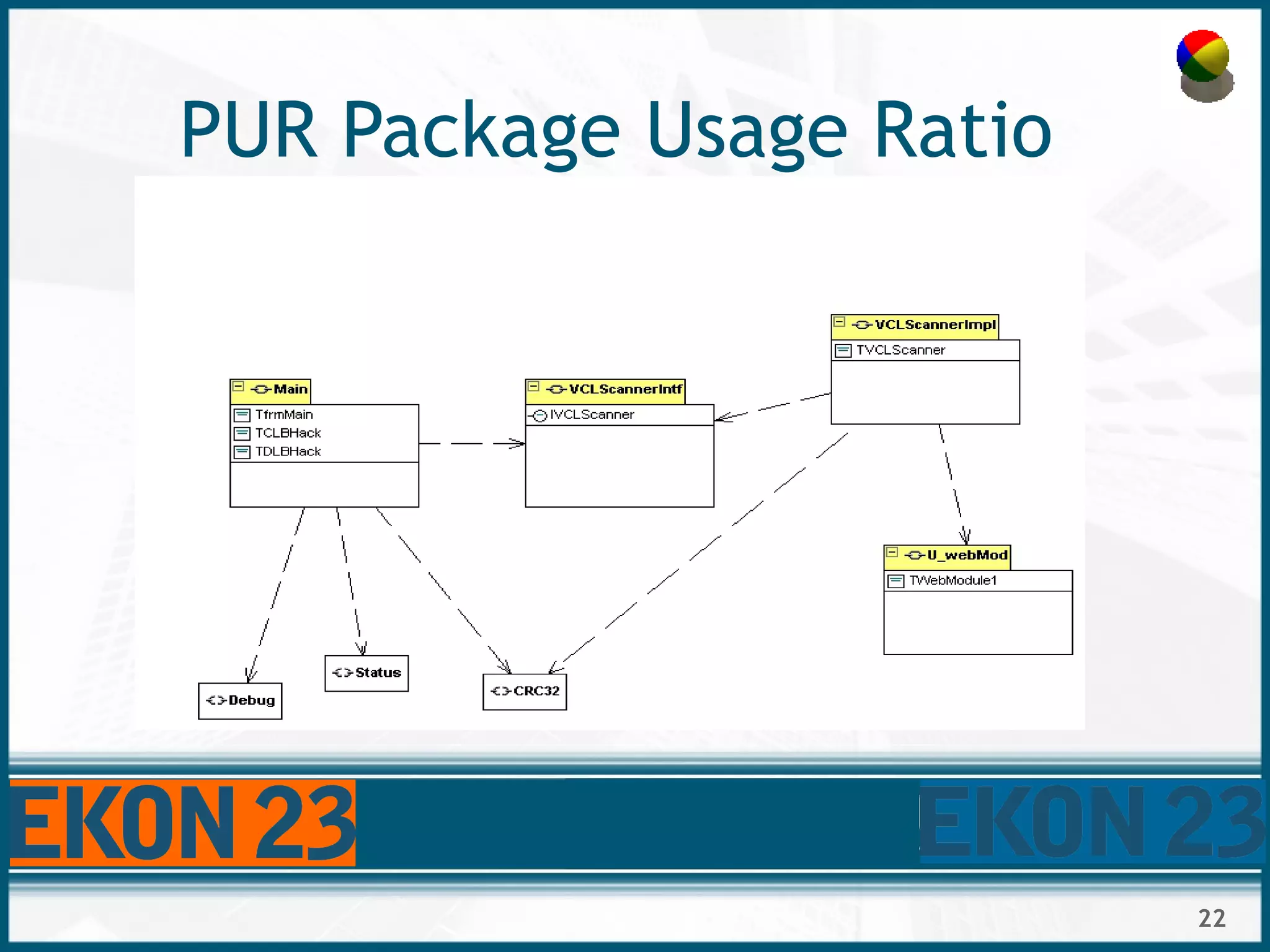
6. PUR (Package Usage Ratio) access information
in a package from outside
7. DD Dependency Dispersion (SS, Shotgun Surgery
(Little changes distributed over too many
objects or procedures  patterns missed))
8. CR Comment Relation
9. MDC (Module Design Complexity (Class with too
many delegating methods)
10. NORM (remote methods called (Missing
polymorphism))
18
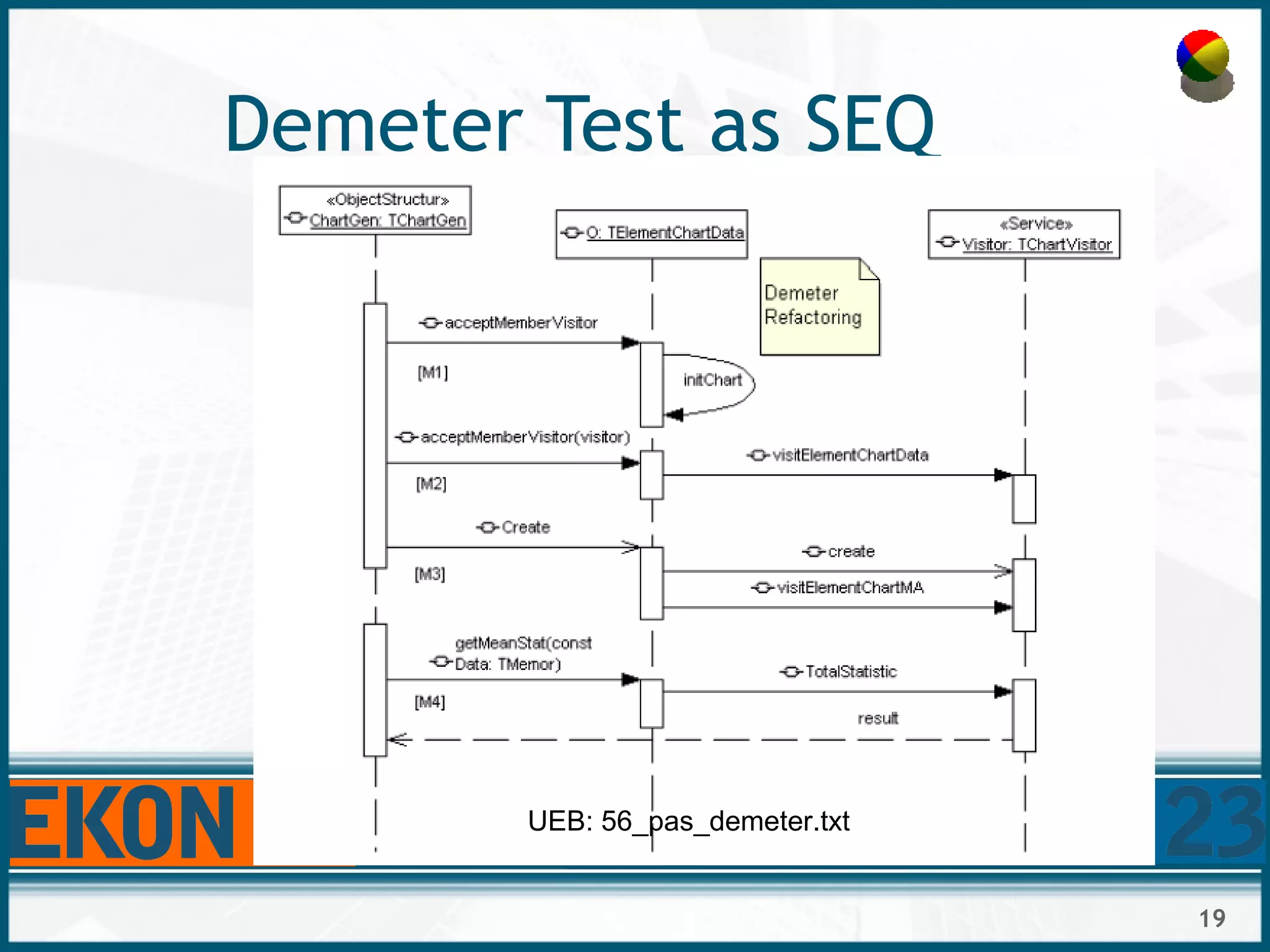
Law of Demeter
1. [M1] an Objekt O selbst
Bsp.: self.initChart(vdata);
2. [M2] an Objekte, die als Parameter in der Nachricht
m vorkommen
Bsp.: O.acceptmemberVisitor(visitor)
visitor.visitElementChartData;
3. [M3] an Objekte, die O als Reaktion auf m erstellt
Bsp.: visitor:= TChartVisitor.create(cData, madata);
4. [M4] an Objekte, auf die O direkt mit einem Member
zugreifen kann
Bsp.: O.Ctnr:= visitor.TotalStatistic
19
Demeter Test as SEQ
UEB: 56_pas_demeter.txt
20
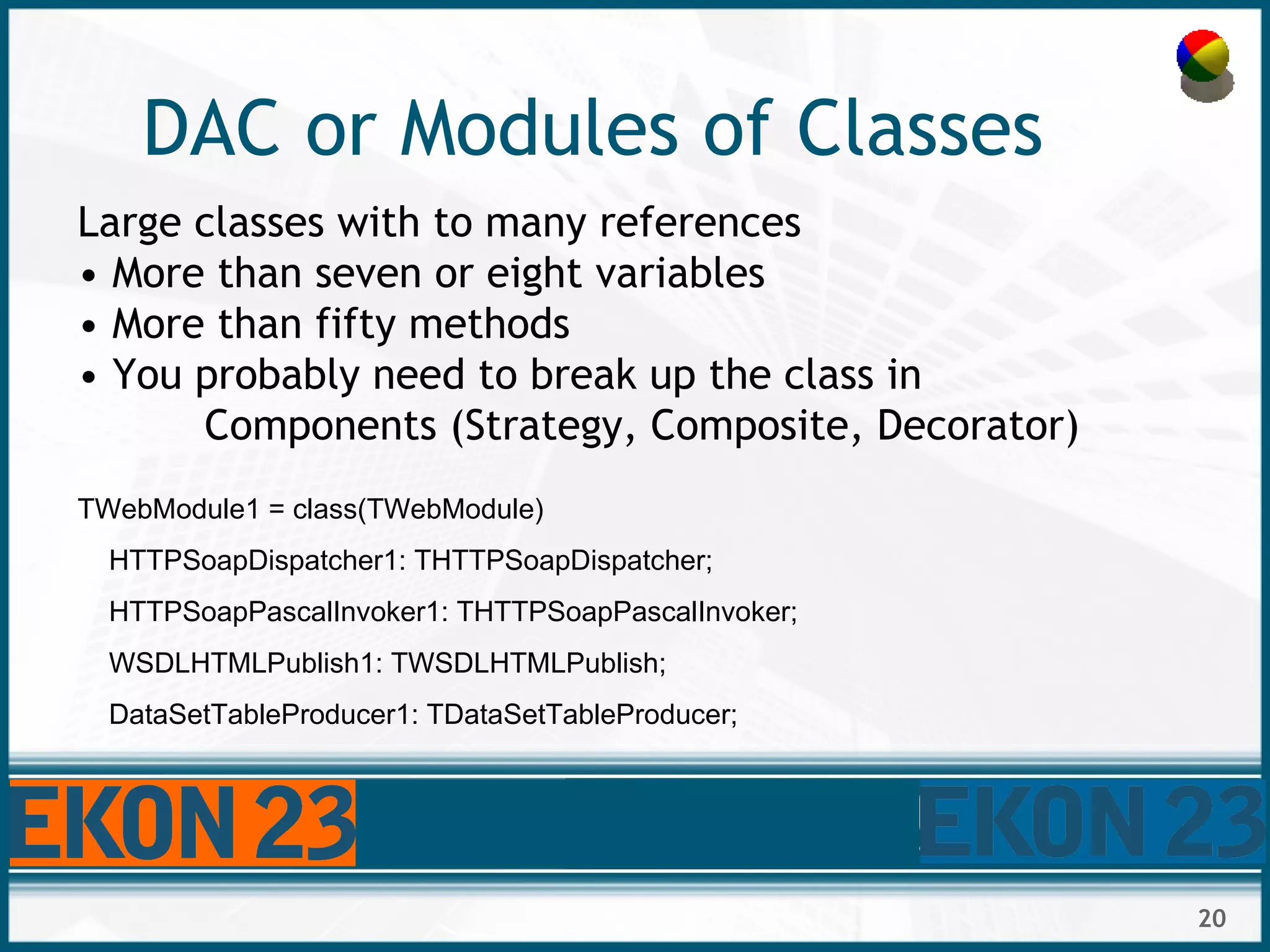
DAC or Modules of Classes
Large classes with to many references
• More than seven or eight variables
• More than fifty methods
• You probably need to break up the class in
Components (Strategy, Composite, Decorator)
TWebModule1 = class(TWebModule)
HTTPSoapDispatcher1: THTTPSoapDispatcher;
HTTPSoapPascalInvoker1: THTTPSoapPascalInvoker;
WSDLHTMLPublish1: TWSDLHTMLPublish;
DataSetTableProducer1: TDataSetTableProducer;
21
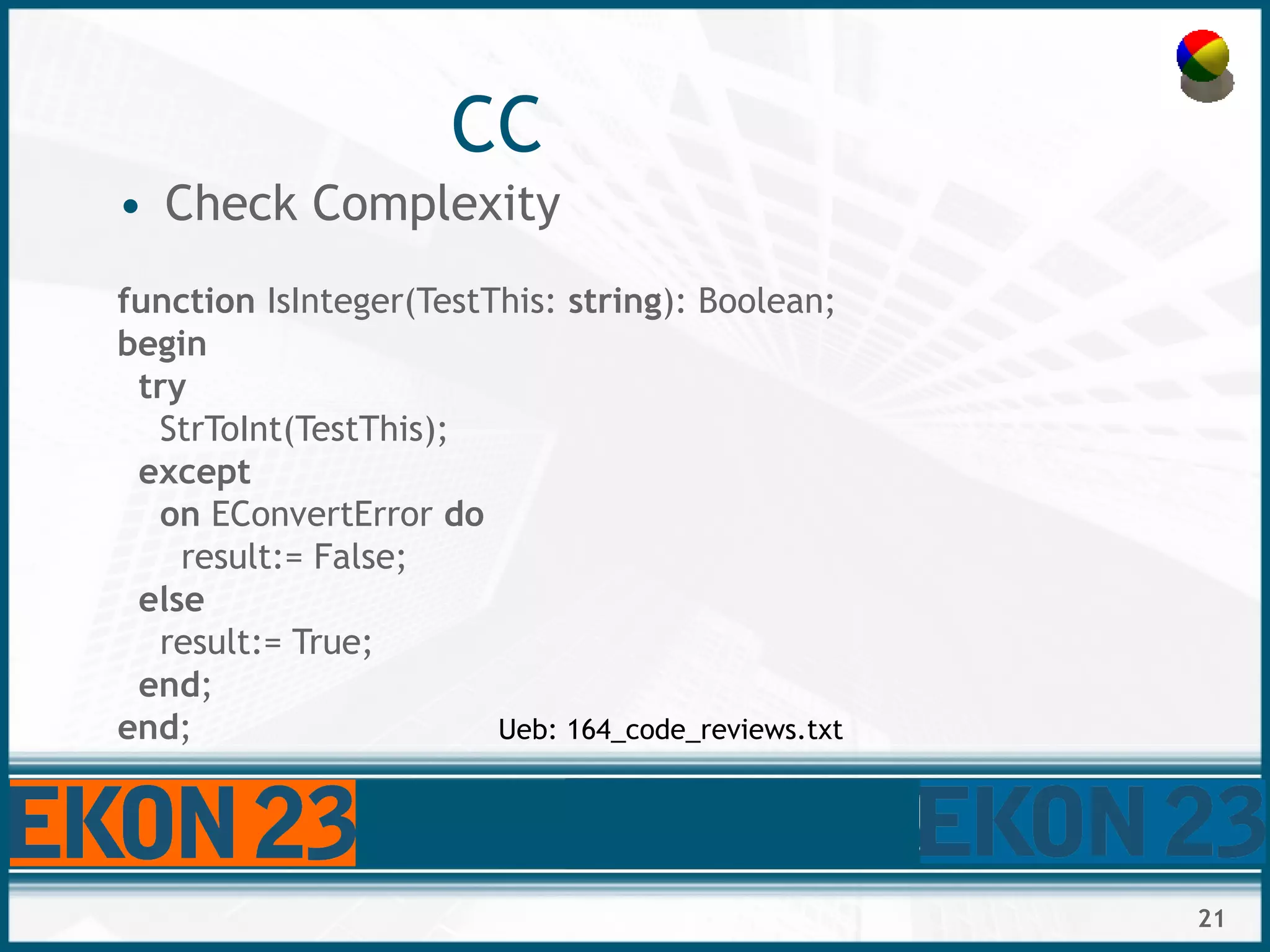
CC
• Check Complexity
function IsInteger(TestThis: string): Boolean;
begin
try
StrToInt(TestThis);
except
on EConvertError do
result:= False;
else
result:= True;
end;
end; Ueb: 164_code_reviews.txt
22
PUR Package Usage Ratio
23
DD – Test keywords knowledge
Procedure CopyRecord(const SourceTable, DestTable:
TTable);
var i: Word;
begin
DestTable.Append;
For i:= 0 to SourceTable.FieldCount - 1 do
DestTable.Fields[i].Assign(SourceTable.Fields[i]);
DestTable.Post;
end;
24
DD – use small procedures
Procedure CopyRecord(const SourceTable, DestTable:
TTable);
var i: Word;
begin
DestTable.Append;
For i:= 0 to SourceTable.FieldCount - 1 do
DestTable.Fields[i].Assign(SourceTable.Fields[i]);
DestTable.Post;
end;
25
Why is Refactoring important?
• Only defense against software decay.
• Often needed to fix reusability bugs.
• Lets you add patterns or templates after you
have written a program;
• Lets you transform program into framework.
• Estimation of the value (capital) of code!
• Necessary for beautiful software.
26
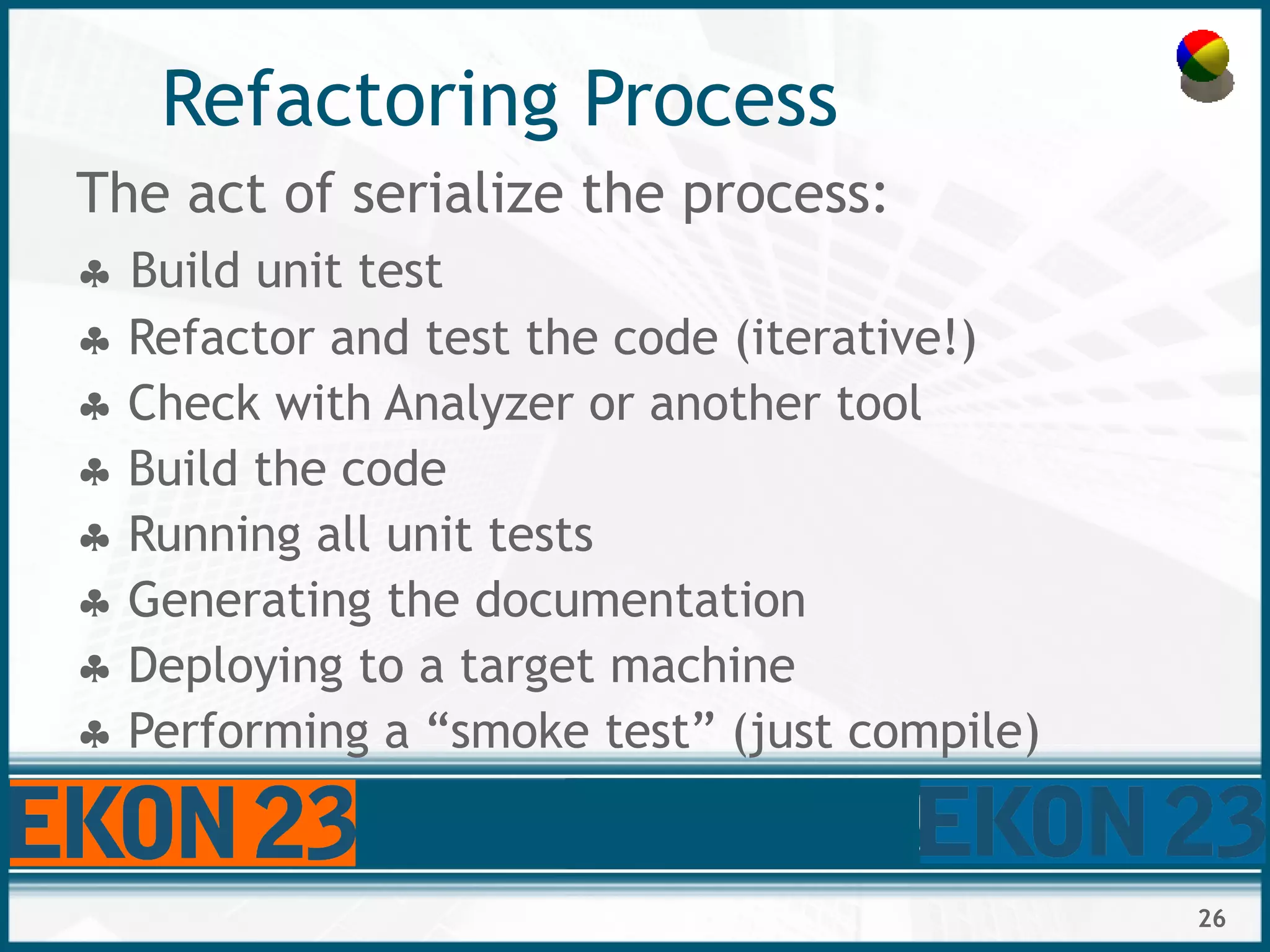
Refactoring Process
The act of serialize the process:
 Build unit test
 Refactor and test the code (iterative!)
 Check with Analyzer or another tool
 Build the code
 Running all unit tests
 Generating the documentation
 Deploying to a target machine
 Performing a “smoke test” (just compile)
27
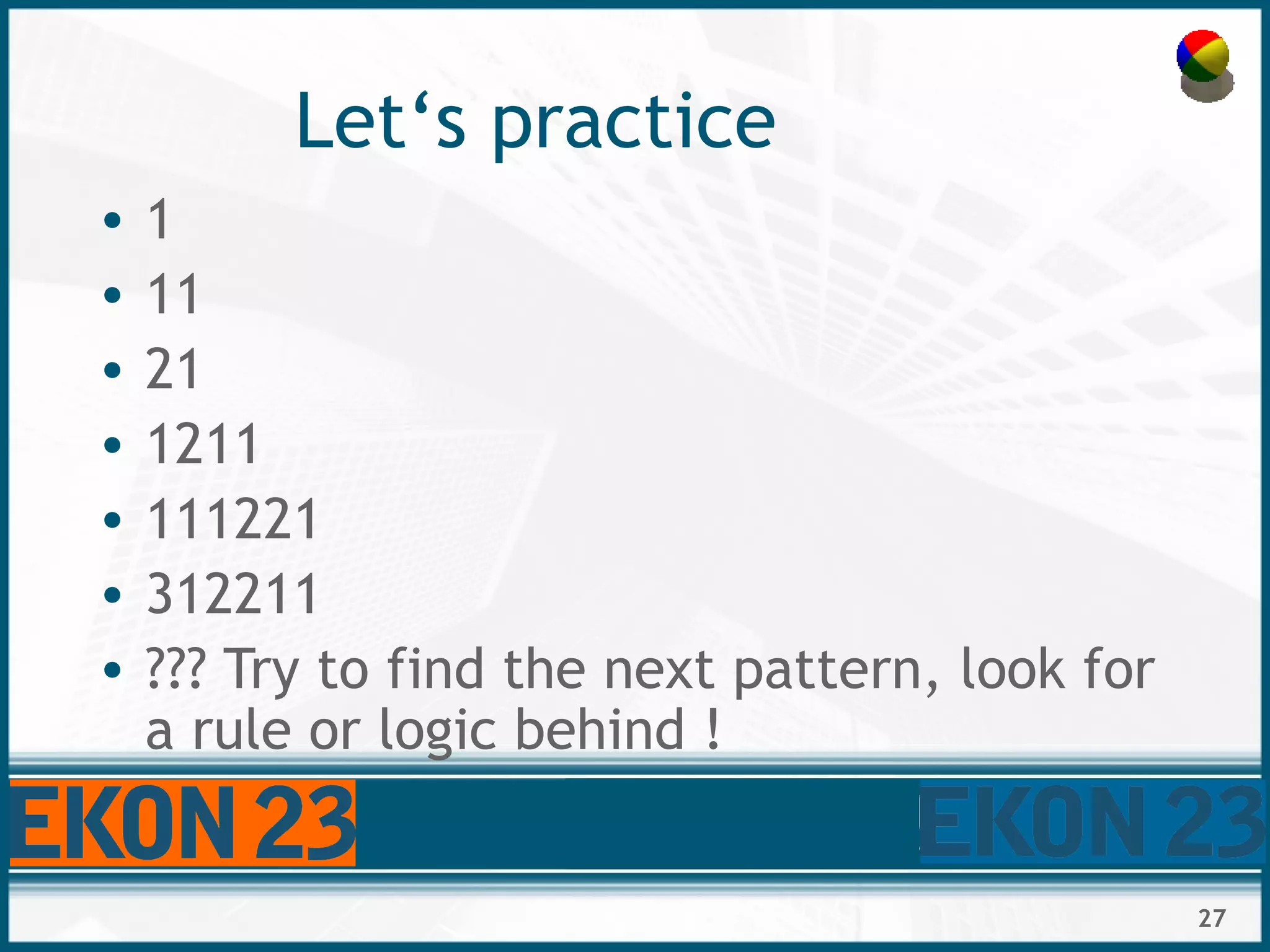
Let‘s practice
• 1
• 11
• 21
• 1211
• 111221
• 312211
• ??? Try to find the next pattern, look for
a rule or logic behind !
28
Before R.
function runString(Vshow: string): string;
var i: byte;
Rword, tmpStr: string;
cntr, nCount: integer;
begin
cntr:=1; nCount:=0;
Rword:=''; //initialize
tmpStr:=Vshow; // input last result
for i:= 1 to length(tmpStr) do begin
if i= length(tmpstr) then begin
if (tmpStr[i-1]=tmpStr[i]) then cntr:= cntr +1;
if cntr = 1 then nCount:= cntr
Rword:= Rword + intToStr(ncount) + tmpStr[i]
end else
if (tmpStr[i]=tmpStr[i+1]) then begin
cntr:= cntr +1;
nCount:= cntr;
end else begin
if cntr = 1 then cntr:=1 else cntr:=1; //reinit counter!
Rword:= Rword + intToStr(ncount) + tmpStr[i] //+ last char(tmpStr)
end;
end; // end for loop
result:=Rword;
end; UEB: 9_pas_umlrunner.txt
29
After R.
function charCounter(instr: string): string;
var i, cntr: integer; Rword: string;
begin
cntr:= 1;
Rword:=' ';
for i:= 1 to length(instr) do begin
//last number in line
if i= length(instr) then
concatChars()
else
if (instr[i]=instr[i+1]) then cntr:= cntr +1
else begin
concatChars()
//reinit counter!
cntr:= 1;
end;
end; //for
result:= Rword;
end;
UEB: 12_pas_umlrunner_solution.txt
30
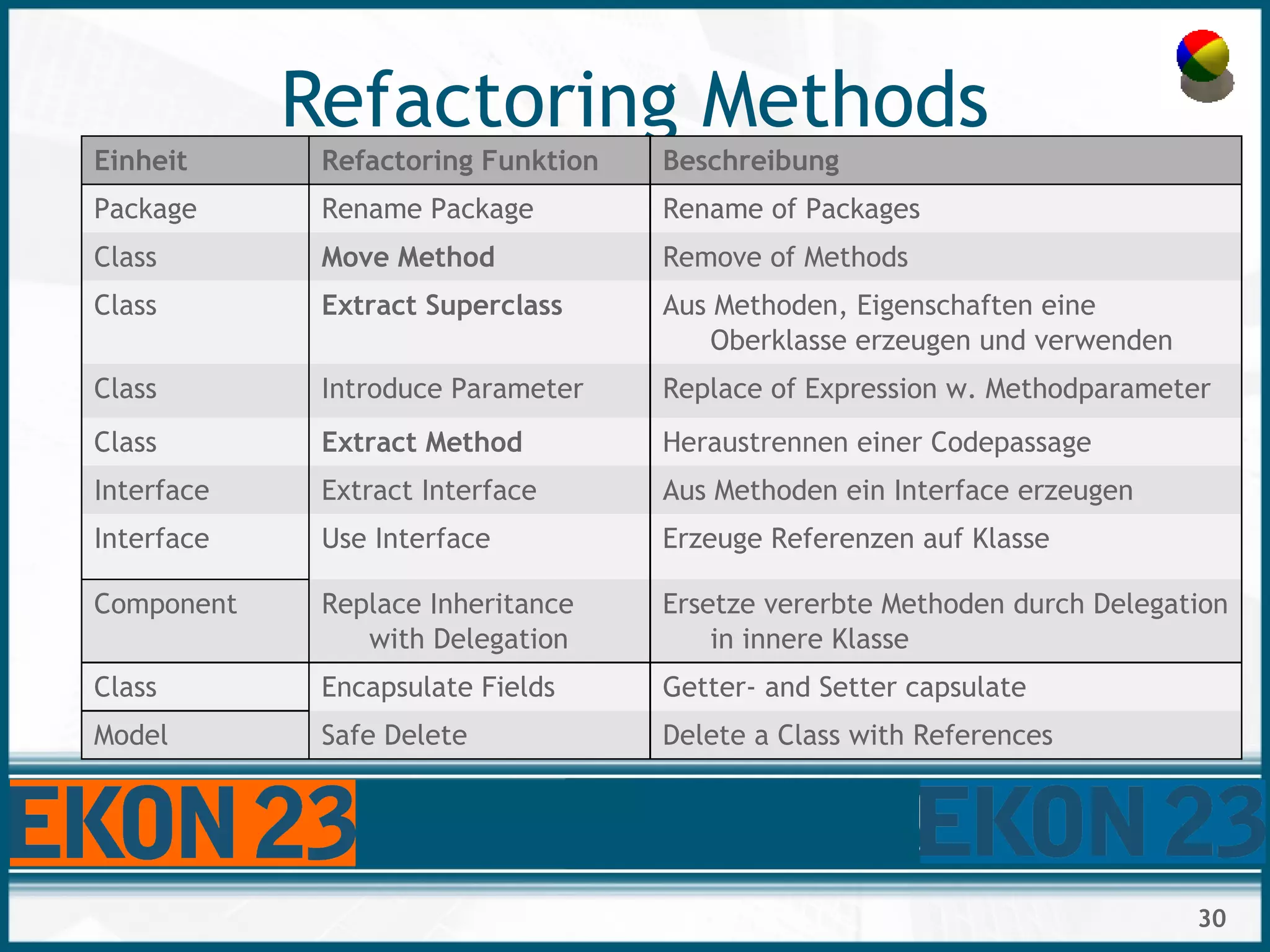
Refactoring Methods
Einheit Refactoring Funktion Beschreibung
Package Rename Package Rename of Packages
Class Move Method Remove of Methods
Class Extract Superclass Aus Methoden, Eigenschaften eine
Oberklasse erzeugen und verwenden
Class Introduce Parameter Replace of Expression w. Methodparameter
Class Extract Method Heraustrennen einer Codepassage
Interface Extract Interface Aus Methoden ein Interface erzeugen
Interface Use Interface Erzeuge Referenzen auf Klasse
Component Replace Inheritance
with Delegation
Ersetze vererbte Methoden durch Delegation
in innere Klasse
Class Encapsulate Fields Getter- and Setter capsulate
Model Safe Delete Delete a Class with References
31
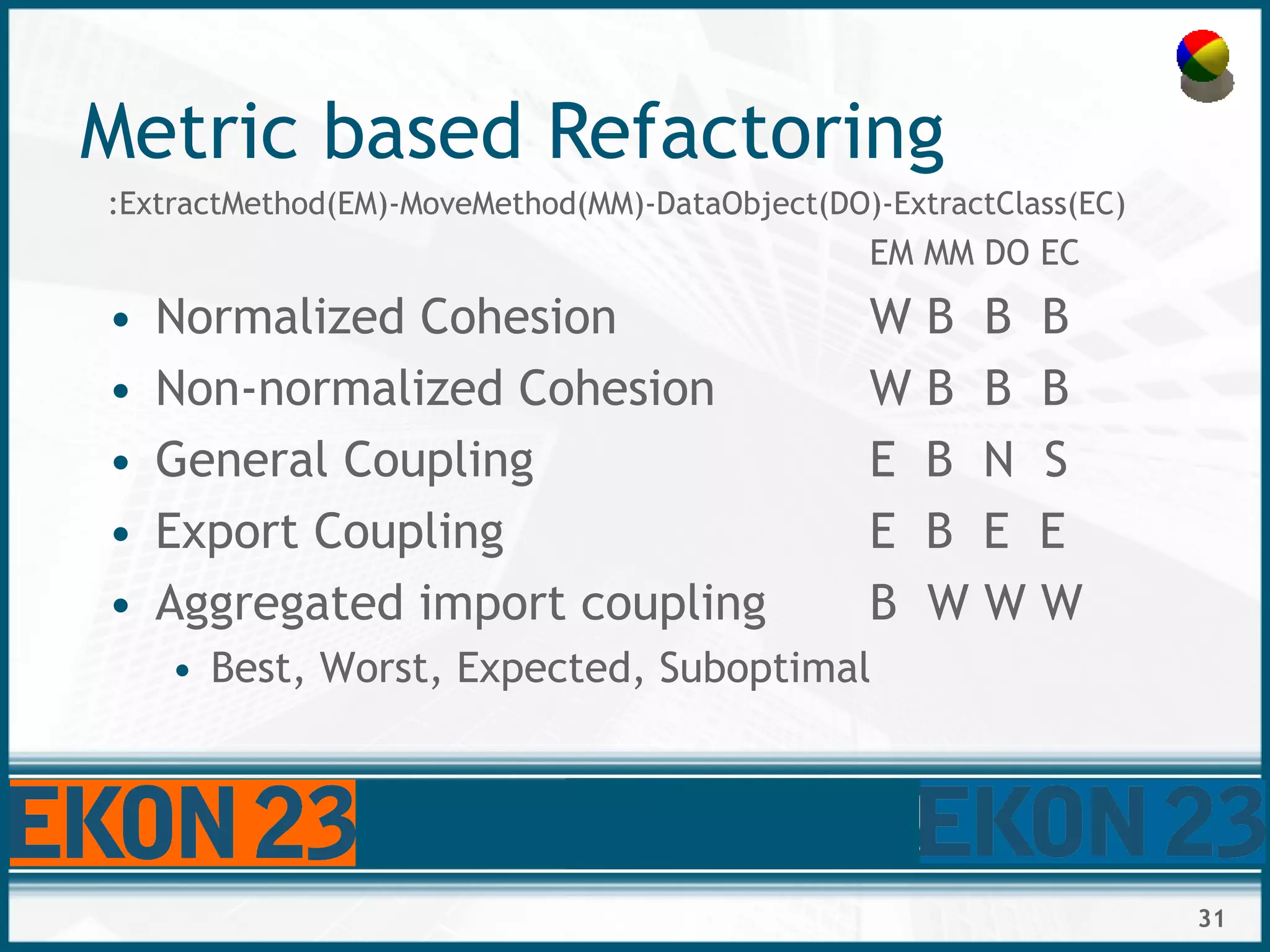
Metric based Refactoring
:ExtractMethod(EM)-MoveMethod(MM)-DataObject(DO)-ExtractClass(EC)
EM MM DO EC
• Normalized Cohesion W B B B
• Non-normalized Cohesion W B B B
• General Coupling E B N S
• Export Coupling E B E E
• Aggregated import coupling B W W W
• Best, Worst, Expected, Suboptimal
32
Audits & Metric Links:
• https://www.sonarqube.org/
• http://www.softwareschule.ch/
• Report Pascal Analyzer:
http://www.softwareschule.ch/download/pascal_analyzer.pdf
• Refactoring Martin Fowler (1999, Addison-Wesley)
• http://c2.com/cgi/wiki?CodeSmell
• https://www.slideshare.net/maxkleiner1/code-review-with-sonar
• Model View in Together:
• www.softwareschule.ch/download/delphi2007_modelview.pdf
33
Q&A
max@kleiner.com
www.softwareschule.ch

EKON 23 Code_review_checklist

  • 1.
    Code Review Checklist Howfar is a code review going? “Metrics measure the design of code after it has been written, a Review proofs it and Refactoring improves code.”
  • 2.
    2 The Problem is •That the problem of source code smells is additive (new bugs arise but the old ones stay) • Das kann bei uns nicht passieren! – wieso ist das denn passiert? • Management is arrogance and developers are too proud to admit mistakes • Programmers don't die, they just GOSUB without RETURN.
  • 3.
    3 Improve the SituationAgenda • Check your Documents with UML API? • A Docu Structure to the 5 Top Level Metrics • Back to Source Code Bugs & Smells • Improve your Code (Metric Based Refactoring) • Optimisation and Tools
  • 4.
    4 API Layers toStructure Metrics are for detecting bad code entities • Function calls for type • Class blocks for object • Module components for file • Library package for directory • Framework deployment for device UEB: 640_API_LayerDetection_EKON23.TXT
  • 5.
    5 API Layers toUML! Metrics are for detecting bad code entities • Function calls for Sequence Diagram • Class blocks for Class Diagram • Module components for Com.Diagram • Library package for Package Diagram • Framework deployment for Dep.D http://www.kleiner.ch/kleiner/UML_bigpicture.pdf
  • 6.
    6 What‘s API Layering? BadCoordination possible • Function with Threads • Class Access on objects with Null Pointer • Module Bad Open/Close of Input/Output Streams or I/O Connections component • Package return values or package namespace • Framework in deployment code • Docker Composer Access of Container image constructor on non initialized vars
  • 7.
    7 Metrics deal with BadStructure (how cohesion & coupling) • General Code Size (in module) • Cohesion (in classes and inheritance) • Complexity • Coupling (between classes or units) • Cyclic Dependency, Declare+Definition, ACD-Metric • Interfaces or Packages (design & runtime) • Static, Public, Private (inheritance or delegate) UEB: 10_pas_oodesign_solution.txt
  • 8.
    8 Finally you canmeasure: Bad Habit (no naming convention, no coverage) Duplicated, dead code (side effects), bugs & smells Long Methods (to much code), missing layering Temporary Fields (confusion), comments or docs Long Parameter List (Object is missing) Data Classes (no methods) • Large Class with too many delegating methods In a Kiviat Chart you get a Best Practices Circle! UEB: 33_pas_cipher_file_1.txt
  • 9.
  • 10.
    10 Review Doc Map TIOBEMetrics SONAR Rule Set 1. Code coverage [4] Coverage 2. Abstract documentation [6,8] Size, Issues 3. Cyclomatic complexity [7,3] Complexity, Maintainability 4. Compiler warnings [1] Reliability 5. Coding standards [1,3] Reliability, Maintainability 6. Code duplication [5] Duplication 7. Fan out [3,5] Maintainability, Duplication 8. Security flaws [2] Security https://www.tiobe.com/tqi/definition/ https://www.sonarqube.org/
  • 11.
    11 Review Doc StructureII • Reliability means less Bugs The degree to which a system or component performs specified functions under specified conditions for a specified period of time. • Security means less Vulnerability The degree of protection of information and data so that unauthorized persons or systems cannot read or modify them and authorized persons or systems are not denied access to them. • Maintainability means less Code Smells The degree of effectiveness and efficiency with which the product can be modified in the sense of measured code smells which a non compliant to coding conventions or standards. • Operability means less Complexity The degree to which the product has attributes that enable it to be understood, learned, used and attractive to the user, when used under specified conditions. • Functionality means more Coverage and Size It measures the minimum number of test cases required for full test coverage.
  • 12.
  • 13.
    13 When and whyMetrics ? Before a Code Review By changes of a release Redesign with UML (Patterns or Profiles) Law of Demeter not passed Bad Testability (FAT or SAT) • Work on little steps at a time • Modify not only structure but also code format
  • 14.
    14 Some Kind ofwonderful ? • statusbar1.simpletext • simplepanel:= true! • TLinarBitmap = TLinearBitmap; //Spelling bug • aus Win32.VCL.Dialogs.pas • WndProcPtrAtom: TAtom = 0; • aus indy: self.sender! • procedure TIdMessageSender_W(Self: TIdMessage; const T: TIdEmailAddressItem); • begin Self.Sender := T; end; UEB: 8_pas_verwechselt.txt
  • 15.
    15 Metric/Review Checklist 1. Standards- are the Pascal software standards for name conventions being followed? 2. Are all program headers completed? 3. Are changes commented appropriately? 4. Are release notes Clear? Complete? 5. Installation Issues, Licenses, Certs. Are there any? 6. Version Control, Are output products clear? 7. Test Instructions - Are they any? Complete? 8. "Die andere Seite, sehr dunkel sie ist" - "Yoda, halt's Maul und iß Deinen Toast!"
  • 16.
    16 Top Ten Metrics 1.VOD Violation of Law of Demeter 2. Halstead NOpmd (Operands/Operators) 3. DAC (Data Abstraction Coupling)(Too many responsibilities or references in the field) 4. CC (Complexity Report), McCabe cyclomatic complexity, Decision Points) 5. CBO (Coupling between Objects) Modularity
  • 17.
    17 Top Ten II 6.PUR (Package Usage Ratio) access information in a package from outside 7. DD Dependency Dispersion (SS, Shotgun Surgery (Little changes distributed over too many objects or procedures  patterns missed)) 8. CR Comment Relation 9. MDC (Module Design Complexity (Class with too many delegating methods) 10. NORM (remote methods called (Missing polymorphism))
  • 18.
    18 Law of Demeter 1.[M1] an Objekt O selbst Bsp.: self.initChart(vdata); 2. [M2] an Objekte, die als Parameter in der Nachricht m vorkommen Bsp.: O.acceptmemberVisitor(visitor) visitor.visitElementChartData; 3. [M3] an Objekte, die O als Reaktion auf m erstellt Bsp.: visitor:= TChartVisitor.create(cData, madata); 4. [M4] an Objekte, auf die O direkt mit einem Member zugreifen kann Bsp.: O.Ctnr:= visitor.TotalStatistic
  • 19.
    19 Demeter Test asSEQ UEB: 56_pas_demeter.txt
  • 20.
    20 DAC or Modulesof Classes Large classes with to many references • More than seven or eight variables • More than fifty methods • You probably need to break up the class in Components (Strategy, Composite, Decorator) TWebModule1 = class(TWebModule) HTTPSoapDispatcher1: THTTPSoapDispatcher; HTTPSoapPascalInvoker1: THTTPSoapPascalInvoker; WSDLHTMLPublish1: TWSDLHTMLPublish; DataSetTableProducer1: TDataSetTableProducer;
  • 21.
    21 CC • Check Complexity functionIsInteger(TestThis: string): Boolean; begin try StrToInt(TestThis); except on EConvertError do result:= False; else result:= True; end; end; Ueb: 164_code_reviews.txt
  • 22.
  • 23.
    23 DD – Testkeywords knowledge Procedure CopyRecord(const SourceTable, DestTable: TTable); var i: Word; begin DestTable.Append; For i:= 0 to SourceTable.FieldCount - 1 do DestTable.Fields[i].Assign(SourceTable.Fields[i]); DestTable.Post; end;
  • 24.
    24 DD – usesmall procedures Procedure CopyRecord(const SourceTable, DestTable: TTable); var i: Word; begin DestTable.Append; For i:= 0 to SourceTable.FieldCount - 1 do DestTable.Fields[i].Assign(SourceTable.Fields[i]); DestTable.Post; end;
  • 25.
    25 Why is Refactoringimportant? • Only defense against software decay. • Often needed to fix reusability bugs. • Lets you add patterns or templates after you have written a program; • Lets you transform program into framework. • Estimation of the value (capital) of code! • Necessary for beautiful software.
  • 26.
    26 Refactoring Process The actof serialize the process:  Build unit test  Refactor and test the code (iterative!)  Check with Analyzer or another tool  Build the code  Running all unit tests  Generating the documentation  Deploying to a target machine  Performing a “smoke test” (just compile)
  • 27.
    27 Let‘s practice • 1 •11 • 21 • 1211 • 111221 • 312211 • ??? Try to find the next pattern, look for a rule or logic behind !
  • 28.
    28 Before R. function runString(Vshow:string): string; var i: byte; Rword, tmpStr: string; cntr, nCount: integer; begin cntr:=1; nCount:=0; Rword:=''; //initialize tmpStr:=Vshow; // input last result for i:= 1 to length(tmpStr) do begin if i= length(tmpstr) then begin if (tmpStr[i-1]=tmpStr[i]) then cntr:= cntr +1; if cntr = 1 then nCount:= cntr Rword:= Rword + intToStr(ncount) + tmpStr[i] end else if (tmpStr[i]=tmpStr[i+1]) then begin cntr:= cntr +1; nCount:= cntr; end else begin if cntr = 1 then cntr:=1 else cntr:=1; //reinit counter! Rword:= Rword + intToStr(ncount) + tmpStr[i] //+ last char(tmpStr) end; end; // end for loop result:=Rword; end; UEB: 9_pas_umlrunner.txt
  • 29.
    29 After R. function charCounter(instr:string): string; var i, cntr: integer; Rword: string; begin cntr:= 1; Rword:=' '; for i:= 1 to length(instr) do begin //last number in line if i= length(instr) then concatChars() else if (instr[i]=instr[i+1]) then cntr:= cntr +1 else begin concatChars() //reinit counter! cntr:= 1; end; end; //for result:= Rword; end; UEB: 12_pas_umlrunner_solution.txt
  • 30.
    30 Refactoring Methods Einheit RefactoringFunktion Beschreibung Package Rename Package Rename of Packages Class Move Method Remove of Methods Class Extract Superclass Aus Methoden, Eigenschaften eine Oberklasse erzeugen und verwenden Class Introduce Parameter Replace of Expression w. Methodparameter Class Extract Method Heraustrennen einer Codepassage Interface Extract Interface Aus Methoden ein Interface erzeugen Interface Use Interface Erzeuge Referenzen auf Klasse Component Replace Inheritance with Delegation Ersetze vererbte Methoden durch Delegation in innere Klasse Class Encapsulate Fields Getter- and Setter capsulate Model Safe Delete Delete a Class with References
  • 31.
    31 Metric based Refactoring :ExtractMethod(EM)-MoveMethod(MM)-DataObject(DO)-ExtractClass(EC) EMMM DO EC • Normalized Cohesion W B B B • Non-normalized Cohesion W B B B • General Coupling E B N S • Export Coupling E B E E • Aggregated import coupling B W W W • Best, Worst, Expected, Suboptimal
  • 32.
    32 Audits & MetricLinks: • https://www.sonarqube.org/ • http://www.softwareschule.ch/ • Report Pascal Analyzer: http://www.softwareschule.ch/download/pascal_analyzer.pdf • Refactoring Martin Fowler (1999, Addison-Wesley) • http://c2.com/cgi/wiki?CodeSmell • https://www.slideshare.net/maxkleiner1/code-review-with-sonar • Model View in Together: • www.softwareschule.ch/download/delphi2007_modelview.pdf
  • 33.