clean code
There’s no problem so simple that a bad developer
can’t make it complicated. Steve Bohlen
Programming is the art of telling another human what
one wants the computer to do. Donald Knuth
1
warning
A quite not versed rhetorical presenter.
2
warning
A quite not versed rhetorical presenter.
Feel free to interrupt me and ask when something is not clear.
2
warning
A quite not versed rhetorical presenter.
Feel free to interrupt me and ask when something is not clear.
Or something worth discussing.
2
what clean code stands for?
Clean code is a reader-focused development style that produ-
ces software that’s easy to write, read and maintain.
3
why it matters?
Broken windows theory
One broken window is all it takes to start the decline.
4
why it matters?
Broken windows theory
One broken window is all it takes to start the decline.
It’s too easy to slip into the mindset of “All the rest of this code
is crap, I’ll just follow suit.”
4
why it matters?
Broken windows theory
One broken window is all it takes to start the decline.
It’s too easy to slip into the mindset of “All the rest of this code
is crap, I’ll just follow suit.”
It’s the software entropy.
4
why it matters?
Broken windows theory
One broken window is all it takes to start the decline.
It’s too easy to slip into the mindset of “All the rest of this code
is crap, I’ll just follow suit.”
It’s the software entropy.
So called: “software rot.”
4
the four characteristics of rotting software
From the book Design Principles and Design Patterns de Robert
C. Martins
5
1 - rigidity
It’s hard to solve simple problems.
No one knows how long will take to solve them.
Estimating is hard.
6
2 - fragility
The software breaks too often.
A change in one unrelated part breaks others.
Changes must be echoed in many places.
7
3 - immobility
It’s the inability of reusing software from other places.
8
4 - viscosity
Its easier to go to the hacking mode than to the design preser-
vation mode.
9
implications
O preço da gambiarra
10
implications
O preço da gambiarra
Software rot implies in frustrated developers.
10
implications
O preço da gambiarra
Software rot implies in frustrated developers.
Frustrated developers implies in more rotting.
10
implications
O preço da gambiarra
Software rot implies in frustrated developers.
Frustrated developers implies in more rotting.
Too much rooting implies in system rewrite.
10
who’s fault?
Managers
11
who’s fault?
Managers
NOPS
11
who’s fault?
Managers
NOPS
DEVELOPERS
11
who’s fault?
Managers
NOPS
DEVELOPERS
The clinical analogy
11
solution?
Good practices.
Software Wisdom.
Clean code!
Anyone can write code a computer can understand, but profes-
sional developers write code humans can understand.
12
literature
1. Clean code: A hand book of Agile Software craftsmanship;
Robert C. Martin.
2. The pragmatical programmer; Andrew Hunt.
3. Code Complete … Lot’s more
Those who do not remember the past are condemned
to repeat it. Jorge Agustin Nicolas Ruiz de Santayana y
Borras
13
some principles
Dear truth always deceiving simplicity. - John Green
Follow what suites you most.
14
some principles
Dear truth always deceiving simplicity. - John Green
Follow what suites you most.
Obviously this is not an exhaustive list.
14
principle - solid
Or the “first five principles” by Michael Feathers.
15
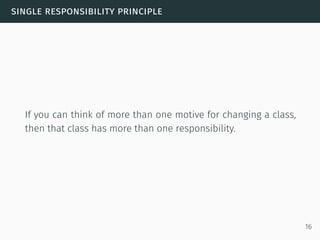
single responsibility principle
If you can think of more than one motive for changing a class,
then that class has more than one responsibility.
16
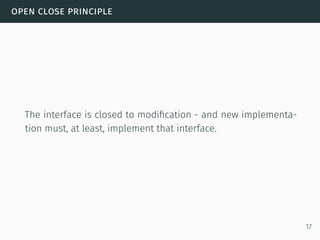
open close principle
The interface is closed to modification - and new implementa-
tion must, at least, implement that interface.
17
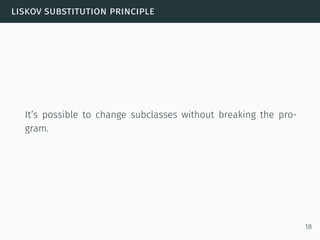
liskov substitution principle
It’s possible to change subclasses without breaking the pro-
gram.
18
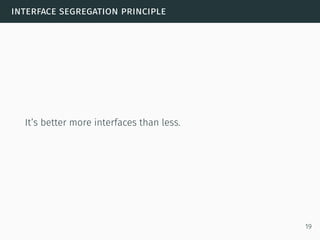
interface segregation principle
It’s better more interfaces than less.
19
dependency inversion
One should depend only on abstractions.
20
principle - dry
Don’t Repeat Yourself
21
principle - dry
Don’t Repeat Yourself
Two or more things are orthogonal if changes in one do not
affect any of the others
21
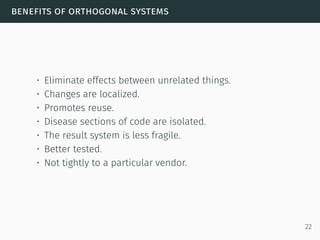
benefits of orthogonal systems
• Eliminate effects between unrelated things.
• Changes are localized.
• Promotes reuse.
• Disease sections of code are isolated.
• The result system is less fragile.
• Better tested.
• Not tightly to a particular vendor.
22
principle - law of demeter
You don’t ever, ever play with your toy’s toys.
23
principle - law of demeter
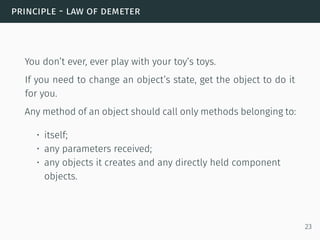
You don’t ever, ever play with your toy’s toys.
If you need to change an object’s state, get the object to do it
for you.
Any method of an object should call only methods belonging to:
• itself;
• any parameters received;
• any objects it creates and any directly held component
objects.
23
principle - composite reuse
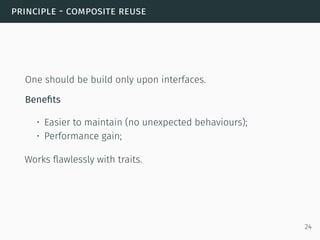
One should be build only upon interfaces.
Benefits
• Easier to maintain (no unexpected behaviours);
• Performance gain;
Works flawlessly with traits.
24
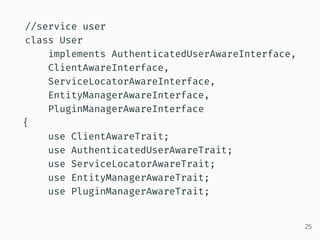
//service user
class User
implements AuthenticatedUserAwareInterface,
ClientAwareInterface,
ServiceLocatorAwareInterface,
EntityManagerAwareInterface,
PluginManagerAwareInterface
{
use ClientAwareTrait;
use AuthenticatedUserAwareTrait;
use ServiceLocatorAwareTrait;
use EntityManagerAwareTrait;
use PluginManagerAwareTrait;
25
principle - design by contract
Objects collaborate with each other on the basis of “mutual obli-
gations and benefits”. - Bertrand Meyer
26
principle - design by contract
Objects collaborate with each other on the basis of “mutual obli-
gations and benefits”. - Bertrand Meyer
Developing became the process of honoring contracts. :P
26
principle - design by contract
Objects collaborate with each other on the basis of “mutual obli-
gations and benefits”. - Bertrand Meyer
Developing became the process of honoring contracts. :P
Accept few and promise few.
26
principle - design by contract
Objects collaborate with each other on the basis of “mutual obli-
gations and benefits”. - Bertrand Meyer
Developing became the process of honoring contracts. :P
Accept few and promise few.
If your contract indicates that you’ll accept anything and pro-
mise the world in return, then you’ve got a lot of code to write.
26
principle - the scout rule
Clean code is not about perfection.. It’s about honesty.
27
principle - the scout rule
Clean code is not about perfection.. It’s about honesty.
We made our best to leave the camp cleaner than we find it?
27
practise
Tips for applying the previous principles.
28
functions arguments
The ideal number of arguments of a function is ZERO.
29
functions arguments
The ideal number of arguments of a function is ZERO.
More than tree is unacceptable.
29
functions arguments
The ideal number of arguments of a function is ZERO.
More than tree is unacceptable.
Flag arguments are ugly.
They state a SRP violation.
29
function returns
Output from function is not so good as well.
30
function returns
Output from function is not so good as well.
If functions must change a thing it must change itself.
(Demeter Law)
30
comments - usage scenarios
Put in the dock block at least the authors name.
31
comments - usage scenarios
Put in the dock block at least the authors name.
Attaching responsibility and accountability to the source code
does wonders in keeping people honest.
31
comments - usage scenarios
Put in the dock block at least the authors name.
Attaching responsibility and accountability to the source code
does wonders in keeping people honest.
Comments serves as well to discuss the purpose and trade-offs
of implementations.
31
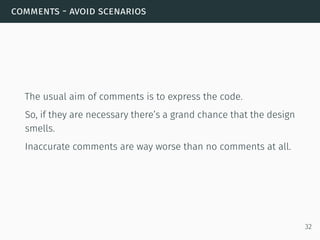
comments - avoid scenarios
The usual aim of comments is to express the code.
32
comments - avoid scenarios
The usual aim of comments is to express the code.
So, if they are necessary there’s a grand chance that the design
smells.
32
comments - avoid scenarios
The usual aim of comments is to express the code.
So, if they are necessary there’s a grand chance that the design
smells.
Inaccurate comments are way worse than no comments at all.
32
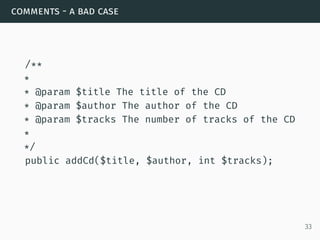
comments - a bad case
/**
*
* @param $title The title of the CD
* @param $author The author of the CD
* @param $tracks The number of tracks of the CD
*
*/
public addCd($title, $author, int $tracks);
33
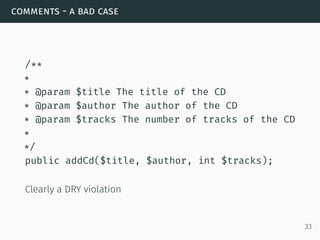
comments - a bad case
/**
*
* @param $title The title of the CD
* @param $author The author of the CD
* @param $tracks The number of tracks of the CD
*
*/
public addCd($title, $author, int $tracks);
Clearly a DRY violation
33
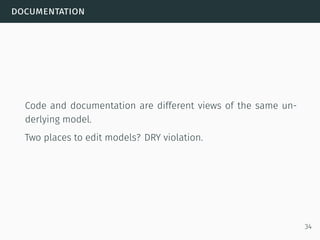
documentation
Code and documentation are different views of the same un-
derlying model.
Two places to edit models? DRY violation.
34
classes - journal metaphor (srp)
Classes should be like journal articles.
35
classes - journal metaphor (srp)
Classes should be like journal articles.
In the header you get an general overview.
You are able to decide if you go further or not.
35
classes - journal metaphor (srp)
Classes should be like journal articles.
In the header you get an general overview.
You are able to decide if you go further or not.
As you read down details increases.
35
classes - journal metaphor (srp)
Classes should be like journal articles.
In the header you get an general overview.
You are able to decide if you go further or not.
As you read down details increases.
A journal is made of many little articles.
35
objects vs data structures
In any good system the distinction of data structures and ob-
jects is clear.
36
objects vs data structures
In any good system the distinction of data structures and ob-
jects is clear.
Objects hide data and expose operations over it.
36
objects vs data structures
In any good system the distinction of data structures and ob-
jects is clear.
Objects hide data and expose operations over it.
Data structures expose data and have no meaningful operation.
36
naming
Long names are generally better and simple names.
Complex operations can be made simple when intermediate va-
riables are used.
37
naming
Long names are generally better and simple names.
Complex operations can be made simple when intermediate va-
riables are used.
Need to see the source for to know what a function does? Work
on names!
37
naming
Long names are generally better and simple names.
Complex operations can be made simple when intermediate va-
riables are used.
Need to see the source for to know what a function does? Work
on names!
If there’s an And in a function name it’s violating SRP.
37
conventions
Follow a coding standard, no matter which, but all the code must
follow the chosen one.
Examples for php
PSR2, Zend, Symphony, etc.
38
many little classes vs few big ones
Some fear to have to browser in many files till find the right
piece of code.
39
many little classes vs few big ones
Some fear to have to browser in many files till find the right
piece of code.
Many classes does not imply in comprehension damage.
39
many little classes vs few big ones
Some fear to have to browser in many files till find the right
piece of code.
Many classes does not imply in comprehension damage.
The Many and the Few approaches both have the same amount
of business logic to care of.
39
many little classes vs few big ones
Some fear to have to browser in many files till find the right
piece of code.
Many classes does not imply in comprehension damage.
The Many and the Few approaches both have the same amount
of business logic to care of.
So the question is:
You prefer your tools being organized in boxes with little com-
partments and good names?
39
many little classes vs few big ones
Some fear to have to browser in many files till find the right
piece of code.
Many classes does not imply in comprehension damage.
The Many and the Few approaches both have the same amount
of business logic to care of.
So the question is:
You prefer your tools being organized in boxes with little com-
partments and good names?
Or only a compartment and all inside?
39
many little classes are always better than few big ones
Any regular system will contain a vast quantity of logic
40
many little classes are always better than few big ones
Any regular system will contain a vast quantity of logic
The first goal of managing complexity is organizing in a way de-
velopers know how to look for a certain thing, without having to
worry about neighbour details.
40
many little classes are always better than few big ones
Any regular system will contain a vast quantity of logic
The first goal of managing complexity is organizing in a way de-
velopers know how to look for a certain thing, without having to
worry about neighbour details.
We want our systems to have many little classes - not few big
ones.
Relates to ISP.
40
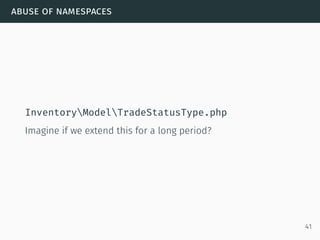
abuse of namespaces
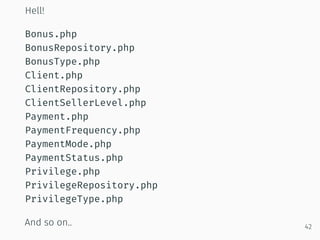
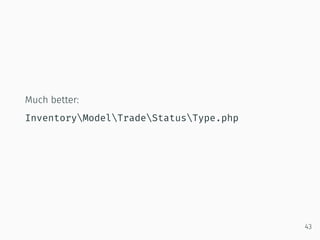
InventoryModelTradeStatusType.php
Imagine if we extend this for a long period?
41
Hell!
Bonus.php
BonusRepository.php
BonusType.php
Client.php
ClientRepository.php
ClientSellerLevel.php
Payment.php
PaymentFrequency.php
PaymentMode.php
PaymentStatus.php
Privilege.php
PrivilegeRepository.php
PrivilegeType.php
And so on.. 42
Much better:
InventoryModelTradeStatusType.php
43
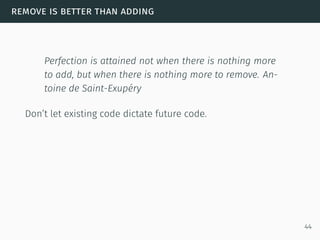
remove is better than adding
Perfection is attained not when there is nothing more
to add, but when there is nothing more to remove. An-
toine de Saint-Exupéry
Don’t let existing code dictate future code.
44
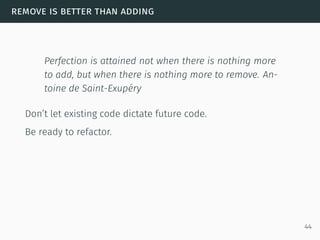
remove is better than adding
Perfection is attained not when there is nothing more
to add, but when there is nothing more to remove. An-
toine de Saint-Exupéry
Don’t let existing code dictate future code.
Be ready to refactor.
44
remove is better than adding
Perfection is attained not when there is nothing more
to add, but when there is nothing more to remove. An-
toine de Saint-Exupéry
Don’t let existing code dictate future code.
Be ready to refactor.
It may impact project schedule.
44
remove is better than adding
Perfection is attained not when there is nothing more
to add, but when there is nothing more to remove. An-
toine de Saint-Exupéry
Don’t let existing code dictate future code.
Be ready to refactor.
It may impact project schedule.
The assumption is that the impact will be less than the cost of
not making the change.
44
object calisthenics
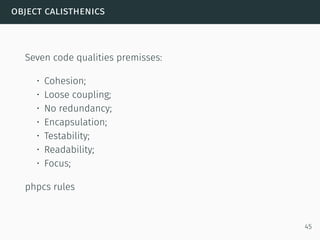
Seven code qualities premisses:
• Cohesion;
• Loose coupling;
• No redundancy;
• Encapsulation;
• Testability;
• Readability;
• Focus;
phpcs rules
45
1 - one level of indentation per method;
Benefits
Finding bugs is much easier.
If you have more than one indentation level you have more than
one abstraction level.
46
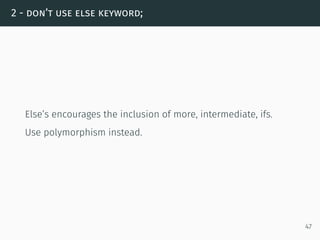
2 - don’t use else keyword;
Else’s encourages the inclusion of more, intermediate, ifs.
Use polymorphism instead.
47
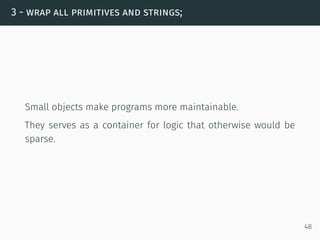
3 - wrap all primitives and strings;
Small objects make programs more maintainable.
They serves as a container for logic that otherwise would be
sparse.
48
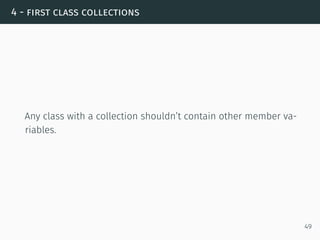
4 - first class collections
Any class with a collection shouldn’t contain other member va-
riables.
49
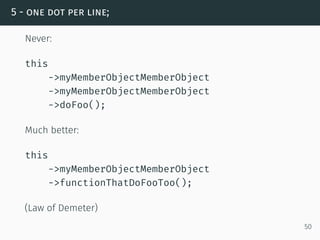
5 - one dot per line;
Never:
this
->myMemberObjectMemberObject
->doFoo();
Much better:
this
->myMemberObjectMemberObject
->functionThatDoFooToo();
(Law of Demeter)
50
6 - don’t abbreviate;
Abbreviation because of exhaustive use?
51
6 - don’t abbreviate;
Abbreviation because of exhaustive use?
DRY violation.
51
6 - don’t abbreviate;
Abbreviation because of exhaustive use?
DRY violation.
Too long names?
51
6 - don’t abbreviate;
Abbreviation because of exhaustive use?
DRY violation.
Too long names?
Maybe a SRP problem.
51
7 - keep all entities small;
No classes over 50 lines and no packages over 10 files.
52
8 - no classes with more than two instance variables.
A class Name with first, middle and last name might be decom-
posed to:
A class Name with a Surname class and a GivenNames class.
53
9 - no getters/setters/properties
When you have the enough quantity of encapsulation provided
from the previous rules you will never need to do any operation
on the getters/setters.
54
testing clean code
Testing code use different pattens than production code.
They have different constraints.
There things you will never do in production code that in testing
code is allowed.
Like memory and performance things.
55
testing clean code
Testing code use different pattens than production code.
They have different constraints.
There things you will never do in production code that in testing
code is allowed.
Like memory and performance things.
But never clarity things.
55
meta programming
Civilization advances by extending the number of im-
portant operations we can perform without thinking.
Alfred North Whitehead
What we want?
56
meta programming
Civilization advances by extending the number of im-
portant operations we can perform without thinking.
Alfred North Whitehead
What we want?
To go beyond using meta data for simple preferences.
56
meta programming
Civilization advances by extending the number of im-
portant operations we can perform without thinking.
Alfred North Whitehead
What we want?
To go beyond using meta data for simple preferences.
We want to configure and drive the application via meta data as
much as possible.
56
meta programming
Civilization advances by extending the number of im-
portant operations we can perform without thinking.
Alfred North Whitehead
What we want?
To go beyond using meta data for simple preferences.
We want to configure and drive the application via meta data as
much as possible.
Our goal is to think declaratively.
56
meta programming
Civilization advances by extending the number of im-
portant operations we can perform without thinking.
Alfred North Whitehead
What we want?
To go beyond using meta data for simple preferences.
We want to configure and drive the application via meta data as
much as possible.
Our goal is to think declaratively.
And create highly dynamic and adaptable programs.
56
meta programming
Civilization advances by extending the number of im-
portant operations we can perform without thinking.
Alfred North Whitehead
What we want?
To go beyond using meta data for simple preferences.
We want to configure and drive the application via meta data as
much as possible.
Our goal is to think declaratively.
And create highly dynamic and adaptable programs.
How?
56
meta programming
Civilization advances by extending the number of im-
portant operations we can perform without thinking.
Alfred North Whitehead
What we want?
To go beyond using meta data for simple preferences.
We want to configure and drive the application via meta data as
much as possible.
Our goal is to think declaratively.
And create highly dynamic and adaptable programs.
How?
Program for the general case, and put the specifics somewhere
else - outside the code base. 56
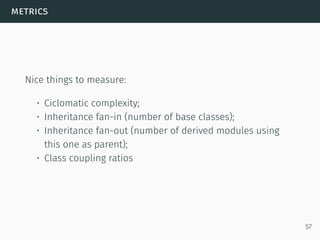
metrics
Nice things to measure:
• Ciclomatic complexity;
• Inheritance fan-in (number of base classes);
• Inheritance fan-out (number of derived modules using
this one as parent);
• Class coupling ratios
57
no magic
Never buy magic!
Before you commit to a framework, make sure you could write
it.
58
no magic
Never buy magic!
Before you commit to a framework, make sure you could write
it.
Do this by actually writing something simple that does the ba-
sics that you need.
58
no magic
Never buy magic!
Before you commit to a framework, make sure you could write
it.
Do this by actually writing something simple that does the ba-
sics that you need.
Make sure the magic all goes away.
58
conclusion
Quality is a team issue. Andy hunt.
Teams as a hole should not tolerate broken windows.
59
Obviously no one will ever do the hundred percent of what was
here exposed.
But if we aim for the 80% where code needs the most.
We are cool.
Parts not critical to performance must be clean - not optimized.
60
Remember…
The best programmers are 28 times best than the worst
ones. Robert Glass, Facts and Fallacies of Software En-
gineering
61
Remember…
The best programmers are 28 times best than the worst
ones. Robert Glass, Facts and Fallacies of Software En-
gineering
So there’s always room for improvement.
61
Remember…
The best programmers are 28 times best than the worst
ones. Robert Glass, Facts and Fallacies of Software En-
gineering
So there’s always room for improvement.
Thanks for all!
61

Clean code

  • 1.
    clean code There’s noproblem so simple that a bad developer can’t make it complicated. Steve Bohlen Programming is the art of telling another human what one wants the computer to do. Donald Knuth 1
  • 2.
    warning A quite notversed rhetorical presenter. 2
  • 3.
    warning A quite notversed rhetorical presenter. Feel free to interrupt me and ask when something is not clear. 2
  • 4.
    warning A quite notversed rhetorical presenter. Feel free to interrupt me and ask when something is not clear. Or something worth discussing. 2
  • 5.
    what clean codestands for? Clean code is a reader-focused development style that produ- ces software that’s easy to write, read and maintain. 3
  • 6.
    why it matters? Brokenwindows theory One broken window is all it takes to start the decline. 4
  • 7.
    why it matters? Brokenwindows theory One broken window is all it takes to start the decline. It’s too easy to slip into the mindset of “All the rest of this code is crap, I’ll just follow suit.” 4
  • 8.
    why it matters? Brokenwindows theory One broken window is all it takes to start the decline. It’s too easy to slip into the mindset of “All the rest of this code is crap, I’ll just follow suit.” It’s the software entropy. 4
  • 9.
    why it matters? Brokenwindows theory One broken window is all it takes to start the decline. It’s too easy to slip into the mindset of “All the rest of this code is crap, I’ll just follow suit.” It’s the software entropy. So called: “software rot.” 4
  • 10.
    the four characteristicsof rotting software From the book Design Principles and Design Patterns de Robert C. Martins 5
  • 11.
    1 - rigidity It’shard to solve simple problems. No one knows how long will take to solve them. Estimating is hard. 6
  • 12.
    2 - fragility Thesoftware breaks too often. A change in one unrelated part breaks others. Changes must be echoed in many places. 7
  • 13.
    3 - immobility It’sthe inability of reusing software from other places. 8
  • 14.
    4 - viscosity Itseasier to go to the hacking mode than to the design preser- vation mode. 9
  • 15.
  • 16.
    implications O preço dagambiarra Software rot implies in frustrated developers. 10
  • 17.
    implications O preço dagambiarra Software rot implies in frustrated developers. Frustrated developers implies in more rotting. 10
  • 18.
    implications O preço dagambiarra Software rot implies in frustrated developers. Frustrated developers implies in more rotting. Too much rooting implies in system rewrite. 10
  • 19.
  • 20.
  • 21.
  • 22.
  • 23.
    solution? Good practices. Software Wisdom. Cleancode! Anyone can write code a computer can understand, but profes- sional developers write code humans can understand. 12
  • 24.
    literature 1. Clean code:A hand book of Agile Software craftsmanship; Robert C. Martin. 2. The pragmatical programmer; Andrew Hunt. 3. Code Complete … Lot’s more Those who do not remember the past are condemned to repeat it. Jorge Agustin Nicolas Ruiz de Santayana y Borras 13
  • 25.
    some principles Dear truthalways deceiving simplicity. - John Green Follow what suites you most. 14
  • 26.
    some principles Dear truthalways deceiving simplicity. - John Green Follow what suites you most. Obviously this is not an exhaustive list. 14
  • 27.
    principle - solid Orthe “first five principles” by Michael Feathers. 15
  • 28.
    single responsibility principle Ifyou can think of more than one motive for changing a class, then that class has more than one responsibility. 16
  • 29.
    open close principle Theinterface is closed to modification - and new implementa- tion must, at least, implement that interface. 17
  • 30.
    liskov substitution principle It’spossible to change subclasses without breaking the pro- gram. 18
  • 31.
    interface segregation principle It’sbetter more interfaces than less. 19
  • 32.
    dependency inversion One shoulddepend only on abstractions. 20
  • 33.
    principle - dry Don’tRepeat Yourself 21
  • 34.
    principle - dry Don’tRepeat Yourself Two or more things are orthogonal if changes in one do not affect any of the others 21
  • 35.
    benefits of orthogonalsystems • Eliminate effects between unrelated things. • Changes are localized. • Promotes reuse. • Disease sections of code are isolated. • The result system is less fragile. • Better tested. • Not tightly to a particular vendor. 22
  • 36.
    principle - lawof demeter You don’t ever, ever play with your toy’s toys. 23
  • 37.
    principle - lawof demeter You don’t ever, ever play with your toy’s toys. If you need to change an object’s state, get the object to do it for you. Any method of an object should call only methods belonging to: • itself; • any parameters received; • any objects it creates and any directly held component objects. 23
  • 38.
    principle - compositereuse One should be build only upon interfaces. Benefits • Easier to maintain (no unexpected behaviours); • Performance gain; Works flawlessly with traits. 24
  • 39.
    //service user class User implementsAuthenticatedUserAwareInterface, ClientAwareInterface, ServiceLocatorAwareInterface, EntityManagerAwareInterface, PluginManagerAwareInterface { use ClientAwareTrait; use AuthenticatedUserAwareTrait; use ServiceLocatorAwareTrait; use EntityManagerAwareTrait; use PluginManagerAwareTrait; 25
  • 40.
    principle - designby contract Objects collaborate with each other on the basis of “mutual obli- gations and benefits”. - Bertrand Meyer 26
  • 41.
    principle - designby contract Objects collaborate with each other on the basis of “mutual obli- gations and benefits”. - Bertrand Meyer Developing became the process of honoring contracts. :P 26
  • 42.
    principle - designby contract Objects collaborate with each other on the basis of “mutual obli- gations and benefits”. - Bertrand Meyer Developing became the process of honoring contracts. :P Accept few and promise few. 26
  • 43.
    principle - designby contract Objects collaborate with each other on the basis of “mutual obli- gations and benefits”. - Bertrand Meyer Developing became the process of honoring contracts. :P Accept few and promise few. If your contract indicates that you’ll accept anything and pro- mise the world in return, then you’ve got a lot of code to write. 26
  • 44.
    principle - thescout rule Clean code is not about perfection.. It’s about honesty. 27
  • 45.
    principle - thescout rule Clean code is not about perfection.. It’s about honesty. We made our best to leave the camp cleaner than we find it? 27
  • 46.
    practise Tips for applyingthe previous principles. 28
  • 47.
    functions arguments The idealnumber of arguments of a function is ZERO. 29
  • 48.
    functions arguments The idealnumber of arguments of a function is ZERO. More than tree is unacceptable. 29
  • 49.
    functions arguments The idealnumber of arguments of a function is ZERO. More than tree is unacceptable. Flag arguments are ugly. They state a SRP violation. 29
  • 50.
    function returns Output fromfunction is not so good as well. 30
  • 51.
    function returns Output fromfunction is not so good as well. If functions must change a thing it must change itself. (Demeter Law) 30
  • 52.
    comments - usagescenarios Put in the dock block at least the authors name. 31
  • 53.
    comments - usagescenarios Put in the dock block at least the authors name. Attaching responsibility and accountability to the source code does wonders in keeping people honest. 31
  • 54.
    comments - usagescenarios Put in the dock block at least the authors name. Attaching responsibility and accountability to the source code does wonders in keeping people honest. Comments serves as well to discuss the purpose and trade-offs of implementations. 31
  • 55.
    comments - avoidscenarios The usual aim of comments is to express the code. 32
  • 56.
    comments - avoidscenarios The usual aim of comments is to express the code. So, if they are necessary there’s a grand chance that the design smells. 32
  • 57.
    comments - avoidscenarios The usual aim of comments is to express the code. So, if they are necessary there’s a grand chance that the design smells. Inaccurate comments are way worse than no comments at all. 32
  • 58.
    comments - abad case /** * * @param $title The title of the CD * @param $author The author of the CD * @param $tracks The number of tracks of the CD * */ public addCd($title, $author, int $tracks); 33
  • 59.
    comments - abad case /** * * @param $title The title of the CD * @param $author The author of the CD * @param $tracks The number of tracks of the CD * */ public addCd($title, $author, int $tracks); Clearly a DRY violation 33
  • 60.
    documentation Code and documentationare different views of the same un- derlying model. Two places to edit models? DRY violation. 34
  • 61.
    classes - journalmetaphor (srp) Classes should be like journal articles. 35
  • 62.
    classes - journalmetaphor (srp) Classes should be like journal articles. In the header you get an general overview. You are able to decide if you go further or not. 35
  • 63.
    classes - journalmetaphor (srp) Classes should be like journal articles. In the header you get an general overview. You are able to decide if you go further or not. As you read down details increases. 35
  • 64.
    classes - journalmetaphor (srp) Classes should be like journal articles. In the header you get an general overview. You are able to decide if you go further or not. As you read down details increases. A journal is made of many little articles. 35
  • 65.
    objects vs datastructures In any good system the distinction of data structures and ob- jects is clear. 36
  • 66.
    objects vs datastructures In any good system the distinction of data structures and ob- jects is clear. Objects hide data and expose operations over it. 36
  • 67.
    objects vs datastructures In any good system the distinction of data structures and ob- jects is clear. Objects hide data and expose operations over it. Data structures expose data and have no meaningful operation. 36
  • 68.
    naming Long names aregenerally better and simple names. Complex operations can be made simple when intermediate va- riables are used. 37
  • 69.
    naming Long names aregenerally better and simple names. Complex operations can be made simple when intermediate va- riables are used. Need to see the source for to know what a function does? Work on names! 37
  • 70.
    naming Long names aregenerally better and simple names. Complex operations can be made simple when intermediate va- riables are used. Need to see the source for to know what a function does? Work on names! If there’s an And in a function name it’s violating SRP. 37
  • 71.
    conventions Follow a codingstandard, no matter which, but all the code must follow the chosen one. Examples for php PSR2, Zend, Symphony, etc. 38
  • 72.
    many little classesvs few big ones Some fear to have to browser in many files till find the right piece of code. 39
  • 73.
    many little classesvs few big ones Some fear to have to browser in many files till find the right piece of code. Many classes does not imply in comprehension damage. 39
  • 74.
    many little classesvs few big ones Some fear to have to browser in many files till find the right piece of code. Many classes does not imply in comprehension damage. The Many and the Few approaches both have the same amount of business logic to care of. 39
  • 75.
    many little classesvs few big ones Some fear to have to browser in many files till find the right piece of code. Many classes does not imply in comprehension damage. The Many and the Few approaches both have the same amount of business logic to care of. So the question is: You prefer your tools being organized in boxes with little com- partments and good names? 39
  • 76.
    many little classesvs few big ones Some fear to have to browser in many files till find the right piece of code. Many classes does not imply in comprehension damage. The Many and the Few approaches both have the same amount of business logic to care of. So the question is: You prefer your tools being organized in boxes with little com- partments and good names? Or only a compartment and all inside? 39
  • 77.
    many little classesare always better than few big ones Any regular system will contain a vast quantity of logic 40
  • 78.
    many little classesare always better than few big ones Any regular system will contain a vast quantity of logic The first goal of managing complexity is organizing in a way de- velopers know how to look for a certain thing, without having to worry about neighbour details. 40
  • 79.
    many little classesare always better than few big ones Any regular system will contain a vast quantity of logic The first goal of managing complexity is organizing in a way de- velopers know how to look for a certain thing, without having to worry about neighbour details. We want our systems to have many little classes - not few big ones. Relates to ISP. 40
  • 80.
  • 81.
  • 82.
  • 83.
    remove is betterthan adding Perfection is attained not when there is nothing more to add, but when there is nothing more to remove. An- toine de Saint-Exupéry Don’t let existing code dictate future code. 44
  • 84.
    remove is betterthan adding Perfection is attained not when there is nothing more to add, but when there is nothing more to remove. An- toine de Saint-Exupéry Don’t let existing code dictate future code. Be ready to refactor. 44
  • 85.
    remove is betterthan adding Perfection is attained not when there is nothing more to add, but when there is nothing more to remove. An- toine de Saint-Exupéry Don’t let existing code dictate future code. Be ready to refactor. It may impact project schedule. 44
  • 86.
    remove is betterthan adding Perfection is attained not when there is nothing more to add, but when there is nothing more to remove. An- toine de Saint-Exupéry Don’t let existing code dictate future code. Be ready to refactor. It may impact project schedule. The assumption is that the impact will be less than the cost of not making the change. 44
  • 87.
    object calisthenics Seven codequalities premisses: • Cohesion; • Loose coupling; • No redundancy; • Encapsulation; • Testability; • Readability; • Focus; phpcs rules 45
  • 88.
    1 - onelevel of indentation per method; Benefits Finding bugs is much easier. If you have more than one indentation level you have more than one abstraction level. 46
  • 89.
    2 - don’tuse else keyword; Else’s encourages the inclusion of more, intermediate, ifs. Use polymorphism instead. 47
  • 90.
    3 - wrapall primitives and strings; Small objects make programs more maintainable. They serves as a container for logic that otherwise would be sparse. 48
  • 91.
    4 - firstclass collections Any class with a collection shouldn’t contain other member va- riables. 49
  • 92.
    5 - onedot per line; Never: this ->myMemberObjectMemberObject ->myMemberObjectMemberObject ->doFoo(); Much better: this ->myMemberObjectMemberObject ->functionThatDoFooToo(); (Law of Demeter) 50
  • 93.
    6 - don’tabbreviate; Abbreviation because of exhaustive use? 51
  • 94.
    6 - don’tabbreviate; Abbreviation because of exhaustive use? DRY violation. 51
  • 95.
    6 - don’tabbreviate; Abbreviation because of exhaustive use? DRY violation. Too long names? 51
  • 96.
    6 - don’tabbreviate; Abbreviation because of exhaustive use? DRY violation. Too long names? Maybe a SRP problem. 51
  • 97.
    7 - keepall entities small; No classes over 50 lines and no packages over 10 files. 52
  • 98.
    8 - noclasses with more than two instance variables. A class Name with first, middle and last name might be decom- posed to: A class Name with a Surname class and a GivenNames class. 53
  • 99.
    9 - nogetters/setters/properties When you have the enough quantity of encapsulation provided from the previous rules you will never need to do any operation on the getters/setters. 54
  • 100.
    testing clean code Testingcode use different pattens than production code. They have different constraints. There things you will never do in production code that in testing code is allowed. Like memory and performance things. 55
  • 101.
    testing clean code Testingcode use different pattens than production code. They have different constraints. There things you will never do in production code that in testing code is allowed. Like memory and performance things. But never clarity things. 55
  • 102.
    meta programming Civilization advancesby extending the number of im- portant operations we can perform without thinking. Alfred North Whitehead What we want? 56
  • 103.
    meta programming Civilization advancesby extending the number of im- portant operations we can perform without thinking. Alfred North Whitehead What we want? To go beyond using meta data for simple preferences. 56
  • 104.
    meta programming Civilization advancesby extending the number of im- portant operations we can perform without thinking. Alfred North Whitehead What we want? To go beyond using meta data for simple preferences. We want to configure and drive the application via meta data as much as possible. 56
  • 105.
    meta programming Civilization advancesby extending the number of im- portant operations we can perform without thinking. Alfred North Whitehead What we want? To go beyond using meta data for simple preferences. We want to configure and drive the application via meta data as much as possible. Our goal is to think declaratively. 56
  • 106.
    meta programming Civilization advancesby extending the number of im- portant operations we can perform without thinking. Alfred North Whitehead What we want? To go beyond using meta data for simple preferences. We want to configure and drive the application via meta data as much as possible. Our goal is to think declaratively. And create highly dynamic and adaptable programs. 56
  • 107.
    meta programming Civilization advancesby extending the number of im- portant operations we can perform without thinking. Alfred North Whitehead What we want? To go beyond using meta data for simple preferences. We want to configure and drive the application via meta data as much as possible. Our goal is to think declaratively. And create highly dynamic and adaptable programs. How? 56
  • 108.
    meta programming Civilization advancesby extending the number of im- portant operations we can perform without thinking. Alfred North Whitehead What we want? To go beyond using meta data for simple preferences. We want to configure and drive the application via meta data as much as possible. Our goal is to think declaratively. And create highly dynamic and adaptable programs. How? Program for the general case, and put the specifics somewhere else - outside the code base. 56
  • 109.
    metrics Nice things tomeasure: • Ciclomatic complexity; • Inheritance fan-in (number of base classes); • Inheritance fan-out (number of derived modules using this one as parent); • Class coupling ratios 57
  • 110.
    no magic Never buymagic! Before you commit to a framework, make sure you could write it. 58
  • 111.
    no magic Never buymagic! Before you commit to a framework, make sure you could write it. Do this by actually writing something simple that does the ba- sics that you need. 58
  • 112.
    no magic Never buymagic! Before you commit to a framework, make sure you could write it. Do this by actually writing something simple that does the ba- sics that you need. Make sure the magic all goes away. 58
  • 113.
    conclusion Quality is ateam issue. Andy hunt. Teams as a hole should not tolerate broken windows. 59
  • 114.
    Obviously no onewill ever do the hundred percent of what was here exposed. But if we aim for the 80% where code needs the most. We are cool. Parts not critical to performance must be clean - not optimized. 60
  • 115.
    Remember… The best programmersare 28 times best than the worst ones. Robert Glass, Facts and Fallacies of Software En- gineering 61
  • 116.
    Remember… The best programmersare 28 times best than the worst ones. Robert Glass, Facts and Fallacies of Software En- gineering So there’s always room for improvement. 61
  • 117.
    Remember… The best programmersare 28 times best than the worst ones. Robert Glass, Facts and Fallacies of Software En- gineering So there’s always room for improvement. Thanks for all! 61