Dr. Maria Idrees; PT
MS (RIU)
DPT (TUF)
Adrenocorticosteroids
 The glucocorticoids (cortisol, corticosterone)
are primarily involved in the control of glucose
metabolism and the body’s ability to deal with
stress.
 Mineralocorticoids, such as aldosterone, are
involved in maintaining fluid and electrolyte
balance in the body.
Role of Glucocorticoids
in Normal Function
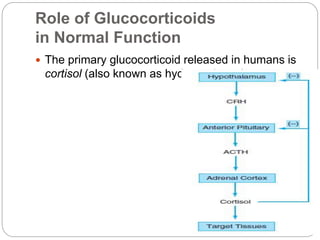
 The primary glucocorticoid released in humans is
cortisol (also known as hydrocortisone).
Mechanism of Action
of Glucocorticoids
 Specifically, glucocorticoids exert their classic
cellular effects first by entering the target cell
and binding to a receptor located in the cytosol.
 Binding the glucocorticoid to the receptor
creates an activated hormone-receptor complex.
 This activated complex then travels
(translocates) to the nucleus of the cell, where it
binds directly to specific DNA gene segments
that control inflammation.
Physiologic Effects of
Glucocorticoids
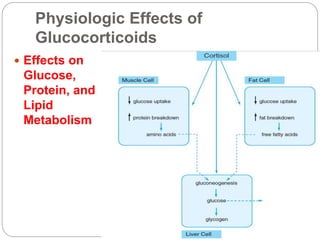
 Effects on
Glucose,
Protein, and
Lipid
Metabolism
 Anti-Inflammatory Effects
 glucocorticoids often inhibit transcription
factors that normally stimulate genes within
specific cells to express inflammatory
components.
 Glucocorticoids—for example—act on
macrophages, lymphocytes, and endothelial
cells to inhibit the expression of inflammatory
proteins (cytokines) such as interleukin-1,
interleukin-6, tissue necrosis factor alpha,
interferon gamma, and similar inflammatory
cytokines.
 Immunosuppression
 Glucocorticoids have long been recognized
for their ability to inhibit hypersensitivity
reactions, especially delayed or cell-mediated
allergic reactions.
 Many immunosuppressive effects are
mediated by the same actions that explain the
anti inflammatory effects of these drugs.
Therapeutic Glucocorticoid
Agents
Glucocorticoid Use in Endocrine
Conditions
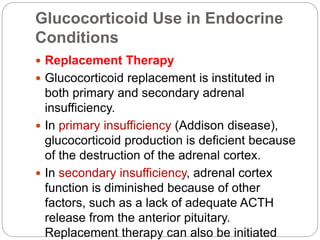
 Replacement Therapy
 Glucocorticoid replacement is instituted in
both primary and secondary adrenal
insufficiency.
 In primary insufficiency (Addison disease),
glucocorticoid production is deficient because
of the destruction of the adrenal cortex.
 In secondary insufficiency, adrenal cortex
function is diminished because of other
factors, such as a lack of adequate ACTH
release from the anterior pituitary.
Replacement therapy can also be initiated
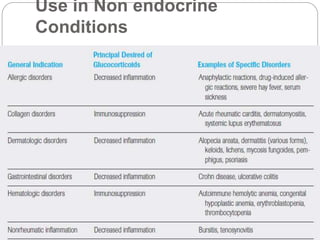
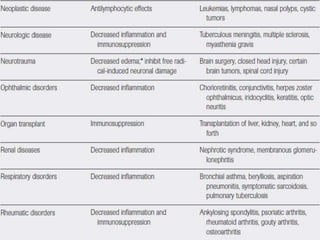
Use in Non endocrine
Conditions
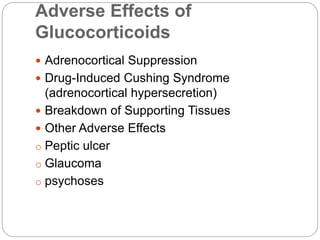
Adverse Effects of
Glucocorticoids
 Adrenocortical Suppression
 Drug-Induced Cushing Syndrome
(adrenocortical hypersecretion)
 Breakdown of Supporting Tissues
 Other Adverse Effects
o Peptic ulcer
o Glaucoma
o psychoses
Drugs That Inhibit Adrenocortical
Hormone Biosynthesis
 Aminoglutethimide (Cytadren)
 Metyrapone (Metopirone)
 Ketoconazole (Nizoral)
 Mitotane (Lysodren)
Mineralocorticoids
 Mineralocorticoids are also steroid
hormones that are produced by the
adrenal cortex.
 The principal mineralocorticoid in
humans is aldosterone.
 Aldosterone is primarily involved in
maintaining fluid and electrolyte balance
in the body.
 This hormone works on the kidneys to
increase sodium and water reabsorption
Regulation of Mineralocorticoid
Secretion
 A primary stimulus for aldosterone release is increased
levels of angiotensin II
 Basically, a sudden fall in blood pressure initiates a chain
of events that generates increased circulating levels of
angiotensin II
 Angiotensin II helps maintain blood pressure by
vasoconstricting peripheral vessels
 Angiotensin II helps exert a more prolonged
antihypotensive effect by stimulating aldosterone
secretion from the adrenal cortex.
 In addition, aldosterone secretion is regulated by
increased plasma potassium levels
 Elevated plasma potassium serves as a stimulus to
Mechanism of Action of
Mineralocorticoids
Adverse Effects of
Mineralocorticoid Agonists
 Hypertension
 Other adverse effects
peripheral edema
weight gain
hypokalemia
Mineralocorticoid Antagonists
 Spironolactone (Aldactone)
 Eplerenone (Inspra)

Adrenocorticosteroids.pptx

  • 1.
    Dr. Maria Idrees;PT MS (RIU) DPT (TUF) Adrenocorticosteroids
  • 2.
     The glucocorticoids(cortisol, corticosterone) are primarily involved in the control of glucose metabolism and the body’s ability to deal with stress.  Mineralocorticoids, such as aldosterone, are involved in maintaining fluid and electrolyte balance in the body.
  • 3.
    Role of Glucocorticoids inNormal Function  The primary glucocorticoid released in humans is cortisol (also known as hydrocortisone).
  • 4.
    Mechanism of Action ofGlucocorticoids  Specifically, glucocorticoids exert their classic cellular effects first by entering the target cell and binding to a receptor located in the cytosol.  Binding the glucocorticoid to the receptor creates an activated hormone-receptor complex.  This activated complex then travels (translocates) to the nucleus of the cell, where it binds directly to specific DNA gene segments that control inflammation.
  • 5.
    Physiologic Effects of Glucocorticoids Effects on Glucose, Protein, and Lipid Metabolism
  • 6.
     Anti-Inflammatory Effects glucocorticoids often inhibit transcription factors that normally stimulate genes within specific cells to express inflammatory components.  Glucocorticoids—for example—act on macrophages, lymphocytes, and endothelial cells to inhibit the expression of inflammatory proteins (cytokines) such as interleukin-1, interleukin-6, tissue necrosis factor alpha, interferon gamma, and similar inflammatory cytokines.
  • 7.
     Immunosuppression  Glucocorticoidshave long been recognized for their ability to inhibit hypersensitivity reactions, especially delayed or cell-mediated allergic reactions.  Many immunosuppressive effects are mediated by the same actions that explain the anti inflammatory effects of these drugs.
  • 8.
  • 9.
    Glucocorticoid Use inEndocrine Conditions  Replacement Therapy  Glucocorticoid replacement is instituted in both primary and secondary adrenal insufficiency.  In primary insufficiency (Addison disease), glucocorticoid production is deficient because of the destruction of the adrenal cortex.  In secondary insufficiency, adrenal cortex function is diminished because of other factors, such as a lack of adequate ACTH release from the anterior pituitary. Replacement therapy can also be initiated
  • 10.
    Use in Nonendocrine Conditions
  • 12.
    Adverse Effects of Glucocorticoids Adrenocortical Suppression  Drug-Induced Cushing Syndrome (adrenocortical hypersecretion)  Breakdown of Supporting Tissues  Other Adverse Effects o Peptic ulcer o Glaucoma o psychoses
  • 13.
    Drugs That InhibitAdrenocortical Hormone Biosynthesis  Aminoglutethimide (Cytadren)  Metyrapone (Metopirone)  Ketoconazole (Nizoral)  Mitotane (Lysodren)
  • 14.
    Mineralocorticoids  Mineralocorticoids arealso steroid hormones that are produced by the adrenal cortex.  The principal mineralocorticoid in humans is aldosterone.  Aldosterone is primarily involved in maintaining fluid and electrolyte balance in the body.  This hormone works on the kidneys to increase sodium and water reabsorption
  • 15.
    Regulation of Mineralocorticoid Secretion A primary stimulus for aldosterone release is increased levels of angiotensin II  Basically, a sudden fall in blood pressure initiates a chain of events that generates increased circulating levels of angiotensin II  Angiotensin II helps maintain blood pressure by vasoconstricting peripheral vessels  Angiotensin II helps exert a more prolonged antihypotensive effect by stimulating aldosterone secretion from the adrenal cortex.  In addition, aldosterone secretion is regulated by increased plasma potassium levels  Elevated plasma potassium serves as a stimulus to
  • 16.
    Mechanism of Actionof Mineralocorticoids
  • 17.
    Adverse Effects of MineralocorticoidAgonists  Hypertension  Other adverse effects peripheral edema weight gain hypokalemia
  • 18.
    Mineralocorticoid Antagonists  Spironolactone(Aldactone)  Eplerenone (Inspra)

Editor's Notes

  • #17 (1) Aldosterone (A) enters the cell and binds to a cytosolic receptor (R), creating an activated hormone-receptor complex (A–R). (2) A–R complex travels to the cell’s nucleus, where it induces mRNA synthesis. (3) mRNA units undergo translation in the cytosol. (4) Specific proteins are synthesized that increase membrane permeability to sodium (Na). (5) Na leaves the nephron lumen and enters the cell down an electrochemical gradient. (6) Na is actively reabsorbed into the body, and potassium (K) is actively secreted from the bloodstream by the cellular Na-K pump.