Discourse Analysis
Maria Jose Cardenas
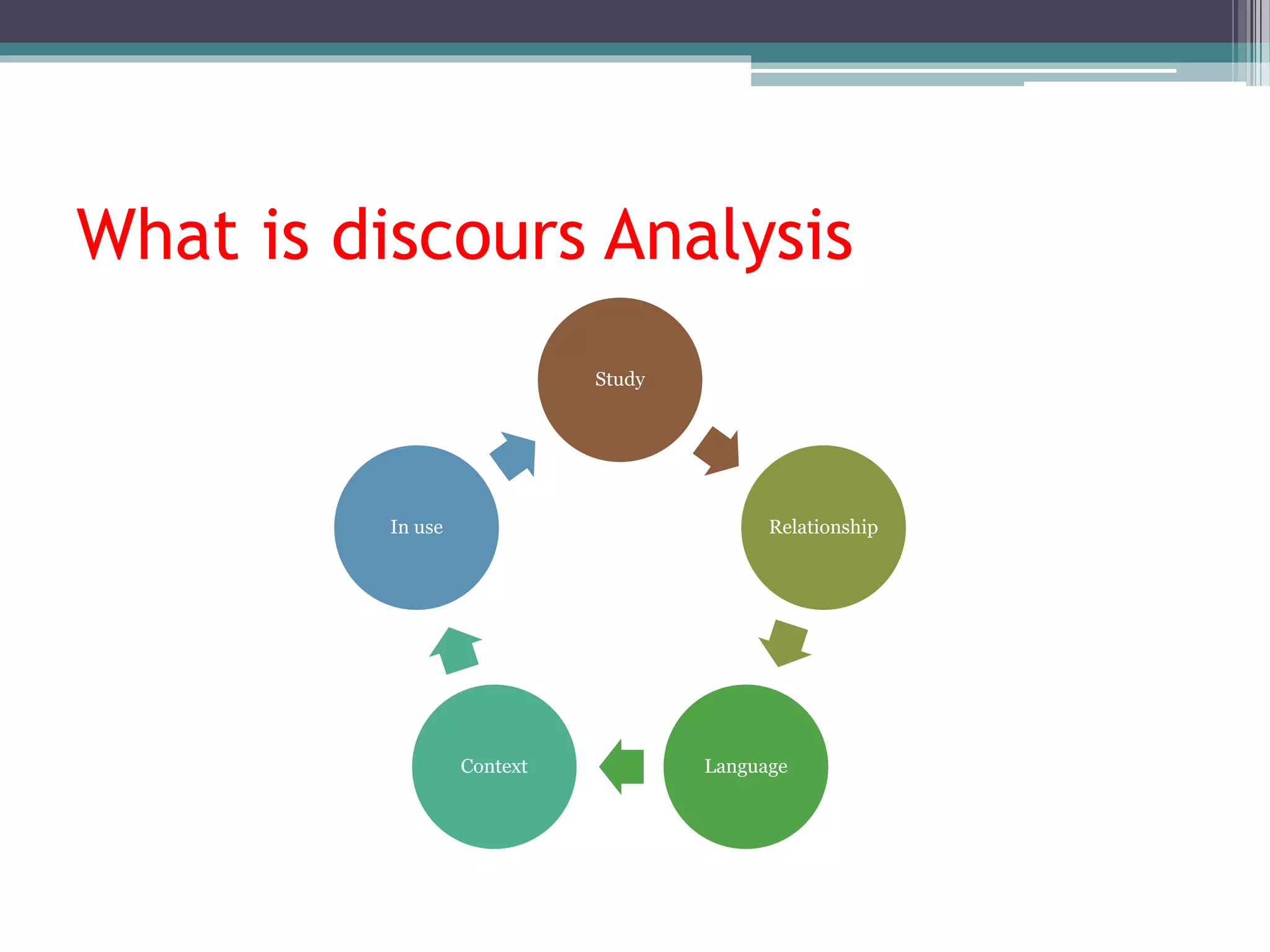
What is discours Analysis
Study
Relationship
LanguageContext
In use
Form and function
• Grammatical form will play different functions.
• In order to clarify their intenction we can use the
intonation as guide.
• Tone contour, the direction of his pitch raises of fall.
• Grammatical form and phonological forms can´t
indicate the fuction but if we analyse the context and
together, we can make a decision about the function
of a conversation.
• Funtion: command, statement, question or
exclamation
• Discourse will focus in more elements that
grammatical form and phonology as the
relationship between participants and rules.
• Different types of spoken interaction: phone call,
buying things, in classroom. These situation will
have their own formulae such as: opening and
closing the encounter, different role
relationships, different purposes and different
settings.
•
Speech acts and discourse structures
• Speech acts: When we talk about a bit of speech
or writing is a request or question, what a piece
of language is doing.
• Discourse analysis is concerned with the
relationship between language and the contexts
of its use.
• Discourses have beginnings, middles and ends.
The scope of Discourse Analysis
• Discourse analysis is interested in the words
and/or sentences that should be linked to one
another in a fashion that corresponds to
conventional formulae, just as we do with
speech; therefore in the organisation of written
interaction.
Spoken discourse
• The Birmingham model has connections with speech acts and
the larger structures.
• We speak accordingly fixed persepction or our roles in society.
• Framing move use the the word to give a sequence and
transaction part of a formal structred conversation.
• There is a sequence in a spoken discourse of interventions of
the participants.
• Exchange: includes question, answer and comment.
• Functioning of moves: questionnins (initiation move), answer
or non verbal response (response move) and feedback (follow
-up move)
• Different sittuation will require different formulae
Conversations outside the classroom
• Vary in their degree of structureness
• Politeness and sensitivity appear to prepare the
ground.
• Other features such as intonation, gestures, etc…
to make us confidentof the analysis.
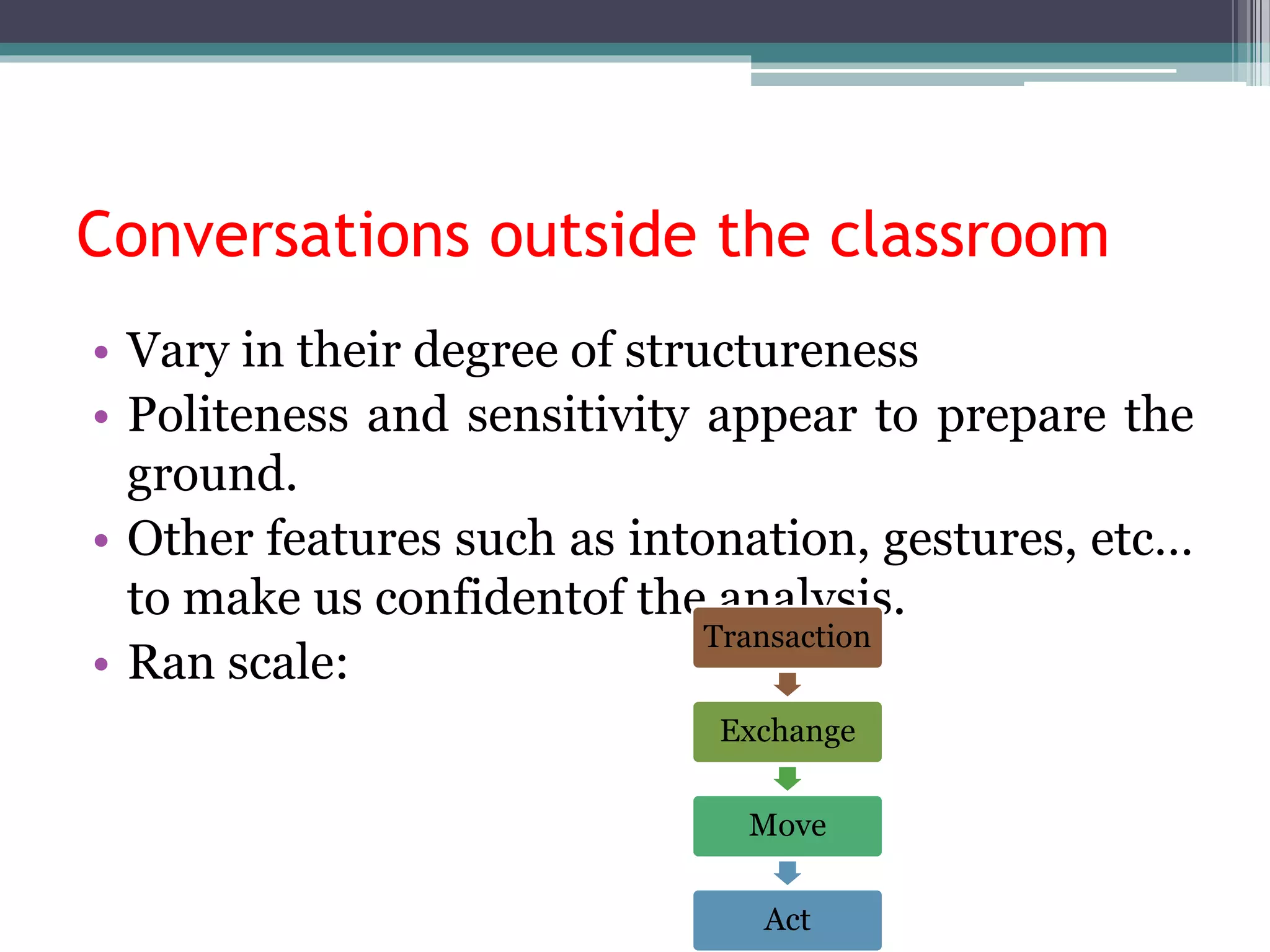
• Ran scale:
Transaction
Exchange
Move
Act
Talk as social activity
• When we hava a casual o spontaneous dialogue
will vary the diagram.
• How people behave and cooperate in discourse
process and the use of adjency pairs, turn taking,
how conversational openning and closing is
managed, how topics enter and disappear.
• And everybody has the right to intervent and say
something.
Written Discourse
• The writer has time to thinks and write well
structured sentences.
• We start organizing by units that are paragraphs.
Creating link between clausules that are called
cohesion.
• Grammaticals links such as: pronominalisation,
ellipsis and conjunction of various elements.
• Cohesive item will guide us to interpret the text.
Coheren is to make sense to whole the text.
Text and Interpretation
• Cohesive markers create links across boundaries and
pair and chain together items that are related.
• We have to make sense of a text and that is to interpret.
• Procedural: the process of interpretation textual patern.
• Textual patterns: certaon patterns that reoccur in time to
time is deeply ingrained in our cuture. Present in bit of
text as phrases, clauses and senteces called segments.
• Reading a text is like a dialigue with the writer.
• Cause relational approach: phenonenon- reason,
cause-consequence, instrument-achievement.
• The phenomenon- reason united two sentences of a
extract with cause –consequence will bring logical
sequencies.
• Matching relationships: when segments of a text are
contrasted and compared.
• Illocutory act: relationships betwee the textual
segments enter into with one another.
Larger patterns in text
• The clause -relational approach is related with
long text. Present problem solution pattern that
is in the first sentence present a situation,
secodnd sentence the problem and third
sentnence the solution.
• Reader and writer be aware about signallign
devices such as but.

Discourse analysis

  • 1.
  • 2.
    What is discoursAnalysis Study Relationship LanguageContext In use
  • 3.
    Form and function •Grammatical form will play different functions. • In order to clarify their intenction we can use the intonation as guide. • Tone contour, the direction of his pitch raises of fall. • Grammatical form and phonological forms can´t indicate the fuction but if we analyse the context and together, we can make a decision about the function of a conversation. • Funtion: command, statement, question or exclamation
  • 4.
    • Discourse willfocus in more elements that grammatical form and phonology as the relationship between participants and rules. • Different types of spoken interaction: phone call, buying things, in classroom. These situation will have their own formulae such as: opening and closing the encounter, different role relationships, different purposes and different settings. •
  • 5.
    Speech acts anddiscourse structures • Speech acts: When we talk about a bit of speech or writing is a request or question, what a piece of language is doing. • Discourse analysis is concerned with the relationship between language and the contexts of its use. • Discourses have beginnings, middles and ends.
  • 6.
    The scope ofDiscourse Analysis • Discourse analysis is interested in the words and/or sentences that should be linked to one another in a fashion that corresponds to conventional formulae, just as we do with speech; therefore in the organisation of written interaction.
  • 7.
    Spoken discourse • TheBirmingham model has connections with speech acts and the larger structures. • We speak accordingly fixed persepction or our roles in society. • Framing move use the the word to give a sequence and transaction part of a formal structred conversation. • There is a sequence in a spoken discourse of interventions of the participants. • Exchange: includes question, answer and comment. • Functioning of moves: questionnins (initiation move), answer or non verbal response (response move) and feedback (follow -up move) • Different sittuation will require different formulae
  • 8.
    Conversations outside theclassroom • Vary in their degree of structureness • Politeness and sensitivity appear to prepare the ground. • Other features such as intonation, gestures, etc… to make us confidentof the analysis. • Ran scale: Transaction Exchange Move Act
  • 9.
    Talk as socialactivity • When we hava a casual o spontaneous dialogue will vary the diagram. • How people behave and cooperate in discourse process and the use of adjency pairs, turn taking, how conversational openning and closing is managed, how topics enter and disappear. • And everybody has the right to intervent and say something.
  • 10.
    Written Discourse • Thewriter has time to thinks and write well structured sentences. • We start organizing by units that are paragraphs. Creating link between clausules that are called cohesion. • Grammaticals links such as: pronominalisation, ellipsis and conjunction of various elements. • Cohesive item will guide us to interpret the text. Coheren is to make sense to whole the text.
  • 11.
    Text and Interpretation •Cohesive markers create links across boundaries and pair and chain together items that are related. • We have to make sense of a text and that is to interpret. • Procedural: the process of interpretation textual patern. • Textual patterns: certaon patterns that reoccur in time to time is deeply ingrained in our cuture. Present in bit of text as phrases, clauses and senteces called segments. • Reading a text is like a dialigue with the writer.
  • 12.
    • Cause relationalapproach: phenonenon- reason, cause-consequence, instrument-achievement. • The phenomenon- reason united two sentences of a extract with cause –consequence will bring logical sequencies. • Matching relationships: when segments of a text are contrasted and compared. • Illocutory act: relationships betwee the textual segments enter into with one another.
  • 13.
    Larger patterns intext • The clause -relational approach is related with long text. Present problem solution pattern that is in the first sentence present a situation, secodnd sentence the problem and third sentnence the solution. • Reader and writer be aware about signallign devices such as but.