ZFSfilesystem++Marc Seeger (marc-seeger.de)Now with 100% more pictures of kittens!
The basic idea
The usual featuresFile names/Directories => FAT / InodesMetadata => time/size/…CRUD => + truncate, appending, moving, linksSecurity => ACL ()/capabilites ()
The good stuffJournaling => metadata only /completeEncryptionTransparent compressionChecksumsSnapshots/Versioning
Layout
Logical Volume Manager (LVM)Operating SystemLogical Volume ManagerVolume(consisting of HDDs)
Problems today
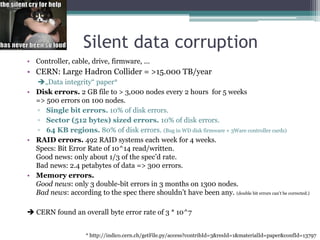
Silent data corruptionController, cable, drive, firmware, ...CERN: Large Hadron Collider = >15.000 TB/year„Data integrity“ paper*Disk errors. 2 GB file to > 3,000 nodes every 2 hours  for 5 weeks=> 500 errors on 100 nodes. Single bit errors. 10% of disk errors.Sector (512 bytes) sized errors. 10% of disk errors.64 KB regions. 80% of disk errors. (Bug in WD disk firmware + 3Ware controller cards)RAID errors. 492 RAID systems each week for 4 weeks.Specs: Bit Error Rate of 10^14 read/written. Good news: only about 1/3 of the spec’d rate.Bad news: 2.4 petabytes of data => 300 errors.Memory errors.Good news: only 3 double-bit errors in 3 months on 1300 nodes.Bad news: according to the spec there shouldn’t have been any. (double bit errors can’t be corrected.) CERN found an overall byte error rate of 3 * 10^7* http://indico.cern.ch/getFile.py/access?contribId=3&resId=1&materialId=paper&confId=13797
ManagementLabels, partitions, volumes, provisioning, grow/shrink, /etc files...Limits:  filesystem/volume size, file size, number of files,files per directory, number of snapshots ...Different tools to manage file, block, iSCSI, NFS, CIFS ...
SlowLinear-time createfat locksfixed block sizenaïve prefetchdirty region loggingpainful RAID rebuildsgrowing backup time
What‘s different about ZFS“ZFS is a new kind of file system that provides:simple administrationtransactional semanticsend-to-end data integrityimmense scalability.ZFS is not an incremental improvement to existing technology; it is a fundamentally new approach to data management.We've blown away 20 years of obsolete assumptions, eliminated complexity at the source, and created a storage system that's actually a pleasure to use.”
pooled storage modelcompletely eliminates:the concept of volumesand the associated problems of:PartitionsProvisioningWasted bandwidthStranded storage.Thousands of file systems can draw from a common storage pool, each one consuming only as much space as it actually needs. The combined I/O bandwidth of all devices in the pool is available to all filesystems at all times.
All operations are copy-on-write transactions the on-disk state is always valid.There is no need to fsck(1M) a ZFS file system, ever.Every block is checksummed to prevent silent data corruption (user-selectable algorithm)the data is self-healing in replicated (mirrored or RAID) configurations.If one copy is damaged, ZFS detects it and uses another copy to repair it.
RAID-Zsimilar to RAID-5 but:uses variable stripe width to eliminate the RAID-5 write hole.All RAID-Z writes are full-stripe writes.no read-modify-write taxno write holeno need for NVRAM in hardware.(ZFS loves cheap disks)
But cheap disks can fail!No problem: ZFS provides disk scrubbing(like ECC memory scrubbing)256 bit block checksumworks while storage pool is live and in use!
Scalability128-bit filesystem256 quadrillion zettabytes.All metadata is allocated dynamically no need to pre-allocate inodes or otherwise limit the scalability of the file system when it is first created.Directories can have up to 248 (256 trillion) entriesNo limit exists on the number of file systems …… or number of files that can be contained within a file system.
SnapshotsA snapshot is a read-only copy of a file system or volume. Snapshots can be created quickly and easily. Initially, snapshots consume no additional space within the pool.Snapshots are happening at constant-timeAs data within the active dataset changes, the snapshot consumes space by continuing to reference the old data.Incremental backups are so efficient that they can be used for remote replication — e.g. to transmit an incremental update every 10 seconds.
Performance!ZFS has a pipelined I/O engine, similar in concept to CPU pipelines.The pipeline operates on I/O dependency graphs and provides scoreboarding, priority, deadline scheduling, out-of-order issue and I/O aggregation.I/O loads that bring other file systems to their knees are handled with ease by the ZFS I/O pipeline. (quote: sun)
CompressionZFS provides built-in compression. In addition to reducing space usage by 2-3x, compression also reduces the amount of I/O by 2-3x. For this reason, enabling compression actually makes some workloads go faster.In addition to file systems, ZFS storage pools can provide volumes for applications that need raw-device semantics. ZFS volumes can be used as swap devices, for example. And if you enable compression on a swap volume, you now have compressed virtual memory.

ZFS

  • 1.
    ZFSfilesystem++Marc Seeger (marc-seeger.de)Nowwith 100% more pictures of kittens!
  • 2.
  • 3.
    The usual featuresFilenames/Directories => FAT / InodesMetadata => time/size/…CRUD => + truncate, appending, moving, linksSecurity => ACL ()/capabilites ()
  • 4.
    The good stuffJournaling=> metadata only /completeEncryptionTransparent compressionChecksumsSnapshots/Versioning
  • 5.
  • 6.
    Logical Volume Manager(LVM)Operating SystemLogical Volume ManagerVolume(consisting of HDDs)
  • 7.
  • 8.
    Silent data corruptionController,cable, drive, firmware, ...CERN: Large Hadron Collider = >15.000 TB/year„Data integrity“ paper*Disk errors. 2 GB file to > 3,000 nodes every 2 hours for 5 weeks=> 500 errors on 100 nodes. Single bit errors. 10% of disk errors.Sector (512 bytes) sized errors. 10% of disk errors.64 KB regions. 80% of disk errors. (Bug in WD disk firmware + 3Ware controller cards)RAID errors. 492 RAID systems each week for 4 weeks.Specs: Bit Error Rate of 10^14 read/written. Good news: only about 1/3 of the spec’d rate.Bad news: 2.4 petabytes of data => 300 errors.Memory errors.Good news: only 3 double-bit errors in 3 months on 1300 nodes.Bad news: according to the spec there shouldn’t have been any. (double bit errors can’t be corrected.) CERN found an overall byte error rate of 3 * 10^7* http://indico.cern.ch/getFile.py/access?contribId=3&resId=1&materialId=paper&confId=13797
  • 9.
    ManagementLabels, partitions, volumes,provisioning, grow/shrink, /etc files...Limits: filesystem/volume size, file size, number of files,files per directory, number of snapshots ...Different tools to manage file, block, iSCSI, NFS, CIFS ...
  • 10.
    SlowLinear-time createfat locksfixedblock sizenaïve prefetchdirty region loggingpainful RAID rebuildsgrowing backup time
  • 11.
    What‘s different aboutZFS“ZFS is a new kind of file system that provides:simple administrationtransactional semanticsend-to-end data integrityimmense scalability.ZFS is not an incremental improvement to existing technology; it is a fundamentally new approach to data management.We've blown away 20 years of obsolete assumptions, eliminated complexity at the source, and created a storage system that's actually a pleasure to use.”
  • 12.
    pooled storage modelcompletelyeliminates:the concept of volumesand the associated problems of:PartitionsProvisioningWasted bandwidthStranded storage.Thousands of file systems can draw from a common storage pool, each one consuming only as much space as it actually needs. The combined I/O bandwidth of all devices in the pool is available to all filesystems at all times.
  • 13.
    All operations arecopy-on-write transactions the on-disk state is always valid.There is no need to fsck(1M) a ZFS file system, ever.Every block is checksummed to prevent silent data corruption (user-selectable algorithm)the data is self-healing in replicated (mirrored or RAID) configurations.If one copy is damaged, ZFS detects it and uses another copy to repair it.
  • 14.
    RAID-Zsimilar to RAID-5but:uses variable stripe width to eliminate the RAID-5 write hole.All RAID-Z writes are full-stripe writes.no read-modify-write taxno write holeno need for NVRAM in hardware.(ZFS loves cheap disks)
  • 15.
    But cheap diskscan fail!No problem: ZFS provides disk scrubbing(like ECC memory scrubbing)256 bit block checksumworks while storage pool is live and in use!
  • 16.
    Scalability128-bit filesystem256 quadrillionzettabytes.All metadata is allocated dynamically no need to pre-allocate inodes or otherwise limit the scalability of the file system when it is first created.Directories can have up to 248 (256 trillion) entriesNo limit exists on the number of file systems …… or number of files that can be contained within a file system.
  • 17.
    SnapshotsA snapshot isa read-only copy of a file system or volume. Snapshots can be created quickly and easily. Initially, snapshots consume no additional space within the pool.Snapshots are happening at constant-timeAs data within the active dataset changes, the snapshot consumes space by continuing to reference the old data.Incremental backups are so efficient that they can be used for remote replication — e.g. to transmit an incremental update every 10 seconds.
  • 18.
    Performance!ZFS has apipelined I/O engine, similar in concept to CPU pipelines.The pipeline operates on I/O dependency graphs and provides scoreboarding, priority, deadline scheduling, out-of-order issue and I/O aggregation.I/O loads that bring other file systems to their knees are handled with ease by the ZFS I/O pipeline. (quote: sun)
  • 19.
    CompressionZFS provides built-incompression. In addition to reducing space usage by 2-3x, compression also reduces the amount of I/O by 2-3x. For this reason, enabling compression actually makes some workloads go faster.In addition to file systems, ZFS storage pools can provide volumes for applications that need raw-device semantics. ZFS volumes can be used as swap devices, for example. And if you enable compression on a swap volume, you now have compressed virtual memory.

Editor's Notes

  • #5 For example, deleting a file on a Unix file system involves two steps:Removing its directory entry.Marking space for the file and its inode as free in the free space map.
  • #7 Erweiterbarkeit der Volume Groups durch Hinzufügen von Physical Volumes (Festplatten) und der daraus folgenden Erweiterbarkeit der darin enthaltenen Logical Volumes. Unter den meisten Betriebssystemen im laufenden Betrieb möglich RAID
  • #9 http://storagemojo.com/2007/09/19/cerns-data-corruption-research/
  • #11 Dirty Region Logging (DRL) is an optional property of a volume, used to provide a speedy recovery of mirrored volumes after a system failure. DRL keeps track of the regions that have changed due to I/O writes to a mirrored volume. DRL uses this information to recover only the portions of the volume that need to be recovered.