DislocationMuhammad ShahiduzzamanProfessor & Head DepartmentOrthopaedic Surgery.  DMC
DefinitionIt is complete and persistent displacement of a joint in which at least part of the supporting joint capsule and some of its ligaments are disrupted.
Types of dislocationCongenital AcquiredTraumaticPathological  e.g. TB hip, Septic ArthritisParalytic e.g. Poliomyelitis, cerebral palsy, etcInflammatory disorders, rheumatoid arthritis,etc
DislocationNo joint is immune from dislocationMost commonly occur in the following joints. ShoulderHipElbowMetacarpophalengeal joint Facet joint dislocation in cervical spine.Acromiclavicular joint dislocation.
Typical deformities in dislocationShoulder- abduction deformitiesElbow- flexion deformitiesHip: Anterior- flexion abduction and internal rotation deformities.Posterior-flexion, adduction and internal rotation deformityKnee-flexion deformityAnkle-varus deformity
InvestigationsRadiograph of the affected part should include anterior posterior and lateral views and sometimes special views needed.CT Scan
Principles of managementAcute dislocation should be reduced as soon as possible.Open reduction is rarely necessary for acute dislocation.Close reduction with intravenous analgesia and sedation or under GA should be attempted first for most uncomplicated dislocation.
ComplicationAcute: Injury to peripheral nerve and vesselsChronic: Unreduced dislocation			Recurrent dislocation			Traumatic osteoarthritis			Joint stiffness			Avascular necrosis			Myositis ossificans
Caution !Excessive force should not be used in close reduction. Forceful manipulation may lead to fracture.Interposition of soft tissue, bony fragment or buttonhole in capsule may make close reduction impossible.
Remember in DislocationIt is an orthopedic emergency.Reduction should be quick and prompt.Reduction should always be under G/A or sedation.Swelling is less in compared to fractures.Movements are more restricted than in fractures.
Remember in DislocationClosed reduction is sufficient in most of the times.Open reduction is restored to if specifically indicated.Reduction techniques should always be very gentle.Pain will not subside by splinting unlike fractures.
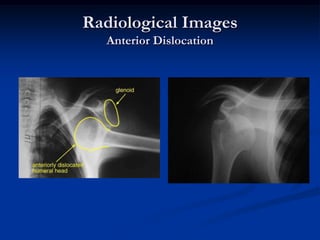
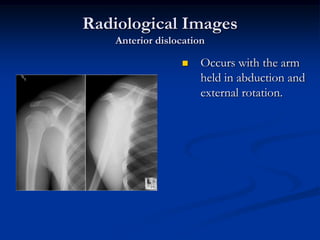
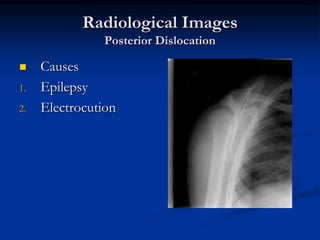
Shoulder DislocationTypes:Anterior dislocation: Varities of dislocations like Subcoracoid, subglenoid, sub-infraclavicular, inferior.Posterior Dislocation
Radiological ImagesAnterior Dislocation
Radiological ImagesAnterior dislocationOccurs with the arm held in abduction and external rotation.
Radiological ImagesPosterior DislocationCausesEpilepsyElectrocution
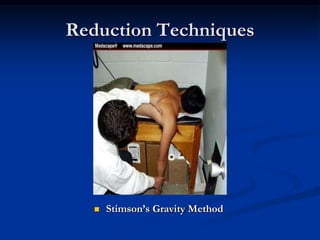
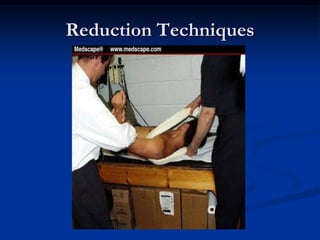
Reduction TechniquesStimson’s Gravity Method
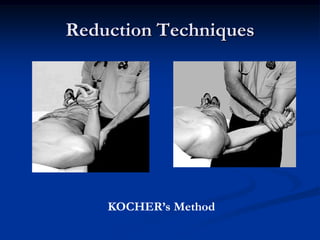
Reduction TechniquesKOCHER’s Method
Reduction Techniques
After TreatmentThe arm should be fasten to the chest with a body bandage minimum period of three weeks.
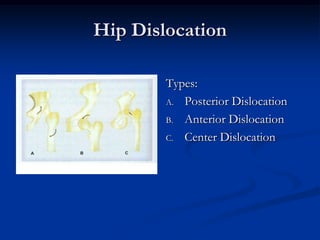
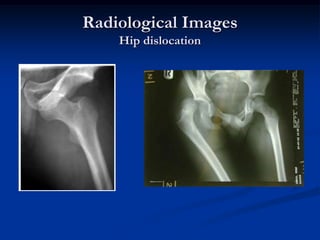
Hip DislocationTypes:Posterior DislocationAnterior DislocationCenter Dislocation
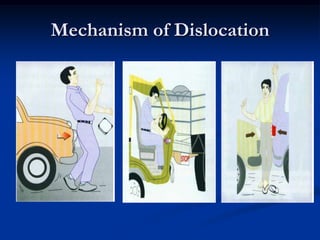
Mechanism of Dislocation
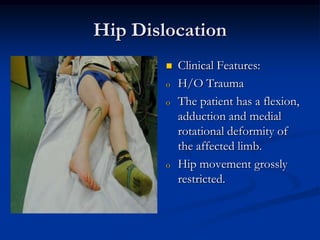
Hip DislocationClinical Features:H/O Trauma
The patient has a flexion, adduction and medial rotational deformity of the affected limb.
Hip movement grossly restricted.Radiological ImagesHip dislocation
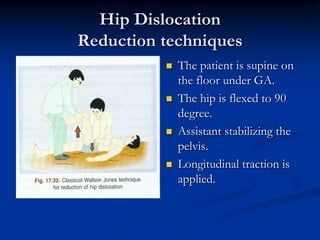
Hip DislocationReduction techniquesThe patient is supine on the floor under GA.The hip is flexed to 90 degree.Assistant stabilizing the pelvis.Longitudinal traction is applied.
Hip DislocationAfter TreatmentThe patient is put on surface traction for three weeks.Full weight bearing is permitted after 6 wks.
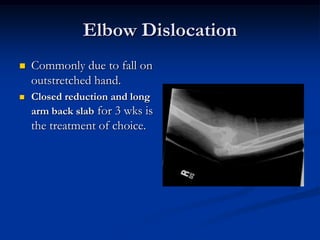
Elbow DislocationCommonly due to fall on outstretched hand.Closed reduction and long arm back slab for 3 wks is the treatment of choice.
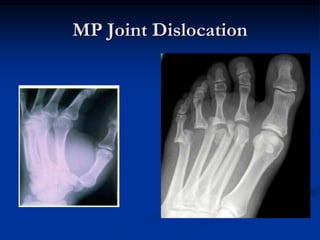
MP Joint Dislocation
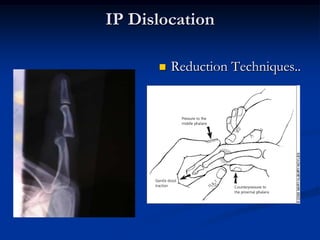
IP DislocationReduction Techniques..
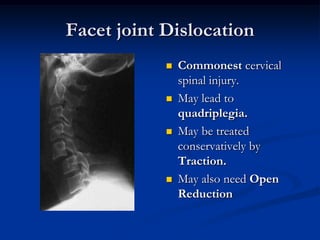
Facet joint DislocationCommonest cervical spinal injury.May lead to quadriplegia.May be treated conservatively by Traction.May also need Open Reduction

Dislocation