CHAPTER 4
CONDUCTION IN SEMICONDUCTORS
Prof. Dr. Beşire GÖNÜL
CHAPTER 4
CONDUCTION IN SEMICONDUCTORS
• Carrier drift
• Carrier mobility
• Saturated drift velocity
• Mobility variation with temperature
• A derivation of Ohm’s law
• Drift current equations
• Semiconductor band diagrams with an electric field present
• Carrier diffusion
• The flux equation
• The Einstein relation
• Total current density
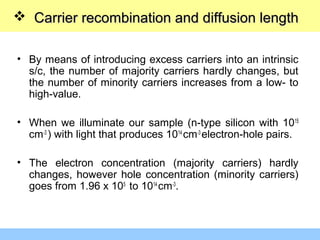
• Carrier recombination and diffusion length
• We now have some idea of the number density
of charge carriers (electrons and holes) present
in a semiconductor material from the work we
covered in the last chapter. Since current is the
rate of flow of charge , we shall be able calculate
currents flowing in real devices since we know
the number of charge carriers. There are two
current mechanisms which cause charges to
move in semiconductors. The two mechanisms
we shall study in this chapter are drift anddrift and
diffusiondiffusion.
 Drift and DiffusionDrift and Diffusion
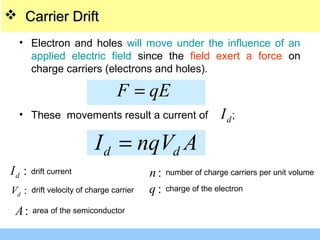
• Electron and holes will move under the influence of an
applied electric field since the field exert a force on
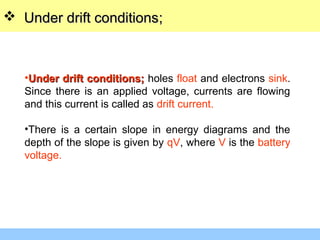
charge carriers (electrons and holes).
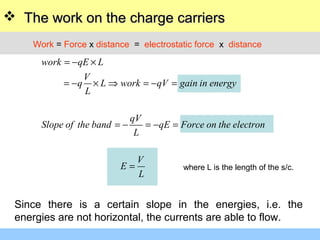
• These movements result a current of ;
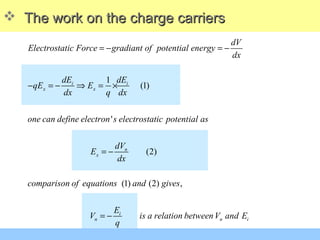
F qE=
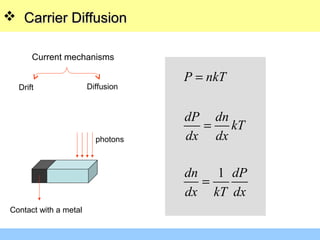
 Carrier DriftCarrier Drift
dI
d dI nqV A=
:dI
:dV
drift current number of charge carriers per unit volume
charge of the electrondrift velocity of charge carrier
area of the semiconductor:A
:q
:n
 Carrier Mobility ,Carrier Mobility , µ
dV Eµ=
:E
:µ
applied field
mobility of charge carrier
[ ]








−
=
SecV
cm
2
µ µ is a proportionality factor






=
E
Vd
µ
 So is a measure how easily charge carriers move under the influence of
an applied field or determines how mobile the charge carriers are.
µ
µ
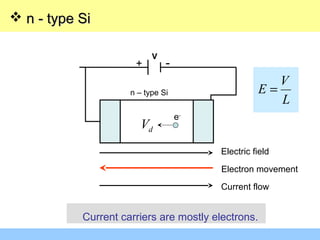
 n - type Sin - type Si
+ -
V
n – type Si
e-
dV
Electric field
Electron movement
Current flow
Current carriers are mostly electrons.
L
V
E =
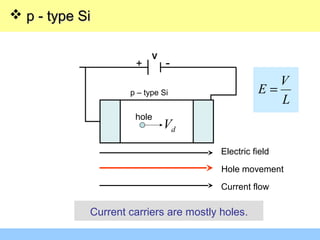
+ -
V
p – type Si
hole
dV
Electric field
Hole movement
Current flow
Current carriers are mostly holes.
 p - type Sip - type Si
L
V
E =
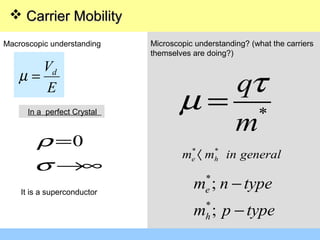
 Carrier MobilityCarrier Mobility
E
Vd
=µ
Macroscopic understanding
In a perfect Crystal
0ρ
σ
=
→∞
It is a superconductor
Microscopic understanding? (what the carriers
themselves are doing?)
*
q
m
τ
µ =
generalinmm he
**
〈
*
*
;
;
e
h
m n type
m p type
−
−
• A perfect crystal has a perfect periodicity and therefore
the potential seen by a carrier in a perfect crystal is
completely periodic.
• So the crystal has no resistance to current flow and
behaves as a superconductor. The perfect periodic
potential does not impede the movement of the charge
carriers. However, in a real device or specimen, the
presence of impurities, interstitials, subtitionals,
temperature , etc. creates a resistance to current flow.
• The presence of all these upsets the periodicity of the
potential seen by a charge carrier.
µ
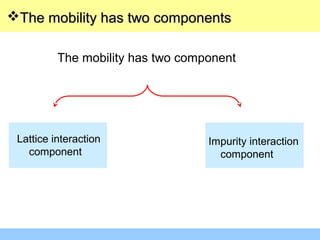
The mobility has two component
The mobility has two componentsThe mobility has two components
Impurity interaction
component
Lattice interaction
component
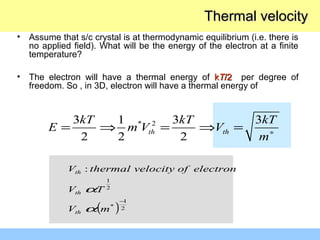
• Assume that s/c crystal is at thermodynamic equilibrium (i.e. there is
no applied field). What will be the energy of the electron at a finite
temperature?
• The electron will have a thermal energy of kkTT/2/2 per degree of
freedom. So , in 3D, electron will have a thermal energy of
Thermal velocityThermal velocity
* 23 1 3 3
2 2 2
th th
kT kT kT
E m V V
m∗
= ⇒ = ⇒ =
( )2
1
*
2
1
:
−
mV
TV
electronofvelocitythermalV
th
th
th
α
α
• Since there is no applied field, the movement of
the charge carriers will be completely random.
This randomness result no net current flow. As
a result of thermal energy there are almost an
equal number of carriers moving right as left, in
as out or up as down.
Random motionRandom motion resultresult no currentno current..
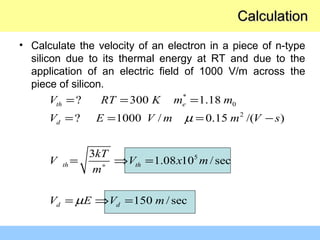
*
0
2
5
? 300 1.18
? 1000 / 0.15 /( )
3
1.08 10 /sec
150 /sec
th e
d
th th
d d
V RT K m m
V E V m m V s
kT
V V x m
m
V E V m
µ
µ
∗
= = =
= = = −
= ⇒ =
= ⇒ =
• Calculate the velocity of an electron in a piece of n-type
silicon due to its thermal energy at RT and due to the
application of an electric field of 1000 V/m across the
piece of silicon.
CalculationCalculation
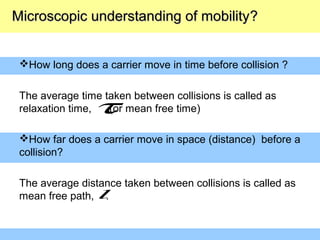
How long does a carrier move in time before collision ?
The average time taken between collisions is called as
relaxation time, (or mean free time)
How far does a carrier move in space (distance) before a
collision?
The average distance taken between collisions is called as
mean free path, .
Microscopic understanding of mobilityMicroscopic understanding of mobility??
τ
l
*d
F
V
m
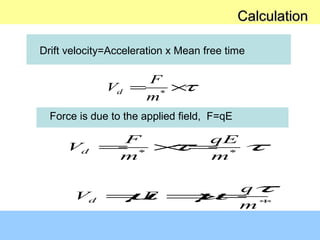
τ= ×
CalculationCalculation
* *d
d
F qE
V
m m
q
V E
m
τ τ
τµ µ ∗
= × =
= ⇒=
Drift velocity=Acceleration x Mean free time
Force is due to the applied field, F=qE
*
2 2
12 13
5 5
5 12 7
? ? 1.18 0.59
0.15 /( ) 0.0458 /( )
10 sec 1.54 10 sec
1.08 10 / 1.052 10 /
(1.08 10 / )(10 ) 10
(1.052 10
elec hole
elec
hole
e o h o
e h
e e h h
e h
th th
e th e
h th h
l m m m m
m V s m V s
m m
x
q q
v x m s v x m s
l v x m s s m
l v x
τ
µ µ
µ µ
τ τ
τ
τ
∗
∗ ∗
− −
− −
= = = =
= − = −
= = = =
= =
= = =
= = 5 13 8
/ )(1.54 10 sec) 2.34 10m s x x m− −
=
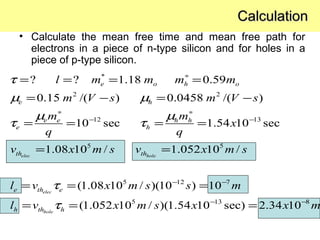
• Calculate the mean free time and mean free path for
electrons in a piece of n-type silicon and for holes in a
piece of p-type silicon.
CalculationCalculation
 Saturated Drift VelocitiesSaturated Drift Velocities
dV Eµ=
dV
E E
for efor e--
for holesfor holes
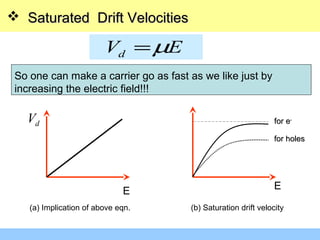
So one can make a carrier go as fast as we like just by
increasing the electric field!!!
(a) Implication of above eqn. (b) Saturation drift velocity
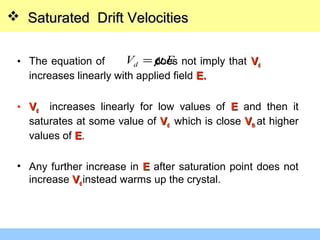
• The equation of does not imply that VVdd
increases linearly with applied field E.E.
• VVdd increases linearly for low values of EE and then it
saturates at some value of VVdd which is close VVthth at higher
values of EE.
• Any further increase in EE after saturation point does not
increase VVdd instead warms up the crystal.
EVd .µ=
 Saturated Drift VelocitiesSaturated Drift Velocities
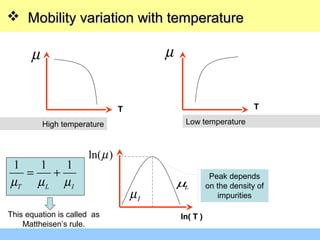
 Mobility variation with temperatureMobility variation with temperature
µ
)ln(µ
µ
TTTT
ln( T )ln( T )
Peak depends
on the density of
impurities
High temperature Low temperature
Iµ
Lµ
1 1 1
T L Iµ µ µ
= +
This equation is called as
Mattheisen’s rule.
2
3
2
3
1
−−
⇒×= TTCLµ
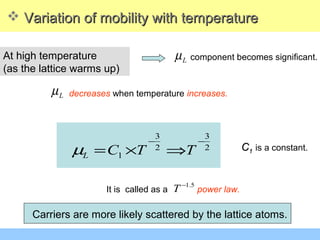
 Variation of mobility with temperatureVariation of mobility with temperature
At high temperature
(as the lattice warms up)
Lµ component becomes significant.
Lµ decreases when temperature increases.
It is called as a power law.
CC11 is a constant.
1.5
T −
Carriers are more likely scattered by the lattice atoms.
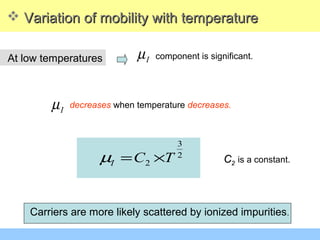
At low temperatures
 Variation of mobility with temperatureVariation of mobility with temperature
Iµ component is significant.
Iµ decreases when temperature decreases.
2
3
2 TCI ×=µ CC22 is a constant.
Carriers are more likely scattered by ionized impurities.
This fact is used in high speed devices called High Electron
Mobility Transistors (HEMTs) where electrons are made to
move in undoped material, with the resulting high
carrier mobilities!
The peak of the mobility curve depends on the number
density of ionized impurities.
 Variation of mobility with temperatureVariation of mobility with temperature
HEMTs are high speed devices.
Highly doped samples will therefore cause more
scattering, and have a lower mobility, than low doped
samples.
 A Derivation of Ohm’s LawA Derivation of Ohm’s Law
2
2
1
d d d
d
d
x d x x
x x
I nqV A V E
I q
J
A m
nq
J nqV nq E J E
m
nq
J E
m
µ
τ
µ
τ
µ
τ
σ σ ρ
σ
∗
∗
∗
= =
= =
 
= = =  ÷
 
= = =
[ ] [ ]
[ ] [ ]1 ( )
m
m
ρ
σ
= Ω−
= Ω−
 A Derivation of Ohm’s LawA Derivation of Ohm’s Law
R
V
I =
VA V
I
L Rρ
= =
V
L
area
current
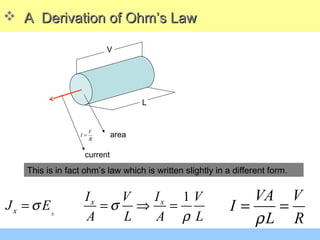
This is in fact ohm’s law which is written slightly in a different form.
1
x
x x
x
I IV V
J E
A L A L
σ σ
ρ
= = ⇒ =
 Drift Current EquationsDrift Current Equations
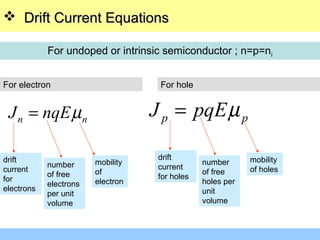
For undoped or intrinsic semiconductor ; n=p=ni
For electron
n nJ nqEµ=
drift
current
for
electrons
number
of free
electrons
per unit
volume
mobility
of
electron
For hole
p pJ pqEµ=
drift
current
for holes
number
of free
holes per
unit
volume
mobility
of holes
 Drift Current EquationsDrift Current Equations
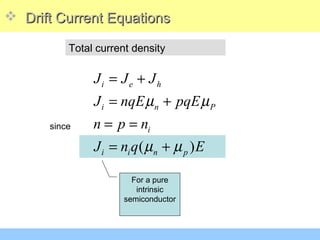
Total current density
( )
i e h
i n P
i
i i n p
J J J
J nqE pqE
n p n
J n q E
µ µ
µ µ
= +
= +
= =
= +
since
For a pure
intrinsic
semiconductor
 Drift Current EquationsDrift Current Equations
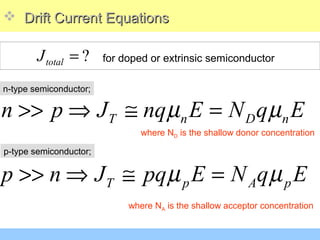
?=totalJ for doped or extrinsic semiconductor
n-type semiconductor;
T n D nn p J nq E N q Eµ µ>> ⇒ ≅ =
where ND is the shallow donor concentration
p-type semiconductor;
T p A pp n J pq E N q Eµ µ>> ⇒ ≅ =
where NA is the shallow acceptor concentration
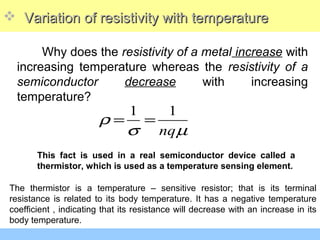
 Variation of resistivity with temperatureVariation of resistivity with temperature
Why does the resistivity of a metal increase with
increasing temperature whereas the resistivity of a
semiconductor decrease with increasing
temperature?
1 1
nq
ρ
σ µ
= =
This fact is used in a real semiconductor device called a
thermistor, which is used as a temperature sensing element.
The thermistor is a temperature – sensitive resistor; that is its terminal
resistance is related to its body temperature. It has a negative temperature
coefficient , indicating that its resistance will decrease with an increase in its
body temperature.
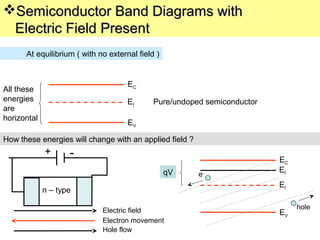
Semiconductor Band Diagrams withSemiconductor Band Diagrams with
Electric Field PresentElectric Field Present
At equilibrium ( with no external field )
EC
Eİ
EV
All these
energies
are
horizontal
Pure/undoped semiconductor
How these energies will change with an applied field ?
+ -
n – type
Electric field
Electron movement
Hole flow
EC
Eİ
EV
Efe-
hole
qV
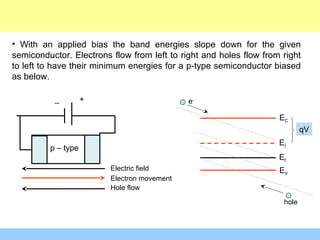
• With an applied bias the band energies slope down for the given
semiconductor. Electrons flow from left to right and holes flow from right
to left to have their minimum energies for a p-type semiconductor biased
as below.
p – type
Electric field
Electron movement
Hole flow
EC
Eİ
EV
Ef
e-
hole
qV
+_
 Under drift conditionsUnder drift conditions;;
•Under drift conditions;Under drift conditions; holes float and electrons sink.
Since there is an applied voltage, currents are flowing
and this current is called as drift current.
•There is a certain slope in energy diagrams and the
depth of the slope is given by qV, where V is the battery
voltage.
work qE L
V
q L work qV gain in energy
L
qV
Slope of the band qE Force on the electron
L
V
E
L
= − ×
= − × ⇒ = − =
= − = − =
=
 The work on the charge carriersThe work on the charge carriers
Work = Force x distance = electrostatic force x distance
Since there is a certain slope in the energies, i.e. the
energies are not horizontal, the currents are able to flow.
where L is the length of the s/c.
 The work on the charge carriersThe work on the charge carriers
1
(1)
'
(2)
(1) (2) ,
i i
x x
n
x
i
n n
dV
Electrostatic Force gradiant of potential energy
dx
dE dE
qE E
dx q dx
one can define electron s electrostatic potential as
dV
E
dx
comparison of equations and gives
E
V is a relation betweenV an
q
= − = −
− = − ⇒ = ×
= −
= − id E
 Carrier DiffusionCarrier Diffusion
Current mechanisms
Drift Diffusion
1
P nkT
dP dn
kT
dx dx
dn dP
dx kT dx
=
=
=
photons
Contact with a metal
 Carrier DiffusionCarrier Diffusion
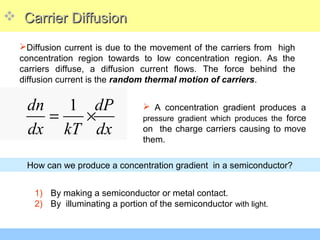
Diffusion current is due to the movement of the carriers from high
concentration region towards to low concentration region. As the
carriers diffuse, a diffusion current flows. The force behind the
diffusion current is the random thermal motion of carriers.
1dn dP
dx kT dx
= ×
 A concentration gradient produces a
pressure gradient which produces the force
on the charge carriers causing to move
them.
How can we produce a concentration gradient in a semiconductor?
1) By making a semiconductor or metal contact.
2) By illuminating a portion of the semiconductor with light.
Illuminating a portion of the semiconductor with light
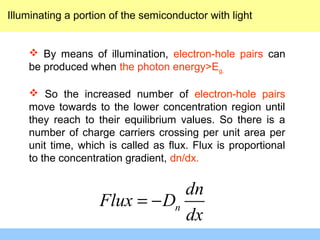
 By means of illumination, electron-hole pairs can
be produced when the photon energy>Eg.
 So the increased number of electron-hole pairs
move towards to the lower concentration region until
they reach to their equilibrium values. So there is a
number of charge carriers crossing per unit area per
unit time, which is called as flux. Flux is proportional
to the concentration gradient, dn/dx.
n
dn
Flux D
dx
= −
 FluxFlux
[ ]
[ ]
2 1
2
2
,
,th
n n n
p p p
n p
Flux m s
D l D m s
The current densities for electrons and holes
dn dn
J q D qD for electrons
dx dx
dp dp
J q D qD for holes
dx dx
J A m
ν
− −
= −
= =
 
= − − = ÷
 
 
= + − = − ÷
 
   =   
 Einstein RelationEinstein Relation
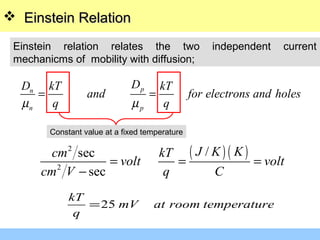
Einstein relation relates the two independent current
mechanicms of mobility with diffusion;
pn
n p
DD kT kT
and for electrons and holes
q qµ µ
= =
Constant value at a fixed temperature
( ) ( )2
2
/sec
sec
J K Kcm kT
volt volt
cm V q C
= = =
−
25
kT
mV at room temperature
q
=
 Total Current DensityTotal Current Density
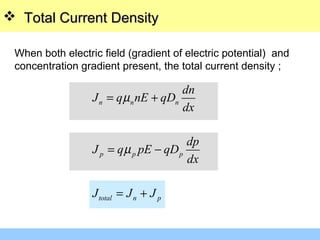
When both electric field (gradient of electric potential) and
concentration gradient present, the total current density ;
n n n
p p p
total n p
dn
J q nE qD
dx
dp
J q pE qD
dx
J J J
µ
µ
= +
= −
= +
 Carrier recombination and diffusion lengthCarrier recombination and diffusion length
• By means of introducing excess carriers into an intrinsic
s/c, the number of majority carriers hardly changes, but
the number of minority carriers increases from a low- to
high-value.
• When we illuminate our sample (n-type silicon with 1015
cm-3
) with light that produces 1014
cm-3
electron-hole pairs.
• The electron concentration (majority carriers) hardly
changes, however hole concentration (minority carriers)
goes from 1.96 x 10⁵
to 1014
cm-3
.
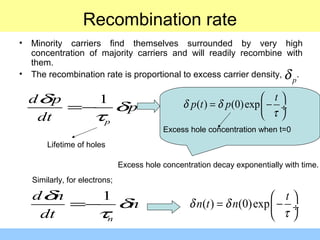
Recombination rate
• Minority carriers find themselves surrounded by very high
concentration of majority carriers and will readily recombine with
them.
• The recombination rate is proportional to excess carrier density, .
pδ
1
n
d n
n
dt
δ
δ
τ
=− ( ) (0)exp
t
n t nδ δ
τ
 
= − ÷
 
( ) (0)exp
t
p t pδ δ
τ
 
= − ÷
 
1
p
d p
p
dt
δ
δ
τ
=−
Lifetime of holes
Excess hole concentration when t=0
Excess hole concentration decay exponentially with time.
Similarly, for electrons;
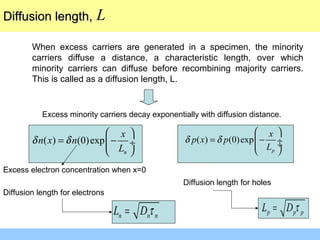
Diffusion length,Diffusion length,
When excess carriers are generated in a specimen, the minority
carriers diffuse a distance, a characteristic length, over which
minority carriers can diffuse before recombining majority carriers.
This is called as a diffusion length, L.
Excess minority carriers decay exponentially with diffusion distance.
( ) (0)exp
n
x
n x n
L
δ δ
 
= − ÷
 
( ) (0)exp
p
x
p x p
L
δ δ
 
= − ÷ ÷
 
n n nL D τ= p p pL D τ=
L
Excess electron concentration when x=0
Diffusion length for electrons
Diffusion length for holes

Mobility

  • 1.
    CHAPTER 4 CONDUCTION INSEMICONDUCTORS Prof. Dr. Beşire GÖNÜL
  • 2.
    CHAPTER 4 CONDUCTION INSEMICONDUCTORS • Carrier drift • Carrier mobility • Saturated drift velocity • Mobility variation with temperature • A derivation of Ohm’s law • Drift current equations • Semiconductor band diagrams with an electric field present • Carrier diffusion • The flux equation • The Einstein relation • Total current density • Carrier recombination and diffusion length
  • 3.
    • We nowhave some idea of the number density of charge carriers (electrons and holes) present in a semiconductor material from the work we covered in the last chapter. Since current is the rate of flow of charge , we shall be able calculate currents flowing in real devices since we know the number of charge carriers. There are two current mechanisms which cause charges to move in semiconductors. The two mechanisms we shall study in this chapter are drift anddrift and diffusiondiffusion.  Drift and DiffusionDrift and Diffusion
  • 4.
    • Electron andholes will move under the influence of an applied electric field since the field exert a force on charge carriers (electrons and holes). • These movements result a current of ; F qE=  Carrier DriftCarrier Drift dI d dI nqV A= :dI :dV drift current number of charge carriers per unit volume charge of the electrondrift velocity of charge carrier area of the semiconductor:A :q :n
  • 5.
     Carrier Mobility,Carrier Mobility , µ dV Eµ= :E :µ applied field mobility of charge carrier [ ]         − = SecV cm 2 µ µ is a proportionality factor       = E Vd µ  So is a measure how easily charge carriers move under the influence of an applied field or determines how mobile the charge carriers are. µ µ
  • 6.
     n -type Sin - type Si + - V n – type Si e- dV Electric field Electron movement Current flow Current carriers are mostly electrons. L V E =
  • 7.
    + - V p –type Si hole dV Electric field Hole movement Current flow Current carriers are mostly holes.  p - type Sip - type Si L V E =
  • 8.
     Carrier MobilityCarrierMobility E Vd =µ Macroscopic understanding In a perfect Crystal 0ρ σ = →∞ It is a superconductor Microscopic understanding? (what the carriers themselves are doing?) * q m τ µ = generalinmm he ** 〈 * * ; ; e h m n type m p type − −
  • 9.
    • A perfectcrystal has a perfect periodicity and therefore the potential seen by a carrier in a perfect crystal is completely periodic. • So the crystal has no resistance to current flow and behaves as a superconductor. The perfect periodic potential does not impede the movement of the charge carriers. However, in a real device or specimen, the presence of impurities, interstitials, subtitionals, temperature , etc. creates a resistance to current flow. • The presence of all these upsets the periodicity of the potential seen by a charge carrier. µ
  • 10.
    The mobility hastwo component The mobility has two componentsThe mobility has two components Impurity interaction component Lattice interaction component
  • 11.
    • Assume thats/c crystal is at thermodynamic equilibrium (i.e. there is no applied field). What will be the energy of the electron at a finite temperature? • The electron will have a thermal energy of kkTT/2/2 per degree of freedom. So , in 3D, electron will have a thermal energy of Thermal velocityThermal velocity * 23 1 3 3 2 2 2 th th kT kT kT E m V V m∗ = ⇒ = ⇒ = ( )2 1 * 2 1 : − mV TV electronofvelocitythermalV th th th α α
  • 12.
    • Since thereis no applied field, the movement of the charge carriers will be completely random. This randomness result no net current flow. As a result of thermal energy there are almost an equal number of carriers moving right as left, in as out or up as down. Random motionRandom motion resultresult no currentno current..
  • 13.
    * 0 2 5 ? 300 1.18 ?1000 / 0.15 /( ) 3 1.08 10 /sec 150 /sec th e d th th d d V RT K m m V E V m m V s kT V V x m m V E V m µ µ ∗ = = = = = = − = ⇒ = = ⇒ = • Calculate the velocity of an electron in a piece of n-type silicon due to its thermal energy at RT and due to the application of an electric field of 1000 V/m across the piece of silicon. CalculationCalculation
  • 14.
    How long doesa carrier move in time before collision ? The average time taken between collisions is called as relaxation time, (or mean free time) How far does a carrier move in space (distance) before a collision? The average distance taken between collisions is called as mean free path, . Microscopic understanding of mobilityMicroscopic understanding of mobility?? τ l
  • 15.
    *d F V m τ= × CalculationCalculation * *d d FqE V m m q V E m τ τ τµ µ ∗ = × = = ⇒= Drift velocity=Acceleration x Mean free time Force is due to the applied field, F=qE
  • 16.
    * 2 2 12 13 55 5 12 7 ? ? 1.18 0.59 0.15 /( ) 0.0458 /( ) 10 sec 1.54 10 sec 1.08 10 / 1.052 10 / (1.08 10 / )(10 ) 10 (1.052 10 elec hole elec hole e o h o e h e e h h e h th th e th e h th h l m m m m m V s m V s m m x q q v x m s v x m s l v x m s s m l v x τ µ µ µ µ τ τ τ τ ∗ ∗ ∗ − − − − = = = = = − = − = = = = = = = = = = = 5 13 8 / )(1.54 10 sec) 2.34 10m s x x m− − = • Calculate the mean free time and mean free path for electrons in a piece of n-type silicon and for holes in a piece of p-type silicon. CalculationCalculation
  • 17.
     Saturated DriftVelocitiesSaturated Drift Velocities dV Eµ= dV E E for efor e-- for holesfor holes So one can make a carrier go as fast as we like just by increasing the electric field!!! (a) Implication of above eqn. (b) Saturation drift velocity
  • 18.
    • The equationof does not imply that VVdd increases linearly with applied field E.E. • VVdd increases linearly for low values of EE and then it saturates at some value of VVdd which is close VVthth at higher values of EE. • Any further increase in EE after saturation point does not increase VVdd instead warms up the crystal. EVd .µ=  Saturated Drift VelocitiesSaturated Drift Velocities
  • 19.
     Mobility variationwith temperatureMobility variation with temperature µ )ln(µ µ TTTT ln( T )ln( T ) Peak depends on the density of impurities High temperature Low temperature Iµ Lµ 1 1 1 T L Iµ µ µ = + This equation is called as Mattheisen’s rule.
  • 20.
    2 3 2 3 1 −− ⇒×= TTCLµ  Variationof mobility with temperatureVariation of mobility with temperature At high temperature (as the lattice warms up) Lµ component becomes significant. Lµ decreases when temperature increases. It is called as a power law. CC11 is a constant. 1.5 T − Carriers are more likely scattered by the lattice atoms.
  • 21.
    At low temperatures Variation of mobility with temperatureVariation of mobility with temperature Iµ component is significant. Iµ decreases when temperature decreases. 2 3 2 TCI ×=µ CC22 is a constant. Carriers are more likely scattered by ionized impurities.
  • 22.
    This fact isused in high speed devices called High Electron Mobility Transistors (HEMTs) where electrons are made to move in undoped material, with the resulting high carrier mobilities! The peak of the mobility curve depends on the number density of ionized impurities.  Variation of mobility with temperatureVariation of mobility with temperature HEMTs are high speed devices. Highly doped samples will therefore cause more scattering, and have a lower mobility, than low doped samples.
  • 23.
     A Derivationof Ohm’s LawA Derivation of Ohm’s Law 2 2 1 d d d d d x d x x x x I nqV A V E I q J A m nq J nqV nq E J E m nq J E m µ τ µ τ µ τ σ σ ρ σ ∗ ∗ ∗ = = = =   = = =  ÷   = = = [ ] [ ] [ ] [ ]1 ( ) m m ρ σ = Ω− = Ω−
  • 24.
     A Derivationof Ohm’s LawA Derivation of Ohm’s Law R V I = VA V I L Rρ = = V L area current This is in fact ohm’s law which is written slightly in a different form. 1 x x x x I IV V J E A L A L σ σ ρ = = ⇒ =
  • 25.
     Drift CurrentEquationsDrift Current Equations For undoped or intrinsic semiconductor ; n=p=ni For electron n nJ nqEµ= drift current for electrons number of free electrons per unit volume mobility of electron For hole p pJ pqEµ= drift current for holes number of free holes per unit volume mobility of holes
  • 26.
     Drift CurrentEquationsDrift Current Equations Total current density ( ) i e h i n P i i i n p J J J J nqE pqE n p n J n q E µ µ µ µ = + = + = = = + since For a pure intrinsic semiconductor
  • 27.
     Drift CurrentEquationsDrift Current Equations ?=totalJ for doped or extrinsic semiconductor n-type semiconductor; T n D nn p J nq E N q Eµ µ>> ⇒ ≅ = where ND is the shallow donor concentration p-type semiconductor; T p A pp n J pq E N q Eµ µ>> ⇒ ≅ = where NA is the shallow acceptor concentration
  • 28.
     Variation ofresistivity with temperatureVariation of resistivity with temperature Why does the resistivity of a metal increase with increasing temperature whereas the resistivity of a semiconductor decrease with increasing temperature? 1 1 nq ρ σ µ = = This fact is used in a real semiconductor device called a thermistor, which is used as a temperature sensing element. The thermistor is a temperature – sensitive resistor; that is its terminal resistance is related to its body temperature. It has a negative temperature coefficient , indicating that its resistance will decrease with an increase in its body temperature.
  • 29.
    Semiconductor Band DiagramswithSemiconductor Band Diagrams with Electric Field PresentElectric Field Present At equilibrium ( with no external field ) EC Eİ EV All these energies are horizontal Pure/undoped semiconductor How these energies will change with an applied field ? + - n – type Electric field Electron movement Hole flow EC Eİ EV Efe- hole qV
  • 30.
    • With anapplied bias the band energies slope down for the given semiconductor. Electrons flow from left to right and holes flow from right to left to have their minimum energies for a p-type semiconductor biased as below. p – type Electric field Electron movement Hole flow EC Eİ EV Ef e- hole qV +_
  • 31.
     Under driftconditionsUnder drift conditions;; •Under drift conditions;Under drift conditions; holes float and electrons sink. Since there is an applied voltage, currents are flowing and this current is called as drift current. •There is a certain slope in energy diagrams and the depth of the slope is given by qV, where V is the battery voltage.
  • 32.
    work qE L V qL work qV gain in energy L qV Slope of the band qE Force on the electron L V E L = − × = − × ⇒ = − = = − = − = =  The work on the charge carriersThe work on the charge carriers Work = Force x distance = electrostatic force x distance Since there is a certain slope in the energies, i.e. the energies are not horizontal, the currents are able to flow. where L is the length of the s/c.
  • 33.
     The workon the charge carriersThe work on the charge carriers 1 (1) ' (2) (1) (2) , i i x x n x i n n dV Electrostatic Force gradiant of potential energy dx dE dE qE E dx q dx one can define electron s electrostatic potential as dV E dx comparison of equations and gives E V is a relation betweenV an q = − = − − = − ⇒ = × = − = − id E
  • 34.
     Carrier DiffusionCarrierDiffusion Current mechanisms Drift Diffusion 1 P nkT dP dn kT dx dx dn dP dx kT dx = = = photons Contact with a metal
  • 35.
     Carrier DiffusionCarrierDiffusion Diffusion current is due to the movement of the carriers from high concentration region towards to low concentration region. As the carriers diffuse, a diffusion current flows. The force behind the diffusion current is the random thermal motion of carriers. 1dn dP dx kT dx = ×  A concentration gradient produces a pressure gradient which produces the force on the charge carriers causing to move them. How can we produce a concentration gradient in a semiconductor? 1) By making a semiconductor or metal contact. 2) By illuminating a portion of the semiconductor with light.
  • 36.
    Illuminating a portionof the semiconductor with light  By means of illumination, electron-hole pairs can be produced when the photon energy>Eg.  So the increased number of electron-hole pairs move towards to the lower concentration region until they reach to their equilibrium values. So there is a number of charge carriers crossing per unit area per unit time, which is called as flux. Flux is proportional to the concentration gradient, dn/dx. n dn Flux D dx = −
  • 37.
     FluxFlux [ ] [] 2 1 2 2 , ,th n n n p p p n p Flux m s D l D m s The current densities for electrons and holes dn dn J q D qD for electrons dx dx dp dp J q D qD for holes dx dx J A m ν − − = − = =   = − − = ÷     = + − = − ÷      =   
  • 38.
     Einstein RelationEinsteinRelation Einstein relation relates the two independent current mechanicms of mobility with diffusion; pn n p DD kT kT and for electrons and holes q qµ µ = = Constant value at a fixed temperature ( ) ( )2 2 /sec sec J K Kcm kT volt volt cm V q C = = = − 25 kT mV at room temperature q =
  • 39.
     Total CurrentDensityTotal Current Density When both electric field (gradient of electric potential) and concentration gradient present, the total current density ; n n n p p p total n p dn J q nE qD dx dp J q pE qD dx J J J µ µ = + = − = +
  • 40.
     Carrier recombinationand diffusion lengthCarrier recombination and diffusion length • By means of introducing excess carriers into an intrinsic s/c, the number of majority carriers hardly changes, but the number of minority carriers increases from a low- to high-value. • When we illuminate our sample (n-type silicon with 1015 cm-3 ) with light that produces 1014 cm-3 electron-hole pairs. • The electron concentration (majority carriers) hardly changes, however hole concentration (minority carriers) goes from 1.96 x 10⁵ to 1014 cm-3 .
  • 41.
    Recombination rate • Minoritycarriers find themselves surrounded by very high concentration of majority carriers and will readily recombine with them. • The recombination rate is proportional to excess carrier density, . pδ 1 n d n n dt δ δ τ =− ( ) (0)exp t n t nδ δ τ   = − ÷   ( ) (0)exp t p t pδ δ τ   = − ÷   1 p d p p dt δ δ τ =− Lifetime of holes Excess hole concentration when t=0 Excess hole concentration decay exponentially with time. Similarly, for electrons;
  • 42.
    Diffusion length,Diffusion length, Whenexcess carriers are generated in a specimen, the minority carriers diffuse a distance, a characteristic length, over which minority carriers can diffuse before recombining majority carriers. This is called as a diffusion length, L. Excess minority carriers decay exponentially with diffusion distance. ( ) (0)exp n x n x n L δ δ   = − ÷   ( ) (0)exp p x p x p L δ δ   = − ÷ ÷   n n nL D τ= p p pL D τ= L Excess electron concentration when x=0 Diffusion length for electrons Diffusion length for holes