EE4353/5353 – Fundamentals of Advanced Semiconductor Technology
Lecture 4
Carrier Action
EE 4353/5353
Dr. Ariful Haque
EE4353/5353 – Fundamentals of Advanced Semiconductor Technology
Carrier Action
• The three primary action
– drift: charged-particle motion in response to an applied
electric field
– diffusion: process whereby particles tend to spread out as
a result of their difference of concentrations
– recombination-generation:
• Generation is a process whereby carriers are created
• Recombination is a process whereby carriers are
destroyed
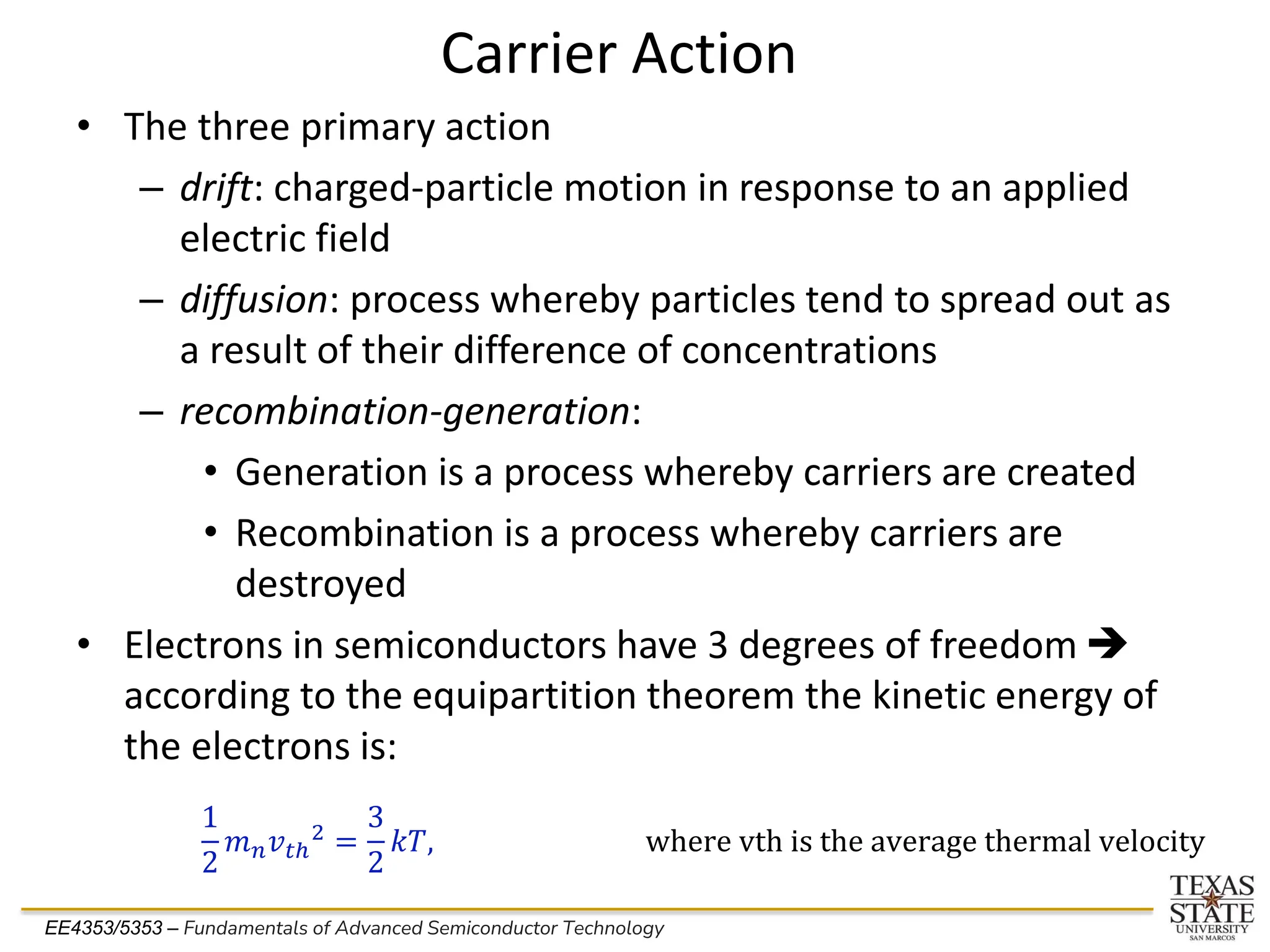
• Electrons in semiconductors have 3 degrees of freedom ➔
according to the equipartition theorem the kinetic energy of
the electrons is:
1
2
𝑚𝑛𝑣𝑡ℎ
2
=
3
2
𝑘𝑇, where vth is the average thermal velocity
EE4353/5353 – Fundamentals of Advanced Semiconductor Technology
Carrier Scattering
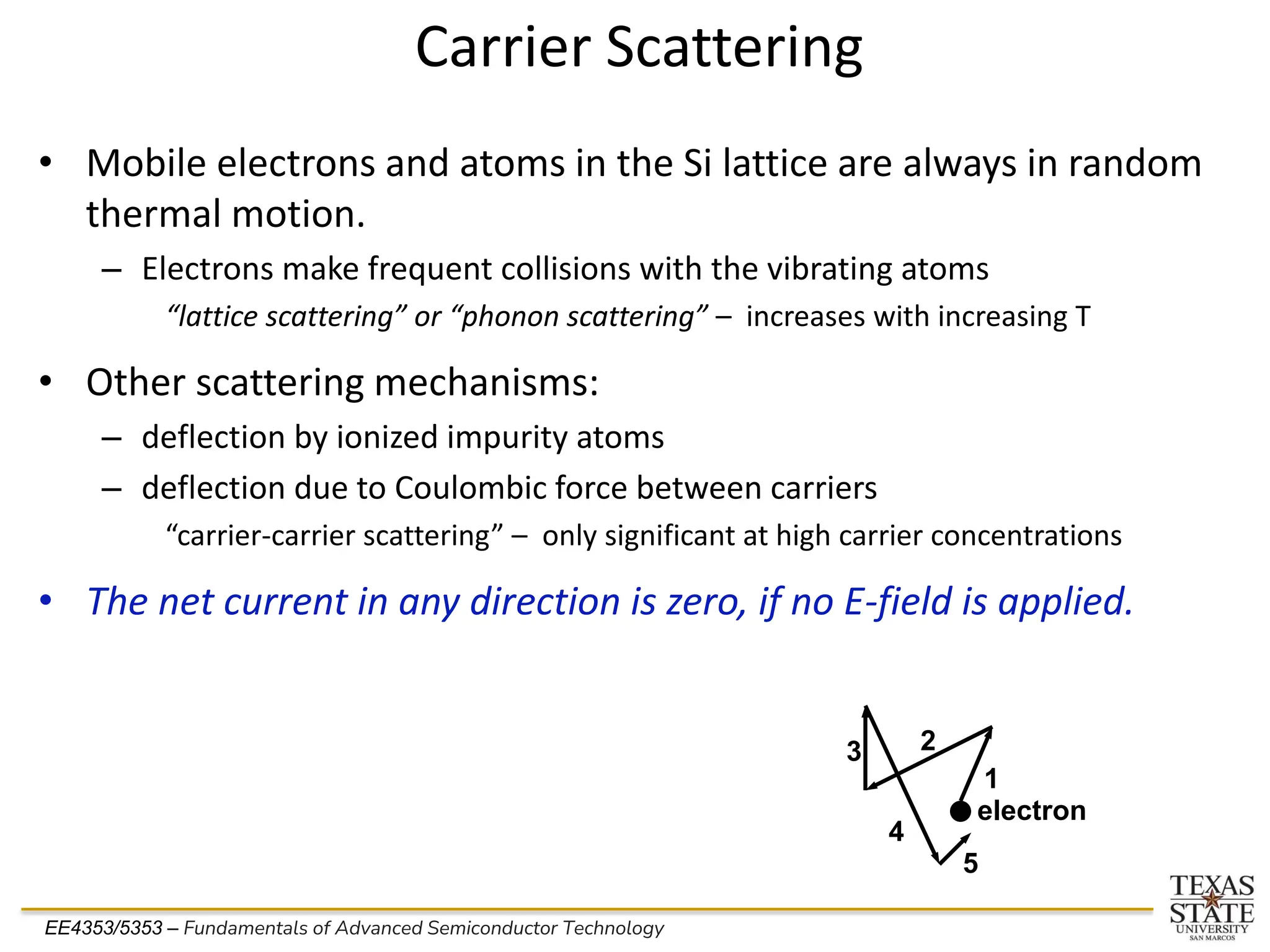
• Mobile electrons and atoms in the Si lattice are always in random
thermal motion.
– Electrons make frequent collisions with the vibrating atoms
“lattice scattering” or “phonon scattering” – increases with increasing T
• Other scattering mechanisms:
– deflection by ionized impurity atoms
– deflection due to Coulombic force between carriers
“carrier-carrier scattering” – only significant at high carrier concentrations
• The net current in any direction is zero, if no E-field is applied.
1
2
3
4
5
electron
EE4353/5353 – Fundamentals of Advanced Semiconductor Technology
Carrier Drift
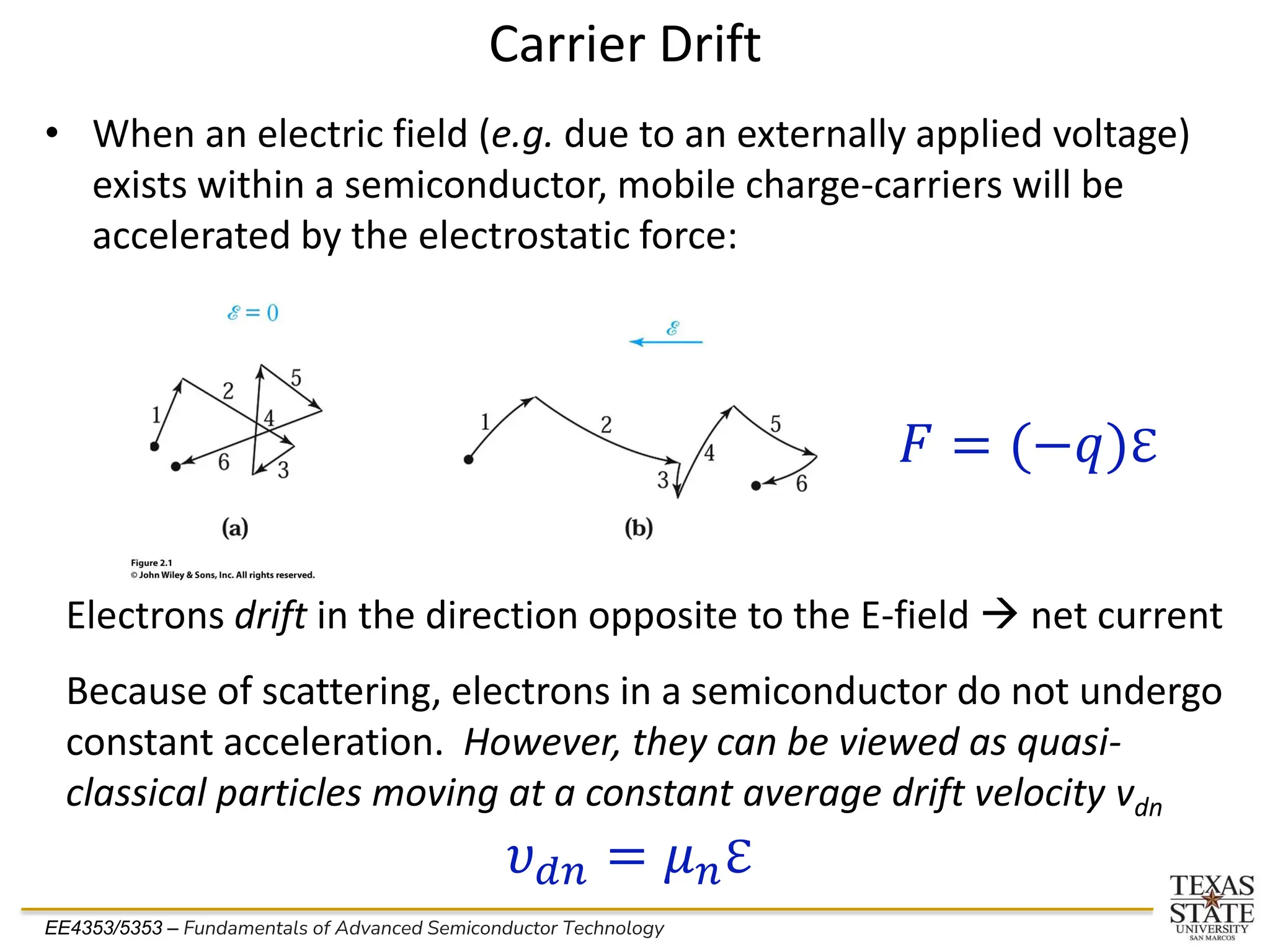
• When an electric field (e.g. due to an externally applied voltage)
exists within a semiconductor, mobile charge-carriers will be
accelerated by the electrostatic force:
Electrons drift in the direction opposite to the E-field → net current
Because of scattering, electrons in a semiconductor do not undergo
constant acceleration. However, they can be viewed as quasi-
classical particles moving at a constant average drift velocity vdn
𝐹 = (−𝑞)ℇ
𝜐𝑑𝑛 = 𝜇𝑛ℇ
EE4353/5353 – Fundamentals of Advanced Semiconductor Technology
Conductivity and Mobility
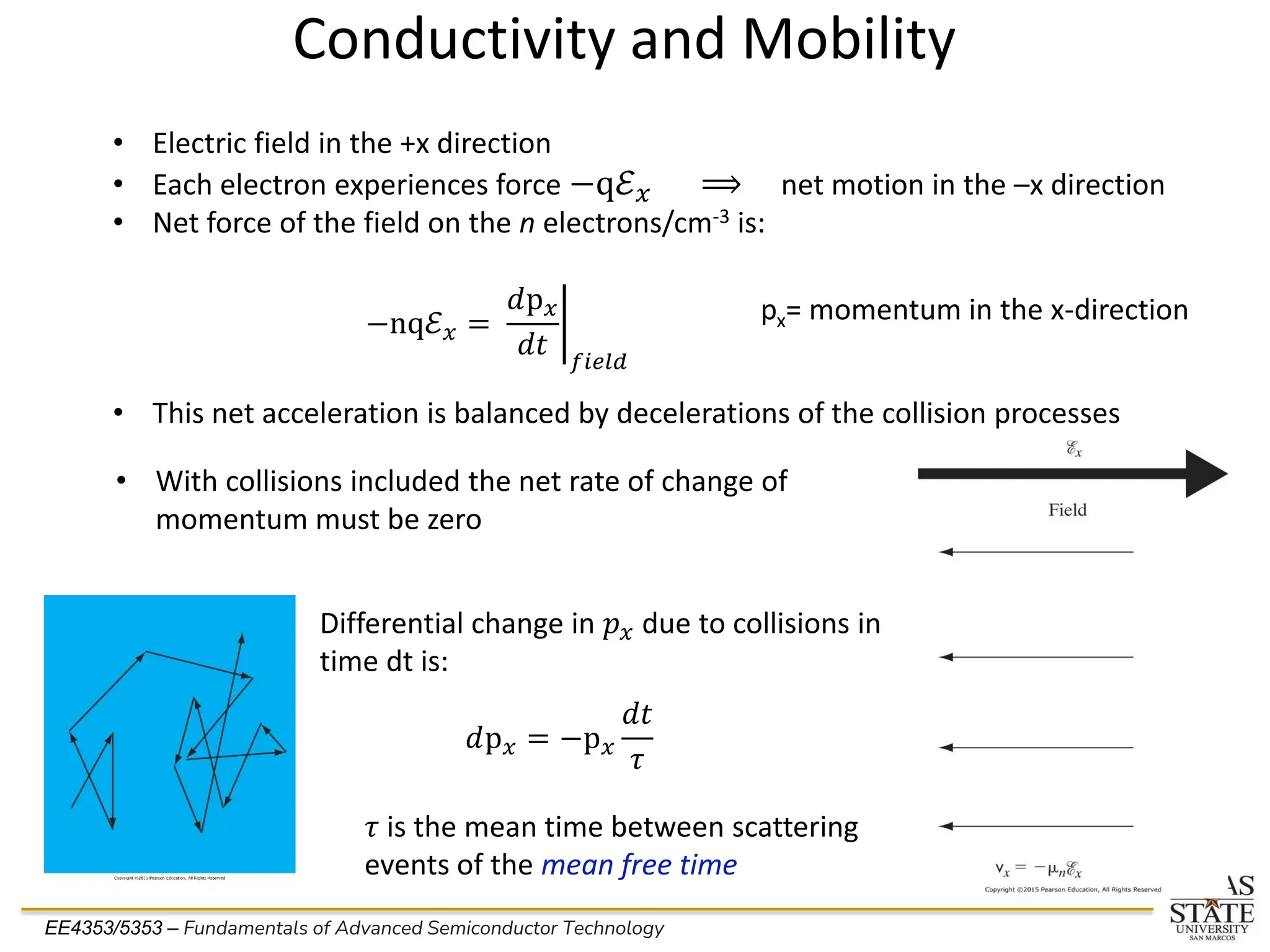
• Electric field in the +x direction
• Each electron experiences force −qℰ𝑥 ⟹ net motion in the –x direction
• Net force of the field on the n electrons/cm-3 is:
• This net acceleration is balanced by decelerations of the collision processes
−nqℰ𝑥 = ቤ
𝑑p𝑥
𝑑𝑡 𝑓𝑖𝑒𝑙𝑑
• With collisions included the net rate of change of
momentum must be zero
Differential change in 𝑝𝑥 due to collisions in
time dt is:
𝑑p𝑥 = −p𝑥
𝑑𝑡
𝜏
𝜏 is the mean time between scattering
events of the mean free time
px= momentum in the x-direction
EE4353/5353 – Fundamentals of Advanced Semiconductor Technology
Conductivity and Mobility
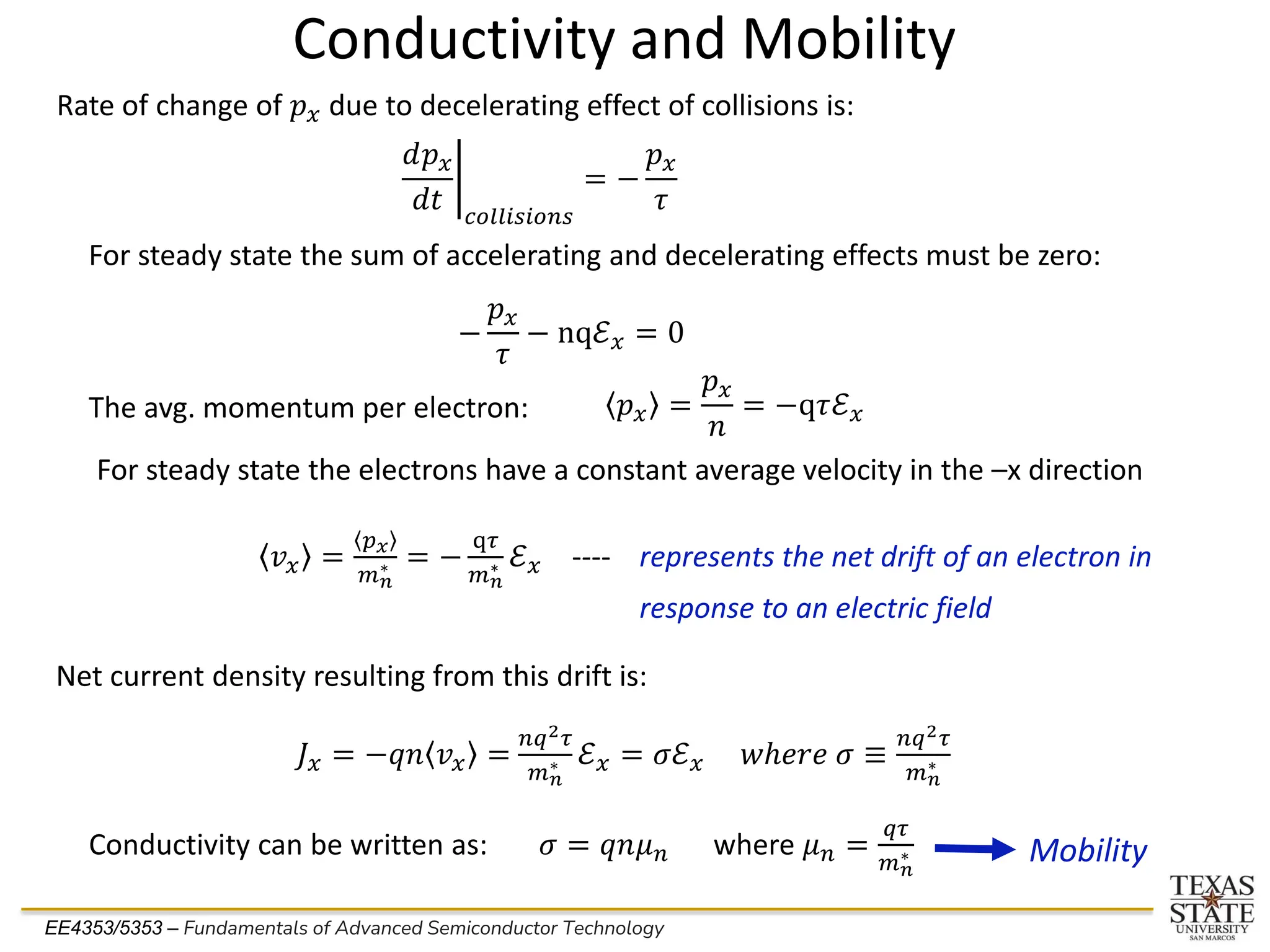
Rate of change of 𝑝𝑥 due to decelerating effect of collisions is:
ቤ
𝑑𝑝𝑥
𝑑𝑡 𝑐𝑜𝑙𝑙𝑖𝑠𝑖𝑜𝑛𝑠
= −
𝑝𝑥
𝜏
For steady state the sum of accelerating and decelerating effects must be zero:
The avg. momentum per electron:
−
𝑝𝑥
𝜏
− nqℰ𝑥 = 0
𝑝𝑥 =
𝑝𝑥
𝑛
= −q𝜏ℰ𝑥
For steady state the electrons have a constant average velocity in the –x direction
𝑣𝑥 =
𝑝𝑥
𝑚𝑛
∗ = −
q𝜏
𝑚𝑛
∗ ℰ𝑥 ---- represents the net drift of an electron in
response to an electric field
Net current density resulting from this drift is:
𝐽𝑥 = −𝑞𝑛 𝑣𝑥 =
𝑛𝑞2𝜏
𝑚𝑛
∗ ℰ𝑥 = 𝜎ℰ𝑥 𝑤ℎ𝑒𝑟𝑒 𝜎 ≡
𝑛𝑞2𝜏
𝑚𝑛
∗
Conductivity can be written as: 𝜎 = 𝑞𝑛𝜇𝑛 where 𝜇𝑛 =
𝑞𝜏
𝑚𝑛
∗ Mobility
EE4353/5353 – Fundamentals of Advanced Semiconductor Technology
Carrier Mobility, m
mn  [qtmn / mn*] is the electron mobility
mp  [qtmp / mp*] is the hole mobility
Similarly, for holes:
Si Ge GaAs InAs
mn (cm2/Vs) 1400 3900 8500 30,000
mp (cm2/Vs) 450 1900 400 500
Electron and hole mobilities for intrinsic semiconductors @ 300K
For electrons:
𝜐𝑑𝑝 = ൘
𝑞ℇ𝜏𝑚𝑝
𝑚𝑝
∗ ≡ 𝜇𝑝ℇ
𝜐𝑑𝑛 = ൗ
𝑞ℇ𝜏𝑚𝑛
𝑚𝑛
∗ ≡ 𝜇𝑛ℇ
EE4353/5353 – Fundamentals of Advanced Semiconductor Technology
Drift Velocity Calculation
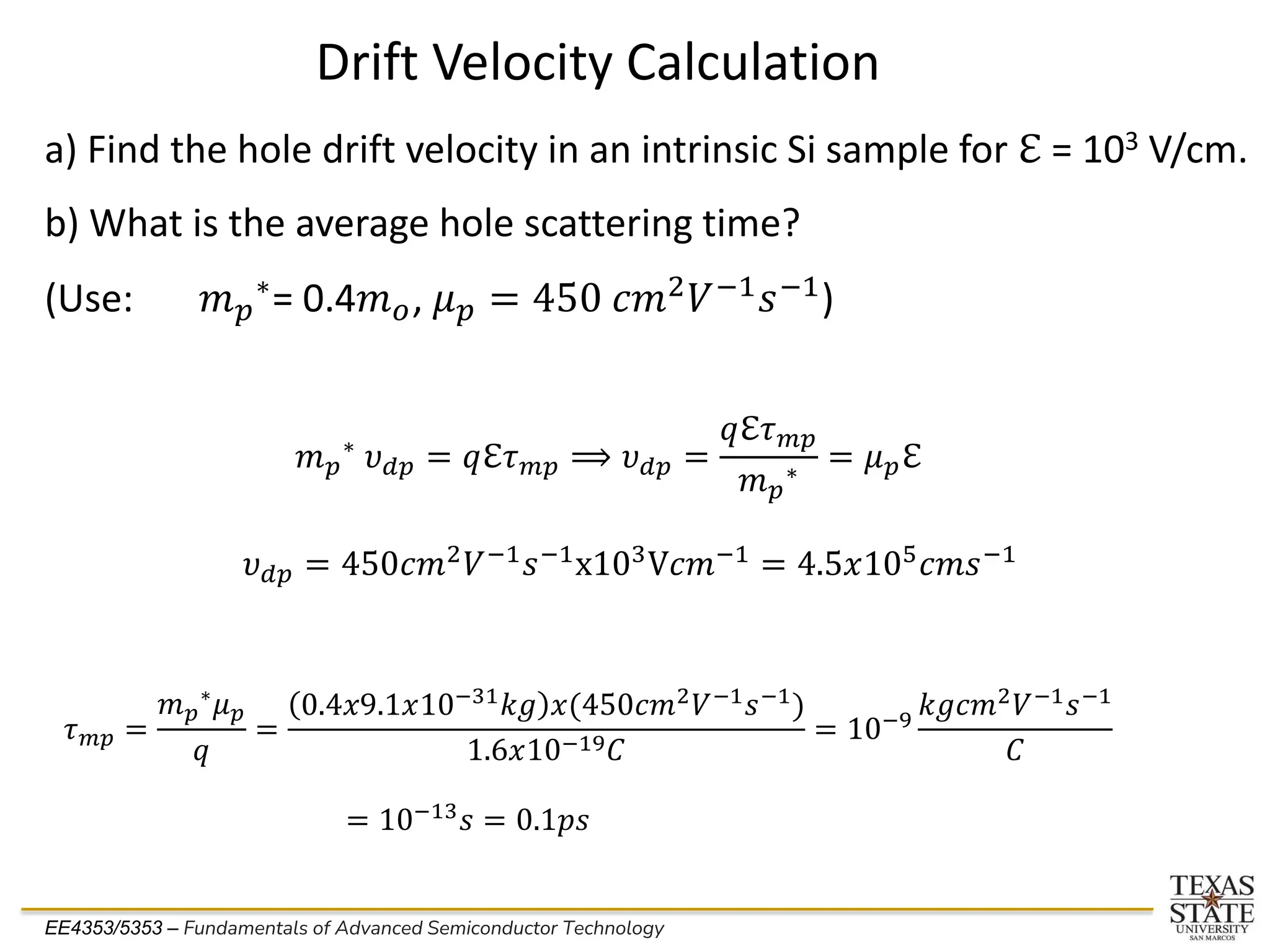
a) Find the hole drift velocity in an intrinsic Si sample for ℇ = 103 V/cm.
b) What is the average hole scattering time?
(Use: 𝑚𝑝
∗= 0.4𝑚𝑜, 𝜇𝑝 = 450 𝑐𝑚2𝑉−1𝑠−1)
𝑚𝑝
∗ 𝜐𝑑𝑝 = 𝑞ℇ𝜏𝑚𝑝 ⟹ 𝜐𝑑𝑝 =
𝑞ℇ𝜏𝑚𝑝
𝑚𝑝
∗
= 𝜇𝑝ℇ
𝜐𝑑𝑝 = 450𝑐𝑚2𝑉−1𝑠−1x10³V𝑐𝑚−1 = 4.5𝑥105𝑐𝑚𝑠−1
𝜏𝑚𝑝 =
𝑚𝑝
∗
𝜇𝑝
𝑞
=
0.4𝑥9.1𝑥10−31
𝑘𝑔 𝑥(450𝑐𝑚2
𝑉−1
𝑠−1
)
1.6𝑥10−19𝐶
= 10−9
𝑘𝑔𝑐𝑚2
𝑉−1
𝑠−1
𝐶
= 10−13
𝑠 = 0.1𝑝𝑠
EE4353/5353 – Fundamentals of Advanced Semiconductor Technology
Conductivity and Resistivity
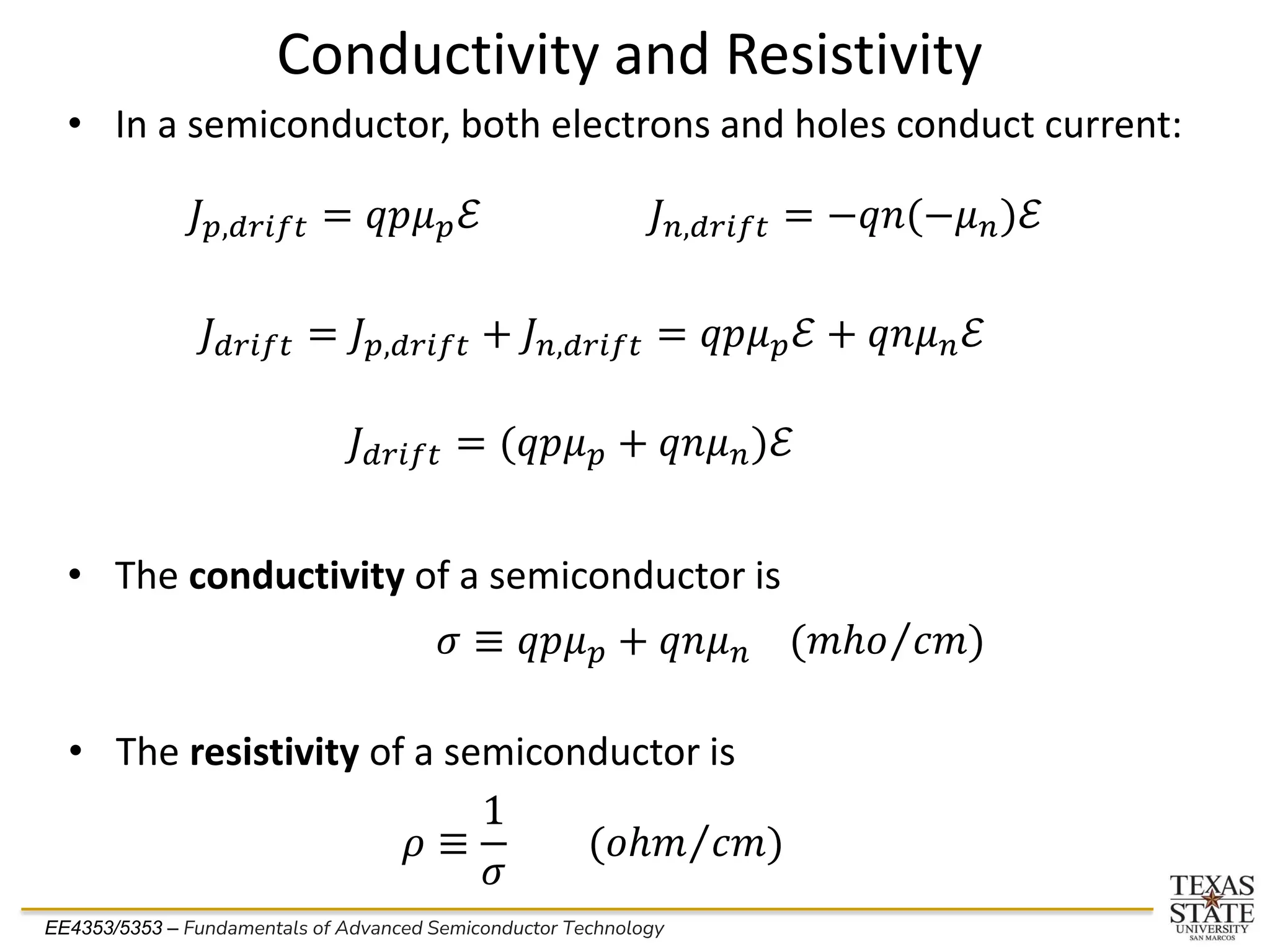
• In a semiconductor, both electrons and holes conduct current:
𝐽𝑝,𝑑𝑟𝑖𝑓𝑡 = 𝑞𝑝𝜇𝑝ℰ 𝐽𝑛,𝑑𝑟𝑖𝑓𝑡 = −𝑞𝑛(−𝜇𝑛)ℰ
𝐽𝑑𝑟𝑖𝑓𝑡 = 𝐽𝑝,𝑑𝑟𝑖𝑓𝑡 + 𝐽𝑛,𝑑𝑟𝑖𝑓𝑡 = 𝑞𝑝𝜇𝑝ℰ + 𝑞𝑛𝜇𝑛ℰ
𝐽𝑑𝑟𝑖𝑓𝑡 = (𝑞𝑝𝜇𝑝 + 𝑞𝑛𝜇𝑛)ℰ
• The conductivity of a semiconductor is
𝜎 ≡ 𝑞𝑝𝜇𝑝 + 𝑞𝑛𝜇𝑛 ( Τ
𝑚ℎ𝑜 𝑐𝑚)
• The resistivity of a semiconductor is
𝜌 ≡
1
𝜎
( Τ
𝑜ℎ𝑚 𝑐𝑚)
EE4353/5353 – Fundamentals of Advanced Semiconductor Technology
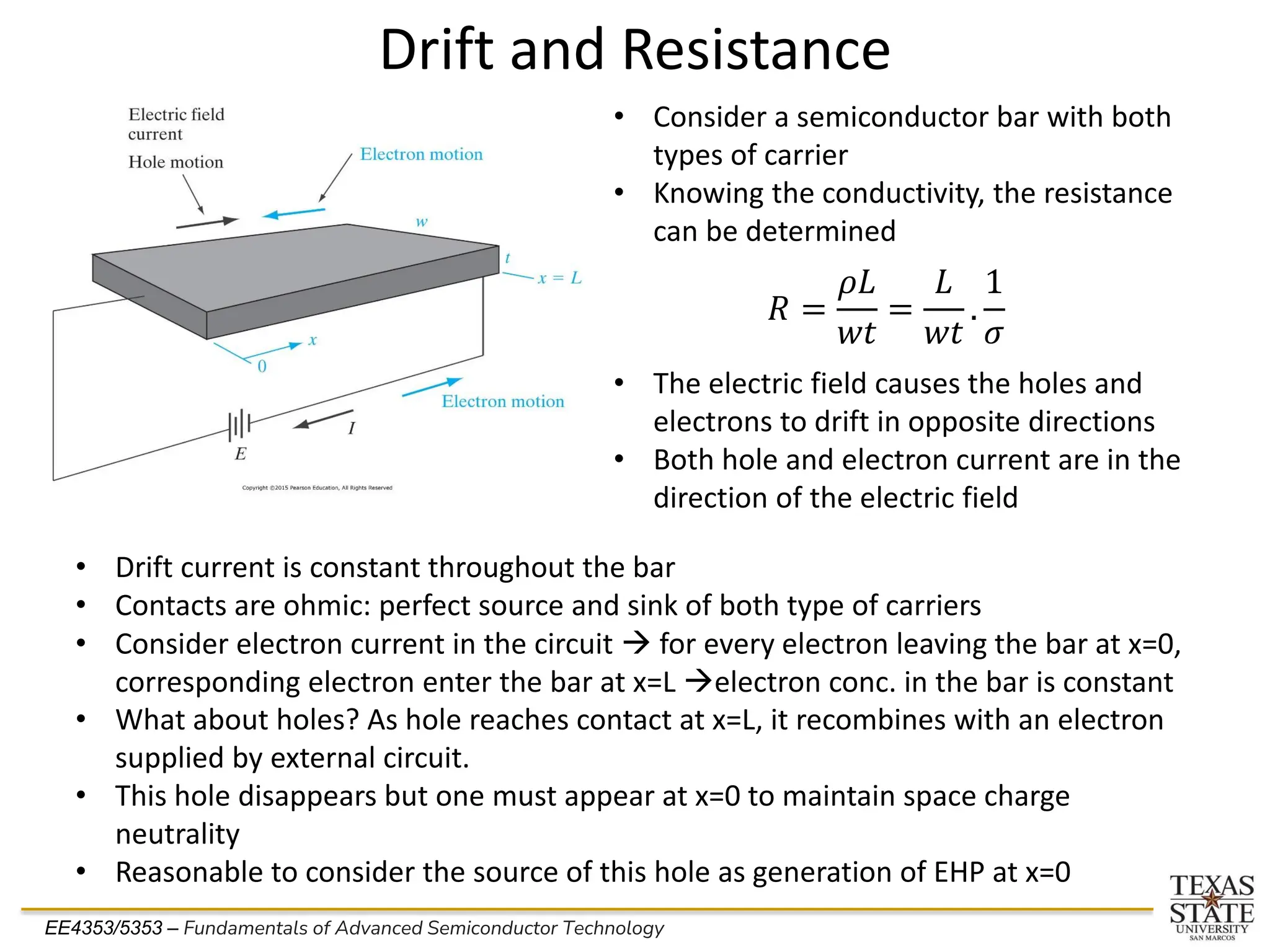
Drift and Resistance
• Consider a semiconductor bar with both
types of carrier
• Knowing the conductivity, the resistance
can be determined
• The electric field causes the holes and
electrons to drift in opposite directions
• Both hole and electron current are in the
direction of the electric field
𝑅 =
𝜌𝐿
𝑤𝑡
=
𝐿
𝑤𝑡
.
1
𝜎
• Drift current is constant throughout the bar
• Contacts are ohmic: perfect source and sink of both type of carriers
• Consider electron current in the circuit → for every electron leaving the bar at x=0,
corresponding electron enter the bar at x=L →electron conc. in the bar is constant
• What about holes? As hole reaches contact at x=L, it recombines with an electron
supplied by external circuit.
• This hole disappears but one must appear at x=0 to maintain space charge
neutrality
• Reasonable to consider the source of this hole as generation of EHP at x=0
EE4353/5353 – Fundamentals of Advanced Semiconductor Technology
Mechanisms of Carrier Scattering
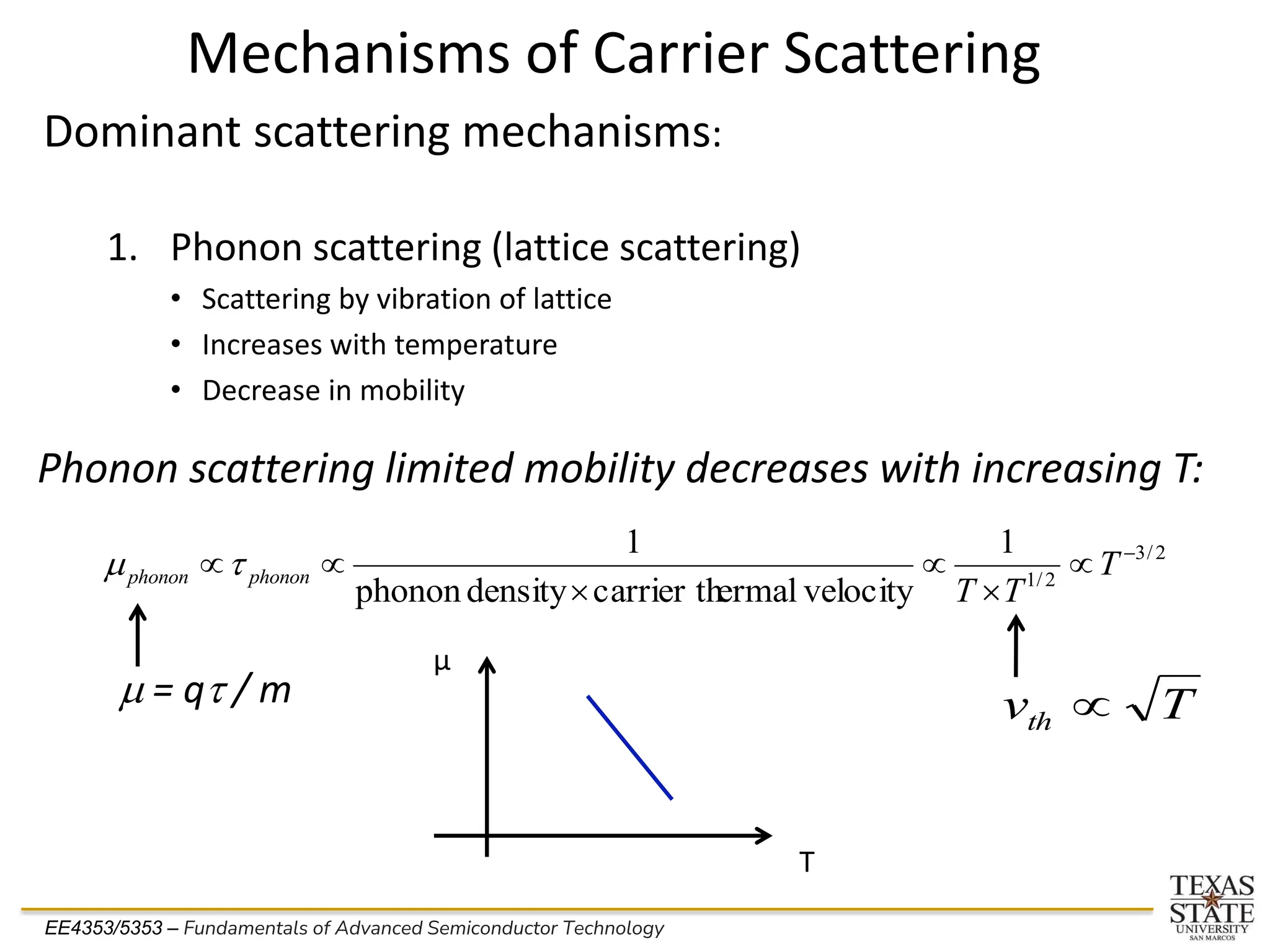
Dominant scattering mechanisms:
1. Phonon scattering (lattice scattering)
• Scattering by vibration of lattice
• Increases with temperature
• Decrease in mobility
2
/
3
2
/
1
1
velocity
ermal
carrier th
density
phonon
1 −





 T
T
T
phonon
phonon t
m
Phonon scattering limited mobility decreases with increasing T:
m = qt / m T
vth 
T
µ
EE4353/5353 – Fundamentals of Advanced Semiconductor Technology
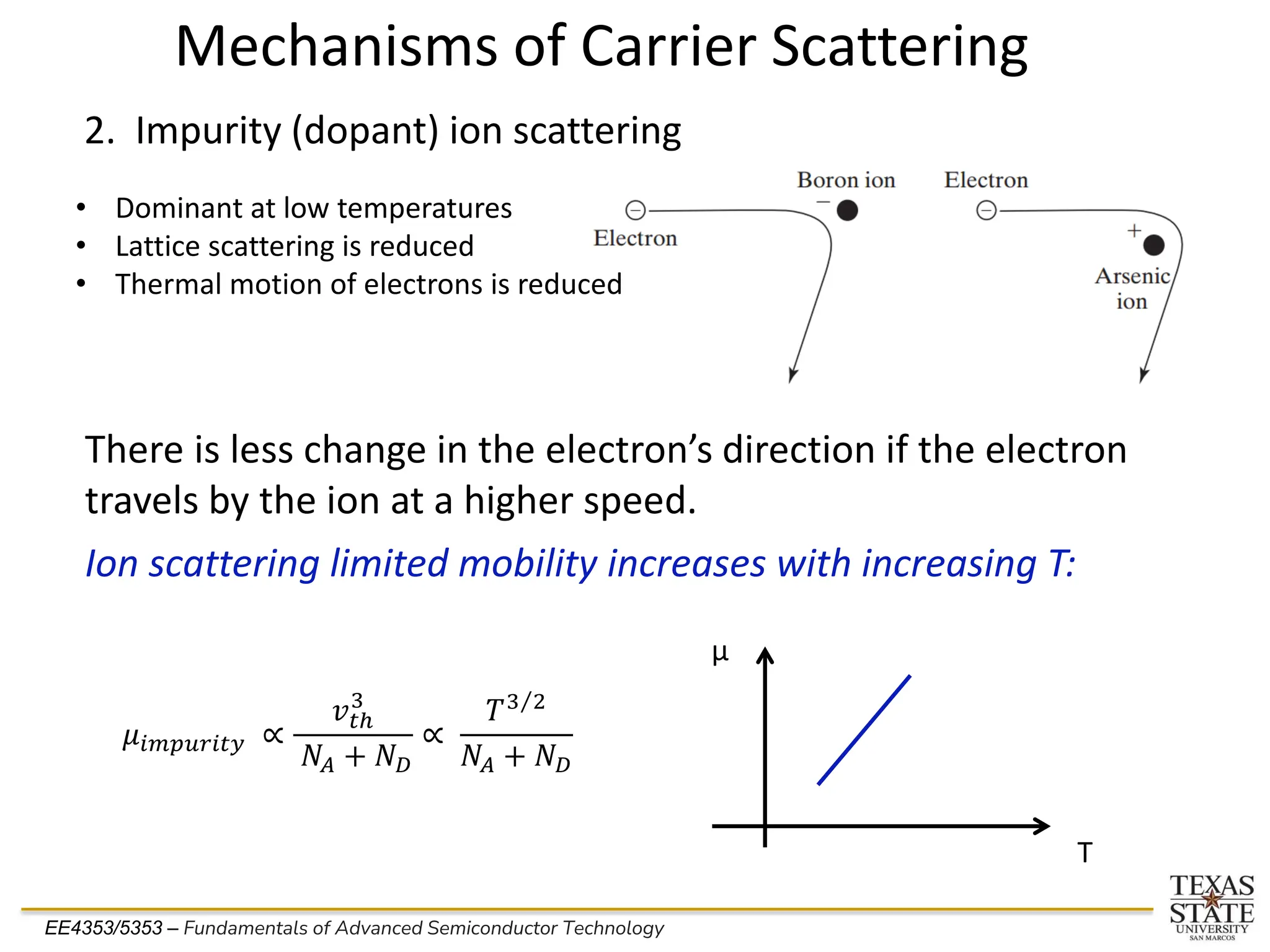
There is less change in the electron’s direction if the electron
travels by the ion at a higher speed.
Ion scattering limited mobility increases with increasing T:
T
µ
2. Impurity (dopant) ion scattering
Mechanisms of Carrier Scattering
• Dominant at low temperatures
• Lattice scattering is reduced
• Thermal motion of electrons is reduced
𝜇𝑖𝑚𝑝𝑢𝑟𝑖𝑡𝑦 ∝
𝑣𝑡ℎ
3
𝑁𝐴 + 𝑁𝐷
∝
𝑇 Τ
3 2
𝑁𝐴 + 𝑁𝐷
EE4353/5353 – Fundamentals of Advanced Semiconductor Technology
Mechanisms of Carrier Scattering
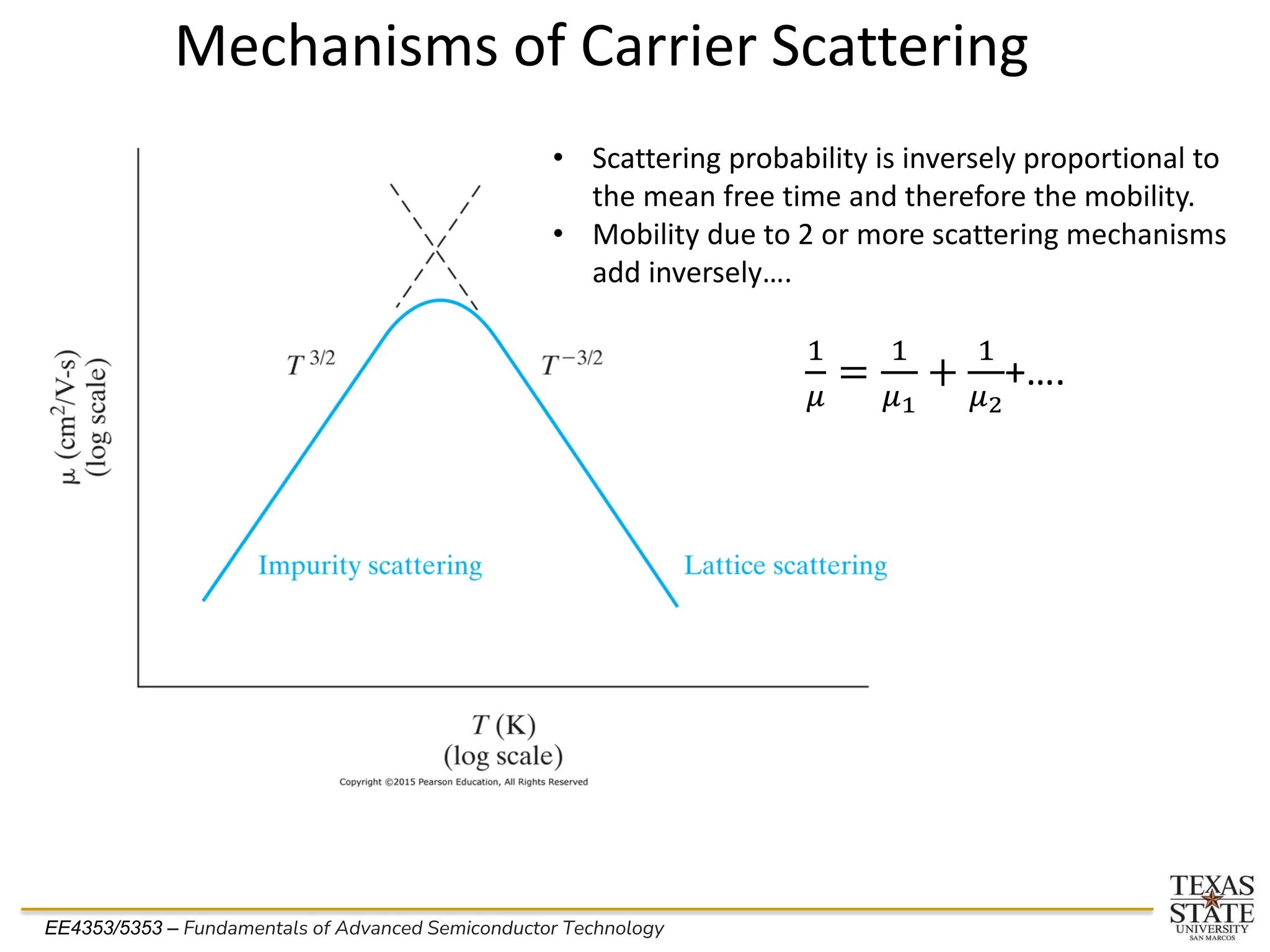
• Scattering probability is inversely proportional to
the mean free time and therefore the mobility.
• Mobility due to 2 or more scattering mechanisms
add inversely….
1
𝜇
=
1
𝜇1
+
1
𝜇2
+….
EE4353/5353 – Fundamentals of Advanced Semiconductor Technology
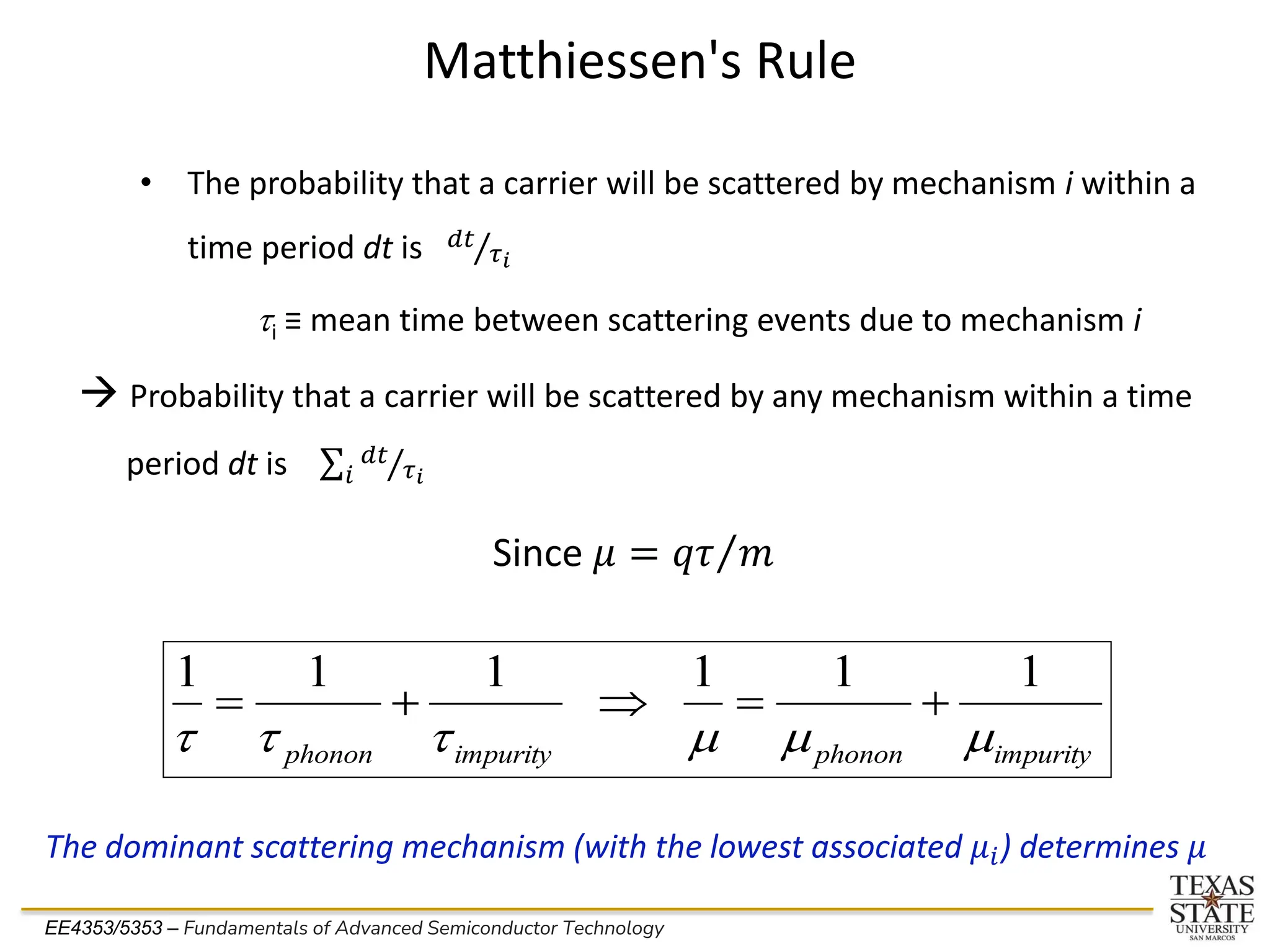
Matthiessen's Rule
→ Probability that a carrier will be scattered by any mechanism within a time
period dt is σ𝑖 Τ
𝑑𝑡
𝜏𝑖
impurity
phonon
impurity
phonon m
m
m
t
t
t
1
1
1
1
1
1
+
=

+
=
• The probability that a carrier will be scattered by mechanism i within a
time period dt is Τ
𝑑𝑡
𝜏𝑖
ti ≡ mean time between scattering events due to mechanism i
The dominant scattering mechanism (with the lowest associated 𝜇𝑖) determines 𝜇
Since 𝜇 = Τ
𝑞𝜏 𝑚
EE4353/5353 – Fundamentals of Advanced Semiconductor Technology
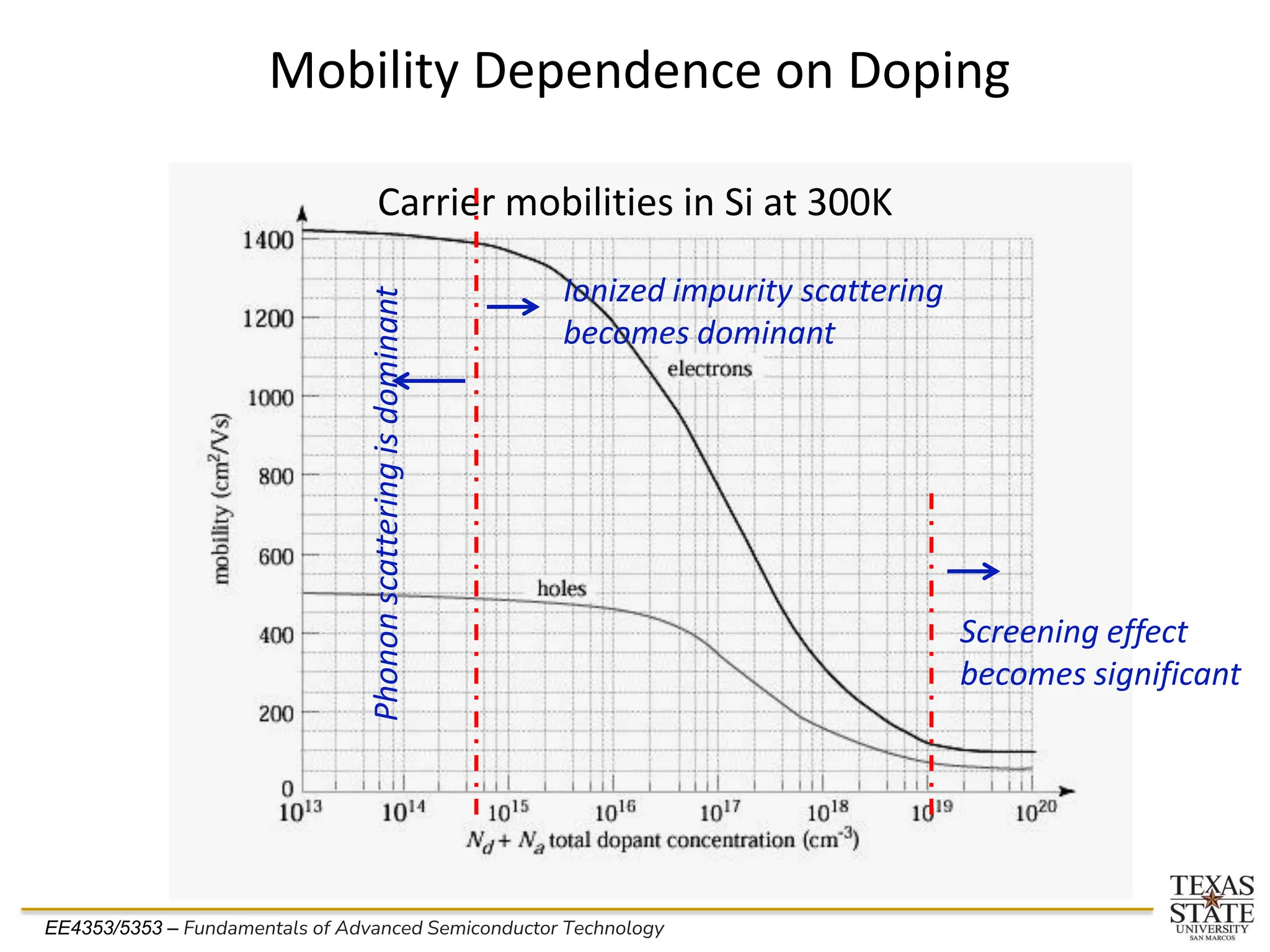
Mobility Dependence on Doping
Carrier mobilities in Si at 300K
Phonon
scattering
is
dominant
Ionized impurity scattering
becomes dominant
Screening effect
becomes significant
EE4353/5353 – Fundamentals of Advanced Semiconductor Technology
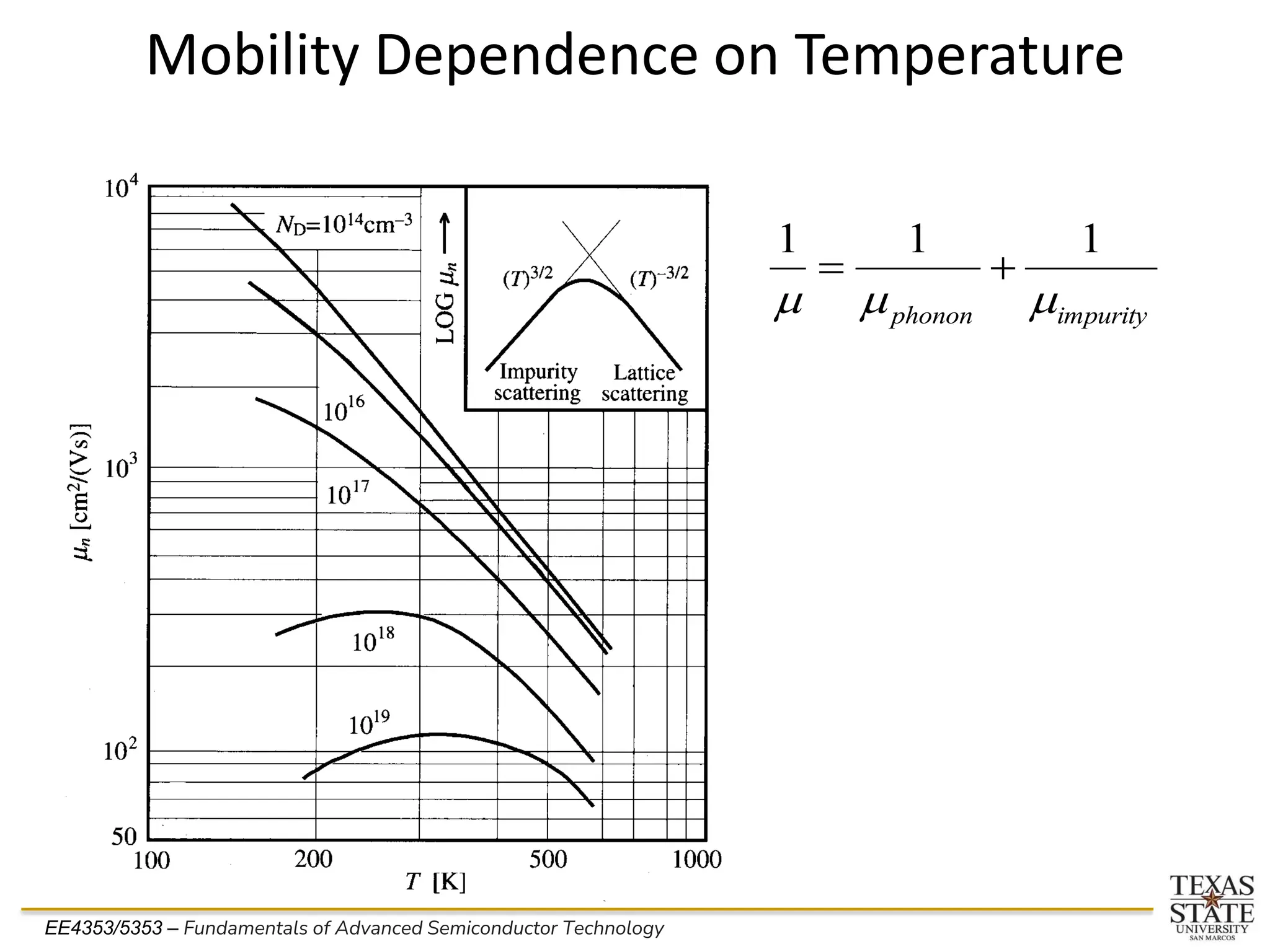
Mobility Dependence on Temperature
impurity
phonon m
m
m
1
1
1
+
=
EE4353/5353 – Fundamentals of Advanced Semiconductor Technology
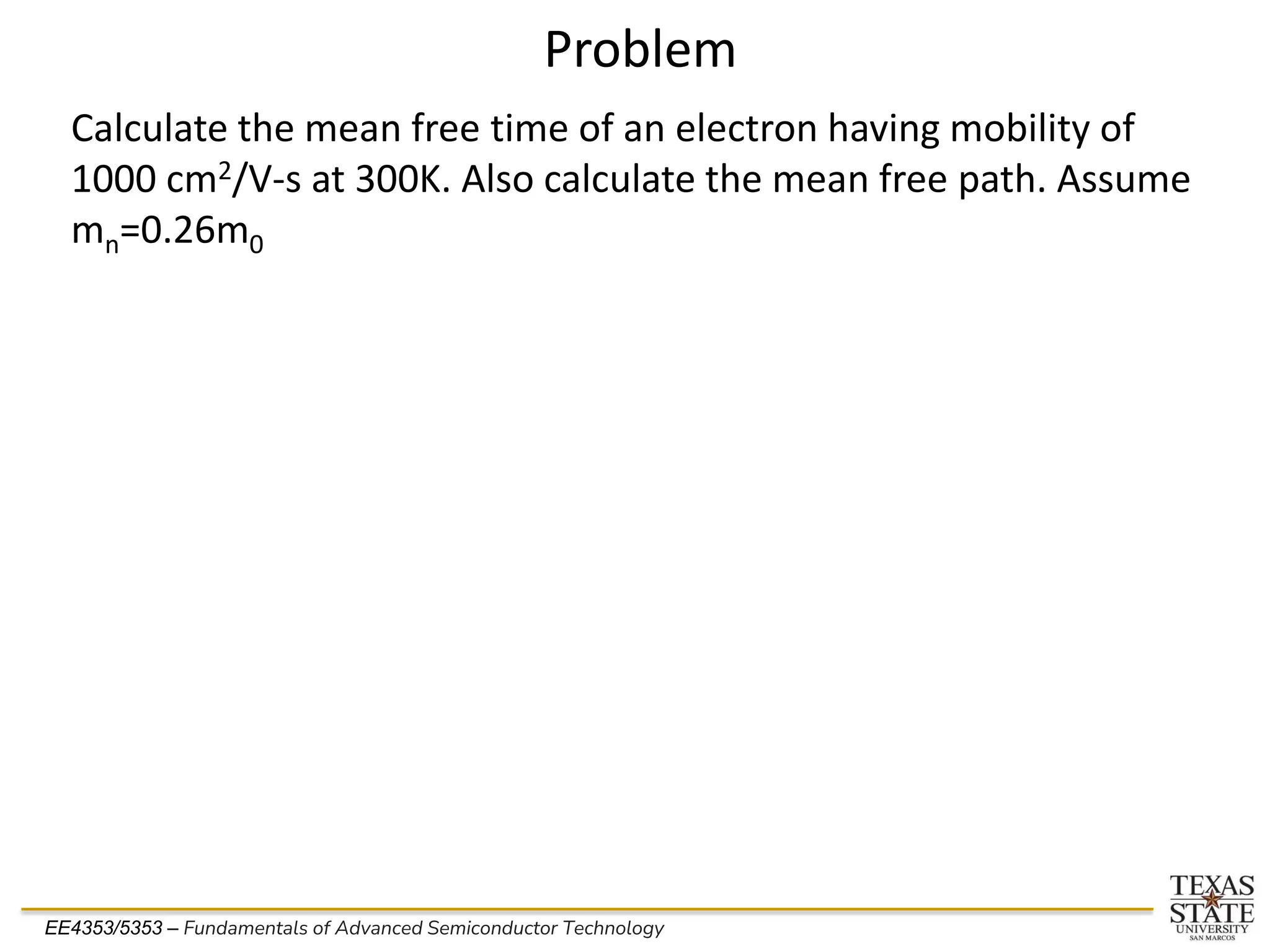
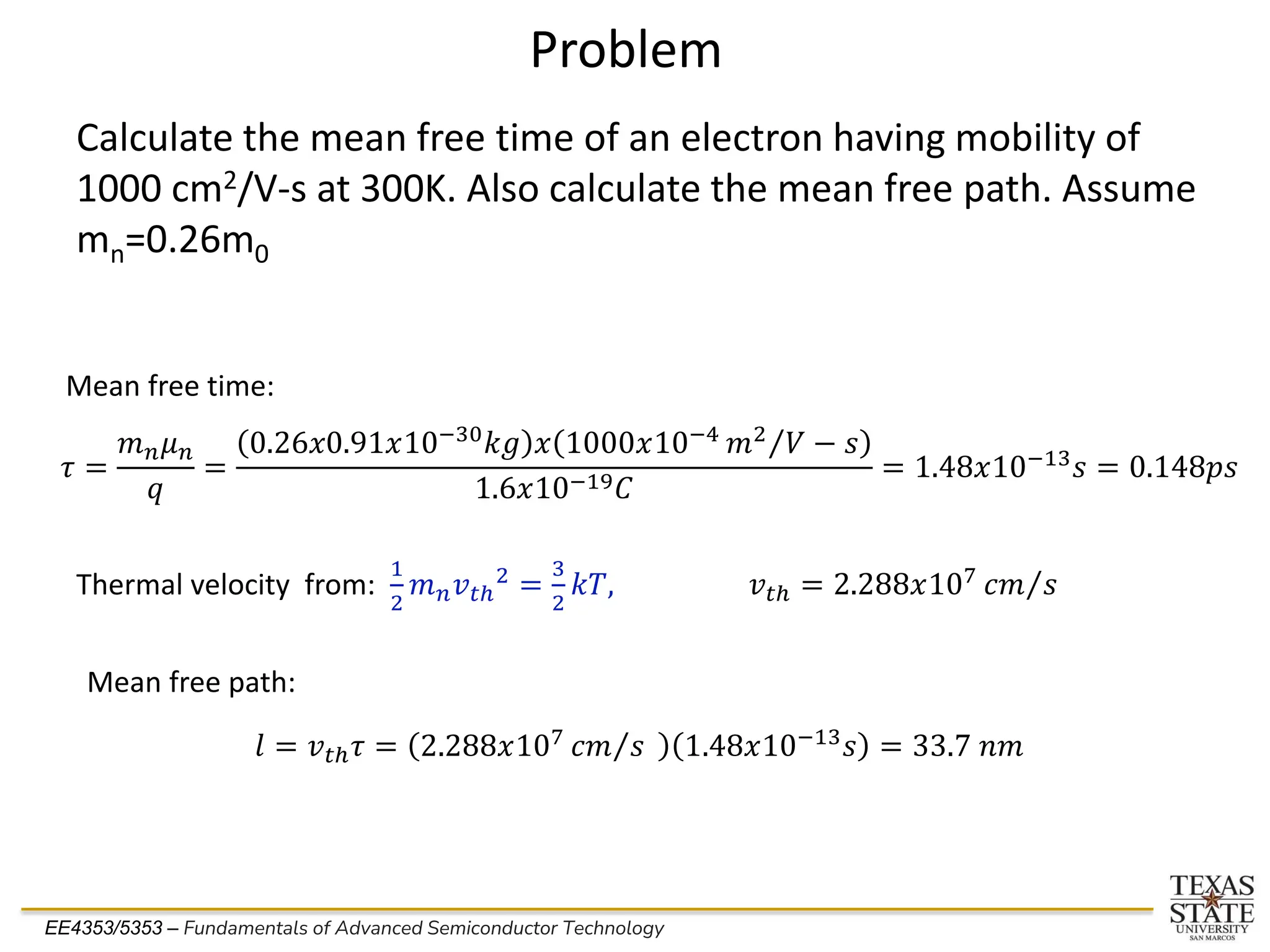
Problem
Calculate the mean free time of an electron having mobility of
1000 cm2/V-s at 300K. Also calculate the mean free path. Assume
mn=0.26m0
EE4353/5353 – Fundamentals of Advanced Semiconductor Technology
Problem
Calculate the mean free time of an electron having mobility of
1000 cm2/V-s at 300K. Also calculate the mean free path. Assume
mn=0.26m0
𝜏 =
𝑚𝑛𝜇𝑛
𝑞
=
0.26𝑥0.91𝑥10−30
𝑘𝑔 𝑥 1000𝑥10−4 Τ
𝑚2
𝑉 − 𝑠
1.6𝑥10−19𝐶
= 1.48𝑥10−13𝑠 = 0.148𝑝𝑠
Mean free time:
Thermal velocity from:
1
2
𝑚𝑛𝑣𝑡ℎ
2
=
3
2
𝑘𝑇, 𝑣𝑡ℎ = 2.288𝑥107 Τ
𝑐𝑚 𝑠
Mean free path:
𝑙 = 𝑣𝑡ℎ𝜏 = 2.288𝑥107 Τ
𝑐𝑚 𝑠 1.48𝑥10−13
𝑠 = 33.7 𝑛𝑚
EE4353/5353 – Fundamentals of Advanced Semiconductor Technology
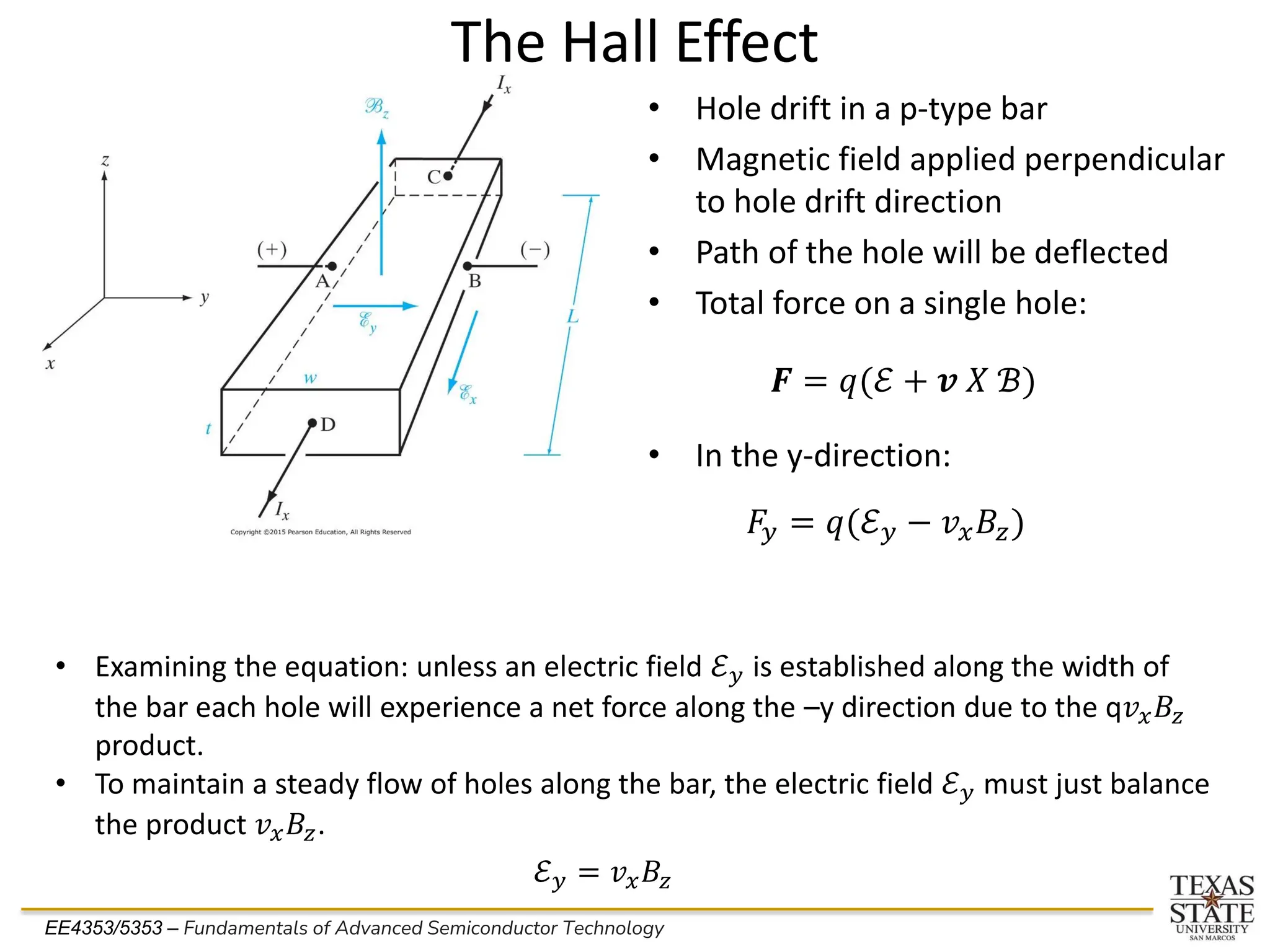
The Hall Effect
• Hole drift in a p-type bar
• Magnetic field applied perpendicular
to hole drift direction
• Path of the hole will be deflected
• Total force on a single hole:
• In the y-direction:
𝑭 = 𝑞(ℰ + 𝒗 𝑋 ℬ)
𝐹𝑦 = 𝑞(ℰ𝑦 − 𝑣𝑥𝐵𝑧)
• Examining the equation: unless an electric field ℰ𝑦 is established along the width of
the bar each hole will experience a net force along the –y direction due to the q𝑣𝑥𝐵𝑧
product.
• To maintain a steady flow of holes along the bar, the electric field ℰ𝑦 must just balance
the product 𝑣𝑥𝐵𝑧.
ℰ𝑦 = 𝑣𝑥𝐵𝑧
EE4353/5353 – Fundamentals of Advanced Semiconductor Technology
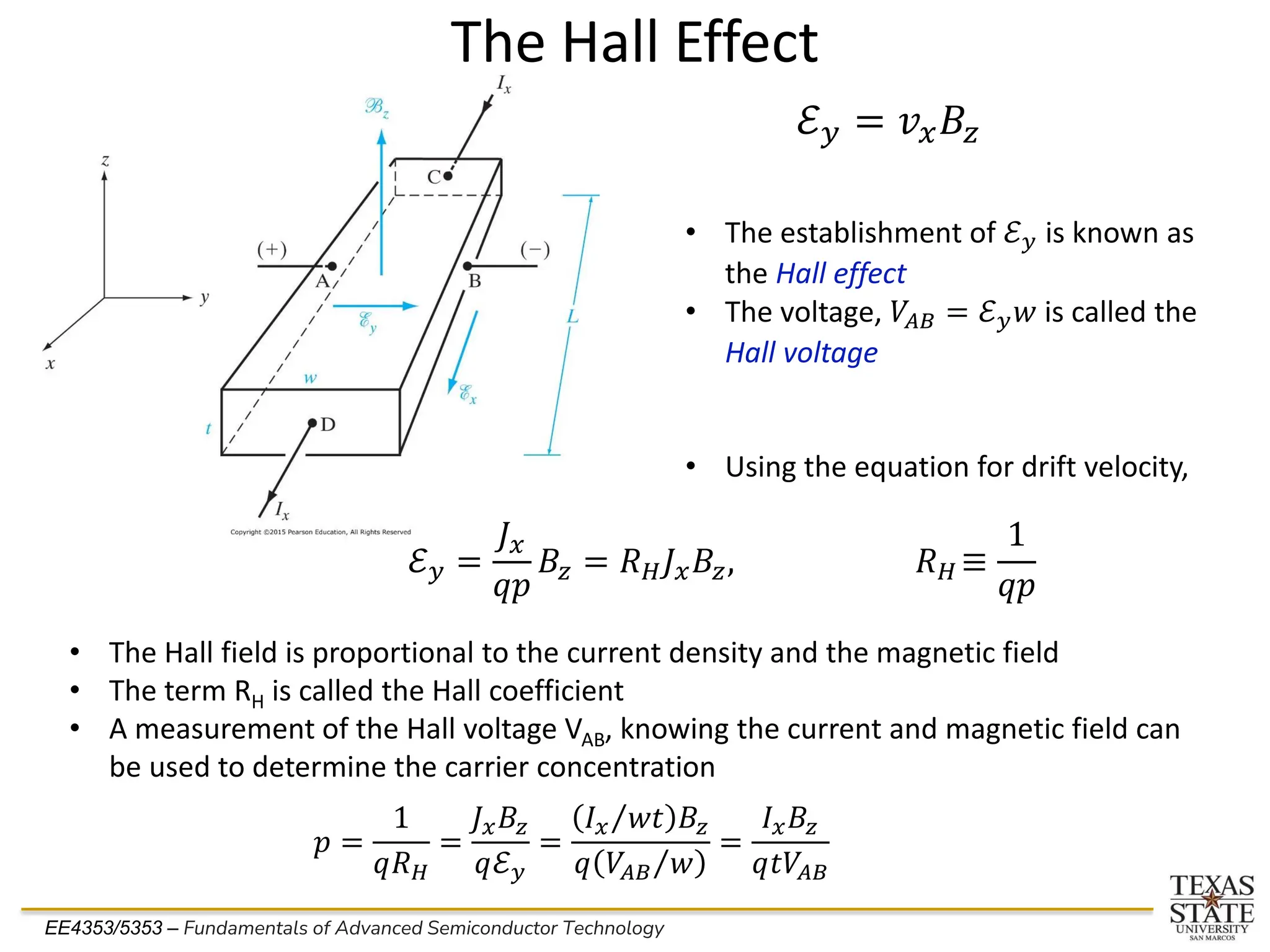
The Hall Effect
ℰ𝑦 = 𝑣𝑥𝐵𝑧
• The establishment of ℰ𝑦 is known as
the Hall effect
• The voltage, 𝑉𝐴𝐵 = ℰ𝑦𝑤 is called the
Hall voltage
• Using the equation for drift velocity,
ℰ𝑦 =
𝐽𝑥
𝑞𝑝
𝐵𝑧 = 𝑅𝐻𝐽𝑥𝐵𝑧, 𝑅𝐻 ≡
1
𝑞𝑝
• The Hall field is proportional to the current density and the magnetic field
• The term RH is called the Hall coefficient
• A measurement of the Hall voltage VAB, knowing the current and magnetic field can
be used to determine the carrier concentration
𝑝 =
1
𝑞𝑅𝐻
=
𝐽𝑥𝐵𝑧
𝑞ℰ𝑦
=
Τ
𝐼𝑥 𝑤𝑡 𝐵𝑧
𝑞 Τ
𝑉𝐴𝐵 𝑤
=
𝐼𝑥𝐵𝑧
𝑞𝑡𝑉𝐴𝐵
EE4353/5353 – Fundamentals of Advanced Semiconductor Technology
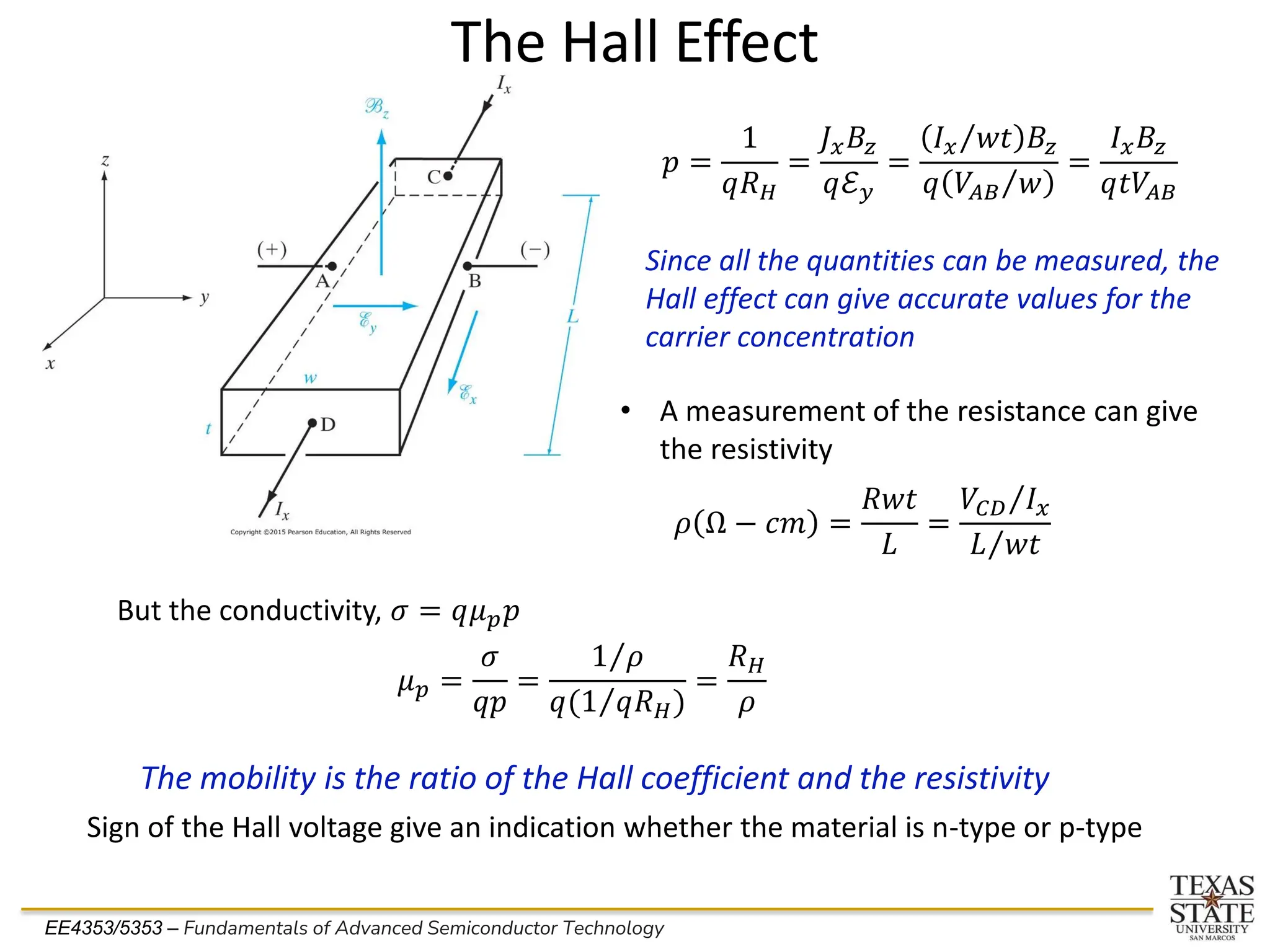
The Hall Effect
𝑝 =
1
𝑞𝑅𝐻
=
𝐽𝑥𝐵𝑧
𝑞ℰ𝑦
=
Τ
𝐼𝑥 𝑤𝑡 𝐵𝑧
𝑞 Τ
𝑉𝐴𝐵 𝑤
=
𝐼𝑥𝐵𝑧
𝑞𝑡𝑉𝐴𝐵
Since all the quantities can be measured, the
Hall effect can give accurate values for the
carrier concentration
• A measurement of the resistance can give
the resistivity
𝜌 Ω − 𝑐𝑚 =
𝑅𝑤𝑡
𝐿
=
Τ
𝑉𝐶𝐷 𝐼𝑥
Τ
𝐿 𝑤𝑡
But the conductivity, 𝜎 = 𝑞𝜇𝑝𝑝
𝜇𝑝 =
𝜎
𝑞𝑝
=
Τ
1 𝜌
𝑞( Τ
1 𝑞𝑅𝐻)
=
𝑅𝐻
𝜌
The mobility is the ratio of the Hall coefficient and the resistivity
Sign of the Hall voltage give an indication whether the material is n-type or p-type
EE4353/5353 – Fundamentals of Advanced Semiconductor Technology
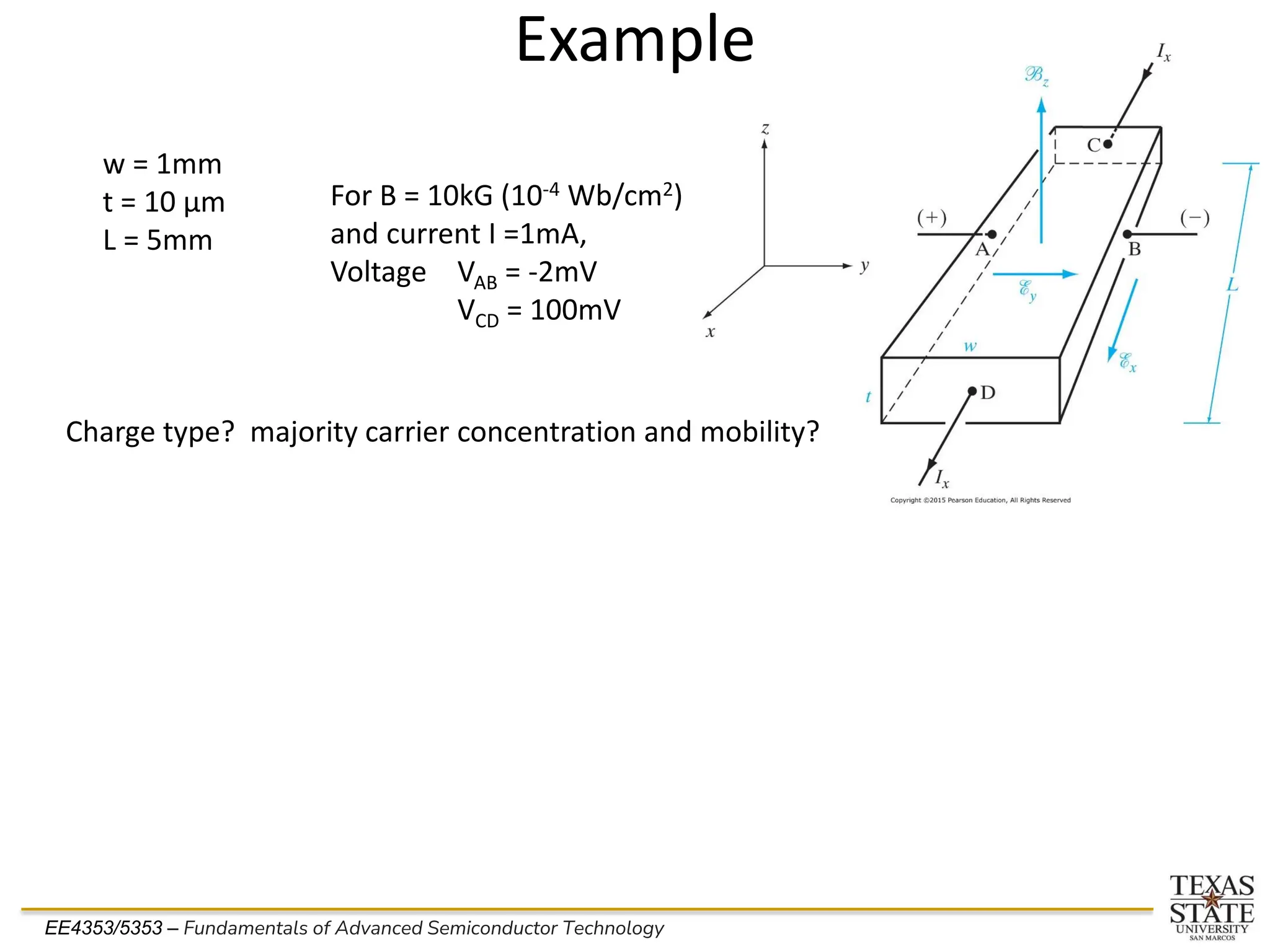
Example
w = 1mm
t = 10 µm
L = 5mm
For B = 10kG (10-4 Wb/cm2)
and current I =1mA,
Voltage VAB = -2mV
VCD = 100mV
Charge type? majority carrier concentration and mobility?
EE4353/5353 – Fundamentals of Advanced Semiconductor Technology
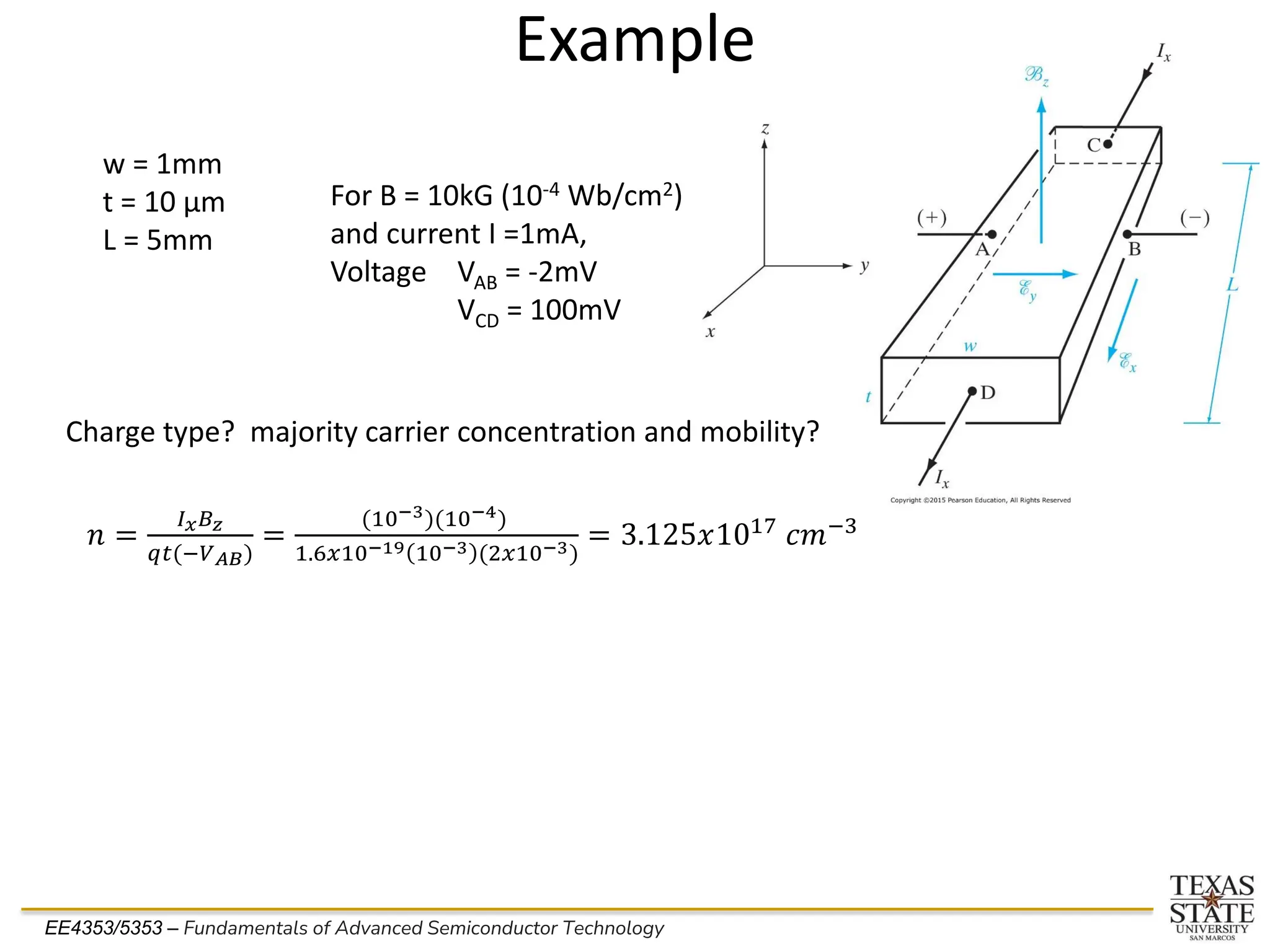
Example
w = 1mm
t = 10 µm
L = 5mm
For B = 10kG (10-4 Wb/cm2)
and current I =1mA,
Voltage VAB = -2mV
VCD = 100mV
Charge type? majority carrier concentration and mobility?
𝑛 =
𝐼𝑥𝐵𝑧
𝑞𝑡(−𝑉𝐴𝐵)
=
(10−3)(10−4)
1.6𝑥10−19 10−3 (2𝑥10−3)
= 3.125𝑥1017 𝑐𝑚−3
EE4353/5353 – Fundamentals of Advanced Semiconductor Technology
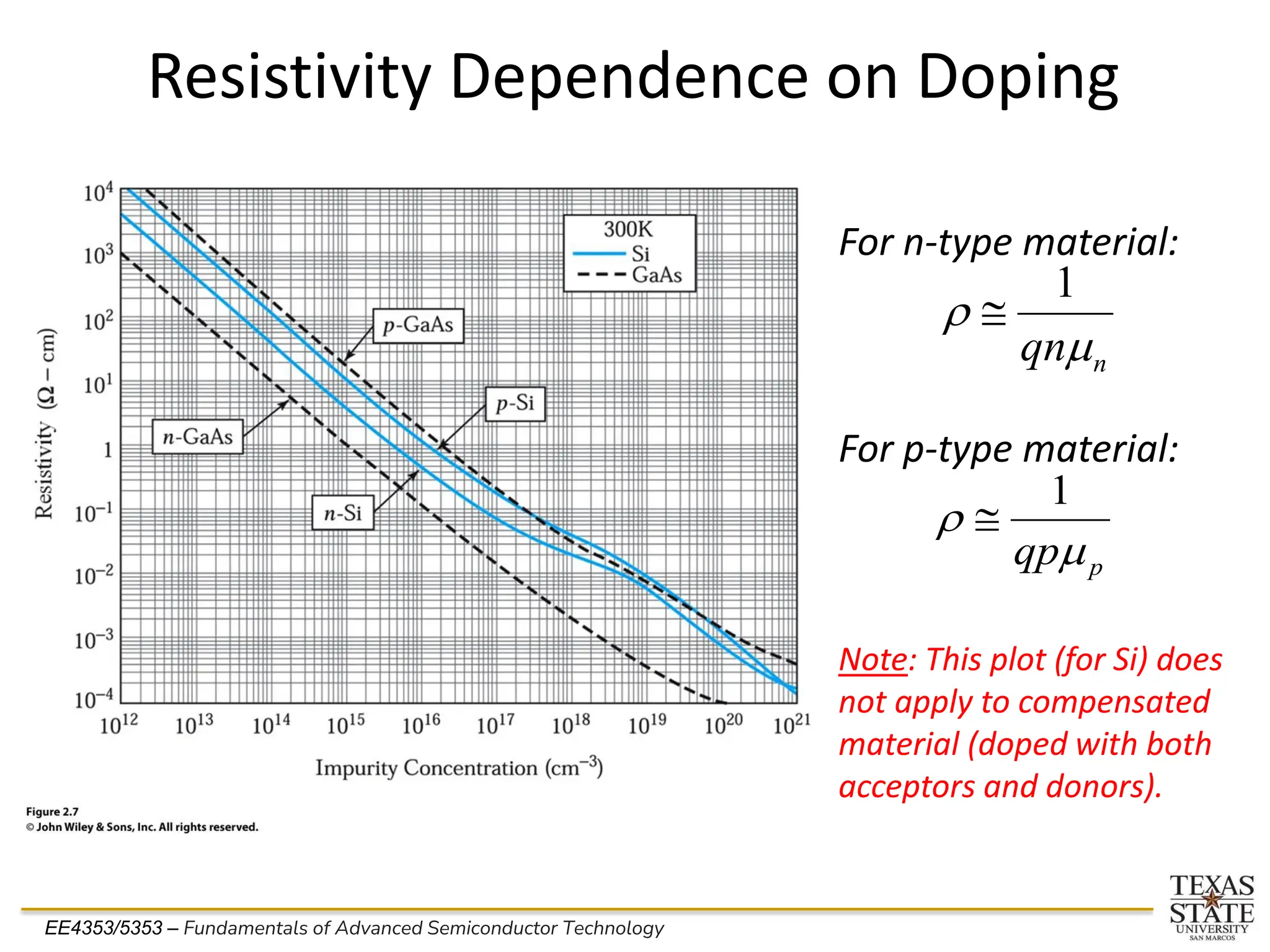
Resistivity Dependence on Doping
For n-type material:
n
qnm

1

For p-type material:
p
qpm

1

Note: This plot (for Si) does
not apply to compensated
material (doped with both
acceptors and donors).

The carrier structure of a P and N type Semiconductor

  • 1.
    EE4353/5353 – Fundamentalsof Advanced Semiconductor Technology Lecture 4 Carrier Action EE 4353/5353 Dr. Ariful Haque
  • 2.
    EE4353/5353 – Fundamentalsof Advanced Semiconductor Technology Carrier Action • The three primary action – drift: charged-particle motion in response to an applied electric field – diffusion: process whereby particles tend to spread out as a result of their difference of concentrations – recombination-generation: • Generation is a process whereby carriers are created • Recombination is a process whereby carriers are destroyed • Electrons in semiconductors have 3 degrees of freedom ➔ according to the equipartition theorem the kinetic energy of the electrons is: 1 2 𝑚𝑛𝑣𝑡ℎ 2 = 3 2 𝑘𝑇, where vth is the average thermal velocity
  • 3.
    EE4353/5353 – Fundamentalsof Advanced Semiconductor Technology Carrier Scattering • Mobile electrons and atoms in the Si lattice are always in random thermal motion. – Electrons make frequent collisions with the vibrating atoms “lattice scattering” or “phonon scattering” – increases with increasing T • Other scattering mechanisms: – deflection by ionized impurity atoms – deflection due to Coulombic force between carriers “carrier-carrier scattering” – only significant at high carrier concentrations • The net current in any direction is zero, if no E-field is applied. 1 2 3 4 5 electron
  • 4.
    EE4353/5353 – Fundamentalsof Advanced Semiconductor Technology Carrier Drift • When an electric field (e.g. due to an externally applied voltage) exists within a semiconductor, mobile charge-carriers will be accelerated by the electrostatic force: Electrons drift in the direction opposite to the E-field → net current Because of scattering, electrons in a semiconductor do not undergo constant acceleration. However, they can be viewed as quasi- classical particles moving at a constant average drift velocity vdn 𝐹 = (−𝑞)ℇ 𝜐𝑑𝑛 = 𝜇𝑛ℇ
  • 5.
    EE4353/5353 – Fundamentalsof Advanced Semiconductor Technology Conductivity and Mobility • Electric field in the +x direction • Each electron experiences force −qℰ𝑥 ⟹ net motion in the –x direction • Net force of the field on the n electrons/cm-3 is: • This net acceleration is balanced by decelerations of the collision processes −nqℰ𝑥 = ቤ 𝑑p𝑥 𝑑𝑡 𝑓𝑖𝑒𝑙𝑑 • With collisions included the net rate of change of momentum must be zero Differential change in 𝑝𝑥 due to collisions in time dt is: 𝑑p𝑥 = −p𝑥 𝑑𝑡 𝜏 𝜏 is the mean time between scattering events of the mean free time px= momentum in the x-direction
  • 6.
    EE4353/5353 – Fundamentalsof Advanced Semiconductor Technology Conductivity and Mobility Rate of change of 𝑝𝑥 due to decelerating effect of collisions is: ቤ 𝑑𝑝𝑥 𝑑𝑡 𝑐𝑜𝑙𝑙𝑖𝑠𝑖𝑜𝑛𝑠 = − 𝑝𝑥 𝜏 For steady state the sum of accelerating and decelerating effects must be zero: The avg. momentum per electron: − 𝑝𝑥 𝜏 − nqℰ𝑥 = 0 𝑝𝑥 = 𝑝𝑥 𝑛 = −q𝜏ℰ𝑥 For steady state the electrons have a constant average velocity in the –x direction 𝑣𝑥 = 𝑝𝑥 𝑚𝑛 ∗ = − q𝜏 𝑚𝑛 ∗ ℰ𝑥 ---- represents the net drift of an electron in response to an electric field Net current density resulting from this drift is: 𝐽𝑥 = −𝑞𝑛 𝑣𝑥 = 𝑛𝑞2𝜏 𝑚𝑛 ∗ ℰ𝑥 = 𝜎ℰ𝑥 𝑤ℎ𝑒𝑟𝑒 𝜎 ≡ 𝑛𝑞2𝜏 𝑚𝑛 ∗ Conductivity can be written as: 𝜎 = 𝑞𝑛𝜇𝑛 where 𝜇𝑛 = 𝑞𝜏 𝑚𝑛 ∗ Mobility
  • 7.
    EE4353/5353 – Fundamentalsof Advanced Semiconductor Technology Carrier Mobility, m mn  [qtmn / mn*] is the electron mobility mp  [qtmp / mp*] is the hole mobility Similarly, for holes: Si Ge GaAs InAs mn (cm2/Vs) 1400 3900 8500 30,000 mp (cm2/Vs) 450 1900 400 500 Electron and hole mobilities for intrinsic semiconductors @ 300K For electrons: 𝜐𝑑𝑝 = ൘ 𝑞ℇ𝜏𝑚𝑝 𝑚𝑝 ∗ ≡ 𝜇𝑝ℇ 𝜐𝑑𝑛 = ൗ 𝑞ℇ𝜏𝑚𝑛 𝑚𝑛 ∗ ≡ 𝜇𝑛ℇ
  • 8.
    EE4353/5353 – Fundamentalsof Advanced Semiconductor Technology Drift Velocity Calculation a) Find the hole drift velocity in an intrinsic Si sample for ℇ = 103 V/cm. b) What is the average hole scattering time? (Use: 𝑚𝑝 ∗= 0.4𝑚𝑜, 𝜇𝑝 = 450 𝑐𝑚2𝑉−1𝑠−1) 𝑚𝑝 ∗ 𝜐𝑑𝑝 = 𝑞ℇ𝜏𝑚𝑝 ⟹ 𝜐𝑑𝑝 = 𝑞ℇ𝜏𝑚𝑝 𝑚𝑝 ∗ = 𝜇𝑝ℇ 𝜐𝑑𝑝 = 450𝑐𝑚2𝑉−1𝑠−1x10³V𝑐𝑚−1 = 4.5𝑥105𝑐𝑚𝑠−1 𝜏𝑚𝑝 = 𝑚𝑝 ∗ 𝜇𝑝 𝑞 = 0.4𝑥9.1𝑥10−31 𝑘𝑔 𝑥(450𝑐𝑚2 𝑉−1 𝑠−1 ) 1.6𝑥10−19𝐶 = 10−9 𝑘𝑔𝑐𝑚2 𝑉−1 𝑠−1 𝐶 = 10−13 𝑠 = 0.1𝑝𝑠
  • 9.
    EE4353/5353 – Fundamentalsof Advanced Semiconductor Technology Conductivity and Resistivity • In a semiconductor, both electrons and holes conduct current: 𝐽𝑝,𝑑𝑟𝑖𝑓𝑡 = 𝑞𝑝𝜇𝑝ℰ 𝐽𝑛,𝑑𝑟𝑖𝑓𝑡 = −𝑞𝑛(−𝜇𝑛)ℰ 𝐽𝑑𝑟𝑖𝑓𝑡 = 𝐽𝑝,𝑑𝑟𝑖𝑓𝑡 + 𝐽𝑛,𝑑𝑟𝑖𝑓𝑡 = 𝑞𝑝𝜇𝑝ℰ + 𝑞𝑛𝜇𝑛ℰ 𝐽𝑑𝑟𝑖𝑓𝑡 = (𝑞𝑝𝜇𝑝 + 𝑞𝑛𝜇𝑛)ℰ • The conductivity of a semiconductor is 𝜎 ≡ 𝑞𝑝𝜇𝑝 + 𝑞𝑛𝜇𝑛 ( Τ 𝑚ℎ𝑜 𝑐𝑚) • The resistivity of a semiconductor is 𝜌 ≡ 1 𝜎 ( Τ 𝑜ℎ𝑚 𝑐𝑚)
  • 10.
    EE4353/5353 – Fundamentalsof Advanced Semiconductor Technology Drift and Resistance • Consider a semiconductor bar with both types of carrier • Knowing the conductivity, the resistance can be determined • The electric field causes the holes and electrons to drift in opposite directions • Both hole and electron current are in the direction of the electric field 𝑅 = 𝜌𝐿 𝑤𝑡 = 𝐿 𝑤𝑡 . 1 𝜎 • Drift current is constant throughout the bar • Contacts are ohmic: perfect source and sink of both type of carriers • Consider electron current in the circuit → for every electron leaving the bar at x=0, corresponding electron enter the bar at x=L →electron conc. in the bar is constant • What about holes? As hole reaches contact at x=L, it recombines with an electron supplied by external circuit. • This hole disappears but one must appear at x=0 to maintain space charge neutrality • Reasonable to consider the source of this hole as generation of EHP at x=0
  • 11.
    EE4353/5353 – Fundamentalsof Advanced Semiconductor Technology Mechanisms of Carrier Scattering Dominant scattering mechanisms: 1. Phonon scattering (lattice scattering) • Scattering by vibration of lattice • Increases with temperature • Decrease in mobility 2 / 3 2 / 1 1 velocity ermal carrier th density phonon 1 −       T T T phonon phonon t m Phonon scattering limited mobility decreases with increasing T: m = qt / m T vth  T µ
  • 12.
    EE4353/5353 – Fundamentalsof Advanced Semiconductor Technology There is less change in the electron’s direction if the electron travels by the ion at a higher speed. Ion scattering limited mobility increases with increasing T: T µ 2. Impurity (dopant) ion scattering Mechanisms of Carrier Scattering • Dominant at low temperatures • Lattice scattering is reduced • Thermal motion of electrons is reduced 𝜇𝑖𝑚𝑝𝑢𝑟𝑖𝑡𝑦 ∝ 𝑣𝑡ℎ 3 𝑁𝐴 + 𝑁𝐷 ∝ 𝑇 Τ 3 2 𝑁𝐴 + 𝑁𝐷
  • 13.
    EE4353/5353 – Fundamentalsof Advanced Semiconductor Technology Mechanisms of Carrier Scattering • Scattering probability is inversely proportional to the mean free time and therefore the mobility. • Mobility due to 2 or more scattering mechanisms add inversely…. 1 𝜇 = 1 𝜇1 + 1 𝜇2 +….
  • 14.
    EE4353/5353 – Fundamentalsof Advanced Semiconductor Technology Matthiessen's Rule → Probability that a carrier will be scattered by any mechanism within a time period dt is σ𝑖 Τ 𝑑𝑡 𝜏𝑖 impurity phonon impurity phonon m m m t t t 1 1 1 1 1 1 + =  + = • The probability that a carrier will be scattered by mechanism i within a time period dt is Τ 𝑑𝑡 𝜏𝑖 ti ≡ mean time between scattering events due to mechanism i The dominant scattering mechanism (with the lowest associated 𝜇𝑖) determines 𝜇 Since 𝜇 = Τ 𝑞𝜏 𝑚
  • 15.
    EE4353/5353 – Fundamentalsof Advanced Semiconductor Technology Mobility Dependence on Doping Carrier mobilities in Si at 300K Phonon scattering is dominant Ionized impurity scattering becomes dominant Screening effect becomes significant
  • 16.
    EE4353/5353 – Fundamentalsof Advanced Semiconductor Technology Mobility Dependence on Temperature impurity phonon m m m 1 1 1 + =
  • 17.
    EE4353/5353 – Fundamentalsof Advanced Semiconductor Technology Problem Calculate the mean free time of an electron having mobility of 1000 cm2/V-s at 300K. Also calculate the mean free path. Assume mn=0.26m0
  • 18.
    EE4353/5353 – Fundamentalsof Advanced Semiconductor Technology Problem Calculate the mean free time of an electron having mobility of 1000 cm2/V-s at 300K. Also calculate the mean free path. Assume mn=0.26m0 𝜏 = 𝑚𝑛𝜇𝑛 𝑞 = 0.26𝑥0.91𝑥10−30 𝑘𝑔 𝑥 1000𝑥10−4 Τ 𝑚2 𝑉 − 𝑠 1.6𝑥10−19𝐶 = 1.48𝑥10−13𝑠 = 0.148𝑝𝑠 Mean free time: Thermal velocity from: 1 2 𝑚𝑛𝑣𝑡ℎ 2 = 3 2 𝑘𝑇, 𝑣𝑡ℎ = 2.288𝑥107 Τ 𝑐𝑚 𝑠 Mean free path: 𝑙 = 𝑣𝑡ℎ𝜏 = 2.288𝑥107 Τ 𝑐𝑚 𝑠 1.48𝑥10−13 𝑠 = 33.7 𝑛𝑚
  • 19.
    EE4353/5353 – Fundamentalsof Advanced Semiconductor Technology The Hall Effect • Hole drift in a p-type bar • Magnetic field applied perpendicular to hole drift direction • Path of the hole will be deflected • Total force on a single hole: • In the y-direction: 𝑭 = 𝑞(ℰ + 𝒗 𝑋 ℬ) 𝐹𝑦 = 𝑞(ℰ𝑦 − 𝑣𝑥𝐵𝑧) • Examining the equation: unless an electric field ℰ𝑦 is established along the width of the bar each hole will experience a net force along the –y direction due to the q𝑣𝑥𝐵𝑧 product. • To maintain a steady flow of holes along the bar, the electric field ℰ𝑦 must just balance the product 𝑣𝑥𝐵𝑧. ℰ𝑦 = 𝑣𝑥𝐵𝑧
  • 20.
    EE4353/5353 – Fundamentalsof Advanced Semiconductor Technology The Hall Effect ℰ𝑦 = 𝑣𝑥𝐵𝑧 • The establishment of ℰ𝑦 is known as the Hall effect • The voltage, 𝑉𝐴𝐵 = ℰ𝑦𝑤 is called the Hall voltage • Using the equation for drift velocity, ℰ𝑦 = 𝐽𝑥 𝑞𝑝 𝐵𝑧 = 𝑅𝐻𝐽𝑥𝐵𝑧, 𝑅𝐻 ≡ 1 𝑞𝑝 • The Hall field is proportional to the current density and the magnetic field • The term RH is called the Hall coefficient • A measurement of the Hall voltage VAB, knowing the current and magnetic field can be used to determine the carrier concentration 𝑝 = 1 𝑞𝑅𝐻 = 𝐽𝑥𝐵𝑧 𝑞ℰ𝑦 = Τ 𝐼𝑥 𝑤𝑡 𝐵𝑧 𝑞 Τ 𝑉𝐴𝐵 𝑤 = 𝐼𝑥𝐵𝑧 𝑞𝑡𝑉𝐴𝐵
  • 21.
    EE4353/5353 – Fundamentalsof Advanced Semiconductor Technology The Hall Effect 𝑝 = 1 𝑞𝑅𝐻 = 𝐽𝑥𝐵𝑧 𝑞ℰ𝑦 = Τ 𝐼𝑥 𝑤𝑡 𝐵𝑧 𝑞 Τ 𝑉𝐴𝐵 𝑤 = 𝐼𝑥𝐵𝑧 𝑞𝑡𝑉𝐴𝐵 Since all the quantities can be measured, the Hall effect can give accurate values for the carrier concentration • A measurement of the resistance can give the resistivity 𝜌 Ω − 𝑐𝑚 = 𝑅𝑤𝑡 𝐿 = Τ 𝑉𝐶𝐷 𝐼𝑥 Τ 𝐿 𝑤𝑡 But the conductivity, 𝜎 = 𝑞𝜇𝑝𝑝 𝜇𝑝 = 𝜎 𝑞𝑝 = Τ 1 𝜌 𝑞( Τ 1 𝑞𝑅𝐻) = 𝑅𝐻 𝜌 The mobility is the ratio of the Hall coefficient and the resistivity Sign of the Hall voltage give an indication whether the material is n-type or p-type
  • 22.
    EE4353/5353 – Fundamentalsof Advanced Semiconductor Technology Example w = 1mm t = 10 µm L = 5mm For B = 10kG (10-4 Wb/cm2) and current I =1mA, Voltage VAB = -2mV VCD = 100mV Charge type? majority carrier concentration and mobility?
  • 23.
    EE4353/5353 – Fundamentalsof Advanced Semiconductor Technology Example w = 1mm t = 10 µm L = 5mm For B = 10kG (10-4 Wb/cm2) and current I =1mA, Voltage VAB = -2mV VCD = 100mV Charge type? majority carrier concentration and mobility? 𝑛 = 𝐼𝑥𝐵𝑧 𝑞𝑡(−𝑉𝐴𝐵) = (10−3)(10−4) 1.6𝑥10−19 10−3 (2𝑥10−3) = 3.125𝑥1017 𝑐𝑚−3
  • 24.
    EE4353/5353 – Fundamentalsof Advanced Semiconductor Technology Resistivity Dependence on Doping For n-type material: n qnm  1  For p-type material: p qpm  1  Note: This plot (for Si) does not apply to compensated material (doped with both acceptors and donors).