ROTARY VANE PUMP INTERNAL AND
EXTERNAL PRESSURIZED
PRESENTER: LUKSHMAN RAO
LECTURER’S NAME :MADAM SITI HARTINI
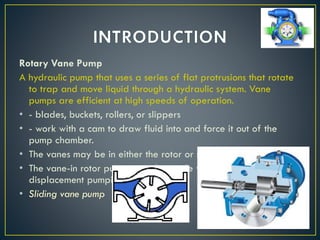
Rotary Vane Pump
A hydraulic pump that uses a series of flat protrusions that rotate
to trap and move liquid through a hydraulic system. Vane
pumps are efficient at high speeds of operation.
• - blades, buckets, rollers, or slippers
• - work with a cam to draw fluid into and force it out of the
pump chamber.
• The vanes may be in either the rotor or stator.
• The vane-in rotor pumps may be made with constant or variable
displacement pumping elements.
• Sliding vane pump
• While vane pumps can handle moderate viscosity liquids, they
excel at handling low viscosity liquids such as LP gas (propane),
ammonia, solvents, alcohol, fuel oils, gasoline, and refrigerants.
• Vane pumps have no internal metal-to-metal contact and self-
compensate for wear, enabling them to maintain peak
performance on these non-lubricating liquids.
• Though efficiency drops quickly
• Aerosol and Propellants
• Aviation Service - Fuel Transfer, Deicing
• Auto Industry - Fuels, Lubes, Refrigeration Coolants
• Bulk Transfer of LPG and NH3
• LPG Cylinder Filling
• Alcohols
• Refrigeration - Freons, Ammonia
• Solvents
• Aqueous solutions
• Externals (head, casing) - Cast iron, ductile iron, steel, and stainless steel.
• Vane, Pushrods - Carbon graphite, PEEK.
• End Plates - Carbon graphite
• Shaft Seal - Component mechanical seals, industry-standard cartridge
mechanical seals, and magnetically-driven pumps.
• Packing - Available from some vendors, but not usually recommended for
thin liquid service
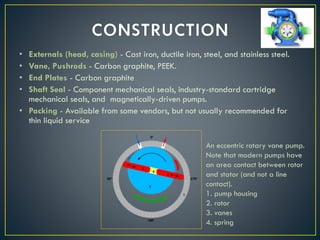
An eccentric rotary vane pump.
Note that modern pumps have
an area contact between rotor
and stator (and not a line
contact).
1. pump housing
2. rotor
3. vanes
4. spring
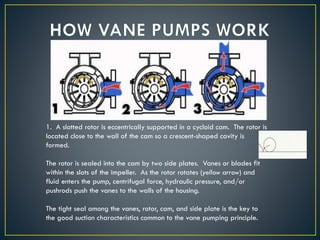
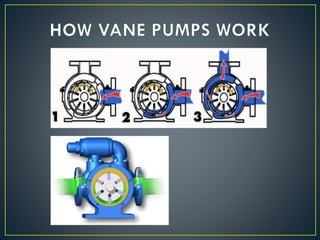
1. A slotted rotor is eccentrically supported in a cycloid cam. The rotor is
located close to the wall of the cam so a crescent-shaped cavity is
formed.
The rotor is sealed into the cam by two side plates. Vanes or blades fit
within the slots of the impeller. As the rotor rotates (yellow arrow) and
fluid enters the pump, centrifugal force, hydraulic pressure, and/or
pushrods push the vanes to the walls of the housing.
The tight seal among the vanes, rotor, cam, and side plate is the key to
the good suction characteristics common to the vane pumping principle.
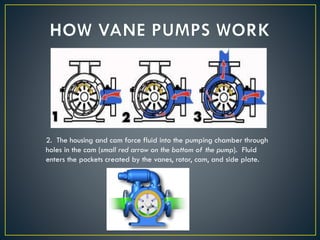
2. The housing and cam force fluid into the pumping chamber through
holes in the cam (small red arrow on the bottom of the pump). Fluid
enters the pockets created by the vanes, rotor, cam, and side plate.
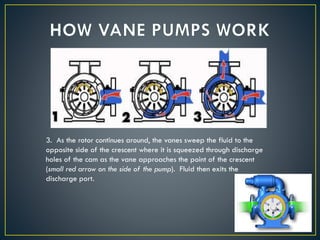
3. As the rotor continues around, the vanes sweep the fluid to the
opposite side of the crescent where it is squeezed through discharge
holes of the cam as the vane approaches the point of the crescent
(small red arrow on the side of the pump). Fluid then exits the
discharge port.
• Handles thin liquids at
relatively higher pressures
• Compensates for wear
through vane extension
• Sometimes preferred for
solvents, LPG
• Can run dry for short
periods
• Can have one seal or
stuffing box
• Develops good vacuum
• Can have two stuffing
boxes
• Complex housing and many
parts
• Not suitable for high
pressures
• Not suitable for high
viscosity
Not good with abrasives
• Vane pump are not well suited to handling abrasive
applications. Vane pumps have fixed end clearances on both
sides of the rotor and vanes similar to external gear
pumps. Once wear occurs, this clearance cannot be adjusted,
but some manufacturers supply replaceable or reversible end
plates.
• http://aptnk.in/wp-content/uploads/2010/10/Fuzzy-Logic-
Control-of-Air-Conditioners.pdf
• http://www.shorstmeyer.com/wxfaqs/humidity/humidity.html

Rotary Vane Pump

  • 1.
    ROTARY VANE PUMPINTERNAL AND EXTERNAL PRESSURIZED PRESENTER: LUKSHMAN RAO LECTURER’S NAME :MADAM SITI HARTINI
  • 2.
    Rotary Vane Pump Ahydraulic pump that uses a series of flat protrusions that rotate to trap and move liquid through a hydraulic system. Vane pumps are efficient at high speeds of operation. • - blades, buckets, rollers, or slippers • - work with a cam to draw fluid into and force it out of the pump chamber. • The vanes may be in either the rotor or stator. • The vane-in rotor pumps may be made with constant or variable displacement pumping elements. • Sliding vane pump
  • 3.
    • While vanepumps can handle moderate viscosity liquids, they excel at handling low viscosity liquids such as LP gas (propane), ammonia, solvents, alcohol, fuel oils, gasoline, and refrigerants. • Vane pumps have no internal metal-to-metal contact and self- compensate for wear, enabling them to maintain peak performance on these non-lubricating liquids. • Though efficiency drops quickly
  • 4.
    • Aerosol andPropellants • Aviation Service - Fuel Transfer, Deicing • Auto Industry - Fuels, Lubes, Refrigeration Coolants • Bulk Transfer of LPG and NH3 • LPG Cylinder Filling • Alcohols • Refrigeration - Freons, Ammonia • Solvents • Aqueous solutions
  • 5.
    • Externals (head,casing) - Cast iron, ductile iron, steel, and stainless steel. • Vane, Pushrods - Carbon graphite, PEEK. • End Plates - Carbon graphite • Shaft Seal - Component mechanical seals, industry-standard cartridge mechanical seals, and magnetically-driven pumps. • Packing - Available from some vendors, but not usually recommended for thin liquid service An eccentric rotary vane pump. Note that modern pumps have an area contact between rotor and stator (and not a line contact). 1. pump housing 2. rotor 3. vanes 4. spring
  • 6.
    1. A slottedrotor is eccentrically supported in a cycloid cam. The rotor is located close to the wall of the cam so a crescent-shaped cavity is formed. The rotor is sealed into the cam by two side plates. Vanes or blades fit within the slots of the impeller. As the rotor rotates (yellow arrow) and fluid enters the pump, centrifugal force, hydraulic pressure, and/or pushrods push the vanes to the walls of the housing. The tight seal among the vanes, rotor, cam, and side plate is the key to the good suction characteristics common to the vane pumping principle.
  • 7.
    2. The housingand cam force fluid into the pumping chamber through holes in the cam (small red arrow on the bottom of the pump). Fluid enters the pockets created by the vanes, rotor, cam, and side plate.
  • 8.
    3. As therotor continues around, the vanes sweep the fluid to the opposite side of the crescent where it is squeezed through discharge holes of the cam as the vane approaches the point of the crescent (small red arrow on the side of the pump). Fluid then exits the discharge port.
  • 10.
    • Handles thinliquids at relatively higher pressures • Compensates for wear through vane extension • Sometimes preferred for solvents, LPG • Can run dry for short periods • Can have one seal or stuffing box • Develops good vacuum • Can have two stuffing boxes • Complex housing and many parts • Not suitable for high pressures • Not suitable for high viscosity Not good with abrasives
  • 11.
    • Vane pumpare not well suited to handling abrasive applications. Vane pumps have fixed end clearances on both sides of the rotor and vanes similar to external gear pumps. Once wear occurs, this clearance cannot be adjusted, but some manufacturers supply replaceable or reversible end plates.
  • 12.