Simple Archive Architectures
Lighton Phiri and Hussein Suleman
Digital Libraries Laboratory
Department of Computer Science
University of Cape Town
IFLA '15 Workshop on Digital Libraries: research methods and tools
www.martinwest.uct.ac.za
2
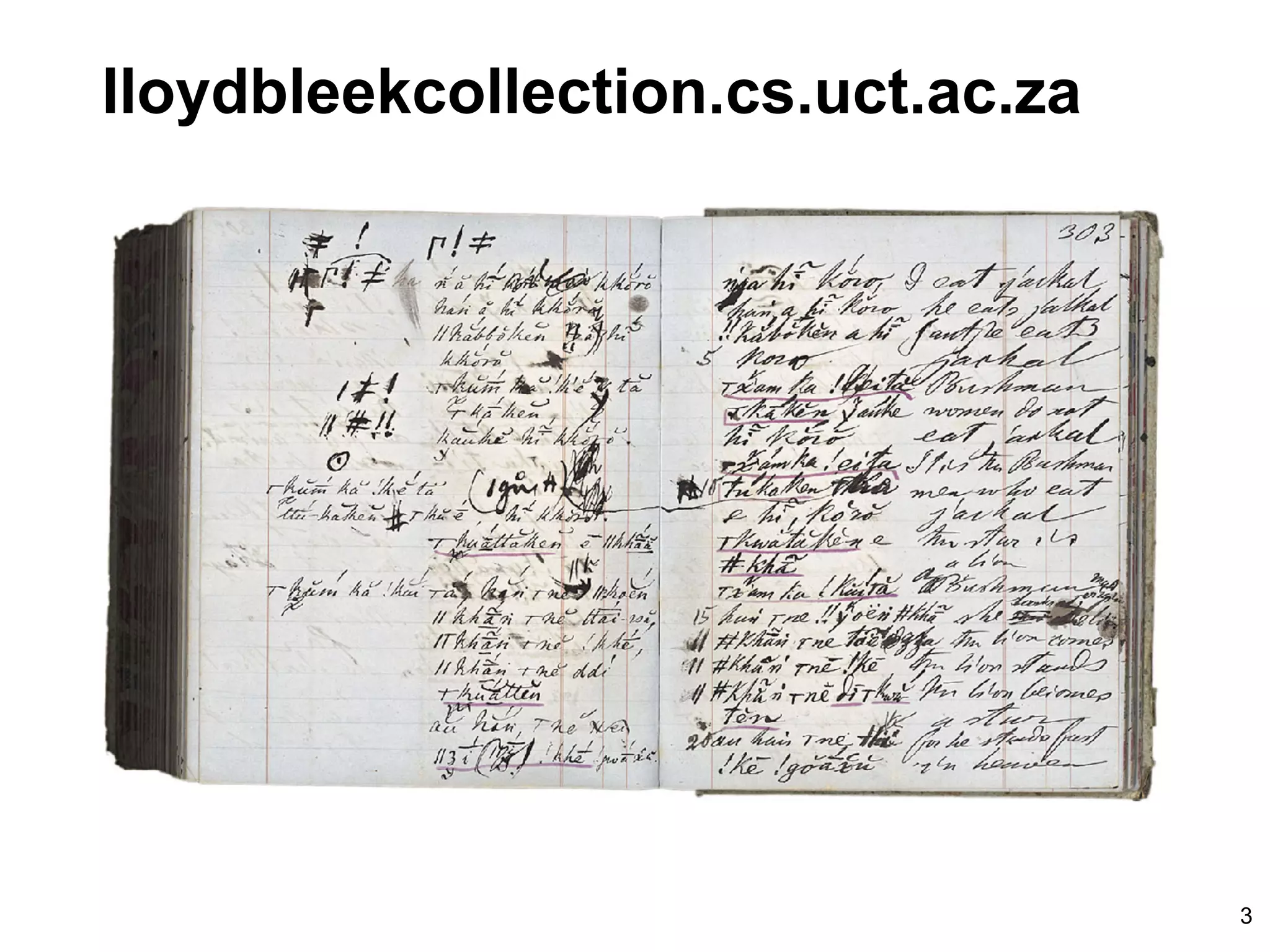
lloydbleekcollection.cs.uct.ac.za
3
Contextual Overview
● Problems and challenges
○ Preservation costs
○ Technical skills and expertise
○ Computing resources
● Proposed solution
○ Explicit simplicity and minimalism
○ Principled design of DL tools and services
● Motivation
○ Successes of minimalism---Project Gutenburg
4
Research goals
5
● Is it feasible to implement DLSes based
on simple architectures?
○ How should simplicity for DLS storage and
service architectures be defined?
■ Derivation of design principles
■ Simple repository prototype + case studies
○ What are the implications of simplifying DLS?
■ Developer user study
■ Performance evaluation
○ What are some of the comparative advantages
and disadvantages of simple architectures?
■ DSpace 3.1 comparative evaluation
6
Claim #1: Simplicity for DL storage and
services can be defined through derivation
Design Principles (1)
7
● Meta-analysis of popular software
applications
○ 12 candidate tools were considered---even split
between DL and non-DL tools
○ Tool attributes that potentially influenced design of
tools identified
○ Pair-wise comparison done to assess most
appropriate attributes
● Eight guiding design principles derived [1]
○ Applicable for simple and minimalistic architectures
Design Principles (2)
8
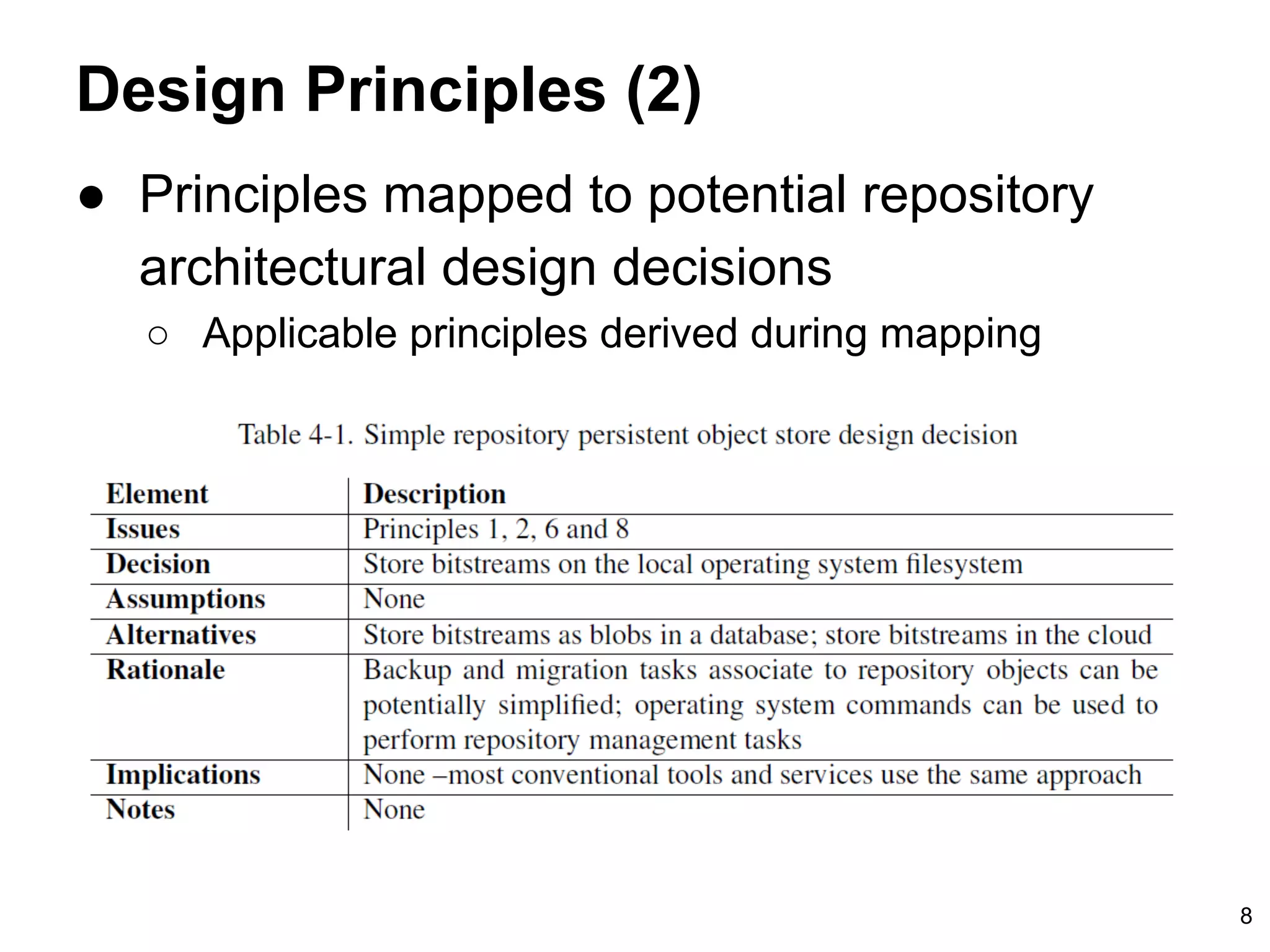
● Principles mapped to potential repository
architectural design decisions
○ Applicable principles derived during mapping
Simple Repository Prototype
9
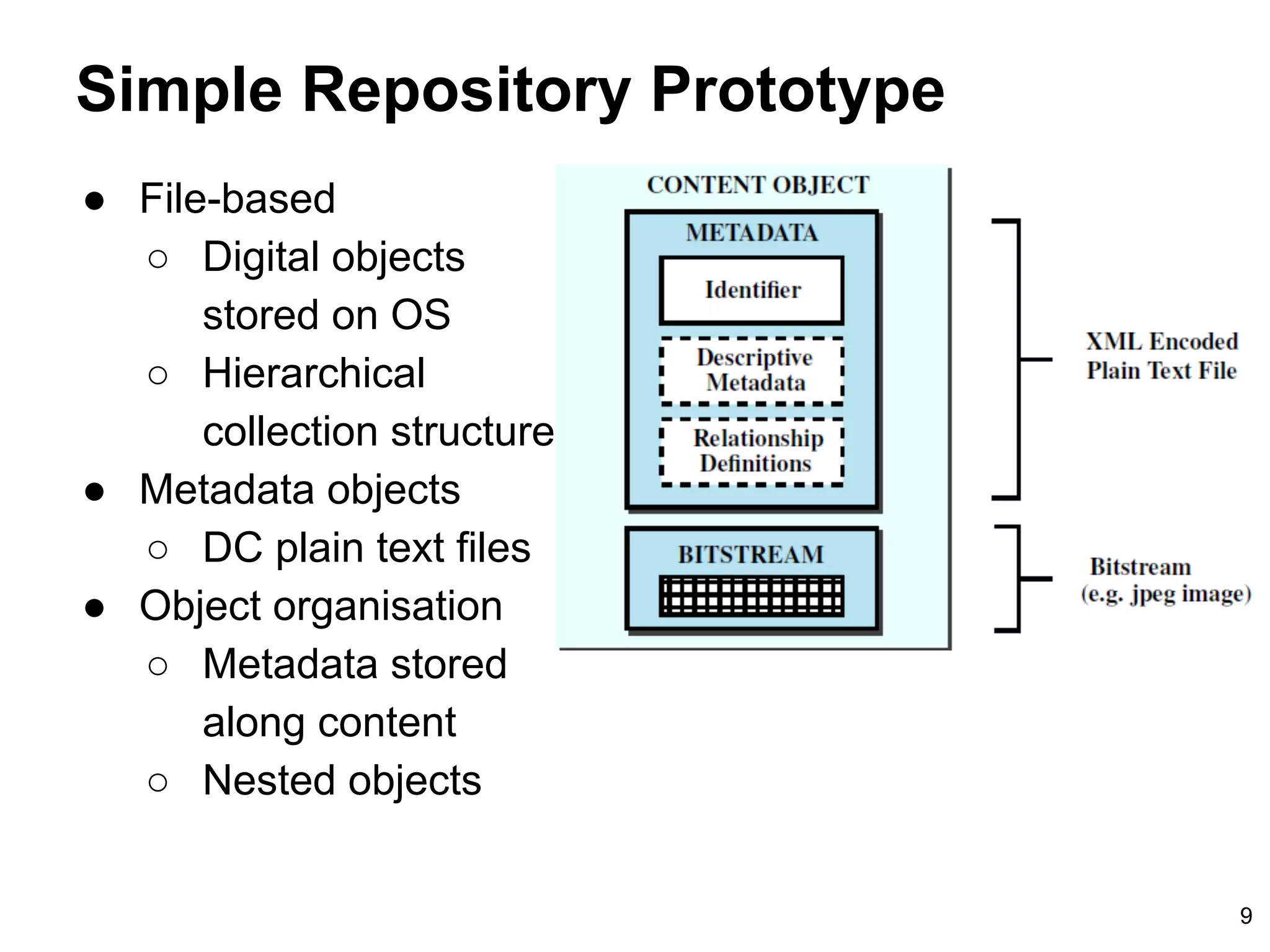
● File-based
○ Digital objects
stored on OS
○ Hierarchical
collection structure
● Metadata objects
○ DC plain text files
● Object organisation
○ Metadata stored
along content
○ Nested objects
Case studies
● Two case studies involving two different
collections
○ The Bleek and Lloyd Collection
■ Honours project: “Bonolo” [5]
○ SARU archaeological database
■ Honours project: “The School of Rock Art” [6]
10
“The Digital Bleek and Lloyd”
11
● 18,924 content
objects with a total
size of 6.2GB
● Two-level collection
structure
○ Virtual content
objects
representing
stories
● “Bonolo” [5] DLS
implemented using
repository sub-layer
“SARU Archaeological database”
12
● 72,333 content
objects with a total
size of 283GB
● Four-level collection
structure
● “The School of Rock
Art” [6] implemented
using repository sub-
layer
13
Claim #2: There are desirable features and
advantages possessed by DL tools and
services implemented using simple
architectures
User Study (1)
● Developer-oriented study
○ Assess simplicity and flexibility of simple repository
architecture
● Target population
○ 34 computer science honours students split into 12
groups of twos and threes
○ Basic developer skills and DL knowledge
● Approach
○ Participants tasked to build layered services using
simple repository
○ Post-experiment survey
14
User Study (2)
15
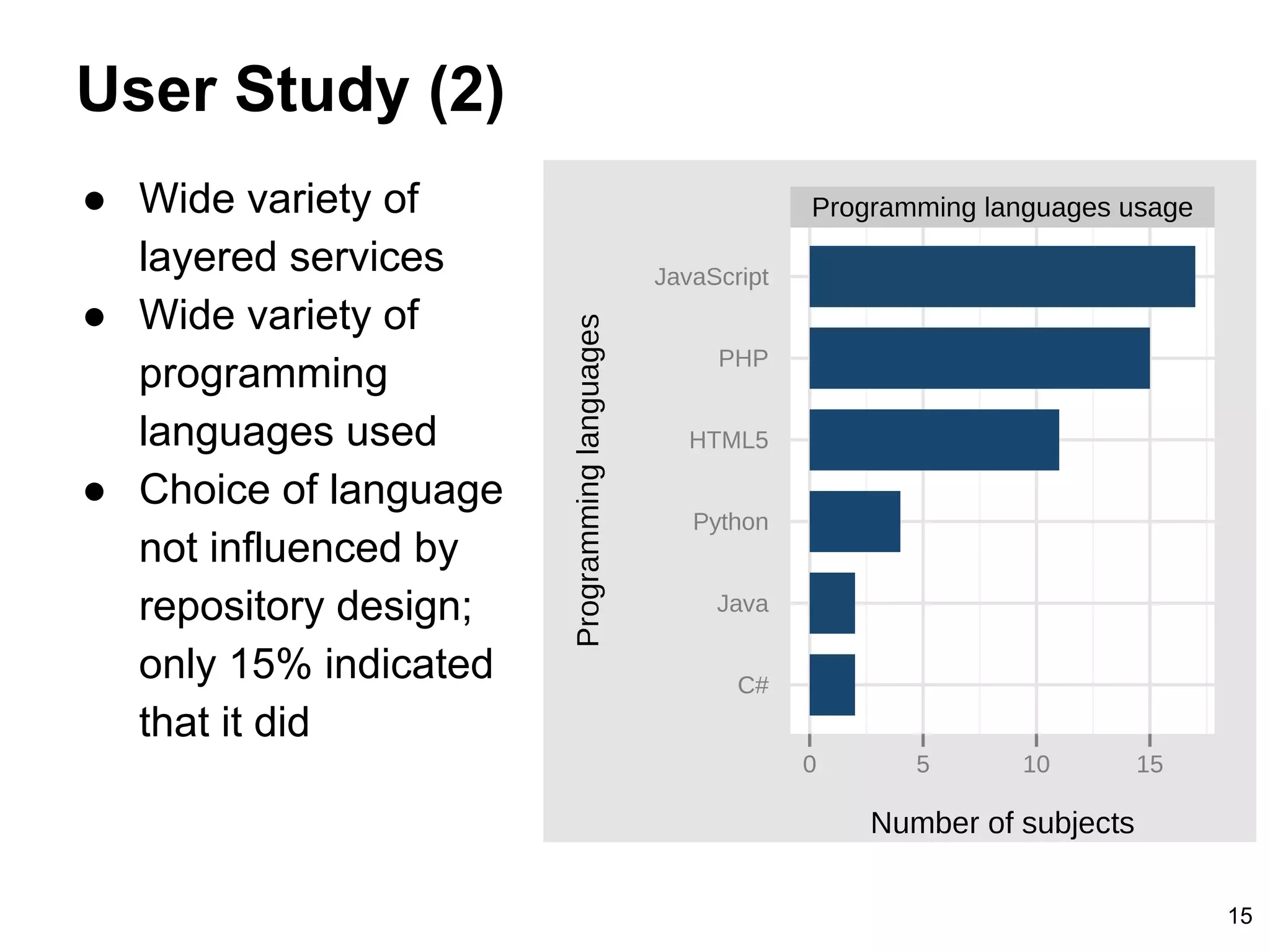
● Wide variety of
layered services
● Wide variety of
programming
languages used
● Choice of language
not influenced by
repository design;
only 15% indicated
that it did
User Study (3)
16
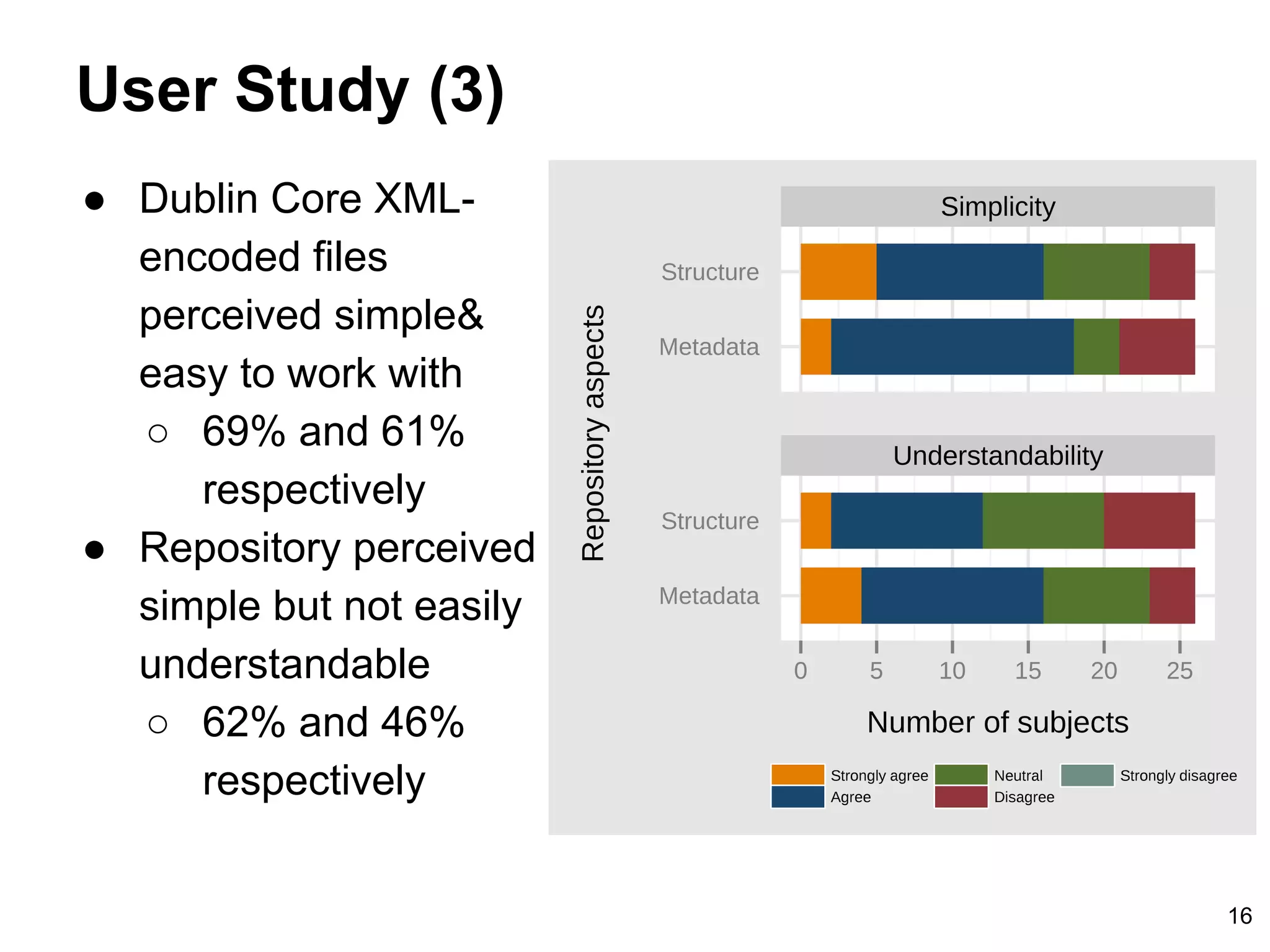
● Dublin Core XML-
encoded files
perceived simple&
easy to work with
○ 69% and 61%
respectively
● Repository perceived
simple but not easily
understandable
○ 62% and 46%
respectively
User Study (4)
● Simplicity resulted in more understandable
repository layer
○ Most participants found Dublin Core XML-
encoded metadata files easy and simple to
work with
○ Most participants found hierarchical structure
simple but not easily understandable
● Flexibility of interaction with repository layer
unaffected by simplicity
○ No influence on programming languages
17
Performance Evaluation (1)
● Assess and benchmark performance relative
to collection size
○ Typical DL service aspects evaluated. Ingestions,
search, OAI-PMH data provider and feed provider
○ Log analysis of production repository informed
aspects
● Comparative assessment with DSpace 3.1
● Experimental design
○ Metrics---Response time
○ Factors---Collection size and structure
18
Performance Evaluation (2)
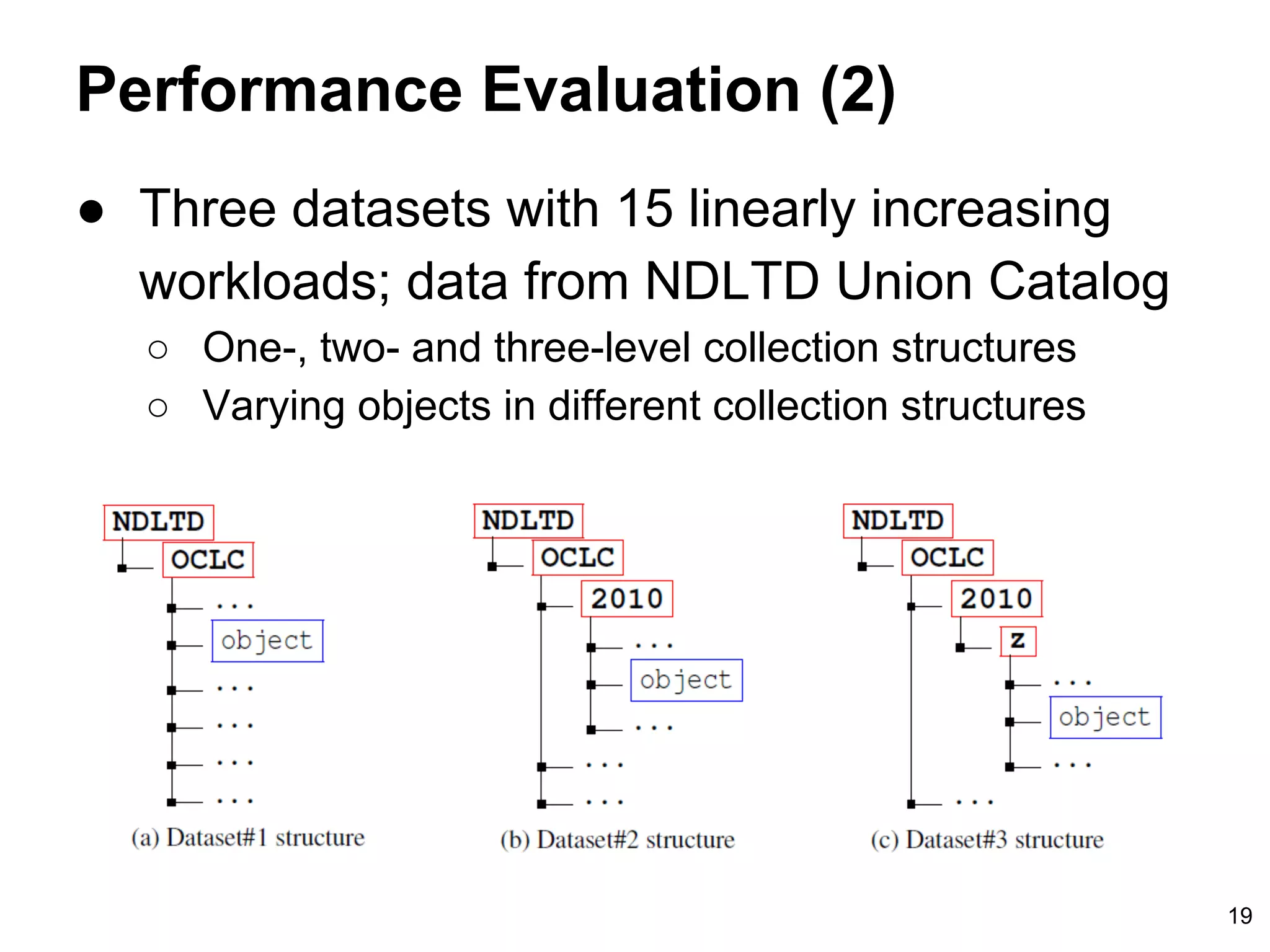
● Three datasets with 15 linearly increasing
workloads; data from NDLTD Union Catalog
○ One-, two- and three-level collection structures
○ Varying objects in different collection structures
19
Performance Evaluation (3)
20
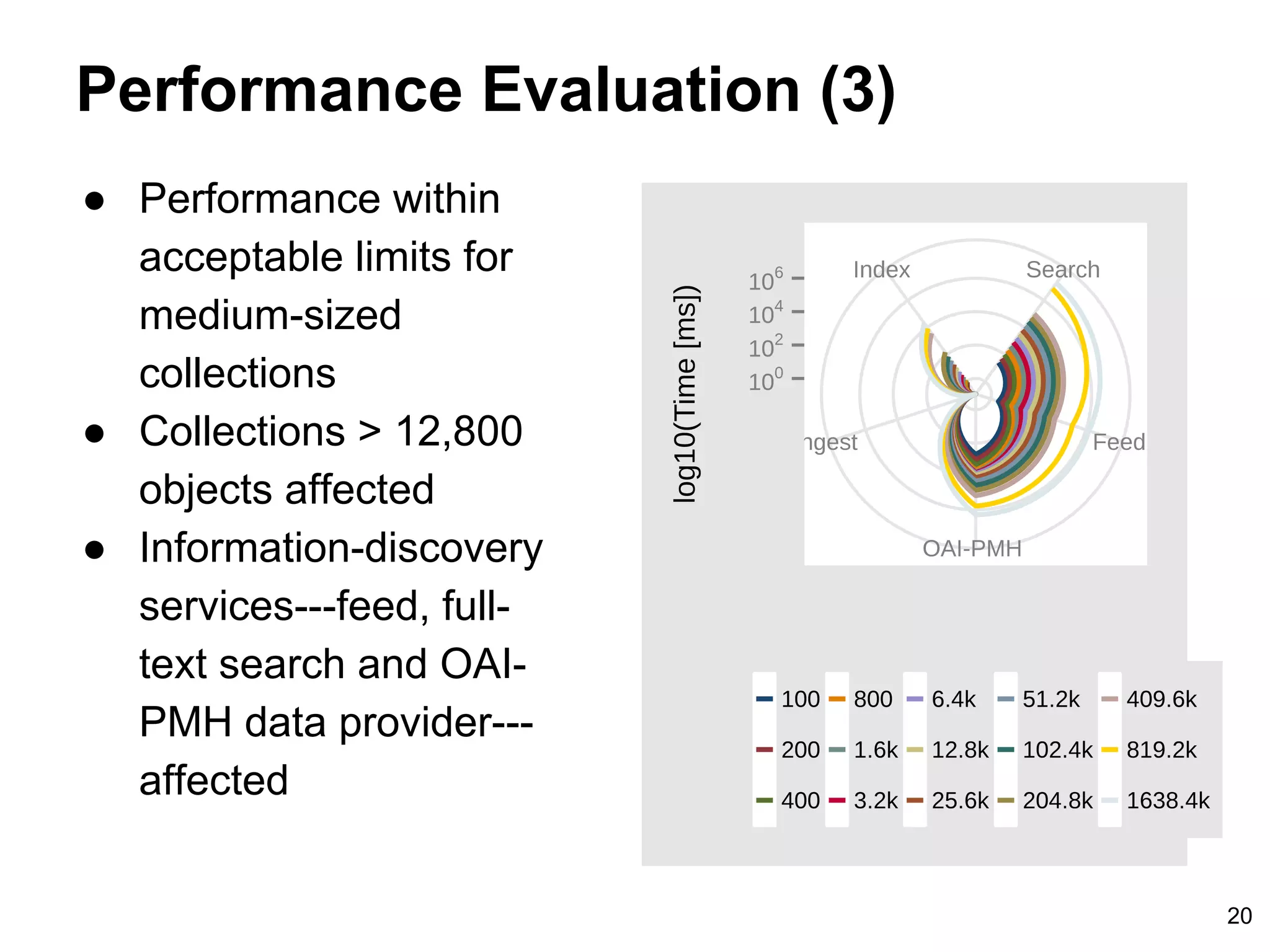
● Performance within
acceptable limits for
medium-sized
collections
● Collections > 12,800
objects affected
● Information-discovery
services---feed, full-
text search and OAI-
PMH data provider---
affected
Performance Evaluation (4)
● Performance benchmarking
○ Performance within acceptable limits for medium
sized collections
○ Performance degradation beyond 12 800 objects
○ Performance degradation adversely affects
information discovery services; ingestion process
unaffected by collection scale
● Comparison with DSpace 3.1
○ Ingestion performance outperformed DSpace 3.1
○ Information discovery services outperformed by
DSpace 3.1
21
Conclusions
● Principled DL design approach undertaken
● Feasibility of simple DL architectures
● Minimalism does not affect flexibility and
extensibility of DL tools and services
● Performance acceptable for small- and
medium-sized collection
● Comparable results with well-established
solutions
22
Bibliography
[1] Lighton Phiri and Hussein Suleman. In Search of Simplicity:
Redesigning the Digital Bleek and Lloyd. DESIDOC ‘12 32(4):
306–312, 2012.
[2] Lighton Phiri et al. Bonolo: A General Digital Library System for
File-based Collections. ICADL ‘12 7634:49–58, 2012.
[3] Lighton Phiri and Hussein Suleman. Flexible Design for Simple
Digital Library Tools and Services. SAICSIT ‘13 160–169, 2013
[4] Lighton Phiri and Hussein Suleman. Managing cultural heritage:
information systems architecture. Facet Publishing 13–134, 2015
[5] Stuart Hammar and Miles Robinson. Bonolo Project URL: http:
//goo.gl/EtblcR
[6] Kaitlyn Crawford et al. The School of Rock Art. URL: http://goo.
gl/U092EH
23
Questions?
http://dl.cs.uct.ac.za
Additional information

Simple Archive Architectures

  • 1.
    Simple Archive Architectures LightonPhiri and Hussein Suleman Digital Libraries Laboratory Department of Computer Science University of Cape Town IFLA '15 Workshop on Digital Libraries: research methods and tools
  • 2.
  • 3.
  • 4.
    Contextual Overview ● Problemsand challenges ○ Preservation costs ○ Technical skills and expertise ○ Computing resources ● Proposed solution ○ Explicit simplicity and minimalism ○ Principled design of DL tools and services ● Motivation ○ Successes of minimalism---Project Gutenburg 4
  • 5.
    Research goals 5 ● Isit feasible to implement DLSes based on simple architectures? ○ How should simplicity for DLS storage and service architectures be defined? ■ Derivation of design principles ■ Simple repository prototype + case studies ○ What are the implications of simplifying DLS? ■ Developer user study ■ Performance evaluation ○ What are some of the comparative advantages and disadvantages of simple architectures? ■ DSpace 3.1 comparative evaluation
  • 6.
    6 Claim #1: Simplicityfor DL storage and services can be defined through derivation
  • 7.
    Design Principles (1) 7 ●Meta-analysis of popular software applications ○ 12 candidate tools were considered---even split between DL and non-DL tools ○ Tool attributes that potentially influenced design of tools identified ○ Pair-wise comparison done to assess most appropriate attributes ● Eight guiding design principles derived [1] ○ Applicable for simple and minimalistic architectures
  • 8.
    Design Principles (2) 8 ●Principles mapped to potential repository architectural design decisions ○ Applicable principles derived during mapping
  • 9.
    Simple Repository Prototype 9 ●File-based ○ Digital objects stored on OS ○ Hierarchical collection structure ● Metadata objects ○ DC plain text files ● Object organisation ○ Metadata stored along content ○ Nested objects
  • 10.
    Case studies ● Twocase studies involving two different collections ○ The Bleek and Lloyd Collection ■ Honours project: “Bonolo” [5] ○ SARU archaeological database ■ Honours project: “The School of Rock Art” [6] 10
  • 11.
    “The Digital Bleekand Lloyd” 11 ● 18,924 content objects with a total size of 6.2GB ● Two-level collection structure ○ Virtual content objects representing stories ● “Bonolo” [5] DLS implemented using repository sub-layer
  • 12.
    “SARU Archaeological database” 12 ●72,333 content objects with a total size of 283GB ● Four-level collection structure ● “The School of Rock Art” [6] implemented using repository sub- layer
  • 13.
    13 Claim #2: Thereare desirable features and advantages possessed by DL tools and services implemented using simple architectures
  • 14.
    User Study (1) ●Developer-oriented study ○ Assess simplicity and flexibility of simple repository architecture ● Target population ○ 34 computer science honours students split into 12 groups of twos and threes ○ Basic developer skills and DL knowledge ● Approach ○ Participants tasked to build layered services using simple repository ○ Post-experiment survey 14
  • 15.
    User Study (2) 15 ●Wide variety of layered services ● Wide variety of programming languages used ● Choice of language not influenced by repository design; only 15% indicated that it did
  • 16.
    User Study (3) 16 ●Dublin Core XML- encoded files perceived simple& easy to work with ○ 69% and 61% respectively ● Repository perceived simple but not easily understandable ○ 62% and 46% respectively
  • 17.
    User Study (4) ●Simplicity resulted in more understandable repository layer ○ Most participants found Dublin Core XML- encoded metadata files easy and simple to work with ○ Most participants found hierarchical structure simple but not easily understandable ● Flexibility of interaction with repository layer unaffected by simplicity ○ No influence on programming languages 17
  • 18.
    Performance Evaluation (1) ●Assess and benchmark performance relative to collection size ○ Typical DL service aspects evaluated. Ingestions, search, OAI-PMH data provider and feed provider ○ Log analysis of production repository informed aspects ● Comparative assessment with DSpace 3.1 ● Experimental design ○ Metrics---Response time ○ Factors---Collection size and structure 18
  • 19.
    Performance Evaluation (2) ●Three datasets with 15 linearly increasing workloads; data from NDLTD Union Catalog ○ One-, two- and three-level collection structures ○ Varying objects in different collection structures 19
  • 20.
    Performance Evaluation (3) 20 ●Performance within acceptable limits for medium-sized collections ● Collections > 12,800 objects affected ● Information-discovery services---feed, full- text search and OAI- PMH data provider--- affected
  • 21.
    Performance Evaluation (4) ●Performance benchmarking ○ Performance within acceptable limits for medium sized collections ○ Performance degradation beyond 12 800 objects ○ Performance degradation adversely affects information discovery services; ingestion process unaffected by collection scale ● Comparison with DSpace 3.1 ○ Ingestion performance outperformed DSpace 3.1 ○ Information discovery services outperformed by DSpace 3.1 21
  • 22.
    Conclusions ● Principled DLdesign approach undertaken ● Feasibility of simple DL architectures ● Minimalism does not affect flexibility and extensibility of DL tools and services ● Performance acceptable for small- and medium-sized collection ● Comparable results with well-established solutions 22
  • 23.
    Bibliography [1] Lighton Phiriand Hussein Suleman. In Search of Simplicity: Redesigning the Digital Bleek and Lloyd. DESIDOC ‘12 32(4): 306–312, 2012. [2] Lighton Phiri et al. Bonolo: A General Digital Library System for File-based Collections. ICADL ‘12 7634:49–58, 2012. [3] Lighton Phiri and Hussein Suleman. Flexible Design for Simple Digital Library Tools and Services. SAICSIT ‘13 160–169, 2013 [4] Lighton Phiri and Hussein Suleman. Managing cultural heritage: information systems architecture. Facet Publishing 13–134, 2015 [5] Stuart Hammar and Miles Robinson. Bonolo Project URL: http: //goo.gl/EtblcR [6] Kaitlyn Crawford et al. The School of Rock Art. URL: http://goo. gl/U092EH 23
  • 24.