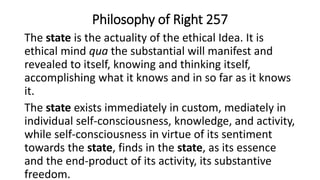
Philosophy of Right 257
The state is the actuality of the ethical Idea. It is
ethical mind qua the substantial will manifest and
revealed to itself, knowing and thinking itself,
accomplishing what it knows and in so far as it knows
it.
The state exists immediately in custom, mediately in
individual self-consciousness, knowledge, and activity,
while self-consciousness in virtue of its sentiment
towards the state, finds in the state, as its essence
and the end-product of its activity, its substantive
freedom.
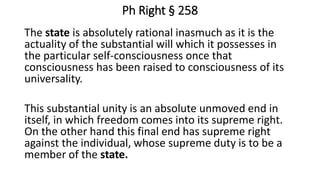
Ph Right § 258
The state is absolutely rational inasmuch as it is the
actuality of the substantial will which it possesses in
the particular self-consciousness once that
consciousness has been raised to consciousness of its
universality.
This substantial unity is an absolute unmoved end in
itself, in which freedom comes into its supreme right.
On the other hand this final end has supreme right
against the individual, whose supreme duty is to be a
member of the state.
Ph of Right 258
The state in and by itself is the ethical whole, the actualisation of
freedom; and it is an absolute end of reason that freedom should be
actual. The state is mind on earth and consciously realising itself there.
In nature, on the other hand, mind actualises itself only as its own
other, as mind asleep.
Only when it is present in consciousness, when it knows itself as a
really existent object, is it the state. In considering freedom, the
starting-point must be not individuality, the single self-consciousness,
but only the essence of self-consciousness; for whether man knows it
or not, this essence is externally realised as a self-subsistent power in
which single individuals are only moments. The march of God in the
world, that is what the state is.
Ph of Right 258
• The basis of the state is the power of reason actualising itself as will. In
considering the Idea of the state, we must not have our eyes on particular
states or on particular institutions. Instead we must consider the Idea, this
actual God, by itself. On some principle or other, any state may be shown
to be bad, this or that defect may be found in it; and yet, at any rate if one
of the mature states of our epoch is in question, it has in it the moments
essential to the existence of the state.
• But since it is easier to find defects than to understand the affirmative, we
may readily fall into the mistake of looking at isolated aspects of the state
and so forgetting its inward organic life. The state is no ideal work of art; it
stands on earth and so in the sphere of caprice, chance, and error, and bad
behaviour may disfigure it in many respects. But the ugliest of men, or a
criminal, or an invalid, or a cripple, is still always a living man. The
affirmative, life, subsists despite his defects, and it is this affirmative factor
which is our theme here.
§ 259
The Idea of the state:
(A) has immediate actuality and is the individual state as a self-
dependent organism – the Constitution or Constitutional Law;
(B) passes over into the relation of one state to other states –
International Law;
(C) is the universal Idea as a genus and as an absolute power over
individual states – the mind which gives itself its actuality in the
process of World-History.
§ 260
The state is the actuality of concrete freedom.
But concrete freedom consists in this, that personal
individuality and its particular interests not only achieve
their complete development and gain explicit recognition
for their right (as they do in the sphere of the family and
civil society) but, for one thing, they also pass over of their
own accord into the interest of the universal, and, for
another thing, they know and will the universal; they even
recognise it as their own substantive mind; they take it as
their end and aim and are active in its pursuit.
Hegel quotes on state

Hegel quotes on state

  • 18.
    Philosophy of Right257 The state is the actuality of the ethical Idea. It is ethical mind qua the substantial will manifest and revealed to itself, knowing and thinking itself, accomplishing what it knows and in so far as it knows it. The state exists immediately in custom, mediately in individual self-consciousness, knowledge, and activity, while self-consciousness in virtue of its sentiment towards the state, finds in the state, as its essence and the end-product of its activity, its substantive freedom.
  • 19.
    Ph Right §258 The state is absolutely rational inasmuch as it is the actuality of the substantial will which it possesses in the particular self-consciousness once that consciousness has been raised to consciousness of its universality. This substantial unity is an absolute unmoved end in itself, in which freedom comes into its supreme right. On the other hand this final end has supreme right against the individual, whose supreme duty is to be a member of the state.
  • 20.
    Ph of Right258 The state in and by itself is the ethical whole, the actualisation of freedom; and it is an absolute end of reason that freedom should be actual. The state is mind on earth and consciously realising itself there. In nature, on the other hand, mind actualises itself only as its own other, as mind asleep. Only when it is present in consciousness, when it knows itself as a really existent object, is it the state. In considering freedom, the starting-point must be not individuality, the single self-consciousness, but only the essence of self-consciousness; for whether man knows it or not, this essence is externally realised as a self-subsistent power in which single individuals are only moments. The march of God in the world, that is what the state is.
  • 21.
    Ph of Right258 • The basis of the state is the power of reason actualising itself as will. In considering the Idea of the state, we must not have our eyes on particular states or on particular institutions. Instead we must consider the Idea, this actual God, by itself. On some principle or other, any state may be shown to be bad, this or that defect may be found in it; and yet, at any rate if one of the mature states of our epoch is in question, it has in it the moments essential to the existence of the state. • But since it is easier to find defects than to understand the affirmative, we may readily fall into the mistake of looking at isolated aspects of the state and so forgetting its inward organic life. The state is no ideal work of art; it stands on earth and so in the sphere of caprice, chance, and error, and bad behaviour may disfigure it in many respects. But the ugliest of men, or a criminal, or an invalid, or a cripple, is still always a living man. The affirmative, life, subsists despite his defects, and it is this affirmative factor which is our theme here.
  • 22.
    § 259 The Ideaof the state: (A) has immediate actuality and is the individual state as a self- dependent organism – the Constitution or Constitutional Law; (B) passes over into the relation of one state to other states – International Law; (C) is the universal Idea as a genus and as an absolute power over individual states – the mind which gives itself its actuality in the process of World-History.
  • 23.
    § 260 The stateis the actuality of concrete freedom. But concrete freedom consists in this, that personal individuality and its particular interests not only achieve their complete development and gain explicit recognition for their right (as they do in the sphere of the family and civil society) but, for one thing, they also pass over of their own accord into the interest of the universal, and, for another thing, they know and will the universal; they even recognise it as their own substantive mind; they take it as their end and aim and are active in its pursuit.