Media Language language
Film Form
A Level Media Studies
Introduction to film language and film form
 You need to learn the basic tools of analysis that
is required to address the questions in the
exams, in coursework and learn the language
you should get used to using whenever you talk
about films.
 Through the analysis of clips and discussing
each other’s film viewing, aspects of industry
can also be introduced.
 Non-Hollywood films will be used to analyse
micro aspects, a gentle introduction to different
genres of films and film form.
 Watching film clips means you are not really
working – doesn’t it!?
Signs
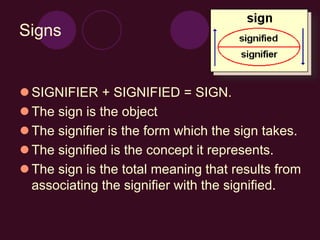
 SIGNIFIER + SIGNIFIED = SIGN.
 The sign is the object
 The signifier is the form which the sign takes.
 The signified is the concept it represents.
 The sign is the total meaning that results from
associating the signifier with the signified.
Semiotics
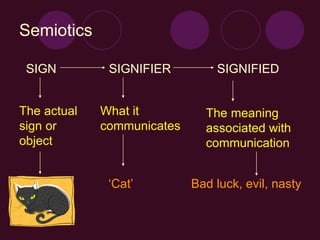
SIGN SIGNIFIER SIGNIFIED
The actual
sign or
object
What it
communicates
The meaning
associated with
communication
‘Cat’ Bad luck, evil, nasty
MACRO and MICRO elements of
film language
 MACRO -
 GENRE
 NARRATIVE
 (REPRESENTATION)
 MICRO –
 CINEMATOGRAPHY
 SOUND
 EDITING
 MISE EN SCENE
 LIGHTING
Cinematography
Refers to the visual aspects of a film’s
language
Camera shots and movement can give us
clear indications of emotion, motive and
give audiences clues as to things that may
be about to happen.
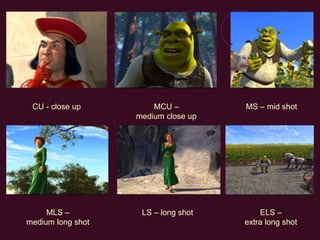
MCU –
medium close up
MLS –
medium long shot
CU - close up
LS – long shot
MS – mid shot
ELS –
extra long shot
Camera shots
Close-up (and extreme close-up)
Medium Close Up
Mid-shot
Mid-long shot
Long shot
Wide (long) shot (often establishing shot)
Low angle shot
High angle shot
Birds eye view
Camera movement
Pan (side to side)
Tilt (up and down)
Whip pan
Crane shot
Tracking shot
It’s important students practise identifying
these shots and link to their developing
knowledge of genre and narrative.
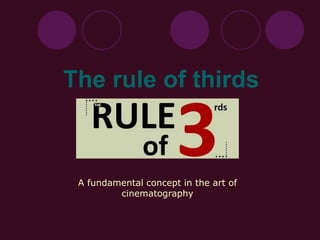
The rule of thirds
A fundamental concept in the art of
cinematography
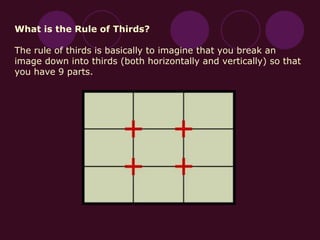
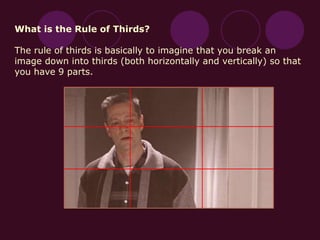
What is the Rule of Thirds?
The rule of thirds is basically to imagine that you break an
image down into thirds (both horizontally and vertically) so that
you have 9 parts.
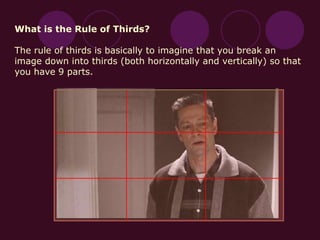
What is the Rule of Thirds?
The rule of thirds is basically to imagine that you break an
image down into thirds (both horizontally and vertically) so that
you have 9 parts.
What is the Rule of Thirds?
The rule of thirds is basically to imagine that you break an
image down into thirds (both horizontally and vertically) so that
you have 9 parts.
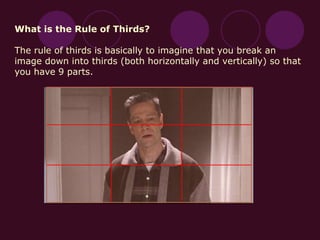
What is the Rule of Thirds?
The rule of thirds is basically to imagine that you break an
image down into thirds (both horizontally and vertically) so that
you have 9 parts.
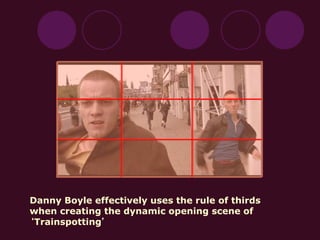
Danny Boyle effectively uses the rule of thirds
when creating the dynamic opening scene of
‘Trainspotting’
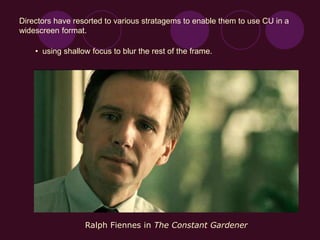
• using shallow focus to blur the rest of the frame.
Directors have resorted to various stratagems to enable them to use CU in a
widescreen format.
Ralph Fiennes in The Constant Gardener
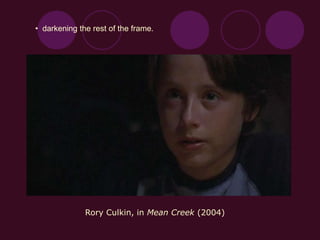
• darkening the rest of the frame.
Rory Culkin, in Mean Creek (2004)
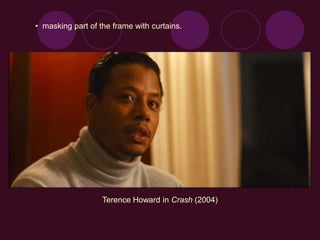
• masking part of the frame with curtains.
Terence Howard in Crash (2004)
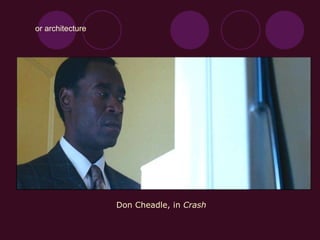
or architecture
Don Cheadle, in Crash
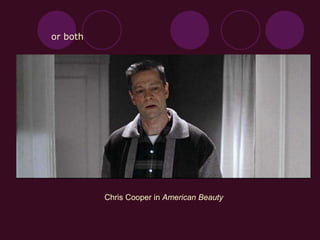
or both
Chris Cooper in American Beauty
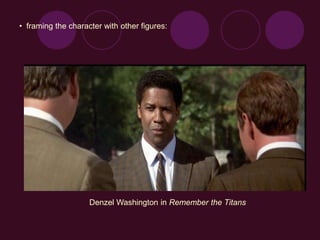
• framing the character with other figures:
Denzel Washington in Remember the Titans
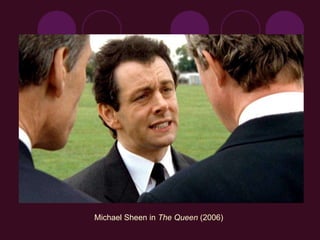
Michael Sheen in The Queen (2006)
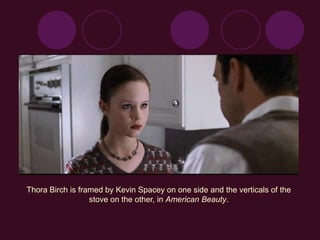
Thora Birch is framed by Kevin Spacey on one side and the verticals of the
stove on the other, in American Beauty.
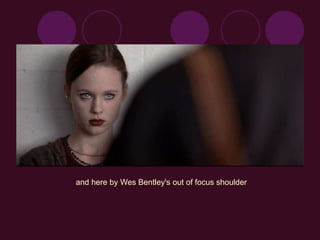
and here by Wes Bentley's out of focus shoulder
a camera tilted to one side so the horizon
is on a slant is canted; also called a
'Dutch angle' or a 'Dutch tilt'
[not to be confused with a 'tilt shot' which
involves camera movement.]
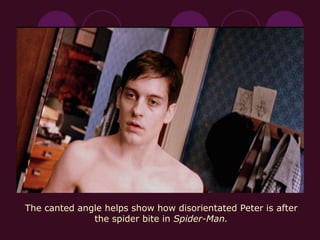
canted angle
The canted angle helps show how disorientated Peter is after
the spider bite in Spider-Man.
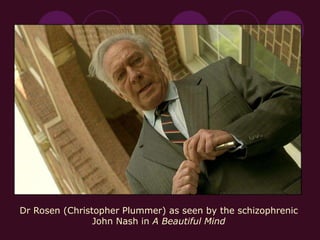
Dr Rosen (Christopher Plummer) as seen by the schizophrenic
John Nash in A Beautiful Mind
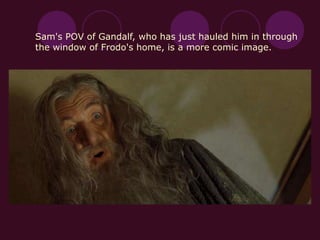
Sam's POV of Gandalf, who has just hauled him in through
the window of Frodo's home, is a more comic image.
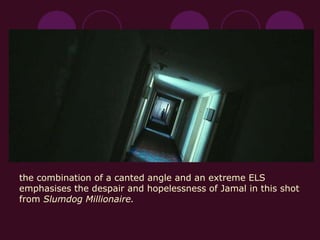
the combination of a canted angle and an extreme ELS
emphasises the despair and hopelessness of Jamal in this shot
from Slumdog Millionaire.
focus
depth of field
the distance through which elements in an image are
in sharp focus
Greater depth of field will be obtained in bright rather
than dull light, and with a narrow lens aperture; or with a
wide-angle rather than a long lens.
A shallow depth of field is often used as a technique to
focus audience attention on the most significant aspect of
a scene.
Depth of field is directly connected, but not to be confused,
with focus.
focus is the quality – the 'sharpness' of an object as it is
registered in the image
depth of field refers to the extent to which the space
represented is in focus.
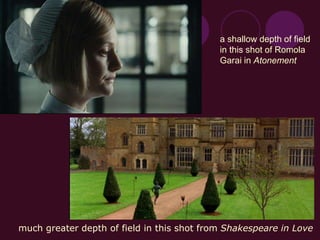
a shallow depth of field
in this shot of Romola
Garai in Atonement
much greater depth of field in this shot from Shakespeare in Love
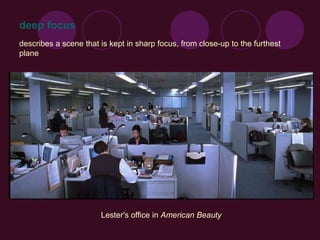
describes a scene that is kept in sharp focus, from close-up to the furthest
plane
Lester's office in American Beauty
deep focus
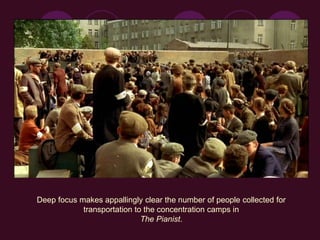
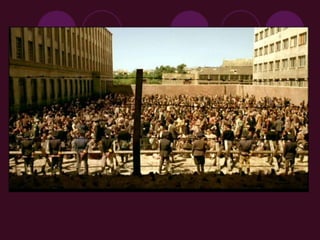
Deep focus makes appallingly clear the number of people collected for
transportation to the concentration camps in
The Pianist.
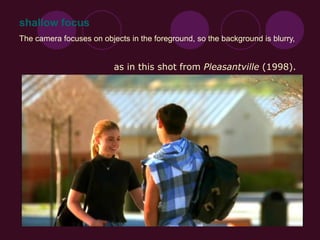
The camera focuses on objects in the foreground, so the background is blurry,
as in this shot from Pleasantville (1998).
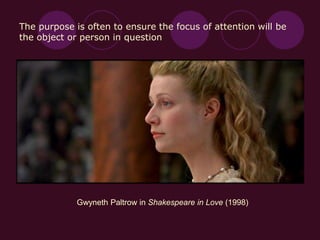
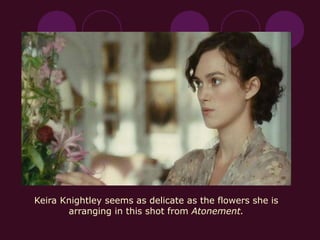
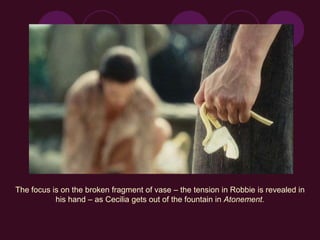
shallow focus
Gwyneth Paltrow in Shakespeare in Love (1998)
The purpose is often to ensure the focus of attention will be
the object or person in question
Keira Knightley seems as delicate as the flowers she is
arranging in this shot from Atonement.
The focus is on the broken fragment of vase – the tension in Robbie is revealed in
his hand – as Cecilia gets out of the fountain in Atonement.
Editing
 Analysing editing is about:
 How it changes the pace of the narrative
 What the editing technique used tells us about
where the narrative is.
 Lots of techniques to use but most common –
 STRAIGHT CUT
 FADE
 DISSOLVE
 Others – wipe, jump cut
The 4 transition types
Cut
Dissolve
Fade
Wipe
Cut
Most common type of transition
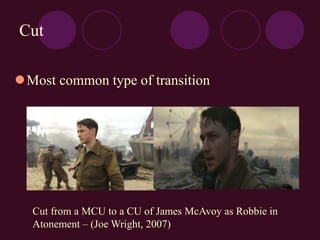
Cut from a MCU to a CU of James McAvoy as Robbie in
Atonement – (Joe Wright, 2007)
Why do we use it?
Most invisible, looks realistic
Does not break the viewer’s suspension of
disbelief
change the scene
compress time
vary the point of view
build up an image or idea
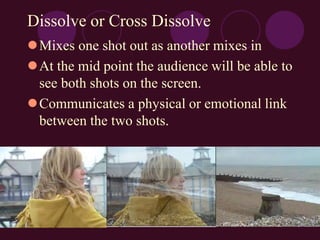
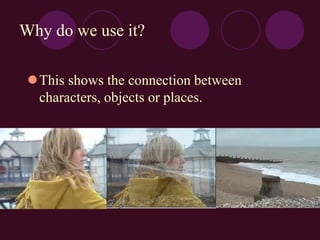
Dissolve or Cross Dissolve
Mixes one shot out as another mixes in
At the mid point the audience will be able to
see both shots on the screen.
Communicates a physical or emotional link
between the two shots.
Why do we use it?
This shows the connection between
characters, objects or places.
The 2 types of editing
Continuity
Montage
Continuity Editing
The usual style of Hollywood realist feature
films. Cuts are unobtrusive, supporting rather
than dominating the narrative. It takes the film
from one shot to the next, moving forward in
time.
The editing isn’t really invisible but the
conventions have become so familiar to visual
literates that we don’t notice them.
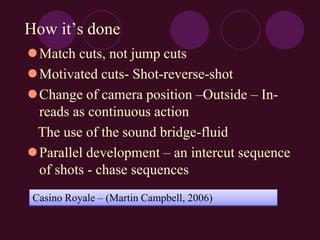
How it’s done
Match cuts, not jump cuts
Motivated cuts- Shot-reverse-shot
Change of camera position –Outside – In-
reads as continuous action
The use of the sound bridge-fluid
Parallel development – an intercut sequence
of shots - chase sequences
Casino Royale – (Martin Campbell, 2006)
Montage Editing
The juxtaposition of shots to represent action
or ideas, using conspicuous techniques.
It creates impact as the viewer is forced to
make connections between the images shown.
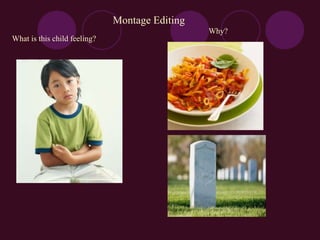
Montage Editing
What is this child feeling?
Why?
How it’s done
Relatively frequent cuts
Use of close ups
Dissolves
Fades
Jump cuts
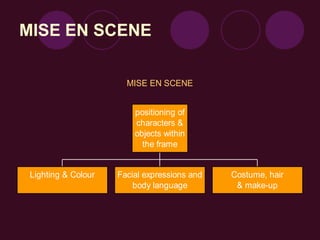
MISE EN SCENE
MISE EN SCENE
Lighting & Colour Facial expressions and
body language
Costume, hair
& make-up
positioning of
characters &
objects within
the frame
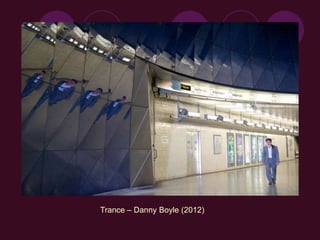
Trance – Danny Boyle (2012)
Setting
Where is it?
What props are used?
Was a set created or did they shoot on
location? Can you tell?
What kind of mood is being conveyed
through this setting?
The overall design of a setting can significantly shape how we
understand story action. In manipulating a shot’s setting, the director
may create props. Props may be functional or become a motif – have
another meaning assigned to them.
Costume and Makeup
Should instill the proper mood.
Represent the characters personality, social
status, and the time period in which they
exist.
Costume often coordinates with setting.
Like setting, costume can have specific functions in the total film,
and the range of possibilities is huge. Costumes may be realistic or
stylised and can also form motifs. Make-up is also necessary and
useful in denoting character.
Lighting
Lighting can be manipulated in many ways to create highlights and
shadows. Highlights provide important cues to the texture of the
surface. There are two basic types of shadow : attached and shading
or cast shadows. An attached shadow occurs when light fails to
illuminate part of an object because of the object’s shape or surface
features. Cast shadows are caused by an object being between the
light source and the camera. Types of lighting also include :
• Sidelight/ crosslight
• Backlighting
• Underlighting
• Top lighting
• Key light
• Fill light
• Low-key illumination
LIGHTING & COLOUR
 Is used to create mood and atmosphere
 Positioning of lights creates different effects
 High key lighting
 Low key lighting
Sound
 The world of the film as we see it on the cinema
screen is known as the DIEGETIC world.
 When we watch a film the sound we hear can be
DIEGETIC OR NON-DIEGETIC.
 DIEGETIC SOUND is sound that is part of the
film world.
 NON-DIEGETIC sound is sound that is not
recognised as part of the film world – e.g. voice
over, background music
 PARALLEL SOUND – sound which compliments
the visual image.
 CONTRAPUNTAL SOUND – sound which does
not fit with the image but helps to create new
meanings.
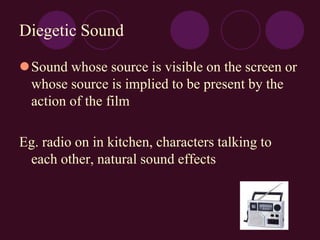
Diegetic Sound
Sound whose source is visible on the screen or
whose source is implied to be present by the
action of the film
Eg. radio on in kitchen, characters talking to
each other, natural sound effects
The Powers of Sound
In addition, sound gives a new value to
silence.
For example, a quiet passage in a film can
create almost unbearable tension, forcing the
viewer to concentrate on the screen and wait
in anticipation for whatever sound will
emerge.
Contrapuntal Sound
Sound used in counterpoint or contrast to the
image
Eg. in horror films a children’s nursery rhyme
playing as suspense builds
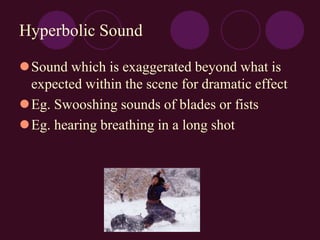
Hyperbolic Sound
Sound which is exaggerated beyond what is
expected within the scene for dramatic effect
Eg. Swooshing sounds of blades or fists
Eg. hearing breathing in a long shot
Sound & Genre
Elements of sound reveal key aspects of
genre to an audience
 Sound is important in informing us about
the time in which a film is set or the kind of
action we can expect
 Certain types of music have become
synonymous with particular genres
Sound & Narrative
Voice overs allow us to see things from a
particular character’s point of view
They are often used to introduce and
‘round up’ the narrative
SOUND BRIDGES aid continuity as sound
from one sequence carries on into the next
SUMMARY
 Understanding and applying film language is key
to your student’s success on this course
 Give them plenty of time to apply knowledge
through analysing clips as a class or in groups
but also consider- individual presentations if you
have confident students.
 Putting knowledge into practise also re-enforces
learning and gives you an opportunity to start
them on some coursework ( i.e. make some film
clips of your own!)

Media language film form (1)

  • 1.
    Media Language language FilmForm A Level Media Studies
  • 2.
    Introduction to filmlanguage and film form  You need to learn the basic tools of analysis that is required to address the questions in the exams, in coursework and learn the language you should get used to using whenever you talk about films.  Through the analysis of clips and discussing each other’s film viewing, aspects of industry can also be introduced.  Non-Hollywood films will be used to analyse micro aspects, a gentle introduction to different genres of films and film form.  Watching film clips means you are not really working – doesn’t it!?
  • 3.
    Signs  SIGNIFIER +SIGNIFIED = SIGN.  The sign is the object  The signifier is the form which the sign takes.  The signified is the concept it represents.  The sign is the total meaning that results from associating the signifier with the signified.
  • 4.
    Semiotics SIGN SIGNIFIER SIGNIFIED Theactual sign or object What it communicates The meaning associated with communication ‘Cat’ Bad luck, evil, nasty
  • 5.
    MACRO and MICROelements of film language  MACRO -  GENRE  NARRATIVE  (REPRESENTATION)  MICRO –  CINEMATOGRAPHY  SOUND  EDITING  MISE EN SCENE  LIGHTING
  • 6.
    Cinematography Refers to thevisual aspects of a film’s language Camera shots and movement can give us clear indications of emotion, motive and give audiences clues as to things that may be about to happen.
  • 7.
    MCU – medium closeup MLS – medium long shot CU - close up LS – long shot MS – mid shot ELS – extra long shot
  • 8.
    Camera shots Close-up (andextreme close-up) Medium Close Up Mid-shot Mid-long shot Long shot Wide (long) shot (often establishing shot) Low angle shot High angle shot Birds eye view
  • 9.
    Camera movement Pan (sideto side) Tilt (up and down) Whip pan Crane shot Tracking shot It’s important students practise identifying these shots and link to their developing knowledge of genre and narrative.
  • 10.
    The rule ofthirds A fundamental concept in the art of cinematography
  • 11.
    What is theRule of Thirds? The rule of thirds is basically to imagine that you break an image down into thirds (both horizontally and vertically) so that you have 9 parts.
  • 12.
    What is theRule of Thirds? The rule of thirds is basically to imagine that you break an image down into thirds (both horizontally and vertically) so that you have 9 parts.
  • 13.
    What is theRule of Thirds? The rule of thirds is basically to imagine that you break an image down into thirds (both horizontally and vertically) so that you have 9 parts.
  • 14.
    What is theRule of Thirds? The rule of thirds is basically to imagine that you break an image down into thirds (both horizontally and vertically) so that you have 9 parts.
  • 15.
    Danny Boyle effectivelyuses the rule of thirds when creating the dynamic opening scene of ‘Trainspotting’
  • 16.
    • using shallowfocus to blur the rest of the frame. Directors have resorted to various stratagems to enable them to use CU in a widescreen format. Ralph Fiennes in The Constant Gardener
  • 17.
    • darkening therest of the frame. Rory Culkin, in Mean Creek (2004)
  • 18.
    • masking partof the frame with curtains. Terence Howard in Crash (2004)
  • 19.
  • 20.
    or both Chris Cooperin American Beauty
  • 21.
    • framing thecharacter with other figures: Denzel Washington in Remember the Titans
  • 22.
    Michael Sheen inThe Queen (2006)
  • 23.
    Thora Birch isframed by Kevin Spacey on one side and the verticals of the stove on the other, in American Beauty.
  • 24.
    and here byWes Bentley's out of focus shoulder
  • 25.
    a camera tiltedto one side so the horizon is on a slant is canted; also called a 'Dutch angle' or a 'Dutch tilt' [not to be confused with a 'tilt shot' which involves camera movement.] canted angle
  • 26.
    The canted anglehelps show how disorientated Peter is after the spider bite in Spider-Man.
  • 27.
    Dr Rosen (ChristopherPlummer) as seen by the schizophrenic John Nash in A Beautiful Mind
  • 28.
    Sam's POV ofGandalf, who has just hauled him in through the window of Frodo's home, is a more comic image.
  • 29.
    the combination ofa canted angle and an extreme ELS emphasises the despair and hopelessness of Jamal in this shot from Slumdog Millionaire.
  • 30.
  • 31.
    depth of field thedistance through which elements in an image are in sharp focus Greater depth of field will be obtained in bright rather than dull light, and with a narrow lens aperture; or with a wide-angle rather than a long lens. A shallow depth of field is often used as a technique to focus audience attention on the most significant aspect of a scene.
  • 32.
    Depth of fieldis directly connected, but not to be confused, with focus. focus is the quality – the 'sharpness' of an object as it is registered in the image depth of field refers to the extent to which the space represented is in focus.
  • 33.
    a shallow depthof field in this shot of Romola Garai in Atonement much greater depth of field in this shot from Shakespeare in Love
  • 34.
    describes a scenethat is kept in sharp focus, from close-up to the furthest plane Lester's office in American Beauty deep focus
  • 35.
    Deep focus makesappallingly clear the number of people collected for transportation to the concentration camps in The Pianist.
  • 37.
    The camera focuseson objects in the foreground, so the background is blurry, as in this shot from Pleasantville (1998). shallow focus
  • 38.
    Gwyneth Paltrow inShakespeare in Love (1998) The purpose is often to ensure the focus of attention will be the object or person in question
  • 39.
    Keira Knightley seemsas delicate as the flowers she is arranging in this shot from Atonement.
  • 40.
    The focus ison the broken fragment of vase – the tension in Robbie is revealed in his hand – as Cecilia gets out of the fountain in Atonement.
  • 41.
    Editing  Analysing editingis about:  How it changes the pace of the narrative  What the editing technique used tells us about where the narrative is.  Lots of techniques to use but most common –  STRAIGHT CUT  FADE  DISSOLVE  Others – wipe, jump cut
  • 42.
    The 4 transitiontypes Cut Dissolve Fade Wipe
  • 43.
    Cut Most common typeof transition Cut from a MCU to a CU of James McAvoy as Robbie in Atonement – (Joe Wright, 2007)
  • 44.
    Why do weuse it? Most invisible, looks realistic Does not break the viewer’s suspension of disbelief change the scene compress time vary the point of view build up an image or idea
  • 45.
    Dissolve or CrossDissolve Mixes one shot out as another mixes in At the mid point the audience will be able to see both shots on the screen. Communicates a physical or emotional link between the two shots.
  • 46.
    Why do weuse it? This shows the connection between characters, objects or places.
  • 47.
    The 2 typesof editing Continuity Montage
  • 48.
    Continuity Editing The usualstyle of Hollywood realist feature films. Cuts are unobtrusive, supporting rather than dominating the narrative. It takes the film from one shot to the next, moving forward in time. The editing isn’t really invisible but the conventions have become so familiar to visual literates that we don’t notice them.
  • 49.
    How it’s done Matchcuts, not jump cuts Motivated cuts- Shot-reverse-shot Change of camera position –Outside – In- reads as continuous action The use of the sound bridge-fluid Parallel development – an intercut sequence of shots - chase sequences Casino Royale – (Martin Campbell, 2006)
  • 50.
    Montage Editing The juxtapositionof shots to represent action or ideas, using conspicuous techniques. It creates impact as the viewer is forced to make connections between the images shown.
  • 51.
    Montage Editing What isthis child feeling? Why?
  • 52.
    How it’s done Relativelyfrequent cuts Use of close ups Dissolves Fades Jump cuts
  • 53.
    MISE EN SCENE MISEEN SCENE Lighting & Colour Facial expressions and body language Costume, hair & make-up positioning of characters & objects within the frame
  • 54.
    Trance – DannyBoyle (2012)
  • 55.
    Setting Where is it? Whatprops are used? Was a set created or did they shoot on location? Can you tell? What kind of mood is being conveyed through this setting? The overall design of a setting can significantly shape how we understand story action. In manipulating a shot’s setting, the director may create props. Props may be functional or become a motif – have another meaning assigned to them.
  • 56.
    Costume and Makeup Shouldinstill the proper mood. Represent the characters personality, social status, and the time period in which they exist. Costume often coordinates with setting. Like setting, costume can have specific functions in the total film, and the range of possibilities is huge. Costumes may be realistic or stylised and can also form motifs. Make-up is also necessary and useful in denoting character.
  • 57.
    Lighting Lighting can bemanipulated in many ways to create highlights and shadows. Highlights provide important cues to the texture of the surface. There are two basic types of shadow : attached and shading or cast shadows. An attached shadow occurs when light fails to illuminate part of an object because of the object’s shape or surface features. Cast shadows are caused by an object being between the light source and the camera. Types of lighting also include : • Sidelight/ crosslight • Backlighting • Underlighting • Top lighting • Key light • Fill light • Low-key illumination
  • 58.
    LIGHTING & COLOUR Is used to create mood and atmosphere  Positioning of lights creates different effects  High key lighting  Low key lighting
  • 59.
    Sound  The worldof the film as we see it on the cinema screen is known as the DIEGETIC world.  When we watch a film the sound we hear can be DIEGETIC OR NON-DIEGETIC.  DIEGETIC SOUND is sound that is part of the film world.  NON-DIEGETIC sound is sound that is not recognised as part of the film world – e.g. voice over, background music  PARALLEL SOUND – sound which compliments the visual image.  CONTRAPUNTAL SOUND – sound which does not fit with the image but helps to create new meanings.
  • 60.
    Diegetic Sound Sound whosesource is visible on the screen or whose source is implied to be present by the action of the film Eg. radio on in kitchen, characters talking to each other, natural sound effects
  • 61.
    The Powers ofSound In addition, sound gives a new value to silence. For example, a quiet passage in a film can create almost unbearable tension, forcing the viewer to concentrate on the screen and wait in anticipation for whatever sound will emerge.
  • 62.
    Contrapuntal Sound Sound usedin counterpoint or contrast to the image Eg. in horror films a children’s nursery rhyme playing as suspense builds
  • 63.
    Hyperbolic Sound Sound whichis exaggerated beyond what is expected within the scene for dramatic effect Eg. Swooshing sounds of blades or fists Eg. hearing breathing in a long shot
  • 64.
    Sound & Genre Elementsof sound reveal key aspects of genre to an audience  Sound is important in informing us about the time in which a film is set or the kind of action we can expect  Certain types of music have become synonymous with particular genres
  • 65.
    Sound & Narrative Voiceovers allow us to see things from a particular character’s point of view They are often used to introduce and ‘round up’ the narrative SOUND BRIDGES aid continuity as sound from one sequence carries on into the next
  • 66.
    SUMMARY  Understanding andapplying film language is key to your student’s success on this course  Give them plenty of time to apply knowledge through analysing clips as a class or in groups but also consider- individual presentations if you have confident students.  Putting knowledge into practise also re-enforces learning and gives you an opportunity to start them on some coursework ( i.e. make some film clips of your own!)