Technetium in Reprocessing of spent nuclear
fuel
K.E.German
II Letnia Szkoła Energetyki i Chemii Jądrowej
The II Summer school of Energetic and Nuclear
Chemistry
Biological and Chemical Research Centre UW
16-20 Sept., 2013
Technetium in
Reprocessing of spent
nuclear fuel
K. E. G e r m a n
Russian Academy of Sciences
A.N. Frumkin Institute of Physical Chemistry and
Electrochemistry
Plan of the presentation
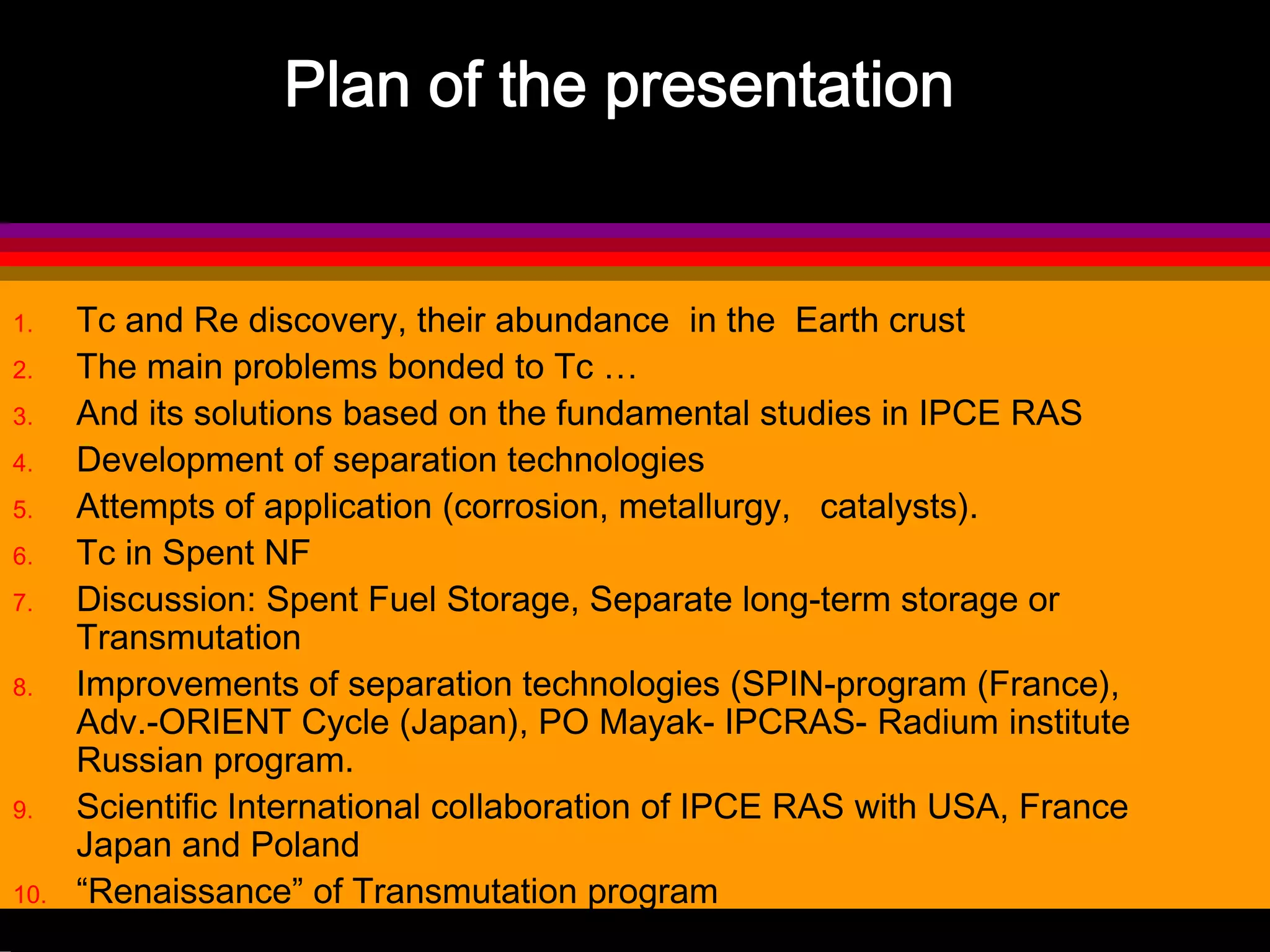
1. Tc and Re discovery, their abundance in the Earth crust
2. The main problems bonded to Tc …
3. And its solutions based on the fundamental studies in IPCE RAS
4. Development of separation technologies
5. Attempts of application (corrosion, metallurgy, catalysts).
6. Tc in Spent NF
7. Discussion: Spent Fuel Storage, Separate long-term storage or
Transmutation
8. Improvements of separation technologies (SPIN-program (France),
Adv.-ORIENT Cycle (Japan), PO Mayak- IPCRAS- Radium institute
Russian program.
9. Scientific International collaboration of IPCE RAS with USA, France
Japan and Poland
10. “Renaissance” of Transmutation program
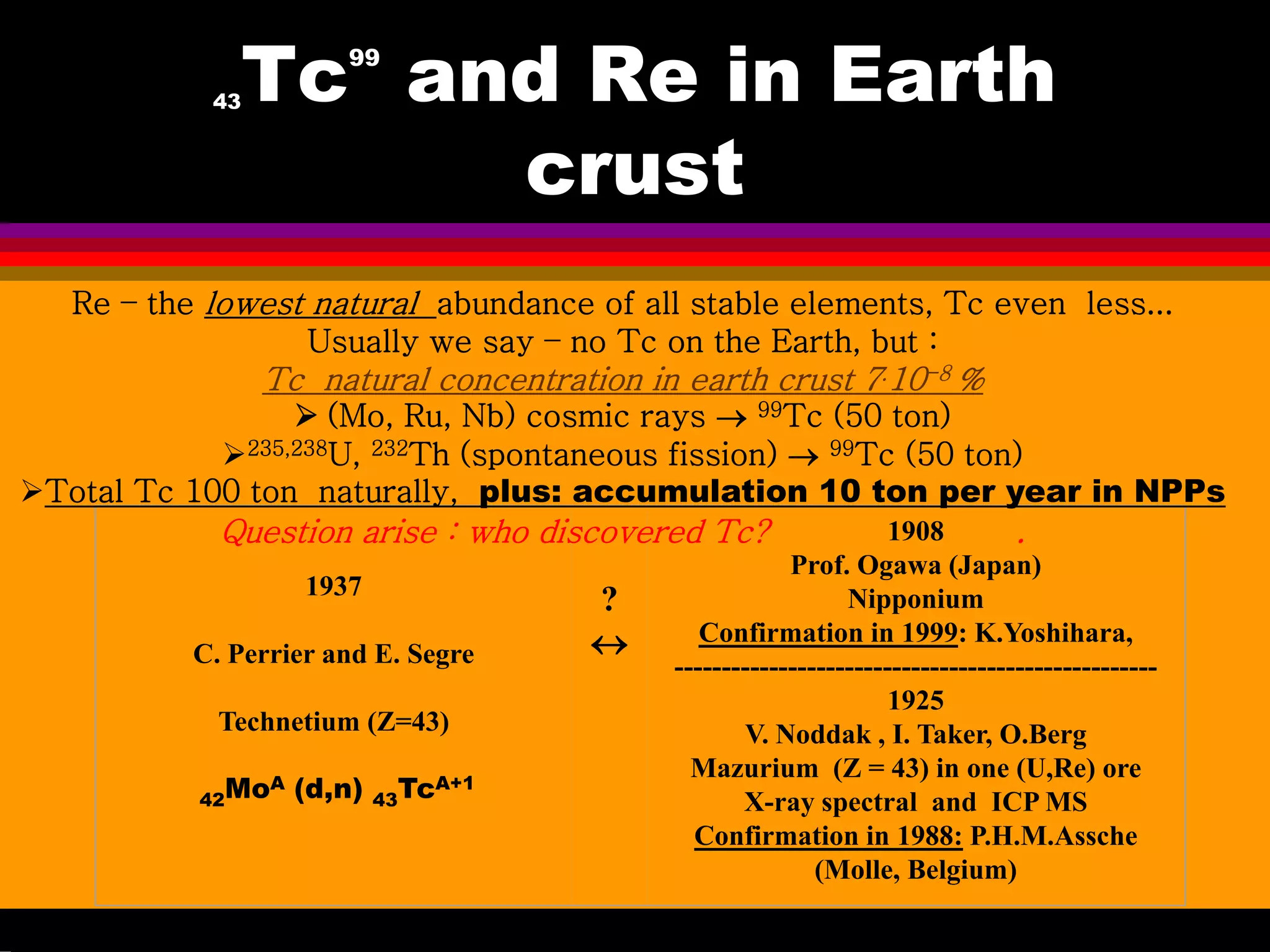
43Tc99
and Re in Earth
crust
1937
C. Perrier and E. Segre
Technetium (Z=43)
42MoА (d,n) 43TcА+1
?
↔
1908
Prof. Ogawa (Japan)
Nipponium
Confirmation in 1999: K.Yoshihara,
---------------------------------------------------
1925
V. Noddak , I. Taker, O.Berg
Mazurium (Z = 43) in one (U,Re) ore
X-ray spectral and ICP MS
Confirmation in 1988: P.H.M.Assche
(Molle, Belgium)
Re – the lowest natural abundance of all stable elements, Tc even less...
Usually we say – no Tc on the Earth, but :
Tc natural concentration in earth crust 7.10-8 %
(Mo, Ru, Nb) cosmic rays → 99Tc (50 ton)
235,238U, 232Th (spontaneous fission) → 99Tc (50 ton)
Total Tc 100 ton naturally, plus: accumulation 10 ton per year in NPPs
Question arise : who discovered Tc? .
Our motivation for exploring Tc
chemistry for the Closed Fuel Cycle
Tc-99 is a key dose contributor at HLW repositories if
TRU elements are greatly reduced by recycling
• long half-life of Tc (t1/2 = 2.14 x 10⁵ years),
• high mobility, and solubility under oxidizing
conditions
Methods for managing the long-term threat of Tc to the
environment
• Stable waste form/repository system providing with
strict limits for Tc release over a long period of time
(~1 million years?).
• Transmutation of radioactive Tc to stable Ru im
nuclear rectors.
Main problems of Tc
Tc is important item in Nuclear Industry
Tc redistribution in PUREX produces
flows with long-lived high radioactive
wastes
Tc interferes at U/Pu separation stage in
PUREX process
Tc accumulation in High burn-up fuel
together with Mo, Ru, Rh
Tc in nuclear waste vitrification: Tc-Mo-
Ru metal phases, Tc(VII) volatility
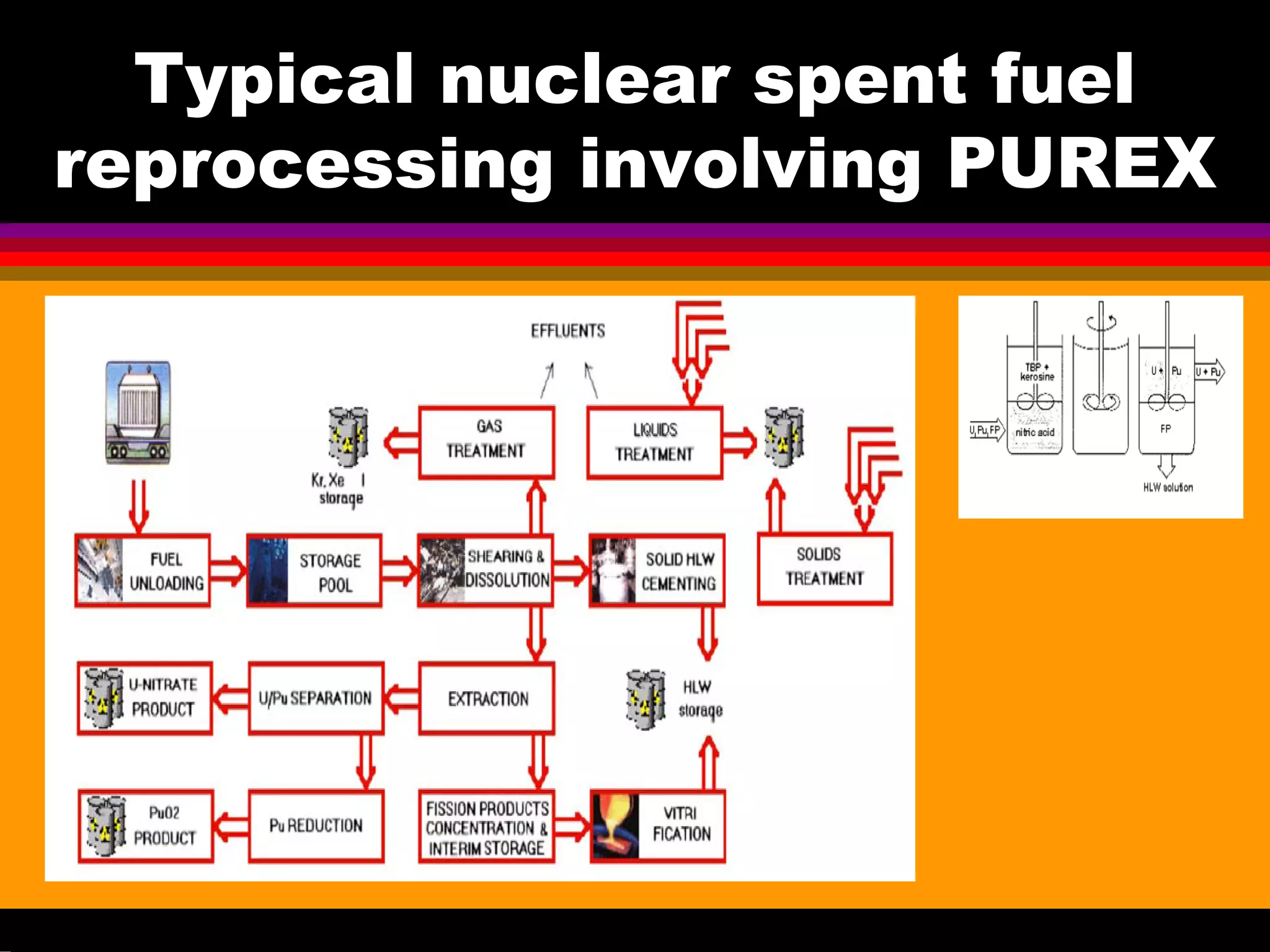
Typical nuclear spent fuel
reprocessing involving PUREX
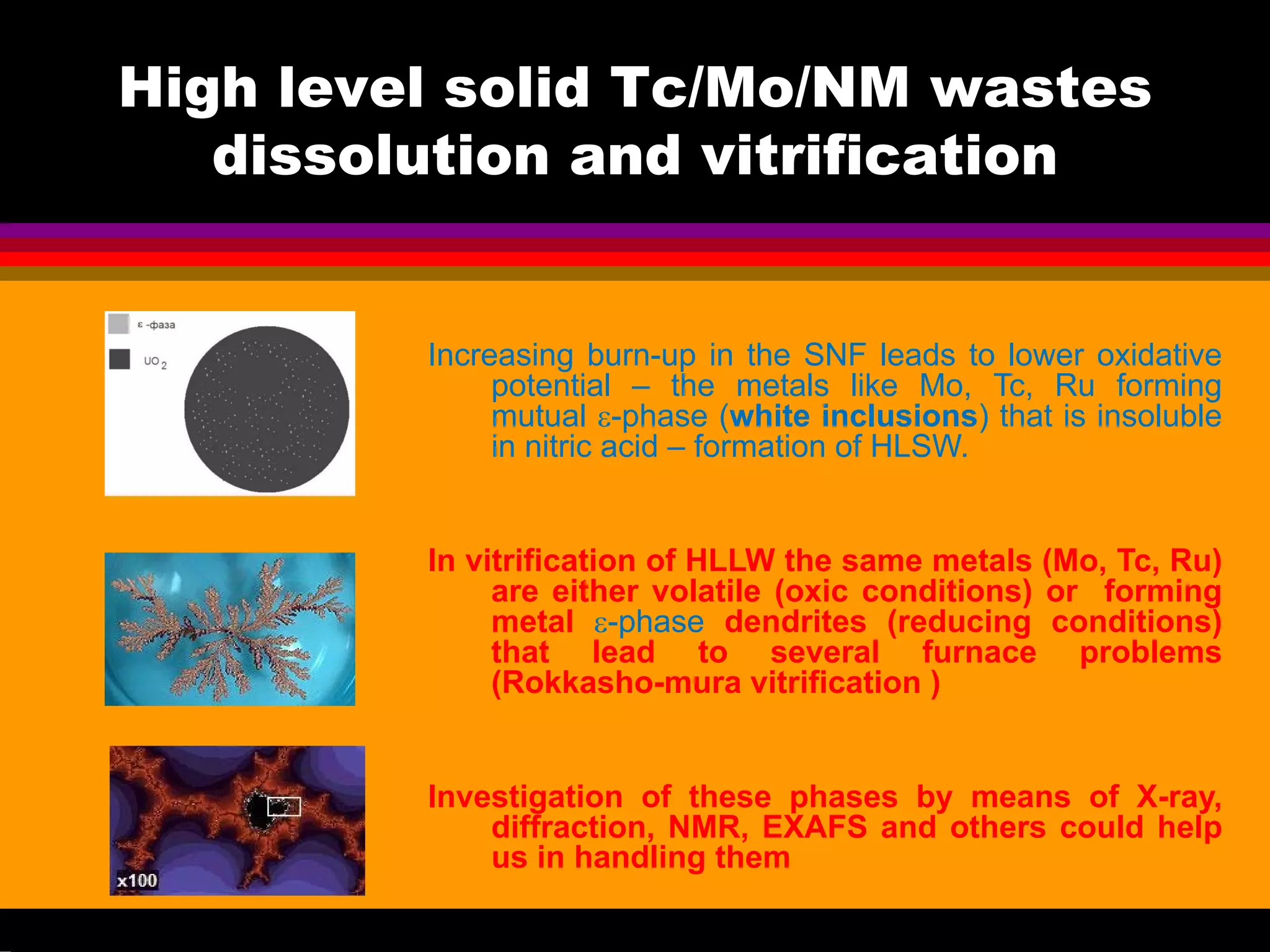
High level solid Tc/Mo/NM wastes
dissolution and vitrification
Increasing burn-up in the SNF leads to lower oxidative
potential – the metals like Mo, Tc, Ru forming
mutual ε-phase (white inclusions) that is insoluble
in nitric acid – formation of HLSW.
In vitrification of HLLW the same metals (Mo, Tc, Ru)
are either volatile (oxic conditions) or forming
metal ε-phase dendrites (reducing conditions)
that lead to several furnace problems
(Rokkasho-mura vitrification )
Investigation of these phases by means of X-ray,
diffraction, NMR, EXAFS and others could help
us in handling them
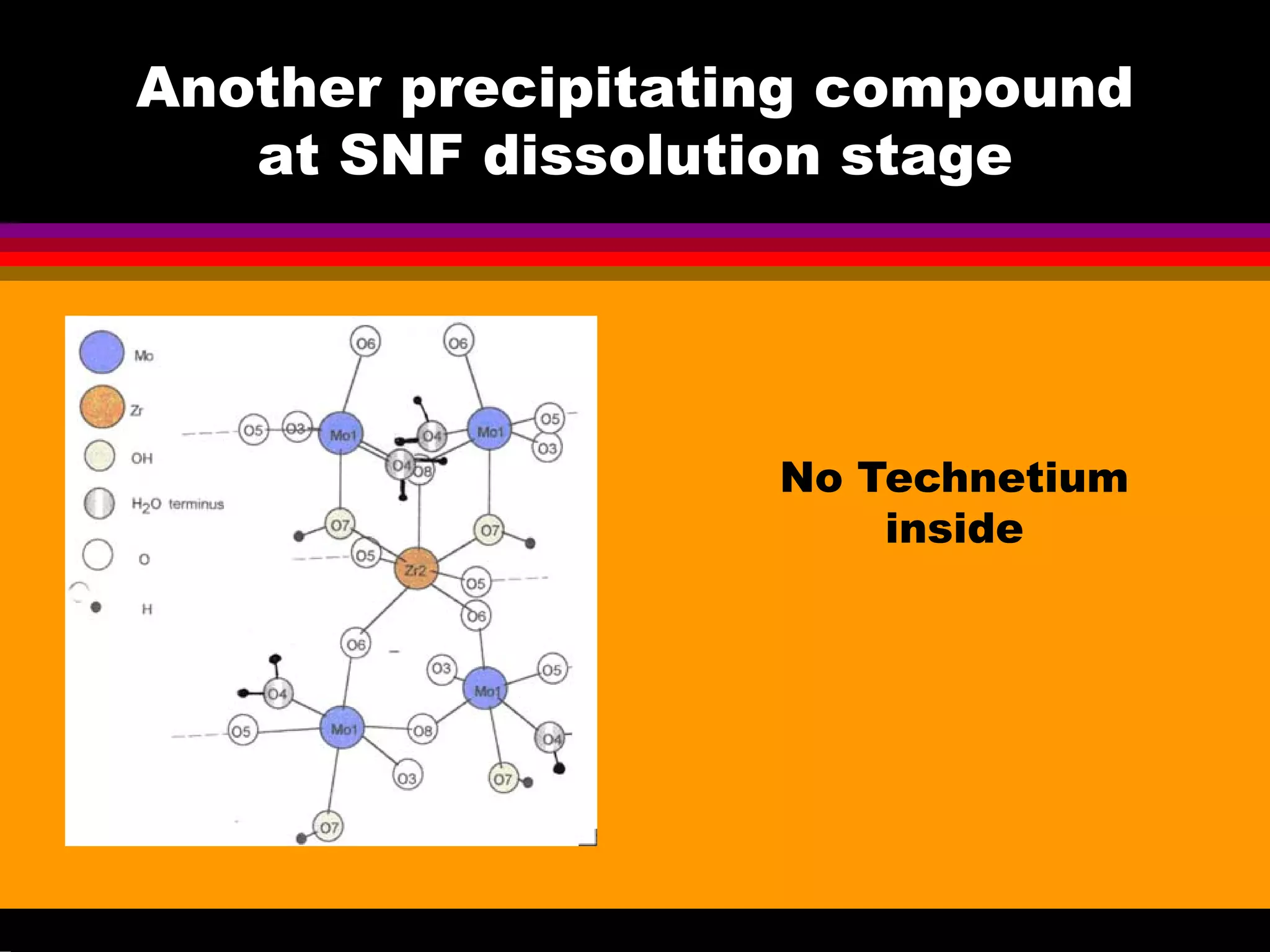
Another precipitating compound
at SNF dissolution stage
No Technetium
inside
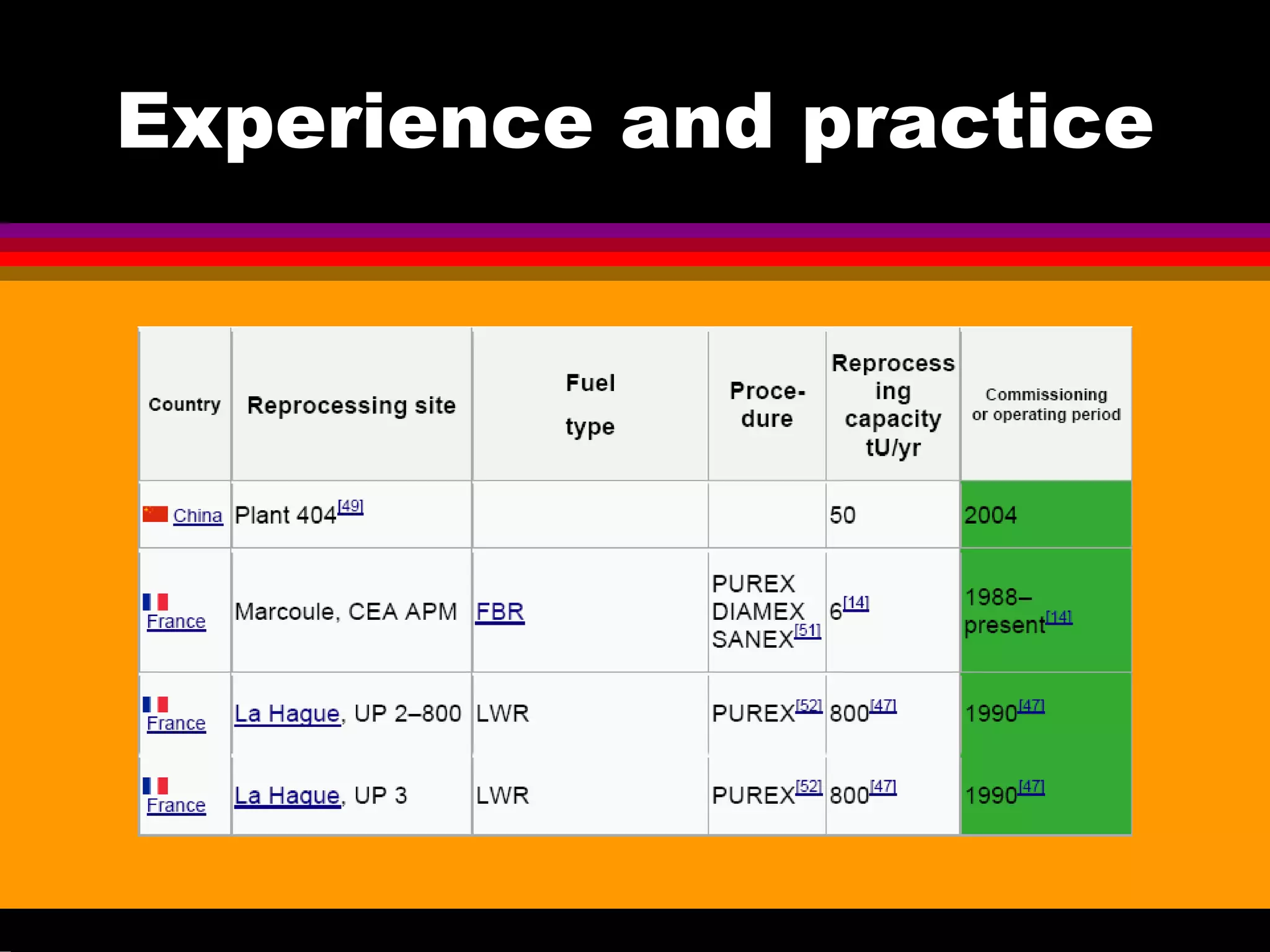
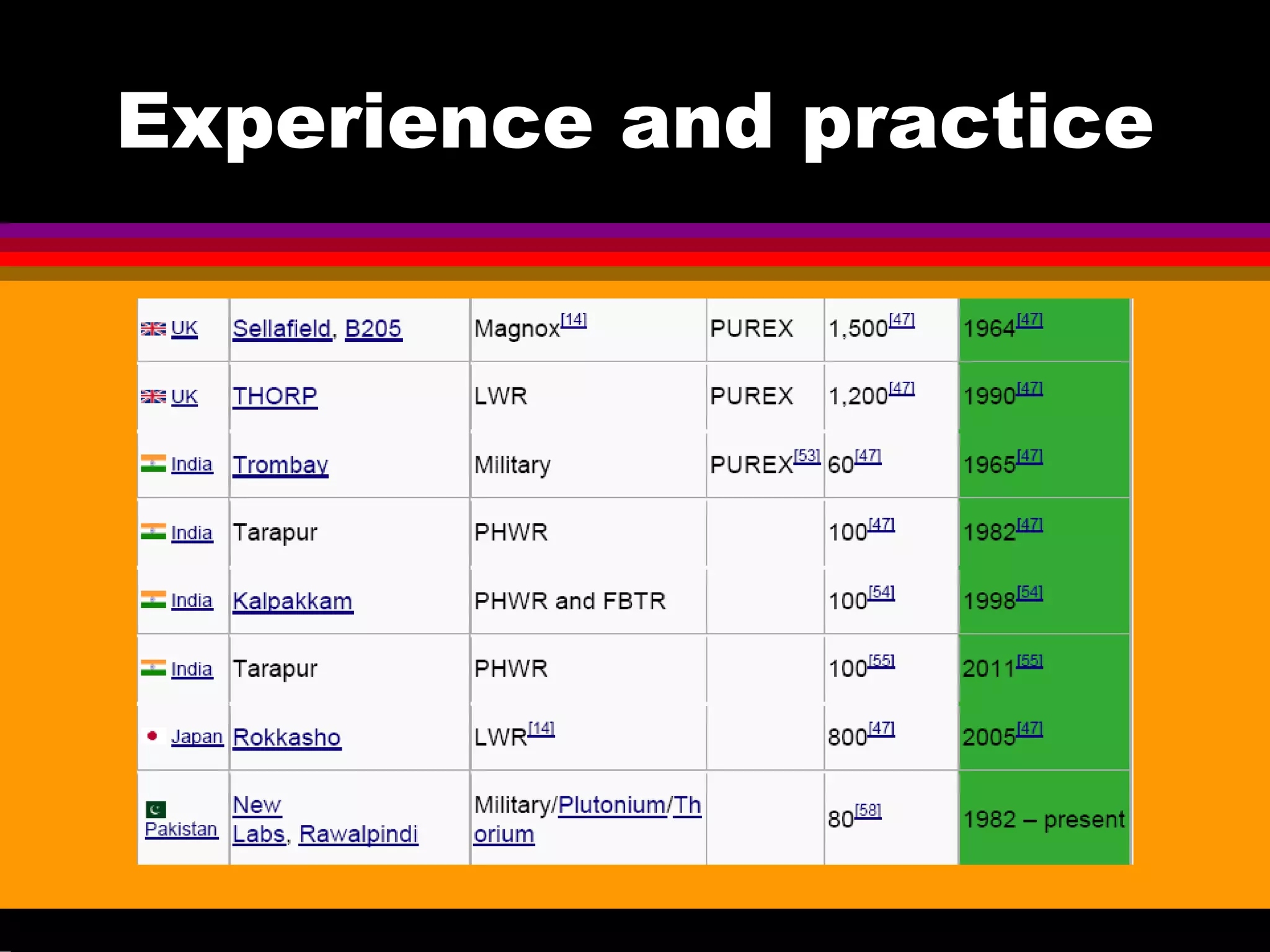
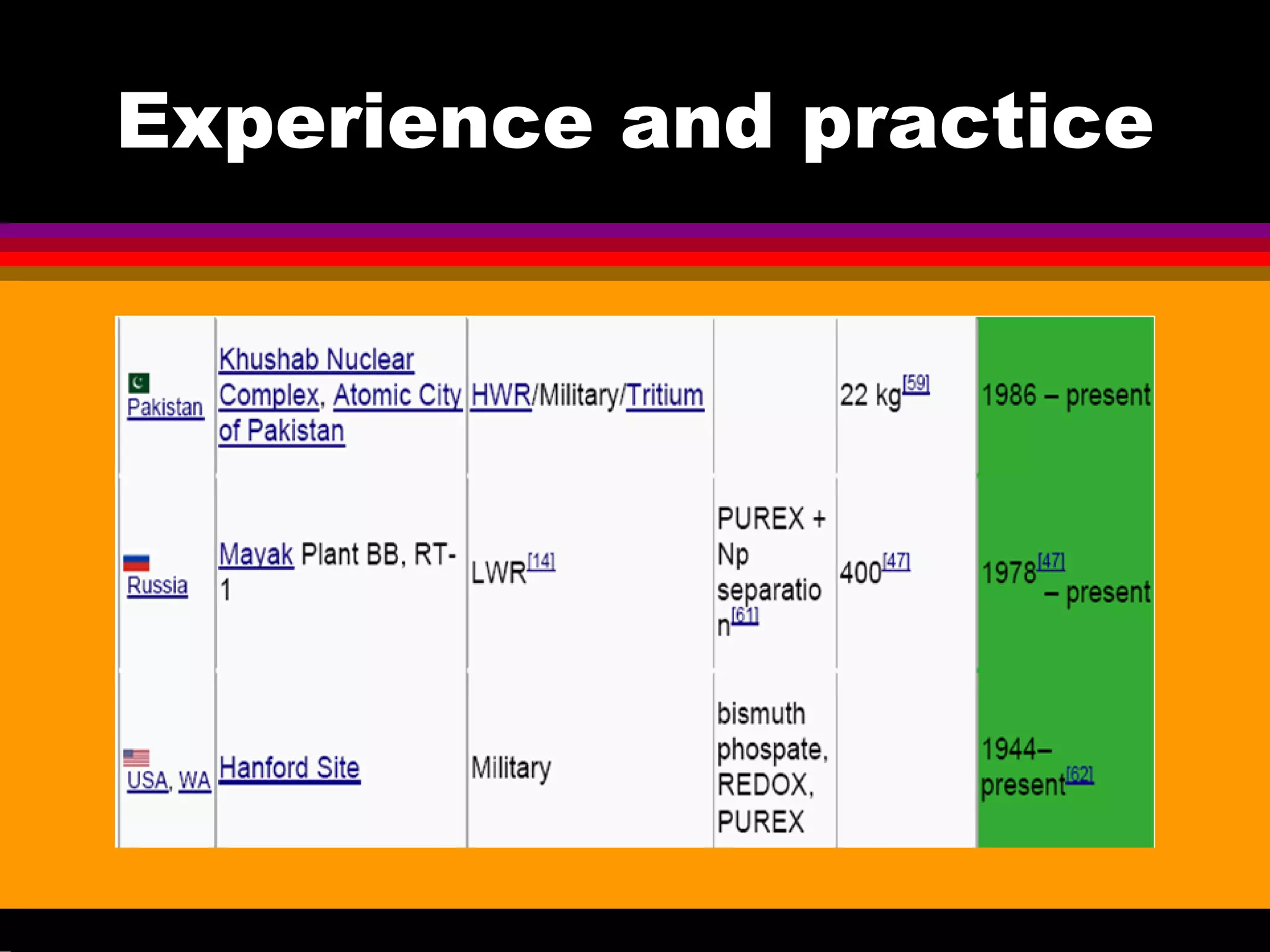
Experience and practice
Some examples of Russian
experience in PUREX
improvement
• The first cycle flowsheet of RT-1
plant is essentially similar to the
THORP flowsheet but is
distinguished by more reliable joint
stripping of Pu, Np, and Tc due to
fairly low acidity.
• This is attained owing to
introduction of a special cycle for
separation of Pu and Np using large
amounts of Fe(II);
• As a result, there are serious
problems with evaporation of the
raffinate of Pu-Np purification cyces
and with localization of Tc in the
high-level waste.
•[Zilberman, Radiochemistry 2008]
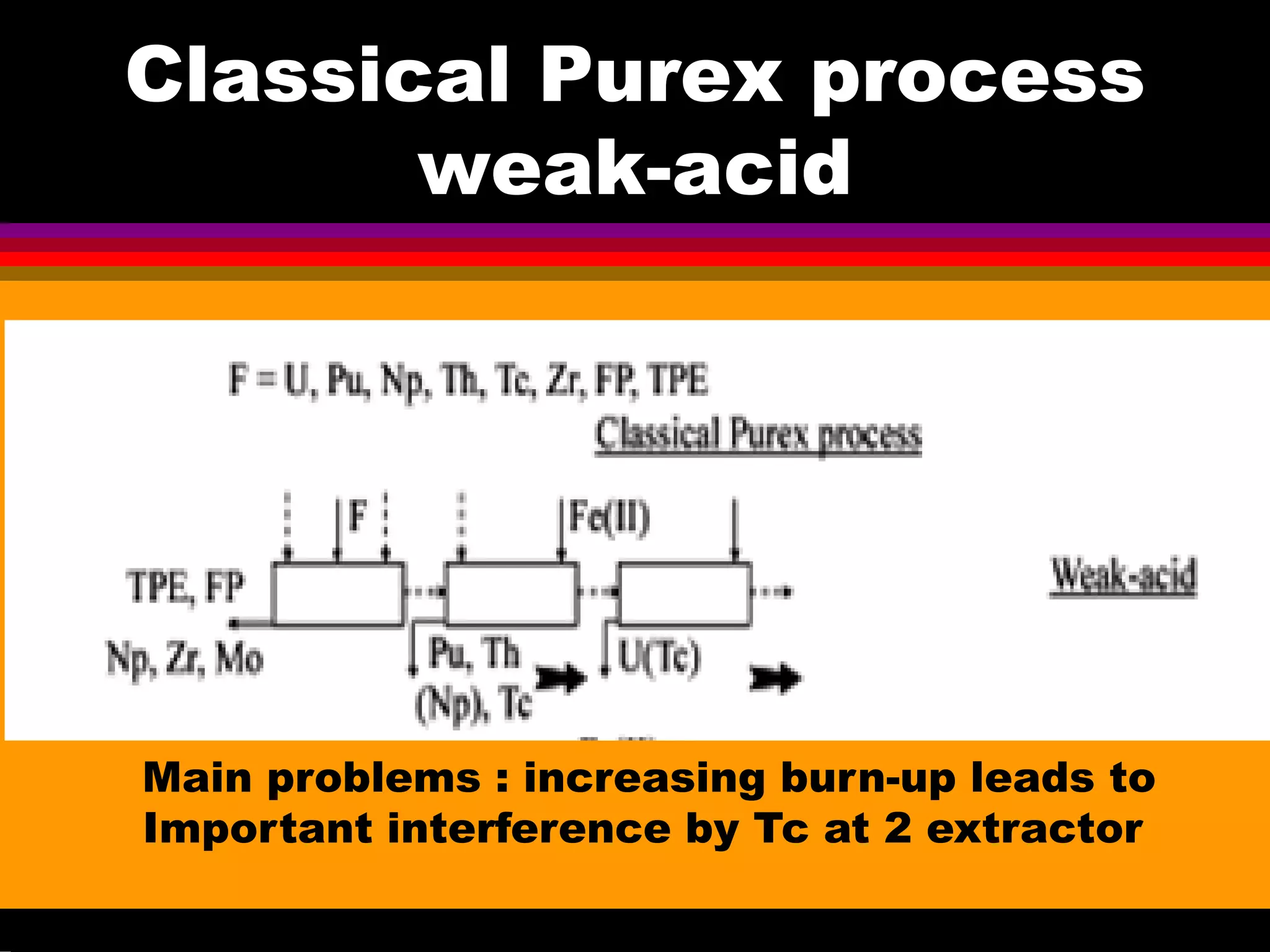
Classical Purex process
weak-acid
Main problems : increasing burn-up leads to
Important interference by Tc at 2 extractor
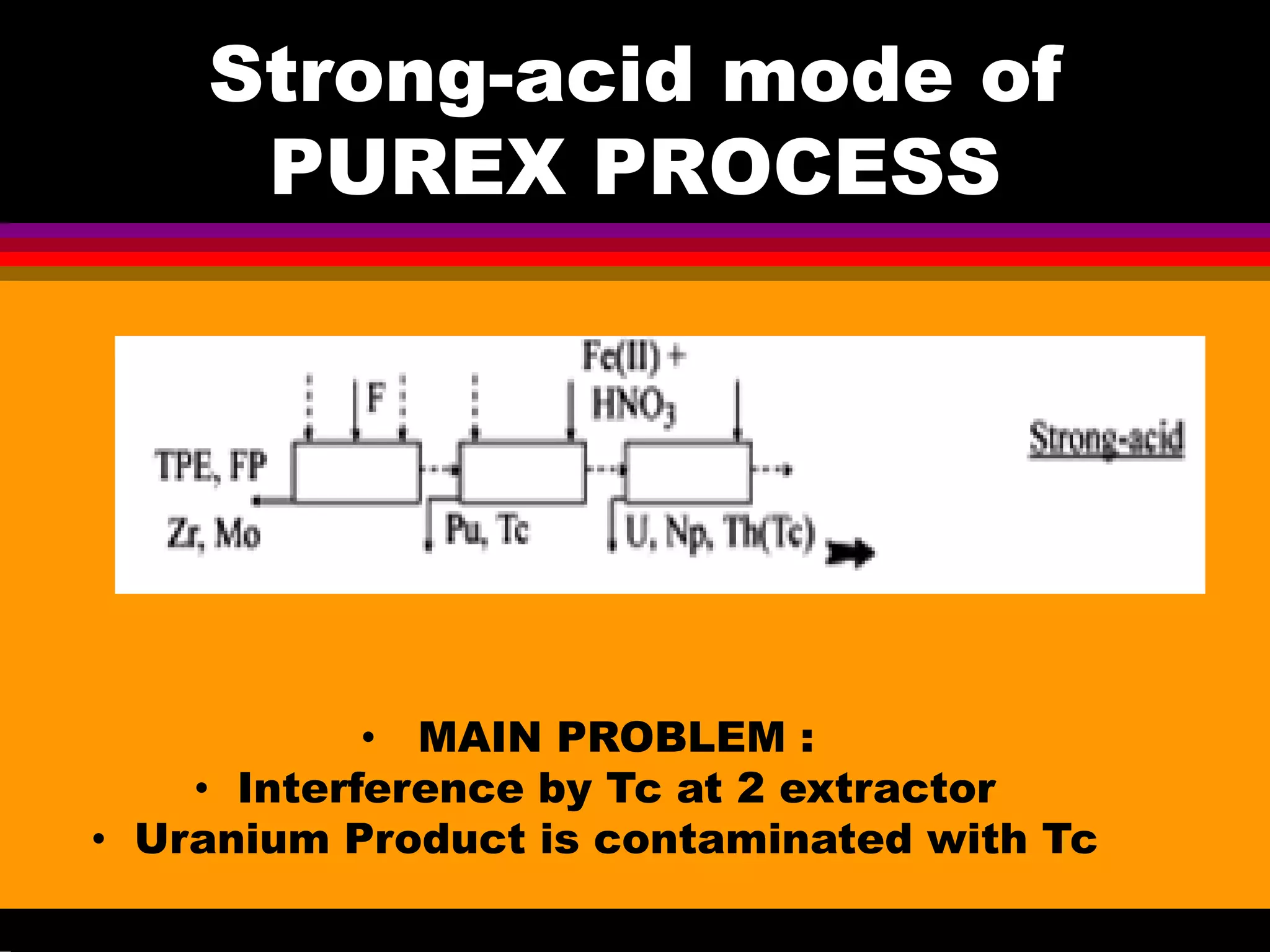
Strong-acid mode of
PUREX PROCESS
• MAIN PROBLEM :
• Interference by Tc at 2 extractor
• Uranium Product is contaminated with Tc
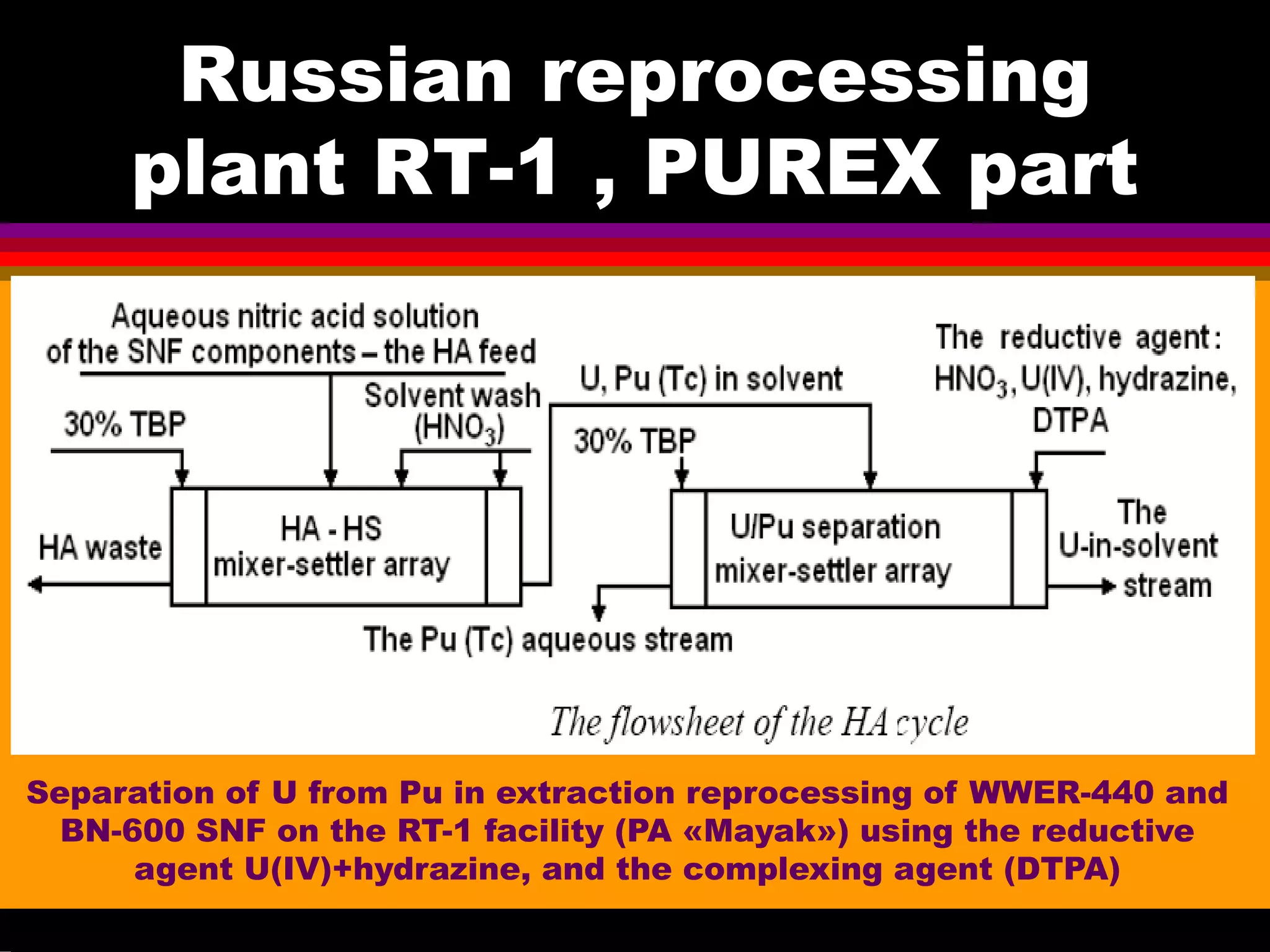
Russian reprocessing
plant RT-1 , PUREX part
Separation of U from Pu in extraction reprocessing of WWER-440 and
BN-600 SNF on the RT-1 facility (PA «Mayak») using the reductive
agent U(IV)+hydrazine, and the complexing agent (DTPA)
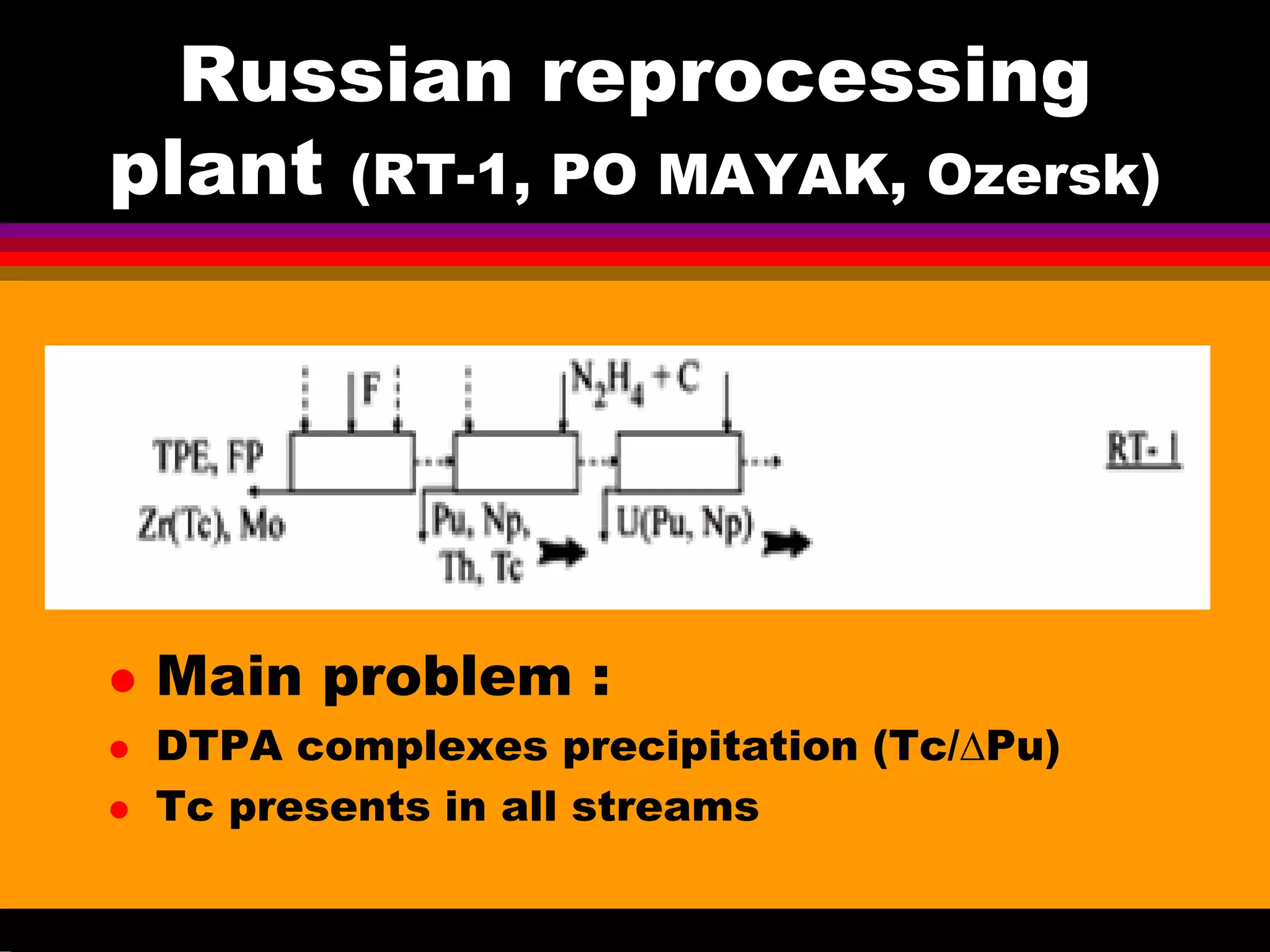
Russian reprocessing
plant (RT-1, PO MAYAK, Ozersk)
Main problem :
DTPA complexes precipitation (Tc/ΔPu)
Tc presents in all streams
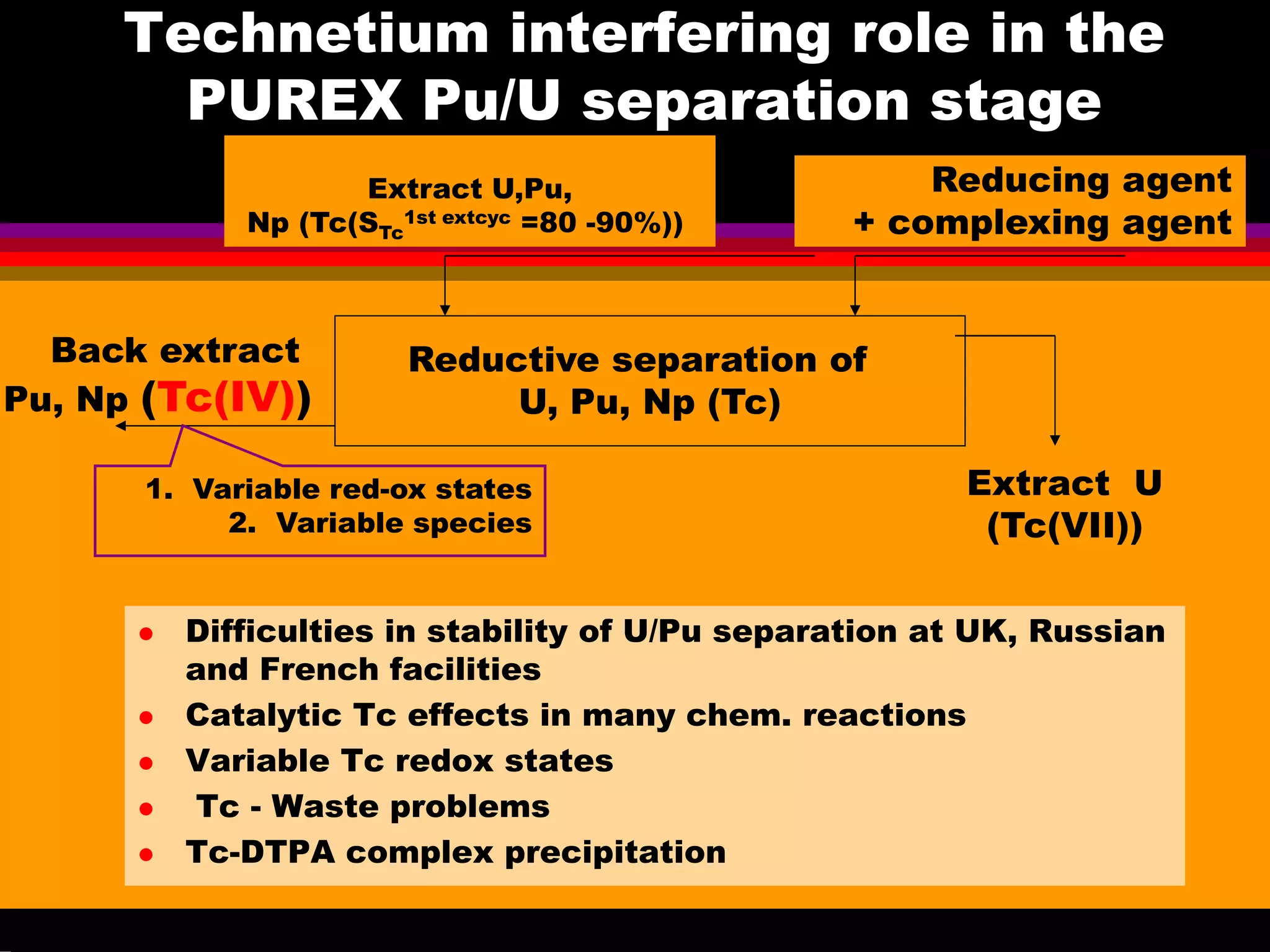
Technetium interfering role in the
PUREX Pu/U separation stage
Reductive separation of
U, Pu, Np (Tc)
Reducing agent
+ complexing agent
Extract U,Pu,
Np (Tc(STc
1st extcyc =80 -90%))
Back extract
Pu, Np (Tc(IV))
Extract U
(Tc(VII))
1. Variable red-ox states
2. Variable species
Difficulties in stability of U/Pu separation at UK, Russian
and French facilities
Catalytic Tc effects in many chem. reactions
Variable Tc redox states
Tc - Waste problems
Tc-DTPA complex precipitation
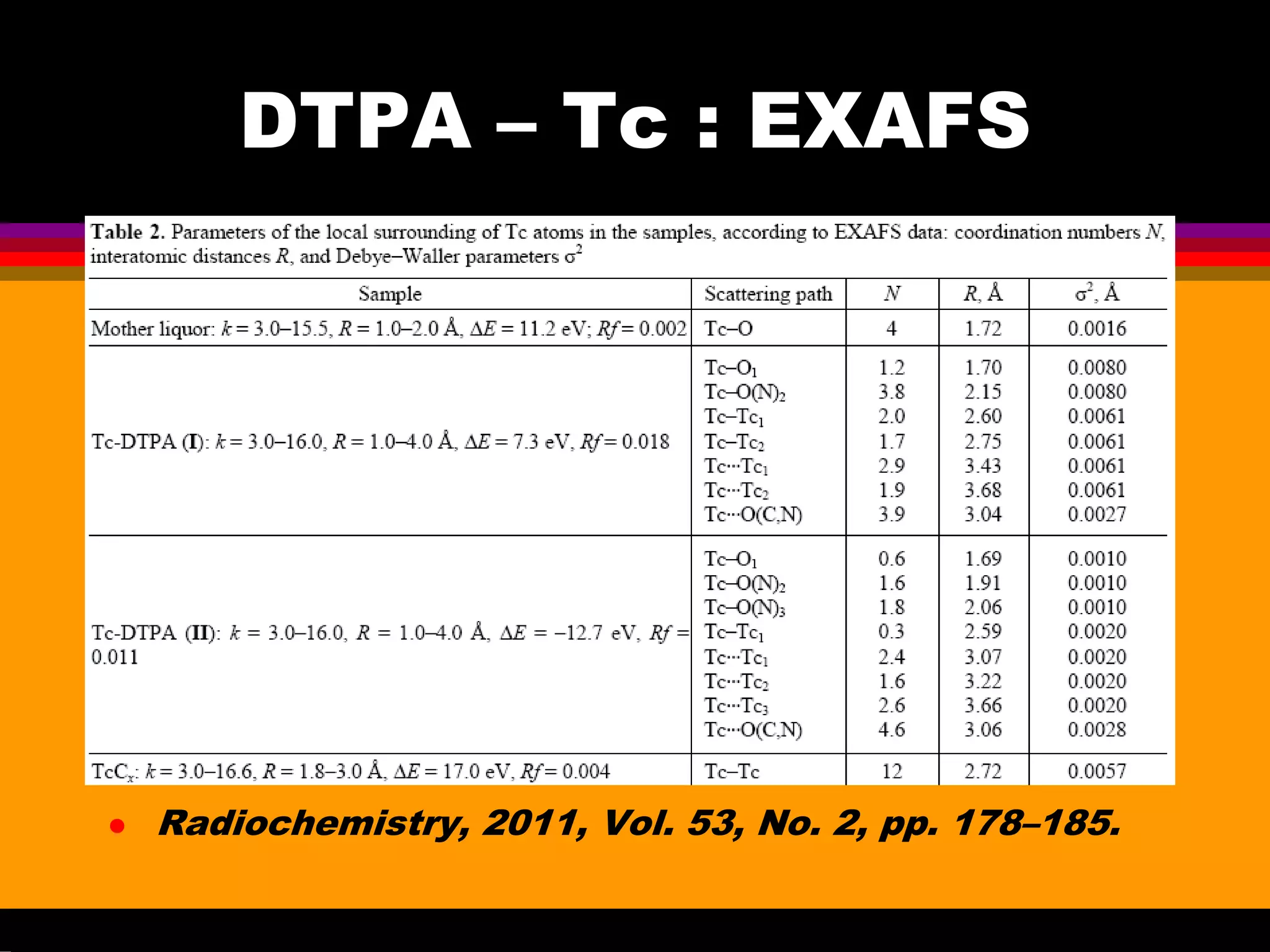
DTPA – Tc : EXAFS
Radiochemistry, 2011, Vol. 53, No. 2, pp. 178–185.
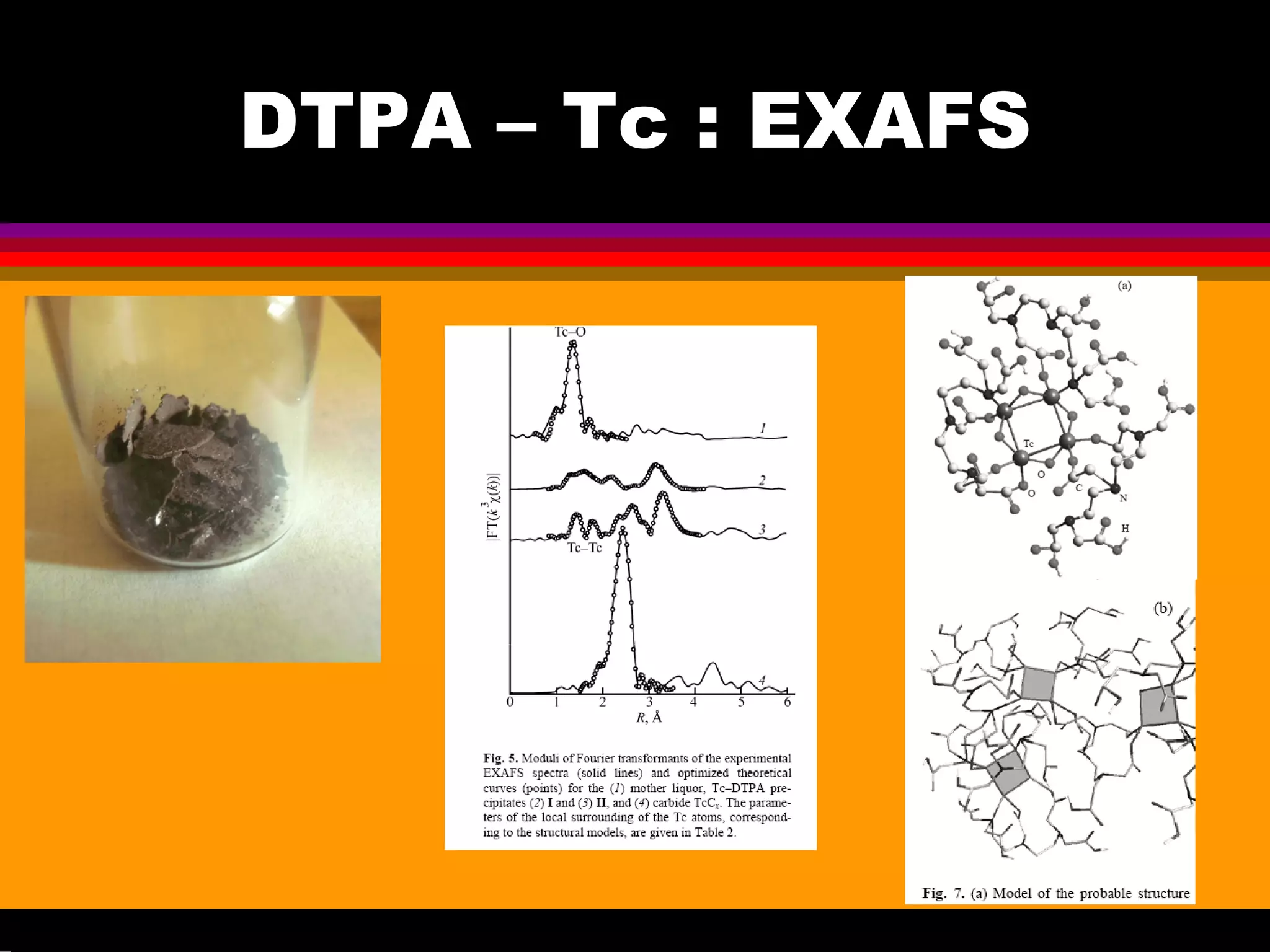
DTPA – Tc : EXAFS
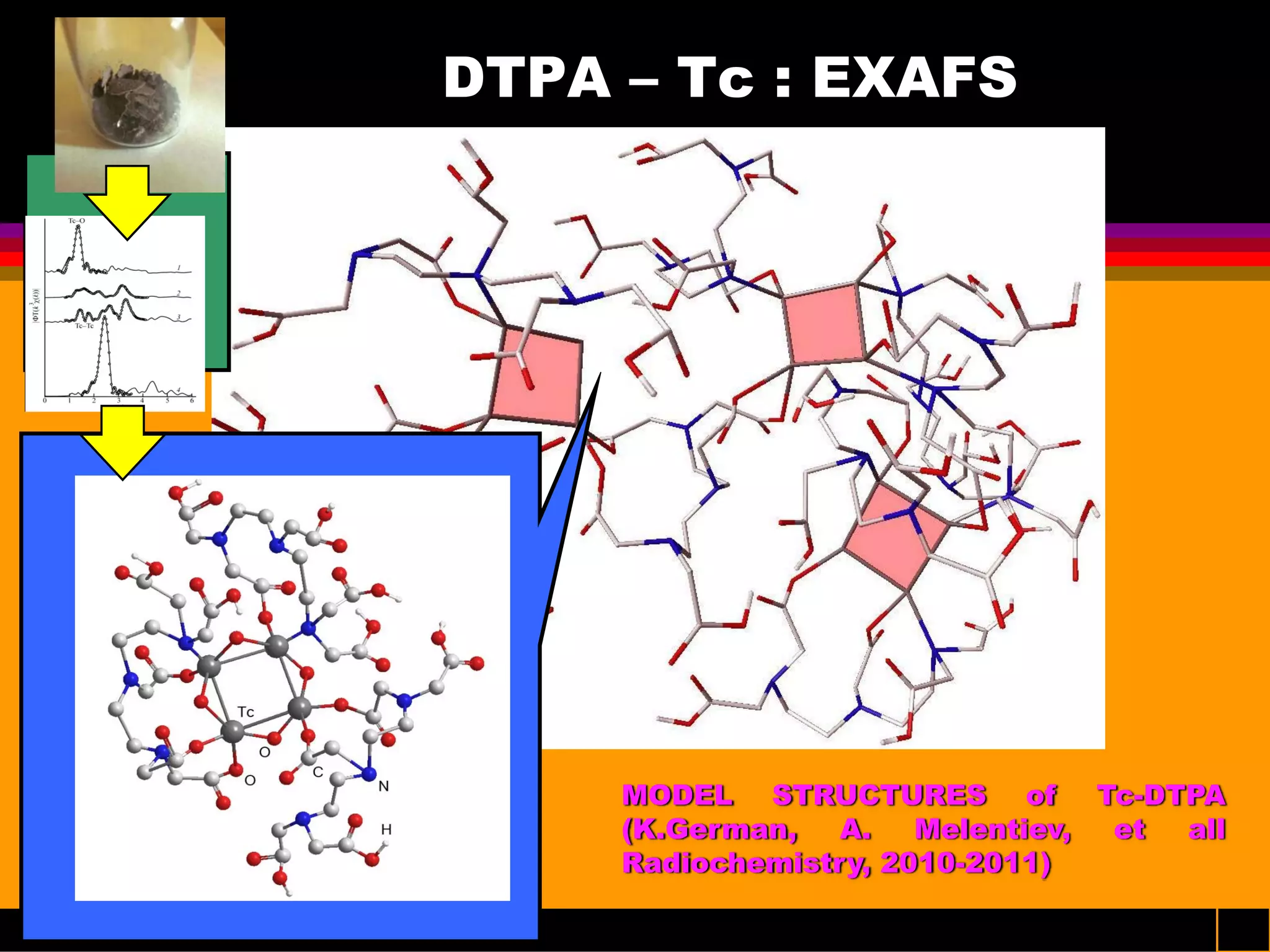
MODEL STRUCTURES of Tc-DTPA
(K.German, A. Melentiev, et all
Radiochemistry, 2010-2011)
7
DTPA – Tc : EXAFS
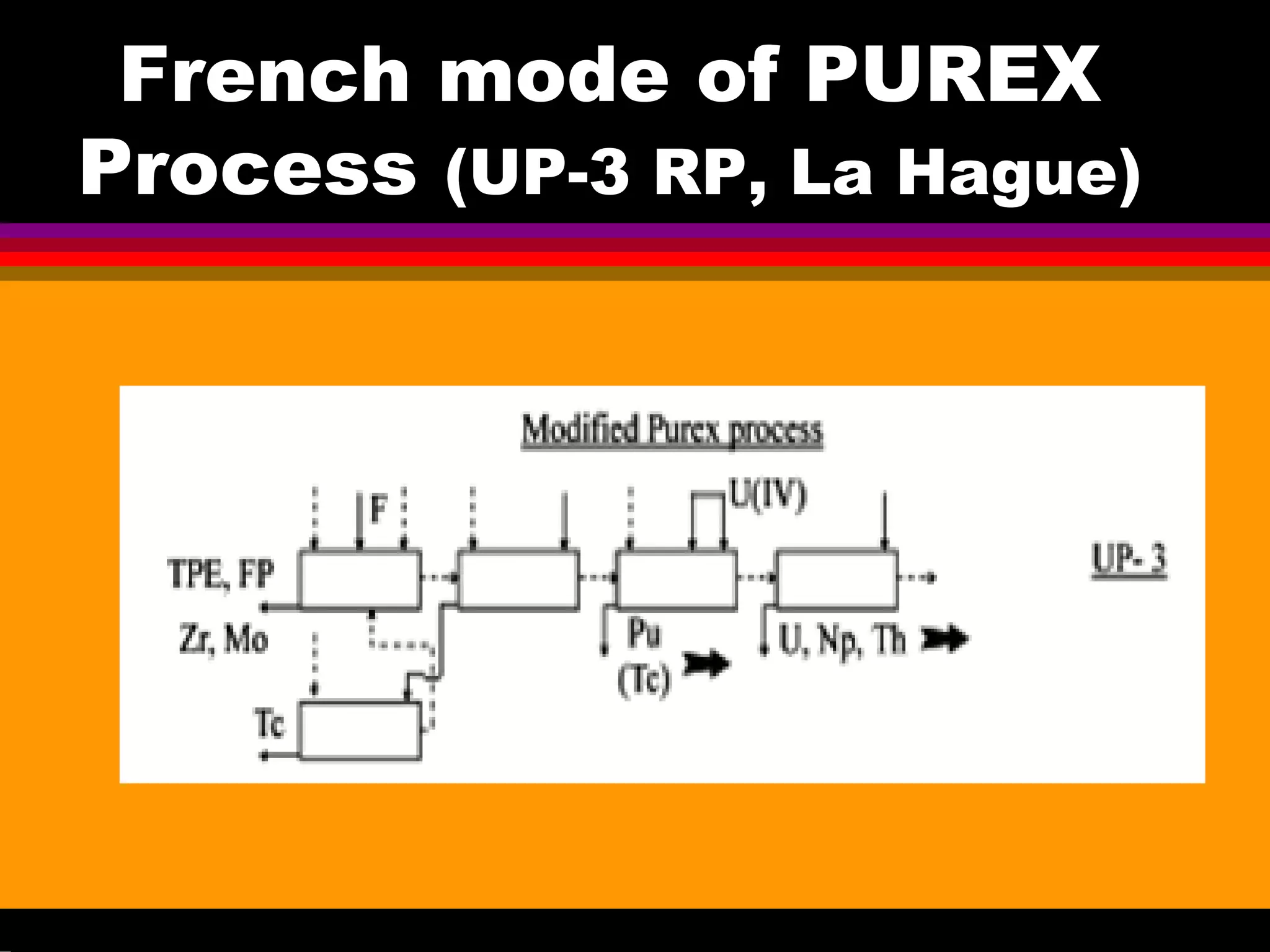
French mode of PUREX
Process (UP-3 RP, La Hague)
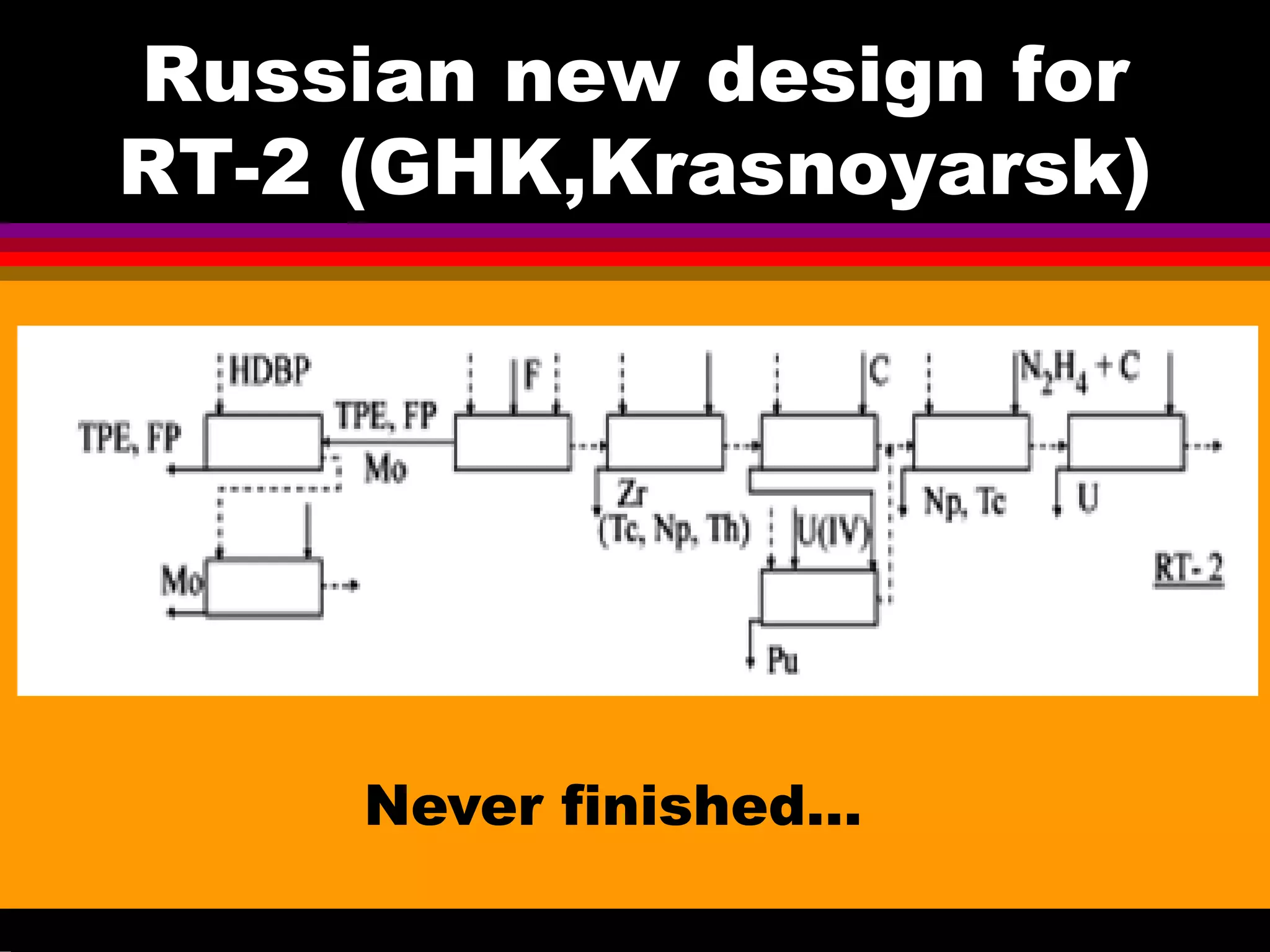
Russian new design for
RT-2 (GHK,Krasnoyarsk)
Never finished…
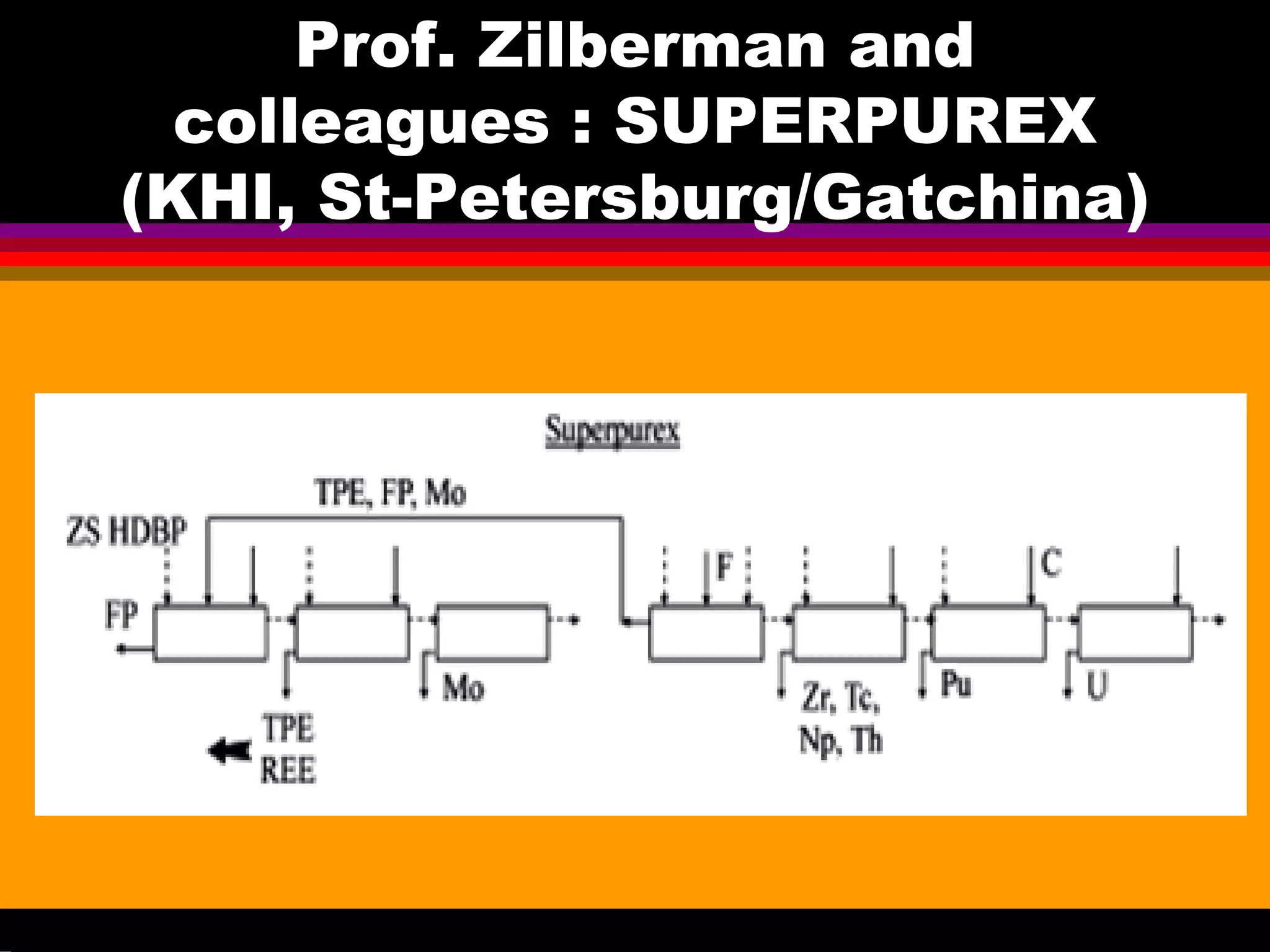
Prof. Zilberman and
colleagues : SUPERPUREX
(KHI, St-Petersburg/Gatchina)
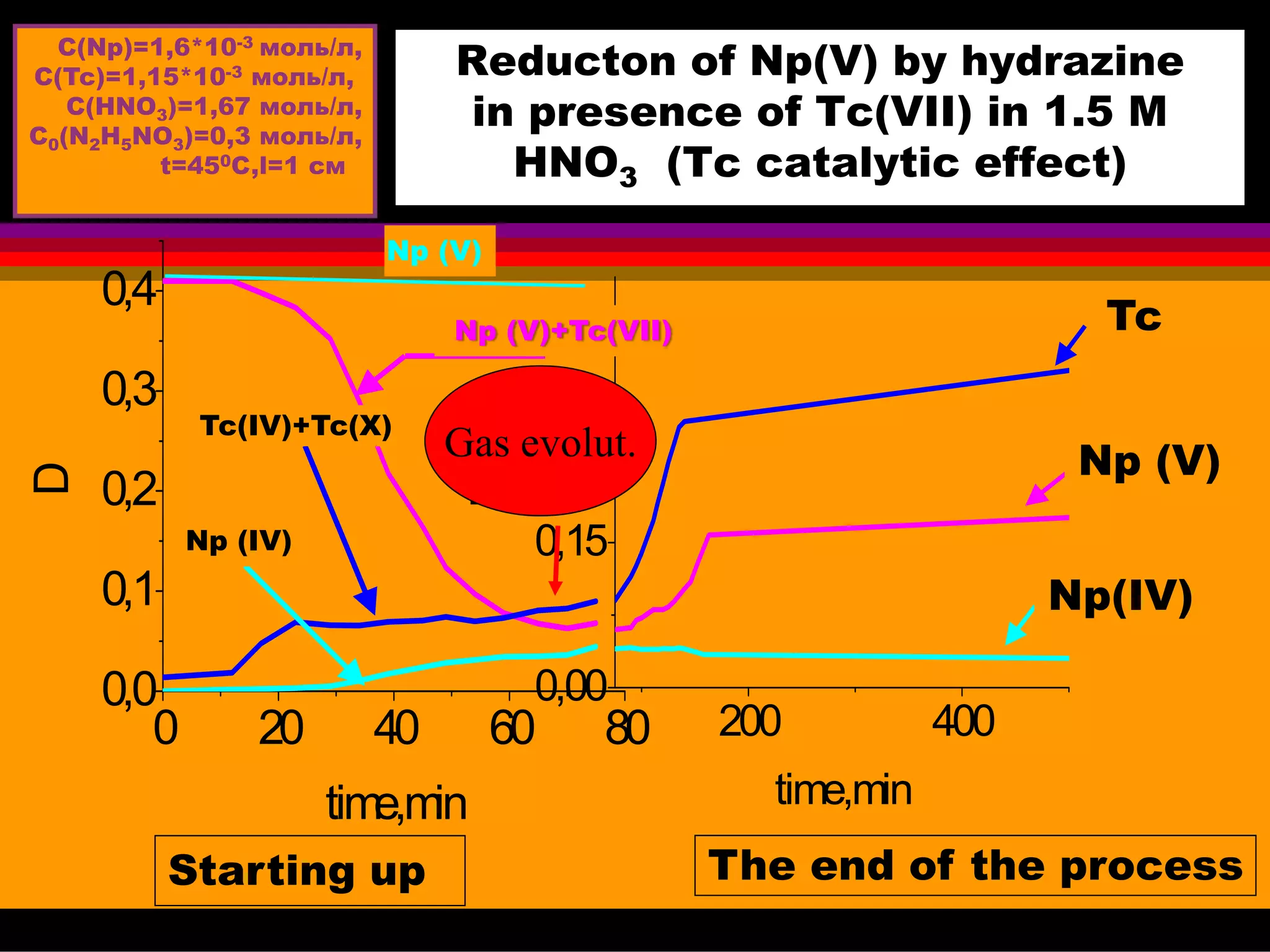
Reducton of Np(V) by hydrazine
in presence of Tc(VII) in 1.5 M
HNO3 (Tc catalytic effect)
0 20 40 60 80
0,0
0,1
0,2
0,3
0,4
D
time,min
Np (V)
Tc(IV)+Tc(X)
Np (IV)
Starting up
C(Np)=1,6*10-3 моль/л,
С(Tc)=1,15*10-3 моль/л,
C(HNO3)=1,67 моль/л,
C0(N2H5NO3)=0,3 моль/л,
t=450C,l=1 см
200 400
0,00
0,15
0,30
D
time,min
The end of the process
Tc
Np (V)
Np(IV)
Gas evolut.
Np (V)+Tc(VII)
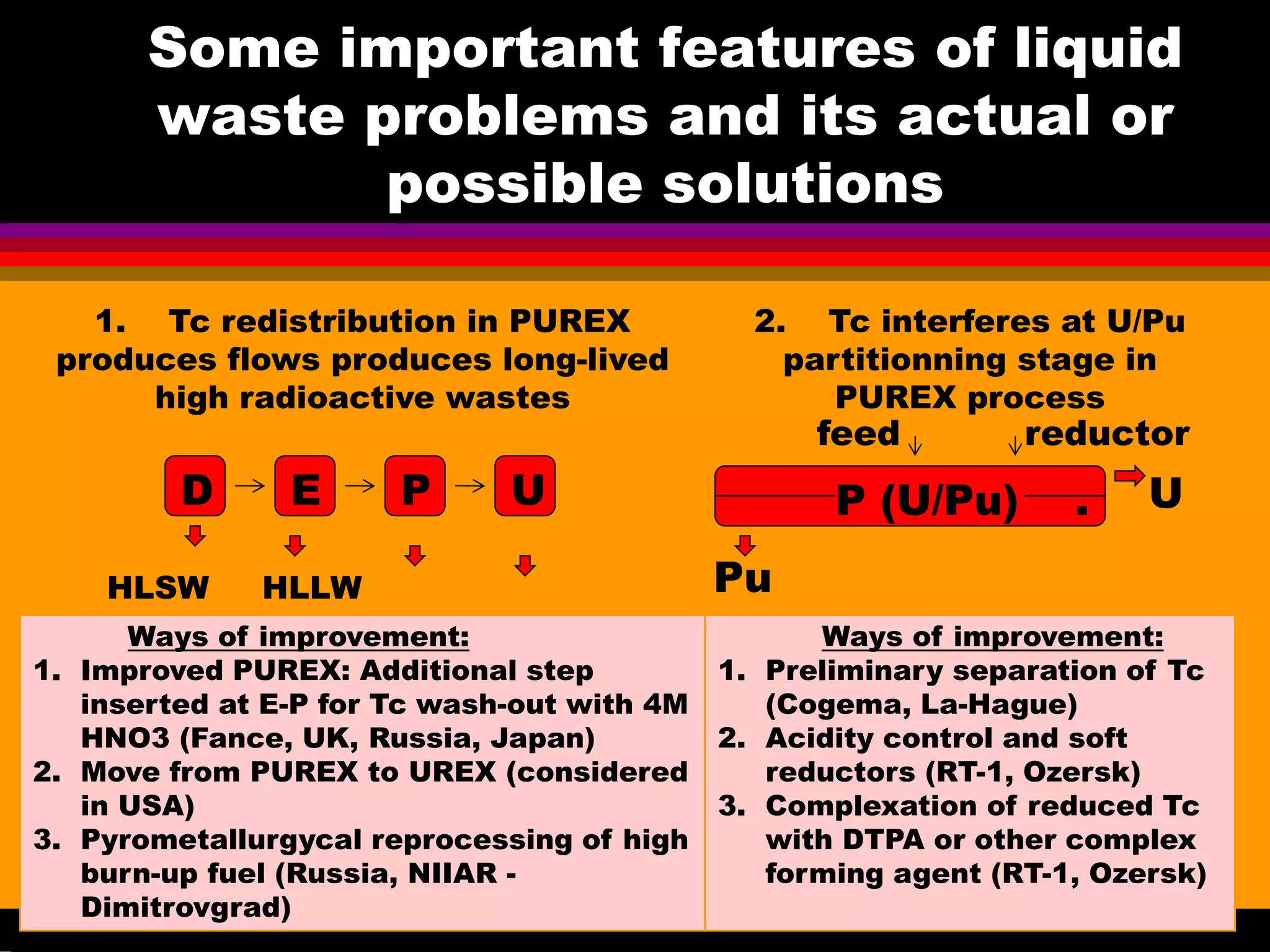
Some important features of liquid
waste problems and its actual or
possible solutions
1. Tc redistribution in PUREX
produces flows produces long-lived
high radioactive wastes
HLSW HLLW
2. Tc interferes at U/Pu
partitionning stage in
PUREX process
Ways of improvement:
1. Improved PUREX: Additional step
inserted at E-P for Tc wash-out with 4M
HNO3 (Fance, UK, Russia, Japan)
2. Move from PUREX to UREX (considered
in USA)
3. Pyrometallurgycal reprocessing of high
burn-up fuel (Russia, NIIAR -
Dimitrovgrad)
Ways of improvement:
1. Preliminary separation of Tc
(Cogema, La-Hague)
2. Acidity control and soft
reductors (RT-1, Ozersk)
3. Complexation of reduced Tc
with DTPA or other complex
forming agent (RT-1, Ozersk)
D UE P P (U/Pu) .
Pu
U
reductorfeed
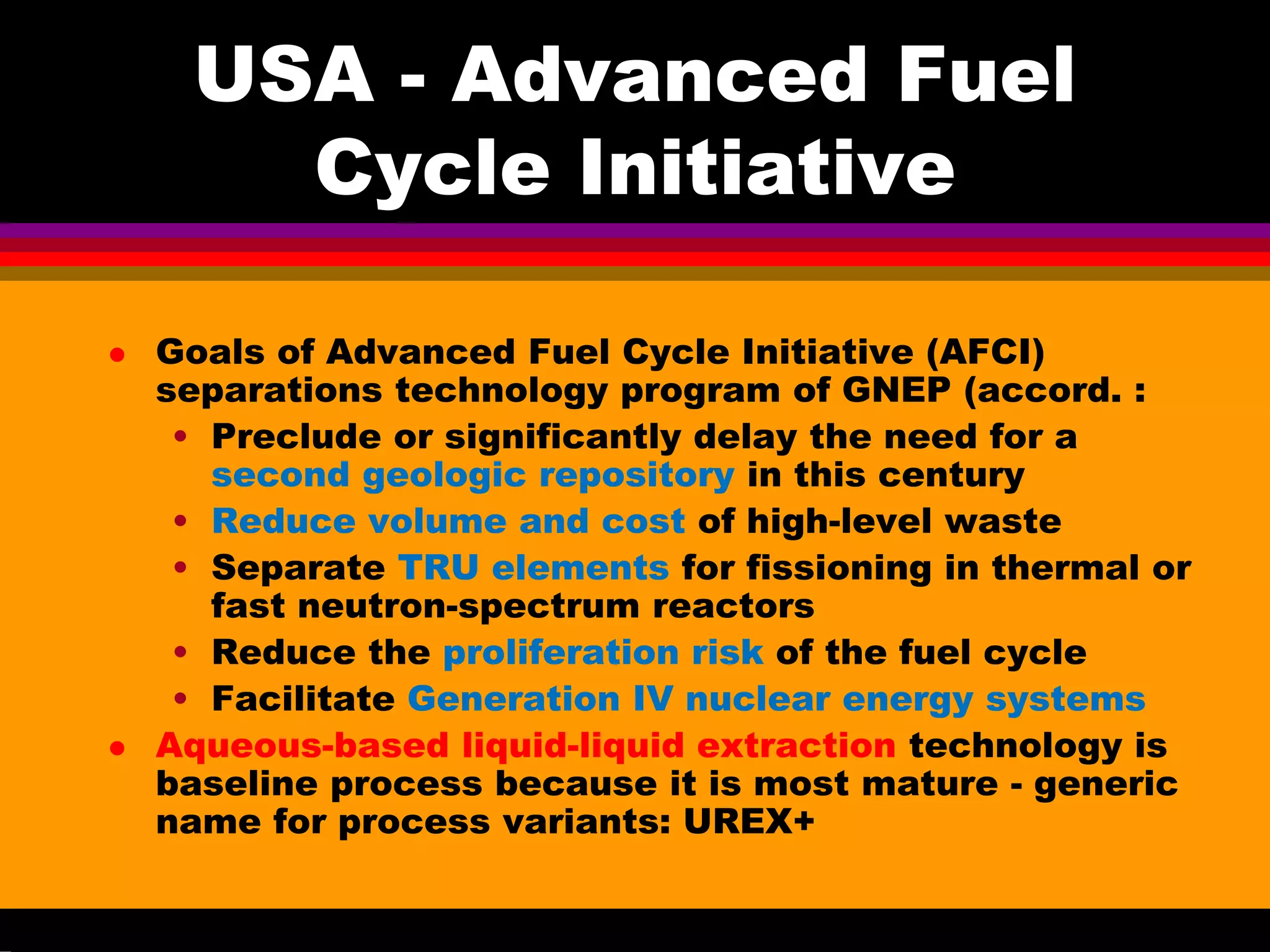
USA - Advanced Fuel
Cycle Initiative
Goals of Advanced Fuel Cycle Initiative (AFCI)
separations technology program of GNEP (accord. :
• Preclude or significantly delay the need for a
second geologic repository in this century
• Reduce volume and cost of high-level waste
• Separate TRU elements for fissioning in thermal or
fast neutron-spectrum reactors
• Reduce the proliferation risk of the fuel cycle
• Facilitate Generation IV nuclear energy systems
Aqueous-based liquid-liquid extraction technology is
baseline process because it is most mature - generic
name for process variants: UREX+
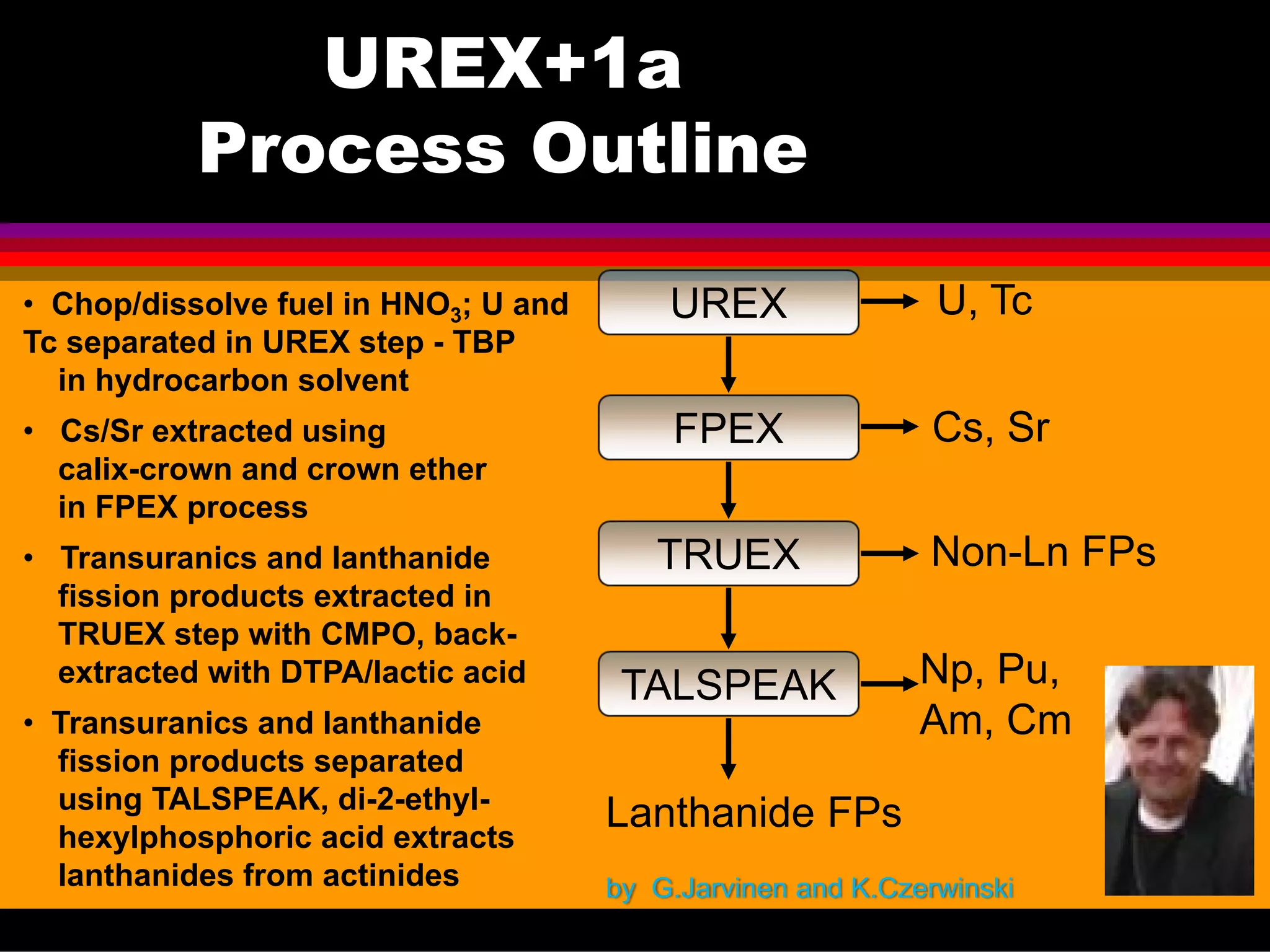
UREX+1a
Process Outline
TALSPEAK
UREX
FPEX
TRUEX
Lanthanide FPs
by G.Jarvinen and K.Czerwinski
U, Tc
Cs, Sr
Non-Ln FPs
Np, Pu,
Am, Cm
• Chop/dissolve fuel in HNO3; U and
Tc separated in UREX step - TBP
in hydrocarbon solvent
• Cs/Sr extracted using
calix-crown and crown ether
in FPEX process
• Transuranics and lanthanide
fission products extracted in
TRUEX step with CMPO, back-
extracted with DTPA/lactic acid
• Transuranics and lanthanide
fission products separated
using TALSPEAK, di-2-ethyl-
hexylphosphoric acid extracts
lanthanides from actinides
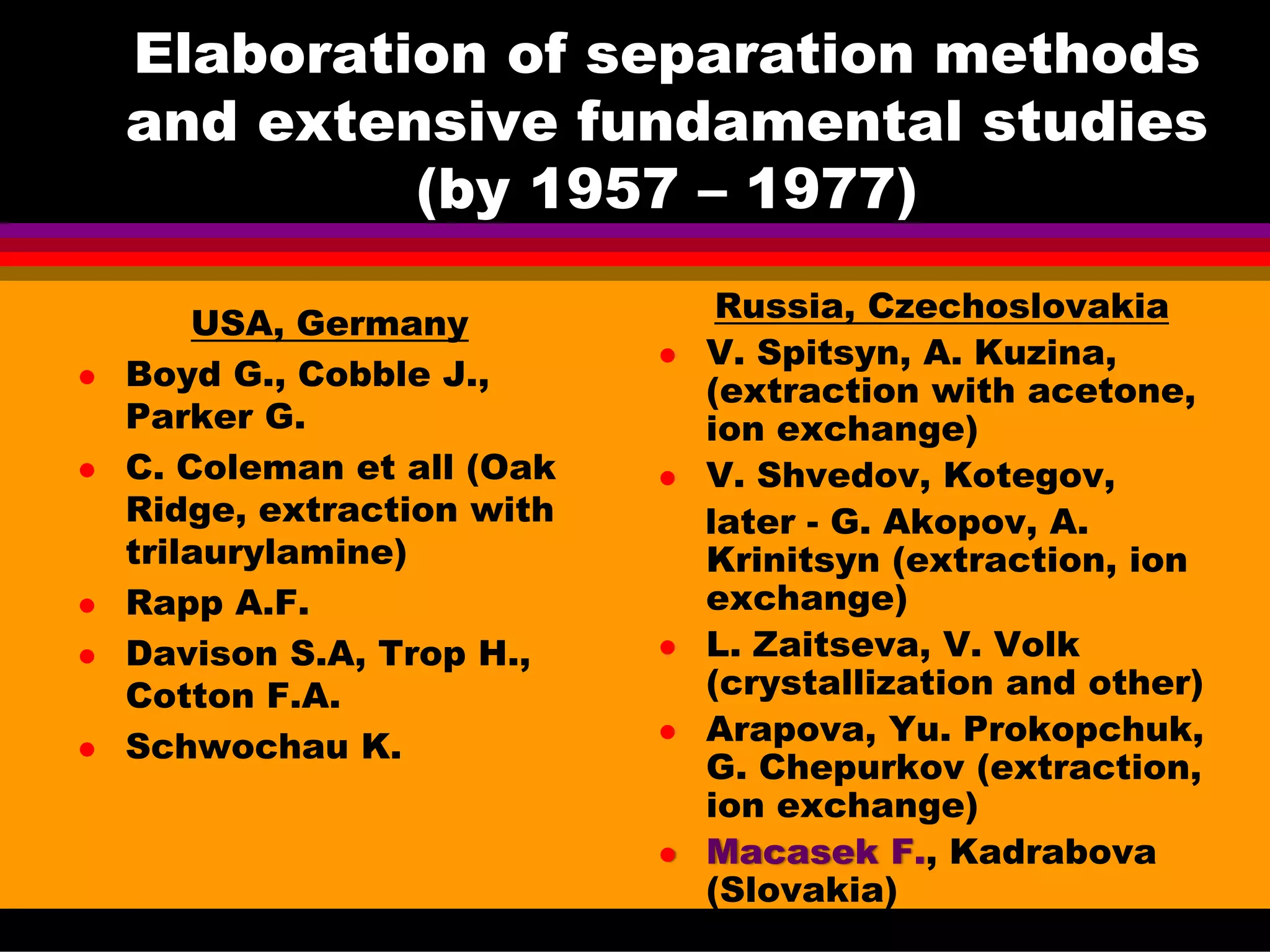
Elaboration of separation methods
and extensive fundamental studies
(by 1957 – 1977)
USA, Germany
Boyd G., Cobble J.,
Parker G.
C. Coleman et all (Oak
Ridge, extraction with
trilaurylamine)
Rapp A.F.
Davison S.A, Trop H.,
Cotton F.A.
Schwochau K.
Russia, Czechoslovakia
V. Spitsyn, A. Kuzina,
(extraction with acetone,
ion exchange)
V. Shvedov, Kotegov,
later - G. Akopov, A.
Krinitsyn (extraction, ion
exchange)
L. Zaitseva, V. Volk
(crystallization and other)
Arapova, Yu. Prokopchuk,
G. Chepurkov (extraction,
ion exchange)
Macasek F., Kadrabova
(Slovakia)
Industrial scale
separation of Tc-99g
Five main approaches were elaborated,
each one has its advantages and disadvantages
Precipitation  co-precipitation
(USA, Russia)
Selective gas adsorption
(USA, Kentucky)
Anion exchange (USA, Russia)
Adsorption at carbon (Japan)
Liquid-Liquid Extraction (USA, Russia, France, Japan)
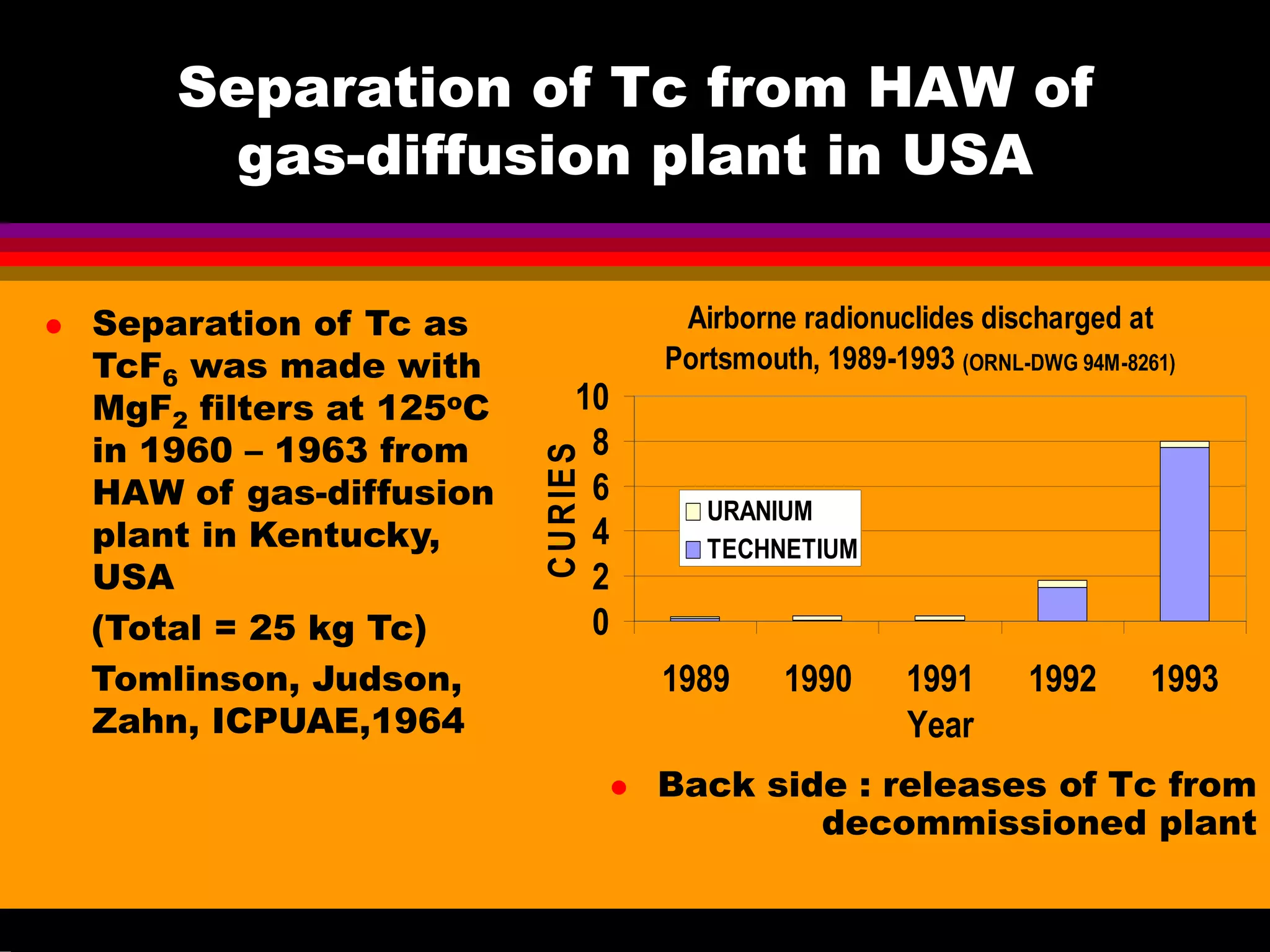
Separation of Tc from HAW of
gas-diffusion plant in USA
Back side : releases of Tc from
decommissioned plant
Airborne radionuclides discharged at
Portsmouth, 1989-1993 (ORNL-DWG 94M-8261)
0
2
4
6
8
10
1989 1990 1991 1992 1993
Year
CURIES
URANIUM
TECHNETIUM
Separation of Tc as
TcF6 was made with
MgF2 filters at 125oC
in 1960 – 1963 from
HAW of gas-diffusion
plant in Kentucky,
USA
(Total = 25 kg Tc)
Tomlinson, Judson,
Zahn, ICPUAE,1964
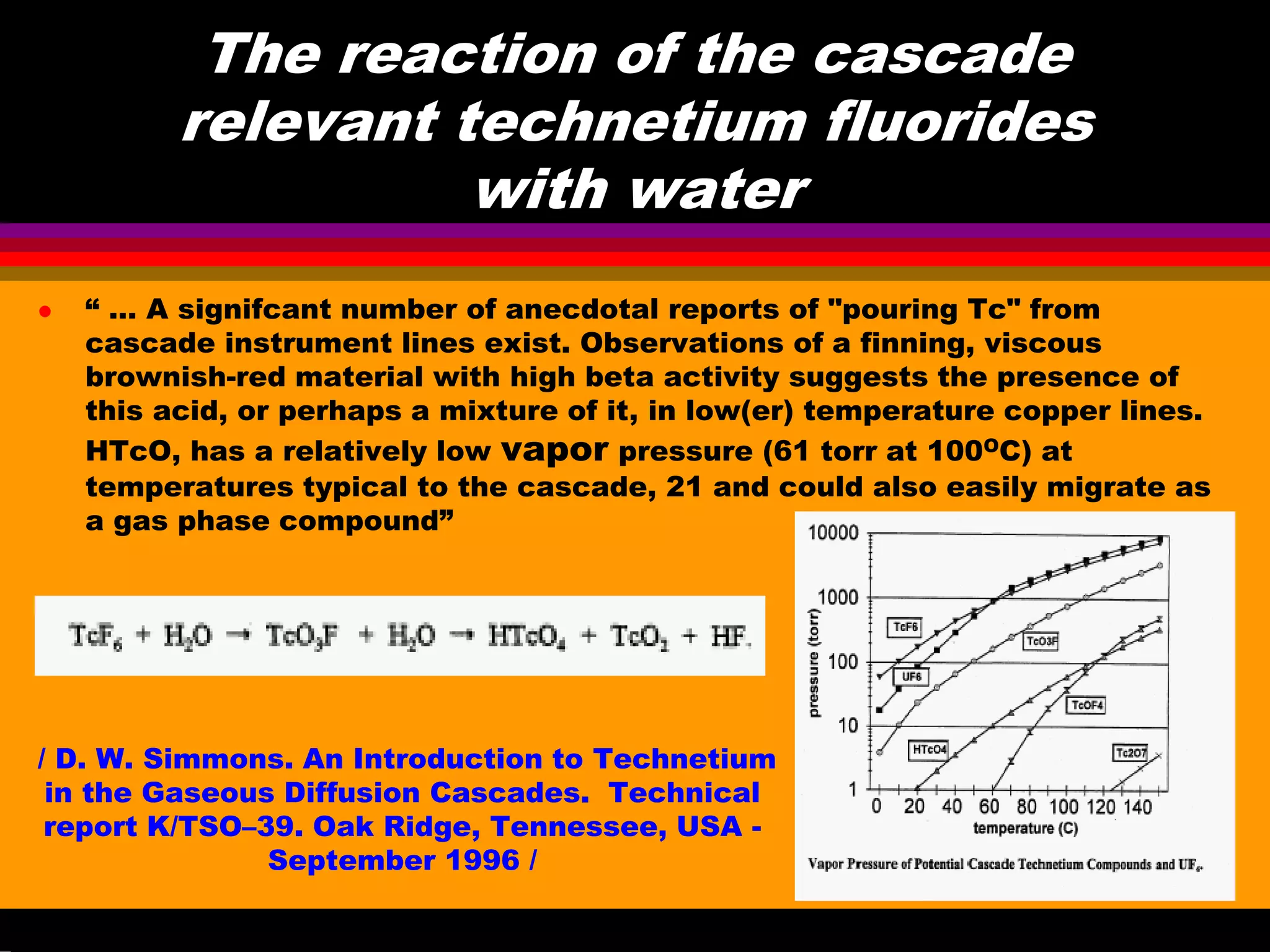
The reaction of the cascade
relevant technetium fluorides
with water
“ … A signifcant number of anecdotal reports of "pouring Tc" from
cascade instrument lines exist. Observations of a finning, viscous
brownish-red material with high beta activity suggests the presence of
this acid, or perhaps a mixture of it, in low(er) temperature copper lines.
HTcO, has a relatively low vapor pressure (61 torr at 100OC) at
temperatures typical to the cascade, 21 and could also easily migrate as
a gas phase compound”
/ D. W. Simmons. An Introduction to Technetium
in the Gaseous Diffusion Cascades. Technical
report K/TSO–39. Oak Ridge, Tennessee, USA -
September 1996 /
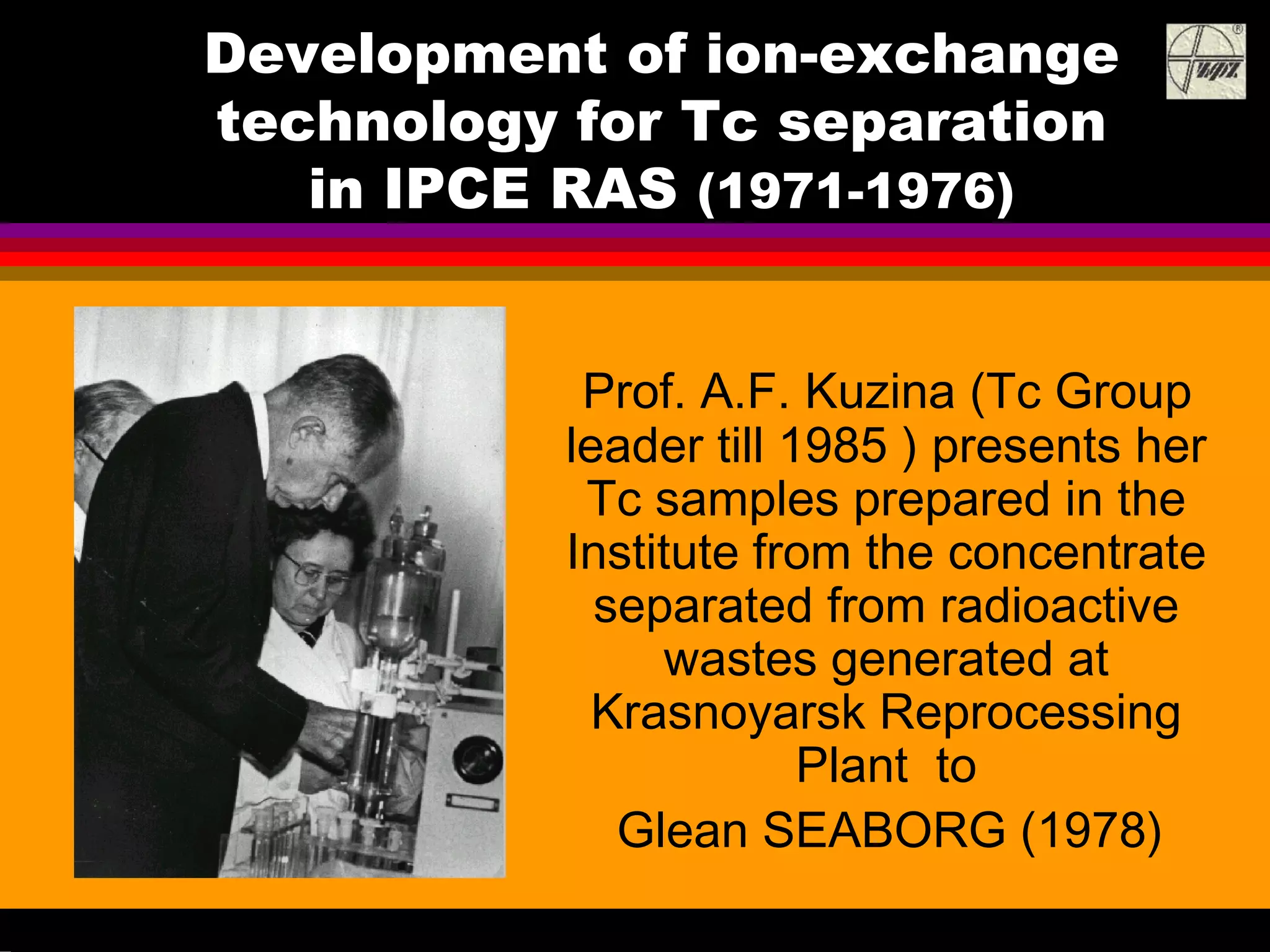
Development of ion-exchange
technology for Tc separation
in IPCE RAS (1971-1976)
Prof. A.F. Kuzina (Tc Group
leader till 1985 ) presents her
Tc samples prepared in the
Institute from the concentrate
separated from radioactive
wastes generated at
Krasnoyarsk Reprocessing
Plant to
Glean SEABORG (1978)
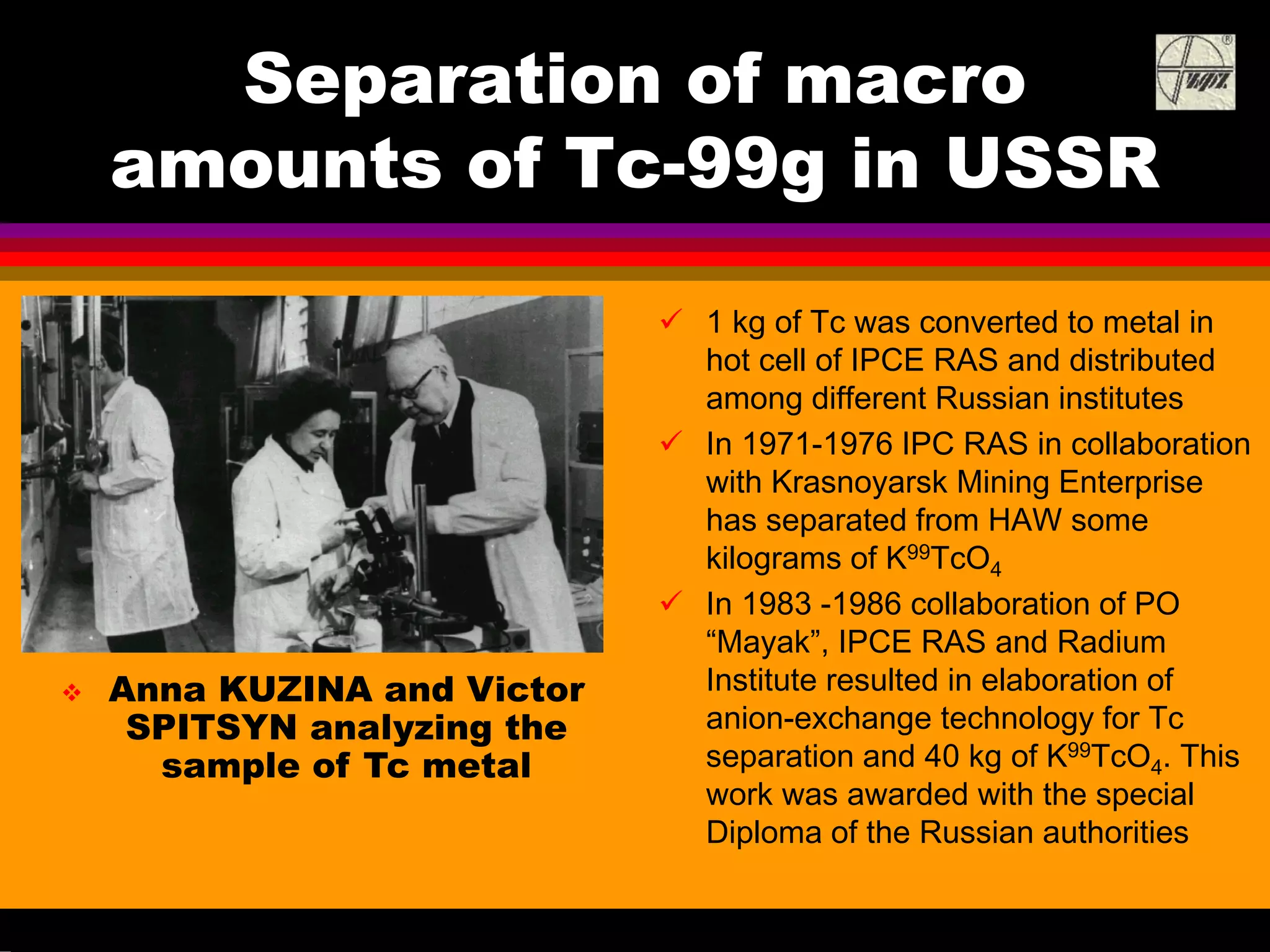
Separation of macro
amounts of Tc-99g in USSR
1 kg of Tc was converted to metal in
hot cell of IPCE RAS and distributed
among different Russian institutes
In 1971-1976 IPC RAS in collaboration
with Krasnoyarsk Mining Enterprise
has separated from HAW some
kilograms of K99TcO4
In 1983 -1986 collaboration of PO
“Mayak”, IPCE RAS and Radium
Institute resulted in elaboration of
anion-exchange technology for Tc
separation and 40 kg of K99TcO4. This
work was awarded with the special
Diploma of the Russian authorities
Anna KUZINA and Victor
SPITSYN analyzing the
sample of Tc metal
Some new Tc(VII) compounds
synthesised in IPCE RAS and
NLVU for reprocessing of SNF
N New compound of Tc or Re Structure C solubility 25°C, M/L ρ Kass
1 Tetrapropylammonium pertechnetate Pna21 a = 13.22(4),
b = 12.35(3),
c = 10.13(4) Å
(8.7 ±0.2) x 10-3 1,26 2,6 ± 0,4
2 Tetrapropylammonium perrhenate Pna21 a = 13.169(2), b =
12.311(2), c =
10.107(1) Å
(8.9 ±0.2) x 10-3 1.57 2,5 ± 0,3
3 Anilinium pertechnetate P21/c 9.8388(2)
5.89920(10) 14.6540(2) Å
(7.9 ± 0.2) x 10-2 2.07 -
4 Anilinium perrhenate P21/c 9.8714(4)
5.9729(2) 14.6354(5)
(8.3 ± 0.2) x 10-2 2.7 -
5 Tetrahexylammonium perthechnetate - (7.1 ± 0.5) x 10-5 1,07 40 ± 5
6 Tetrapentylammonium pertechnetate - (8.0 ± 0.2) x 10-4 1.33 -
7 Threephenylguanidinium pertechnetate P-1 9.87(1) 14.09(1)
15.44(1)
99.6 101.8 95.4
(3.9 ± 0.3) x 10-3 1,3 -
8 LiTcO4*3H2O P63mc, a=7.8604(1)
b=5.4164(1) A
5. 1
9 [(NpO2)2(TcO4)4*3H2O]n
P-1 5.322(5) 13.034(7)
15.46(9)
107.08 98.05 93.86(6)
0.95 4.99
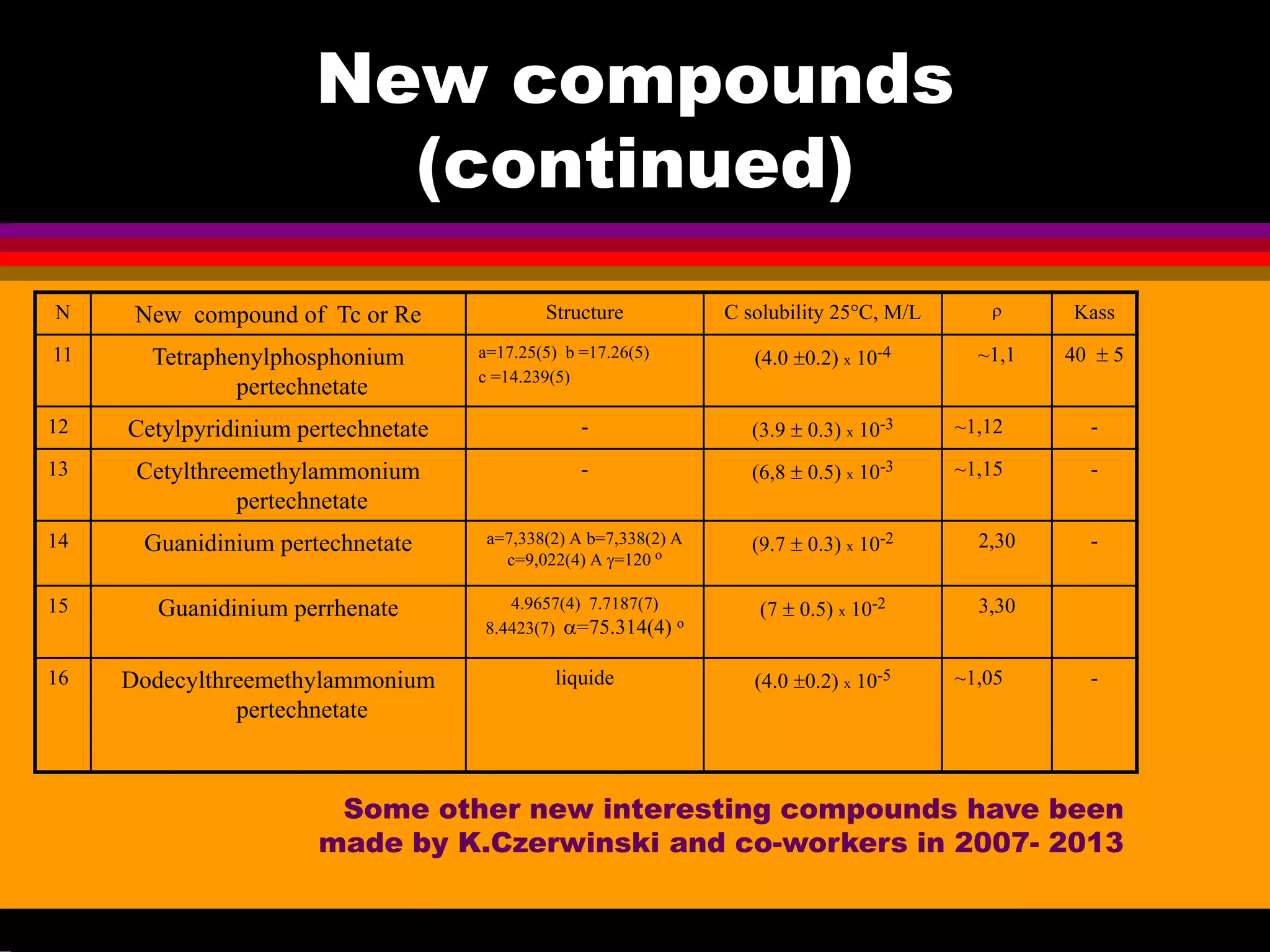
New compounds
(continued)
N New compound of Tc or Re Structure C solubility 25°C, M/L ρ Kass
11 Tetraphenylphosphonium
pertechnetate
a=17.25(5) b =17.26(5)
c =14.239(5)
(4.0 ±0.2) x 10-4 ~1,1 40 ± 5
12 Cetylpyridinium pertechnetate - (3.9 ± 0.3) x 10-3 ~1,12 -
13 Cetylthreemethylammonium
pertechnetate
- (6,8 ± 0.5) x 10-3 ~1,15 -
14 Guanidinium pertechnetate a=7,338(2) A b=7,338(2) A
c=9,022(4) A γ=120 o
(9.7 ± 0.3) x 10-2 2,30 -
15 Guanidinium perrhenate 4.9657(4) 7.7187(7)
8.4423(7) α=75.314(4) o
(7 ± 0.5) x 10-2 3,30
16 Dodecylthreemethylammonium
pertechnetate
liquide (4.0 ±0.2) x 10-5 ~1,05 -
Some other new interesting compounds have been
made by K.Czerwinski and co-workers in 2007- 2013
A few examples of new Tc compound
structures made in IPCE RAS
(K.German, M.Grigoriev, A.Maruk etc.)
[Anil-H]TcO4[GuH]ReO4
LiTcO4*3H2O
[Bu4N]TcO4
[(AnO2)2(MO4)4*3H2O]n ,
(An = U, Np; M = Tc, Re)
[Pr4N]TcO4
[Tc2Ac4](TcO4)2
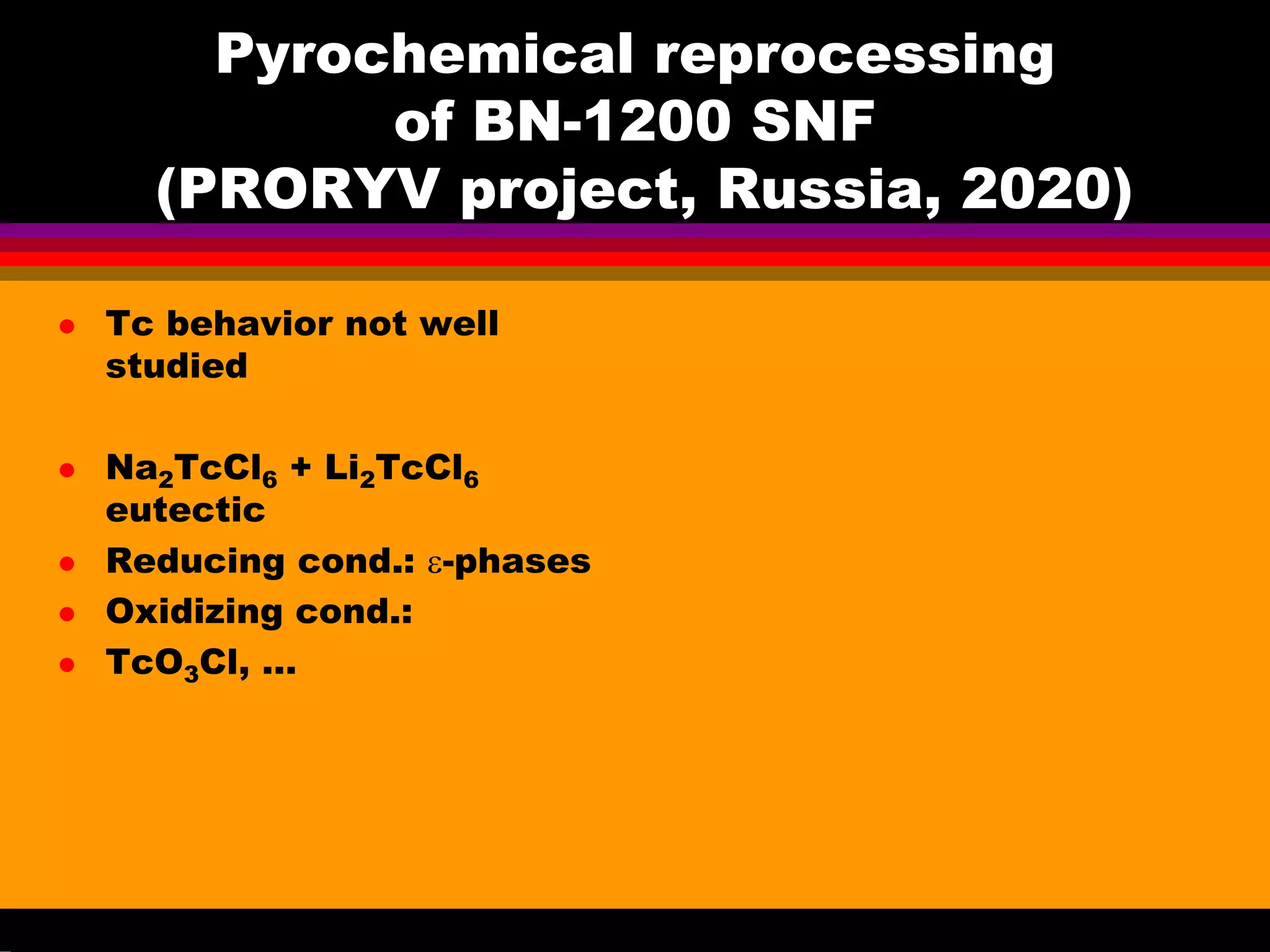
Pyrochemical reprocessing
of BN-1200 SNF
(PRORYV project, Russia, 2020)
Tc behavior not well
studied
Na2TcCl6 + Li2TcCl6
eutectic
Reducing cond.: ε-phases
Oxidizing cond.:
TcO3Cl, …
Top of the fundamental studies on Tc in IPCE RAS
10 (!) oxidation states were found for
Tc in HX (X = Cl, Br, I) :
7+, 6+, 5+, 4+, 3+, 2.5+, 2+, 1.83+, 1.66+, 1.5+
1. 3-gonal-prismatic Tc chlorides and iodides ( 2 clusters of Tc(1.83+)
and Tc(1.66+) : (Me4N)x[Tc6(m-Cl)6Cl6]Cly ) (K.German and others)
2. 4-gonal-prismatic Tc cluster bromide (addition of Tc2X2 to (1)
S.Kryutchkov)
3. octahedral Tc cluster bromides and iodides (angular conversion of (1))
а
в
1 2 3
Each synthesis involve up to 10 g of Tc !
Structures: unique in inorganic chemistry
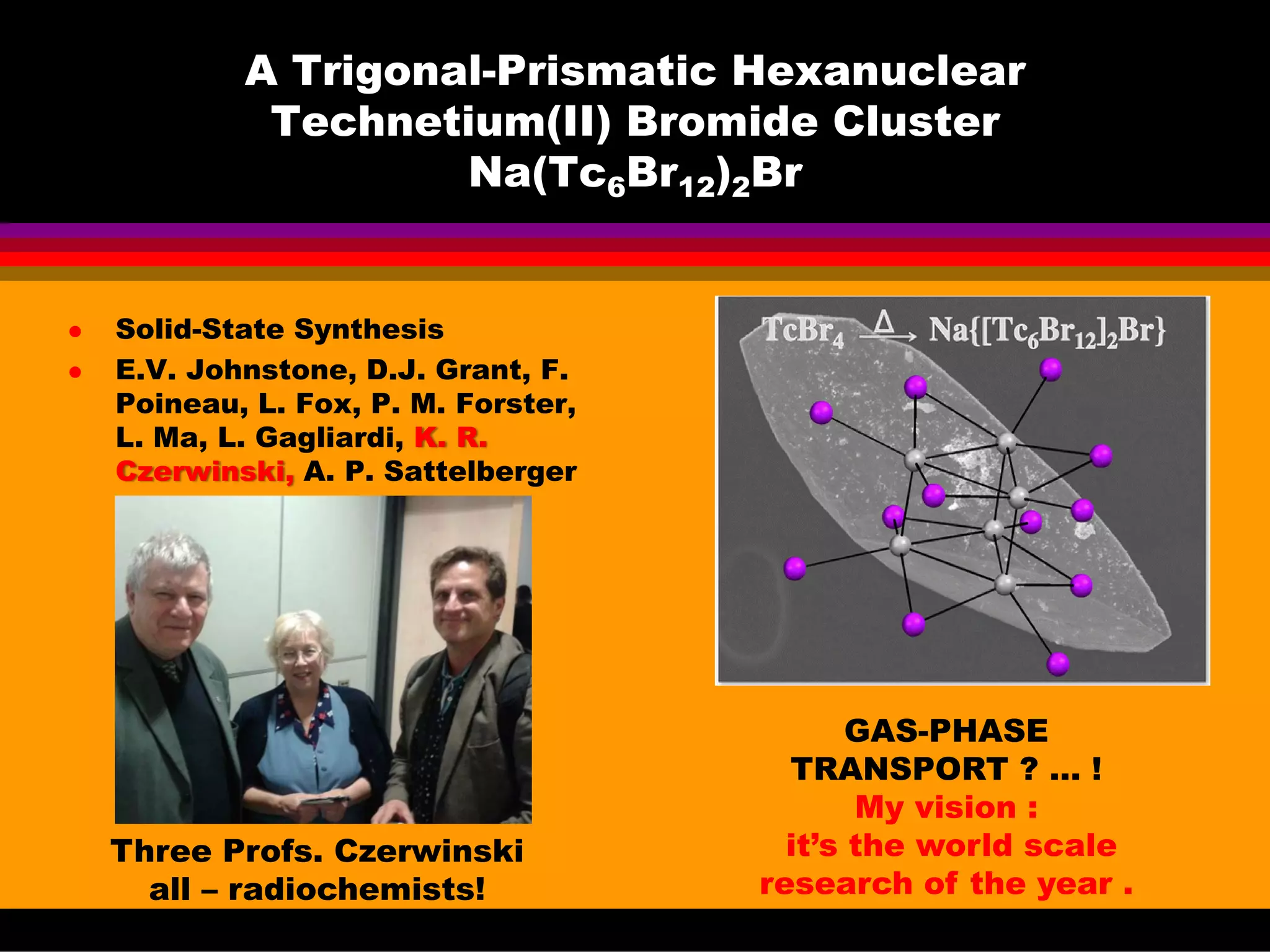
A Trigonal-Prismatic Hexanuclear
Technetium(II) Bromide Cluster
Na(Tc6Br12)2Br
Solid-State Synthesis
E.V. Johnstone, D.J. Grant, F.
Poineau, L. Fox, P. M. Forster,
L. Ma, L. Gagliardi, K. R.
Czerwinski, A. P. Sattelberger
GAS-PHASE
TRANSPORT ? … !
My vision :
it’s the world scale
research of the year .
Three Profs. Czerwinski
all – radiochemists!
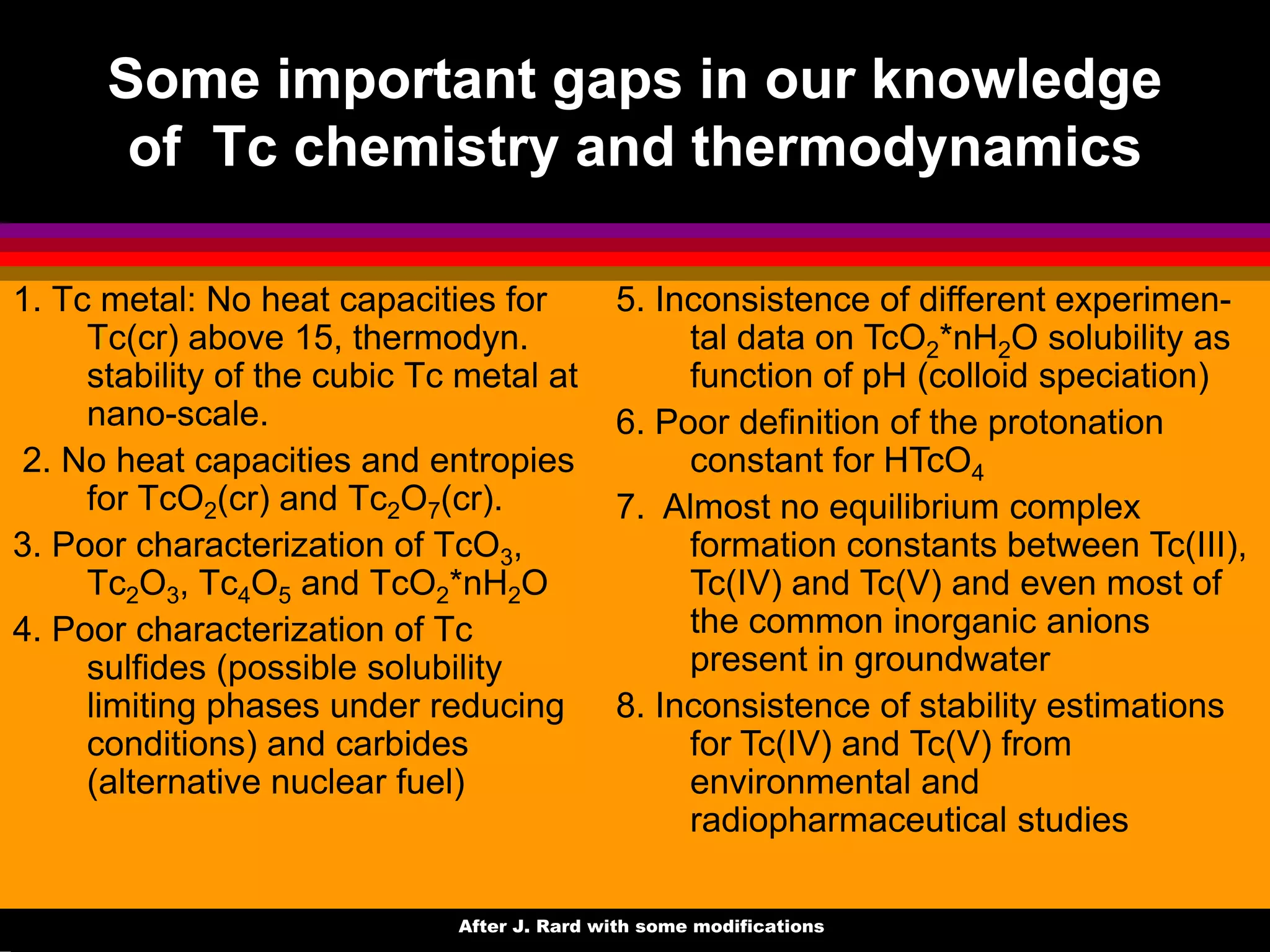
Some important gaps in our knowledge
of Tc chemistry and thermodynamics
1. Tc metal: No heat capacities for
Tc(cr) above 15, thermodyn.
stability of the cubic Tc metal at
nano-scale.
2. No heat capacities and entropies
for TcO2(cr) and Tc2O7(cr).
3. Poor characterization of TcO3,
Tc2O3, Tc4O5 and TcO2*nH2O
4. Poor characterization of Tc
sulfides (possible solubility
limiting phases under reducing
conditions) and carbides
(alternative nuclear fuel)
5. Inconsistence of different experimen-
tal data on TcO2*nH2O solubility as
function of pH (colloid speciation)
6. Poor definition of the protonation
constant for HTcO4
7. Almost no equilibrium complex
formation constants between Tc(III),
Tc(IV) and Tc(V) and even most of
the common inorganic anions
present in groundwater
8. Inconsistence of stability estimations
for Tc(IV) and Tc(V) from
environmental and
radiopharmaceutical studies
After J. Rard with some modifications
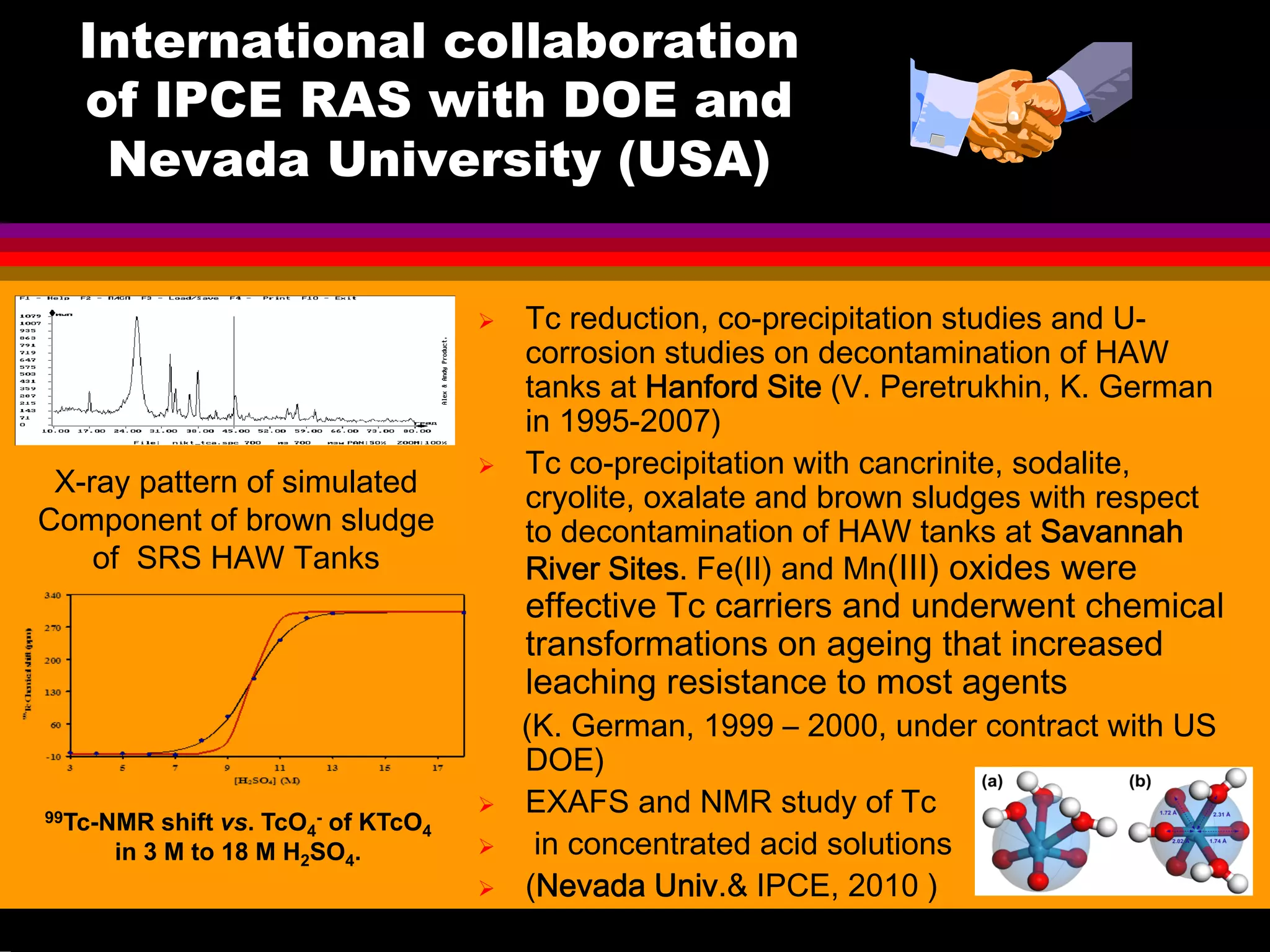
International collaboration
of IPCE RAS with DOE and
Nevada University (USA)
Tc reduction, co-precipitation studies and U-
corrosion studies on decontamination of HAW
tanks at Hanford Site (V. Peretrukhin, K. German
in 1995-2007)
Tc co-precipitation with cancrinite, sodalite,
cryolite, oxalate and brown sludges with respect
to decontamination of HAW tanks at Savannah
River Sites. Fe(II) and Mn(III) oxides were
effective Tc carriers and underwent chemical
transformations on ageing that increased
leaching resistance to most agents
(K. German, 1999 – 2000, under contract with US
DOE)
EXAFS and NMR study of Tc
in concentrated acid solutions
(Nevada Univ.& IPCE, 2010 )
X-ray pattern of simulated
Component of brown sludge
of SRS HAW Tanks
99Tc-NMR shift vs. TcO4
- of KTcO4
in 3 M to 18 M H2SO4.
99Tc concentrations found in
various tank sludges at SRS
Tank
Number
[Tc-99],
mCi/g dried
solids
Reference
17 0.462 d'Entremont et
al. 1997
20, white
solids
0.34 d'Entremont and
Hester 1996
20, brown
solids
0.94 d'Entremont and
Hester 1996
42 0.22 Hay 1999
51 0.21 Hay 1999
8 0.22 Hay 1999
11 0.34 Hay 1999
The discovery of relatively high
99Tc concentrations in
inorganic mineral sludge heels
taken from some tanks at the
US-DOE Savannah River Site
(SRS) has prompted
investigations of Tc uptake
from alkaline highly active
waste (HAW) by solid
adsorbents
The SRS waste volumes (Table 2.4 of "Integrated
Database Report - 1993: S.Spent Fuel and Radioactive
Waste Inventories, Projections, and Characteristics,”]
Tc-99 quantities (Table 2.11), and
Volume, Tc-99, Ci [Tc-99], [Tc], 106 Kd
liters Ci/liter g/liter total
Liquid 61.4 1.68E+04 2.74E-03 0.162 -
Sludge 13.9 1.14E+04 8.20E-03 0.483 3
Salt Cake 53.8 2.78E+03 5.17E-04 0.0305 0.2
Overall waste 129.1 3.098E+04 2.40E-03 0.141 -
Question was: Which components absorb Tc with Kd
higher than 3 and are resistant to leaching?
Tc-99 concentrations
calculated from these data
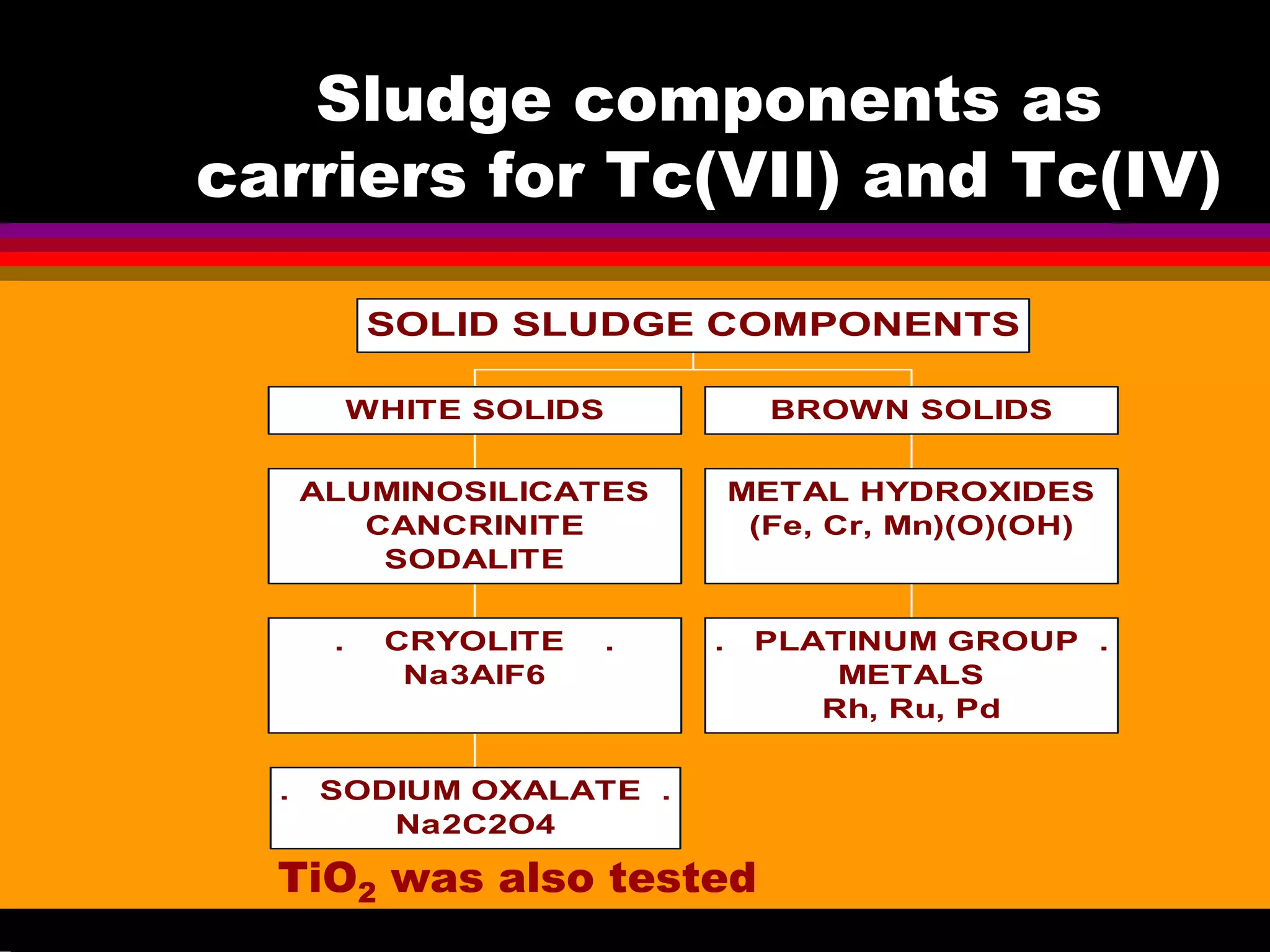
Sludge components as
carriers for Tc(VII) and Tc(IV)
. SODIUM OXALATE .
Na2C2O4
. CRYOLITE .
Na3AlF6
ALUMINOSILICATES
CANCRINITE
SODALITE
WHITE SOLIDS
. PLATINUM GROUP .
METALS
Rh, Ru, Pd
METAL HYDROXIDES
(Fe, Cr, Mn)(O)(OH)
BROWN SOLIDS
SOLID SLUDGE COMPONENTS
TiO2 was also tested
Experimental conditions for
precipitation and leaching tests:
Precipitation tests:
Wastes are alkaline
Tc is redox sensitive
Sharp differences in the
redox potential within the
tanks are observed,
So, both:
oxidizing [Tc(VII)]
and reducing [Tc(IV)]
conditions were tested in
0.1- 5 N NaOH + 0-5 N NaOH.
Leaching modes:
Surface leaching.
Complete dissolution.
Leaching agents
all precipitates : 0.1N NaOH
aluminosilicates - NaHF2
Na oxalate - 0.1N NaOH, NaNO2
FeOOH - 0.1N NaOH, H2O2
MnOOH - 0.1N NaOH, H2O2
TiO2 - 0.1- 3N NaOH
Methods: Liquid scintillation counting (LSC) of solutions, XRD, NMR, IR
Study of Tc uptake with
Aluminosilicates under oxidizing
conditions at 70-130oC
Solution Formed solid Kd
10-3
-10-5
M Tc
0.2-5M NaOH
0.5-5 M NaNO3
Cancrinite less 1
10-3
-10-5
M Tc
0.2-5M NaOH
NaNO3 free
Sodalite less 1
TcO4
- is too large
and therefore it is
excluded from the
aluminosilicate
structure in both
cancrinite and
sodalite
Literature data have demonstrated the
possibility of ClO4
- and MnO4
- co-crystallisaton
with aluminosilicates : purple
Na8[AlSiO4]6(MnO4)2 (Weller,1999 etc.)
OUR EXPERIMENTS on TcO4
- (reaction: NaAlO2+Na2SiO3+NaOH)
Case of Aluminosilicates formed in
concentrated Tc(VII) solution
[Tc] = 0.2 M
in NaNO3 solutions -
cancrinite
in NaNO3-free solutions -
sodalite
Although NMR spectrum
presented shift typical for
coordinated Tc(VII) its
concentration is very low
Dissolution in NaHF2 and LSC
has shown : [Tc] in solid
cancrinite was 57 mg/kg ~ 100
times less than in initial
solution
Fig. 1. NMR-99
Tc spectrum of the aluminosilicate containing
57 mg-Tc/kg. Tc spectrum presents evidence for -30 ppm shift
characteristic of coordinated pertechnetate
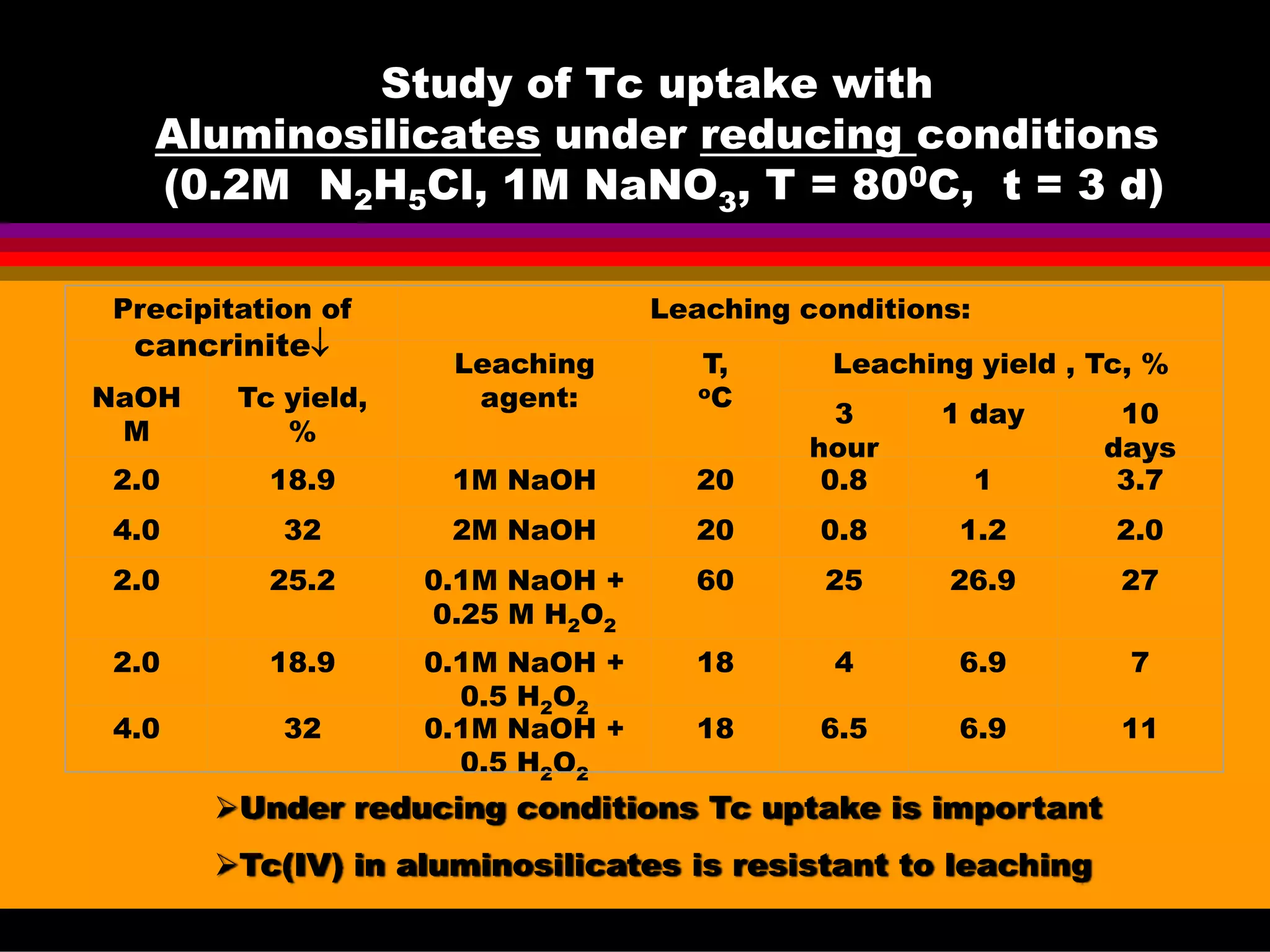
Study of Tc uptake with
Aluminosilicates under reducing conditions
(0.2M N2H5Cl, 1M NaNO3, T = 800С, t = 3 d)
Precipitation of
cancrinite↓
Leaching conditions:
NaOH
M
Tc yield,
%
Leaching
agent:
T,
oC
Leaching yield , Tc, %
3
hour
1 day 10
days
2.0 18.9 1M NaOH 20 0.8 1 3.7
4.0 32 2M NaOH 20 0.8 1.2 2.0
2.0 25.2 0.1M NaOH +
0.25 M H2O2
60 25 26.9 27
2.0 18.9 0.1M NaOH +
0.5 H2O2
18 4 6.9 7
4.0 32 0.1M NaOH +
0.5 H2O2
18 6.5 6.9 11
Under reducing conditions Tc uptake is important
Tc(IV) in aluminosilicates is resistant to leaching
Study of Tc(VII) sorption
by crystalline TiO2
under oxidizing conditions
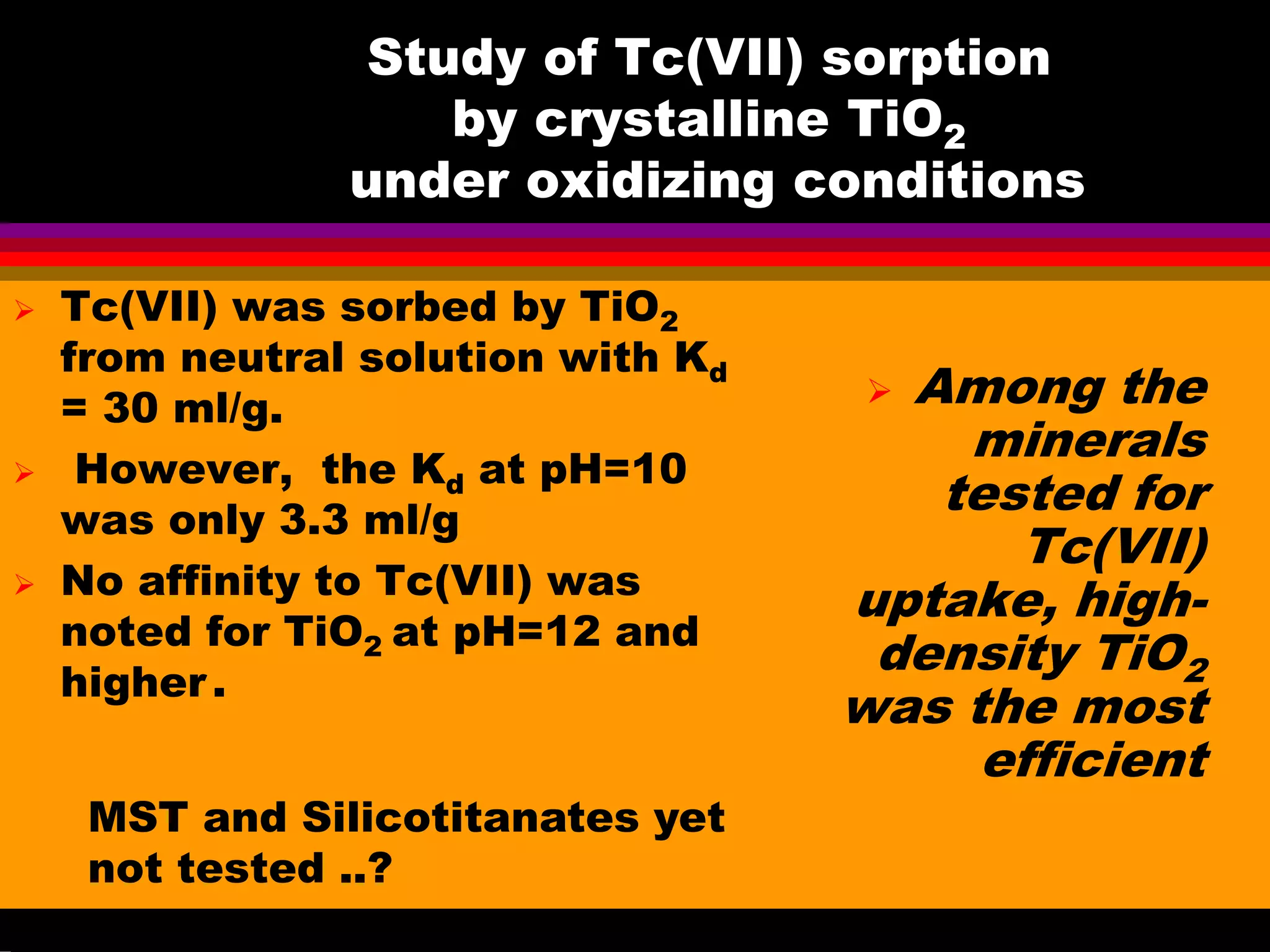
Tc(VII) was sorbed by TiO2
from neutral solution with Kd
= 30 ml/g.
However, the Kd at pH=10
was only 3.3 ml/g
No affinity to Tc(VII) was
noted for TiO2 at pH=12 and
higher.
Among the
minerals
tested for
Tc(VII)
uptake, high-
density TiO2
was the most
efficient
MST and Silicotitanates yet
not tested ..?
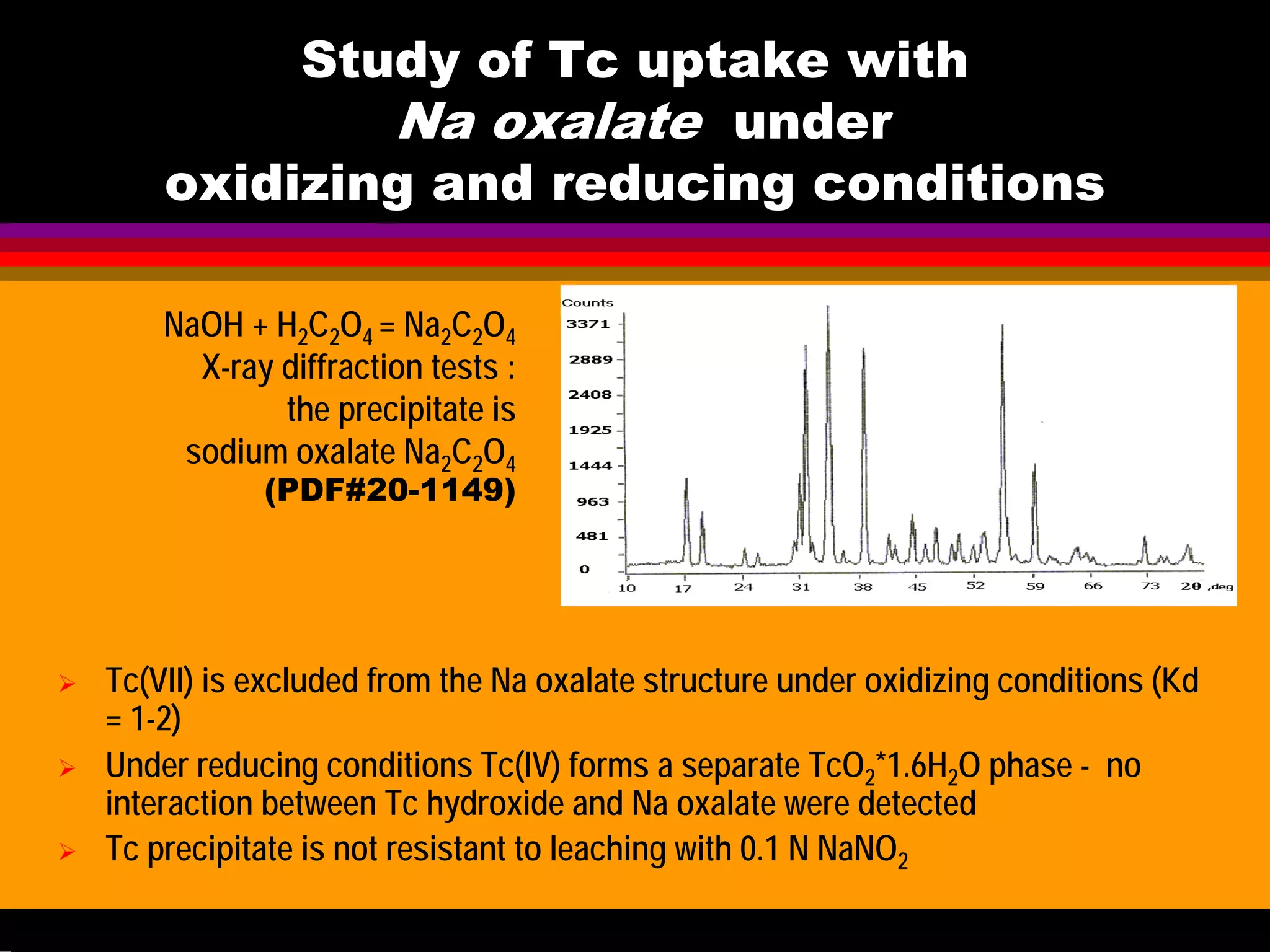
Study of Tc uptake with
Na oxalate under
oxidizing and reducing conditions
Tc(VII) is excluded from the Na oxalate structure under oxidizing conditions (Kd
= 1-2)
Under reducing conditions Tc(IV) forms a separate TcO2*1.6H2O phase - no
interaction between Tc hydroxide and Na oxalate were detected
Tc precipitate is not resistant to leaching with 0.1 N NaNO2
NaOH + H2C2O4 = Na2C2O4
X-ray diffraction tests :
the precipitate is
sodium oxalate Na2C2O4
(PDF#20-1149)
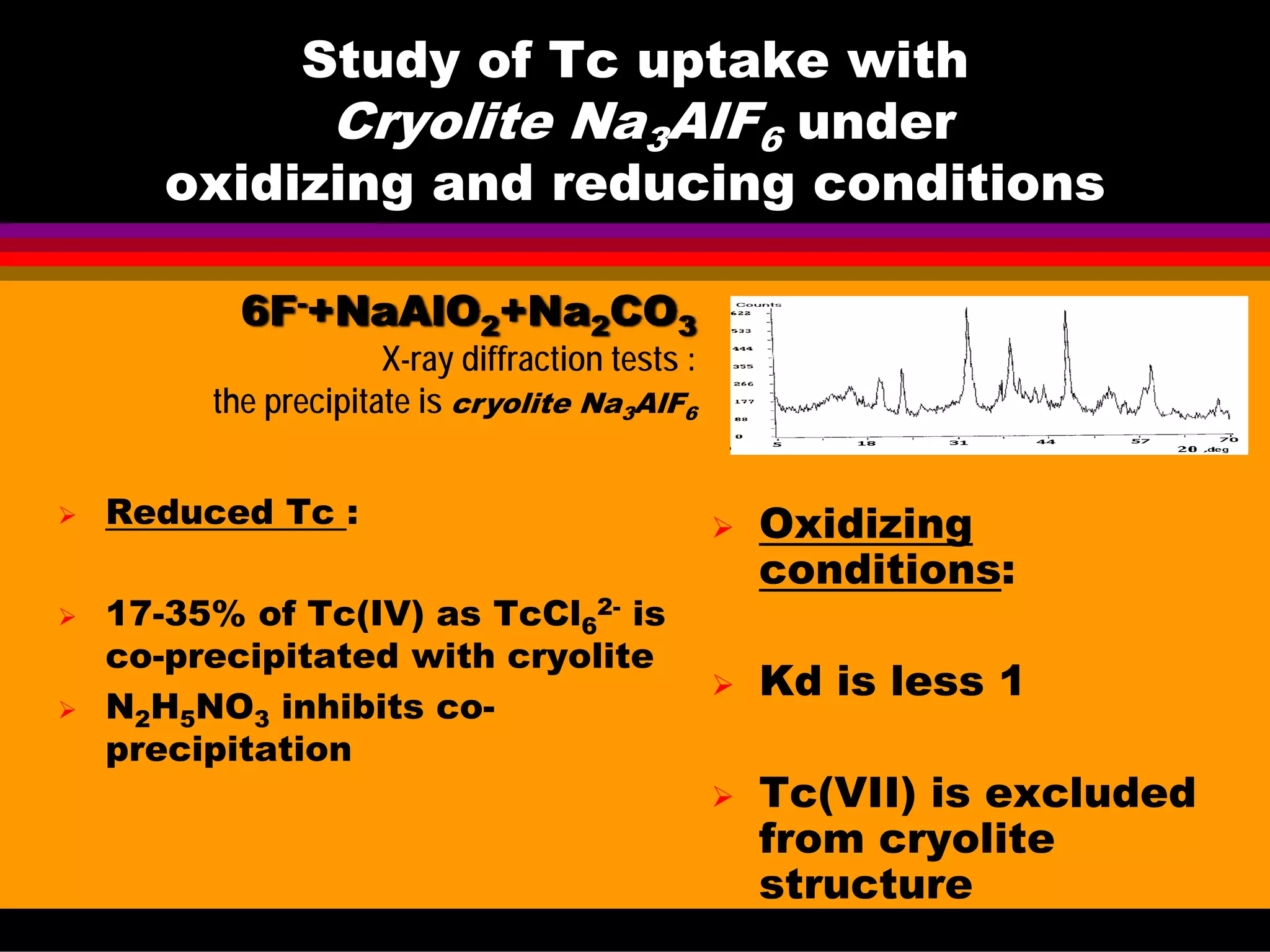
Study of Tc uptake with
Cryolite Na3AlF6 under
oxidizing and reducing conditions
Reduced Tc :
17-35% of Tc(IV) as TcCl6
2- is
co-precipitated with cryolite
N2H5NO3 inhibits co-
precipitation
Oxidizing
conditions:
Kd is less 1
Tc(VII) is excluded
from cryolite
structure
6F-+NaAlO2+Na2CO3
X-ray diffraction tests :
the precipitate is cryolite Na3AlF6
Tc(IV) uptake with Cryolite Na3AlF6
under reducing conditions
N
o
[NH4F]
initial,
M
[Na2CO3] in
final
solution, M
[N2H5NO3],
in final
solution, M
Tc(IV)
uptake,
%
1
2
3
4
5
8
9
10
2,0
2.5
3.0
4,0
6,0
2,0
2,0
2,0
0,6
0.6
0,6
0.6
0,6
0,4
0,8
0,6
-
-
-
-
-
-
-
0,1
20
23
26
28
35
25
17
0
• Tc(IV) is added as Na2TcCl6 to (NH4F+NaAlO2) solution
• No additional reducing agent in exp. No 1-9
• Leaching test were impossible to quantify relative to real cryolite
in tanks as complete peptization occurred.
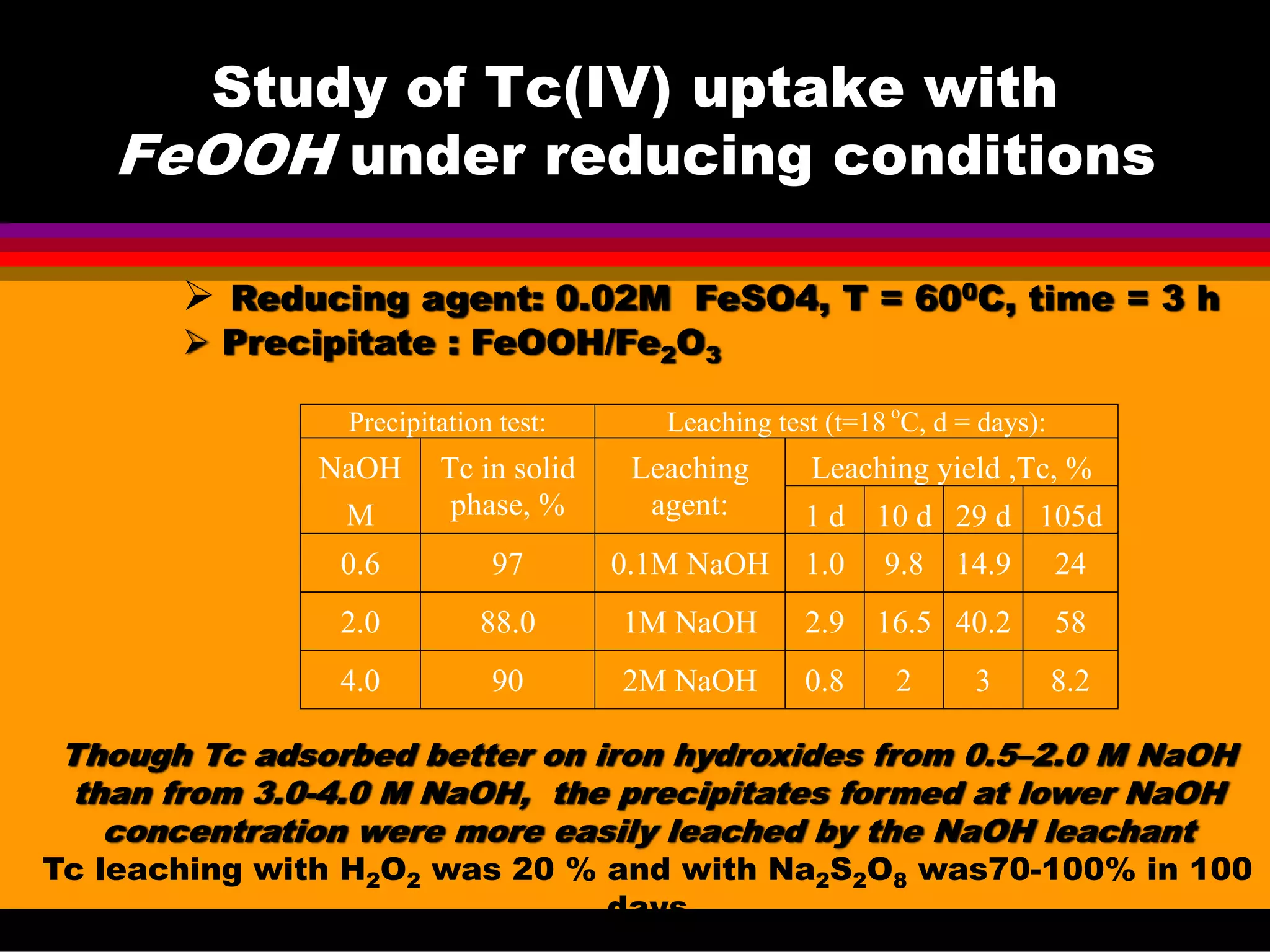
Study of Tc(IV) uptake with
FeOOH under reducing conditions
Precipitation test: Leaching test (t=18 o
C, d = days):
NaOH
M
Tc in solid
phase, %
Leaching
agent:
Leaching yield ,Tc, %
1 d 10 d 29 d 105d
0.6 97 0.1M NaOH 1.0 9.8 14.9 24
2.0 88.0 1M NaOH 2.9 16.5 40.2 58
4.0 90 2M NaOH 0.8 2 3 8.2
Reducing agent: 0.02M FeSO4, T = 600С, time = 3 h
Precipitate : FeOOH/Fe2O3
Though Tc adsorbed better on iron hydroxides from 0.5–2.0 M NaOH
than from 3.0-4.0 M NaOH, the precipitates formed at lower NaOH
concentration were more easily leached by the NaOH leachant
Tc leaching with H2O2 was 20 % and with Na2S2O8 was70-100% in 100
days
Study of Tc(IV) uptake with MnOOH under
reducing conditions
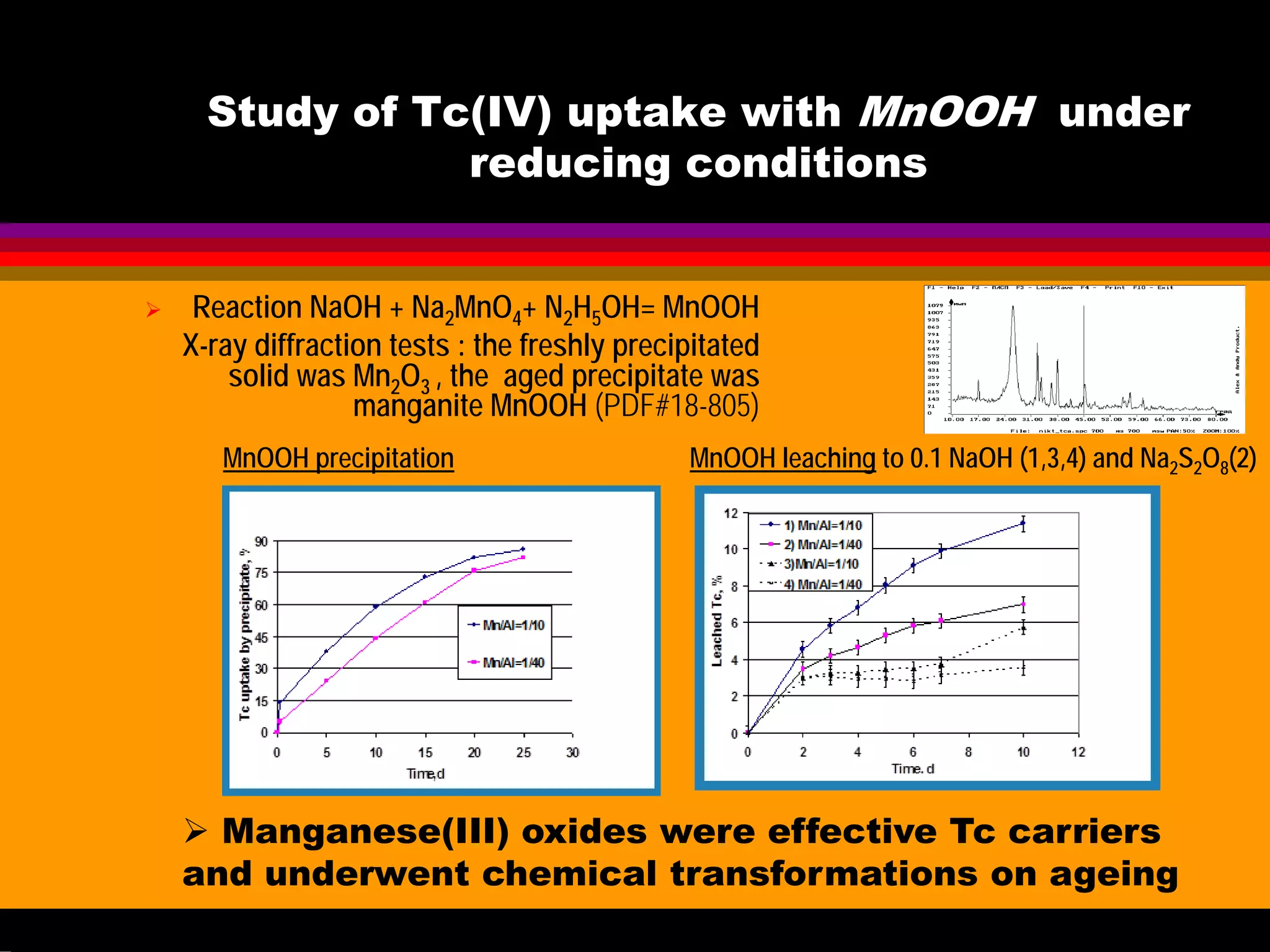
Reaction NaOH + Na2MnO4+ N2H5OH= MnOOH
X-ray diffraction tests : the freshly precipitated
solid was Mn2O3 , the aged precipitate was
manganite MnOOH (PDF#18-805)
Manganese(III) oxides were effective Tc carriers
and underwent chemical transformations on ageing
that increased leaching resistance to most agents.
MnOOH precipitation MnOOH leaching to 0.1 NaOH (1,3,4) and Na2S2O8(2)
Tc & HLW Vitrification
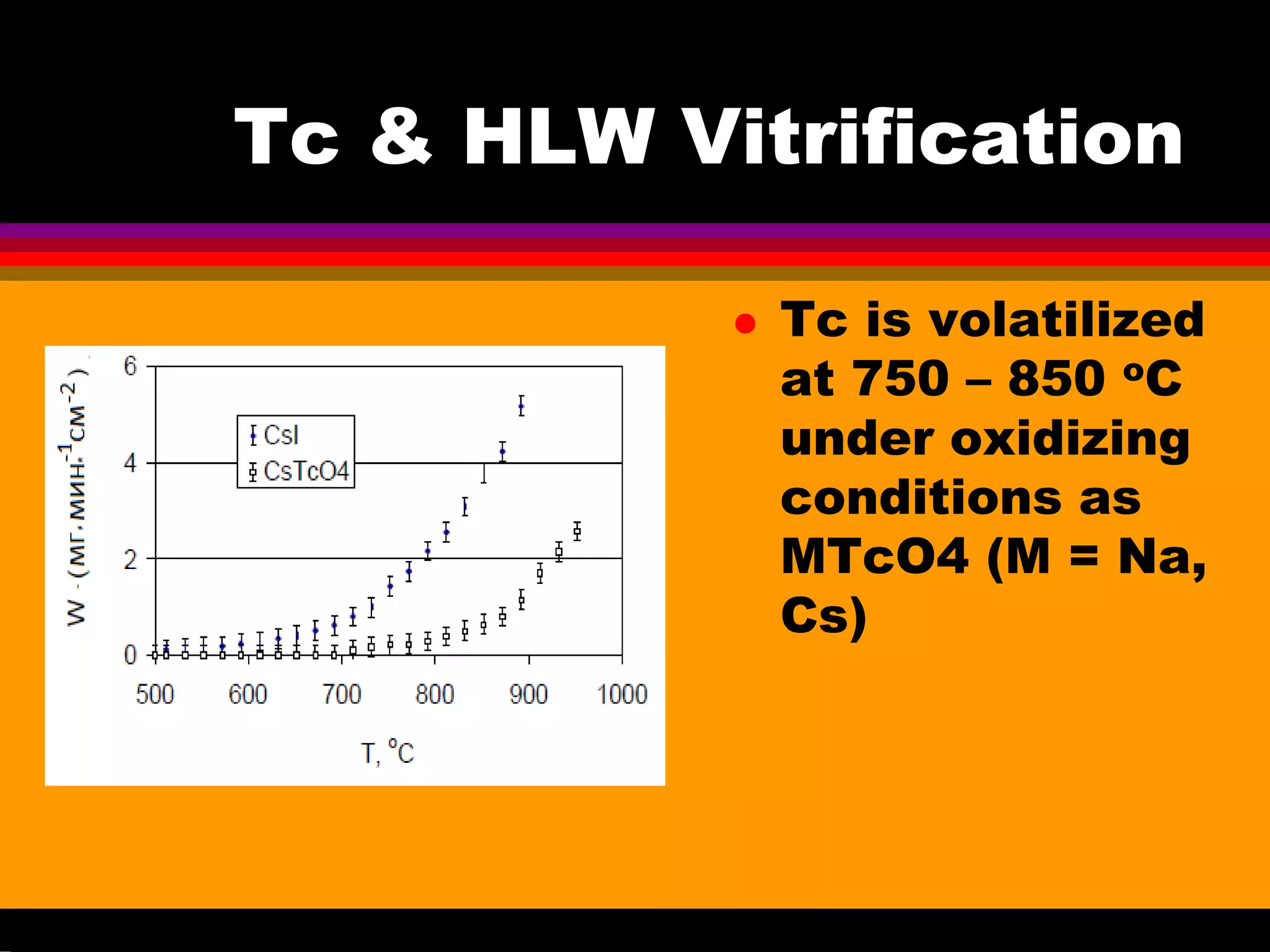
Tc is volatilized
at 750 – 850 oC
under oxidizing
conditions as
MTcO4 (M = Na,
Cs)
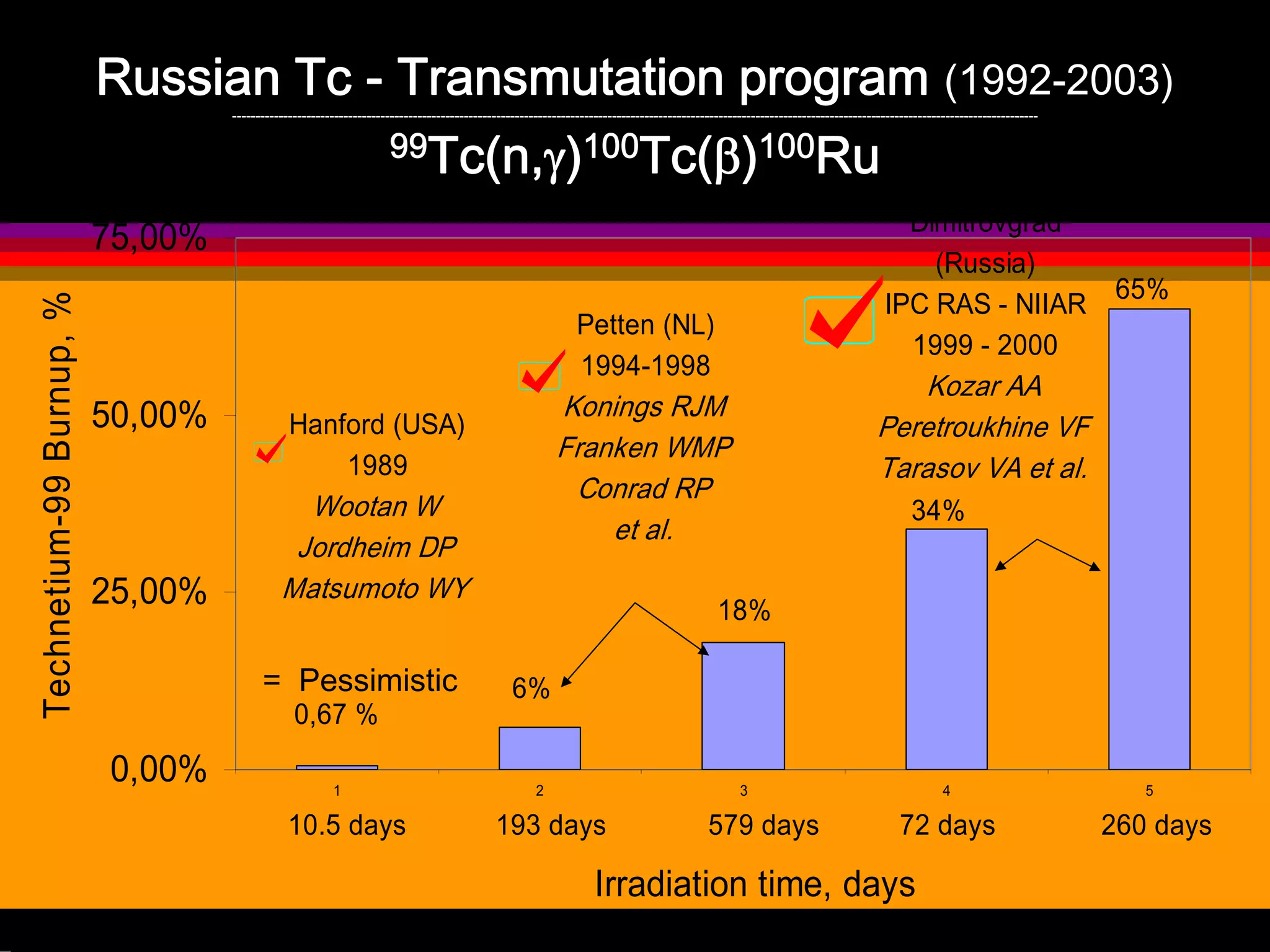
Russian Tc - Transmutation program (1992-2003)
------------------------------------------------------------------------------------------------------------------------------------------------------------------------------
99Tc(n,γ)100Tc(β)100Ru
0,00%
25,00%
50,00%
75,00%
1 2 3 4 5
Irradiation time, days
Technetium-99Burnup,%
Hanford (USA)
1989
Wootan W
Jordheim DP
Matsumoto WY
Petten (NL)
1994-1998
Konings RJM
Franken WMP
Conrad RP
et al.
Dimitrovgrad
(Russia)
IPC RAS - NIIAR
1999 - 2000
Kozar AA
Peretroukhine VF
Tarasov VA et al.
6%
18%
34%
65%
10.5 days 193 days 579 days 72 days 260 days
0,67 %
= Pessimistic
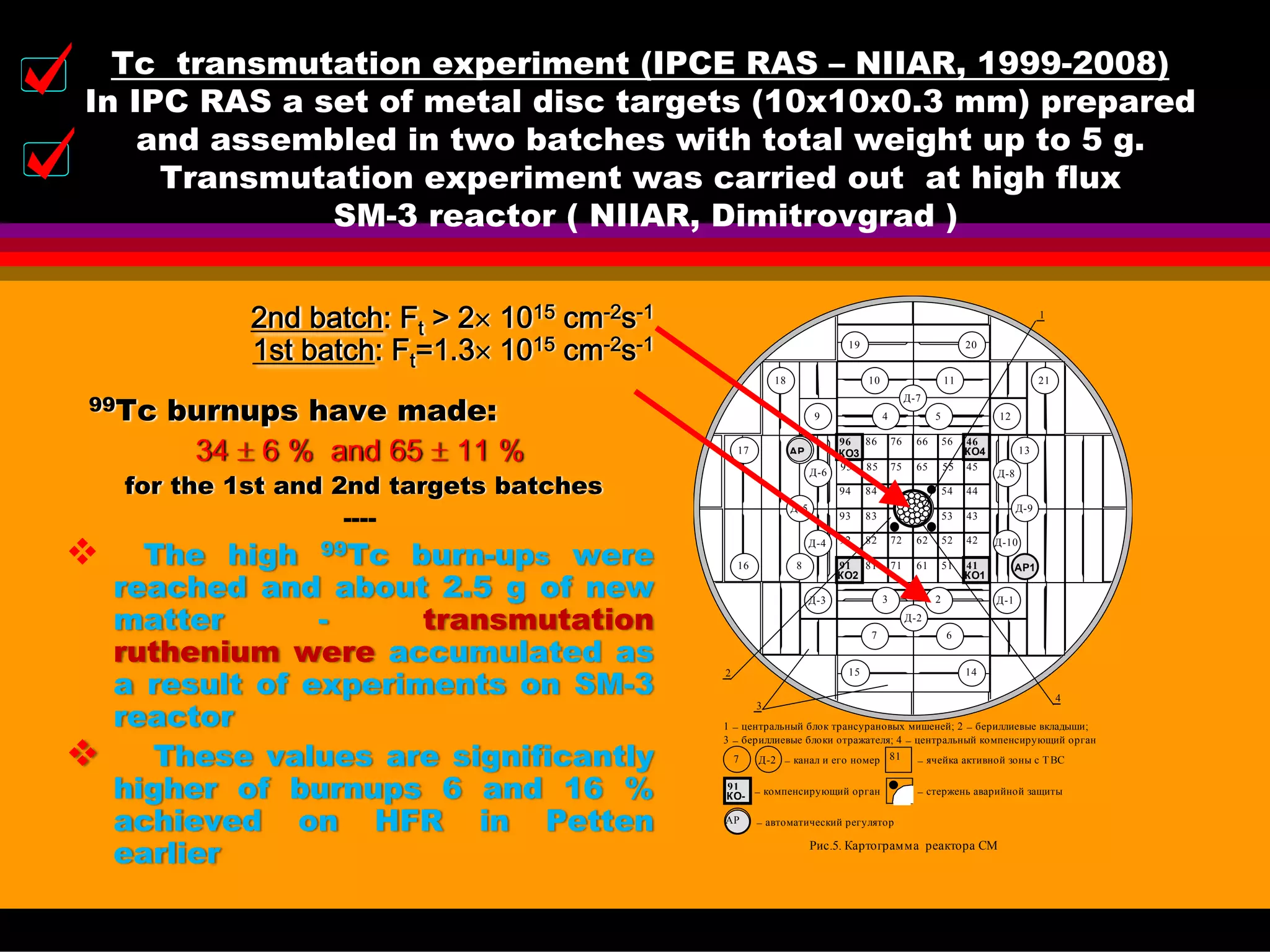
Tc transmutation experiment (IPCE RAS – NIIAR, 1999-2008)
In IPC RAS a set of metal disc targets (10x10x0.3 mm) prepared
and assembled in two batches with total weight up to 5 g.
Transmutation experiment was carried out at high flux
SM-3 reactor ( NIIAR, Dimitrovgrad )
2nd batch: Ft > 2× 1015 cm-2s-1
1st batch: Ft=1.3× 1015 cm-2s-1
99Tc burnups have made:
34 ± 6 % and 65 ± 11 %
for the 1st and 2nd targets batches
----
The high 99Tc burn-ups were
reached and about 2.5 g of new
matter - transmutation
ruthenium were accumulated as
a result of experiments on SM-3
reactor
These values are significantly
higher of burnups 6 and 16 %
achieved on HFR in Petten
earlier
1 − центральный блок трансурановых мишеней; 2 − бериллиевые вкладыши;
3 − бериллиевые блоки отражателя; 4 − центральный компенсирующий орган
− автоматический регулятор
− стержень аварийной защиты
− ячейка активной зоны с ТВС
− компенсирующий орган
− канал и его номер7 Д-2 81
91
КО-
АР
4
3
2
1
Д-3 Д-1
9 12
465666768696
6575 45558595
425262728292
4151617181
44548494
43538393
КО4КО3
КО1
91
КО2
Д-2
2
6
1415
3
7
816
Д-4
Д-5
АР17
Д-6
Д-10
Д-9
13
Д-8
АР1
19
4
10
Д-7
5
20
11 2118
Рис.5. Картограмма реактора СМ
Preparation of artificial stable
Ruthenium by transmutation of
Technetium
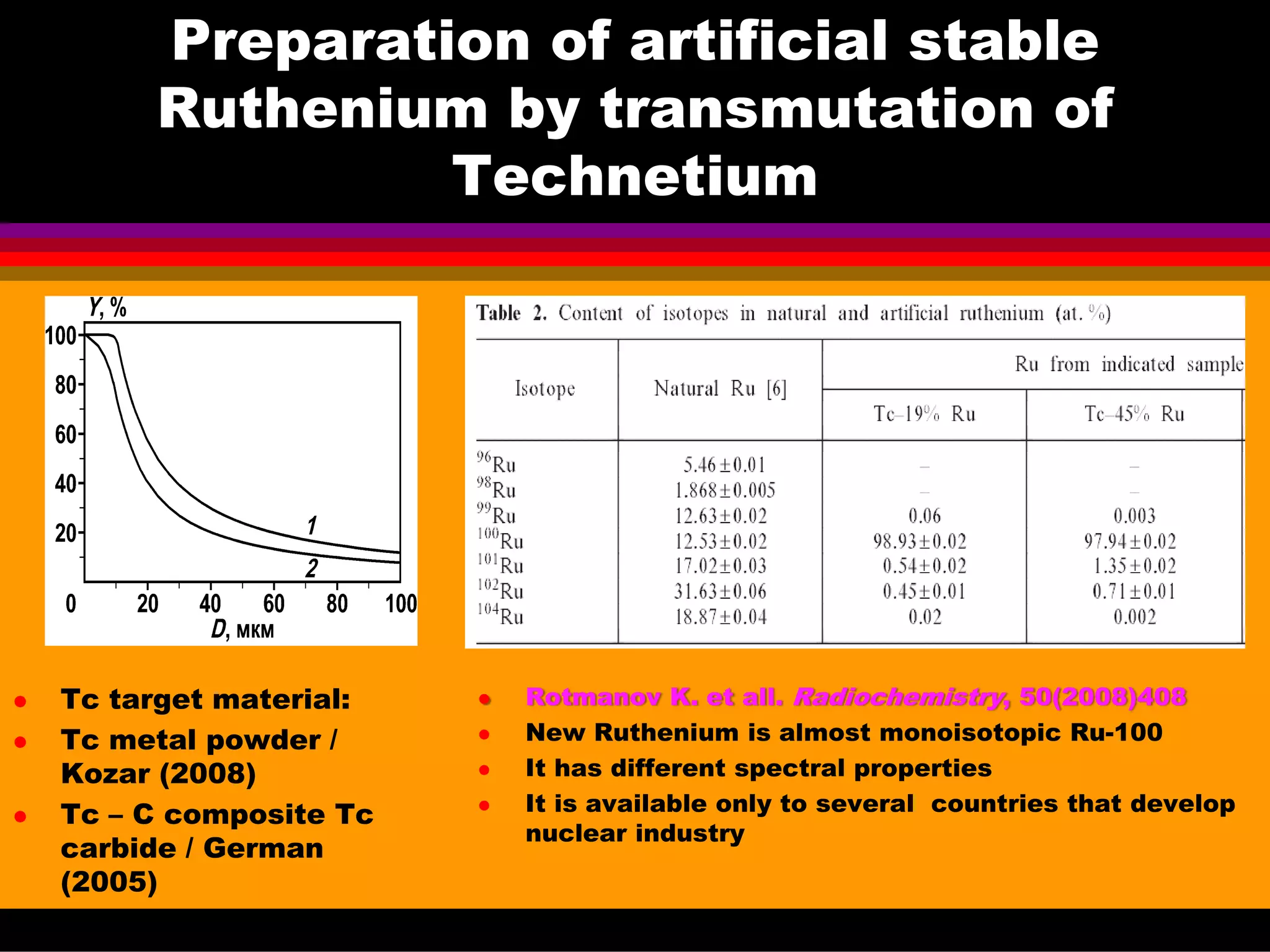
Rotmanov K. et all. Radiochemistry, 50(2008)408
New Ruthenium is almost monoisotopic Ru-100
It has different spectral properties
It is available only to several countries that develop
nuclear industry
Tc target material:
Tc metal powder /
Kozar (2008)
Tc – C composite Tc
carbide / German
(2005)
The IPCE publications
used in the presentation
The principle achievements of recent Russian researches in technetium chemistry, metallurgy, environmental science, nuclear
reprocessing and applications are overviewed. The allied aspects of rhenium chemistry and applications are compared. The
progress in technetium handling during the spent nuclear fuel reprocessing was based on the fundamental studies of numerous
new technetium mono- and polynuclear compounds and species [1-10]. The previous achievements were reviewed in [11].
In concentrated water solutions Tc(VII) often forms crystals isomorphous with perchlorates while in concentrated unhydrous
solutions Tc(VII) behaviour is more similar to Re(VII) compared to Cl(VII) [4-6].
Interesting results were obtained with the Tc-DTPA complex formed under advanced PUREX conditions [6-7]. Great progress
have been achieved in the understanding of Tc(VII) behaviour in acids [8-10] that is important for explanation and prediction of Tc
and Re handling in acids, including the concentrated acid solutions up to highest. The investigation in crystal structures of Tc
compounds [2] enabled us with direct recommendations for the template synthesis for Tc and Re sensors [6]. The progress in Tc
carbonyl compounds gave chance for advanced Tc metal and Tc carbide films deposition [7]. Technetium sulphide and rhenium
were studied both with respect to medicine and to environmental behaviour of these elements [11]. The work on technetium
nanomaterials was carried in Russia in 2009-2010 within RFBR-09-03-00017, while the work on DTPA complexes with RFBR-09-
08000153.
References.
Peretrukhin V.F., German К.E., Маslennikov А.G. etc. Development of chemistry and technology of technetium. In.: «Modern
problems of physical chemistry» р. 681 – 695. М.: «Granitsy Publ.» (2005) 681-695.
Grigoriev M.S., German K.E., Maruk A.Y. // Acta Crystallogr. Sect E. (2007) V. 63. Pt.9. : P. m2061, and p. m2355.
Maruk A.Y. Grigoriev M.S., German K.E. Russ. Coord.Chem (2010) v.36, No 5, pp. 1–8.
Maruk A.Y. Grigoriev M.S., German K.E. Abstracts of the ”Conference on diffraction methods for substance investigations: from
molecules to crystals and nanomaterials”, Chernkgolovka. 30 june-3 july 2008. p.
Maruk A.Y. Grigoriev M.S., German K.E. Abstracts of the ”Conference on diffraction methods for substance investigations: from
molecules to crystals and nanomaterials”, Chernkgolovka. 25 june- 28 june 2010. p.
D.N. Tumanova, K.E. German, V.F. Peretrukhin, Ya.A. Obruchnikova, A.Yu. Tsivadze. Stabilization and spectral characteristics of
technetium and rhenium peroxides. In: 6-th International Symposium on Technetium and Rhenium. NMMU-Port Elizabeth, 7-10
October 2008, p.47.
D.N. Tumanova, K.E. German, V.F. Peretrukhin, A.Yu. Tsivadze. Formation of technetium peroxydes in anhydrous sulfuric acid.
Doklady Phys. Chem. 420 (2008) 114-117.
German K.E., Melentiev A.B., Kalmykov S.N., etc. Tc-DTPA sediments formed in technetium – hydrazine – DTPA – nitric acid
solutions. Journ. Nucl. Medcine and Biol.(2010). Sept. pp.
B.Ya. Zilberman. Radiochemistry , 42 (2000) 1-14.
Katayev E.A., Kolesnikov G.V., Khrustalev V.N. etc. // J. Radioanal. Nucl. Chem. (2009) 282: p. 385–389.
Maruk A.Y., German K.E., Kirakosyan G.A. etc. HtcO4. Abstracts of the 6-th Russian conference on radiochemistry, 12-16 Oct.
2009. Moscow. p.
F. Poineau, Ph. Weck, K. German, A. Maruk, G. Kirakosyan, W. Lukens, D. B. Rego, A. P. Sattelberger, K. R. Czerwinski . Speciation
of Heptavalent Technetium in Sulfuric Acid: Structural and Spectroscopic Studies. RSC-Dalton Transactions (2010) Dec. pp. (in
press).
The IPCE publications used in
the presentation (continued)
Peretrukhin V.F., Moisy Ph., German K.E. etc. J. de la Soc. de Chim. D.I. Mendeleiev (2007) v.51, № 6, p.11-23.
Plekhanov Yu.V., German K.E., Sekine R. Electronic structure of binuclear technetium chloroacetate cluster: quantum Chemical
calculations and assignement of optical and XPE spectra. Radiochemistry, 45 (2003) 243-249.
German K.E., Kryutchkov S.V. Polynuclear technetium halide clusters. Russ. Journ. Inorg. Chem. 47 (2002) 578-583.
N. N. Popova, I. G. Tananaev, S. D. Rovnyi, B. F. Myasoedov, Russ. Chem. Rev., 72 (2003) 101.
German K.E., Peretrukhin V.F., Gedgovd K.N., etc.// Journ. Nucl. Radiochem. Sci. 6 (2006) No.3, pp. 211-214.
Alekseev I.E., Antropov A.E. Accelerated transport of impurity Tc-99m atoms at polymorph transition in irradiated metal
molybdenum. Radiochemistry, 44 (2002) 334-336 (Rus).
Sidorenko G.V., Miroslavov A.E., Suglobov D.N. Vapor deposition of technetium coatings by thermolysis of volatile carbonyl
complexes : II. Chemical and phase composition, microstructure, and corrosion resistance of coatings. Radiochemistry, 51 (2009)
583-593.
K.E. German, Yu.V. Plekhanov. // Quantum chemical model of Technetium Carbide. Journal of Nuclear and Radiochemical
Sciences (2006) V. 6, No.3, pp. 215-216.
A.B. Melent’ev, V.A. Misharin, A.N. Mashkin, I.G.Tananaev, K.E.German. Abstracts of the 6-th Russian conference on
radiochemistry, 12-16 Oct. 2009. Moscow. p. 209.
D.N.Tumanova, K. E. German, Ph. Moisy, M. Lecomte, V. F. Peretrukhin. Catalytic effects of Tс ions on the Np -hydrazinium - nitric
acid system. In: Abstracts of the 6-th International Symposium on Technetium and Rhenium. NMMU-Port Elizabeth, 7-10 October
2008, p.46.
German K. E., Dorokhov A. V., Kopytin A. V., etc. // Journ. Nucl. Radiochem. Sci. (2006) V. 6, No.3, pp. 217-220.
German K.E., Kosareva I.M., Peretroukhin V.F., etc. In: Proceedings of the 5-th Int.Conf. on radioactive wase management and
environmental remediation. ICEM'95. V.1. Cross-cutting Issues and management of high-level waste and spent fuel. (Eds.: S.Slate,
Feizollahi, C.Creer), NY(1995) p. 713 - 722.
Slobodkin A.I., Tourova T.P., German K.E., etc. Int. Journ. System. Evolut. Microbiol. (2006). V. 56. P. 369-372.
Tarasov V.P., Muravlev Yu. B., German K.E., Popova N.N. Tc-99 NMR of Technetium and Technetium-Ruthenium nanoparticles. In:
Magnetic Resonance in Colloid and Interface Science. Edited by Jacques P. Fraissard and Olga Lapina. Book Series: NATO
Science Series: II: Mathematics, Physics and Chemistry: Volume 76. Kluwer Academic Publishers. Netherlands (2002) Pp. 455-
468.
Pirogova G.N., Panich N.M. Physicochemical properties of Technetium. Russ. Journ. Inorg. Chem. 47 (2002) 681-687.
Maruk A.Ya., Khaustova T.A., German K.E. etc. Labeling conditions study for technetium-99m thiosemicarbazid derivatives.
School-conference on radiochemistry 2010 Ozersk.
German K.E., Obruchnikova Ya.A., Popova N.N. etc. Abstracts of All-russian conference ” Physico-chemical aspects of
nanotechnology – properties and applications”. Moscow, L.Ya. Karpov Institute of Physical Chemistry. 2009. P.
German K.E., Popova N. N., Tarasov V.P., etc. Journ. Russ. Chem. Soc. Mendeleev, (2010) Sept.No. pp. (in press).
Peretrukhin V. F., Rovnyi S. I.,. Ershov V. V, German K. E., Kozar A. A., Russ. J. Inorg. Chem., 47 (2002) 637.
For conclusion:
OUR MODERN VISION
oF Tc-99 FATE :
Born to Burn
And this fire will give
not ash
but the noble metal
Technetium in reprocessing of spent nuclear fuel -European Summer school

Technetium in reprocessing of spent nuclear fuel -European Summer school

  • 1.
    Technetium in Reprocessingof spent nuclear fuel K.E.German II Letnia Szkoła Energetyki i Chemii Jądrowej
  • 2.
    The II Summerschool of Energetic and Nuclear Chemistry Biological and Chemical Research Centre UW 16-20 Sept., 2013 Technetium in Reprocessing of spent nuclear fuel K. E. G e r m a n Russian Academy of Sciences A.N. Frumkin Institute of Physical Chemistry and Electrochemistry
  • 3.
    Plan of thepresentation 1. Tc and Re discovery, their abundance in the Earth crust 2. The main problems bonded to Tc … 3. And its solutions based on the fundamental studies in IPCE RAS 4. Development of separation technologies 5. Attempts of application (corrosion, metallurgy, catalysts). 6. Tc in Spent NF 7. Discussion: Spent Fuel Storage, Separate long-term storage or Transmutation 8. Improvements of separation technologies (SPIN-program (France), Adv.-ORIENT Cycle (Japan), PO Mayak- IPCRAS- Radium institute Russian program. 9. Scientific International collaboration of IPCE RAS with USA, France Japan and Poland 10. “Renaissance” of Transmutation program
  • 4.
    43Tc99 and Re inEarth crust 1937 C. Perrier and E. Segre Technetium (Z=43) 42MoА (d,n) 43TcА+1 ? ↔ 1908 Prof. Ogawa (Japan) Nipponium Confirmation in 1999: K.Yoshihara, --------------------------------------------------- 1925 V. Noddak , I. Taker, O.Berg Mazurium (Z = 43) in one (U,Re) ore X-ray spectral and ICP MS Confirmation in 1988: P.H.M.Assche (Molle, Belgium) Re – the lowest natural abundance of all stable elements, Tc even less... Usually we say – no Tc on the Earth, but : Tc natural concentration in earth crust 7.10-8 % (Mo, Ru, Nb) cosmic rays → 99Tc (50 ton) 235,238U, 232Th (spontaneous fission) → 99Tc (50 ton) Total Tc 100 ton naturally, plus: accumulation 10 ton per year in NPPs Question arise : who discovered Tc? .
  • 5.
    Our motivation forexploring Tc chemistry for the Closed Fuel Cycle Tc-99 is a key dose contributor at HLW repositories if TRU elements are greatly reduced by recycling • long half-life of Tc (t1/2 = 2.14 x 10⁵ years), • high mobility, and solubility under oxidizing conditions Methods for managing the long-term threat of Tc to the environment • Stable waste form/repository system providing with strict limits for Tc release over a long period of time (~1 million years?). • Transmutation of radioactive Tc to stable Ru im nuclear rectors.
  • 6.
    Main problems ofTc Tc is important item in Nuclear Industry Tc redistribution in PUREX produces flows with long-lived high radioactive wastes Tc interferes at U/Pu separation stage in PUREX process Tc accumulation in High burn-up fuel together with Mo, Ru, Rh Tc in nuclear waste vitrification: Tc-Mo- Ru metal phases, Tc(VII) volatility
  • 7.
    Typical nuclear spentfuel reprocessing involving PUREX
  • 8.
    High level solidTc/Mo/NM wastes dissolution and vitrification Increasing burn-up in the SNF leads to lower oxidative potential – the metals like Mo, Tc, Ru forming mutual ε-phase (white inclusions) that is insoluble in nitric acid – formation of HLSW. In vitrification of HLLW the same metals (Mo, Tc, Ru) are either volatile (oxic conditions) or forming metal ε-phase dendrites (reducing conditions) that lead to several furnace problems (Rokkasho-mura vitrification ) Investigation of these phases by means of X-ray, diffraction, NMR, EXAFS and others could help us in handling them
  • 9.
    Another precipitating compound atSNF dissolution stage No Technetium inside
  • 10.
  • 11.
  • 12.
  • 13.
    Some examples ofRussian experience in PUREX improvement • The first cycle flowsheet of RT-1 plant is essentially similar to the THORP flowsheet but is distinguished by more reliable joint stripping of Pu, Np, and Tc due to fairly low acidity. • This is attained owing to introduction of a special cycle for separation of Pu and Np using large amounts of Fe(II); • As a result, there are serious problems with evaporation of the raffinate of Pu-Np purification cyces and with localization of Tc in the high-level waste. •[Zilberman, Radiochemistry 2008]
  • 14.
    Classical Purex process weak-acid Mainproblems : increasing burn-up leads to Important interference by Tc at 2 extractor
  • 15.
    Strong-acid mode of PUREXPROCESS • MAIN PROBLEM : • Interference by Tc at 2 extractor • Uranium Product is contaminated with Tc
  • 16.
    Russian reprocessing plant RT-1, PUREX part Separation of U from Pu in extraction reprocessing of WWER-440 and BN-600 SNF on the RT-1 facility (PA «Mayak») using the reductive agent U(IV)+hydrazine, and the complexing agent (DTPA)
  • 17.
    Russian reprocessing plant (RT-1,PO MAYAK, Ozersk) Main problem : DTPA complexes precipitation (Tc/ΔPu) Tc presents in all streams
  • 18.
    Technetium interfering rolein the PUREX Pu/U separation stage Reductive separation of U, Pu, Np (Tc) Reducing agent + complexing agent Extract U,Pu, Np (Tc(STc 1st extcyc =80 -90%)) Back extract Pu, Np (Tc(IV)) Extract U (Tc(VII)) 1. Variable red-ox states 2. Variable species Difficulties in stability of U/Pu separation at UK, Russian and French facilities Catalytic Tc effects in many chem. reactions Variable Tc redox states Tc - Waste problems Tc-DTPA complex precipitation
  • 19.
    DTPA – Tc: EXAFS Radiochemistry, 2011, Vol. 53, No. 2, pp. 178–185.
  • 20.
    DTPA – Tc: EXAFS
  • 21.
    MODEL STRUCTURES ofTc-DTPA (K.German, A. Melentiev, et all Radiochemistry, 2010-2011) 7 DTPA – Tc : EXAFS
  • 22.
    French mode ofPUREX Process (UP-3 RP, La Hague)
  • 23.
    Russian new designfor RT-2 (GHK,Krasnoyarsk) Never finished…
  • 24.
    Prof. Zilberman and colleagues: SUPERPUREX (KHI, St-Petersburg/Gatchina)
  • 25.
    Reducton of Np(V)by hydrazine in presence of Tc(VII) in 1.5 M HNO3 (Tc catalytic effect) 0 20 40 60 80 0,0 0,1 0,2 0,3 0,4 D time,min Np (V) Tc(IV)+Tc(X) Np (IV) Starting up C(Np)=1,6*10-3 моль/л, С(Tc)=1,15*10-3 моль/л, C(HNO3)=1,67 моль/л, C0(N2H5NO3)=0,3 моль/л, t=450C,l=1 см 200 400 0,00 0,15 0,30 D time,min The end of the process Tc Np (V) Np(IV) Gas evolut. Np (V)+Tc(VII)
  • 26.
    Some important featuresof liquid waste problems and its actual or possible solutions 1. Tc redistribution in PUREX produces flows produces long-lived high radioactive wastes HLSW HLLW 2. Tc interferes at U/Pu partitionning stage in PUREX process Ways of improvement: 1. Improved PUREX: Additional step inserted at E-P for Tc wash-out with 4M HNO3 (Fance, UK, Russia, Japan) 2. Move from PUREX to UREX (considered in USA) 3. Pyrometallurgycal reprocessing of high burn-up fuel (Russia, NIIAR - Dimitrovgrad) Ways of improvement: 1. Preliminary separation of Tc (Cogema, La-Hague) 2. Acidity control and soft reductors (RT-1, Ozersk) 3. Complexation of reduced Tc with DTPA or other complex forming agent (RT-1, Ozersk) D UE P P (U/Pu) . Pu U reductorfeed
  • 27.
    USA - AdvancedFuel Cycle Initiative Goals of Advanced Fuel Cycle Initiative (AFCI) separations technology program of GNEP (accord. : • Preclude or significantly delay the need for a second geologic repository in this century • Reduce volume and cost of high-level waste • Separate TRU elements for fissioning in thermal or fast neutron-spectrum reactors • Reduce the proliferation risk of the fuel cycle • Facilitate Generation IV nuclear energy systems Aqueous-based liquid-liquid extraction technology is baseline process because it is most mature - generic name for process variants: UREX+
  • 28.
    UREX+1a Process Outline TALSPEAK UREX FPEX TRUEX Lanthanide FPs byG.Jarvinen and K.Czerwinski U, Tc Cs, Sr Non-Ln FPs Np, Pu, Am, Cm • Chop/dissolve fuel in HNO3; U and Tc separated in UREX step - TBP in hydrocarbon solvent • Cs/Sr extracted using calix-crown and crown ether in FPEX process • Transuranics and lanthanide fission products extracted in TRUEX step with CMPO, back- extracted with DTPA/lactic acid • Transuranics and lanthanide fission products separated using TALSPEAK, di-2-ethyl- hexylphosphoric acid extracts lanthanides from actinides
  • 29.
    Elaboration of separationmethods and extensive fundamental studies (by 1957 – 1977) USA, Germany Boyd G., Cobble J., Parker G. C. Coleman et all (Oak Ridge, extraction with trilaurylamine) Rapp A.F. Davison S.A, Trop H., Cotton F.A. Schwochau K. Russia, Czechoslovakia V. Spitsyn, A. Kuzina, (extraction with acetone, ion exchange) V. Shvedov, Kotegov, later - G. Akopov, A. Krinitsyn (extraction, ion exchange) L. Zaitseva, V. Volk (crystallization and other) Arapova, Yu. Prokopchuk, G. Chepurkov (extraction, ion exchange) Macasek F., Kadrabova (Slovakia)
  • 30.
    Industrial scale separation ofTc-99g Five main approaches were elaborated, each one has its advantages and disadvantages Precipitation co-precipitation (USA, Russia) Selective gas adsorption (USA, Kentucky) Anion exchange (USA, Russia) Adsorption at carbon (Japan) Liquid-Liquid Extraction (USA, Russia, France, Japan)
  • 31.
    Separation of Tcfrom HAW of gas-diffusion plant in USA Back side : releases of Tc from decommissioned plant Airborne radionuclides discharged at Portsmouth, 1989-1993 (ORNL-DWG 94M-8261) 0 2 4 6 8 10 1989 1990 1991 1992 1993 Year CURIES URANIUM TECHNETIUM Separation of Tc as TcF6 was made with MgF2 filters at 125oC in 1960 – 1963 from HAW of gas-diffusion plant in Kentucky, USA (Total = 25 kg Tc) Tomlinson, Judson, Zahn, ICPUAE,1964
  • 32.
    The reaction ofthe cascade relevant technetium fluorides with water “ … A signifcant number of anecdotal reports of "pouring Tc" from cascade instrument lines exist. Observations of a finning, viscous brownish-red material with high beta activity suggests the presence of this acid, or perhaps a mixture of it, in low(er) temperature copper lines. HTcO, has a relatively low vapor pressure (61 torr at 100OC) at temperatures typical to the cascade, 21 and could also easily migrate as a gas phase compound” / D. W. Simmons. An Introduction to Technetium in the Gaseous Diffusion Cascades. Technical report K/TSO–39. Oak Ridge, Tennessee, USA - September 1996 /
  • 33.
    Development of ion-exchange technologyfor Tc separation in IPCE RAS (1971-1976) Prof. A.F. Kuzina (Tc Group leader till 1985 ) presents her Tc samples prepared in the Institute from the concentrate separated from radioactive wastes generated at Krasnoyarsk Reprocessing Plant to Glean SEABORG (1978)
  • 34.
    Separation of macro amountsof Tc-99g in USSR 1 kg of Tc was converted to metal in hot cell of IPCE RAS and distributed among different Russian institutes In 1971-1976 IPC RAS in collaboration with Krasnoyarsk Mining Enterprise has separated from HAW some kilograms of K99TcO4 In 1983 -1986 collaboration of PO “Mayak”, IPCE RAS and Radium Institute resulted in elaboration of anion-exchange technology for Tc separation and 40 kg of K99TcO4. This work was awarded with the special Diploma of the Russian authorities Anna KUZINA and Victor SPITSYN analyzing the sample of Tc metal
  • 35.
    Some new Tc(VII)compounds synthesised in IPCE RAS and NLVU for reprocessing of SNF N New compound of Tc or Re Structure C solubility 25°C, M/L ρ Kass 1 Tetrapropylammonium pertechnetate Pna21 a = 13.22(4), b = 12.35(3), c = 10.13(4) Å (8.7 ±0.2) x 10-3 1,26 2,6 ± 0,4 2 Tetrapropylammonium perrhenate Pna21 a = 13.169(2), b = 12.311(2), c = 10.107(1) Å (8.9 ±0.2) x 10-3 1.57 2,5 ± 0,3 3 Anilinium pertechnetate P21/c 9.8388(2) 5.89920(10) 14.6540(2) Å (7.9 ± 0.2) x 10-2 2.07 - 4 Anilinium perrhenate P21/c 9.8714(4) 5.9729(2) 14.6354(5) (8.3 ± 0.2) x 10-2 2.7 - 5 Tetrahexylammonium perthechnetate - (7.1 ± 0.5) x 10-5 1,07 40 ± 5 6 Tetrapentylammonium pertechnetate - (8.0 ± 0.2) x 10-4 1.33 - 7 Threephenylguanidinium pertechnetate P-1 9.87(1) 14.09(1) 15.44(1) 99.6 101.8 95.4 (3.9 ± 0.3) x 10-3 1,3 - 8 LiTcO4*3H2O P63mc, a=7.8604(1) b=5.4164(1) A 5. 1 9 [(NpO2)2(TcO4)4*3H2O]n P-1 5.322(5) 13.034(7) 15.46(9) 107.08 98.05 93.86(6) 0.95 4.99
  • 36.
    New compounds (continued) N Newcompound of Tc or Re Structure C solubility 25°C, M/L ρ Kass 11 Tetraphenylphosphonium pertechnetate a=17.25(5) b =17.26(5) c =14.239(5) (4.0 ±0.2) x 10-4 ~1,1 40 ± 5 12 Cetylpyridinium pertechnetate - (3.9 ± 0.3) x 10-3 ~1,12 - 13 Cetylthreemethylammonium pertechnetate - (6,8 ± 0.5) x 10-3 ~1,15 - 14 Guanidinium pertechnetate a=7,338(2) A b=7,338(2) A c=9,022(4) A γ=120 o (9.7 ± 0.3) x 10-2 2,30 - 15 Guanidinium perrhenate 4.9657(4) 7.7187(7) 8.4423(7) α=75.314(4) o (7 ± 0.5) x 10-2 3,30 16 Dodecylthreemethylammonium pertechnetate liquide (4.0 ±0.2) x 10-5 ~1,05 - Some other new interesting compounds have been made by K.Czerwinski and co-workers in 2007- 2013
  • 37.
    A few examplesof new Tc compound structures made in IPCE RAS (K.German, M.Grigoriev, A.Maruk etc.) [Anil-H]TcO4[GuH]ReO4 LiTcO4*3H2O [Bu4N]TcO4 [(AnO2)2(MO4)4*3H2O]n , (An = U, Np; M = Tc, Re) [Pr4N]TcO4 [Tc2Ac4](TcO4)2
  • 38.
    Pyrochemical reprocessing of BN-1200SNF (PRORYV project, Russia, 2020) Tc behavior not well studied Na2TcCl6 + Li2TcCl6 eutectic Reducing cond.: ε-phases Oxidizing cond.: TcO3Cl, …
  • 39.
    Top of thefundamental studies on Tc in IPCE RAS 10 (!) oxidation states were found for Tc in HX (X = Cl, Br, I) : 7+, 6+, 5+, 4+, 3+, 2.5+, 2+, 1.83+, 1.66+, 1.5+ 1. 3-gonal-prismatic Tc chlorides and iodides ( 2 clusters of Tc(1.83+) and Tc(1.66+) : (Me4N)x[Tc6(m-Cl)6Cl6]Cly ) (K.German and others) 2. 4-gonal-prismatic Tc cluster bromide (addition of Tc2X2 to (1) S.Kryutchkov) 3. octahedral Tc cluster bromides and iodides (angular conversion of (1)) а в 1 2 3 Each synthesis involve up to 10 g of Tc ! Structures: unique in inorganic chemistry
  • 40.
    A Trigonal-Prismatic Hexanuclear Technetium(II)Bromide Cluster Na(Tc6Br12)2Br Solid-State Synthesis E.V. Johnstone, D.J. Grant, F. Poineau, L. Fox, P. M. Forster, L. Ma, L. Gagliardi, K. R. Czerwinski, A. P. Sattelberger GAS-PHASE TRANSPORT ? … ! My vision : it’s the world scale research of the year . Three Profs. Czerwinski all – radiochemists!
  • 41.
    Some important gapsin our knowledge of Tc chemistry and thermodynamics 1. Tc metal: No heat capacities for Tc(cr) above 15, thermodyn. stability of the cubic Tc metal at nano-scale. 2. No heat capacities and entropies for TcO2(cr) and Tc2O7(cr). 3. Poor characterization of TcO3, Tc2O3, Tc4O5 and TcO2*nH2O 4. Poor characterization of Tc sulfides (possible solubility limiting phases under reducing conditions) and carbides (alternative nuclear fuel) 5. Inconsistence of different experimen- tal data on TcO2*nH2O solubility as function of pH (colloid speciation) 6. Poor definition of the protonation constant for HTcO4 7. Almost no equilibrium complex formation constants between Tc(III), Tc(IV) and Tc(V) and even most of the common inorganic anions present in groundwater 8. Inconsistence of stability estimations for Tc(IV) and Tc(V) from environmental and radiopharmaceutical studies After J. Rard with some modifications
  • 42.
    International collaboration of IPCERAS with DOE and Nevada University (USA) Tc reduction, co-precipitation studies and U- corrosion studies on decontamination of HAW tanks at Hanford Site (V. Peretrukhin, K. German in 1995-2007) Tc co-precipitation with cancrinite, sodalite, cryolite, oxalate and brown sludges with respect to decontamination of HAW tanks at Savannah River Sites. Fe(II) and Mn(III) oxides were effective Tc carriers and underwent chemical transformations on ageing that increased leaching resistance to most agents (K. German, 1999 – 2000, under contract with US DOE) EXAFS and NMR study of Tc in concentrated acid solutions (Nevada Univ.& IPCE, 2010 ) X-ray pattern of simulated Component of brown sludge of SRS HAW Tanks 99Tc-NMR shift vs. TcO4 - of KTcO4 in 3 M to 18 M H2SO4.
  • 43.
    99Tc concentrations foundin various tank sludges at SRS Tank Number [Tc-99], mCi/g dried solids Reference 17 0.462 d'Entremont et al. 1997 20, white solids 0.34 d'Entremont and Hester 1996 20, brown solids 0.94 d'Entremont and Hester 1996 42 0.22 Hay 1999 51 0.21 Hay 1999 8 0.22 Hay 1999 11 0.34 Hay 1999 The discovery of relatively high 99Tc concentrations in inorganic mineral sludge heels taken from some tanks at the US-DOE Savannah River Site (SRS) has prompted investigations of Tc uptake from alkaline highly active waste (HAW) by solid adsorbents
  • 44.
    The SRS wastevolumes (Table 2.4 of "Integrated Database Report - 1993: S.Spent Fuel and Radioactive Waste Inventories, Projections, and Characteristics,”] Tc-99 quantities (Table 2.11), and Volume, Tc-99, Ci [Tc-99], [Tc], 106 Kd liters Ci/liter g/liter total Liquid 61.4 1.68E+04 2.74E-03 0.162 - Sludge 13.9 1.14E+04 8.20E-03 0.483 3 Salt Cake 53.8 2.78E+03 5.17E-04 0.0305 0.2 Overall waste 129.1 3.098E+04 2.40E-03 0.141 - Question was: Which components absorb Tc with Kd higher than 3 and are resistant to leaching? Tc-99 concentrations calculated from these data
  • 45.
    Sludge components as carriersfor Tc(VII) and Tc(IV) . SODIUM OXALATE . Na2C2O4 . CRYOLITE . Na3AlF6 ALUMINOSILICATES CANCRINITE SODALITE WHITE SOLIDS . PLATINUM GROUP . METALS Rh, Ru, Pd METAL HYDROXIDES (Fe, Cr, Mn)(O)(OH) BROWN SOLIDS SOLID SLUDGE COMPONENTS TiO2 was also tested
  • 46.
    Experimental conditions for precipitationand leaching tests: Precipitation tests: Wastes are alkaline Tc is redox sensitive Sharp differences in the redox potential within the tanks are observed, So, both: oxidizing [Tc(VII)] and reducing [Tc(IV)] conditions were tested in 0.1- 5 N NaOH + 0-5 N NaOH. Leaching modes: Surface leaching. Complete dissolution. Leaching agents all precipitates : 0.1N NaOH aluminosilicates - NaHF2 Na oxalate - 0.1N NaOH, NaNO2 FeOOH - 0.1N NaOH, H2O2 MnOOH - 0.1N NaOH, H2O2 TiO2 - 0.1- 3N NaOH Methods: Liquid scintillation counting (LSC) of solutions, XRD, NMR, IR
  • 47.
    Study of Tcuptake with Aluminosilicates under oxidizing conditions at 70-130oC Solution Formed solid Kd 10-3 -10-5 M Tc 0.2-5M NaOH 0.5-5 M NaNO3 Cancrinite less 1 10-3 -10-5 M Tc 0.2-5M NaOH NaNO3 free Sodalite less 1 TcO4 - is too large and therefore it is excluded from the aluminosilicate structure in both cancrinite and sodalite Literature data have demonstrated the possibility of ClO4 - and MnO4 - co-crystallisaton with aluminosilicates : purple Na8[AlSiO4]6(MnO4)2 (Weller,1999 etc.) OUR EXPERIMENTS on TcO4 - (reaction: NaAlO2+Na2SiO3+NaOH)
  • 48.
    Case of Aluminosilicatesformed in concentrated Tc(VII) solution [Tc] = 0.2 M in NaNO3 solutions - cancrinite in NaNO3-free solutions - sodalite Although NMR spectrum presented shift typical for coordinated Tc(VII) its concentration is very low Dissolution in NaHF2 and LSC has shown : [Tc] in solid cancrinite was 57 mg/kg ~ 100 times less than in initial solution Fig. 1. NMR-99 Tc spectrum of the aluminosilicate containing 57 mg-Tc/kg. Tc spectrum presents evidence for -30 ppm shift characteristic of coordinated pertechnetate
  • 49.
    Study of Tcuptake with Aluminosilicates under reducing conditions (0.2M N2H5Cl, 1M NaNO3, T = 800С, t = 3 d) Precipitation of cancrinite↓ Leaching conditions: NaOH M Tc yield, % Leaching agent: T, oC Leaching yield , Tc, % 3 hour 1 day 10 days 2.0 18.9 1M NaOH 20 0.8 1 3.7 4.0 32 2M NaOH 20 0.8 1.2 2.0 2.0 25.2 0.1M NaOH + 0.25 M H2O2 60 25 26.9 27 2.0 18.9 0.1M NaOH + 0.5 H2O2 18 4 6.9 7 4.0 32 0.1M NaOH + 0.5 H2O2 18 6.5 6.9 11 Under reducing conditions Tc uptake is important Tc(IV) in aluminosilicates is resistant to leaching
  • 50.
    Study of Tc(VII)sorption by crystalline TiO2 under oxidizing conditions Tc(VII) was sorbed by TiO2 from neutral solution with Kd = 30 ml/g. However, the Kd at pH=10 was only 3.3 ml/g No affinity to Tc(VII) was noted for TiO2 at pH=12 and higher. Among the minerals tested for Tc(VII) uptake, high- density TiO2 was the most efficient MST and Silicotitanates yet not tested ..?
  • 51.
    Study of Tcuptake with Na oxalate under oxidizing and reducing conditions Tc(VII) is excluded from the Na oxalate structure under oxidizing conditions (Kd = 1-2) Under reducing conditions Tc(IV) forms a separate TcO2*1.6H2O phase - no interaction between Tc hydroxide and Na oxalate were detected Tc precipitate is not resistant to leaching with 0.1 N NaNO2 NaOH + H2C2O4 = Na2C2O4 X-ray diffraction tests : the precipitate is sodium oxalate Na2C2O4 (PDF#20-1149)
  • 52.
    Study of Tcuptake with Cryolite Na3AlF6 under oxidizing and reducing conditions Reduced Tc : 17-35% of Tc(IV) as TcCl6 2- is co-precipitated with cryolite N2H5NO3 inhibits co- precipitation Oxidizing conditions: Kd is less 1 Tc(VII) is excluded from cryolite structure 6F-+NaAlO2+Na2CO3 X-ray diffraction tests : the precipitate is cryolite Na3AlF6
  • 53.
    Tc(IV) uptake withCryolite Na3AlF6 under reducing conditions N o [NH4F] initial, M [Na2CO3] in final solution, M [N2H5NO3], in final solution, M Tc(IV) uptake, % 1 2 3 4 5 8 9 10 2,0 2.5 3.0 4,0 6,0 2,0 2,0 2,0 0,6 0.6 0,6 0.6 0,6 0,4 0,8 0,6 - - - - - - - 0,1 20 23 26 28 35 25 17 0 • Tc(IV) is added as Na2TcCl6 to (NH4F+NaAlO2) solution • No additional reducing agent in exp. No 1-9 • Leaching test were impossible to quantify relative to real cryolite in tanks as complete peptization occurred.
  • 54.
    Study of Tc(IV)uptake with FeOOH under reducing conditions Precipitation test: Leaching test (t=18 o C, d = days): NaOH M Tc in solid phase, % Leaching agent: Leaching yield ,Tc, % 1 d 10 d 29 d 105d 0.6 97 0.1M NaOH 1.0 9.8 14.9 24 2.0 88.0 1M NaOH 2.9 16.5 40.2 58 4.0 90 2M NaOH 0.8 2 3 8.2 Reducing agent: 0.02M FeSO4, T = 600С, time = 3 h Precipitate : FeOOH/Fe2O3 Though Tc adsorbed better on iron hydroxides from 0.5–2.0 M NaOH than from 3.0-4.0 M NaOH, the precipitates formed at lower NaOH concentration were more easily leached by the NaOH leachant Tc leaching with H2O2 was 20 % and with Na2S2O8 was70-100% in 100 days
  • 55.
    Study of Tc(IV)uptake with MnOOH under reducing conditions Reaction NaOH + Na2MnO4+ N2H5OH= MnOOH X-ray diffraction tests : the freshly precipitated solid was Mn2O3 , the aged precipitate was manganite MnOOH (PDF#18-805) Manganese(III) oxides were effective Tc carriers and underwent chemical transformations on ageing that increased leaching resistance to most agents. MnOOH precipitation MnOOH leaching to 0.1 NaOH (1,3,4) and Na2S2O8(2)
  • 56.
    Tc & HLWVitrification Tc is volatilized at 750 – 850 oC under oxidizing conditions as MTcO4 (M = Na, Cs)
  • 57.
    Russian Tc -Transmutation program (1992-2003) ------------------------------------------------------------------------------------------------------------------------------------------------------------------------------ 99Tc(n,γ)100Tc(β)100Ru 0,00% 25,00% 50,00% 75,00% 1 2 3 4 5 Irradiation time, days Technetium-99Burnup,% Hanford (USA) 1989 Wootan W Jordheim DP Matsumoto WY Petten (NL) 1994-1998 Konings RJM Franken WMP Conrad RP et al. Dimitrovgrad (Russia) IPC RAS - NIIAR 1999 - 2000 Kozar AA Peretroukhine VF Tarasov VA et al. 6% 18% 34% 65% 10.5 days 193 days 579 days 72 days 260 days 0,67 % = Pessimistic
  • 58.
    Tc transmutation experiment(IPCE RAS – NIIAR, 1999-2008) In IPC RAS a set of metal disc targets (10x10x0.3 mm) prepared and assembled in two batches with total weight up to 5 g. Transmutation experiment was carried out at high flux SM-3 reactor ( NIIAR, Dimitrovgrad ) 2nd batch: Ft > 2× 1015 cm-2s-1 1st batch: Ft=1.3× 1015 cm-2s-1 99Tc burnups have made: 34 ± 6 % and 65 ± 11 % for the 1st and 2nd targets batches ---- The high 99Tc burn-ups were reached and about 2.5 g of new matter - transmutation ruthenium were accumulated as a result of experiments on SM-3 reactor These values are significantly higher of burnups 6 and 16 % achieved on HFR in Petten earlier 1 − центральный блок трансурановых мишеней; 2 − бериллиевые вкладыши; 3 − бериллиевые блоки отражателя; 4 − центральный компенсирующий орган − автоматический регулятор − стержень аварийной защиты − ячейка активной зоны с ТВС − компенсирующий орган − канал и его номер7 Д-2 81 91 КО- АР 4 3 2 1 Д-3 Д-1 9 12 465666768696 6575 45558595 425262728292 4151617181 44548494 43538393 КО4КО3 КО1 91 КО2 Д-2 2 6 1415 3 7 816 Д-4 Д-5 АР17 Д-6 Д-10 Д-9 13 Д-8 АР1 19 4 10 Д-7 5 20 11 2118 Рис.5. Картограмма реактора СМ
  • 59.
    Preparation of artificialstable Ruthenium by transmutation of Technetium Rotmanov K. et all. Radiochemistry, 50(2008)408 New Ruthenium is almost monoisotopic Ru-100 It has different spectral properties It is available only to several countries that develop nuclear industry Tc target material: Tc metal powder / Kozar (2008) Tc – C composite Tc carbide / German (2005)
  • 60.
    The IPCE publications usedin the presentation The principle achievements of recent Russian researches in technetium chemistry, metallurgy, environmental science, nuclear reprocessing and applications are overviewed. The allied aspects of rhenium chemistry and applications are compared. The progress in technetium handling during the spent nuclear fuel reprocessing was based on the fundamental studies of numerous new technetium mono- and polynuclear compounds and species [1-10]. The previous achievements were reviewed in [11]. In concentrated water solutions Tc(VII) often forms crystals isomorphous with perchlorates while in concentrated unhydrous solutions Tc(VII) behaviour is more similar to Re(VII) compared to Cl(VII) [4-6]. Interesting results were obtained with the Tc-DTPA complex formed under advanced PUREX conditions [6-7]. Great progress have been achieved in the understanding of Tc(VII) behaviour in acids [8-10] that is important for explanation and prediction of Tc and Re handling in acids, including the concentrated acid solutions up to highest. The investigation in crystal structures of Tc compounds [2] enabled us with direct recommendations for the template synthesis for Tc and Re sensors [6]. The progress in Tc carbonyl compounds gave chance for advanced Tc metal and Tc carbide films deposition [7]. Technetium sulphide and rhenium were studied both with respect to medicine and to environmental behaviour of these elements [11]. The work on technetium nanomaterials was carried in Russia in 2009-2010 within RFBR-09-03-00017, while the work on DTPA complexes with RFBR-09- 08000153. References. Peretrukhin V.F., German К.E., Маslennikov А.G. etc. Development of chemistry and technology of technetium. In.: «Modern problems of physical chemistry» р. 681 – 695. М.: «Granitsy Publ.» (2005) 681-695. Grigoriev M.S., German K.E., Maruk A.Y. // Acta Crystallogr. Sect E. (2007) V. 63. Pt.9. : P. m2061, and p. m2355. Maruk A.Y. Grigoriev M.S., German K.E. Russ. Coord.Chem (2010) v.36, No 5, pp. 1–8. Maruk A.Y. Grigoriev M.S., German K.E. Abstracts of the ”Conference on diffraction methods for substance investigations: from molecules to crystals and nanomaterials”, Chernkgolovka. 30 june-3 july 2008. p. Maruk A.Y. Grigoriev M.S., German K.E. Abstracts of the ”Conference on diffraction methods for substance investigations: from molecules to crystals and nanomaterials”, Chernkgolovka. 25 june- 28 june 2010. p. D.N. Tumanova, K.E. German, V.F. Peretrukhin, Ya.A. Obruchnikova, A.Yu. Tsivadze. Stabilization and spectral characteristics of technetium and rhenium peroxides. In: 6-th International Symposium on Technetium and Rhenium. NMMU-Port Elizabeth, 7-10 October 2008, p.47. D.N. Tumanova, K.E. German, V.F. Peretrukhin, A.Yu. Tsivadze. Formation of technetium peroxydes in anhydrous sulfuric acid. Doklady Phys. Chem. 420 (2008) 114-117. German K.E., Melentiev A.B., Kalmykov S.N., etc. Tc-DTPA sediments formed in technetium – hydrazine – DTPA – nitric acid solutions. Journ. Nucl. Medcine and Biol.(2010). Sept. pp. B.Ya. Zilberman. Radiochemistry , 42 (2000) 1-14. Katayev E.A., Kolesnikov G.V., Khrustalev V.N. etc. // J. Radioanal. Nucl. Chem. (2009) 282: p. 385–389. Maruk A.Y., German K.E., Kirakosyan G.A. etc. HtcO4. Abstracts of the 6-th Russian conference on radiochemistry, 12-16 Oct. 2009. Moscow. p. F. Poineau, Ph. Weck, K. German, A. Maruk, G. Kirakosyan, W. Lukens, D. B. Rego, A. P. Sattelberger, K. R. Czerwinski . Speciation of Heptavalent Technetium in Sulfuric Acid: Structural and Spectroscopic Studies. RSC-Dalton Transactions (2010) Dec. pp. (in press).
  • 61.
    The IPCE publicationsused in the presentation (continued) Peretrukhin V.F., Moisy Ph., German K.E. etc. J. de la Soc. de Chim. D.I. Mendeleiev (2007) v.51, № 6, p.11-23. Plekhanov Yu.V., German K.E., Sekine R. Electronic structure of binuclear technetium chloroacetate cluster: quantum Chemical calculations and assignement of optical and XPE spectra. Radiochemistry, 45 (2003) 243-249. German K.E., Kryutchkov S.V. Polynuclear technetium halide clusters. Russ. Journ. Inorg. Chem. 47 (2002) 578-583. N. N. Popova, I. G. Tananaev, S. D. Rovnyi, B. F. Myasoedov, Russ. Chem. Rev., 72 (2003) 101. German K.E., Peretrukhin V.F., Gedgovd K.N., etc.// Journ. Nucl. Radiochem. Sci. 6 (2006) No.3, pp. 211-214. Alekseev I.E., Antropov A.E. Accelerated transport of impurity Tc-99m atoms at polymorph transition in irradiated metal molybdenum. Radiochemistry, 44 (2002) 334-336 (Rus). Sidorenko G.V., Miroslavov A.E., Suglobov D.N. Vapor deposition of technetium coatings by thermolysis of volatile carbonyl complexes : II. Chemical and phase composition, microstructure, and corrosion resistance of coatings. Radiochemistry, 51 (2009) 583-593. K.E. German, Yu.V. Plekhanov. // Quantum chemical model of Technetium Carbide. Journal of Nuclear and Radiochemical Sciences (2006) V. 6, No.3, pp. 215-216. A.B. Melent’ev, V.A. Misharin, A.N. Mashkin, I.G.Tananaev, K.E.German. Abstracts of the 6-th Russian conference on radiochemistry, 12-16 Oct. 2009. Moscow. p. 209. D.N.Tumanova, K. E. German, Ph. Moisy, M. Lecomte, V. F. Peretrukhin. Catalytic effects of Tс ions on the Np -hydrazinium - nitric acid system. In: Abstracts of the 6-th International Symposium on Technetium and Rhenium. NMMU-Port Elizabeth, 7-10 October 2008, p.46. German K. E., Dorokhov A. V., Kopytin A. V., etc. // Journ. Nucl. Radiochem. Sci. (2006) V. 6, No.3, pp. 217-220. German K.E., Kosareva I.M., Peretroukhin V.F., etc. In: Proceedings of the 5-th Int.Conf. on radioactive wase management and environmental remediation. ICEM'95. V.1. Cross-cutting Issues and management of high-level waste and spent fuel. (Eds.: S.Slate, Feizollahi, C.Creer), NY(1995) p. 713 - 722. Slobodkin A.I., Tourova T.P., German K.E., etc. Int. Journ. System. Evolut. Microbiol. (2006). V. 56. P. 369-372. Tarasov V.P., Muravlev Yu. B., German K.E., Popova N.N. Tc-99 NMR of Technetium and Technetium-Ruthenium nanoparticles. In: Magnetic Resonance in Colloid and Interface Science. Edited by Jacques P. Fraissard and Olga Lapina. Book Series: NATO Science Series: II: Mathematics, Physics and Chemistry: Volume 76. Kluwer Academic Publishers. Netherlands (2002) Pp. 455- 468. Pirogova G.N., Panich N.M. Physicochemical properties of Technetium. Russ. Journ. Inorg. Chem. 47 (2002) 681-687. Maruk A.Ya., Khaustova T.A., German K.E. etc. Labeling conditions study for technetium-99m thiosemicarbazid derivatives. School-conference on radiochemistry 2010 Ozersk. German K.E., Obruchnikova Ya.A., Popova N.N. etc. Abstracts of All-russian conference ” Physico-chemical aspects of nanotechnology – properties and applications”. Moscow, L.Ya. Karpov Institute of Physical Chemistry. 2009. P. German K.E., Popova N. N., Tarasov V.P., etc. Journ. Russ. Chem. Soc. Mendeleev, (2010) Sept.No. pp. (in press). Peretrukhin V. F., Rovnyi S. I.,. Ershov V. V, German K. E., Kozar A. A., Russ. J. Inorg. Chem., 47 (2002) 637.
  • 62.
    For conclusion: OUR MODERNVISION oF Tc-99 FATE : Born to Burn And this fire will give not ash but the noble metal