

AP Review

The Judiciary
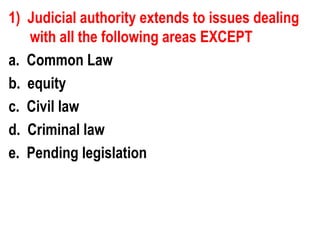
1) Judicial authority extends to issues dealing
   with all the following areas EXCEPT
a. Common Law
b. equity
c. Civil law
d. Criminal law
e. Pending legislation
1) Judicial authority extends to issues dealing
   with all the following areas EXCEPT
a. Common Law
b. equity
c. Civil law
d. Criminal law
e. Pending legislation
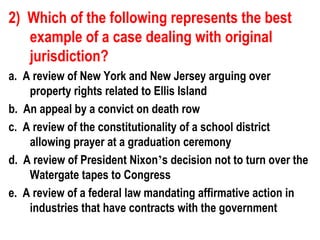
2) Which of the following represents the best
   example of a case dealing with original
   jurisdiction?
a. A review of New York and New Jersey arguing over
    property rights related to Ellis Island
b. An appeal by a convict on death row
c. A review of the constitutionality of a school district
    allowing prayer at a graduation ceremony
d. A review of President Nixon’s decision not to turn over the
    Watergate tapes to Congress
e. A review of a federal law mandating affirmative action in
    industries that have contracts with the government
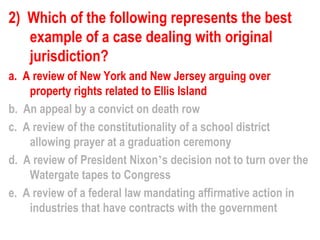
2) Which of the following represents the best
   example of a case dealing with original
   jurisdiction?
a. A review of New York and New Jersey arguing over
    property rights related to Ellis Island
b. An appeal by a convict on death row
c. A review of the constitutionality of a school district
    allowing prayer at a graduation ceremony
d. A review of President Nixon’s decision not to turn over the
    Watergate tapes to Congress
e. A review of a federal law mandating affirmative action in
    industries that have contracts with the government
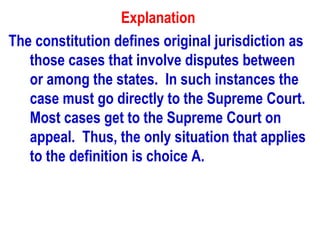
Explanation
The constitution defines original jurisdiction as
   those cases that involve disputes between
   or among the states. In such instances the
   case must go directly to the Supreme Court.
   Most cases get to the Supreme Court on
   appeal. Thus, the only situation that applies
   to the definition is choice A.
3) Which of the following principles does
   common law rely on?
a. Judicial precedent
b. Contract issues
c. Judicial restraint
d. Habeas corpus
e. Judicial activism
3) Which of the following principles does
   common law rely on?
a. Judicial precedent
b. Contract issues
c. Judicial restraint
d. Habeas corpus
e. Judicial activism
Explanation
The basis of common law is judicial precedent
   or its Latin equivalent stare decis. Contract
   law certainly relies on precedent, and
   advocates of judicial restraint and judicial
   activism also have specific viewpoints
   regarding overturning or upholding
   precedent. Habeas corpus appeals can also
   call upon precedent. The point is that the
   principle of precedent is extremely
   important.
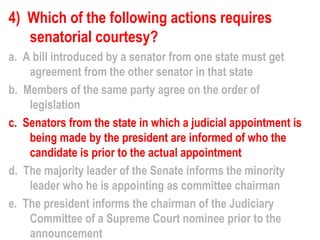
4) Which of the following actions requires
   senatorial courtesy?
a. A bill introduced by a senator from one state must get
    agreement from the other senator in that state
b. Members of the same party agree on the order of
    legislation
c. Senators from the state in which a judicial appointment is
    being made by the president are informed of who the
    candidate is prior to the actual appointment
d. The majority leader of the Senate informs the minority
    leader who he is appointing as committee chairman
e. The president informs the chairman of the Judiciary
    Committee of a Supreme Court nominee prior to the
    announcement
4) Which of the following actions requires
   senatorial courtesy?
a. A bill introduced by a senator from one state must get
    agreement from the other senator in that state
b. Members of the same party agree on the order of
    legislation
c. Senators from the state in which a judicial appointment is
    being made by the president are informed of who the
    candidate is prior to the actual appointment
d. The majority leader of the Senate informs the minority
    leader who he is appointing as committee chairman
e. The president informs the chairman of the Judiciary
    Committee of a Supreme Court nominee prior to the
    announcement
5) Which of the following committees is
   responsible for reviewing Supreme Court
   nominees?
a. House Judiciary
b. Senate Judiciary
c. House Rules
d. Senate Appropriations
e. House Ways and Means
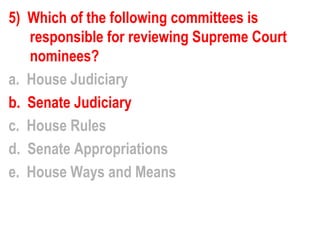
5) Which of the following committees is
   responsible for reviewing Supreme Court
   nominees?
a. House Judiciary
b. Senate Judiciary
c. House Rules
d. Senate Appropriations
e. House Ways and Means
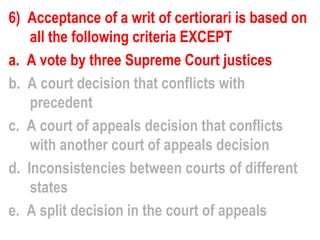
6) Acceptance of a writ of certiorari is based on
    all the following criteria EXCEPT
a. A vote by three Supreme Court justices
b. A court decision that conflicts with
    precedent
c. A court of appeals decision that conflicts
    with another court of appeals decision
d. Inconsistencies between courts of different
    states
e. A split decision in the court of appeals
6) Acceptance of a writ of certiorari is based on
    all the following criteria EXCEPT
a. A vote by three Supreme Court justices
b. A court decision that conflicts with
    precedent
c. A court of appeals decision that conflicts
    with another court of appeals decision
d. Inconsistencies between courts of different
    states
e. A split decision in the court of appeals
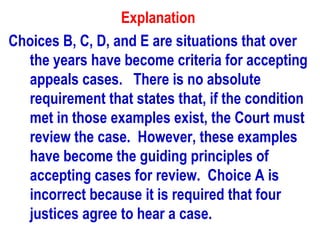
Explanation
Choices B, C, D, and E are situations that over
  the years have become criteria for accepting
  appeals cases. There is no absolute
  requirement that states that, if the condition
  met in those examples exist, the Court must
  review the case. However, these examples
  have become the guiding principles of
  accepting cases for review. Choice A is
  incorrect because it is required that four
  justices agree to hear a case.
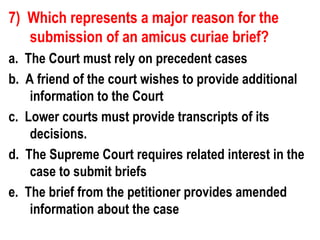
7) Which represents a major reason for the
   submission of an amicus curiae brief?
a. The Court must rely on precedent cases
b. A friend of the court wishes to provide additional
    information to the Court
c. Lower courts must provide transcripts of its
    decisions.
d. The Supreme Court requires related interest in the
    case to submit briefs
e. The brief from the petitioner provides amended
    information about the case
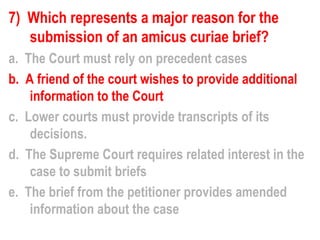
7) Which represents a major reason for the
   submission of an amicus curiae brief?
a. The Court must rely on precedent cases
b. A friend of the court wishes to provide additional
    information to the Court
c. Lower courts must provide transcripts of its
    decisions.
d. The Supreme Court requires related interest in the
    case to submit briefs
e. The brief from the petitioner provides amended
    information about the case
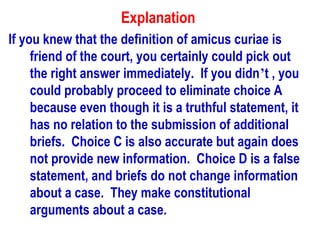
Explanation
If you knew that the definition of amicus curiae is
     friend of the court, you certainly could pick out
     the right answer immediately. If you didn’t , you
     could probably proceed to eliminate choice A
     because even though it is a truthful statement, it
     has no relation to the submission of additional
     briefs. Choice C is also accurate but again does
     not provide new information. Choice D is a false
     statement, and briefs do not change information
     about a case. They make constitutional
     arguments about a case.
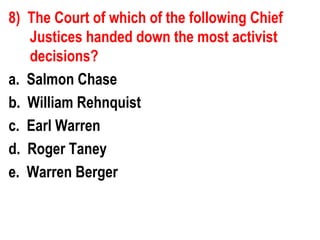
8) The Court of which of the following Chief
   Justices handed down the most activist
   decisions?
a. Salmon Chase
b. William Rehnquist
c. Earl Warren
d. Roger Taney
e. Warren Berger
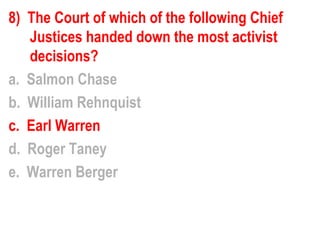
8) The Court of which of the following Chief
   Justices handed down the most activist
   decisions?
a. Salmon Chase
b. William Rehnquist
c. Earl Warren
d. Roger Taney
e. Warren Berger
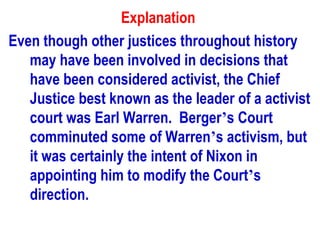
Explanation
Even though other justices throughout history
   may have been involved in decisions that
   have been considered activist, the Chief
   Justice best known as the leader of a activist
   court was Earl Warren. Berger’s Court
   comminuted some of Warren’s activism, but
   it was certainly the intent of Nixon in
   appointing him to modify the Court’s
   direction.
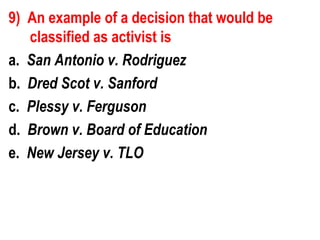
9) An example of a decision that would be
   classified as activist is
a. San Antonio v. Rodriguez
b. Dred Scot v. Sanford
c. Plessy v. Ferguson
d. Brown v. Board of Education
e. New Jersey v. TLO
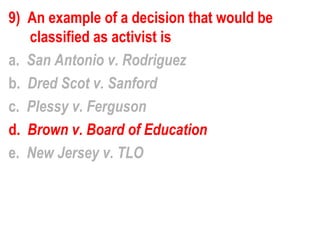
9) An example of a decision that would be
   classified as activist is
a. San Antonio v. Rodriguez
b. Dred Scot v. Sanford
c. Plessy v. Ferguson
d. Brown v. Board of Education
e. New Jersey v. TLO
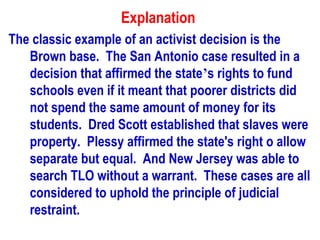
Explanation
The classic example of an activist decision is the
   Brown base. The San Antonio case resulted in a
   decision that affirmed the state’s rights to fund
   schools even if it meant that poorer districts did
   not spend the same amount of money for its
   students. Dred Scott established that slaves were
   property. Plessy affirmed the state's right o allow
   separate but equal. And New Jersey was able to
   search TLO without a warrant. These cases are all
   considered to uphold the principle of judicial
   restraint.
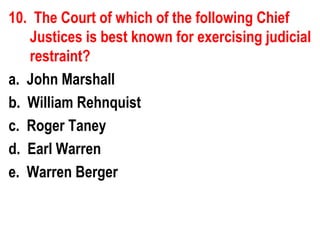
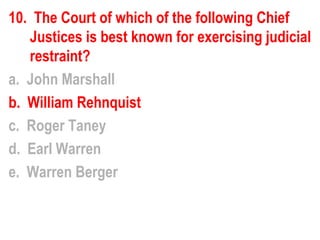
10. The Court of which of the following Chief
   Justices is best known for exercising judicial
   restraint?
a. John Marshall
b. William Rehnquist
c. Roger Taney
d. Earl Warren
e. Warren Berger
10. The Court of which of the following Chief
   Justices is best known for exercising judicial
   restraint?
a. John Marshall
b. William Rehnquist
c. Roger Taney
d. Earl Warren
e. Warren Berger
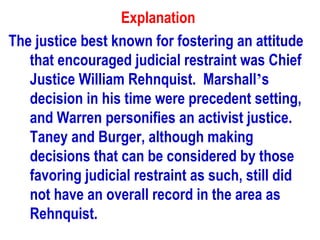
Explanation
The justice best known for fostering an attitude
   that encouraged judicial restraint was Chief
   Justice William Rehnquist. Marshall’s
   decision in his time were precedent setting,
   and Warren personifies an activist justice.
   Taney and Burger, although making
   decisions that can be considered by those
   favoring judicial restraint as such, still did
   not have an overall record in the area as
   Rehnquist.
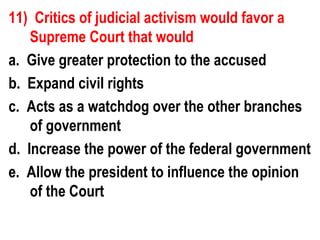
11) Critics of judicial activism would favor a
    Supreme Court that would
a. Give greater protection to the accused
b. Expand civil rights
c. Acts as a watchdog over the other branches
    of government
d. Increase the power of the federal government
e. Allow the president to influence the opinion
    of the Court
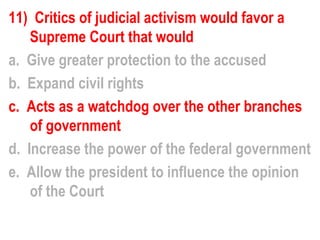
11) Critics of judicial activism would favor a
    Supreme Court that would
a. Give greater protection to the accused
b. Expand civil rights
c. Acts as a watchdog over the other branches
    of government
d. Increase the power of the federal government
e. Allow the president to influence the opinion
    of the Court
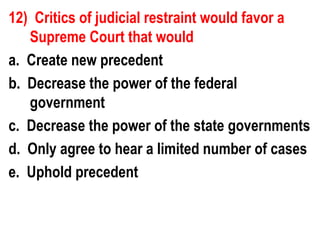
12) Critics of judicial restraint would favor a
   Supreme Court that would
a. Create new precedent
b. Decrease the power of the federal
   government
c. Decrease the power of the state governments
d. Only agree to hear a limited number of cases
e. Uphold precedent
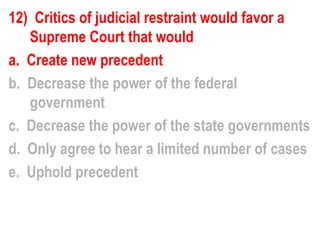
12) Critics of judicial restraint would favor a
   Supreme Court that would
a. Create new precedent
b. Decrease the power of the federal
   government
c. Decrease the power of the state governments
d. Only agree to hear a limited number of cases
e. Uphold precedent
The End

Ap gov review ppt

  • 1.
  • 2.
    1) Judicial authorityextends to issues dealing with all the following areas EXCEPT a. Common Law b. equity c. Civil law d. Criminal law e. Pending legislation
  • 3.
    1) Judicial authorityextends to issues dealing with all the following areas EXCEPT a. Common Law b. equity c. Civil law d. Criminal law e. Pending legislation
  • 4.
    2) Which ofthe following represents the best example of a case dealing with original jurisdiction? a. A review of New York and New Jersey arguing over property rights related to Ellis Island b. An appeal by a convict on death row c. A review of the constitutionality of a school district allowing prayer at a graduation ceremony d. A review of President Nixon’s decision not to turn over the Watergate tapes to Congress e. A review of a federal law mandating affirmative action in industries that have contracts with the government
  • 5.
    2) Which ofthe following represents the best example of a case dealing with original jurisdiction? a. A review of New York and New Jersey arguing over property rights related to Ellis Island b. An appeal by a convict on death row c. A review of the constitutionality of a school district allowing prayer at a graduation ceremony d. A review of President Nixon’s decision not to turn over the Watergate tapes to Congress e. A review of a federal law mandating affirmative action in industries that have contracts with the government
  • 6.
    Explanation The constitution definesoriginal jurisdiction as those cases that involve disputes between or among the states. In such instances the case must go directly to the Supreme Court. Most cases get to the Supreme Court on appeal. Thus, the only situation that applies to the definition is choice A.
  • 7.
    3) Which ofthe following principles does common law rely on? a. Judicial precedent b. Contract issues c. Judicial restraint d. Habeas corpus e. Judicial activism
  • 8.
    3) Which ofthe following principles does common law rely on? a. Judicial precedent b. Contract issues c. Judicial restraint d. Habeas corpus e. Judicial activism
  • 9.
    Explanation The basis ofcommon law is judicial precedent or its Latin equivalent stare decis. Contract law certainly relies on precedent, and advocates of judicial restraint and judicial activism also have specific viewpoints regarding overturning or upholding precedent. Habeas corpus appeals can also call upon precedent. The point is that the principle of precedent is extremely important.
  • 10.
    4) Which ofthe following actions requires senatorial courtesy? a. A bill introduced by a senator from one state must get agreement from the other senator in that state b. Members of the same party agree on the order of legislation c. Senators from the state in which a judicial appointment is being made by the president are informed of who the candidate is prior to the actual appointment d. The majority leader of the Senate informs the minority leader who he is appointing as committee chairman e. The president informs the chairman of the Judiciary Committee of a Supreme Court nominee prior to the announcement
  • 11.
    4) Which ofthe following actions requires senatorial courtesy? a. A bill introduced by a senator from one state must get agreement from the other senator in that state b. Members of the same party agree on the order of legislation c. Senators from the state in which a judicial appointment is being made by the president are informed of who the candidate is prior to the actual appointment d. The majority leader of the Senate informs the minority leader who he is appointing as committee chairman e. The president informs the chairman of the Judiciary Committee of a Supreme Court nominee prior to the announcement
  • 12.
    5) Which ofthe following committees is responsible for reviewing Supreme Court nominees? a. House Judiciary b. Senate Judiciary c. House Rules d. Senate Appropriations e. House Ways and Means
  • 13.
    5) Which ofthe following committees is responsible for reviewing Supreme Court nominees? a. House Judiciary b. Senate Judiciary c. House Rules d. Senate Appropriations e. House Ways and Means
  • 14.
    6) Acceptance ofa writ of certiorari is based on all the following criteria EXCEPT a. A vote by three Supreme Court justices b. A court decision that conflicts with precedent c. A court of appeals decision that conflicts with another court of appeals decision d. Inconsistencies between courts of different states e. A split decision in the court of appeals
  • 15.
    6) Acceptance ofa writ of certiorari is based on all the following criteria EXCEPT a. A vote by three Supreme Court justices b. A court decision that conflicts with precedent c. A court of appeals decision that conflicts with another court of appeals decision d. Inconsistencies between courts of different states e. A split decision in the court of appeals
  • 16.
    Explanation Choices B, C,D, and E are situations that over the years have become criteria for accepting appeals cases. There is no absolute requirement that states that, if the condition met in those examples exist, the Court must review the case. However, these examples have become the guiding principles of accepting cases for review. Choice A is incorrect because it is required that four justices agree to hear a case.
  • 17.
    7) Which representsa major reason for the submission of an amicus curiae brief? a. The Court must rely on precedent cases b. A friend of the court wishes to provide additional information to the Court c. Lower courts must provide transcripts of its decisions. d. The Supreme Court requires related interest in the case to submit briefs e. The brief from the petitioner provides amended information about the case
  • 18.
    7) Which representsa major reason for the submission of an amicus curiae brief? a. The Court must rely on precedent cases b. A friend of the court wishes to provide additional information to the Court c. Lower courts must provide transcripts of its decisions. d. The Supreme Court requires related interest in the case to submit briefs e. The brief from the petitioner provides amended information about the case
  • 19.
    Explanation If you knewthat the definition of amicus curiae is friend of the court, you certainly could pick out the right answer immediately. If you didn’t , you could probably proceed to eliminate choice A because even though it is a truthful statement, it has no relation to the submission of additional briefs. Choice C is also accurate but again does not provide new information. Choice D is a false statement, and briefs do not change information about a case. They make constitutional arguments about a case.
  • 20.
    8) The Courtof which of the following Chief Justices handed down the most activist decisions? a. Salmon Chase b. William Rehnquist c. Earl Warren d. Roger Taney e. Warren Berger
  • 21.
    8) The Courtof which of the following Chief Justices handed down the most activist decisions? a. Salmon Chase b. William Rehnquist c. Earl Warren d. Roger Taney e. Warren Berger
  • 22.
    Explanation Even though otherjustices throughout history may have been involved in decisions that have been considered activist, the Chief Justice best known as the leader of a activist court was Earl Warren. Berger’s Court comminuted some of Warren’s activism, but it was certainly the intent of Nixon in appointing him to modify the Court’s direction.
  • 23.
    9) An exampleof a decision that would be classified as activist is a. San Antonio v. Rodriguez b. Dred Scot v. Sanford c. Plessy v. Ferguson d. Brown v. Board of Education e. New Jersey v. TLO
  • 24.
    9) An exampleof a decision that would be classified as activist is a. San Antonio v. Rodriguez b. Dred Scot v. Sanford c. Plessy v. Ferguson d. Brown v. Board of Education e. New Jersey v. TLO
  • 25.
    Explanation The classic exampleof an activist decision is the Brown base. The San Antonio case resulted in a decision that affirmed the state’s rights to fund schools even if it meant that poorer districts did not spend the same amount of money for its students. Dred Scott established that slaves were property. Plessy affirmed the state's right o allow separate but equal. And New Jersey was able to search TLO without a warrant. These cases are all considered to uphold the principle of judicial restraint.
  • 26.
    10. The Courtof which of the following Chief Justices is best known for exercising judicial restraint? a. John Marshall b. William Rehnquist c. Roger Taney d. Earl Warren e. Warren Berger
  • 27.
    10. The Courtof which of the following Chief Justices is best known for exercising judicial restraint? a. John Marshall b. William Rehnquist c. Roger Taney d. Earl Warren e. Warren Berger
  • 28.
    Explanation The justice bestknown for fostering an attitude that encouraged judicial restraint was Chief Justice William Rehnquist. Marshall’s decision in his time were precedent setting, and Warren personifies an activist justice. Taney and Burger, although making decisions that can be considered by those favoring judicial restraint as such, still did not have an overall record in the area as Rehnquist.
  • 29.
    11) Critics ofjudicial activism would favor a Supreme Court that would a. Give greater protection to the accused b. Expand civil rights c. Acts as a watchdog over the other branches of government d. Increase the power of the federal government e. Allow the president to influence the opinion of the Court
  • 30.
    11) Critics ofjudicial activism would favor a Supreme Court that would a. Give greater protection to the accused b. Expand civil rights c. Acts as a watchdog over the other branches of government d. Increase the power of the federal government e. Allow the president to influence the opinion of the Court
  • 31.
    12) Critics ofjudicial restraint would favor a Supreme Court that would a. Create new precedent b. Decrease the power of the federal government c. Decrease the power of the state governments d. Only agree to hear a limited number of cases e. Uphold precedent
  • 32.
    12) Critics ofjudicial restraint would favor a Supreme Court that would a. Create new precedent b. Decrease the power of the federal government c. Decrease the power of the state governments d. Only agree to hear a limited number of cases e. Uphold precedent
  • 33.