Downloaded 280 times



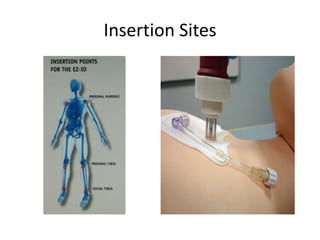

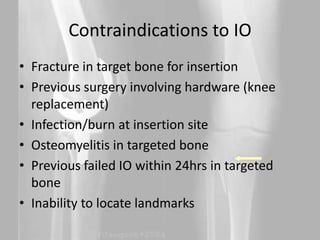
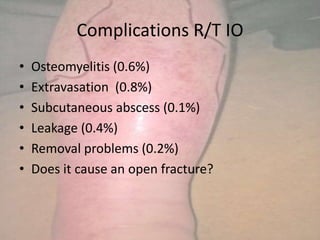
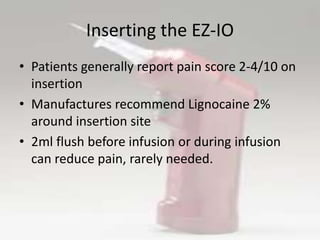


1. Intraosseous (IO) access involves inserting a needle into the bone marrow cavity to provide vascular access for fluid or drug administration when intravenous access is not possible. 2. IO access was first reported in 1922 and is now widely accepted for use in both children and adults with difficult venous access. It provides a reliable route for drug delivery similar to intravenous administration. 3. IO access has several advantages over other emergency vascular access methods in that it is quick to perform, effective, can be used at multiple insertion sites, and has fewer complications than a central venous catheter.


![1-s2.0-S2211419X13000724-main[1]](https://cdn.slidesharecdn.com/ss_thumbnails/eca42c09-14c3-45c7-a43c-e495773b9c96-161102080421-thumbnail.jpg?width=640&height=640&fit=bounds)


